Prepared by:
Ms. Annalyn Pena
The Characteristics of Tourism
Resources
Tourism resources have three main characteristics:
 By tourism we usually mean tangible features that are considered
to be of economic value to the tourism sector. The sector and
tourists therefore has to recognize that a place, landscape or
natural feature is of value before it can become a tourism
resource.
 Most tourism resources are not used exclusively by tourists.
Tourism shares the resource with agriculture, forestry, water
management or residents using local services.
 Tourism resources are perishable. Not only are they vulnerable to
alteration and destruction by tourist pressure but also they are
perishable in another sense. Tourist services such as beds in
accommodation or ride seats in theme parks are impossible to
stock and have to be consumed when and where they exist.
TOURISM RESOURCES AT A
GLOBAL SCALE (LAND)
 mountains, hill lands, plateaus and lowland plains
 Mount Everest (Tibet)
 Zhangye Danxia Mountains
 Chocolate Hills (Philippines)
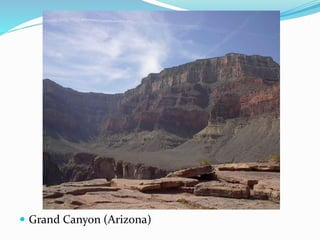
 Grand Canyon (Arizona)
Geothermal Features
 Lava Formations (Ribeira do Chamusco, Portugal)
 Coatepeque Caldera, El Salvador
 Geysers – Nevada, USA
Karst
 Puerto Princesa Underground River (Philippines)
THE COAST
 Beach – extends from the foreshore to a landward
boundary formed by a line of cliffs, protective sand dunes
or a man-made feature such as a sea wall. There are
significant differences between beaches in terms of texture,
from fine-grained sand to coarse shingle, while colours can
vary from the usual buff to white and pink (where the sand
is derived from fragments of coral), contrasting with black
beaches of volcanic origin.
 Coral reefs – a feature of oceanic islands and most
mainland coasts in the tropics, where sea temperatures
range between 23 and 29°C and the water is clear and of
moderate depth. The coral reef ecosystems are
extraordinarily diverse, but are highly vulnerable.
 Coastal wetlands – consisting of estuaries, marshes and
swamps
 Great Barrier Reef (Australia)
 Estuaries
INLAND WATER RESOURCES
 Plitvice Lakes, Croatia
 Yangtze River
CULTURAL FEATURES
TOURISM ATTRACTIONS
 Natural, including beaches, caves, scenic features and
wildlife (flora and fauna)
 Man-made, but not originally designed to attract
tourists
 Man-made and purpose built to attract tourists
 Special events
Natural Attractions
Son Doong Cave, Vietnam
Maya Bay, Ko Phi Phi, Thailand
Great Wall of China (China)
The Colosseum (Rome, Italy)
Durian Building (Singapore)
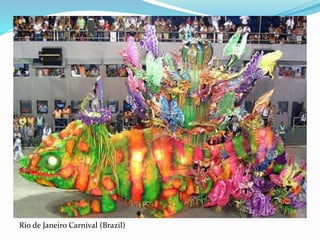
Rio de Janeiro Carnival (Brazil)
Running of the Bulls (Spain)

World tourism resources

  • 1.
  • 2.
    The Characteristics ofTourism Resources Tourism resources have three main characteristics:  By tourism we usually mean tangible features that are considered to be of economic value to the tourism sector. The sector and tourists therefore has to recognize that a place, landscape or natural feature is of value before it can become a tourism resource.  Most tourism resources are not used exclusively by tourists. Tourism shares the resource with agriculture, forestry, water management or residents using local services.  Tourism resources are perishable. Not only are they vulnerable to alteration and destruction by tourist pressure but also they are perishable in another sense. Tourist services such as beds in accommodation or ride seats in theme parks are impossible to stock and have to be consumed when and where they exist.
  • 3.
    TOURISM RESOURCES ATA GLOBAL SCALE (LAND)  mountains, hill lands, plateaus and lowland plains
  • 4.
  • 5.
  • 6.
     Chocolate Hills(Philippines)
  • 7.
  • 8.
    Geothermal Features  LavaFormations (Ribeira do Chamusco, Portugal)
  • 9.
  • 10.
     Geysers –Nevada, USA
  • 11.
    Karst  Puerto PrincesaUnderground River (Philippines)
  • 12.
    THE COAST  Beach– extends from the foreshore to a landward boundary formed by a line of cliffs, protective sand dunes or a man-made feature such as a sea wall. There are significant differences between beaches in terms of texture, from fine-grained sand to coarse shingle, while colours can vary from the usual buff to white and pink (where the sand is derived from fragments of coral), contrasting with black beaches of volcanic origin.  Coral reefs – a feature of oceanic islands and most mainland coasts in the tropics, where sea temperatures range between 23 and 29°C and the water is clear and of moderate depth. The coral reef ecosystems are extraordinarily diverse, but are highly vulnerable.  Coastal wetlands – consisting of estuaries, marshes and swamps
  • 13.
     Great BarrierReef (Australia)
  • 14.
  • 15.
    INLAND WATER RESOURCES Plitvice Lakes, Croatia
  • 16.
  • 17.
  • 18.
    TOURISM ATTRACTIONS  Natural,including beaches, caves, scenic features and wildlife (flora and fauna)  Man-made, but not originally designed to attract tourists  Man-made and purpose built to attract tourists  Special events
  • 19.
  • 20.
    Maya Bay, KoPhi Phi, Thailand
  • 21.
    Great Wall ofChina (China)
  • 22.
  • 23.
  • 24.
    Rio de JaneiroCarnival (Brazil)
  • 25.
    Running of theBulls (Spain)