UNIT 1. PRINCIPLES OF RESPONSIBLE TOURISM
Unit outline
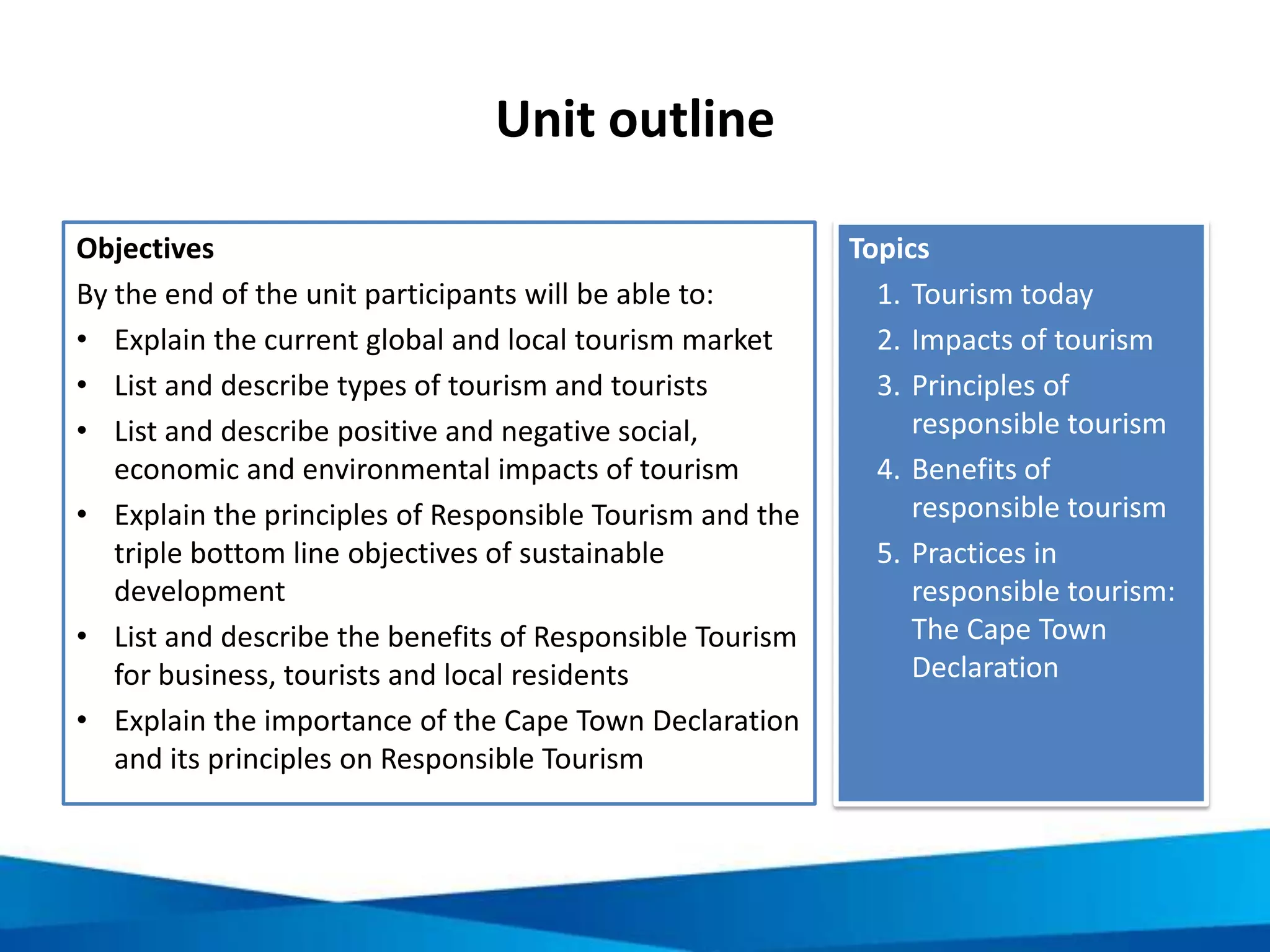
Objectives
By the end of the unit participants will be able to:
• Explain the current global and local tourism market
• List and describe types of tourism and tourists
• List and describe positive and negative
social, economic and environmental impacts of
tourism
• Explain the principles of Responsible Tourism and the
triple bottom line objectives of sustainable
development
• List and describe the benefits of Responsible Tourism
for business, tourists and local residents
• Explain the importance of the Cape Town Declaration
and its principles on Responsible Tourism
Topics
1. Tourism today
2. Impacts of tourism
3. Principles of
responsible tourism
4. Benefits of
responsible tourism
5. Practices in
responsible tourism:
The Cape Town
Declaration
TOPIC 1. TOURISM TODAY
UNIT 1. PRINCIPLES OF RESPONSIBLE TOURISM
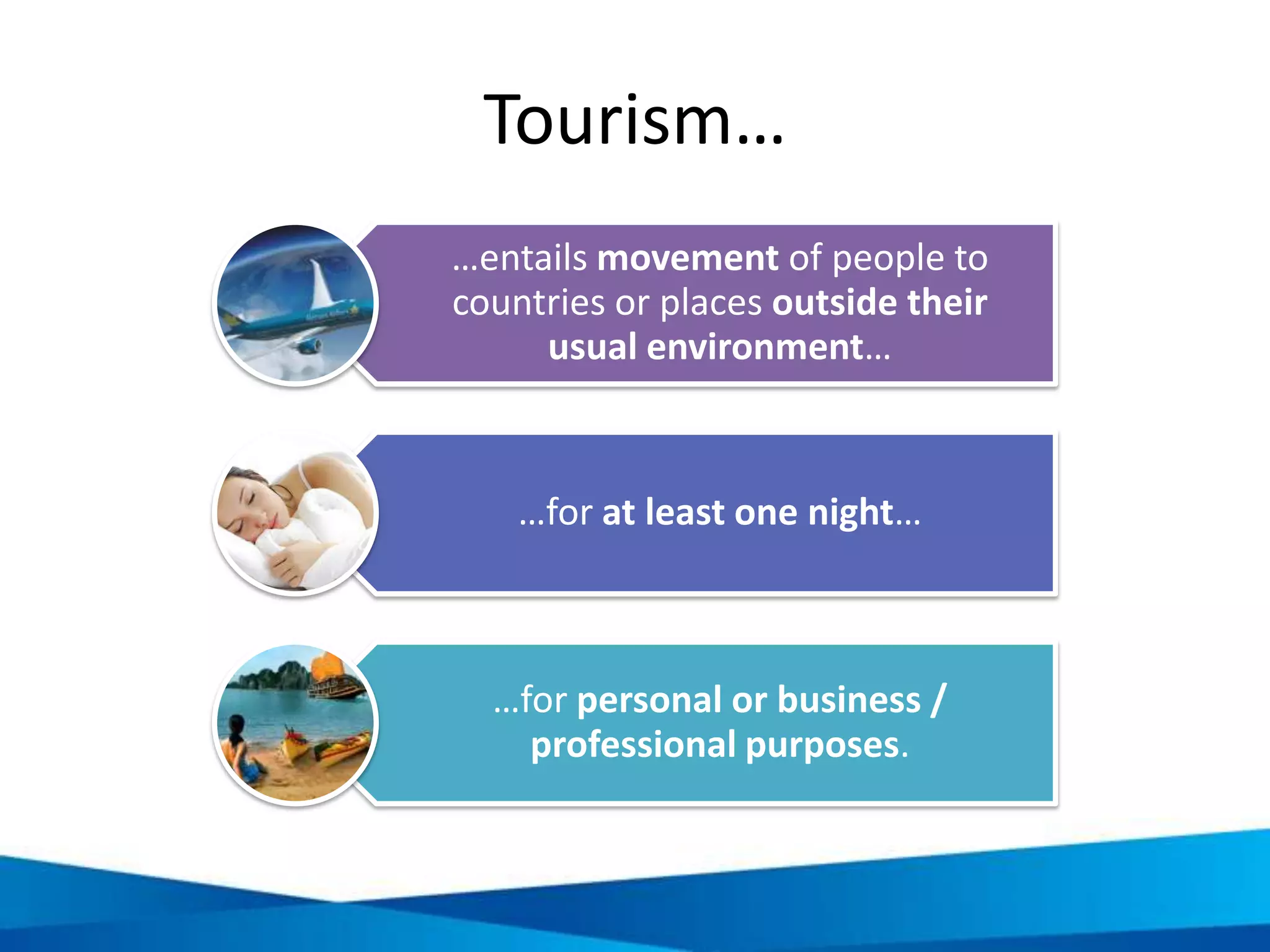
Tourism…
…entails movement of people to
countries or places outside their
usual environment…
…for at least one night…
…for personal or business /
professional purposes.
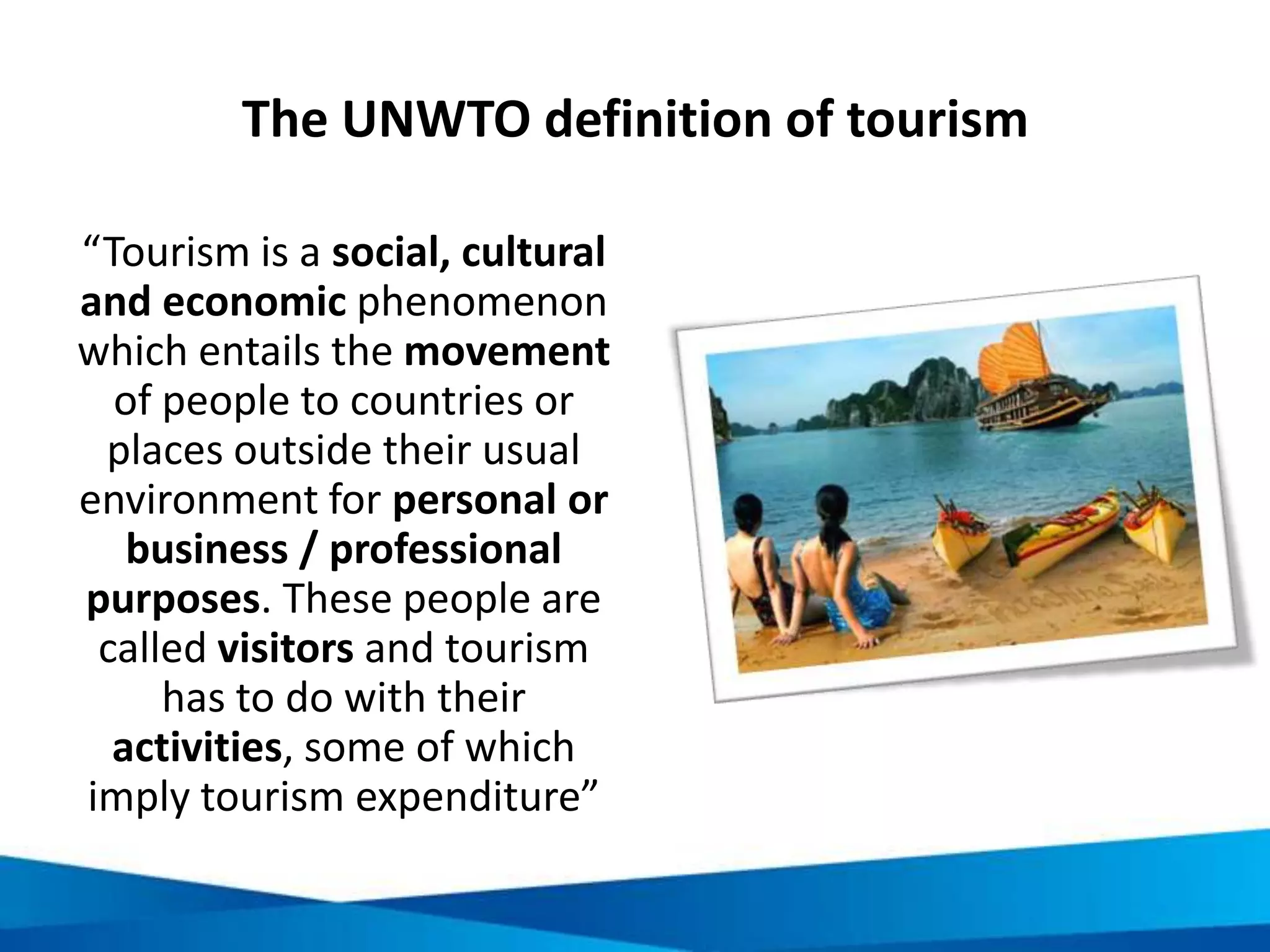
The UNWTO definition of tourism
“Tourism is a social, cultural
and economic phenomenon
which entails the movement
of people to countries or
places outside their usual
environment for personal or
business / professional
purposes. These people are
called visitors and tourism
has to do with their
activities, some of which
imply tourism expenditure”
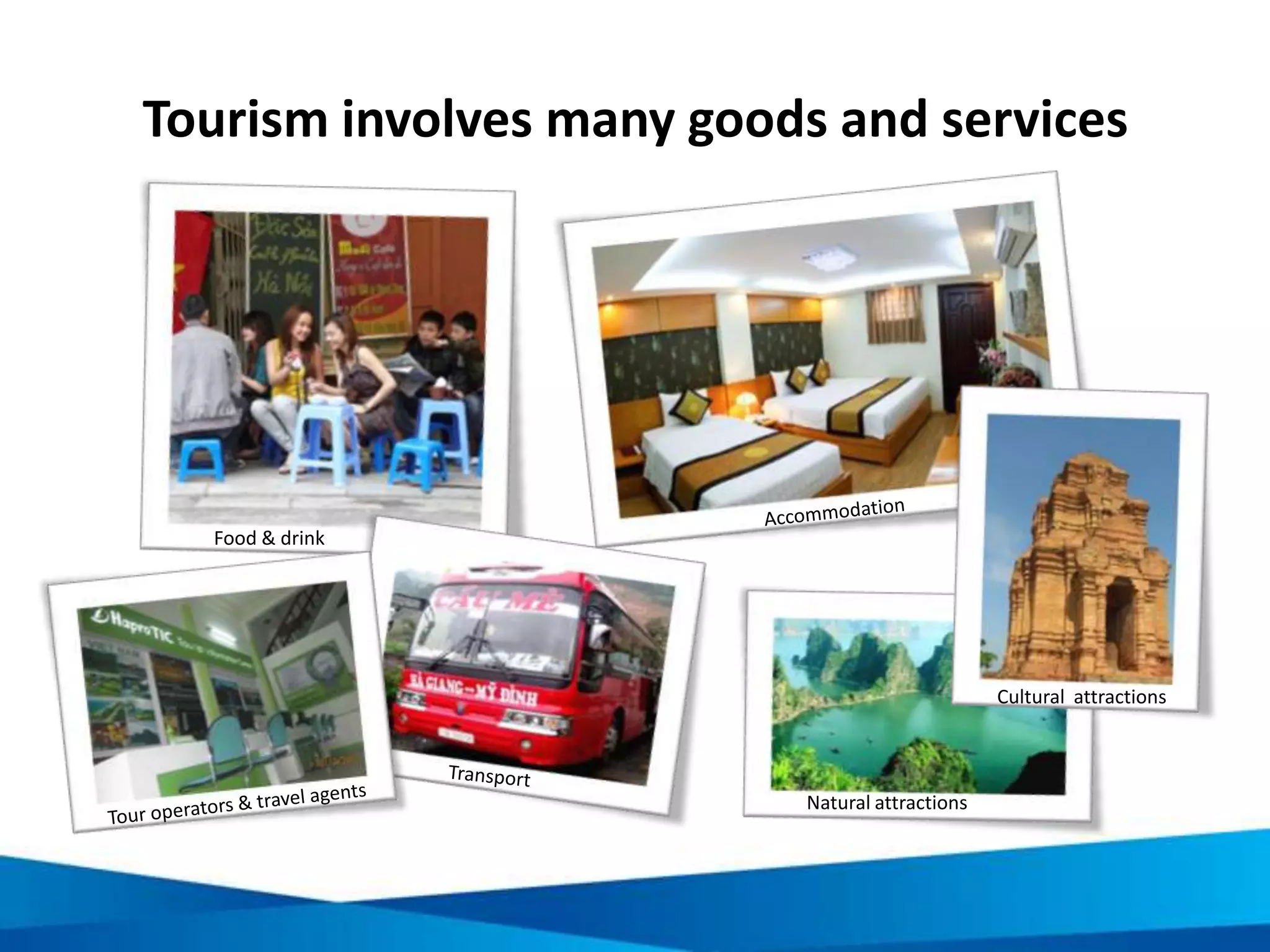
Tourism involves many goods and services
Food & drink
Natural attractions
Cultural attractions
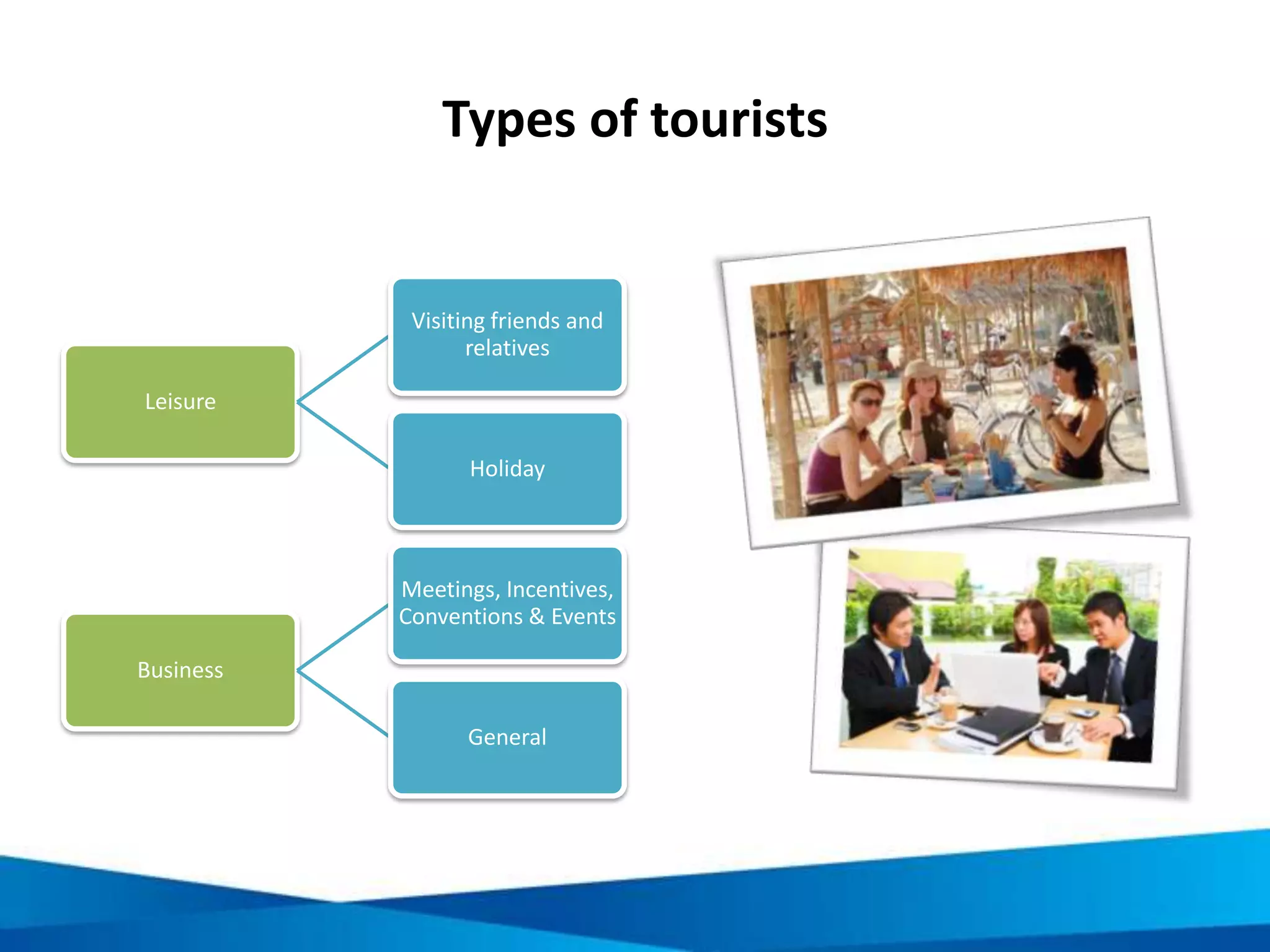
Types of tourists
Leisure
Visiting friends and relatives
Holiday
Business
Meetings, Incentives, Conventi
ons & Events
General
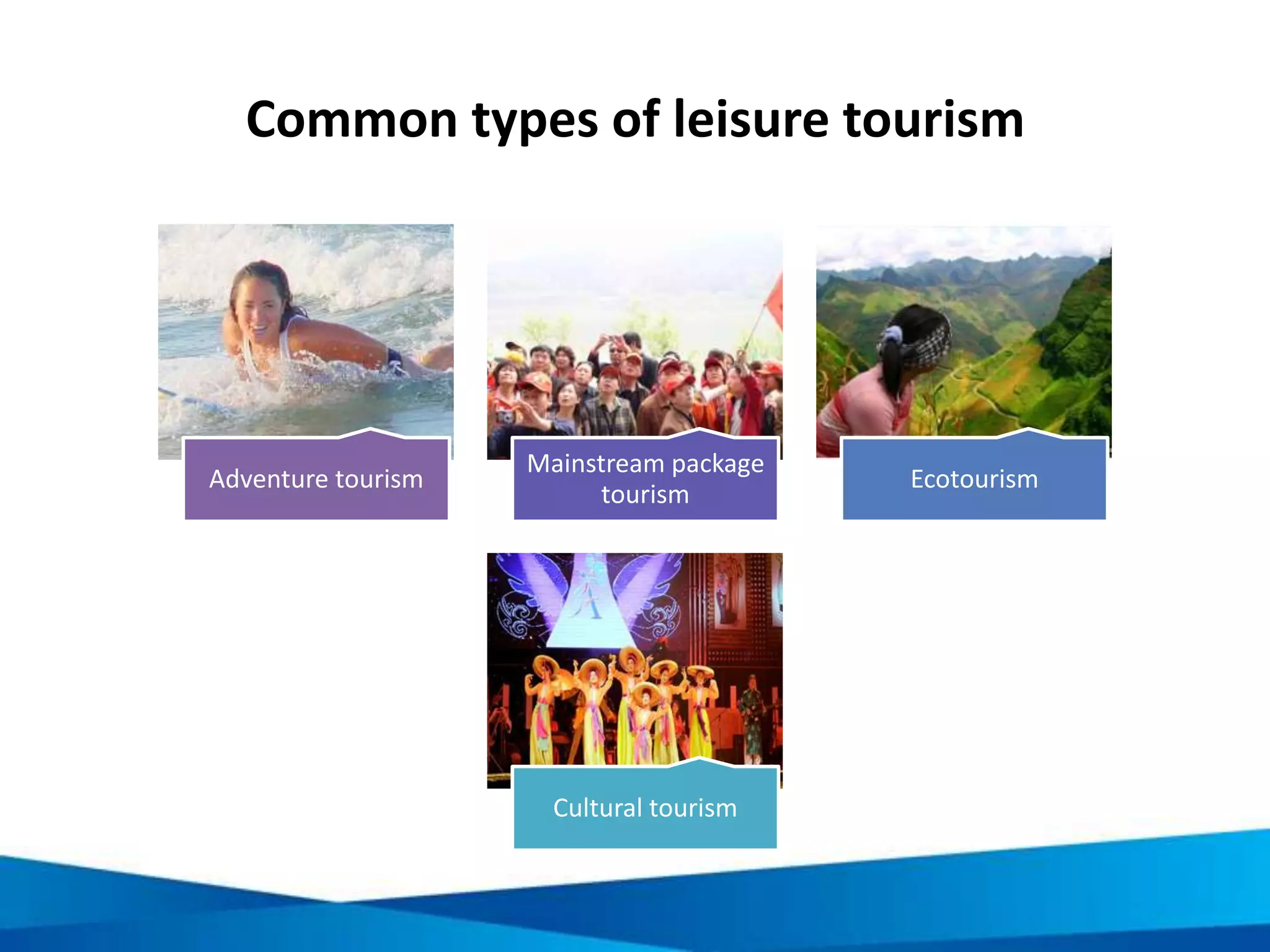
Common types of leisure tourism
Adventure tourism
Mainstream package
tourism
Ecotourism
Cultural tourism
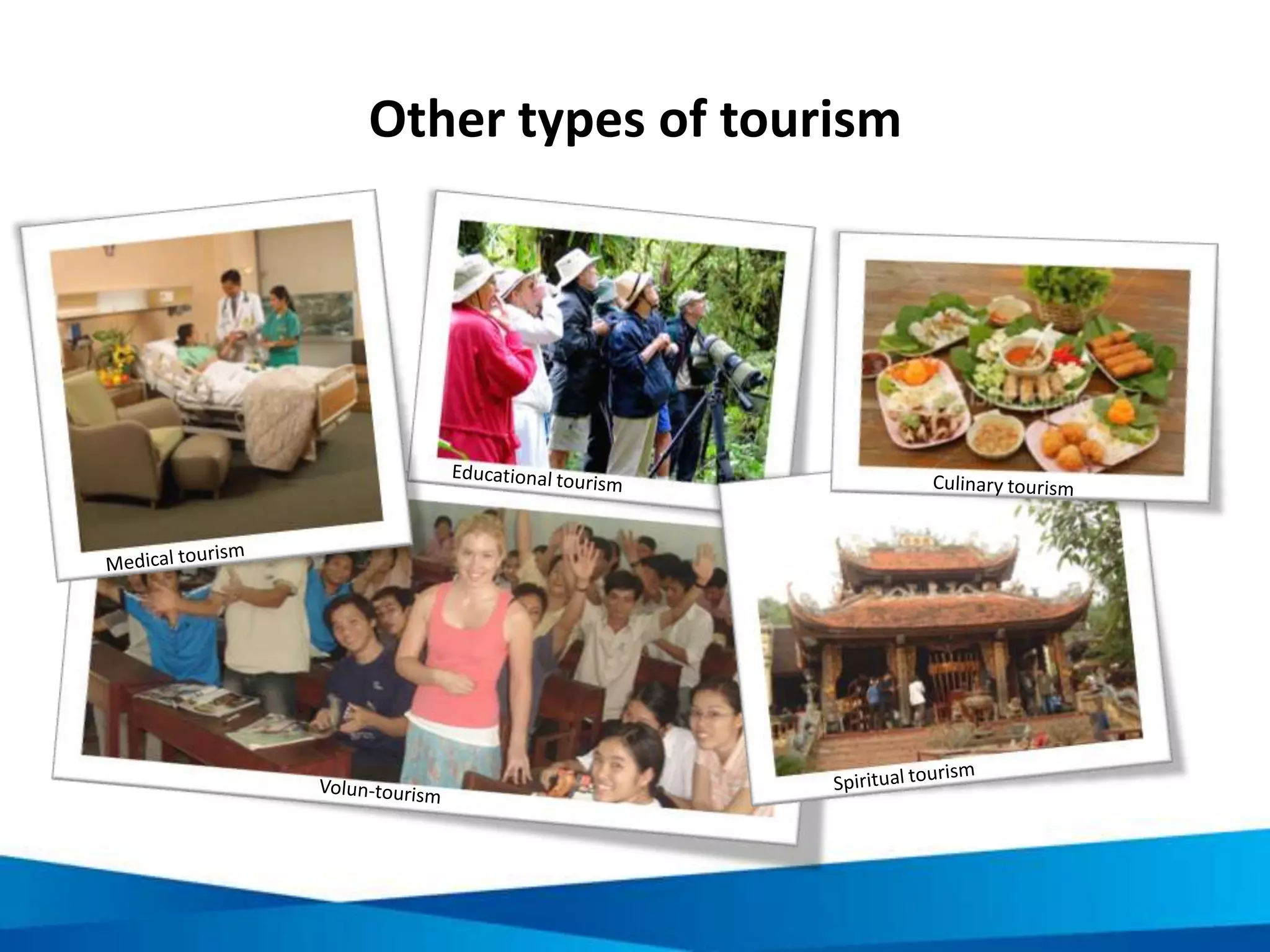
Other types of tourism
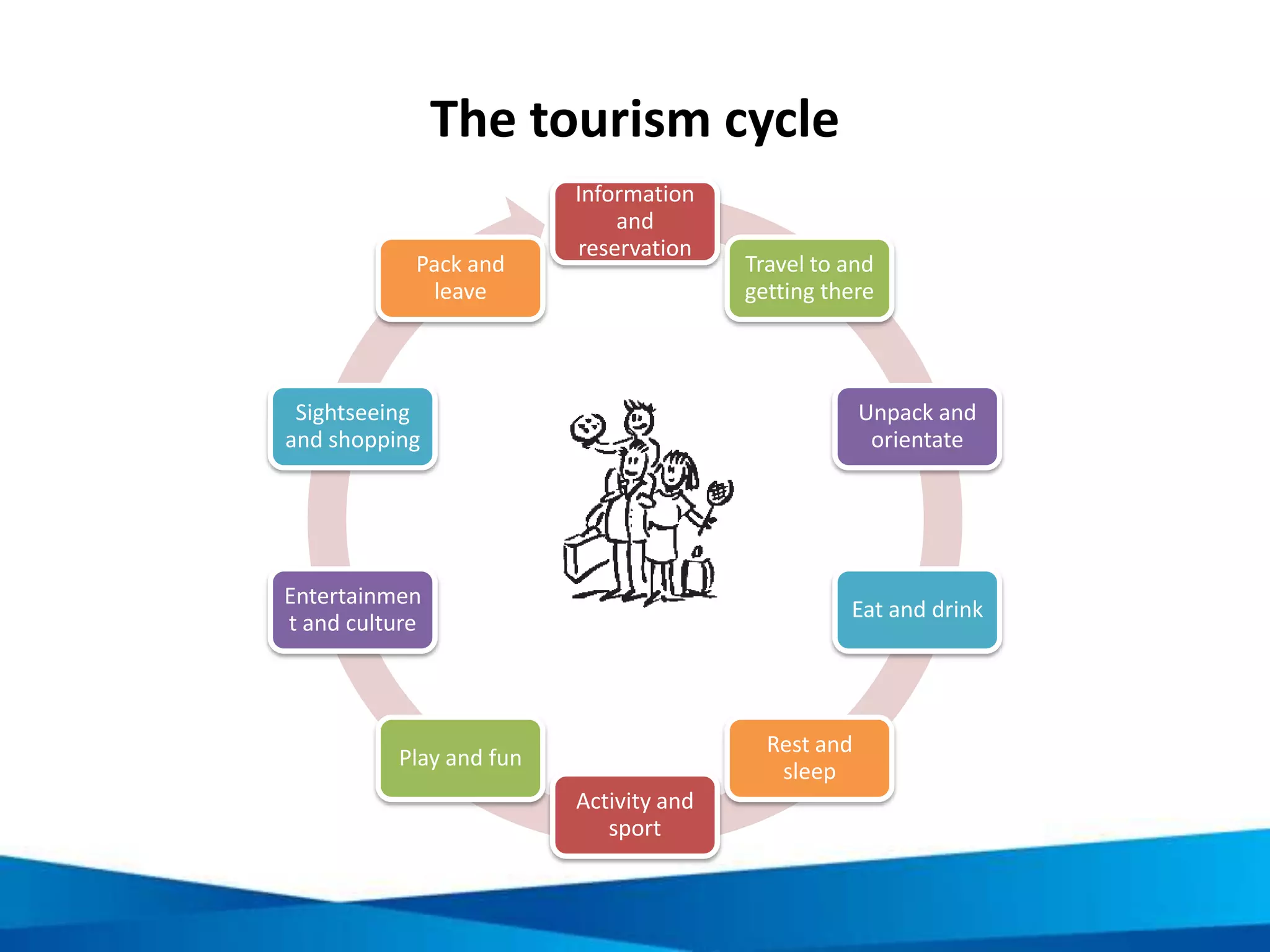
Information
and
reservation
Travel to and
getting there
Unpack and
orientate
Eat and drink
Rest and
sleep
Activity and
sport
Play and fun
Entertainmen
t and culture
Sightseeing
and shopping
Pack and
leave
The tourism cycle
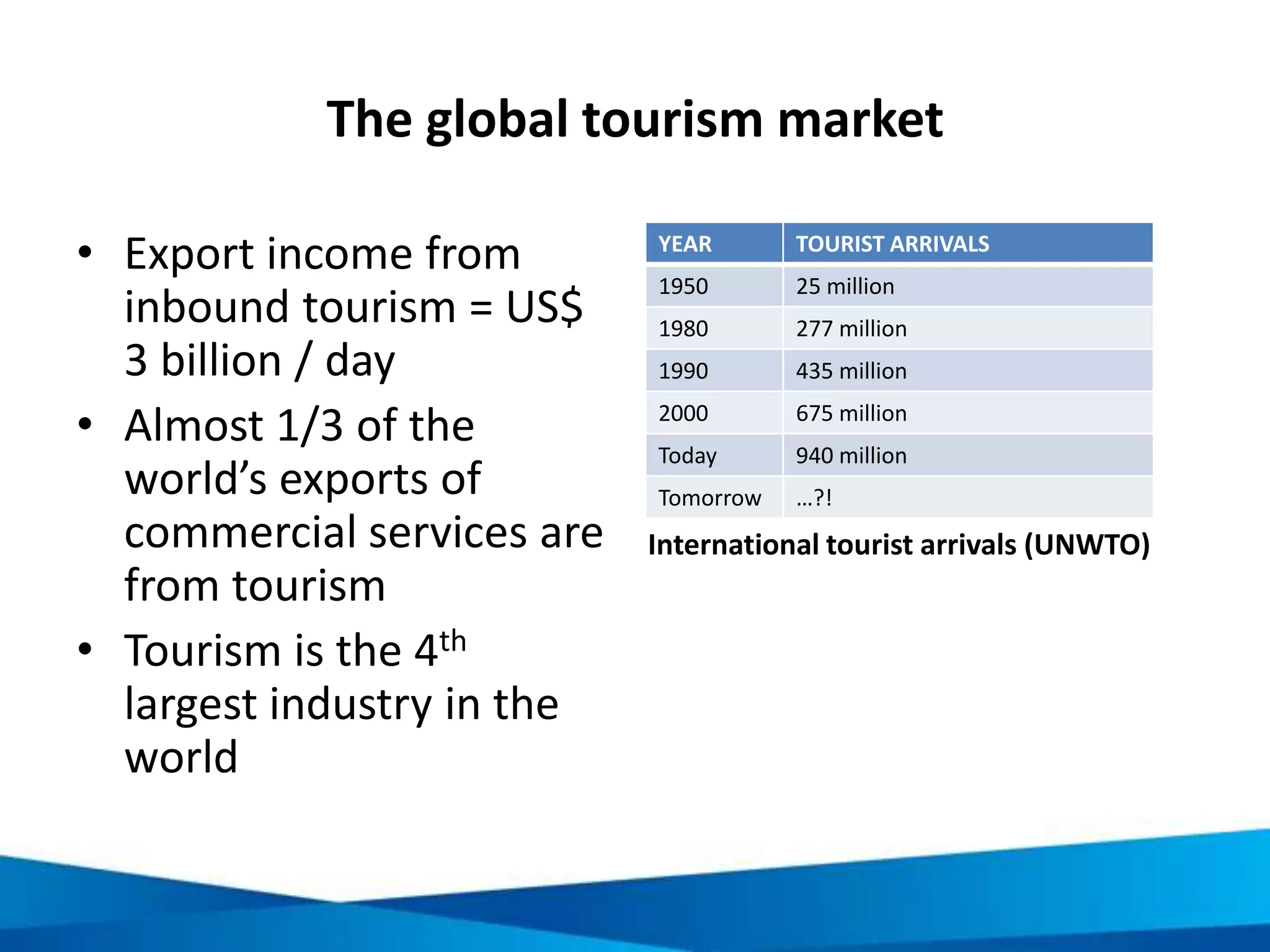
The global tourism market
• Export income from
inbound tourism = US$
3 billion / day
• Almost 1/3 of the
world’s exports of
commercial services are
from tourism
• Tourism is the 4th
largest industry in the
world
International tourist arrivals (UNWTO)
YEAR TOURIST ARRIVALS
1950 25 million
1980 277 million
1990 435 million
2000 675 million
Today 940 million
Tomorrow …?!
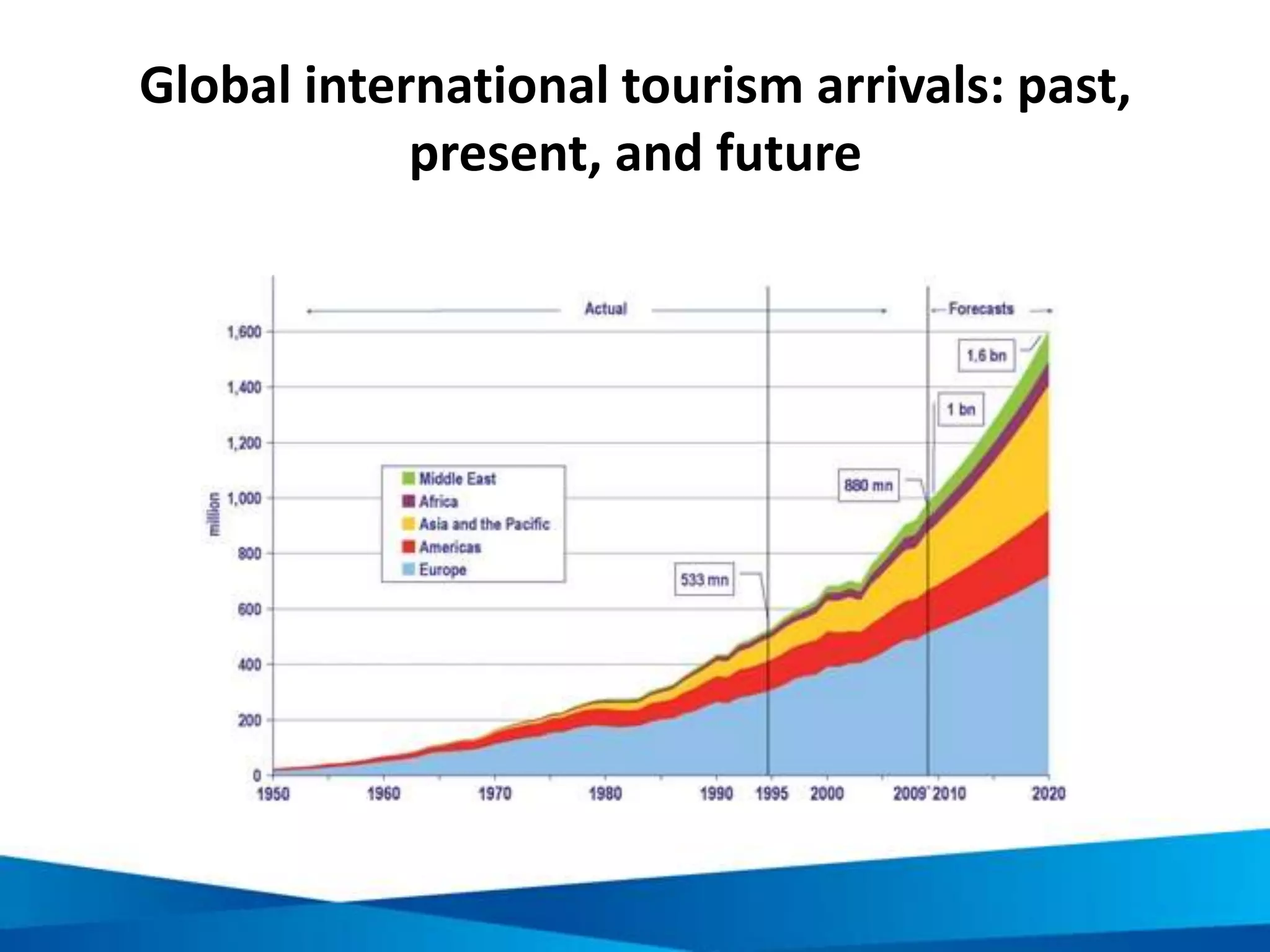
Global international tourism arrivals: past,
present, and future
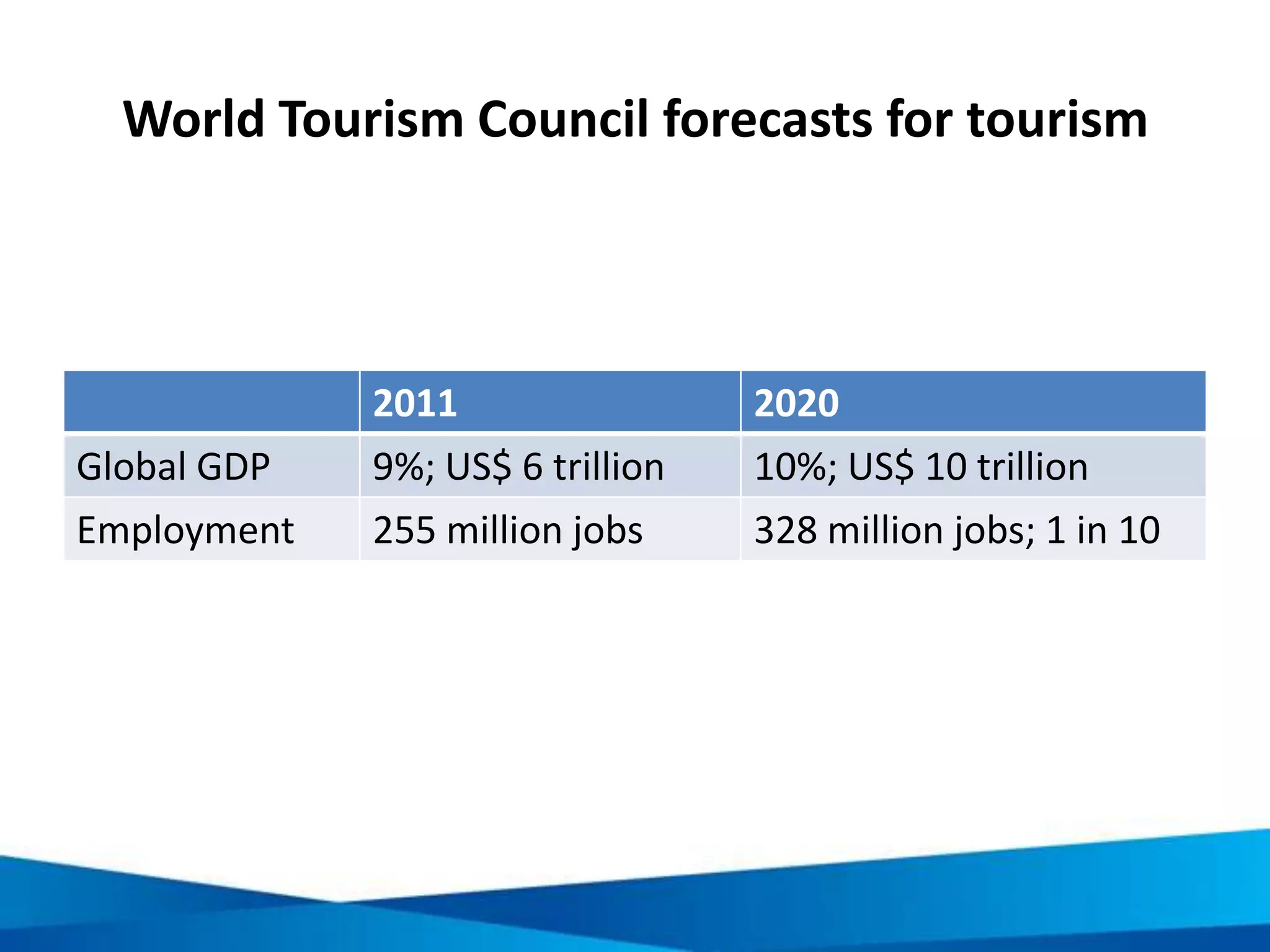
World Tourism Council forecasts for tourism
2011 2020
Global GDP 9%; US$ 6 trillion 10%; US$ 10 trillion
Employment 255 million jobs 328 million jobs; 1 in 10
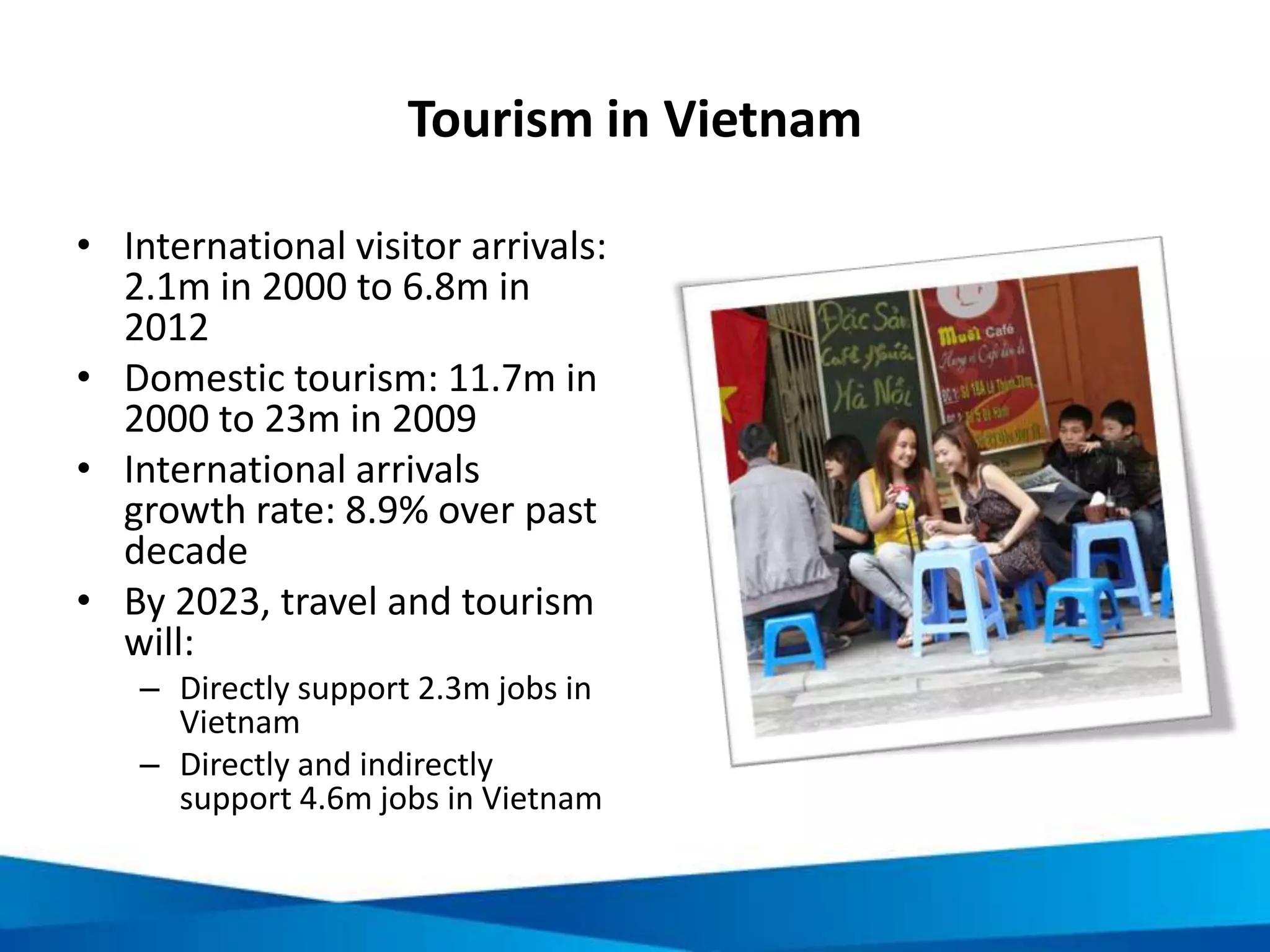
Tourism in Vietnam
• International visitor arrivals:
2.1m in 2000 to 6.8m in
2012
• Domestic tourism: 11.7m in
2000 to 23m in 2009
• International arrivals
growth rate: 8.9% over past
decade
• By 2023, travel and tourism
will:
– Directly support 2.3m jobs in
Vietnam
– Directly and indirectly
support 4.6m jobs in Vietnam
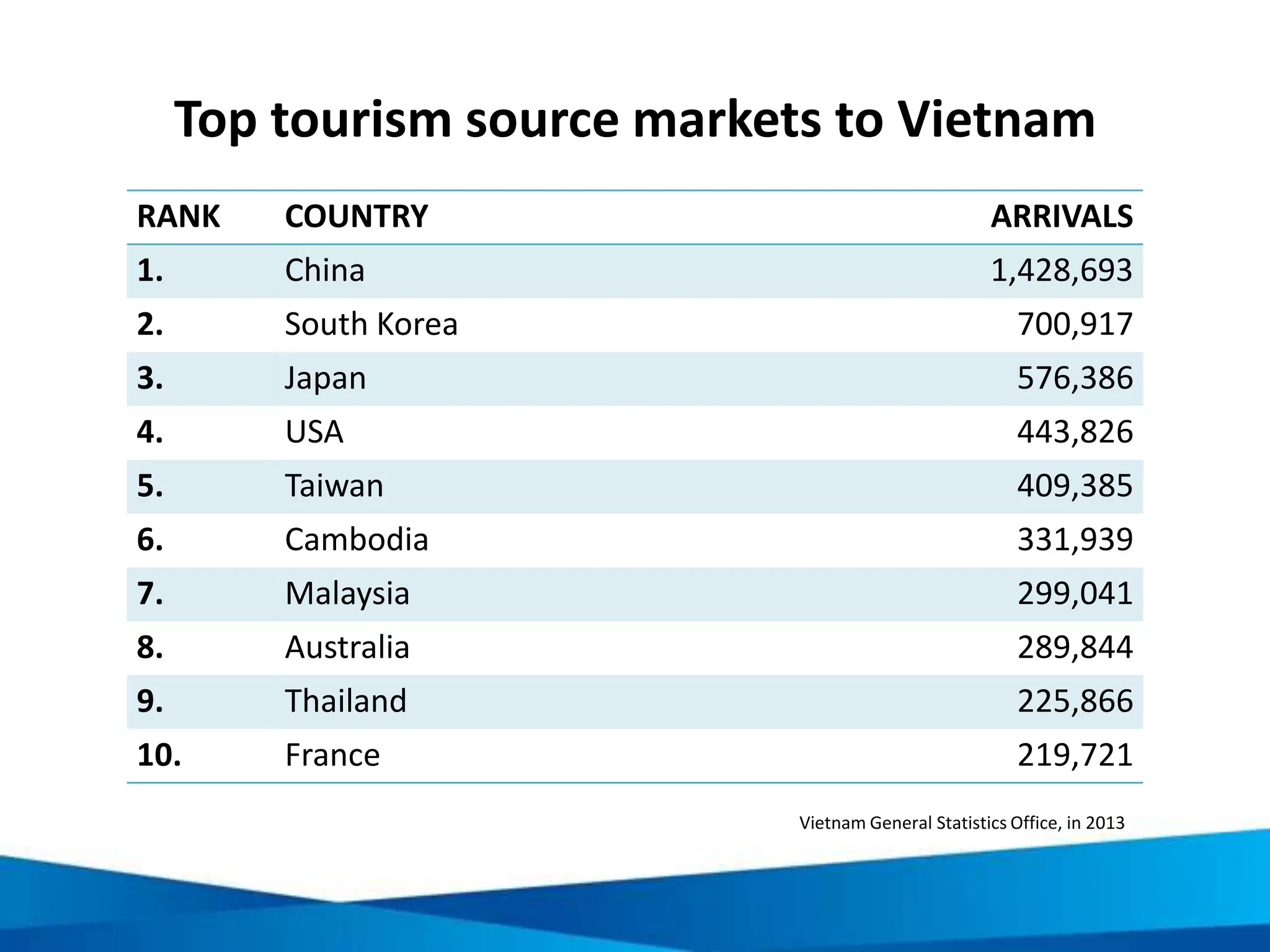
Top tourism source markets to Vietnam
RANK COUNTRY ARRIVALS
1. China 1,428,693
2. South Korea 700,917
3. Japan 576,386
4. USA 443,826
5. Taiwan 409,385
6. Cambodia 331,939
7. Malaysia 299,041
8. Australia 289,844
9. Thailand 225,866
10. France 219,721
Vietnam General Statistics Office, in 2013
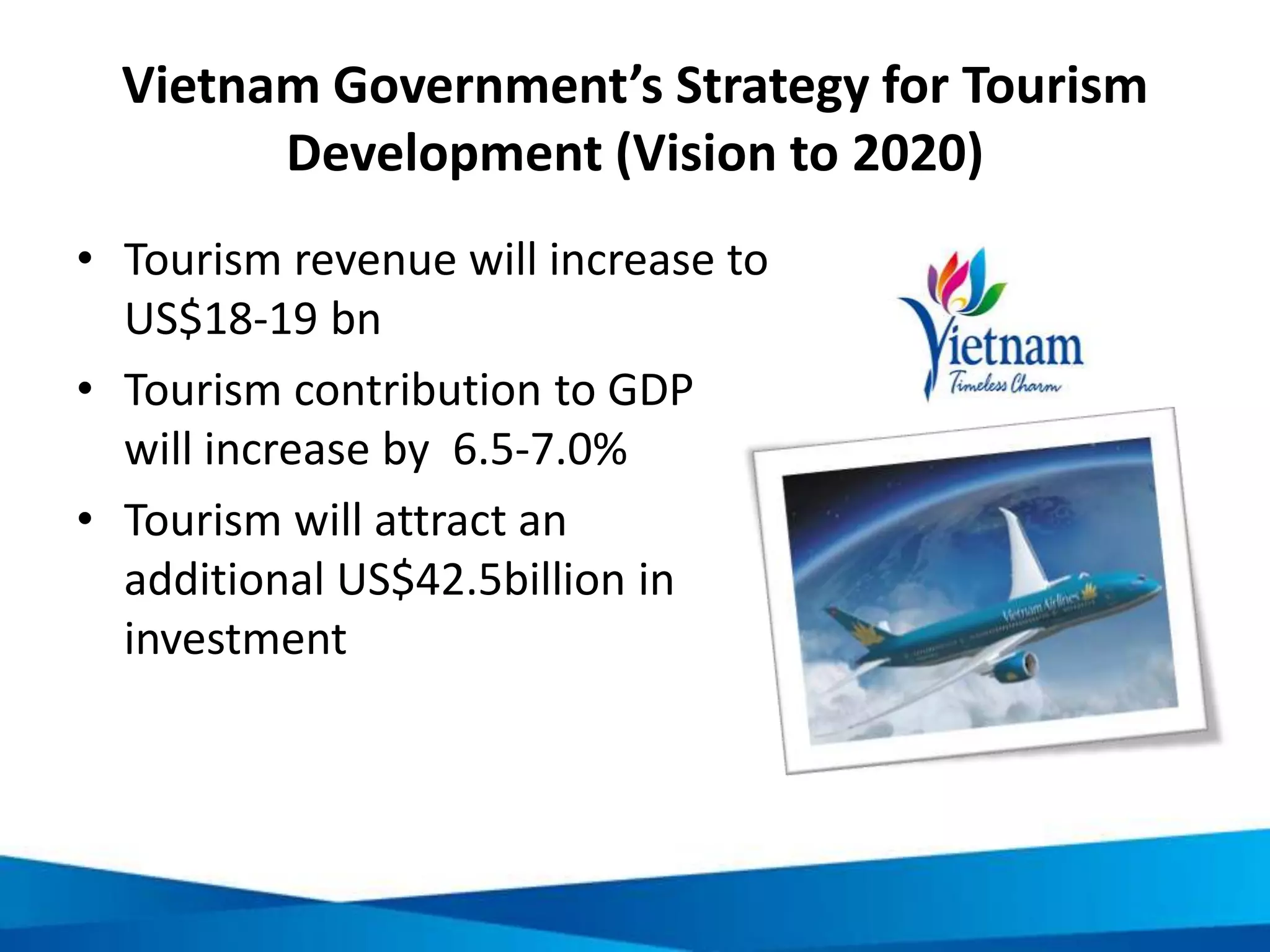
Vietnam Government’s Strategy for Tourism
Development (Vision to 2020)
• Tourism revenue will increase to
US$18-19 bn
• Tourism contribution to GDP
will increase by 6.5-7.0%
• Tourism will attract an
additional US$42.5billion in
investment
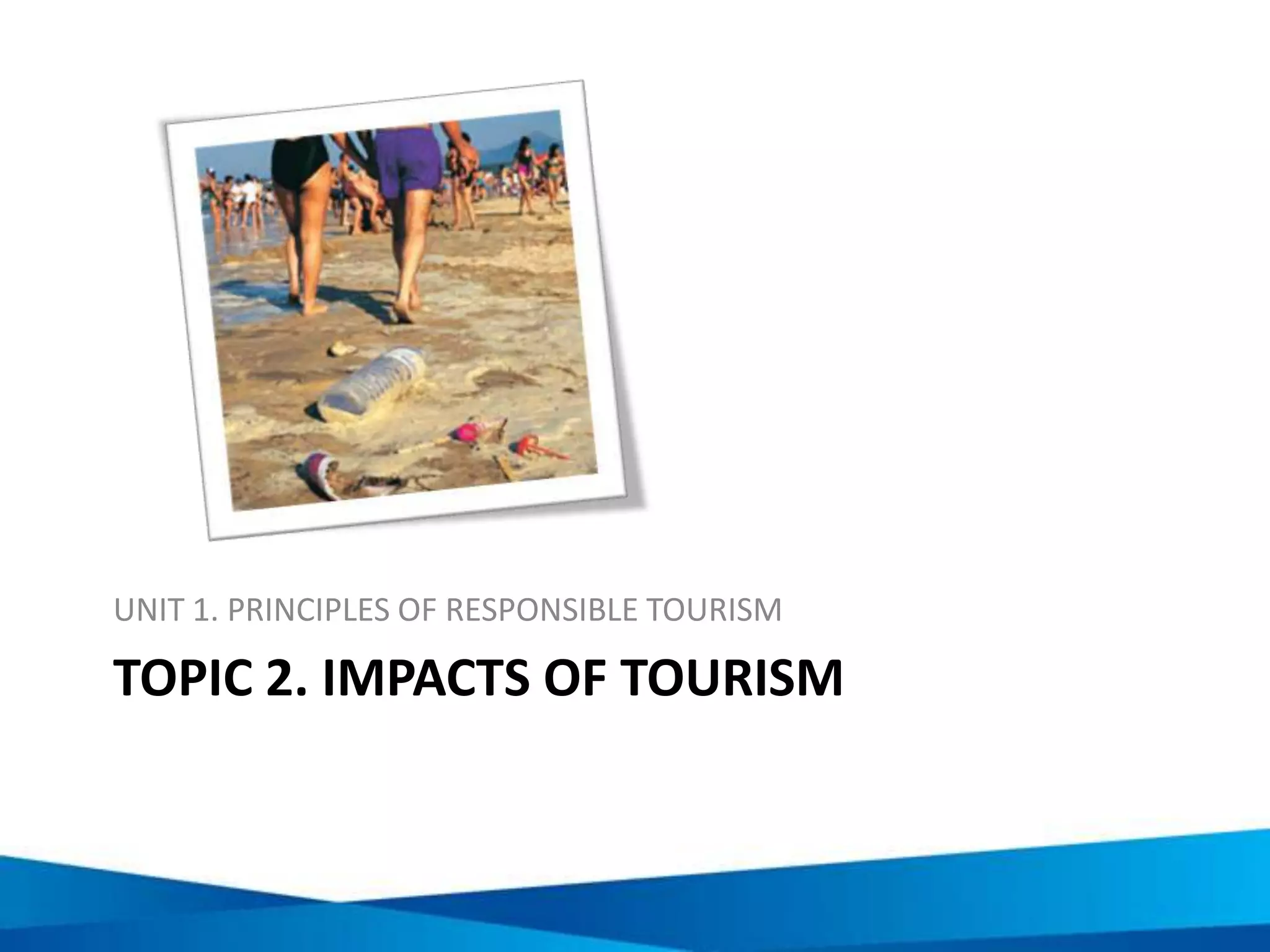
TOPIC 2. IMPACTS OF TOURISM
UNIT 1. PRINCIPLES OF RESPONSIBLE TOURISM
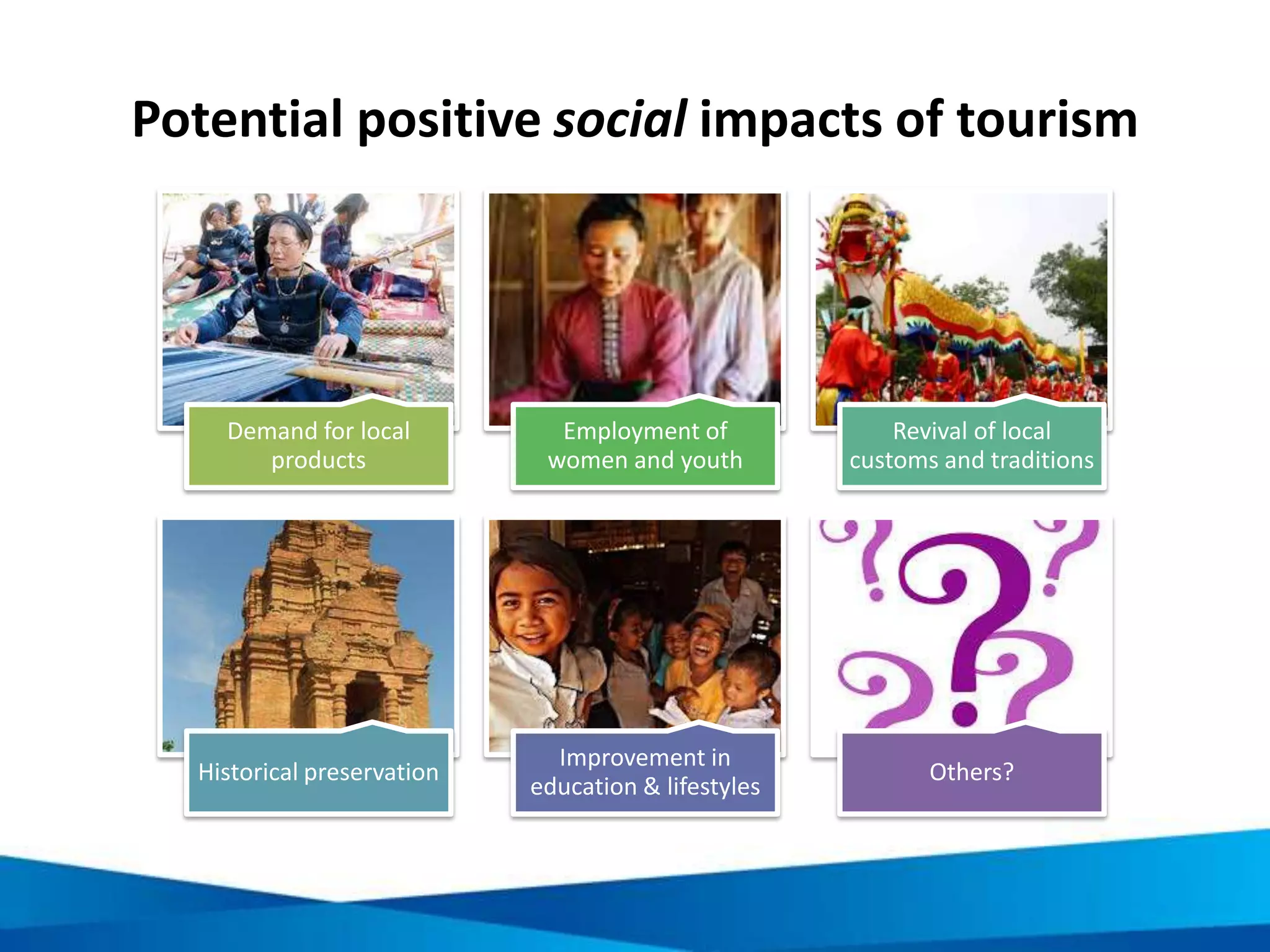
Potential positive social impacts of tourism
Demand for local
products
Employment of
women and youth
Revival of local
customs and traditions
Historical preservation
Improvement in
education & lifestyles
Others?
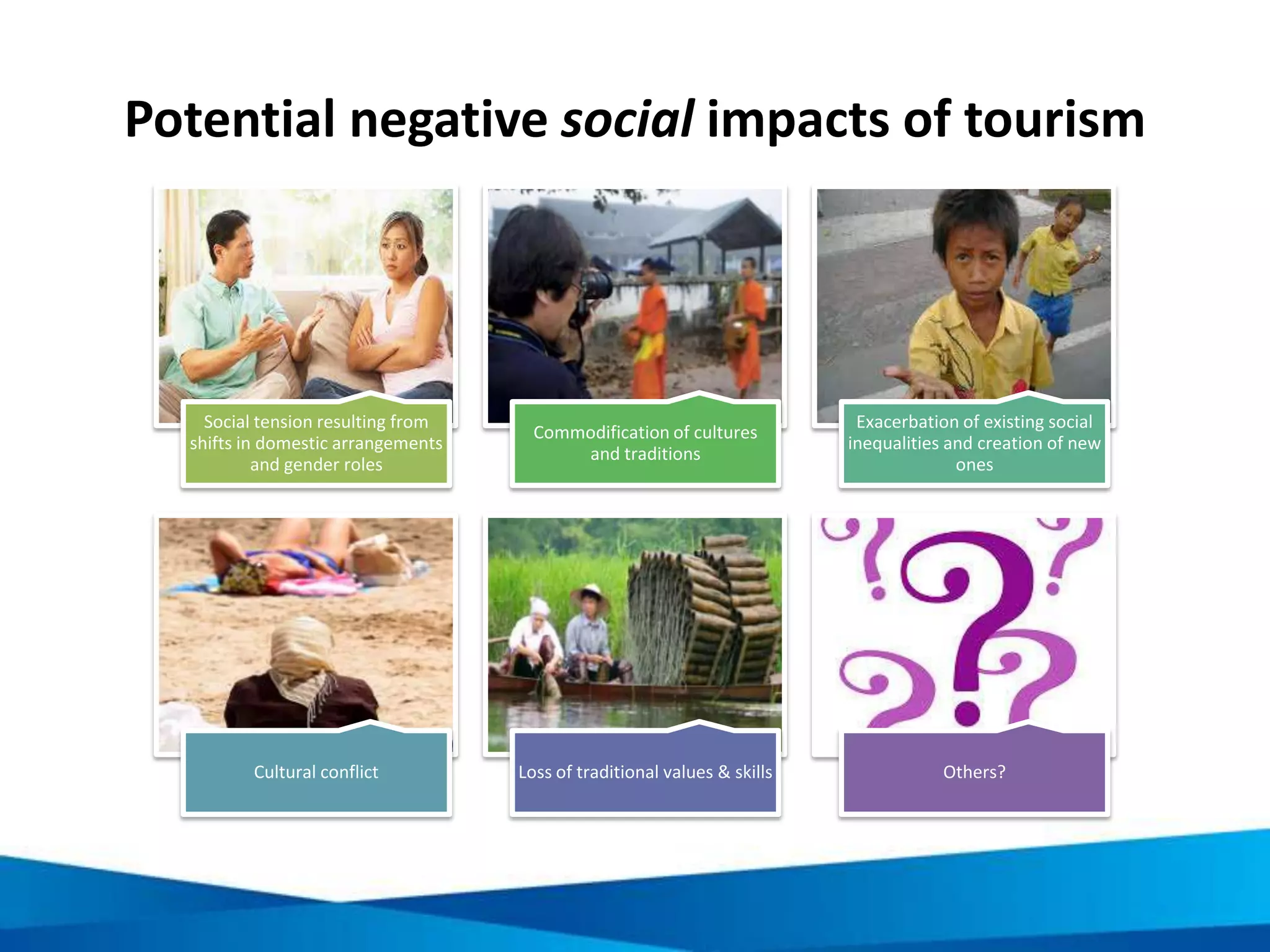
Potential negative social impacts of tourism
Social tension resulting from
shifts in domestic arrangements
and gender roles
Commodification of cultures
and traditions
Exacerbation of existing social
inequalities and creation of new
ones
Cultural conflict Loss of traditional values & skills Others?
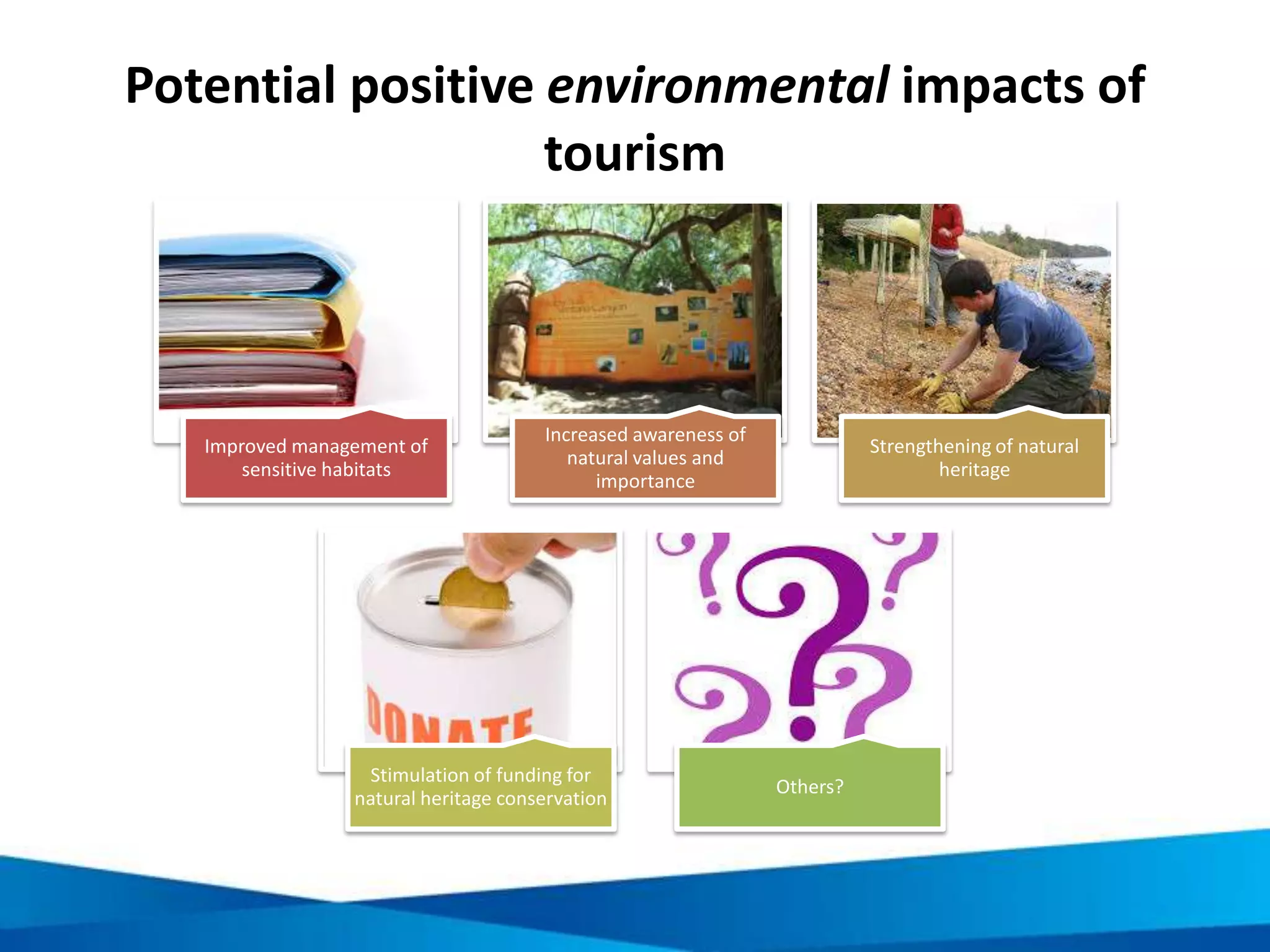
Potential positive environmental impacts of
tourism
Improved management of
sensitive habitats
Increased awareness of
natural values and
importance
Strengthening of natural
heritage
Stimulation of funding for
natural heritage conservation
Others?
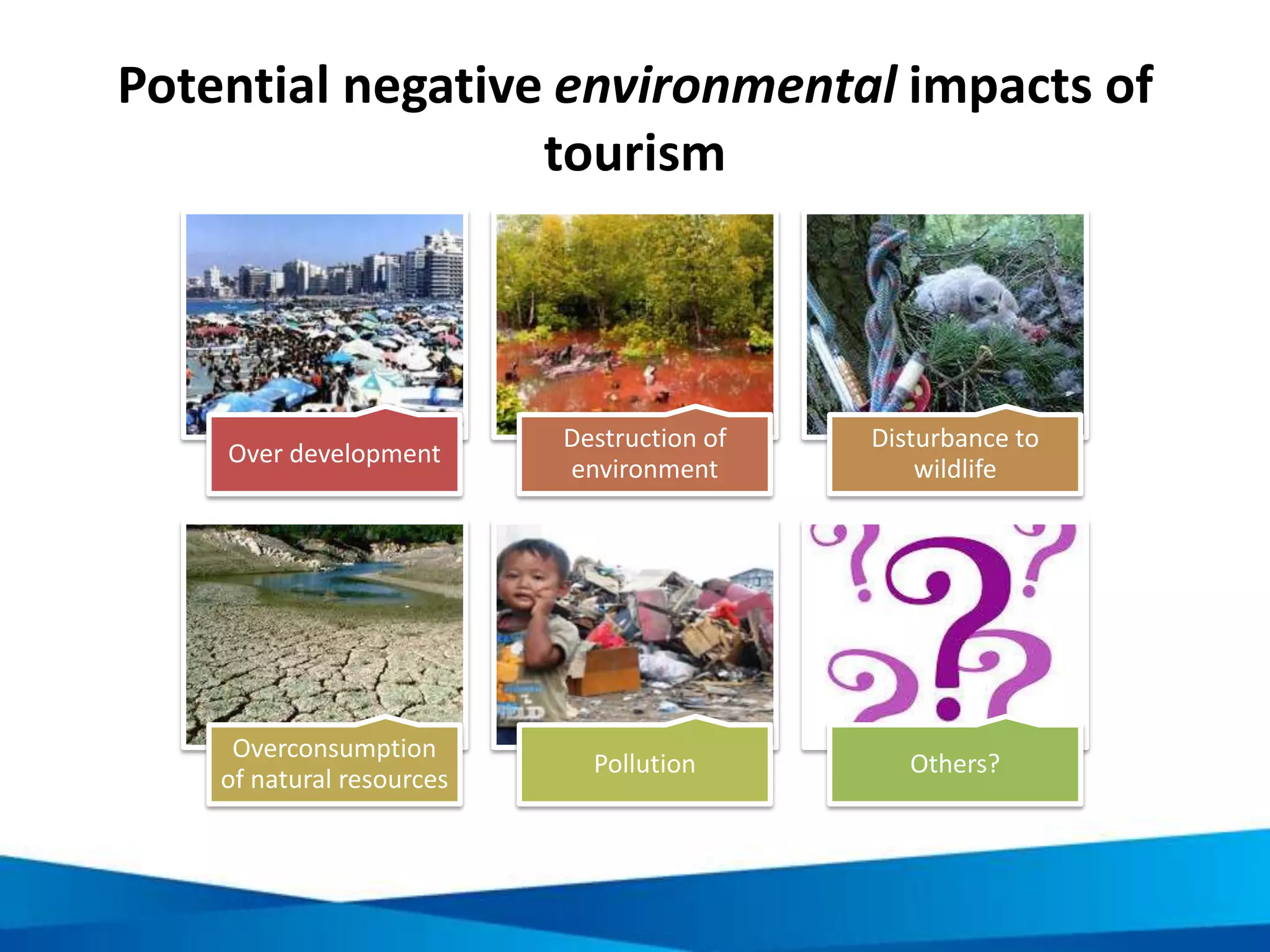
Potential negative environmental impacts of
tourism
Over development
Destruction of
environment
Disturbance to
wildlife
Overconsumption
of natural resources
Pollution Others?
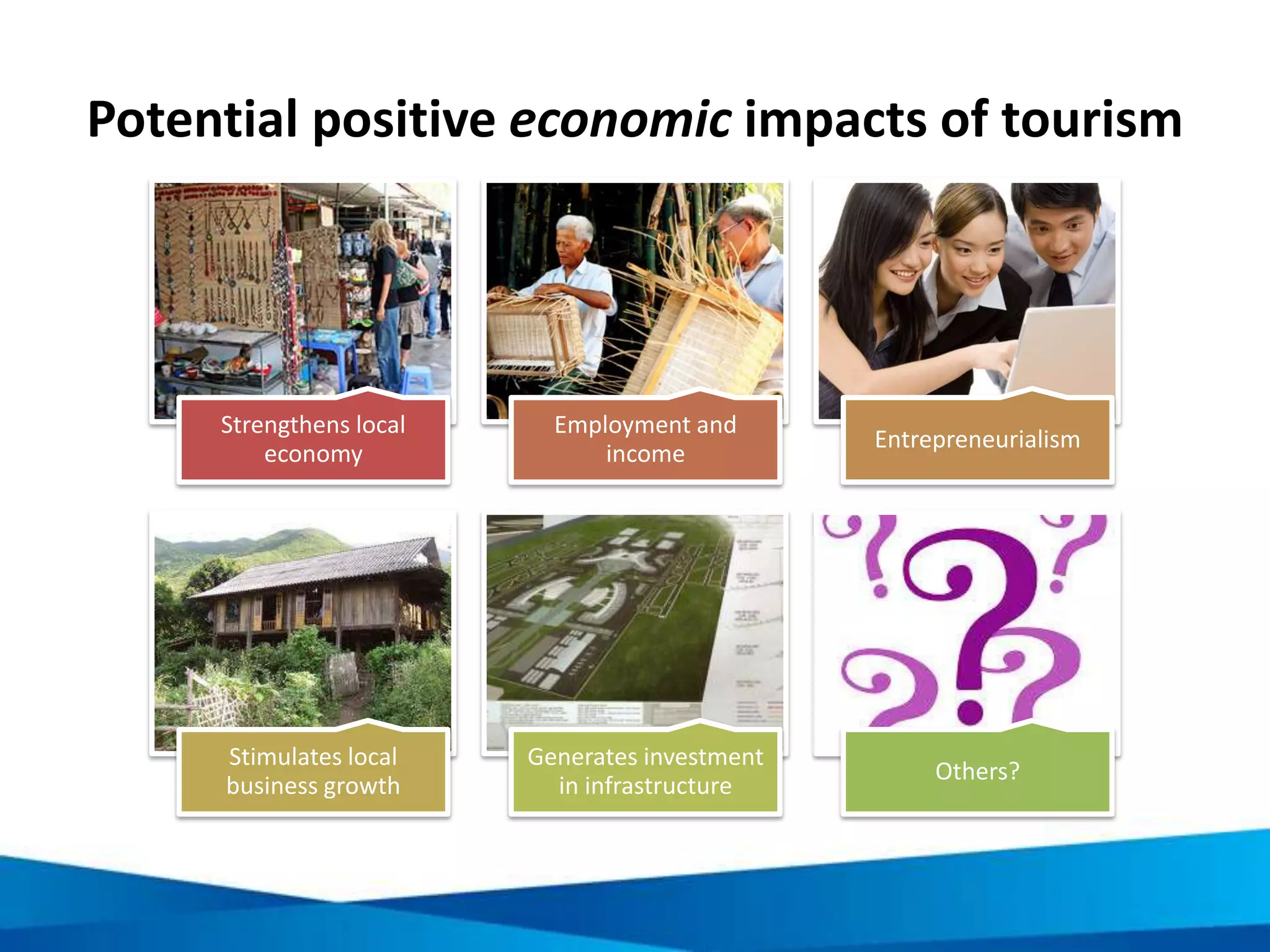
Potential positive economic impacts of tourism
Strengthens local
economy
Employment and
income
Entrepreneurialism
Stimulates local
business growth
Generates investment
in infrastructure
Others?
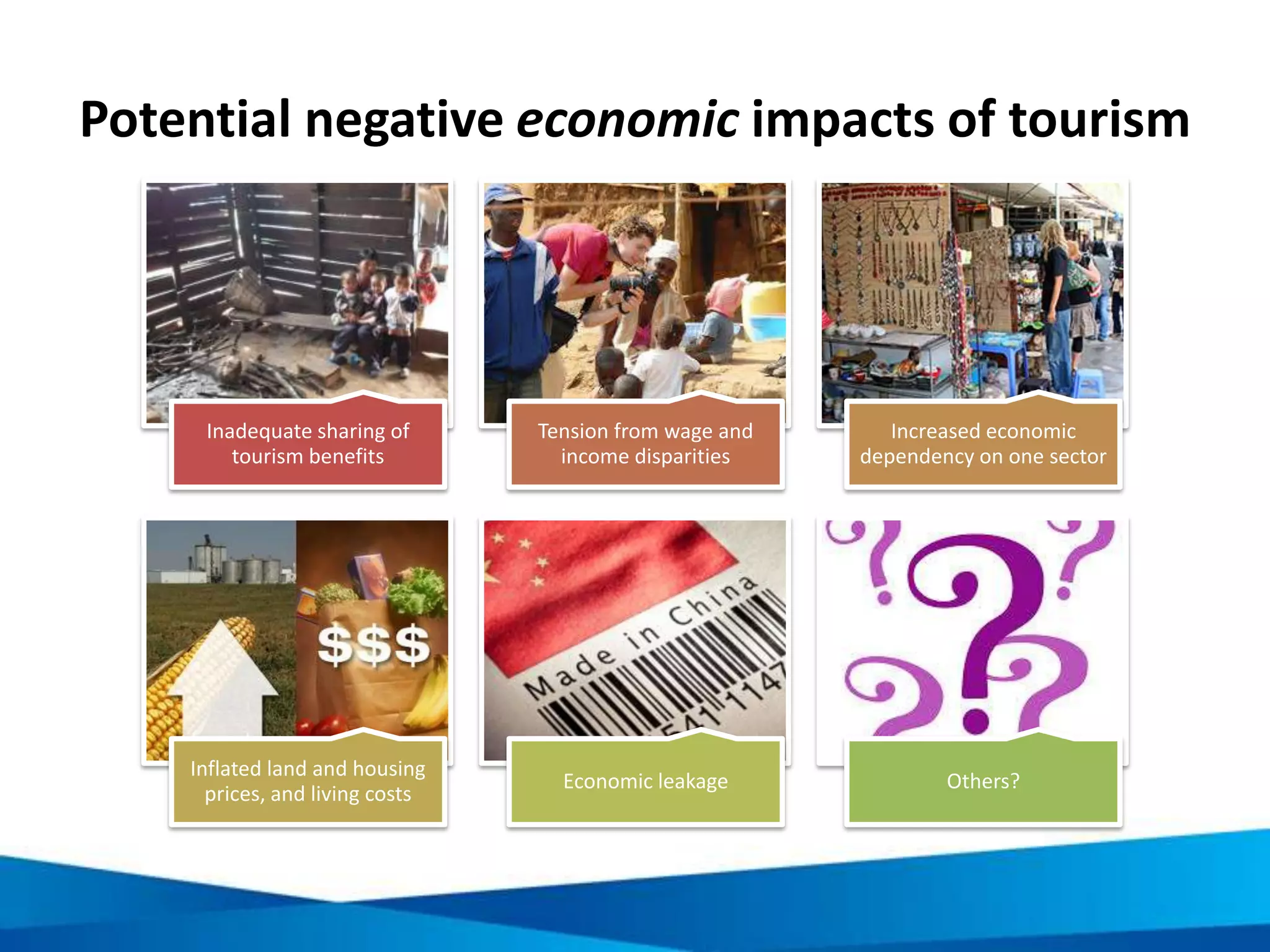
Potential negative economic impacts of tourism
Inadequate sharing of
tourism benefits
Tension from wage and
income disparities
Increased economic
dependency on one sector
Inflated land and housing
prices, and living costs
Economic leakage Others?
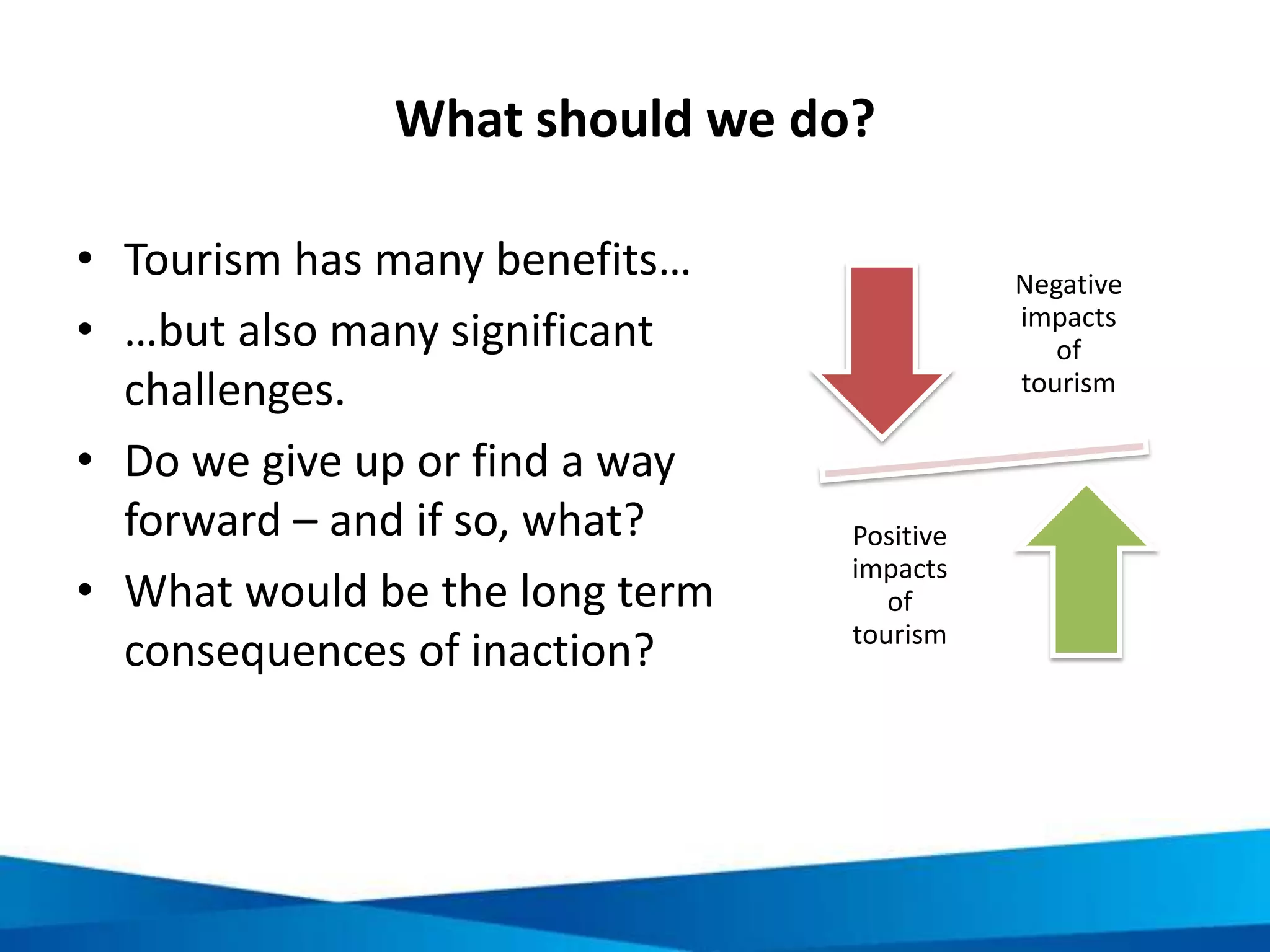
What should we do?
• Tourism has many benefits…
• …but also many significant
challenges.
• Do we give up or find a way
forward – and if so, what?
• What would be the long term
consequences of inaction?
Negative
impacts
of
tourism
Positive
impacts
of
tourism
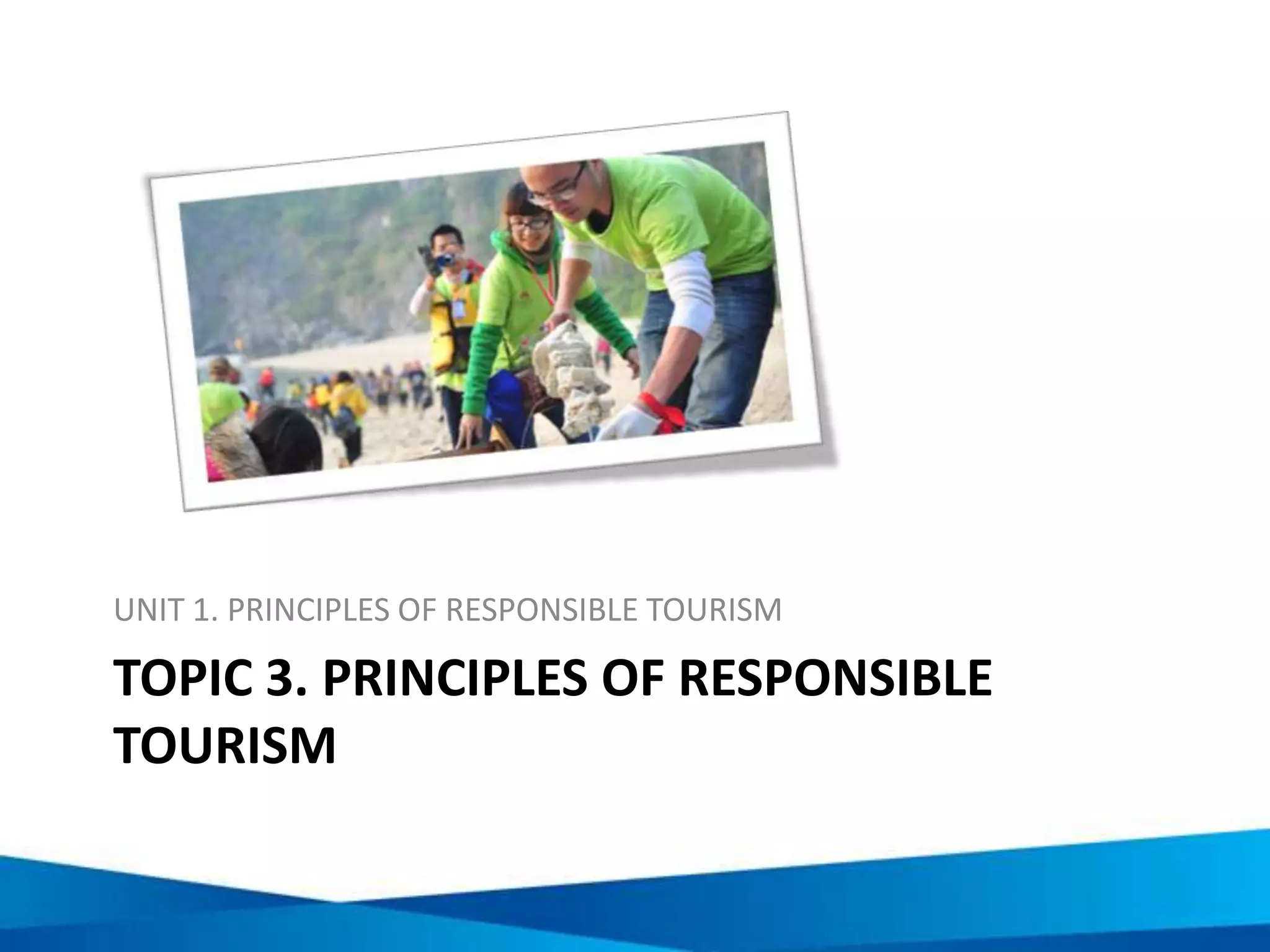
TOPIC 3. PRINCIPLES OF RESPONSIBLE
TOURISM
UNIT 1. PRINCIPLES OF RESPONSIBLE TOURISM
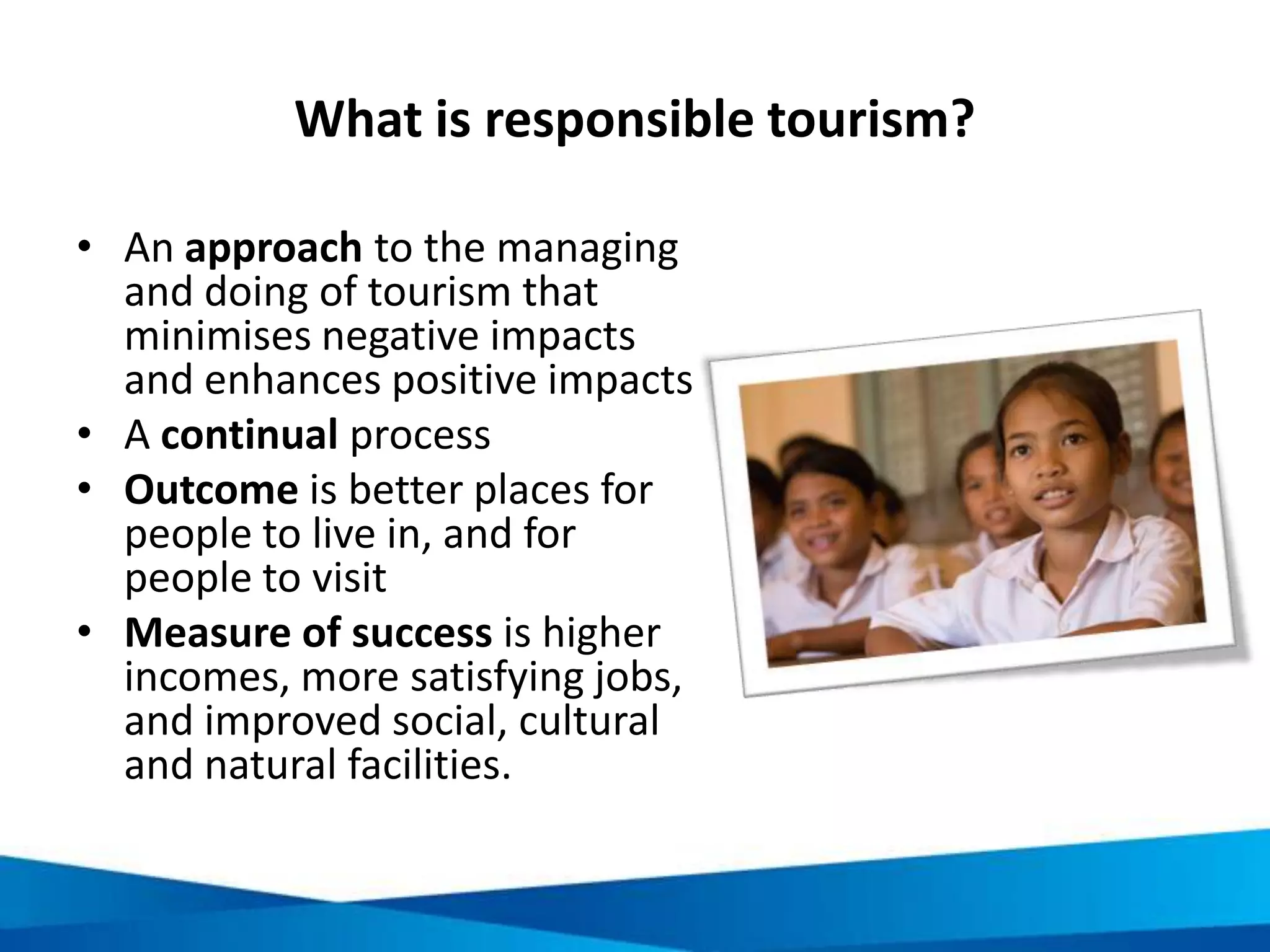
What is responsible tourism?
• An approach to the managing
and doing of tourism that
minimises negative impacts
and enhances positive impacts
• A continual process
• Outcome is better places for
people to live in, and for
people to visit
• Measure of success is higher
incomes, more satisfying
jobs, and improved
social, cultural and natural
facilities.
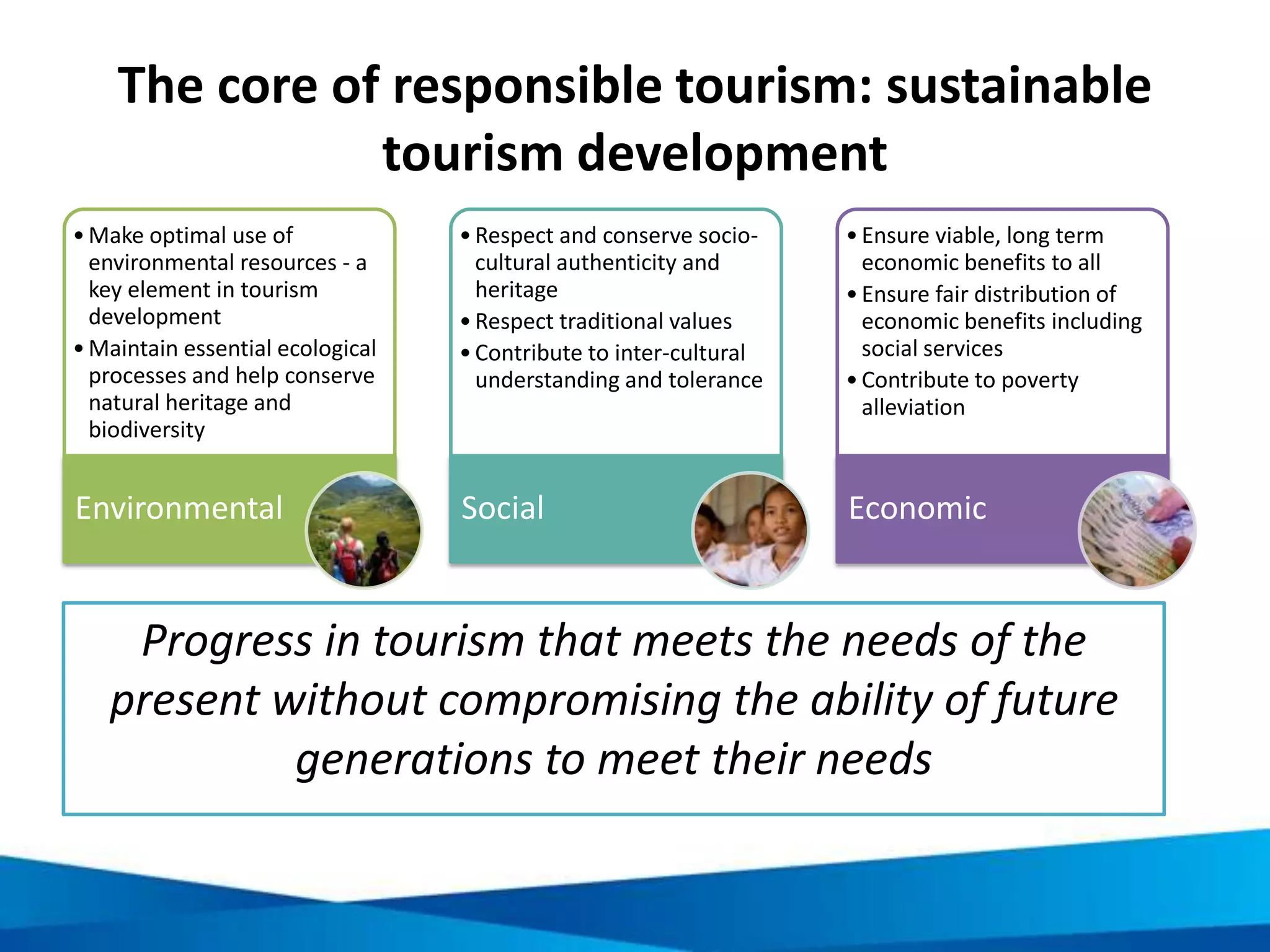
The core of responsible tourism: sustainable
tourism development
•Make optimal use of
environmental resources - a
key element in tourism
development
•Maintain essential ecological
processes and help conserve
natural heritage and
biodiversity
Environmental
•Respect and conserve socio-
cultural authenticity and
heritage
•Respect traditional values
•Contribute to inter-cultural
understanding and tolerance
Social
•Ensure viable, long term
economic benefits to all
•Ensure fair distribution of
economic benefits including
social services
•Contribute to poverty
alleviation
Economic
Progress in tourism that meets the needs of the
present without compromising the ability of future
generations to meet their needs
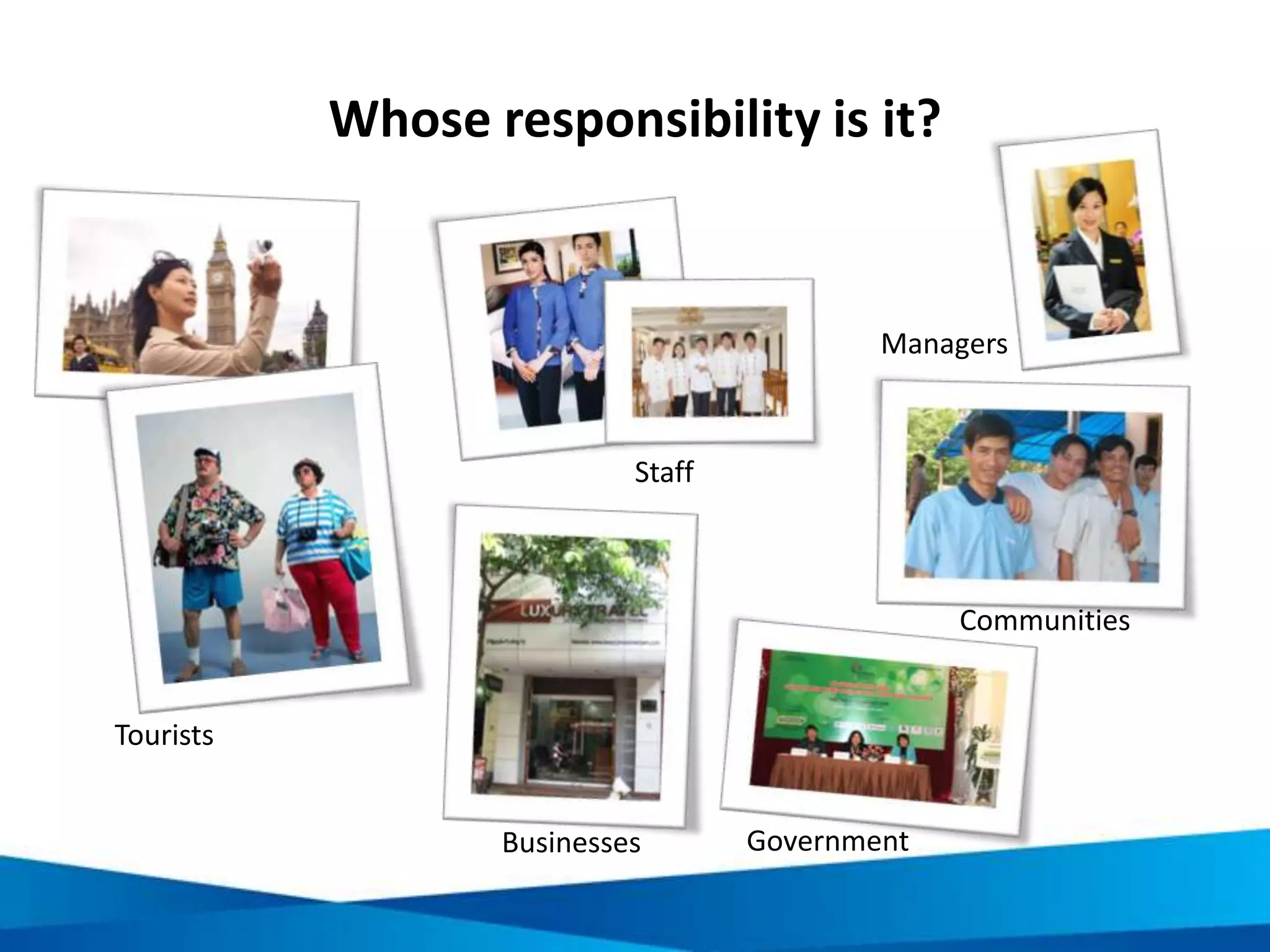
Whose responsibility is it?
Tourists
Managers
Staff
GovernmentBusinesses
Communities
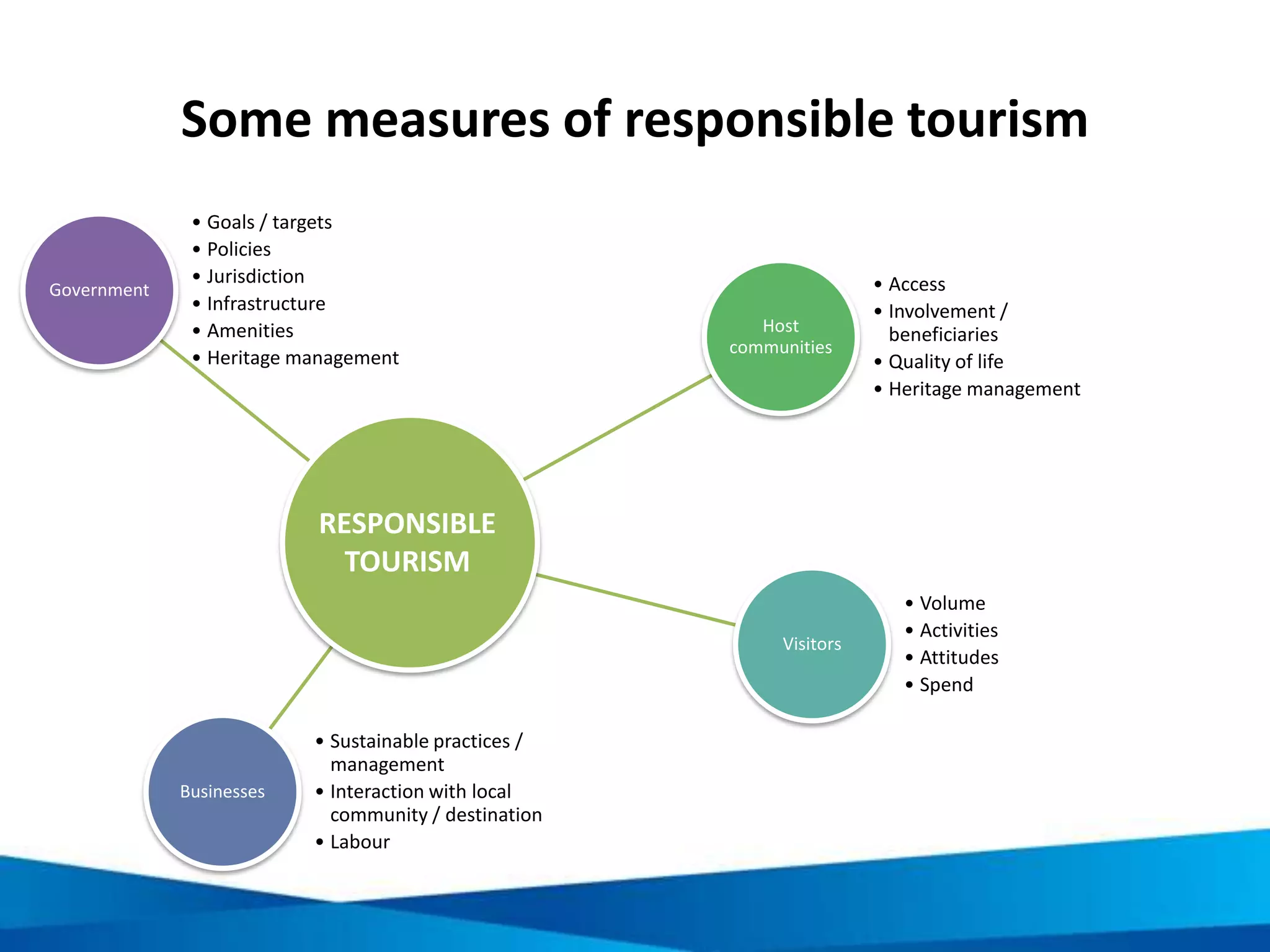
Some measures of responsible tourism
Host
communities
• Access
• Involvement /
beneficiaries
• Quality of life
• Heritage management
Visitors
• Volume
• Activities
• Attitudes
• Spend
Businesses
• Sustainable practices /
management
• Interaction with local
community / destination
• Labour
Government
• Goals / targets
• Policies
• Jurisdiction
• Infrastructure
• Amenities
• Heritage management
RESPONSIBLE
TOURISM
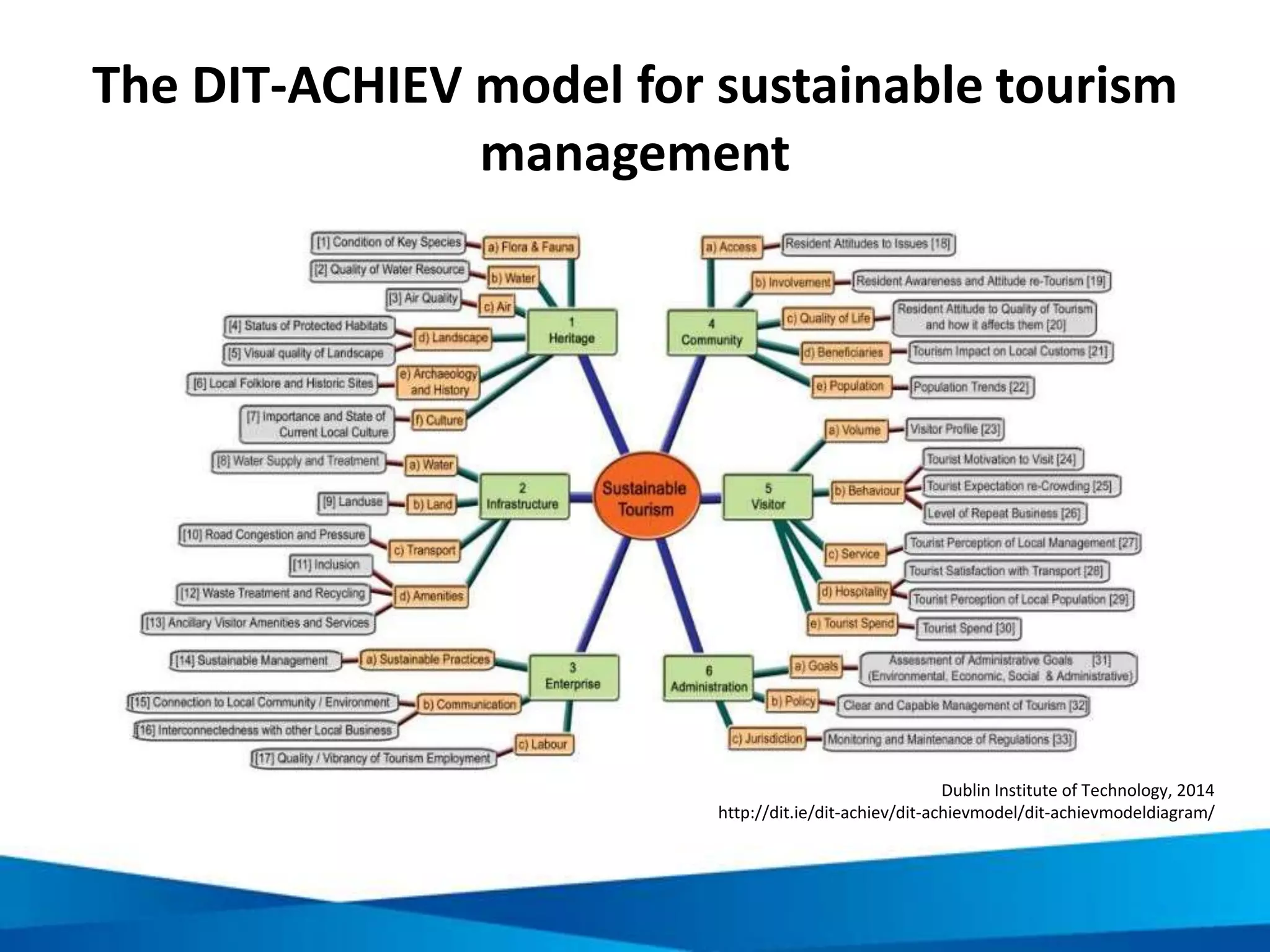
Dublin Institute of Technology, 2014
http://dit.ie/dit-achiev/dit-achievmodel/dit-achievmodeldiagram/
The DIT-ACHIEV model for sustainable tourism
management
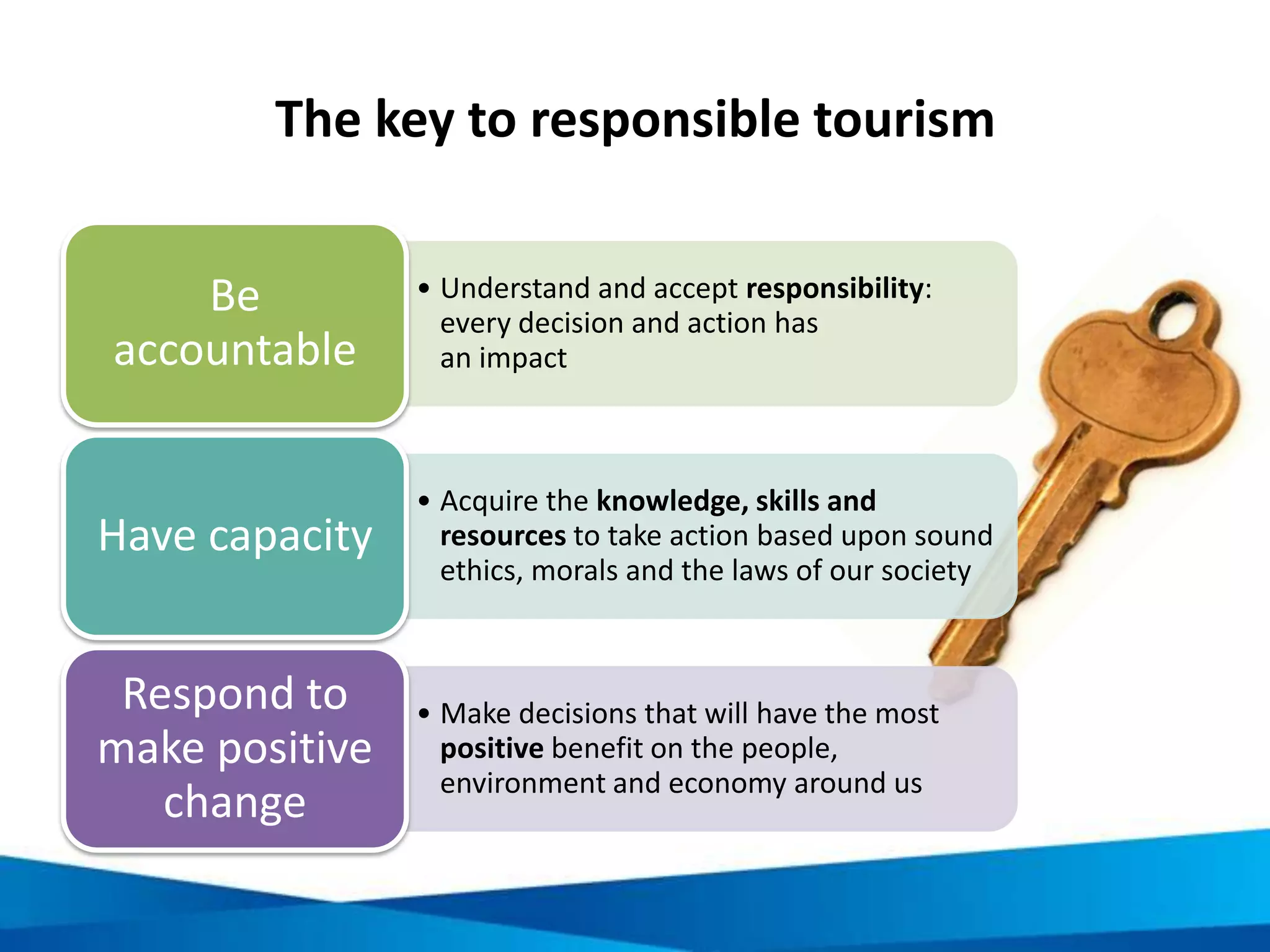
The key to responsible tourism
• Understand and accept responsibility:
every decision and action has
an impact
Be
accountable
• Acquire the knowledge, skills and
resources to take action based upon sound
ethics, morals and the laws of our society
Have capacity
• Make decisions that will have the most
positive benefit on the people,
environment and economy around us
Respond to
make positive
change
TOPIC 4. BENEFITS OF RESPONSIBLE TOURISM
UNIT 1. PRINCIPLES OF RESPONSIBLE TOURISM
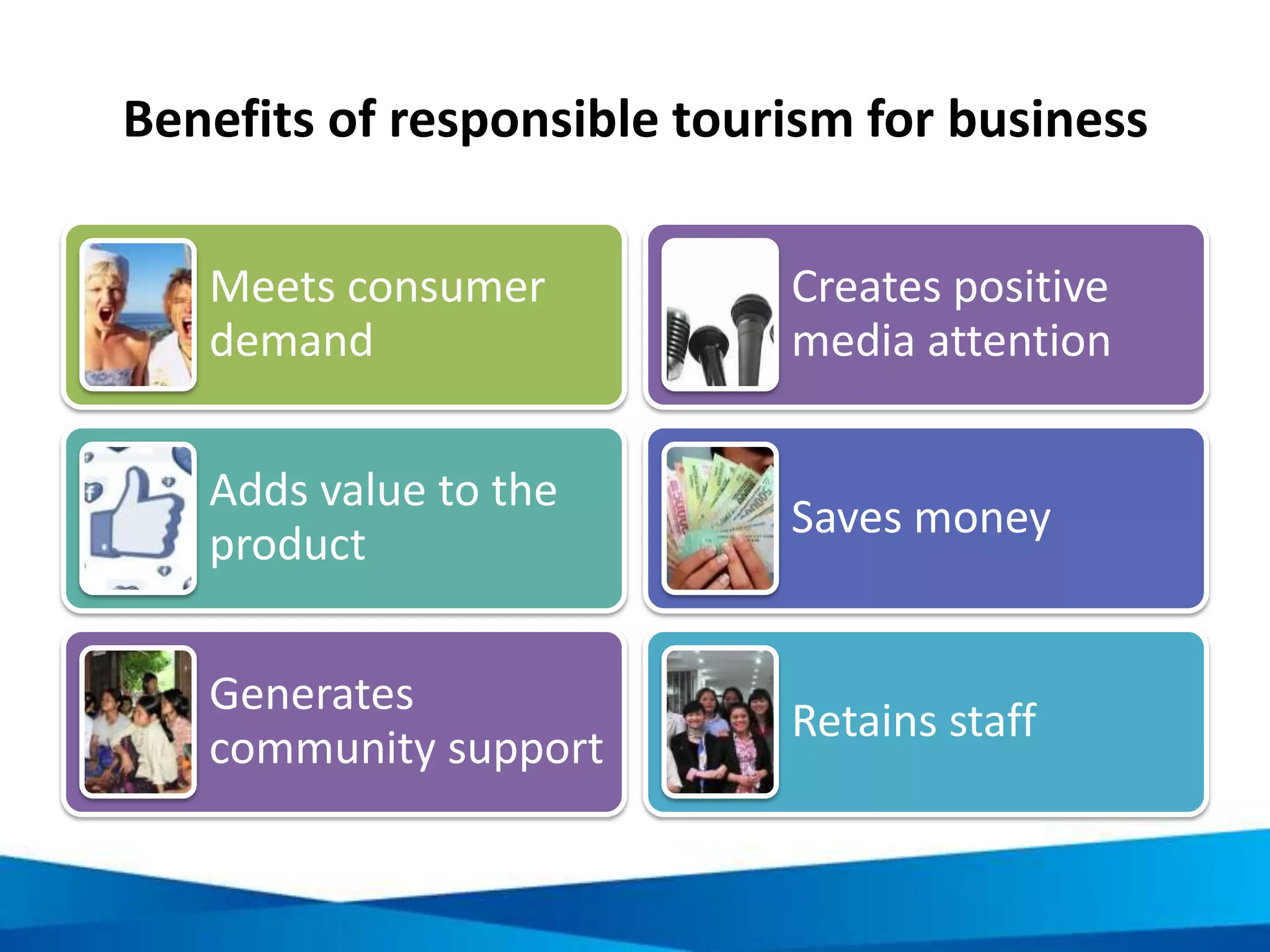
Benefits of responsible tourism for business
Meets consumer
demand
Adds value to the
product
Generates
community support
Creates positive
media attention
Saves money
Retains staff
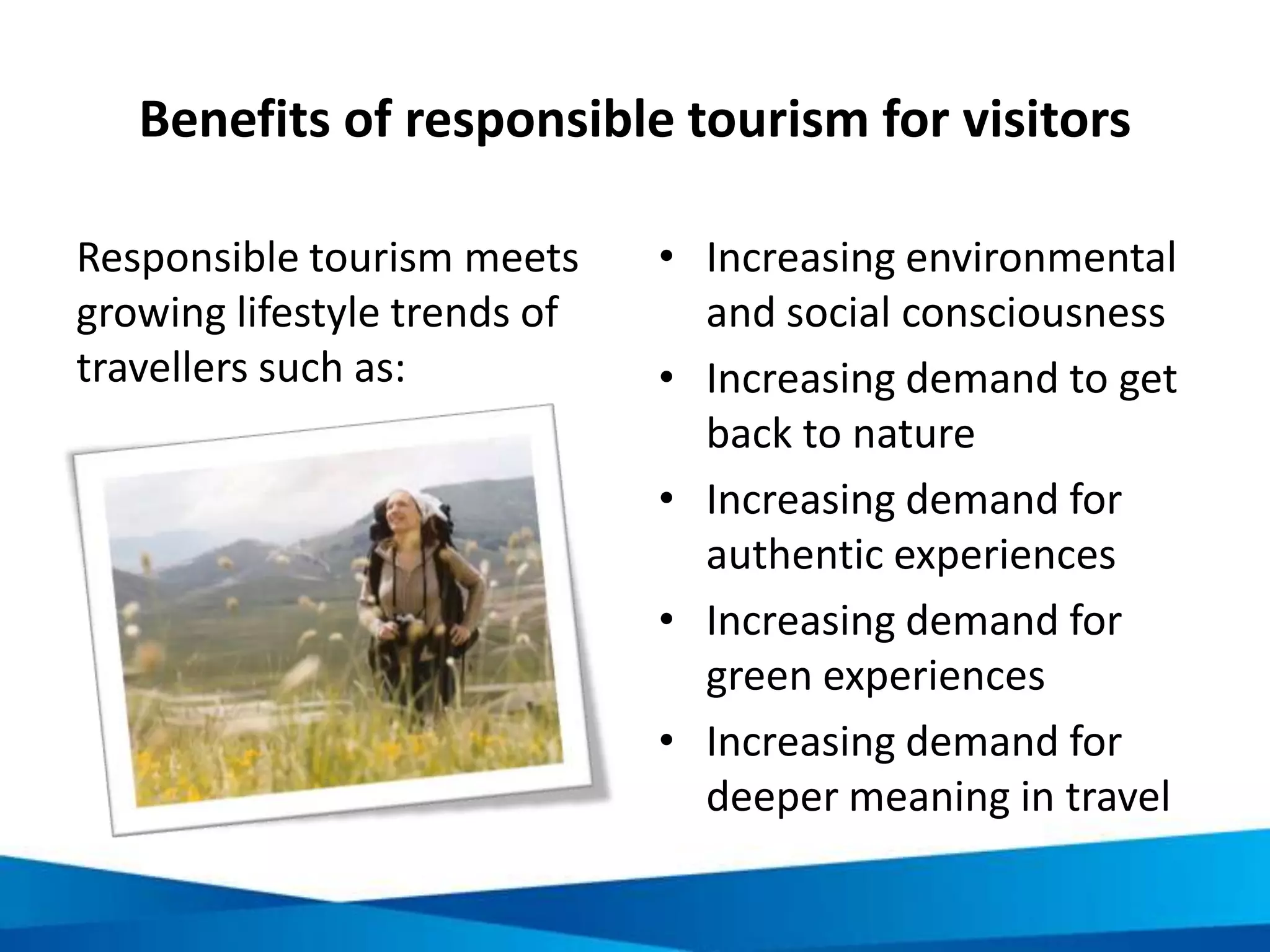
Benefits of responsible tourism for visitors
Responsible tourism meets
growing lifestyle trends of
travellers such as:
• Increasing environmental
and social consciousness
• Increasing demand to get
back to nature
• Increasing demand for
authentic experiences
• Increasing demand for
green experiences
• Increasing demand for
deeper meaning in travel
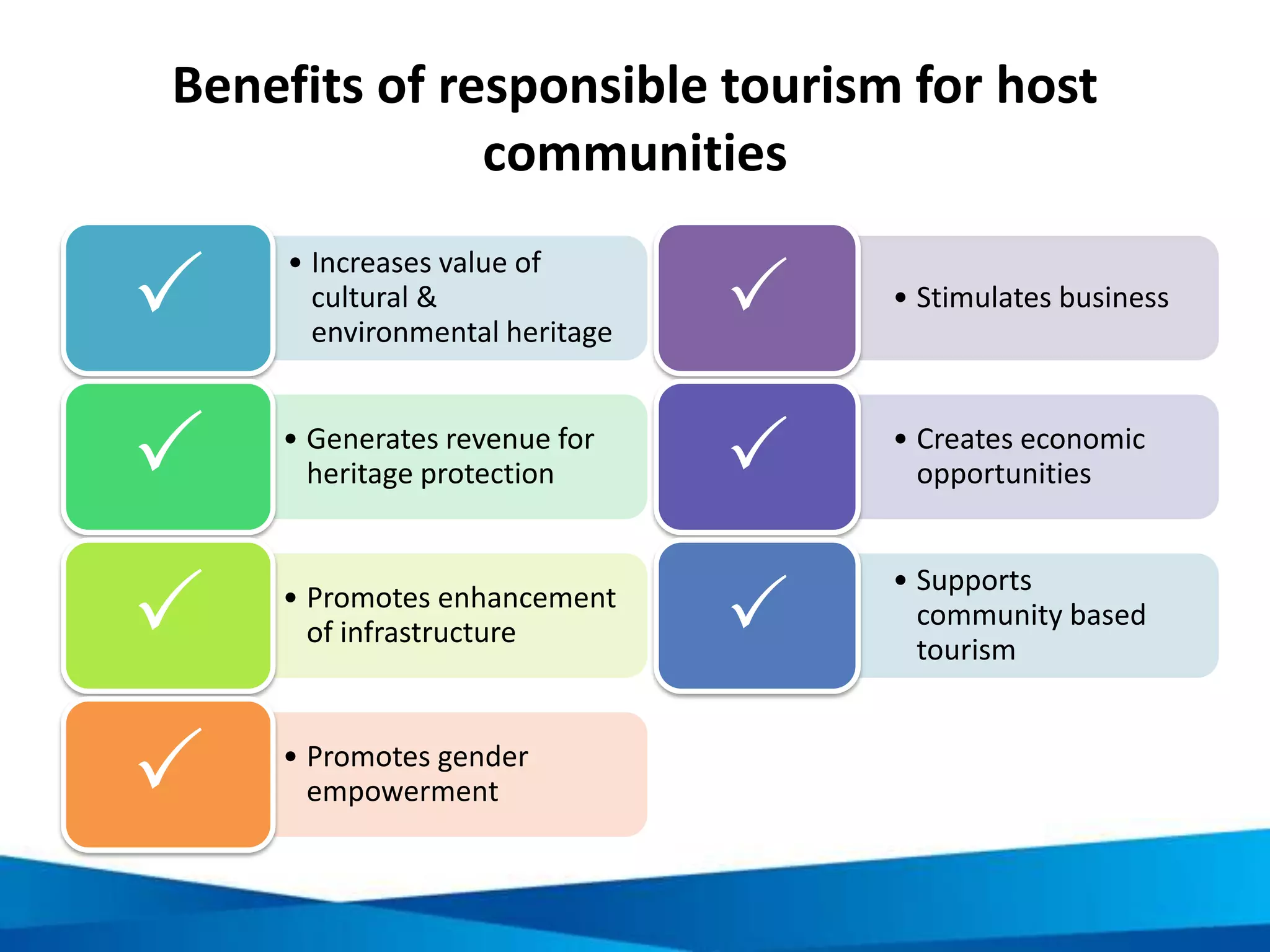
Benefits of responsible tourism for host
communities
• Stimulates business
• Creates economic
opportunities
• Supports
community based
tourism

• Increases value of
cultural &
environmental heritage

• Generates revenue for
heritage protection
• Promotes enhancement
of infrastructure
• Promotes gender
empowerment
TOPIC 5. PRACTICES IN RESPONSIBLE
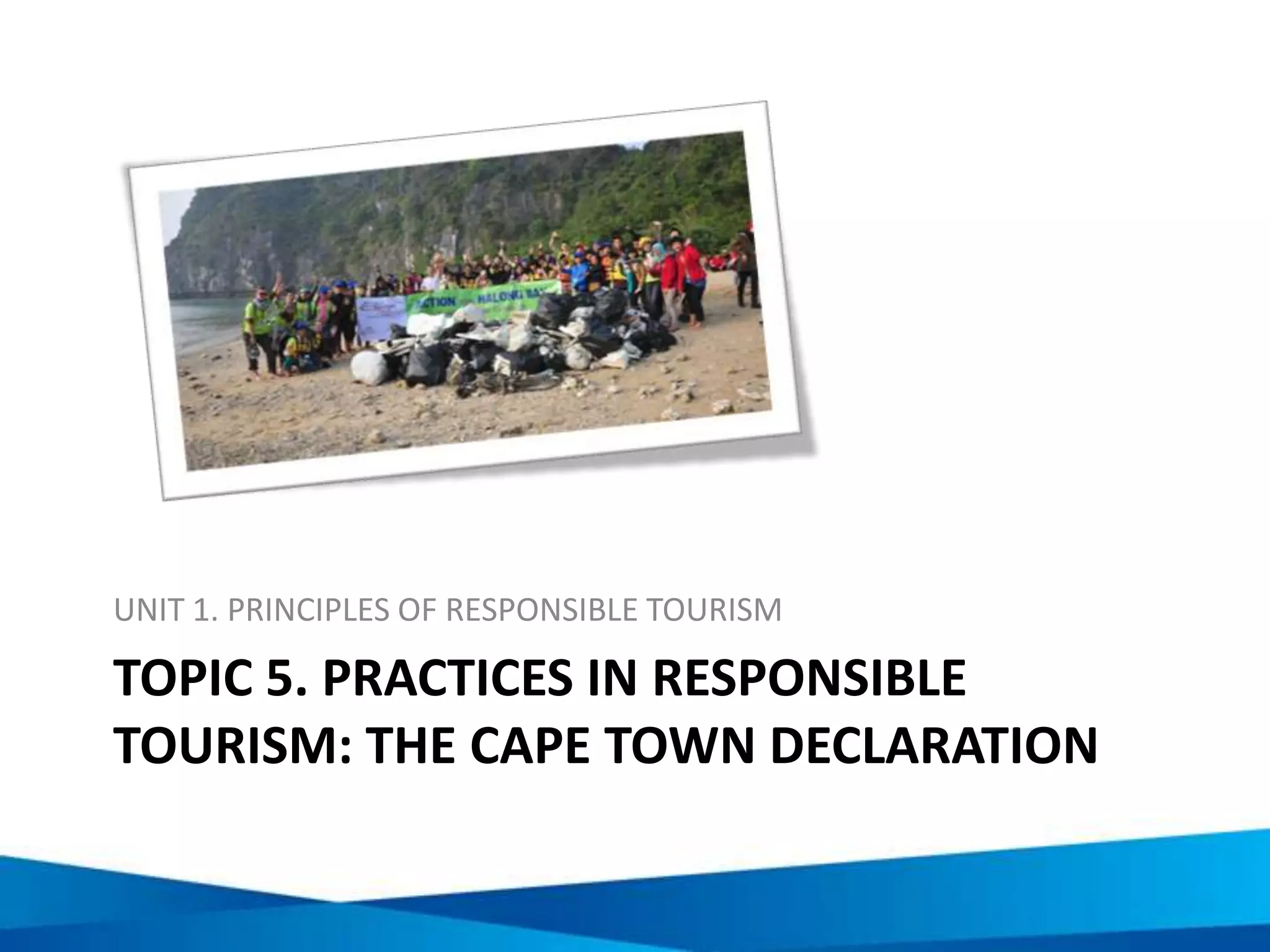
TOURISM: THE CAPE TOWN DECLARATION
UNIT 1. PRINCIPLES OF RESPONSIBLE TOURISM
The Cape Town Declaration
• Tourism sector representatives from
20 countries, plus the UNWTO and
UNEP
• 1st International Conference on
Responsible Tourism in
Destinations, Cape Town, South
Africa, 2002
• Participants agreed on a number of
guiding principles for the
implementation of responsible
tourism
• Guidelines have became the
founding principles of responsible
tourism today
Responsible tourism…
1. …minimises negative economic, environmental, and social
impacts;
2. …generates greater economic benefits for local people and
enhances the well-being of host communities, improves working
conditions and access to the industry;
3. …involves local people in decisions that affect their lives and life
chances;
4. …makes positive contributions to the conservation of natural and
cultural heritage, to the maintenance of the world's diversity;
5. …provides more enjoyable experiences for tourists through more
meaningful connections with local people, and a greater
understanding of local cultural, social and environmental issues;
6. …provides access for physically challenged people; and
7. …is culturally sensitive, engenders respect between tourists and
hosts, and builds local pride and confidence
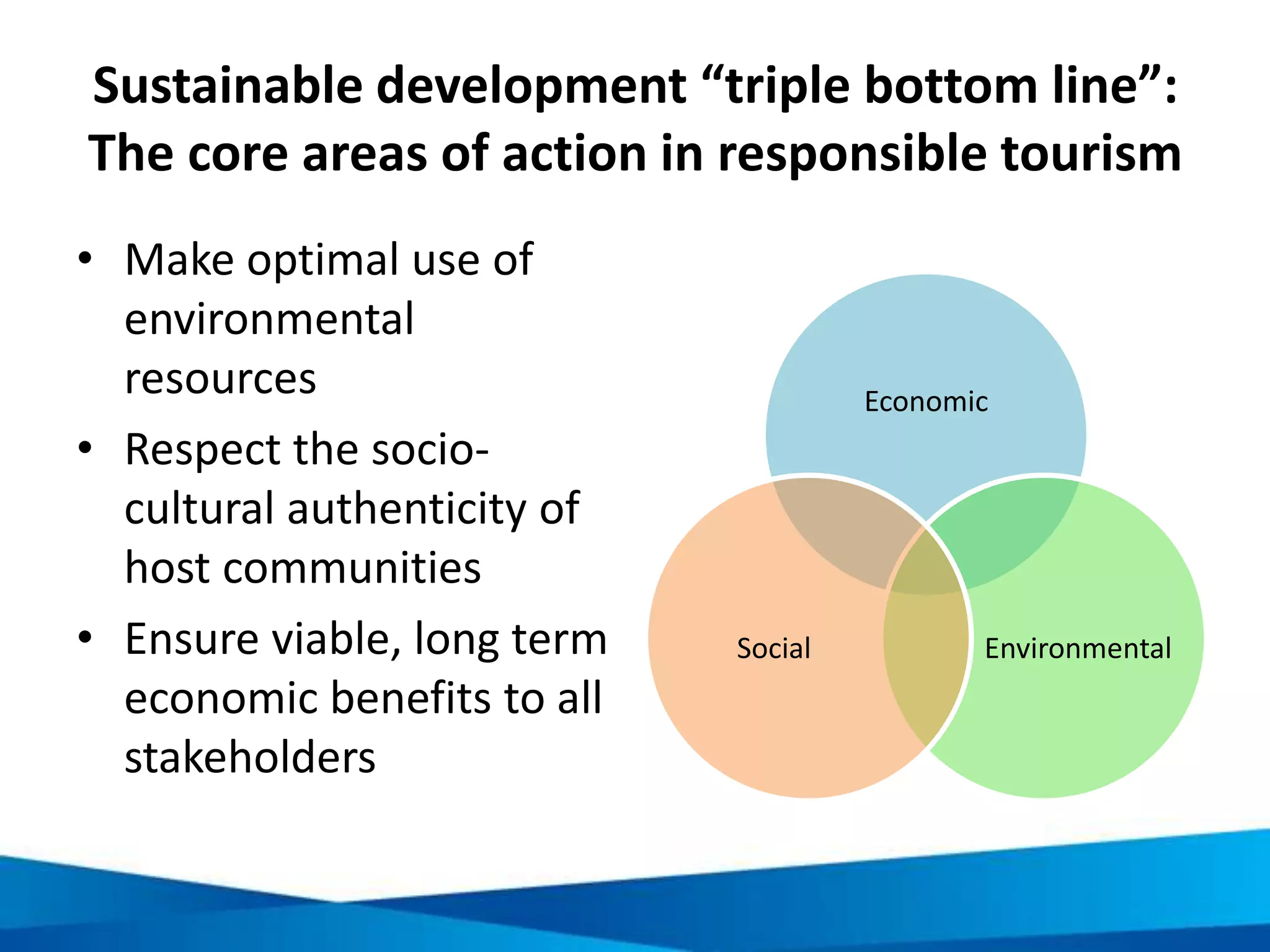
Sustainable development “triple bottom line”:
The core areas of action in responsible tourism
• Make optimal use of
environmental
resources
• Respect the socio-
cultural authenticity of
host communities
• Ensure viable, long term
economic benefits to all
stakeholders
Economic
EnvironmentalSocial
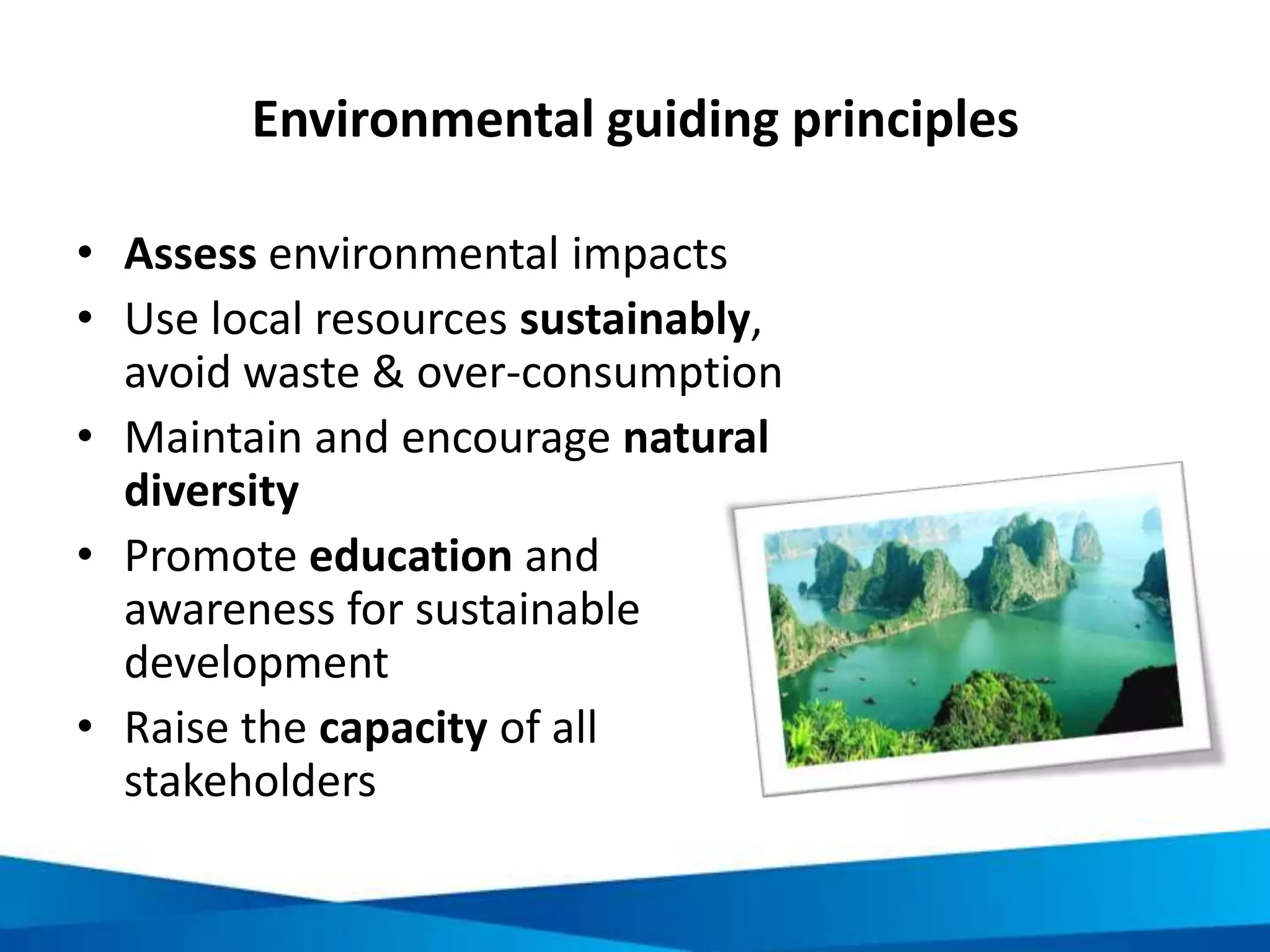
Environmental guiding principles
• Assess environmental impacts
• Use local resources
sustainably, avoid waste & over-
consumption
• Maintain and encourage natural
diversity
• Promote education and
awareness for sustainable
development
• Raise the capacity of all
stakeholders
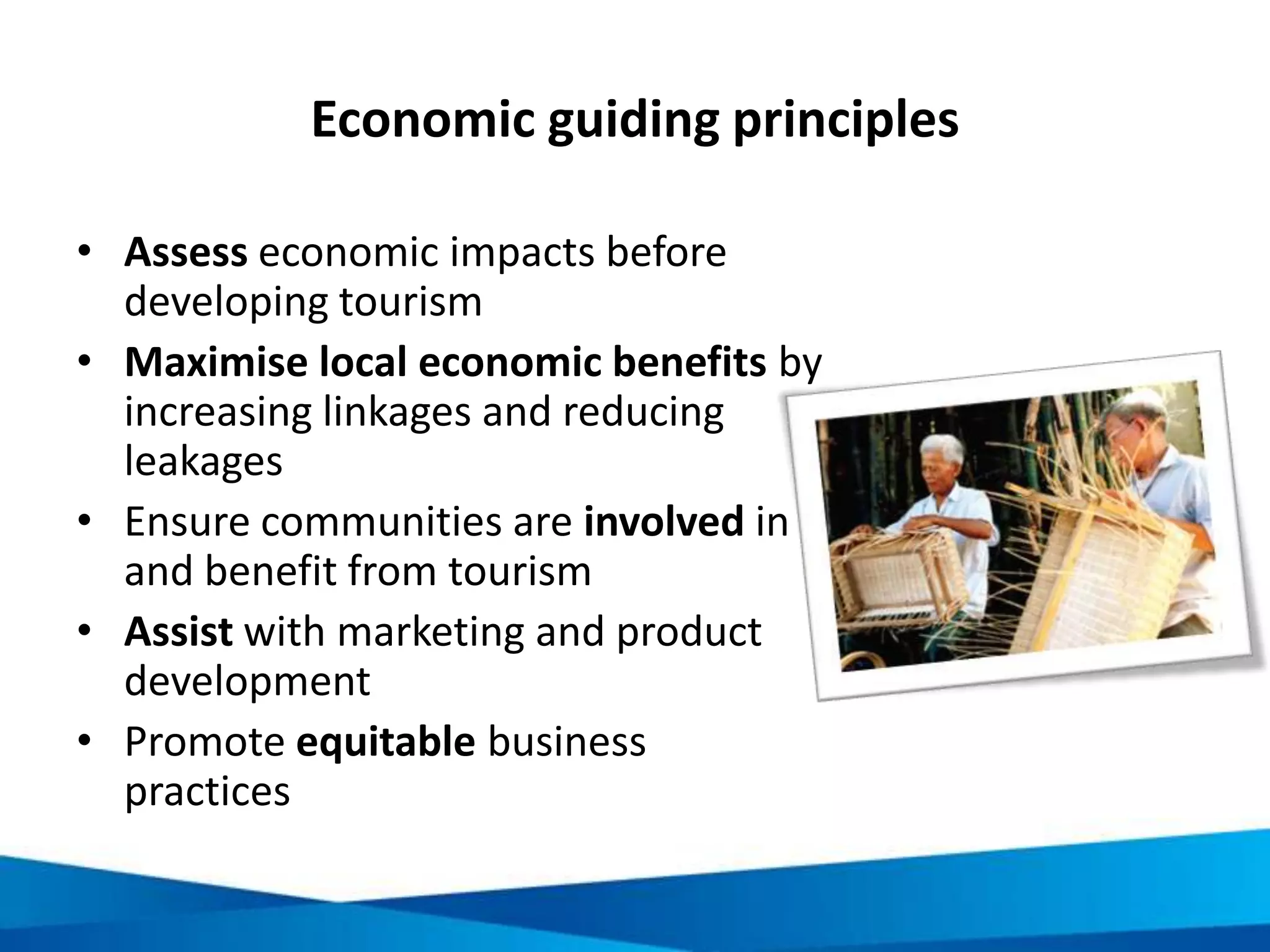
Economic guiding principles
• Assess economic impacts before
developing tourism
• Maximise local economic benefits by
increasing linkages and reducing
leakages
• Ensure communities are involved in
and benefit from tourism
• Assist with marketing and product
development
• Promote equitable business
practices
Social guiding principles
• Involve the local community in
planning and decision-making
• Assess social impacts of tourism
activities
• Maintain and encourage social
and cultural diversity
• Be sensitive to the host culture
Tourism for all
FOCUS AREA PROVISIONS
Tourism information and
publicity
Clear indication of accessible services and facilities…
Preparation of staff Training in communicating with and providing assistance to customers with
disabilities and services and facilities available…
Tourism facilities and sites Provision of goods and services that cater for visitors with disabilities…
Accommodation facilities Allocation of specially designed rooms for people in a wheelchair or mobility
impaired…
Catering facilities Ease of internal and external access to restaurants, cafes and bars…
Museums and other
buildings of tourist interest
Ease of internal and external access, staff training, interpretation for vision and
hearing impaired…
Excursions Tour buses accommodate tourists with physical disabilities, interpretation for
vision and hearing impaired, one or more staff trained in sign language…
The outcome of responsible tourism
“Better places for people
to live in and better places
to visit”
Better places
to live in
Better places
to visit
Virtuous cycle
Being a responsible traveller: environment
• Don’t litter
• Carry your own bag
• Avoid excessive waste
• Leave nature as it is
• Don’t disturb wildlife
• Put out cigarettes properly
• Reduce, re-use and recycle
• Carbon offset
• Save energy
• Do not purchase or eat endangered species
• Others?
Being a responsible traveller: economy
• Use accredited operators
• Buy locally made souvenirs
• Eat at local restaurants
• Stay in locally-owned places
• Purchase fair trade products
• Support responsible tourism organisations
• Others?
Being a responsible traveller: social
• Be considerate of the communities you visit
• Donate via reputable institutions
• Don’t give money to children and beggars
• Respect cultural difference
• Don’t support the illegal drug or sex trade
• Use responsible travel providers
• Use operators with responsible tourism policies
• Others?
Xin trân trọng cảm ơn!
Thank you!

Unit 1: Principles Of Responsible Tourism

  • 1.
    UNIT 1. PRINCIPLESOF RESPONSIBLE TOURISM
  • 2.
    Unit outline Objectives By theend of the unit participants will be able to: • Explain the current global and local tourism market • List and describe types of tourism and tourists • List and describe positive and negative social, economic and environmental impacts of tourism • Explain the principles of Responsible Tourism and the triple bottom line objectives of sustainable development • List and describe the benefits of Responsible Tourism for business, tourists and local residents • Explain the importance of the Cape Town Declaration and its principles on Responsible Tourism Topics 1. Tourism today 2. Impacts of tourism 3. Principles of responsible tourism 4. Benefits of responsible tourism 5. Practices in responsible tourism: The Cape Town Declaration
  • 3.
    TOPIC 1. TOURISMTODAY UNIT 1. PRINCIPLES OF RESPONSIBLE TOURISM
  • 4.
    Tourism… …entails movement ofpeople to countries or places outside their usual environment… …for at least one night… …for personal or business / professional purposes.
  • 5.
    The UNWTO definitionof tourism “Tourism is a social, cultural and economic phenomenon which entails the movement of people to countries or places outside their usual environment for personal or business / professional purposes. These people are called visitors and tourism has to do with their activities, some of which imply tourism expenditure”
  • 6.
    Tourism involves manygoods and services Food & drink Natural attractions Cultural attractions
  • 7.
    Types of tourists Leisure Visitingfriends and relatives Holiday Business Meetings, Incentives, Conventi ons & Events General
  • 8.
    Common types ofleisure tourism Adventure tourism Mainstream package tourism Ecotourism Cultural tourism
  • 9.
  • 10.
    Information and reservation Travel to and gettingthere Unpack and orientate Eat and drink Rest and sleep Activity and sport Play and fun Entertainmen t and culture Sightseeing and shopping Pack and leave The tourism cycle
  • 11.
    The global tourismmarket • Export income from inbound tourism = US$ 3 billion / day • Almost 1/3 of the world’s exports of commercial services are from tourism • Tourism is the 4th largest industry in the world International tourist arrivals (UNWTO) YEAR TOURIST ARRIVALS 1950 25 million 1980 277 million 1990 435 million 2000 675 million Today 940 million Tomorrow …?!
  • 12.
    Global international tourismarrivals: past, present, and future
  • 13.
    World Tourism Councilforecasts for tourism 2011 2020 Global GDP 9%; US$ 6 trillion 10%; US$ 10 trillion Employment 255 million jobs 328 million jobs; 1 in 10
  • 14.
    Tourism in Vietnam •International visitor arrivals: 2.1m in 2000 to 6.8m in 2012 • Domestic tourism: 11.7m in 2000 to 23m in 2009 • International arrivals growth rate: 8.9% over past decade • By 2023, travel and tourism will: – Directly support 2.3m jobs in Vietnam – Directly and indirectly support 4.6m jobs in Vietnam
  • 15.
    Top tourism sourcemarkets to Vietnam RANK COUNTRY ARRIVALS 1. China 1,428,693 2. South Korea 700,917 3. Japan 576,386 4. USA 443,826 5. Taiwan 409,385 6. Cambodia 331,939 7. Malaysia 299,041 8. Australia 289,844 9. Thailand 225,866 10. France 219,721 Vietnam General Statistics Office, in 2013
  • 16.
    Vietnam Government’s Strategyfor Tourism Development (Vision to 2020) • Tourism revenue will increase to US$18-19 bn • Tourism contribution to GDP will increase by 6.5-7.0% • Tourism will attract an additional US$42.5billion in investment
  • 17.
    TOPIC 2. IMPACTSOF TOURISM UNIT 1. PRINCIPLES OF RESPONSIBLE TOURISM
  • 18.
    Potential positive socialimpacts of tourism Demand for local products Employment of women and youth Revival of local customs and traditions Historical preservation Improvement in education & lifestyles Others?
  • 19.
    Potential negative socialimpacts of tourism Social tension resulting from shifts in domestic arrangements and gender roles Commodification of cultures and traditions Exacerbation of existing social inequalities and creation of new ones Cultural conflict Loss of traditional values & skills Others?
  • 20.
    Potential positive environmentalimpacts of tourism Improved management of sensitive habitats Increased awareness of natural values and importance Strengthening of natural heritage Stimulation of funding for natural heritage conservation Others?
  • 21.
    Potential negative environmentalimpacts of tourism Over development Destruction of environment Disturbance to wildlife Overconsumption of natural resources Pollution Others?
  • 22.
    Potential positive economicimpacts of tourism Strengthens local economy Employment and income Entrepreneurialism Stimulates local business growth Generates investment in infrastructure Others?
  • 23.
    Potential negative economicimpacts of tourism Inadequate sharing of tourism benefits Tension from wage and income disparities Increased economic dependency on one sector Inflated land and housing prices, and living costs Economic leakage Others?
  • 24.
    What should wedo? • Tourism has many benefits… • …but also many significant challenges. • Do we give up or find a way forward – and if so, what? • What would be the long term consequences of inaction? Negative impacts of tourism Positive impacts of tourism
  • 25.
    TOPIC 3. PRINCIPLESOF RESPONSIBLE TOURISM UNIT 1. PRINCIPLES OF RESPONSIBLE TOURISM
  • 26.
    What is responsibletourism? • An approach to the managing and doing of tourism that minimises negative impacts and enhances positive impacts • A continual process • Outcome is better places for people to live in, and for people to visit • Measure of success is higher incomes, more satisfying jobs, and improved social, cultural and natural facilities.
  • 27.
    The core ofresponsible tourism: sustainable tourism development •Make optimal use of environmental resources - a key element in tourism development •Maintain essential ecological processes and help conserve natural heritage and biodiversity Environmental •Respect and conserve socio- cultural authenticity and heritage •Respect traditional values •Contribute to inter-cultural understanding and tolerance Social •Ensure viable, long term economic benefits to all •Ensure fair distribution of economic benefits including social services •Contribute to poverty alleviation Economic Progress in tourism that meets the needs of the present without compromising the ability of future generations to meet their needs
  • 28.
    Whose responsibility isit? Tourists Managers Staff GovernmentBusinesses Communities
  • 29.
    Some measures ofresponsible tourism Host communities • Access • Involvement / beneficiaries • Quality of life • Heritage management Visitors • Volume • Activities • Attitudes • Spend Businesses • Sustainable practices / management • Interaction with local community / destination • Labour Government • Goals / targets • Policies • Jurisdiction • Infrastructure • Amenities • Heritage management RESPONSIBLE TOURISM
  • 30.
    Dublin Institute ofTechnology, 2014 http://dit.ie/dit-achiev/dit-achievmodel/dit-achievmodeldiagram/ The DIT-ACHIEV model for sustainable tourism management
  • 31.
    The key toresponsible tourism • Understand and accept responsibility: every decision and action has an impact Be accountable • Acquire the knowledge, skills and resources to take action based upon sound ethics, morals and the laws of our society Have capacity • Make decisions that will have the most positive benefit on the people, environment and economy around us Respond to make positive change
  • 32.
    TOPIC 4. BENEFITSOF RESPONSIBLE TOURISM UNIT 1. PRINCIPLES OF RESPONSIBLE TOURISM
  • 33.
    Benefits of responsibletourism for business Meets consumer demand Adds value to the product Generates community support Creates positive media attention Saves money Retains staff
  • 34.
    Benefits of responsibletourism for visitors Responsible tourism meets growing lifestyle trends of travellers such as: • Increasing environmental and social consciousness • Increasing demand to get back to nature • Increasing demand for authentic experiences • Increasing demand for green experiences • Increasing demand for deeper meaning in travel
  • 35.
    Benefits of responsibletourism for host communities • Stimulates business • Creates economic opportunities • Supports community based tourism  • Increases value of cultural & environmental heritage  • Generates revenue for heritage protection • Promotes enhancement of infrastructure • Promotes gender empowerment
  • 36.
    TOPIC 5. PRACTICESIN RESPONSIBLE TOURISM: THE CAPE TOWN DECLARATION UNIT 1. PRINCIPLES OF RESPONSIBLE TOURISM
  • 37.
    The Cape TownDeclaration • Tourism sector representatives from 20 countries, plus the UNWTO and UNEP • 1st International Conference on Responsible Tourism in Destinations, Cape Town, South Africa, 2002 • Participants agreed on a number of guiding principles for the implementation of responsible tourism • Guidelines have became the founding principles of responsible tourism today
  • 38.
    Responsible tourism… 1. …minimisesnegative economic, environmental, and social impacts; 2. …generates greater economic benefits for local people and enhances the well-being of host communities, improves working conditions and access to the industry; 3. …involves local people in decisions that affect their lives and life chances; 4. …makes positive contributions to the conservation of natural and cultural heritage, to the maintenance of the world's diversity; 5. …provides more enjoyable experiences for tourists through more meaningful connections with local people, and a greater understanding of local cultural, social and environmental issues; 6. …provides access for physically challenged people; and 7. …is culturally sensitive, engenders respect between tourists and hosts, and builds local pride and confidence
  • 39.
    Sustainable development “triplebottom line”: The core areas of action in responsible tourism • Make optimal use of environmental resources • Respect the socio- cultural authenticity of host communities • Ensure viable, long term economic benefits to all stakeholders Economic EnvironmentalSocial
  • 40.
    Environmental guiding principles •Assess environmental impacts • Use local resources sustainably, avoid waste & over- consumption • Maintain and encourage natural diversity • Promote education and awareness for sustainable development • Raise the capacity of all stakeholders
  • 41.
    Economic guiding principles •Assess economic impacts before developing tourism • Maximise local economic benefits by increasing linkages and reducing leakages • Ensure communities are involved in and benefit from tourism • Assist with marketing and product development • Promote equitable business practices
  • 42.
    Social guiding principles •Involve the local community in planning and decision-making • Assess social impacts of tourism activities • Maintain and encourage social and cultural diversity • Be sensitive to the host culture
  • 43.
    Tourism for all FOCUSAREA PROVISIONS Tourism information and publicity Clear indication of accessible services and facilities… Preparation of staff Training in communicating with and providing assistance to customers with disabilities and services and facilities available… Tourism facilities and sites Provision of goods and services that cater for visitors with disabilities… Accommodation facilities Allocation of specially designed rooms for people in a wheelchair or mobility impaired… Catering facilities Ease of internal and external access to restaurants, cafes and bars… Museums and other buildings of tourist interest Ease of internal and external access, staff training, interpretation for vision and hearing impaired… Excursions Tour buses accommodate tourists with physical disabilities, interpretation for vision and hearing impaired, one or more staff trained in sign language…
  • 44.
    The outcome ofresponsible tourism “Better places for people to live in and better places to visit” Better places to live in Better places to visit Virtuous cycle
  • 45.
    Being a responsibletraveller: environment • Don’t litter • Carry your own bag • Avoid excessive waste • Leave nature as it is • Don’t disturb wildlife • Put out cigarettes properly • Reduce, re-use and recycle • Carbon offset • Save energy • Do not purchase or eat endangered species • Others?
  • 46.
    Being a responsibletraveller: economy • Use accredited operators • Buy locally made souvenirs • Eat at local restaurants • Stay in locally-owned places • Purchase fair trade products • Support responsible tourism organisations • Others?
  • 47.
    Being a responsibletraveller: social • Be considerate of the communities you visit • Donate via reputable institutions • Don’t give money to children and beggars • Respect cultural difference • Don’t support the illegal drug or sex trade • Use responsible travel providers • Use operators with responsible tourism policies • Others?
  • 48.
    Xin trân trọngcảm ơn! Thank you!