PRESENTATION ON
Tourist Area Life Cycle
PRESENTED BY-
Ritambhara singh
Tourist Area Life Cycle
 The tourism lifecycle theory was firstly proposed in 1963 by the
German researcher Christaller, who described the development of
tourism through three stages like a common product, namely
“discovery, growth and decline”.
 In1973, Plog argued the evolution of tourism area from the point of
view of tourists’ psychology, which was “allocentric, midcentric,
psychocentric”.
 In 1975, Doxey also brought forward his opinion as “euphoria,
apathy, irritation, antagaonism, destroyed”. His perspective was
from the changes of local residents’ attitude towards tourists.
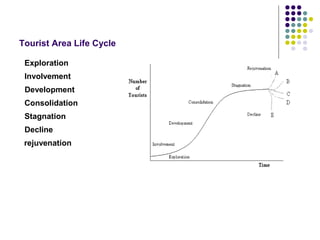
 In 1980, Butler developed a model which shows how any tourist
resort may grow is known asTourist Area Life Cycle
Tourist Area Life Cycle
Exploration
Involvement
Development
Consolidation
Stagnation
Decline
rejuvenation
TALC - Phases
 Exploration
 The new tourist product/s is introduced
 A small number of visitors start coming
 Involvement
 Identifiable tourist season begins to emerge
 Visitor numbers start building
 Impacts start to become apparent
Phases
 Development
 Public policy and investment is required if
destination is to sustain continuing development
 Consolidation
 Visitor numbers continue to increase
 Tourist services are provided by large national or
international companies
 Local operators still play a role
Phases
 Stagnation
 Critical point – decisions have to be made
 Visitor numbers peak
 Visitors attracted by familiarity and extensive
facilities
 Promotion is needed
 Adaptation of products and markets
Phases
 Decline or rejuvenation
 Visitor numbers fall
 Move down market
 More promotion to meet capacity
 Decline or rejuvenation?
Affecting factors on the TALC
 Internal factors
1) uniqueness of resources and attractions
2) Local residents and their attitudes
3) Quality of tourism resource
itself.
4) Management and service.
 External factors
producers, consumers, and
regulating authorities
Applications
 Use this model to study the recovery and its
pattern of life cycle after the bombing in Bali
in 2002 and ,
 The impact to tourism posted by tsunami in
Thailand.
Thank you

Presentation on tourist area life cycle

  • 1.
    PRESENTATION ON Tourist AreaLife Cycle PRESENTED BY- Ritambhara singh
  • 2.
    Tourist Area LifeCycle  The tourism lifecycle theory was firstly proposed in 1963 by the German researcher Christaller, who described the development of tourism through three stages like a common product, namely “discovery, growth and decline”.  In1973, Plog argued the evolution of tourism area from the point of view of tourists’ psychology, which was “allocentric, midcentric, psychocentric”.  In 1975, Doxey also brought forward his opinion as “euphoria, apathy, irritation, antagaonism, destroyed”. His perspective was from the changes of local residents’ attitude towards tourists.  In 1980, Butler developed a model which shows how any tourist resort may grow is known asTourist Area Life Cycle
  • 3.
    Tourist Area LifeCycle Exploration Involvement Development Consolidation Stagnation Decline rejuvenation
  • 4.
    TALC - Phases Exploration  The new tourist product/s is introduced  A small number of visitors start coming  Involvement  Identifiable tourist season begins to emerge  Visitor numbers start building  Impacts start to become apparent
  • 5.
    Phases  Development  Publicpolicy and investment is required if destination is to sustain continuing development  Consolidation  Visitor numbers continue to increase  Tourist services are provided by large national or international companies  Local operators still play a role
  • 6.
    Phases  Stagnation  Criticalpoint – decisions have to be made  Visitor numbers peak  Visitors attracted by familiarity and extensive facilities  Promotion is needed  Adaptation of products and markets
  • 7.
    Phases  Decline orrejuvenation  Visitor numbers fall  Move down market  More promotion to meet capacity  Decline or rejuvenation?
  • 8.
    Affecting factors onthe TALC  Internal factors 1) uniqueness of resources and attractions 2) Local residents and their attitudes 3) Quality of tourism resource itself. 4) Management and service.  External factors producers, consumers, and regulating authorities
  • 9.
    Applications  Use thismodel to study the recovery and its pattern of life cycle after the bombing in Bali in 2002 and ,  The impact to tourism posted by tsunami in Thailand.
  • 10.