1Détente Consultants
Urban tourism
2Détente Consultants
Urban tourism: some key elements
Urban
tourism
A more and
more
popular
tourism
product
A short stay
(max.
3days)
A
destination
not further
than 3 h of
flight
A tourism
product
complemen
tary to the
main
holidays
A product
adapted to
the main
target
clientele of
Romania
It often
represents a
sudden buying
pattern as it is
connected to a
special offer or
an event:
festival, expo,
etc.
The city-breakers:
urban dwellers who
usually travel in
couple without kids
or with friends.
They tend to be from
higher
income/status
social groups
3Détente Consultants
Expectation of urban tourists
Different urban
tourist profiles but
complementary
expectations
A smooth city with a mobility
facilitated by a fluid information
and transportation network
Anxious : waits to be
reassured on the visit
A practical city
A city of happening, but also a city of
memory: rich in heritage but full of
life, thanks to cultural events,
gatherings, etc..
Impulsive : departure
is decided on the
spot, late, by a
special events / desire
A magic city that
surprises
Adventurer : looking
for a geographical
and emotional
wandering
A different city that
promises an
escapade from daily
life
Clever: discovers the
best quality / price
offer
A playful, fun,
recreational city
Looking for a surprising city, fun and practical.
The urban tourist will want to be constantly informed, along his journey to discover this destination.
Profiles for
urban
tourists
4Détente Consultants
Urban tourism: characteristics
Major tendencies in urban tourism:
• Towns and cities try very hard to differentiate themselves, build on
their specificities and attract through intensive event agendas…
• Urban space itself becomes a stage
The town has to
be playful, festive
and sustainable
• Development of tourism related networks of locals: greeters (e.g.:
Berlinezer, etc.)
• The need for tourists to “live the life of a local”, to integrate as full as
possible: “repeaters in Paris”
Encountering and
interacting with
locals
• The increasing interest in visiting and discovering off the beaten
track attractions and places: favelas, contemporary living area, etc.
• New motivations for travelling apart from the traditional cultural-
patrimonial and shopping ones : industrial tourism, natural areas in
urban surroundings, ethnic tourism, etc.
Decentralization
of touristic areas
in the city
5Détente Consultants
Urban tourism: characteristics
New strategies and instruments for marketing the urban tourism destinations and products:
IT instruments
for promotion
and
information
• Multimedia guides,
mobile app.
• Augmented reality
Free and
instantly
available
information
• Before, during and
after the trip
• Mobile websites,
free access to WiFi,
etc.
Web 2.0
• Contents that are
generated by end-
users/tourists are
trusted and
researched
• Social networking
(facebook, twitter,
tripadvisor, …) for
conveying the
message
The
multiplication
of influencers
“many to
many”
• Institutions
• Private providers
• Clients
• Locals
• Networks of
friends and
communities
Territorial
branding
development
• The city branding
combining
tourism,
residential and
economic aspects
is on the increase
• Targeting
international
visibility by
building on local
specificities
6Détente Consultants
Urban renovation/revitalization through tourism: All this was possible because this offer
responds to a increasing demand.
• Often urban tourism (business or leisure) has developed by a strategic work on the offer offer and by inserting it in a
much wider urban strategy (renovation and reconversion of ancient urban areas, economica development, creation
and promotion of local brands, …)
• The following models can be identified:
o Metropolitan areas that have put the tourism industry and events’ management in the center of their strategies : Sevile,
Barcelona, Valencia, Athens, … These have in common the following features :
o Creation of a major event as a launching elements or catalyst (Universal Expo in Seville, the Olympics in Barcelona
or Turin, European Capital of Culture in Galsgow or Lille, …)
o Prioritizing the tourism activity, espacially the urban renovation: reclaiming the port area in Barcelona for leisure
activities, creation of a adventure park in Seville, creation of large touristic equipement (Cité des Sciences,
aquarium, …) in Valencia, urban renovation in Athens, but all with a special emphasis on the touristic and leisure
activity.
o Bilbao targeted the world level architectural creation (Guggenheim Museum) for attracting limelight, creating a
brand and boosting the urban renovation based on the industrial heritage and problems of the town.
o Metropolitan areas who have invested in leisure tourism, meetings and professional events as part of a broader strategy.
Examples:
o Marseille : rebranding the port with its cultural, leisure and touristic activities (150 milion € investments).
o Lyon with a lot of investement in the MICE tourism (palais des congrès,, renovation of Tony Garnier venue,
annoncement of the construction of a expo park), and in the leisure tourism : obtaining a UNESCO World Heritage
Site classification and the creation of a great cultural venue on a department level : the Museum des Confluences.
o Hanover : strategy based on business tourism, especially based on fairs and expositions. The Universal Expo has
obtained important external financing (EU, the German State, etc.).
7Détente Consultants
Urban renovation/revitalization through tourism
• Longtime seen as a self-standing activity, urban tourism is increasingly perceived as an instrument and
facilitator for the creation and promotion of the attractivity of the big towns/cities in Europe.
o Urban tourism remains and important economic sector (industry) but its connections to other
sectors becomes increasingly important : it generates new equipments/infrastructures (museums,
accomodation facilities, restaurants, etc.) with an impact on the quality of life of residents.
o From another perspective the tourism development leverages the cities image and perception: if a
town is viewed as a touristic destination this gives it some of the attributes that makes it attractive
not only for tourists but also for its inhabitants and the business sector as a whole.
o Cities increasingly implement territorial branding strategies that are based on tourism arguments « I
Amsterdam », « Only Lyon », « Be Berlin », the famous « I Love NY ».
• The instruments for the promotion of urban destinations are diversifiying in a decisive way :
o There was usually a barrier between the promotion and communication actions on the one hand and
the tourist information and tourism development ones on the other
o These barriers are becoming irrelevant as the quality of the information a town gives to its visitors
represents nowadays an important element in the seduction and promotion process. The originality
of the tourism products is also a promotion element per se.
o In an urban setting the modernity and interactivity of tourism products/offers is an essential feature
as the urban environment is by its nature is the place of innovation and modernity.
8Détente Consultants
• The main characteristics that enable the evaluation of touristic town are
based on the traditional tourism offer, but the way in which the tourists
discover it has changes dramatically
o Heritage and culture are still the basis of tourism attraction. Yet, the
way in which these are highlighted has evolved considerably:
o The staging of museums and heritage places are playful and
increasingly use IT solutions and tools to guide and inform.
o The discovery tours integrate also this tendancy to integrate new
technology and multimedia instruments.
o The use of virtual reality and augmented reality as a tourism
guiding instrument is still limited due to the high price it entails
o Some themes are extremly popular among urban tourists:
o A rather scientifical culture, especially for men
o The discovery of gardens, British clientele si very attracted to
this theme
o Contemporary art and its place in the public areas, especially
amongst young tourists (with a special interest amongst
northern European young tourists)
Urban renovation/revitalization through tourism
9Détente Consultants
o Event management is also a rapidly evolving feature
oThe event strategy is a key element in creating
tourism attractivity for a town that is in a constant
search of originality. The budgets are big but the
impact is very important.
oOn the other hand having a event agenda that is
balanced and includes an event for each part of the
season is an important aspect for an urban
destination: something has to be happening
everytime in the city!
oThese events are also occasions to discover in a
different manner the traditional heritage of the city:
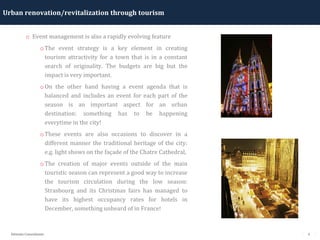
e.g. light shows on the façade of the Chatre Cathedral,
oThe creation of major events outside of the main
touristic season can represent a good way to increase
the tourism circulation during the low season:
Strasbourg and its Christmas fairs has managed to
have its highest occupancy rates for hotels in
December, something unheard of in France!
Urban renovation/revitalization through tourism
10Détente Consultants
Amsterdam
11Détente Consultants
Tourism in Amsterdam
The evolution of foreign tourist’s overnights in Amsterdam
compared to European cities 1987-2007 (index)
o The forecast for hotel capacity in the metropolitan area of
Amsterdam in 2015 is of 13,500 hotel rooms, out of which 9000
will be located inside Amsterdam. The Amsterdam tourism board targets the clienteles
according to their life-cycle.
E.g.: the French clientele is beginning its decline but
the Chinese, Indian and Russian ones are emerging.
12Détente Consultants
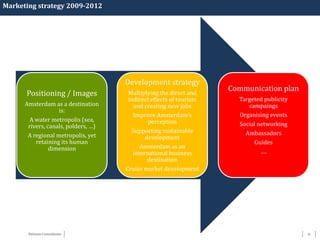
Marketing strategy 2009-2012
Positioning / Images
Amsterdam as a destination
is:
A water metropolis (sea,
rivers, canals, polders, …)
A regional metropolis, yet
retaining its human
dimension
Development strategy
Multiplying the direct and
indirect effects of tourism
and creating new jobs
Improve Amsterdam’s
perception
Supporting sustainable
development
Amsterdam as an
international business
destination
Cruise market development
Communication plan
Targeted publicity
campaings
Organising events
Social networking
Ambassadors
Guides
….
13Détente Consultants
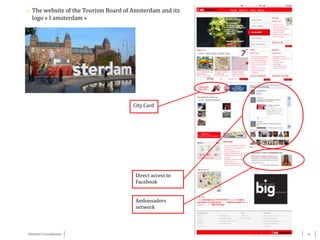
City Card
Direct access to
Facebook
Ambassadors
network
o The website of the Tourism Board of Amsterdam and its
logo « I amsterdam »
14Détente Consultants
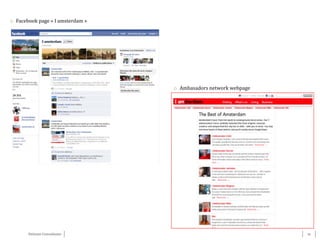
o Facebook page « I amsterdam »
o Ambasadors network webpage
15Détente Consultants
Bilbao
16Détente Consultants
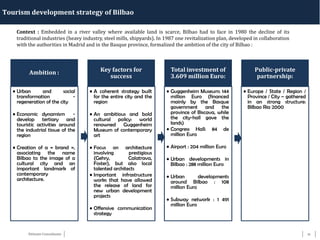
Tourism development strategy of Bilbao
Ambition :
• Urban and social
transformation -
regeneration of the city
• Economic dynamism -
develop tertiary and
touristic activities around
the industrial tissue of the
region
• Creation of a « brand »,
associating the name
Bilbao to the image of a
cultural city and an
important landmark of
contemporary
architecture.
Key factors for
success
• A coherent strategy built
for the entire city and the
region
• An ambitious and bold
cultural policy: world
renowned Guggenheim
Museum of contemporary
art
• Focus on architecture
involving prestigious
(Gehry, Calatrava,
Foster), but also local
talented architects
• Important infrastructure
works that have allowed
the release of land for
new urban development
projects
• Offensive communication
strategy
Total investment of
3.609 million Euro:
• Guggenheim Museum: 144
million Euro (financed
mainly by the Basque
government and the
province of Biscava, while
the city-hall gave the
lands)
• Congress Hall: 84 de
million Euro
• Airport : 204 million Euro
• Urban developments in
Bilbao : 288 million Euro
• Urban developments
around Bilbao : 108
million Euro
• Subway network : 1 491
million Euro
Public-private
partnership:
• Europe / State / Region /
Province / City – gathered
in an strong structure:
Bilbao Ria 2000
Context : Embedded in a river valley where available land is scarce, Bilbao had to face in 1980 the decline of its
traditional industries (heavy industry, steel mills, shipyards). In 1987 one revitalization plan, developed in collaboration
with the authorities in Madrid and in the Basque province, formalized the ambition of the city of Bilbao :
17Détente Consultants
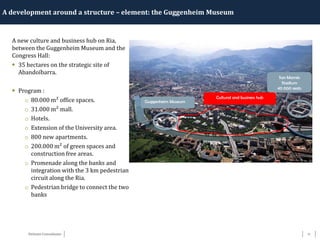
A development around a structure – element: the Guggenheim Museum
Guggenheim Museum
Cultural and business hub
San Mamés
Stadium
40 000 seats
A new culture and business hub on Ria,
between the Guggenheim Museum and the
Congress Hall:
 35 hectares on the strategic site of
Abandoïbarra.
 Program :
o 80.000 m² office spaces.
o 31.000 m² mall.
o Hotels.
o Extension of the University area.
o 800 new apartments.
o 200.000 m² of green spaces and
construction free areas.
o Promenade along the banks and
integration with the 3 km pedestrian
circuit along the Ria.
o Pedestrian bridge to connect the two
banks
18Détente Consultants
Communication
Focus on culture:
World capital of design,
concerts, events,…
19Détente Consultants
Marketing
Direct access to
reservation and
purchase system of
« Bilbao Card »
20Détente Consultants
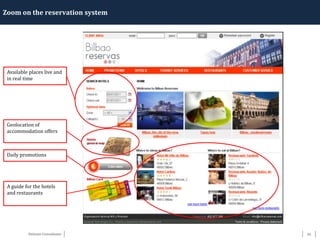
Zoom on the reservation system
Geolocation of
accommodation offers
A guide for the hotels
and restaurants
Available places live and
in real time
Daily promotions
21Détente Consultants
Riga
22Détente Consultants
Riga : city of contrasts
o European Capital of Culture in 2014
o UNESCO city historical centre
o But also, a city where the tourism by
night is developing and becoming more
attractive for numerous English
« staggers »
23Détente Consultants
« Stag Parties » in Riga : main target of Low-cost airlines
Concept
« Stag Parties » (Bachelor parties) : a wild week-end among friends
In order to insure a high occupancy rate for the flights to the Baltic Countries, low-cost airlines, like
Ryanair, don’t hesitate to target groups of young Englishmen who are looking for cheap « Stag Parties ».
Ryanair Riga promotion for English clientele : « Cheap Beer, Cheap girls »
Product
On average, a return flight to Riga costs less than 50 Euro. The Ryanair return flight London –Riga al
costs only 9 Euro (trade agreement between the company and the Latvian authorities)
Other touristic products: Strip Limousine, paint-ball in an old Russian army base, driving an old
Russian car and running it into a tree on a race track …
Between 2004 and 2008 : + 53% « staggers » in Riga
24Détente Consultants
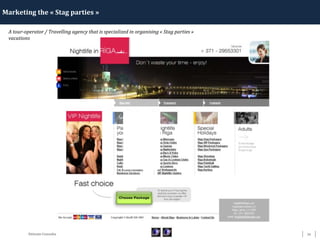
Marketing the « Stag parties »
A tour-operator / Travelling agency that is specialized in organising « Stag parties »
vacations
25Détente Consultants
Official website of the Tourism Office in Riga
Official communication
on the « Blonds’
parade », in the heart of
the City of Beautiful
Women
Presentation of
Riga’s patrimony

Presentation urban tourism

  • 1.
  • 2.
    2Détente Consultants Urban tourism:some key elements Urban tourism A more and more popular tourism product A short stay (max. 3days) A destination not further than 3 h of flight A tourism product complemen tary to the main holidays A product adapted to the main target clientele of Romania It often represents a sudden buying pattern as it is connected to a special offer or an event: festival, expo, etc. The city-breakers: urban dwellers who usually travel in couple without kids or with friends. They tend to be from higher income/status social groups
  • 3.
    3Détente Consultants Expectation ofurban tourists Different urban tourist profiles but complementary expectations A smooth city with a mobility facilitated by a fluid information and transportation network Anxious : waits to be reassured on the visit A practical city A city of happening, but also a city of memory: rich in heritage but full of life, thanks to cultural events, gatherings, etc.. Impulsive : departure is decided on the spot, late, by a special events / desire A magic city that surprises Adventurer : looking for a geographical and emotional wandering A different city that promises an escapade from daily life Clever: discovers the best quality / price offer A playful, fun, recreational city Looking for a surprising city, fun and practical. The urban tourist will want to be constantly informed, along his journey to discover this destination. Profiles for urban tourists
  • 4.
    4Détente Consultants Urban tourism:characteristics Major tendencies in urban tourism: • Towns and cities try very hard to differentiate themselves, build on their specificities and attract through intensive event agendas… • Urban space itself becomes a stage The town has to be playful, festive and sustainable • Development of tourism related networks of locals: greeters (e.g.: Berlinezer, etc.) • The need for tourists to “live the life of a local”, to integrate as full as possible: “repeaters in Paris” Encountering and interacting with locals • The increasing interest in visiting and discovering off the beaten track attractions and places: favelas, contemporary living area, etc. • New motivations for travelling apart from the traditional cultural- patrimonial and shopping ones : industrial tourism, natural areas in urban surroundings, ethnic tourism, etc. Decentralization of touristic areas in the city
  • 5.
    5Détente Consultants Urban tourism:characteristics New strategies and instruments for marketing the urban tourism destinations and products: IT instruments for promotion and information • Multimedia guides, mobile app. • Augmented reality Free and instantly available information • Before, during and after the trip • Mobile websites, free access to WiFi, etc. Web 2.0 • Contents that are generated by end- users/tourists are trusted and researched • Social networking (facebook, twitter, tripadvisor, …) for conveying the message The multiplication of influencers “many to many” • Institutions • Private providers • Clients • Locals • Networks of friends and communities Territorial branding development • The city branding combining tourism, residential and economic aspects is on the increase • Targeting international visibility by building on local specificities
  • 6.
    6Détente Consultants Urban renovation/revitalizationthrough tourism: All this was possible because this offer responds to a increasing demand. • Often urban tourism (business or leisure) has developed by a strategic work on the offer offer and by inserting it in a much wider urban strategy (renovation and reconversion of ancient urban areas, economica development, creation and promotion of local brands, …) • The following models can be identified: o Metropolitan areas that have put the tourism industry and events’ management in the center of their strategies : Sevile, Barcelona, Valencia, Athens, … These have in common the following features : o Creation of a major event as a launching elements or catalyst (Universal Expo in Seville, the Olympics in Barcelona or Turin, European Capital of Culture in Galsgow or Lille, …) o Prioritizing the tourism activity, espacially the urban renovation: reclaiming the port area in Barcelona for leisure activities, creation of a adventure park in Seville, creation of large touristic equipement (Cité des Sciences, aquarium, …) in Valencia, urban renovation in Athens, but all with a special emphasis on the touristic and leisure activity. o Bilbao targeted the world level architectural creation (Guggenheim Museum) for attracting limelight, creating a brand and boosting the urban renovation based on the industrial heritage and problems of the town. o Metropolitan areas who have invested in leisure tourism, meetings and professional events as part of a broader strategy. Examples: o Marseille : rebranding the port with its cultural, leisure and touristic activities (150 milion € investments). o Lyon with a lot of investement in the MICE tourism (palais des congrès,, renovation of Tony Garnier venue, annoncement of the construction of a expo park), and in the leisure tourism : obtaining a UNESCO World Heritage Site classification and the creation of a great cultural venue on a department level : the Museum des Confluences. o Hanover : strategy based on business tourism, especially based on fairs and expositions. The Universal Expo has obtained important external financing (EU, the German State, etc.).
  • 7.
    7Détente Consultants Urban renovation/revitalizationthrough tourism • Longtime seen as a self-standing activity, urban tourism is increasingly perceived as an instrument and facilitator for the creation and promotion of the attractivity of the big towns/cities in Europe. o Urban tourism remains and important economic sector (industry) but its connections to other sectors becomes increasingly important : it generates new equipments/infrastructures (museums, accomodation facilities, restaurants, etc.) with an impact on the quality of life of residents. o From another perspective the tourism development leverages the cities image and perception: if a town is viewed as a touristic destination this gives it some of the attributes that makes it attractive not only for tourists but also for its inhabitants and the business sector as a whole. o Cities increasingly implement territorial branding strategies that are based on tourism arguments « I Amsterdam », « Only Lyon », « Be Berlin », the famous « I Love NY ». • The instruments for the promotion of urban destinations are diversifiying in a decisive way : o There was usually a barrier between the promotion and communication actions on the one hand and the tourist information and tourism development ones on the other o These barriers are becoming irrelevant as the quality of the information a town gives to its visitors represents nowadays an important element in the seduction and promotion process. The originality of the tourism products is also a promotion element per se. o In an urban setting the modernity and interactivity of tourism products/offers is an essential feature as the urban environment is by its nature is the place of innovation and modernity.
  • 8.
    8Détente Consultants • Themain characteristics that enable the evaluation of touristic town are based on the traditional tourism offer, but the way in which the tourists discover it has changes dramatically o Heritage and culture are still the basis of tourism attraction. Yet, the way in which these are highlighted has evolved considerably: o The staging of museums and heritage places are playful and increasingly use IT solutions and tools to guide and inform. o The discovery tours integrate also this tendancy to integrate new technology and multimedia instruments. o The use of virtual reality and augmented reality as a tourism guiding instrument is still limited due to the high price it entails o Some themes are extremly popular among urban tourists: o A rather scientifical culture, especially for men o The discovery of gardens, British clientele si very attracted to this theme o Contemporary art and its place in the public areas, especially amongst young tourists (with a special interest amongst northern European young tourists) Urban renovation/revitalization through tourism
  • 9.
    9Détente Consultants o Eventmanagement is also a rapidly evolving feature oThe event strategy is a key element in creating tourism attractivity for a town that is in a constant search of originality. The budgets are big but the impact is very important. oOn the other hand having a event agenda that is balanced and includes an event for each part of the season is an important aspect for an urban destination: something has to be happening everytime in the city! oThese events are also occasions to discover in a different manner the traditional heritage of the city: e.g. light shows on the façade of the Chatre Cathedral, oThe creation of major events outside of the main touristic season can represent a good way to increase the tourism circulation during the low season: Strasbourg and its Christmas fairs has managed to have its highest occupancy rates for hotels in December, something unheard of in France! Urban renovation/revitalization through tourism
  • 10.
  • 11.
    11Détente Consultants Tourism inAmsterdam The evolution of foreign tourist’s overnights in Amsterdam compared to European cities 1987-2007 (index) o The forecast for hotel capacity in the metropolitan area of Amsterdam in 2015 is of 13,500 hotel rooms, out of which 9000 will be located inside Amsterdam. The Amsterdam tourism board targets the clienteles according to their life-cycle. E.g.: the French clientele is beginning its decline but the Chinese, Indian and Russian ones are emerging.
  • 12.
    12Détente Consultants Marketing strategy2009-2012 Positioning / Images Amsterdam as a destination is: A water metropolis (sea, rivers, canals, polders, …) A regional metropolis, yet retaining its human dimension Development strategy Multiplying the direct and indirect effects of tourism and creating new jobs Improve Amsterdam’s perception Supporting sustainable development Amsterdam as an international business destination Cruise market development Communication plan Targeted publicity campaings Organising events Social networking Ambassadors Guides ….
  • 13.
    13Détente Consultants City Card Directaccess to Facebook Ambassadors network o The website of the Tourism Board of Amsterdam and its logo « I amsterdam »
  • 14.
    14Détente Consultants o Facebookpage « I amsterdam » o Ambasadors network webpage
  • 15.
  • 16.
    16Détente Consultants Tourism developmentstrategy of Bilbao Ambition : • Urban and social transformation - regeneration of the city • Economic dynamism - develop tertiary and touristic activities around the industrial tissue of the region • Creation of a « brand », associating the name Bilbao to the image of a cultural city and an important landmark of contemporary architecture. Key factors for success • A coherent strategy built for the entire city and the region • An ambitious and bold cultural policy: world renowned Guggenheim Museum of contemporary art • Focus on architecture involving prestigious (Gehry, Calatrava, Foster), but also local talented architects • Important infrastructure works that have allowed the release of land for new urban development projects • Offensive communication strategy Total investment of 3.609 million Euro: • Guggenheim Museum: 144 million Euro (financed mainly by the Basque government and the province of Biscava, while the city-hall gave the lands) • Congress Hall: 84 de million Euro • Airport : 204 million Euro • Urban developments in Bilbao : 288 million Euro • Urban developments around Bilbao : 108 million Euro • Subway network : 1 491 million Euro Public-private partnership: • Europe / State / Region / Province / City – gathered in an strong structure: Bilbao Ria 2000 Context : Embedded in a river valley where available land is scarce, Bilbao had to face in 1980 the decline of its traditional industries (heavy industry, steel mills, shipyards). In 1987 one revitalization plan, developed in collaboration with the authorities in Madrid and in the Basque province, formalized the ambition of the city of Bilbao :
  • 17.
    17Détente Consultants A developmentaround a structure – element: the Guggenheim Museum Guggenheim Museum Cultural and business hub San Mamés Stadium 40 000 seats A new culture and business hub on Ria, between the Guggenheim Museum and the Congress Hall:  35 hectares on the strategic site of Abandoïbarra.  Program : o 80.000 m² office spaces. o 31.000 m² mall. o Hotels. o Extension of the University area. o 800 new apartments. o 200.000 m² of green spaces and construction free areas. o Promenade along the banks and integration with the 3 km pedestrian circuit along the Ria. o Pedestrian bridge to connect the two banks
  • 18.
    18Détente Consultants Communication Focus onculture: World capital of design, concerts, events,…
  • 19.
    19Détente Consultants Marketing Direct accessto reservation and purchase system of « Bilbao Card »
  • 20.
    20Détente Consultants Zoom onthe reservation system Geolocation of accommodation offers A guide for the hotels and restaurants Available places live and in real time Daily promotions
  • 21.
  • 22.
    22Détente Consultants Riga :city of contrasts o European Capital of Culture in 2014 o UNESCO city historical centre o But also, a city where the tourism by night is developing and becoming more attractive for numerous English « staggers »
  • 23.
    23Détente Consultants « StagParties » in Riga : main target of Low-cost airlines Concept « Stag Parties » (Bachelor parties) : a wild week-end among friends In order to insure a high occupancy rate for the flights to the Baltic Countries, low-cost airlines, like Ryanair, don’t hesitate to target groups of young Englishmen who are looking for cheap « Stag Parties ». Ryanair Riga promotion for English clientele : « Cheap Beer, Cheap girls » Product On average, a return flight to Riga costs less than 50 Euro. The Ryanair return flight London –Riga al costs only 9 Euro (trade agreement between the company and the Latvian authorities) Other touristic products: Strip Limousine, paint-ball in an old Russian army base, driving an old Russian car and running it into a tree on a race track … Between 2004 and 2008 : + 53% « staggers » in Riga
  • 24.
    24Détente Consultants Marketing the« Stag parties » A tour-operator / Travelling agency that is specialized in organising « Stag parties » vacations
  • 25.
    25Détente Consultants Official websiteof the Tourism Office in Riga Official communication on the « Blonds’ parade », in the heart of the City of Beautiful Women Presentation of Riga’s patrimony