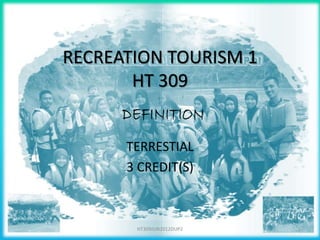
RECREATION TOURISM 1
HT 309
TERRESTIAL
3 CREDIT(S)

HT309JUN2012DUP2

1
HT309JUN2012DUP2

2
SYNOPSIS
• Expose the students to terrestrial –
based recreation activities within the
tourism industry
• Develop competencies in the overall
operation and management of
terrestrial based recreational activities.
• Conduct the activities based on
international safety and risk
management plan standards
HT309JUN2012DUP2

3
Learning Outcomes
student should be able to:1. The concept terrestrial based
recreation and its contribution to
tourism industry
2. Tourism planning , technical
operation management

HT309JUN2012DUP2

4
Learning Outcomes
student should be able to:• The operation and evaluation of terrestrial
recreational activities for tourist and
customers
• Effectives communication in explaining
recreational activities rule and safety
procedures
• Risk management plan in designing and
conducting terrestrial based recreational
activities
HT309JUN2012DUP2

5
Foundation of
recreational
tourism
HT309JUN2012DUP2

6
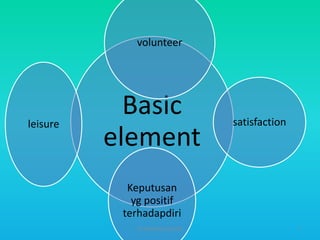
volunteer

leisure

Basic
element

satisfaction

Keputusan
yg positif
terhadapdiri
HT309JUN2012DUP2

7
HT309JUN2012DUP2

8
What is recreation and leisure?

HT309JUN2012DUP2

9
What is recreation and leisure?
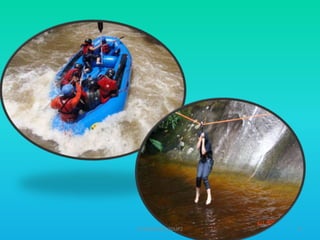
• Recreation is about activities, pastimes, and
experiences which are freely chosen. They are usually
undertaken in free time and produce feelings of well
being, fulfillment, enjoyment, relaxation and
satisfaction.

• They are opportunities to express creativity, achieve
and master new things and feel good about doing so.
• Community based recreation offers an opportunity to
meet people while enjoying a range of social, cultural
or physical activities.

HT309JUN2012DUP2

10
Recreational tourism

HT309JUN2012DUP2

11
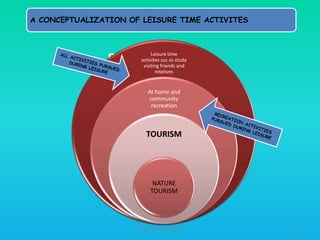
A CONCEPTUALIZATION OF LEISURE TIME ACTIVITES

Leisure time
activites suc as study
visiting friends and
relatives

At home and
community
recreation

TOURISM

NATURE
TOURISM

HT309JUN2012DUP2

12
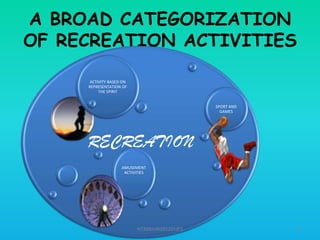
A BROAD CATEGORIZATION
OF RECREATION ACTIVITIES
ACTIVITY BASED ON
REPRESENTATION OF
THE SPIRIT
SPORT AND
GAMES

RECREATION
AMUSEMENT
ACTIVITIES

HT309JUN2012DUP2

13
Future Trends

HT309JUN2012DUP2

14
HT309JUN2012DUP2

15
Outdoor recreation
Definition:

recreation-

refreshment our mind and
body after work hard
through activities.
HT309JUN2012DUP2

16
Definition:

•Outdoor- located in, done in

opened air activities that organized at
the open air such as camping

HT309JUN2012DUP2

17
DEFINITION

•Outdoor recreation
• Organized free time activities that are
participated in for their own sake and
have interaction between participant
and elements of nature. (IBRAHIM
AND CORDES, 1986)

HT309JUN2012DUP2

18
• DEFINITION

LeisureA block unoccupied time often
referred to as a spare time or
free time.

HT309JUN2012DUP2

19
HT309JUN2012DUP2

20
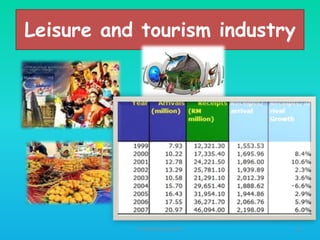
Leisure and tourism industry

HT309JUN2012DUP2

21
Development and demand

Why people recreate or
travel???

HT309JUN2012DUP2

22
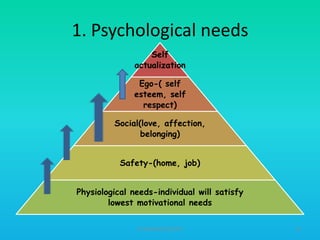
1. Psychological needs
Self
actualization
Ego-( self
esteem, self
respect)
Social(love, affection,
belonging)
Safety-(home, job)
Physiological needs-individual will satisfy
lowest motivational needs
HT309JUN2012DUP2

23
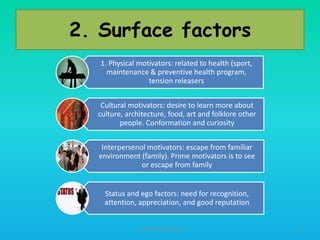
2. Surface factors
1. Physical motivators: related to health (sport,
maintenance & preventive health program,
tension releasers
Cultural motivators: desire to learn more about
culture, architecture, food, art and folklore other
people. Conformation and curiosity
Interpersenol motivators: escape from familiar
environment (family). Prime motivators is to see
or escape from family

Status and ego factors: need for recognition,
attention, appreciation, and good reputation
HT309JUN2012DUP2

24
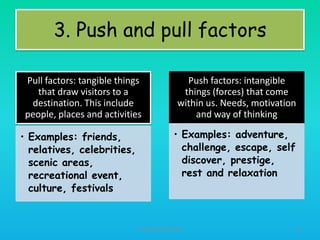
3. Push and pull factors
Pull factors: tangible things
that draw visitors to a
destination. This include
people, places and activities
• Examples: friends,
relatives, celebrities,
scenic areas,
recreational event,
culture, festivals

Push factors: intangible
things (forces) that come
within us. Needs, motivation
and way of thinking
• Examples: adventure,
challenge, escape, self
discover, prestige,
rest and relaxation

HT309JUN2012DUP2

25
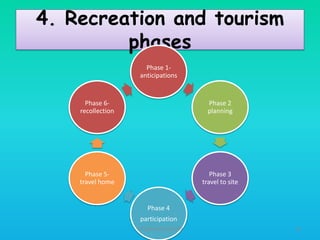
4. Recreation and tourism
phases
Phase 1anticipations

Phase 6recollection

Phase 2
planning

Phase 5travel home

Phase 3
travel to site

Phase 4
participation
HT309JUN2012DUP2

26
Types and need s of
recreation activities
Importance of Recreation??
@BENEFITS??
Why is recreation and leisure
important?
HT309JUN2012DUP2

27
HT309JUN2012DUP2

28
Importance of Recreation??
• PHYSICOLOGY-Recreation is like a rain shower
during the days of scorching heat. It is like a
ray of moonlight in the dreadful darknessEmotional balance (balance between work and
play)-

• PHYSICAL AND HEALTH MENTENANCEResearch has shown that recreation on a daily
basis reduces risks of diabetes and
hypertension, enhances physical and mental
health and improves the quality of life.
• feel fresh and relaxed
HT309JUN2012DUP2

29
• Recreation brings you close to the
nature.
• enhancement of your interpersonal and
intrapersonal skills
• physical health and maintenance
HT309JUN2012DUP2

30
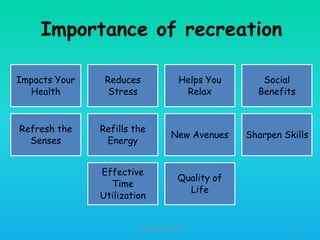
Importance of recreation
Impacts Your
Health

Reduces
Stress

Helps You
Relax

Social
Benefits

Refresh the
Senses

Refills the
Energy

New Avenues

Sharpen Skills

Effective
Time
Utilization

Quality of
Life

HT309JUN2012DUP2

31
HT309JUN2012DUP2

32
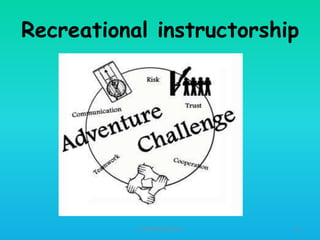
Recreational instructorship

HT309JUN2012DUP2

33
HT309JUN2012DUP2

34
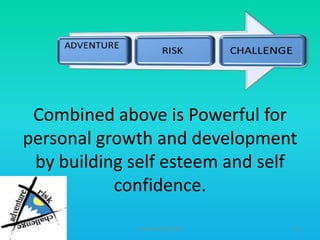
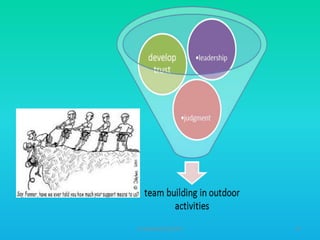
Combined above is Powerful for
personal growth and development
by building self esteem and self
confidence.
HT309JUN2012DUP2

35
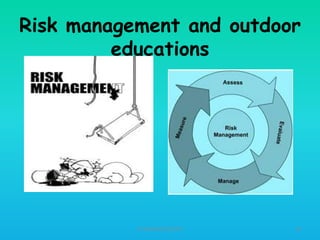
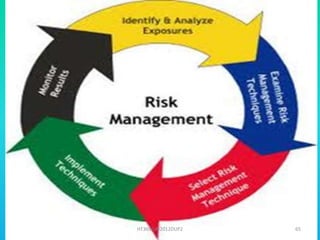
Risk management and outdoor
educations

HT309JUN2012DUP2

36
HT309JUN2012DUP2

37
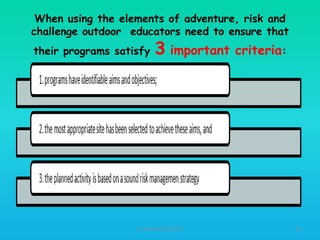
When using the elements of adventure, risk and
challenge outdoor educators need to ensure that
their programs satisfy

3 important

HT309JUN2012DUP2

criteria:

38
Managing risk
• Managing risk in outdoor education hinges on the reduction of the degree
of real risk to a level considered acceptable to everyday exposure.
Understandably, this aim may be an objective of any outdoor program
where risk of injury inherent. Safety, is a paramount consideration,

however, it cannot be guaranteed.
This because there are many factors over which little or no control
can be exerted (eg. Sudden rock fall, gear failure, human error, or
inclement weather.

HT309JUN2012DUP2

39
• Risk management planning is an attempt to
identify particular hazards of an injury (or
death to participants (Ewert 1983).

HT309JUN2012DUP2

40
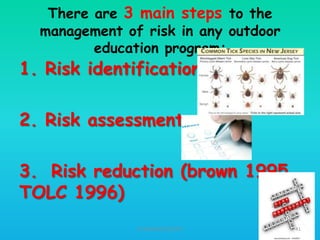
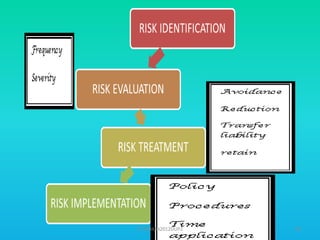
There are 3 main steps to the
management of risk in any outdoor
education program;

1. Risk identification
2. Risk assessment

3. Risk reduction (brown 1995,
TOLC 1996)
HT309JUN2012DUP2

41
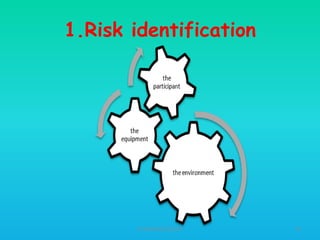
1.Risk identification

HT309JUN2012DUP2

42
2.Risk assessment
• The degree of risk and the probability of an
incident relates to the assessment of risk. to
assess the level of risk in an outdoor
education program will require an evaluation
of the amount of risk identified and the like
hood of an incident or accident occurring
(TOLC 1996).

HT309JUN2012DUP2

43
3.Risk reduction
• The aim of risk reduction is to implement
range of strategies that will minimize risk to an
acceptable level in attempt to prevent
incidents occurring.

HT309JUN2012DUP2

44
A range of strategies appropriate for
reducing risk in outdoor education may
include.
a)

Safety policy guidelines-being familiar with any

workplace, health and safety guidelines….

b)

Risk disclosure-by outlining the nature activity to participant

(and their parents/guardians if under 18 year of age)….

c)

Knowing the participants-ice breakers trust

activities….

d) Staff training-qualified staff
e) Equipment selection, inspection and
maintenance-using approved gear…
HT309JUN2012DUP2

45
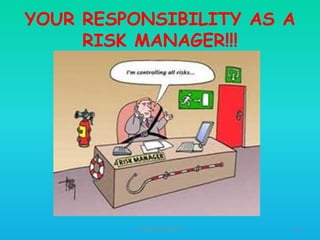
YOUR RESPONSIBILITY AS A
RISK MANAGER!!!

HT309JUN2012DUP2

46
1.

Establish Public Relations. Let people know about your

4.

Insist on Good & continuous Maintenance. Routine,

5.

Establish accident policies. What procedure you/staff

6.

Keep accident report.

risk management effort. It is evidence of your responsibility and
accountability
2.
Identify and correct hazardous condition. Area and
facilities should be analyzed on regular basis. If possible, hazards
should be correct! If not, warned users about them or area or facility
should be discontinued
3.
Provide in service education & training. To enhance
skill and level of safe environment. CPR accident reporting, agency
policies understanding, emergency procedures (What to do first)

schedule records of maintenance and inspection

required to perform in case and accident? Policies and procedures should
clearly defined and accessible by all staff.

HT309JUN2012DUP2

47
HT309JUN2012DUP2

48
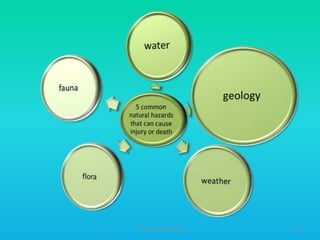
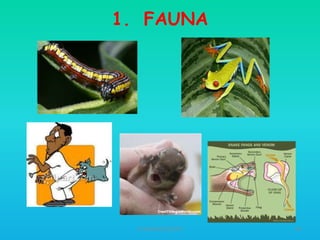
1. FAUNA

HT309JUN2012DUP2

49
Dua Pelajar Cedera Disengat Tebuan Ketika
Menuruni Gunung Korbu
• IPOH: Dua pelajar Sekolah Menengah Tunku
Abdul Rahman, Ipoh, cedera akibat disengat
tebuan ketika mereka dalam perjalanan pulang
dari Gunung Korbu, dekat Kuala Kangsar, kira-kira
60km dari sini, Sabtu.-(Berita Harian
25 Jul 2011)
HT309JUN2012DUP2

50
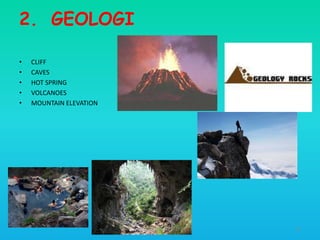
2. GEOLOGI
•
•
•
•
•

CLIFF
CAVES
HOT SPRING
VOLCANOES
MOUNTAIN ELEVATION

HT309JUN2012DUP2

51
LEDANG 29 Sept. - Tindakan seorang lelaki yang bersungguhsungguh mengajak isteri yang baru dikahwininya awal bulan
ini dan seorang adik lelakinya mandi-manda di Air Terjun
Asahan di Jasin, Melaka, berakhir dengan dia mati lemas hari
ini.
Dalam kejadian kira-kira pada pukul 10.20 pagi itu, mangsa,
Mohd. Khidil Ismeet Anuar, 25, lemas ketika cuba
menyelamatkan adik bongsunya, Mohd. Aliff Najmi, 13, yang
tergelincir ke dalam kawasan air terjun berkenaan.
Artikel Penuh:
http://www.utusan.com.my/utusan/Jenayah/20130930/je_03
/Lelaki-baru-kahwin-mati-lemas-ketika-selamatkan-adikbongsu#ixzz2nb680ujm
© Utusan Melayu (M) Bhd
HT309JUN2012DUP2

52
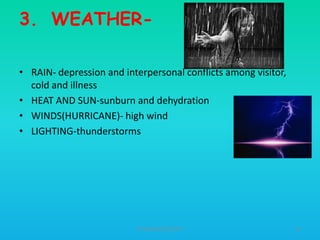
3. WEATHER• RAIN- depression and interpersonal conflicts among visitor,
cold and illness
• HEAT AND SUN-sunburn and dehydration
• WINDS(HURRICANE)- high wind
• LIGHTING-thunderstorms

HT309JUN2012DUP2

53
REMBAU – “Saya tidak dengar bunyi petir, tetapi saya nampak
cahaya yang seribu kali lebih terang daripada cahaya kamera,”
kata salah seorang jurupandu Gunung Datuk yang hanya ingin
dikenali sebagai Din, 30-an, ketika ditemui di kaki Gunung
Datuk, dekat sini, malam kelmarin.

HT309JUN2012DUP2

54
4. FLORA• TOXIC VEGETATION- rengas and others
poisonous shrub.
• BARRIERS AND ORNAMENTAL PLANTS- cactus,
fig, thorn will restrict visitors movement
• TREE FAILURE MECHANICAL- shallow rootingdamage the property
• MECHANICAL TREE FAILURE- insect and trees
disease, high winds, soil condition
HT309JUN2012DUP2

55
5. WATER
• DROWNING-swimming is the most popular cause of death
• TIDAL CONDITION-rip tides and normal ocean tides
(drowning) Visitor usually unaware of riptides
• WATER TEMPERATURE-hypothermia
• CURRENTS – oceans, lakes, stream and lakes-restrict
swimmer/boater to reach safety area, drown over
waterfall, forced against rock and pulled under the water
• FLOODS AND WATER FLUCTUATION- based on drastic rain
downpour and seasonal changes
• NATURAL OBSTACLE IN WATER- logs, slick rock
• WATERFALL AND RAPIDS- undertows, whirlpools

HT309JUN2012DUP2

56
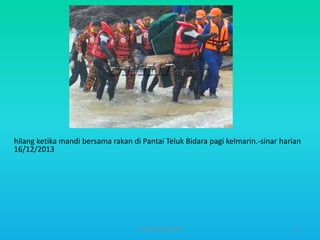
hilang ketika mandi bersama rakan di Pantai Teluk Bidara pagi kelmarin.-sinar harian
16/12/2013

HT309JUN2012DUP2

57
Other type of risk Personnel risk
• 1. Human behavior-exploratory behavior, ego, fighting,
selfish
• 2. Employee termination-hasil ketidak seimbangan akibat
dibuang kerja
• 3. Sexual harassment---you are too cute!!
• 4. Discrimination- race, gender, marital status, disabilities
• 5. Employee safety and health aware with human needs
hierarchical and their exposure affect to outdoor
environment
• 6. Seasonal and part time employees-contract, part time
guide
• 7. Disabilities act
HT309JUN2012DUP2

58
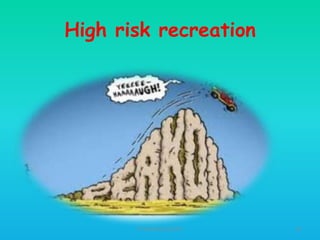
High risk recreation

HT309JUN2012DUP2

59
High risk recreation should not be eliminated, but participants
should be warned of the danger

Benefit of high risk: increased self confident, leadership
development, teamwork, self esteem, overcoming failure, increased peer trust and
group problem solving, youth crime prevention programs, criminal rehabilitation

.

Most popular is a rope activity which includes rope course,
rope ladder, suspended rope, swinging rope, slider web ropes, climbing
wall and balance beams. All rope activities are capable of causing serious
injuries.

HT309JUN2012DUP2

60
Other high risk outdoor recreation
activities and some inherent danger of
participation:

White water rafting, canoeing, kayaking and rafting: turbulent water injuries,
drowning, hypothermia

Mountain climbing-equipment failure, falling, land slides, dehydration,
falling rock and tree (branch)


Cave exploration-equipment failure, lost in cave, falling, lack of medical aid


Wilderness use (camping, expedition, trekking)-dehydration, lack of medical
aid and communication, animal attack, losing direction, falling, hit by trees, broken
legs.

HT309JUN2012DUP2

61
• High risk require extraordinary care,
training and specialized equipment. For
examples. White water canoeists must develop a
higher level canoeing skill, wear protective life jacket
and know the dynamics and hydraulic of fast flowing
rivers

HT309JUN2012DUP2

62
• Avoid “home made and designed”
equipment facilities. All facilities must design,
installed or check by those expertise and experience
in such matters provider, seller and manufacturer.

• Instructor should teach a student the
proper way to handle the risk in order to
minimize the potential of injury.

• Give attention to the mental and
psychological readiness of participant must determine
general health, cardiovascular and strength

HT309JUN2012DUP2

63
• Warning should be clearly and
repeat in high risk situation.
Always give how to instruction before starting
an activity. No person should be forced or
pressured into participation.

HT309JUN2012DUP2

64
HT309JUN2012DUP2

65
HT309JUN2012DUP2

66

Recreation tourism 1

  • 1.
    RECREATION TOURISM 1 HT309 TERRESTIAL 3 CREDIT(S) HT309JUN2012DUP2 1
  • 2.
  • 3.
    SYNOPSIS • Expose thestudents to terrestrial – based recreation activities within the tourism industry • Develop competencies in the overall operation and management of terrestrial based recreational activities. • Conduct the activities based on international safety and risk management plan standards HT309JUN2012DUP2 3
  • 4.
    Learning Outcomes student shouldbe able to:1. The concept terrestrial based recreation and its contribution to tourism industry 2. Tourism planning , technical operation management HT309JUN2012DUP2 4
  • 5.
    Learning Outcomes student shouldbe able to:• The operation and evaluation of terrestrial recreational activities for tourist and customers • Effectives communication in explaining recreational activities rule and safety procedures • Risk management plan in designing and conducting terrestrial based recreational activities HT309JUN2012DUP2 5
  • 6.
  • 7.
  • 8.
  • 9.
    What is recreationand leisure? HT309JUN2012DUP2 9
  • 10.
    What is recreationand leisure? • Recreation is about activities, pastimes, and experiences which are freely chosen. They are usually undertaken in free time and produce feelings of well being, fulfillment, enjoyment, relaxation and satisfaction. • They are opportunities to express creativity, achieve and master new things and feel good about doing so. • Community based recreation offers an opportunity to meet people while enjoying a range of social, cultural or physical activities. HT309JUN2012DUP2 10
  • 11.
  • 12.
    A CONCEPTUALIZATION OFLEISURE TIME ACTIVITES Leisure time activites suc as study visiting friends and relatives At home and community recreation TOURISM NATURE TOURISM HT309JUN2012DUP2 12
  • 13.
    A BROAD CATEGORIZATION OFRECREATION ACTIVITIES ACTIVITY BASED ON REPRESENTATION OF THE SPIRIT SPORT AND GAMES RECREATION AMUSEMENT ACTIVITIES HT309JUN2012DUP2 13
  • 14.
  • 15.
  • 16.
    Outdoor recreation Definition: recreation- refreshment ourmind and body after work hard through activities. HT309JUN2012DUP2 16
  • 17.
    Definition: •Outdoor- located in,done in opened air activities that organized at the open air such as camping HT309JUN2012DUP2 17
  • 18.
    DEFINITION •Outdoor recreation • Organizedfree time activities that are participated in for their own sake and have interaction between participant and elements of nature. (IBRAHIM AND CORDES, 1986) HT309JUN2012DUP2 18
  • 19.
    • DEFINITION LeisureA blockunoccupied time often referred to as a spare time or free time. HT309JUN2012DUP2 19
  • 20.
  • 21.
    Leisure and tourismindustry HT309JUN2012DUP2 21
  • 22.
    Development and demand Whypeople recreate or travel??? HT309JUN2012DUP2 22
  • 23.
    1. Psychological needs Self actualization Ego-(self esteem, self respect) Social(love, affection, belonging) Safety-(home, job) Physiological needs-individual will satisfy lowest motivational needs HT309JUN2012DUP2 23
  • 24.
    2. Surface factors 1.Physical motivators: related to health (sport, maintenance & preventive health program, tension releasers Cultural motivators: desire to learn more about culture, architecture, food, art and folklore other people. Conformation and curiosity Interpersenol motivators: escape from familiar environment (family). Prime motivators is to see or escape from family Status and ego factors: need for recognition, attention, appreciation, and good reputation HT309JUN2012DUP2 24
  • 25.
    3. Push andpull factors Pull factors: tangible things that draw visitors to a destination. This include people, places and activities • Examples: friends, relatives, celebrities, scenic areas, recreational event, culture, festivals Push factors: intangible things (forces) that come within us. Needs, motivation and way of thinking • Examples: adventure, challenge, escape, self discover, prestige, rest and relaxation HT309JUN2012DUP2 25
  • 26.
    4. Recreation andtourism phases Phase 1anticipations Phase 6recollection Phase 2 planning Phase 5travel home Phase 3 travel to site Phase 4 participation HT309JUN2012DUP2 26
  • 27.
    Types and needs of recreation activities Importance of Recreation?? @BENEFITS?? Why is recreation and leisure important? HT309JUN2012DUP2 27
  • 28.
  • 29.
    Importance of Recreation?? •PHYSICOLOGY-Recreation is like a rain shower during the days of scorching heat. It is like a ray of moonlight in the dreadful darknessEmotional balance (balance between work and play)- • PHYSICAL AND HEALTH MENTENANCEResearch has shown that recreation on a daily basis reduces risks of diabetes and hypertension, enhances physical and mental health and improves the quality of life. • feel fresh and relaxed HT309JUN2012DUP2 29
  • 30.
    • Recreation bringsyou close to the nature. • enhancement of your interpersonal and intrapersonal skills • physical health and maintenance HT309JUN2012DUP2 30
  • 31.
    Importance of recreation ImpactsYour Health Reduces Stress Helps You Relax Social Benefits Refresh the Senses Refills the Energy New Avenues Sharpen Skills Effective Time Utilization Quality of Life HT309JUN2012DUP2 31
  • 32.
  • 33.
  • 34.
  • 35.
    Combined above isPowerful for personal growth and development by building self esteem and self confidence. HT309JUN2012DUP2 35
  • 36.
    Risk management andoutdoor educations HT309JUN2012DUP2 36
  • 37.
  • 38.
    When using theelements of adventure, risk and challenge outdoor educators need to ensure that their programs satisfy 3 important HT309JUN2012DUP2 criteria: 38
  • 39.
    Managing risk • Managingrisk in outdoor education hinges on the reduction of the degree of real risk to a level considered acceptable to everyday exposure. Understandably, this aim may be an objective of any outdoor program where risk of injury inherent. Safety, is a paramount consideration, however, it cannot be guaranteed. This because there are many factors over which little or no control can be exerted (eg. Sudden rock fall, gear failure, human error, or inclement weather. HT309JUN2012DUP2 39
  • 40.
    • Risk managementplanning is an attempt to identify particular hazards of an injury (or death to participants (Ewert 1983). HT309JUN2012DUP2 40
  • 41.
    There are 3main steps to the management of risk in any outdoor education program; 1. Risk identification 2. Risk assessment 3. Risk reduction (brown 1995, TOLC 1996) HT309JUN2012DUP2 41
  • 42.
  • 43.
    2.Risk assessment • Thedegree of risk and the probability of an incident relates to the assessment of risk. to assess the level of risk in an outdoor education program will require an evaluation of the amount of risk identified and the like hood of an incident or accident occurring (TOLC 1996). HT309JUN2012DUP2 43
  • 44.
    3.Risk reduction • Theaim of risk reduction is to implement range of strategies that will minimize risk to an acceptable level in attempt to prevent incidents occurring. HT309JUN2012DUP2 44
  • 45.
    A range ofstrategies appropriate for reducing risk in outdoor education may include. a) Safety policy guidelines-being familiar with any workplace, health and safety guidelines…. b) Risk disclosure-by outlining the nature activity to participant (and their parents/guardians if under 18 year of age)…. c) Knowing the participants-ice breakers trust activities…. d) Staff training-qualified staff e) Equipment selection, inspection and maintenance-using approved gear… HT309JUN2012DUP2 45
  • 46.
    YOUR RESPONSIBILITY ASA RISK MANAGER!!! HT309JUN2012DUP2 46
  • 47.
    1. Establish Public Relations.Let people know about your 4. Insist on Good & continuous Maintenance. Routine, 5. Establish accident policies. What procedure you/staff 6. Keep accident report. risk management effort. It is evidence of your responsibility and accountability 2. Identify and correct hazardous condition. Area and facilities should be analyzed on regular basis. If possible, hazards should be correct! If not, warned users about them or area or facility should be discontinued 3. Provide in service education & training. To enhance skill and level of safe environment. CPR accident reporting, agency policies understanding, emergency procedures (What to do first) schedule records of maintenance and inspection required to perform in case and accident? Policies and procedures should clearly defined and accessible by all staff. HT309JUN2012DUP2 47
  • 48.
  • 49.
  • 50.
    Dua Pelajar CederaDisengat Tebuan Ketika Menuruni Gunung Korbu • IPOH: Dua pelajar Sekolah Menengah Tunku Abdul Rahman, Ipoh, cedera akibat disengat tebuan ketika mereka dalam perjalanan pulang dari Gunung Korbu, dekat Kuala Kangsar, kira-kira 60km dari sini, Sabtu.-(Berita Harian 25 Jul 2011) HT309JUN2012DUP2 50
  • 51.
  • 52.
    LEDANG 29 Sept.- Tindakan seorang lelaki yang bersungguhsungguh mengajak isteri yang baru dikahwininya awal bulan ini dan seorang adik lelakinya mandi-manda di Air Terjun Asahan di Jasin, Melaka, berakhir dengan dia mati lemas hari ini. Dalam kejadian kira-kira pada pukul 10.20 pagi itu, mangsa, Mohd. Khidil Ismeet Anuar, 25, lemas ketika cuba menyelamatkan adik bongsunya, Mohd. Aliff Najmi, 13, yang tergelincir ke dalam kawasan air terjun berkenaan. Artikel Penuh: http://www.utusan.com.my/utusan/Jenayah/20130930/je_03 /Lelaki-baru-kahwin-mati-lemas-ketika-selamatkan-adikbongsu#ixzz2nb680ujm © Utusan Melayu (M) Bhd HT309JUN2012DUP2 52
  • 53.
    3. WEATHER• RAIN-depression and interpersonal conflicts among visitor, cold and illness • HEAT AND SUN-sunburn and dehydration • WINDS(HURRICANE)- high wind • LIGHTING-thunderstorms HT309JUN2012DUP2 53
  • 54.
    REMBAU – “Sayatidak dengar bunyi petir, tetapi saya nampak cahaya yang seribu kali lebih terang daripada cahaya kamera,” kata salah seorang jurupandu Gunung Datuk yang hanya ingin dikenali sebagai Din, 30-an, ketika ditemui di kaki Gunung Datuk, dekat sini, malam kelmarin. HT309JUN2012DUP2 54
  • 55.
    4. FLORA• TOXICVEGETATION- rengas and others poisonous shrub. • BARRIERS AND ORNAMENTAL PLANTS- cactus, fig, thorn will restrict visitors movement • TREE FAILURE MECHANICAL- shallow rootingdamage the property • MECHANICAL TREE FAILURE- insect and trees disease, high winds, soil condition HT309JUN2012DUP2 55
  • 56.
    5. WATER • DROWNING-swimmingis the most popular cause of death • TIDAL CONDITION-rip tides and normal ocean tides (drowning) Visitor usually unaware of riptides • WATER TEMPERATURE-hypothermia • CURRENTS – oceans, lakes, stream and lakes-restrict swimmer/boater to reach safety area, drown over waterfall, forced against rock and pulled under the water • FLOODS AND WATER FLUCTUATION- based on drastic rain downpour and seasonal changes • NATURAL OBSTACLE IN WATER- logs, slick rock • WATERFALL AND RAPIDS- undertows, whirlpools HT309JUN2012DUP2 56
  • 57.
    hilang ketika mandibersama rakan di Pantai Teluk Bidara pagi kelmarin.-sinar harian 16/12/2013 HT309JUN2012DUP2 57
  • 58.
    Other type ofrisk Personnel risk • 1. Human behavior-exploratory behavior, ego, fighting, selfish • 2. Employee termination-hasil ketidak seimbangan akibat dibuang kerja • 3. Sexual harassment---you are too cute!! • 4. Discrimination- race, gender, marital status, disabilities • 5. Employee safety and health aware with human needs hierarchical and their exposure affect to outdoor environment • 6. Seasonal and part time employees-contract, part time guide • 7. Disabilities act HT309JUN2012DUP2 58
  • 59.
  • 60.
    High risk recreationshould not be eliminated, but participants should be warned of the danger Benefit of high risk: increased self confident, leadership development, teamwork, self esteem, overcoming failure, increased peer trust and group problem solving, youth crime prevention programs, criminal rehabilitation . Most popular is a rope activity which includes rope course, rope ladder, suspended rope, swinging rope, slider web ropes, climbing wall and balance beams. All rope activities are capable of causing serious injuries. HT309JUN2012DUP2 60
  • 61.
    Other high riskoutdoor recreation activities and some inherent danger of participation:  White water rafting, canoeing, kayaking and rafting: turbulent water injuries, drowning, hypothermia  Mountain climbing-equipment failure, falling, land slides, dehydration, falling rock and tree (branch)  Cave exploration-equipment failure, lost in cave, falling, lack of medical aid  Wilderness use (camping, expedition, trekking)-dehydration, lack of medical aid and communication, animal attack, losing direction, falling, hit by trees, broken legs. HT309JUN2012DUP2 61
  • 62.
    • High riskrequire extraordinary care, training and specialized equipment. For examples. White water canoeists must develop a higher level canoeing skill, wear protective life jacket and know the dynamics and hydraulic of fast flowing rivers HT309JUN2012DUP2 62
  • 63.
    • Avoid “homemade and designed” equipment facilities. All facilities must design, installed or check by those expertise and experience in such matters provider, seller and manufacturer. • Instructor should teach a student the proper way to handle the risk in order to minimize the potential of injury. • Give attention to the mental and psychological readiness of participant must determine general health, cardiovascular and strength HT309JUN2012DUP2 63
  • 64.
    • Warning shouldbe clearly and repeat in high risk situation. Always give how to instruction before starting an activity. No person should be forced or pressured into participation. HT309JUN2012DUP2 64
  • 65.
  • 66.