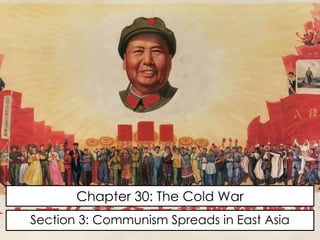

Chapter 30: The Cold War
Section 3: Communism Spreads in East Asia
Objectives
Students will be able to…
1. Analyze China’s communist revolution.
2. Describe China’s roll as a “wild card” in the
Cold War.
3. Explain how war came to Korea and how
the two Koreas followed different paths.
Bellringer
CHOOSE ONE!
1. Write at least three (3) facts that you know
about China’s history, OR
2. Write at least three (3) questions you want
answered about China’s history.
Adults write in complete sentences!
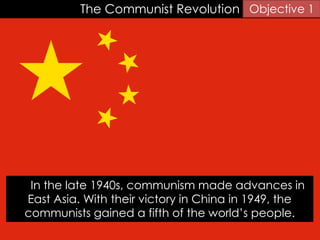
The Communist Revolution
In the late 1940s, communism made advances in
East Asia. With their victory in China in 1949, the
communists gained a fifth of the world’s people.
Objective 1
The Communist Revolution
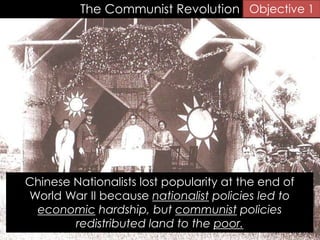
Chinese Nationalists lost popularity at the end of
World War II because nationalist policies led to
economic hardship, but communist policies
redistributed land to the poor.
Objective 1
The Communist Revolution
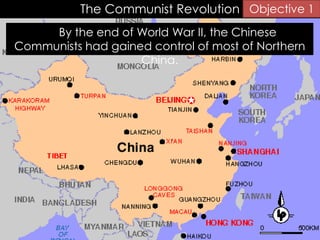
By the end of World War II, the Chinese
Communists had gained control of most of Northern
China.
Objective 1
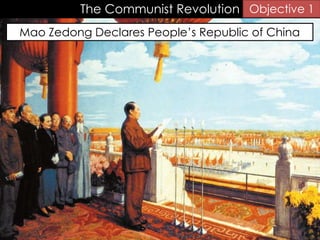
The Communist Revolution
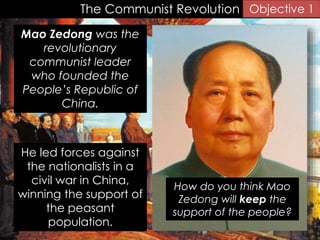
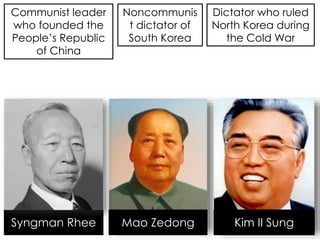
Mao Zedong was the
revolutionary
communist leader
who founded the
People’s Republic of
China.
Objective 1
He led forces against
the nationalists in a
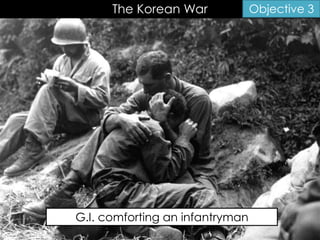
civil war in China,
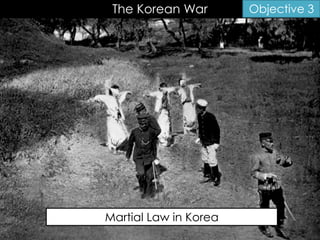
winning the support of
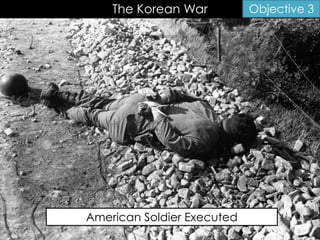
the peasant
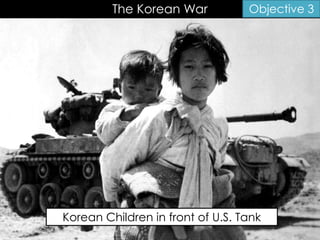
population.
How do you think Mao
Zedong will keep the
support of the people?
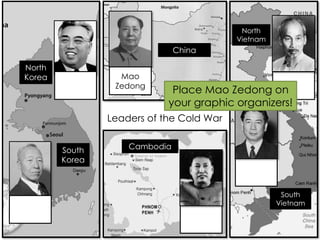
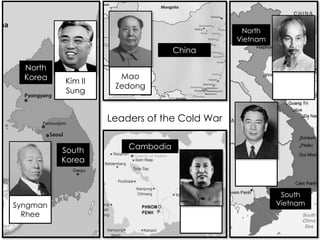
Mao
Zedong
Leaders of the Cold War
China
North
Vietnam
South
Vietnam
Cambodia
North
Korea
South
Korea
Place Mao Zedong on
your graphic organizers!
The Communist Revolution Objective 1
Mao Zedong Declares People’s Republic of China
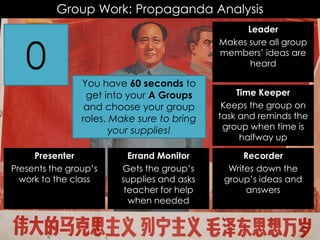
Group Work: Propaganda Analysis
Recorder
Writes down the
group’s ideas and
answers
Time Keeper
Keeps the group on
task and reminds the
group when time is
halfway up
Leader
Makes sure all group
members’ ideas are
heard
Presenter
Presents the group’s
work to the class
Errand Monitor
Gets the group’s
supplies and asks
teacher for help
when needed
6059585756555453525150494847464544434241403938373635343332313029282726252423222120191817161514131211109876543210 You have 60 seconds to
get into your A Groups
and choose your group
roles. Make sure to bring
your supplies!
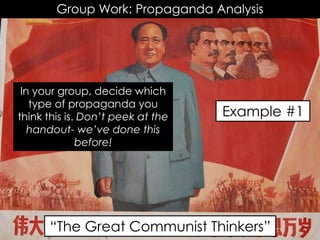
Group Work: Propaganda Analysis
Example #1
“The Great Communist Thinkers”
In your group, decide which
type of propaganda you
think this is. Don’t peek at the
handout- we’ve done this
before!
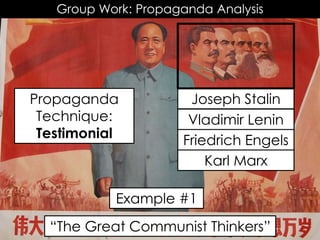
Group Work: Propaganda Analysis
Propaganda
Technique:
Testimonial
Joseph Stalin
Vladimir Lenin
Friedrich Engels
Karl Marx
Example #1
“The Great Communist Thinkers”
Group Work: Propaganda Analysis
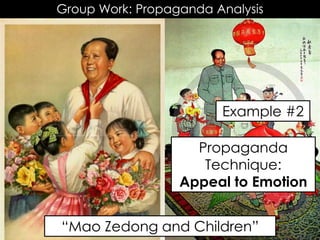
Example #2
“Mao Zedong and Children”
Propaganda
Technique:
Appeal to Emotion
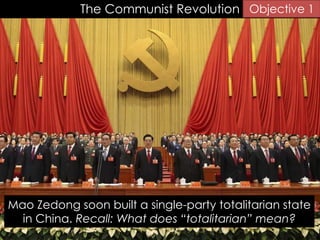
The Communist Revolution
Mao Zedong soon built a single-party totalitarian state
in China. Recall: What does “totalitarian” mean?
Objective 1
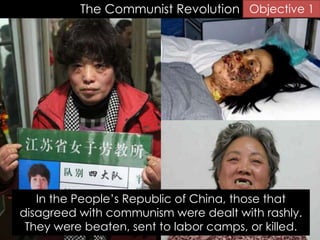
The Communist Revolution
In the People’s Republic of China, those that
disagreed with communism were dealt with rashly.
They were beaten, sent to labor camps, or killed.
Objective 1
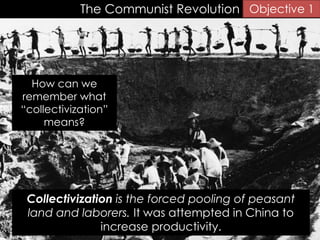
The Communist Revolution
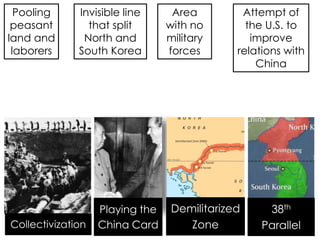
Collectivization is the forced pooling of peasant
land and laborers. It was attempted in China to
increase productivity.
Objective 1
How can we
remember what
“collectivization”
means?
Checkpoint
What is collectivization?
The Communist Revolution Objective 1
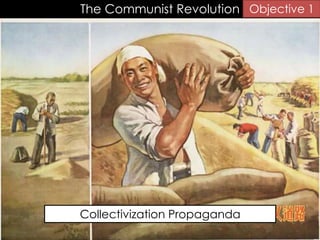
Collectivization Propaganda
The Communist Revolution
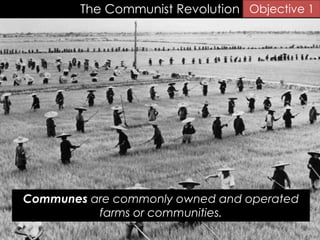
Communes are commonly owned and operated
farms or communities.
Objective 1
Checkpoint
What are communes?
The Communist Revolution
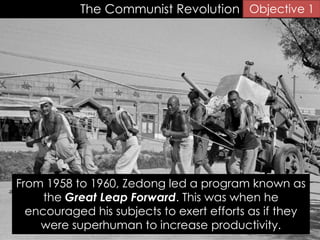
From 1958 to 1960, Zedong led a program known as
the Great Leap Forward. This was when he
encouraged his subjects to exert efforts as if they
were superhuman to increase productivity.
Objective 1
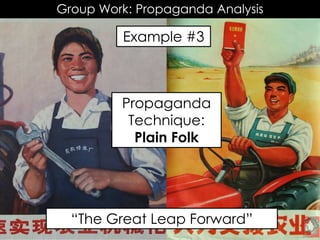
Group Work: Propaganda Analysis
Example #3
“The Great Leap Forward”
Propaganda
Technique:
Plain Folk
The Communist Revolution
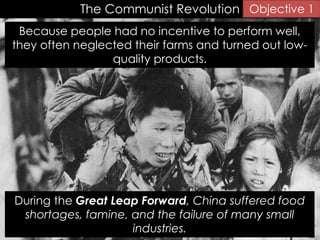
Because people had no incentive to perform well,
they often neglected their farms and turned out low-
quality products.
Objective 1
During the Great Leap Forward, China suffered food
shortages, famine, and the failure of many small
industries.
Checkpoint
What happened to
China because of the
Great Leap Forward?
The Communist Revolution
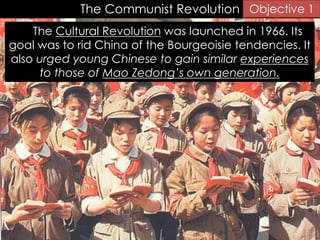
The Cultural Revolution was launched in 1966. Its
goal was to rid China of the Bourgeoisie tendencies. It
also urged young Chinese to gain similar experiences
to those of Mao Zedong’s own generation.
Objective 1
The Communist Revolution Objective 1
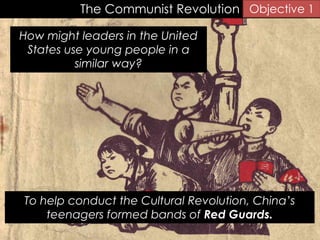
To help conduct the Cultural Revolution, China’s
teenagers formed bands of Red Guards.
How might leaders in the United
States use young people in a
similar way?
The Communist Revolution Objective 1
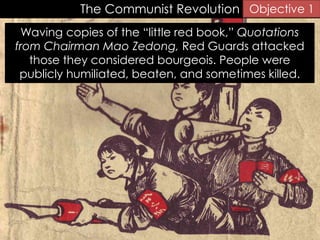
Waving copies of the “little red book,” Quotations
from Chairman Mao Zedong, Red Guards attacked
those they considered bourgeois. People were
publicly humiliated, beaten, and sometimes killed.
The Cold War’s Wild Card Objective 2
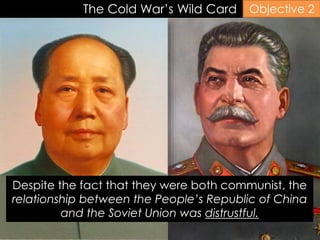
Despite the fact that they were both communist, the
relationship between the People’s Republic of China
and the Soviet Union was distrustful.
The Cold War’s Wild Card
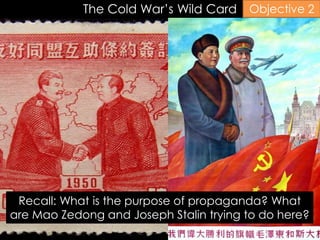
Recall: What is the purpose of propaganda? What
are Mao Zedong and Joseph Stalin trying to do here?
Objective 2
The Cold War’s Wild Card
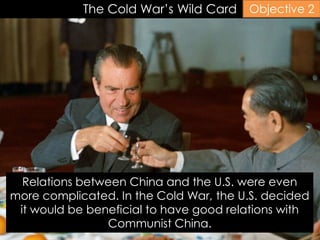
Relations between China and the U.S. were even
more complicated. In the Cold War, the U.S. decided
it would be beneficial to have good relations with
Communist China.
Objective 2
The Cold War’s Wild Card
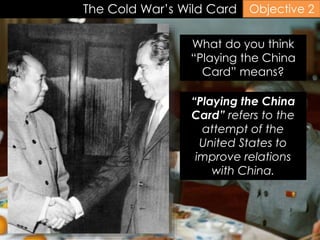
“Playing the China
Card” refers to the
attempt of the
United States to
improve relations
with China.
Objective 2
What do you think
“Playing the China
Card” means?
The Korean War Objective 3
The Korean War
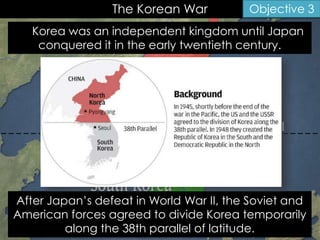
Korea was an independent kingdom until Japan
conquered it in the early twentieth century.
Objective 3
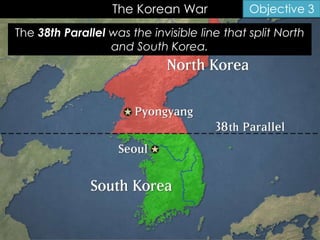
After Japan’s defeat in World War II, the Soviet and
American forces agreed to divide Korea temporarily
along the 38th parallel of latitude.
The Korean War Objective 3
The 38th Parallel was the invisible line that split North
and South Korea.
Checkpoint
What is the 38th
parallel?
The Korean War Objective 3
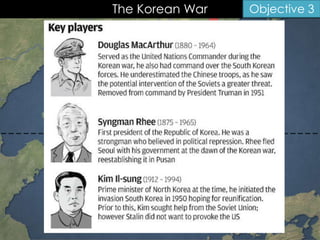
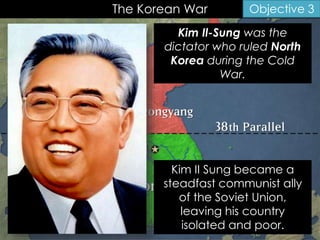
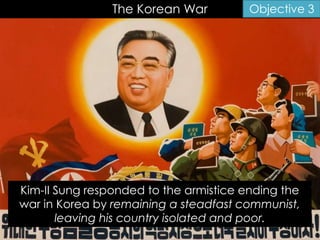
Kim Il-Sung was the
dictator who ruled North
Korea during the Cold
War.
Kim II Sung became a
steadfast communist ally
of the Soviet Union,
leaving his country
isolated and poor.
Kim II
Sung
Mao
Zedong
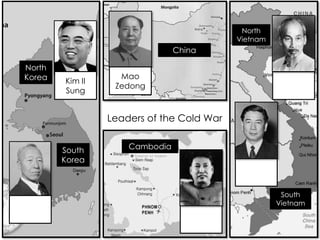
Leaders of the Cold War
China
North
Vietnam
South
Vietnam
Cambodia
North
Korea
South
Korea
The Korean War Objective 3
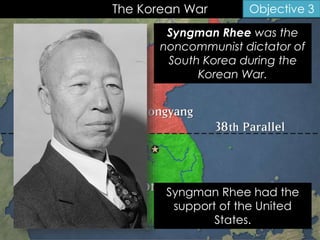
Syngman Rhee was the
noncommunist dictator of
South Korea during the
Korean War.
Syngman Rhee had the
support of the United
States.
Kim II
Sung
Syngman
Rhee
Mao
Zedong
Leaders of the Cold War
China
North
Vietnam
South
Vietnam
Cambodia
North
Korea
South
Korea
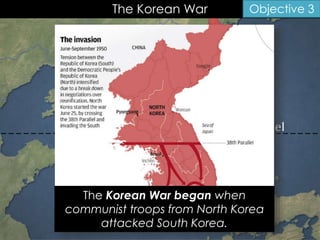
The Korean War Objective 3
The Korean War began when
communist troops from North Korea
attacked South Korea.
Checkpoint
How did the Korean War
begin?
The Korean War Objective 3
G.I. comforting an infantryman
The Korean War Objective 3
Martial Law in Korea
The Korean War Objective 3
American Soldier Executed
The Korean War Objective 3
Korean Children in front of U.S. Tank
The Korean War Objective 3
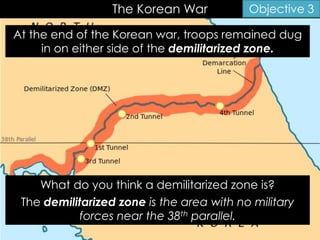
At the end of the Korean war, troops remained dug
in on either side of the demilitarized zone.
The demilitarized zone is the area with no military
forces near the 38th parallel.
What do you think a demilitarized zone is?
Checkpoint
At the end of the Korean war, troops remained
dug in on either side of the ___________________.
Korean War Timeline Objective 3
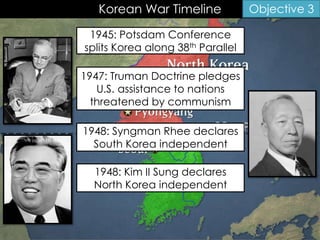
1945: Potsdam Conference
splits Korea along 38th Parallel
1947: Truman Doctrine pledges
U.S. assistance to nations
threatened by communism
1948: Syngman Rhee declares
South Korea independent
1948: Kim II Sung declares
North Korea independent
Korean War Timeline Objective 3
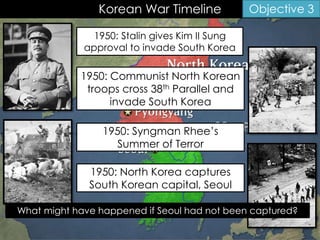
1950: Communist North Korean
troops cross 38th Parallel and
invade South Korea
1950: Syngman Rhee’s
Summer of Terror
1950: North Korea captures
South Korean capital, Seoul
1950: Stalin gives Kim II Sung
approval to invade South Korea
What might have happened if Seoul had not been captured?
Korean War Timeline Objective 3
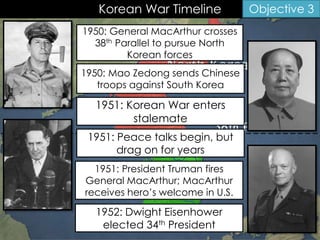
1950: Mao Zedong sends Chinese
troops against South Korea
1951: Korean War enters
stalemate
1951: Peace talks begin, but
drag on for years
1950: General MacArthur crosses
38th Parallel to pursue North
Korean forces
1951: President Truman fires
General MacArthur; MacArthur
receives hero’s welcome in U.S.
1952: Dwight Eisenhower
elected 34th President
Korean War Timeline Objective 3
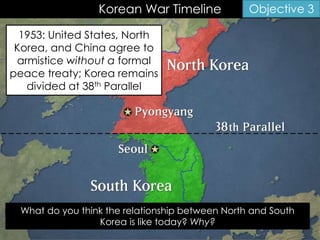
1953: United States, North
Korea, and China agree to
armistice without a formal
peace treaty; Korea remains
divided at 38th Parallel
What do you think the relationship between North and South
Korea is like today? Why?
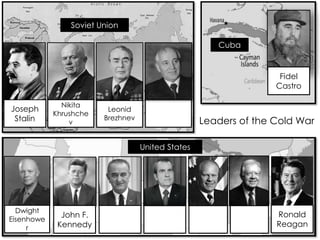
John F.
Kennedy
Dwight
Eisenhowe
r
Ronald
Reagan
United States
Nikita
Khrushche
v
Fidel
Castro
Joseph
Stalin Leaders of the Cold War
Cuba
Soviet Union
Leonid
Brezhnev
The Korean War Objective 3
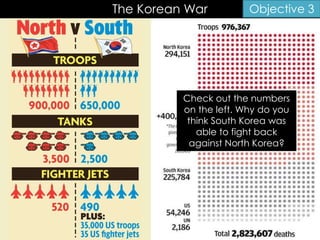
Check out the numbers
on the left. Why do you
think South Korea was
able to fight back
against North Korea?
The Korean War Objective 3
Kim-II Sung responded to the armistice ending the
war in Korea by remaining a steadfast communist,
leaving his country isolated and poor.
The Korean War Objective 3
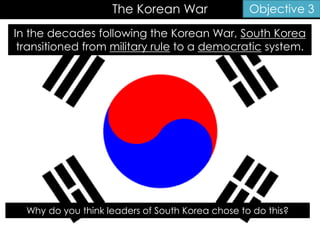
In the decades following the Korean War, South Korea
transitioned from military rule to a democratic system.
Why do you think leaders of South Korea chose to do this?
Checkpoint
What did South Korea
transition to after the
Korean War?
The Korean War Objective 3
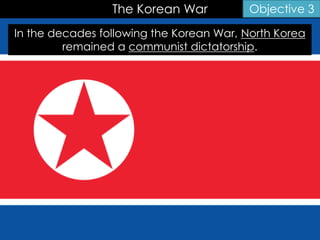
In the decades following the Korean War, North Korea
remained a communist dictatorship.
Collectivization
Playing the
China Card
Demilitarized
Zone
38th
Parallel
Pooling
peasant
land and
laborers
Attempt of
the U.S. to
improve
relations with
China
Invisible line
that split
North and
South Korea
Area
with no
military
forces
Syngman Rhee Mao Zedong Kim II Sung
Communist leader
who founded the
People’s Republic
of China
Noncommunis
t dictator of
South Korea
Dictator who ruled
North Korea during
the Cold War
Exit Ticket
1. Imagine if North Korea and South Korea wanted to be
reunited as a single country.
a. Would you consider this a positive or negative
thing? Explain your answer!
b. Assume that you are in a position of power. What
steps would you take to help these two countries
come together? Provide at least two examples.
2. How do you think the results of the Korean War will
eventually impact the rest of the world? (No
Googling!)
Homework:
Create flashcards for the following terms:
1. Kim II-Sung
2. Syngman Rhee
3. Mao Zedong
Choose two of the following terms:
1. Demilitarized Zone
2. 38th Parallel
3. Great Leap Forward
4. Playing the China Card 3029282726252423222120191817161514131211109876543210

World History: Sample PowerPoint

  • 1.
    Chapter 30: TheCold War Section 3: Communism Spreads in East Asia
  • 2.
    Objectives Students will beable to… 1. Analyze China’s communist revolution. 2. Describe China’s roll as a “wild card” in the Cold War. 3. Explain how war came to Korea and how the two Koreas followed different paths.
  • 3.
    Bellringer CHOOSE ONE! 1. Writeat least three (3) facts that you know about China’s history, OR 2. Write at least three (3) questions you want answered about China’s history. Adults write in complete sentences!
  • 4.
    The Communist Revolution Inthe late 1940s, communism made advances in East Asia. With their victory in China in 1949, the communists gained a fifth of the world’s people. Objective 1
  • 5.
    The Communist Revolution ChineseNationalists lost popularity at the end of World War II because nationalist policies led to economic hardship, but communist policies redistributed land to the poor. Objective 1
  • 6.
    The Communist Revolution Bythe end of World War II, the Chinese Communists had gained control of most of Northern China. Objective 1
  • 7.
    The Communist Revolution MaoZedong was the revolutionary communist leader who founded the People’s Republic of China. Objective 1 He led forces against the nationalists in a civil war in China, winning the support of the peasant population. How do you think Mao Zedong will keep the support of the people?
  • 8.
    Mao Zedong Leaders of theCold War China North Vietnam South Vietnam Cambodia North Korea South Korea Place Mao Zedong on your graphic organizers!
  • 9.
    The Communist RevolutionObjective 1 Mao Zedong Declares People’s Republic of China
  • 10.
    Group Work: PropagandaAnalysis Recorder Writes down the group’s ideas and answers Time Keeper Keeps the group on task and reminds the group when time is halfway up Leader Makes sure all group members’ ideas are heard Presenter Presents the group’s work to the class Errand Monitor Gets the group’s supplies and asks teacher for help when needed 6059585756555453525150494847464544434241403938373635343332313029282726252423222120191817161514131211109876543210 You have 60 seconds to get into your A Groups and choose your group roles. Make sure to bring your supplies!
  • 11.
    Group Work: PropagandaAnalysis Example #1 “The Great Communist Thinkers” In your group, decide which type of propaganda you think this is. Don’t peek at the handout- we’ve done this before!
  • 12.
    Group Work: PropagandaAnalysis Propaganda Technique: Testimonial Joseph Stalin Vladimir Lenin Friedrich Engels Karl Marx Example #1 “The Great Communist Thinkers”
  • 13.
    Group Work: PropagandaAnalysis Example #2 “Mao Zedong and Children” Propaganda Technique: Appeal to Emotion
  • 14.
    The Communist Revolution MaoZedong soon built a single-party totalitarian state in China. Recall: What does “totalitarian” mean? Objective 1
  • 15.
    The Communist Revolution Inthe People’s Republic of China, those that disagreed with communism were dealt with rashly. They were beaten, sent to labor camps, or killed. Objective 1
  • 16.
    The Communist Revolution Collectivizationis the forced pooling of peasant land and laborers. It was attempted in China to increase productivity. Objective 1 How can we remember what “collectivization” means?
  • 17.
  • 18.
    The Communist RevolutionObjective 1 Collectivization Propaganda
  • 19.
    The Communist Revolution Communesare commonly owned and operated farms or communities. Objective 1
  • 20.
  • 21.
    The Communist Revolution From1958 to 1960, Zedong led a program known as the Great Leap Forward. This was when he encouraged his subjects to exert efforts as if they were superhuman to increase productivity. Objective 1
  • 22.
    Group Work: PropagandaAnalysis Example #3 “The Great Leap Forward” Propaganda Technique: Plain Folk
  • 23.
    The Communist Revolution Becausepeople had no incentive to perform well, they often neglected their farms and turned out low- quality products. Objective 1 During the Great Leap Forward, China suffered food shortages, famine, and the failure of many small industries.
  • 24.
    Checkpoint What happened to Chinabecause of the Great Leap Forward?
  • 25.
    The Communist Revolution TheCultural Revolution was launched in 1966. Its goal was to rid China of the Bourgeoisie tendencies. It also urged young Chinese to gain similar experiences to those of Mao Zedong’s own generation. Objective 1
  • 26.
    The Communist RevolutionObjective 1 To help conduct the Cultural Revolution, China’s teenagers formed bands of Red Guards. How might leaders in the United States use young people in a similar way?
  • 27.
    The Communist RevolutionObjective 1 Waving copies of the “little red book,” Quotations from Chairman Mao Zedong, Red Guards attacked those they considered bourgeois. People were publicly humiliated, beaten, and sometimes killed.
  • 28.
    The Cold War’sWild Card Objective 2 Despite the fact that they were both communist, the relationship between the People’s Republic of China and the Soviet Union was distrustful.
  • 29.
    The Cold War’sWild Card Recall: What is the purpose of propaganda? What are Mao Zedong and Joseph Stalin trying to do here? Objective 2
  • 30.
    The Cold War’sWild Card Relations between China and the U.S. were even more complicated. In the Cold War, the U.S. decided it would be beneficial to have good relations with Communist China. Objective 2
  • 31.
    The Cold War’sWild Card “Playing the China Card” refers to the attempt of the United States to improve relations with China. Objective 2 What do you think “Playing the China Card” means?
  • 32.
    The Korean WarObjective 3
  • 33.
    The Korean War Koreawas an independent kingdom until Japan conquered it in the early twentieth century. Objective 3 After Japan’s defeat in World War II, the Soviet and American forces agreed to divide Korea temporarily along the 38th parallel of latitude.
  • 34.
    The Korean WarObjective 3 The 38th Parallel was the invisible line that split North and South Korea.
  • 35.
    Checkpoint What is the38th parallel?
  • 36.
    The Korean WarObjective 3 Kim Il-Sung was the dictator who ruled North Korea during the Cold War. Kim II Sung became a steadfast communist ally of the Soviet Union, leaving his country isolated and poor.
  • 37.
    Kim II Sung Mao Zedong Leaders ofthe Cold War China North Vietnam South Vietnam Cambodia North Korea South Korea
  • 38.
    The Korean WarObjective 3 Syngman Rhee was the noncommunist dictator of South Korea during the Korean War. Syngman Rhee had the support of the United States.
  • 39.
    Kim II Sung Syngman Rhee Mao Zedong Leaders ofthe Cold War China North Vietnam South Vietnam Cambodia North Korea South Korea
  • 40.
    The Korean WarObjective 3 The Korean War began when communist troops from North Korea attacked South Korea.
  • 41.
    Checkpoint How did theKorean War begin?
  • 42.
    The Korean WarObjective 3 G.I. comforting an infantryman
  • 43.
    The Korean WarObjective 3 Martial Law in Korea
  • 44.
    The Korean WarObjective 3 American Soldier Executed
  • 45.
    The Korean WarObjective 3 Korean Children in front of U.S. Tank
  • 46.
    The Korean WarObjective 3 At the end of the Korean war, troops remained dug in on either side of the demilitarized zone. The demilitarized zone is the area with no military forces near the 38th parallel. What do you think a demilitarized zone is?
  • 47.
    Checkpoint At the endof the Korean war, troops remained dug in on either side of the ___________________.
  • 48.
    Korean War TimelineObjective 3 1945: Potsdam Conference splits Korea along 38th Parallel 1947: Truman Doctrine pledges U.S. assistance to nations threatened by communism 1948: Syngman Rhee declares South Korea independent 1948: Kim II Sung declares North Korea independent
  • 49.
    Korean War TimelineObjective 3 1950: Communist North Korean troops cross 38th Parallel and invade South Korea 1950: Syngman Rhee’s Summer of Terror 1950: North Korea captures South Korean capital, Seoul 1950: Stalin gives Kim II Sung approval to invade South Korea What might have happened if Seoul had not been captured?
  • 50.
    Korean War TimelineObjective 3 1950: Mao Zedong sends Chinese troops against South Korea 1951: Korean War enters stalemate 1951: Peace talks begin, but drag on for years 1950: General MacArthur crosses 38th Parallel to pursue North Korean forces 1951: President Truman fires General MacArthur; MacArthur receives hero’s welcome in U.S. 1952: Dwight Eisenhower elected 34th President
  • 51.
    Korean War TimelineObjective 3 1953: United States, North Korea, and China agree to armistice without a formal peace treaty; Korea remains divided at 38th Parallel What do you think the relationship between North and South Korea is like today? Why?
  • 52.
  • 53.
    The Korean WarObjective 3 Check out the numbers on the left. Why do you think South Korea was able to fight back against North Korea?
  • 54.
    The Korean WarObjective 3 Kim-II Sung responded to the armistice ending the war in Korea by remaining a steadfast communist, leaving his country isolated and poor.
  • 55.
    The Korean WarObjective 3 In the decades following the Korean War, South Korea transitioned from military rule to a democratic system. Why do you think leaders of South Korea chose to do this?
  • 56.
    Checkpoint What did SouthKorea transition to after the Korean War?
  • 57.
    The Korean WarObjective 3 In the decades following the Korean War, North Korea remained a communist dictatorship.
  • 58.
    Collectivization Playing the China Card Demilitarized Zone 38th Parallel Pooling peasant landand laborers Attempt of the U.S. to improve relations with China Invisible line that split North and South Korea Area with no military forces
  • 59.
    Syngman Rhee MaoZedong Kim II Sung Communist leader who founded the People’s Republic of China Noncommunis t dictator of South Korea Dictator who ruled North Korea during the Cold War
  • 60.
    Exit Ticket 1. Imagineif North Korea and South Korea wanted to be reunited as a single country. a. Would you consider this a positive or negative thing? Explain your answer! b. Assume that you are in a position of power. What steps would you take to help these two countries come together? Provide at least two examples. 2. How do you think the results of the Korean War will eventually impact the rest of the world? (No Googling!)
  • 61.
    Homework: Create flashcards forthe following terms: 1. Kim II-Sung 2. Syngman Rhee 3. Mao Zedong Choose two of the following terms: 1. Demilitarized Zone 2. 38th Parallel 3. Great Leap Forward 4. Playing the China Card 3029282726252423222120191817161514131211109876543210