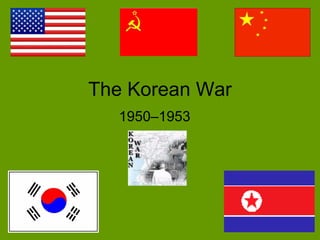
The Korean War 1950–1953
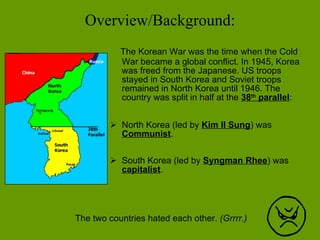
Overview/Background: The Korean War was the time when the Cold War became a global conflict. In 1945, Korea was freed from the Japanese. US troops stayed in South Korea and Soviet troops remained in North Korea until 1946. The country was split in half at the  38 th  parallel :  North Korea (led by  Kim II Sung ) was  Communist .  South Korea (led by  Syngman Rhee ) was  capitalist . The two countries hated each other.  (Grrrr.)
The country was split at the 38 th  parallel because, when they were discussing what to do with Korea, the Americans could only find a small-scale map.
So What Caused The Korean War? 1. President Truman was interested in the Far East: Hmmm…..I have an interest in the Far East.
D omino Theory Europe was not the only place where Communists were coming to power. In the Far East, too, they were getting powerful – China turned Communist in 1949. Truman believed that, if one country fell to Communism, then others would follow, like a line of dominoes. He was worried that, if Korea fell, the Communists would capture Japan.  Task:   Using 6 words, describe the domino theory. _______  _______  _______  _______  _______  _______ One  country  falls  others  will  follow
General MacArthur says... “ Asia is where the communist conspirators have decided to make their play for global conquest. If we lose this war, the fall of Europe is inevitable. There is no choice but victory.”  The US General MacArthur, speaking in 1950.   Question: Why does General MacArthur think Korea is so important for the Americans?
U ndermine Communism In April 1950, the American National Security Council issued a report ( NSC 68 ) recommending that America abandon 'containment' and start 'rolling back' Communism.
Cold War Truman realized the USA was in a competition for world domination with the USSR. By supporting South Korea, America was able to fight Communism without directly attacking Russia.
2.  Stalin  was also involved in the Far East: Hmmm..I too have an interest in the Far East.
K im II Sung Gets Support In 1949, he persuaded Stalin that he could conquer South Korea. Stalin did not think that America would dare to get involved, so he gave his agreement. Stalin saw a chance to continue the cold war and discomfort America, but ‘at arm’s length’ –  without directly confronting  the Americans. Kim II Sung also went to see  Mao Zedong , the leader of China, to get his agreement.
Syngman Rhee Has A Big Mouth 3.   In 1950, Syngman Rhee boasted that he was going to attack North Korea. It was a good enough excuse – on June 25, 1950 the North Koreans invaded South Korea.  … and so began the Korean War.   Chairman Syngman Rhee addresses the National Assembly in 1948.
TASK:  Before we continue on, you must rank the main causes of the Korean War.  Starting with #1 being the most important cause, compile your list.  Include a brief explanation to support your choices.
The Events Of The War
June, 1950 – North Korea Invades South Korea; Truman Commits US Forces. The North Koreans attacked. They were very successful. The  North Korean People's Army (NKPA)  easily defeated the  Republic of Korea's  army (the  ROKs )  They captured most of South Korea, including the capital of  Seoul . The Americans were alarmed and they persuaded the United Nations to support South Korea. Out of the 300,000 UN troops, 260,000 were Americans.
September 15, 1950 – UN Makes Daring Landing At  Inchon The American army, led by  General MacArthur , went to Korea. It landed at Pusan, and made an amphibious landing at Inchon (near Seoul).  It drove back the North Koreans and recaptured South Korea. 125,000 NKPA prisoners were taken.
October 1, 1950 – South Korean Troops Cross At The 38 th  Parallel South Korean troops cross the 38 th  Parallel and enter North Korea. Task:  Evaluate the UN decision to cross into North Korea after successfully recapturing South Korea. List the potential positives and negatives of this action? Ultimate Goal of this action:  to unify Korea under a non-communist government.
Map Interpretation Yalu River Based on this map, why do you think President Truman warned MacArthur to keep the UN forces at least 40 miles from the Yalu River?
October 26, 1950 – UN Forces Reach Yalu River North Korea’s capital,  Pyongyang , fell to UN troops on October 20 th . By October 26 th , the first UN troops had reached the  Yalu River . – the border between China and North Korea. North Korean tank burning in Pyongyang, October 19, 1950.
November 1950, Massive Chinese Attack Across The Yalu River Now the Chinese were alarmed.  200,000 Chinese troops  ('People's Volunteers') attacked MacArthur. They had modern weapons supplied by Russia, and a fanatical hatred of the Americans.  In December, half a million more Chinese troops entered the war. They drove the Americans back. They recaptured North Korea, and advanced into South Korea.
The Chinese troops were a unique enemy, without any of the characteristics of a traditional American or European army. There were no officer corps or ranks in this "people's army." The soldiers addressed their commanders as "Comrade Platoon Leader" or "Comrade Company Commander" and were informed in great detail of their tactical and strategic missions.
February – March 1951: Stalemate The Americans landed more troops. They used bombers. The Chinese admitted to losing 390,000 men dead - UN sources put the figure at up a million Chinese and half a million North Koreans dead. The Americans drove the Chinese back, but lost  54,000  American soldiers doing so.  MacArthur reached the 38 th  parallel in March 1951.
Approximately 90% of the soldiers fighting in Korea suffered from frostbite. In fact, much of the war was fought in extreme cold as Siberian winds whipped across the Asian peninsula.
March 1951 -  President Harry Truman vs. General Douglas MacArthur MacArthur declares "There is no substitute for victory." He wants to push further. He claimed that the only way to bring about victory was by taking the war to China.  In a message to House Republican leader, MacArthur expressed his frustration with the limited war the U.S. was fighting against communists. He publicly criticized Truman’s decisions.
Truman vs. MacArthur Continued After months of heavy fighting, the center of the conflict was returned to the 38th parallel, where it remained for the rest of the war. MacArthur, however, wished to mount another invasion of North Korea. MacArthur also pressed for permission to bomb Chinese bases in Manchuria. Truman refused such permission. When MacArthur persisted in publicly criticizing U.S. policy, Truman, on the recommendation of the Joint Chiefs of Staff, removed him from command on April 11, 1951and installed Gen. Matthew B. Ridgeway as commander in chief. Gen. James Van Fleet then took command of the 8th Army. Ridgeway began (July 10, 1951) truce negotiations with the North Koreans and Chinese, while small unit actions, bitter but indecisive, continued. General Van Fleet was denied permission to go on the offensive and end the “meat grinder” war.
Who Was Right? – You Decide Should President Truman have relieved General MacArthur? Who better understood the situation? Would MacArthur's policies have ended the war in Korea sooner, or would they have risked World War III?  Do you think President Truman was right or wrong in dismissing Gen. MacArthur? Explain your answer.
"We've been using more of a roundish one"   President Harry Truman relieved General Douglas MacArthur of his Far Eastern command for publicly undercutting the president's Korean War policies, and the general returned to Washington, where he and Defense Secretary George Marshall provided conflicting testimonies to congressional committees. MacArthur continued to propose more aggressive tactics against communist China. Marshall argued that MacArthur's tactics would draw the United States into a third world war.
July, 1951 Peace talks  begin as both sides continue fighting.
July 27, 1953 – Truce Ends Korean Fighting; 38 th  Parallel Is Truce Line In July 1953 an  armistice , or truce, was agreed upon. Korea was to remain divided at the 38 th  parallel. Tension still existed on either side of the  demilitarized zone (DMZ) , a neutral area in which no warfare could be waged.
Results of the Korean War It cost the United States 54,000 dead and 103,000 wounded. Total UN casualties reached about 400,000 dead or wounded. South Korea suffered close to a million civilian casualties, with several million made homeless. Nearly 1½ million North Korean and Chinese soldiers were dead or wounded. With such high casualties, how could this possibly be nicknamed “The Forgotten War?”
What Would Truman Have Said? 1. The United States was being tested by the invasion of South Korea. 2. We must stamp out the Communist government in North Korea. 3. United Nations should push as far into North Korea as it is necessary to win the war. 4. I will support whatever decision General MacArthur makes about the conduct of the war. 5. I will do everything possible to win this war, even if it means war with the Soviet Union. 6. United Nations forces should not get any closer than 40 miles from the Soviet and China borders.
QUESTIONS AND TASKS 1. Why do you think this conflict has the nickname “The Forgotten War?” 2. With such high casualties, those who died should not be forgotten.  Create a new nickname for the Korean War. 3. Was the Korean War a success or a failure for the United States?  Explain your answer. 4. Regardless of your answer for question 3, write a letter to justify the war to a mother whose son was killed in the war?
The TV series M*A*S*H was set in the Korean War. Because it was written at the time of the Vietnam War, the program had a strong anti-war message.
Silly putty was invented in 1950!

Koreanwar

  • 1.
    The Korean War1950–1953
  • 2.
    Overview/Background: The KoreanWar was the time when the Cold War became a global conflict. In 1945, Korea was freed from the Japanese. US troops stayed in South Korea and Soviet troops remained in North Korea until 1946. The country was split in half at the 38 th parallel : North Korea (led by Kim II Sung ) was Communist . South Korea (led by Syngman Rhee ) was capitalist . The two countries hated each other. (Grrrr.)
  • 3.
    The country wassplit at the 38 th parallel because, when they were discussing what to do with Korea, the Americans could only find a small-scale map.
  • 4.
    So What CausedThe Korean War? 1. President Truman was interested in the Far East: Hmmm…..I have an interest in the Far East.
  • 5.
    D omino TheoryEurope was not the only place where Communists were coming to power. In the Far East, too, they were getting powerful – China turned Communist in 1949. Truman believed that, if one country fell to Communism, then others would follow, like a line of dominoes. He was worried that, if Korea fell, the Communists would capture Japan. Task: Using 6 words, describe the domino theory. _______ _______ _______ _______ _______ _______ One country falls others will follow
  • 6.
    General MacArthur says...“ Asia is where the communist conspirators have decided to make their play for global conquest. If we lose this war, the fall of Europe is inevitable. There is no choice but victory.” The US General MacArthur, speaking in 1950. Question: Why does General MacArthur think Korea is so important for the Americans?
  • 7.
    U ndermine CommunismIn April 1950, the American National Security Council issued a report ( NSC 68 ) recommending that America abandon 'containment' and start 'rolling back' Communism.
  • 8.
    Cold War Trumanrealized the USA was in a competition for world domination with the USSR. By supporting South Korea, America was able to fight Communism without directly attacking Russia.
  • 9.
    2. Stalin was also involved in the Far East: Hmmm..I too have an interest in the Far East.
  • 10.
    K im IISung Gets Support In 1949, he persuaded Stalin that he could conquer South Korea. Stalin did not think that America would dare to get involved, so he gave his agreement. Stalin saw a chance to continue the cold war and discomfort America, but ‘at arm’s length’ – without directly confronting the Americans. Kim II Sung also went to see Mao Zedong , the leader of China, to get his agreement.
  • 11.
    Syngman Rhee HasA Big Mouth 3. In 1950, Syngman Rhee boasted that he was going to attack North Korea. It was a good enough excuse – on June 25, 1950 the North Koreans invaded South Korea. … and so began the Korean War. Chairman Syngman Rhee addresses the National Assembly in 1948.
  • 12.
    TASK: Beforewe continue on, you must rank the main causes of the Korean War. Starting with #1 being the most important cause, compile your list. Include a brief explanation to support your choices.
  • 13.
  • 14.
    June, 1950 –North Korea Invades South Korea; Truman Commits US Forces. The North Koreans attacked. They were very successful. The North Korean People's Army (NKPA) easily defeated the Republic of Korea's army (the ROKs ) They captured most of South Korea, including the capital of Seoul . The Americans were alarmed and they persuaded the United Nations to support South Korea. Out of the 300,000 UN troops, 260,000 were Americans.
  • 15.
    September 15, 1950– UN Makes Daring Landing At Inchon The American army, led by General MacArthur , went to Korea. It landed at Pusan, and made an amphibious landing at Inchon (near Seoul). It drove back the North Koreans and recaptured South Korea. 125,000 NKPA prisoners were taken.
  • 16.
    October 1, 1950– South Korean Troops Cross At The 38 th Parallel South Korean troops cross the 38 th Parallel and enter North Korea. Task: Evaluate the UN decision to cross into North Korea after successfully recapturing South Korea. List the potential positives and negatives of this action? Ultimate Goal of this action: to unify Korea under a non-communist government.
  • 17.
    Map Interpretation YaluRiver Based on this map, why do you think President Truman warned MacArthur to keep the UN forces at least 40 miles from the Yalu River?
  • 18.
    October 26, 1950– UN Forces Reach Yalu River North Korea’s capital, Pyongyang , fell to UN troops on October 20 th . By October 26 th , the first UN troops had reached the Yalu River . – the border between China and North Korea. North Korean tank burning in Pyongyang, October 19, 1950.
  • 19.
    November 1950, MassiveChinese Attack Across The Yalu River Now the Chinese were alarmed. 200,000 Chinese troops ('People's Volunteers') attacked MacArthur. They had modern weapons supplied by Russia, and a fanatical hatred of the Americans. In December, half a million more Chinese troops entered the war. They drove the Americans back. They recaptured North Korea, and advanced into South Korea.
  • 20.
    The Chinese troopswere a unique enemy, without any of the characteristics of a traditional American or European army. There were no officer corps or ranks in this "people's army." The soldiers addressed their commanders as "Comrade Platoon Leader" or "Comrade Company Commander" and were informed in great detail of their tactical and strategic missions.
  • 21.
    February – March1951: Stalemate The Americans landed more troops. They used bombers. The Chinese admitted to losing 390,000 men dead - UN sources put the figure at up a million Chinese and half a million North Koreans dead. The Americans drove the Chinese back, but lost 54,000 American soldiers doing so. MacArthur reached the 38 th parallel in March 1951.
  • 22.
    Approximately 90% ofthe soldiers fighting in Korea suffered from frostbite. In fact, much of the war was fought in extreme cold as Siberian winds whipped across the Asian peninsula.
  • 23.
    March 1951 - President Harry Truman vs. General Douglas MacArthur MacArthur declares "There is no substitute for victory." He wants to push further. He claimed that the only way to bring about victory was by taking the war to China. In a message to House Republican leader, MacArthur expressed his frustration with the limited war the U.S. was fighting against communists. He publicly criticized Truman’s decisions.
  • 24.
    Truman vs. MacArthurContinued After months of heavy fighting, the center of the conflict was returned to the 38th parallel, where it remained for the rest of the war. MacArthur, however, wished to mount another invasion of North Korea. MacArthur also pressed for permission to bomb Chinese bases in Manchuria. Truman refused such permission. When MacArthur persisted in publicly criticizing U.S. policy, Truman, on the recommendation of the Joint Chiefs of Staff, removed him from command on April 11, 1951and installed Gen. Matthew B. Ridgeway as commander in chief. Gen. James Van Fleet then took command of the 8th Army. Ridgeway began (July 10, 1951) truce negotiations with the North Koreans and Chinese, while small unit actions, bitter but indecisive, continued. General Van Fleet was denied permission to go on the offensive and end the “meat grinder” war.
  • 25.
    Who Was Right?– You Decide Should President Truman have relieved General MacArthur? Who better understood the situation? Would MacArthur's policies have ended the war in Korea sooner, or would they have risked World War III? Do you think President Truman was right or wrong in dismissing Gen. MacArthur? Explain your answer.
  • 26.
    "We've been usingmore of a roundish one" President Harry Truman relieved General Douglas MacArthur of his Far Eastern command for publicly undercutting the president's Korean War policies, and the general returned to Washington, where he and Defense Secretary George Marshall provided conflicting testimonies to congressional committees. MacArthur continued to propose more aggressive tactics against communist China. Marshall argued that MacArthur's tactics would draw the United States into a third world war.
  • 27.
    July, 1951 Peacetalks begin as both sides continue fighting.
  • 28.
    July 27, 1953– Truce Ends Korean Fighting; 38 th Parallel Is Truce Line In July 1953 an armistice , or truce, was agreed upon. Korea was to remain divided at the 38 th parallel. Tension still existed on either side of the demilitarized zone (DMZ) , a neutral area in which no warfare could be waged.
  • 29.
    Results of theKorean War It cost the United States 54,000 dead and 103,000 wounded. Total UN casualties reached about 400,000 dead or wounded. South Korea suffered close to a million civilian casualties, with several million made homeless. Nearly 1½ million North Korean and Chinese soldiers were dead or wounded. With such high casualties, how could this possibly be nicknamed “The Forgotten War?”
  • 30.
    What Would TrumanHave Said? 1. The United States was being tested by the invasion of South Korea. 2. We must stamp out the Communist government in North Korea. 3. United Nations should push as far into North Korea as it is necessary to win the war. 4. I will support whatever decision General MacArthur makes about the conduct of the war. 5. I will do everything possible to win this war, even if it means war with the Soviet Union. 6. United Nations forces should not get any closer than 40 miles from the Soviet and China borders.
  • 31.
    QUESTIONS AND TASKS1. Why do you think this conflict has the nickname “The Forgotten War?” 2. With such high casualties, those who died should not be forgotten. Create a new nickname for the Korean War. 3. Was the Korean War a success or a failure for the United States? Explain your answer. 4. Regardless of your answer for question 3, write a letter to justify the war to a mother whose son was killed in the war?
  • 32.
    The TV seriesM*A*S*H was set in the Korean War. Because it was written at the time of the Vietnam War, the program had a strong anti-war message.
  • 33.
    Silly putty wasinvented in 1950!