World War II
1939-1945
© Ruth Writer
 Isolated
 Domestic agenda only
 Foreign affairs determined by Britain--colonialism
 Geography isolated and insulated
 Francophone saw self as autonomous
Canada before 1914
 Canada broke imperial ties—Statute of Westminster
 Became Commonwealth Nation—1931
 Began to create own foreign diplomacy
 Department of External Affairs [U.S. State Dept.]
 U.S. seen as potential enemy in 1920s
 BTW--U.S. still did have invasion plan in 1930s
Interwar Period—1918-1939
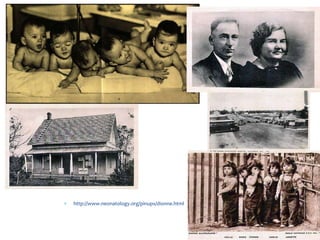
 Born May 1934 in Ontario near Quebec border
 Annette, Emilie, Yvonne, Cecile, Marie
 Born two months premature—weighed total of 14#
 Parents were French Catholic poor with 5 others
 First set to survive infancy—”miracle babies”
 Taken from parents after father signed contract with
Chicago World’s Fair—protect girls from germs,
kidnappers, exploitation
Dionne Quintuplets
 http://www.neonatology.org/pinups/dionne.html
 Became Canada’s largest tourist attraction by 1937
 3000 visitors each day—playground surrounded by glass
 Dolls; post cards; ads for cereal, bonds, honey, soap
 Admission and parking free—souvenirs pricey
 Custody battle—returned home at age 9—sad life
 Moved out at age 18—cut off most family contact
 Emilie—nun died of seizure in 1954; Marie died 1970
 3 married and divorced—children
 Later lived together near Montreal on $746 total per month
 Book written; questions raised
 By 2000 reached settlement of $4 million
 Two still survive—Annette and Cecile [2016]
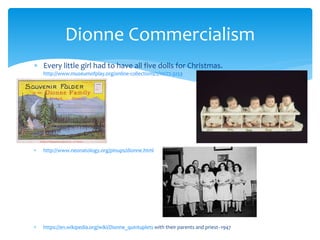
 Every little girl had to have all five dolls for Christmas.
http://www.museumofplay.org/online-collections/2/10/77.3253
 http://www.neonatology.org/pinups/dionne.html
 https://en.wikipedia.org/wiki/Dionne_quintuplets with their parents and priest--1947
Dionne Commercialism
Nation obsessed with Dionne’s
Europe preparing for another conflict
Appeasement not successful
Transition to War
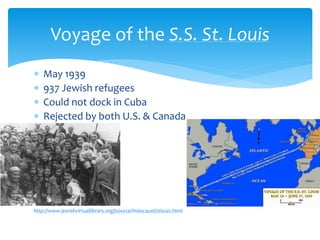
 May 1939
 937 Jewish refugees
 Could not dock in Cuba
 Rejected by both U.S. & Canada
http://www.jewishvirtuallibrary.org/jsource/Holocaust/stlouis.html
Voyage of the S.S. St. Louis
 Canada not welcoming—only 4000 Jewish immigrants
 “None is too many”—1938 restrictions
 Prime Minister King & Hitler met
 Did not realize agenda of Nazi leader
 Anti-Semitism especially in QC--demonstrations
 Catholic
 Francophone nationalistic movement
 Suspicious of Jewish immigrants
 Skilled professionals lost to Canada
Reaction to Holocaust
Canada swept into events
 Rise of fascist and military governments in Europe
 Appeasement bought some time
 Canadian debated neutrality in House of Commons
 Global war by 1939
 Canada had little control yet knew why fighting
 No grumbling
 No expectation of benefit
 Altruism
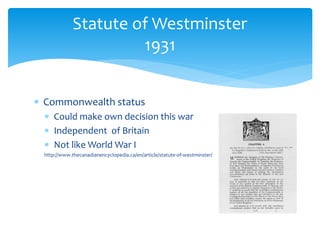
 Commonwealth status
 Could make own decision this war
 Independent of Britain
 Not like World War I
http://www.thecanadianencyclopedia.ca/en/article/statute-of-westminster/
Statute of Westminster
1931
 Economic response first
 First time made independent decision
 Statute of Westminster--1931
 Sovereignty issue
 Canada was one MAJOR ally of Britain
 Symbolic delay of few days
 Only a few opposed war
 Pacifists
 Given White Feathers
 First Canadian troops arrived December 1939
 U.S. and Canada—mutual defense initiatives
Canada enters War
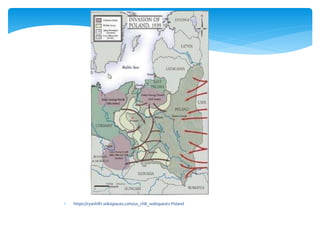
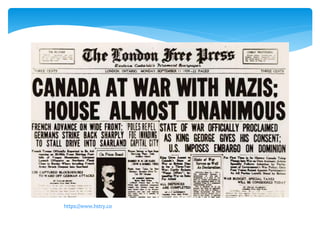
 1st—German invasion of Poland
 3rd—Britain declares war
 10th—Canada declares war with 4 voting NO
 King isolationist but supported Britain
 Canada became bridge between Britain and U.S.
September 1939
 https://ryanhill1.wikispaces.com/us_ch8_webquest2-Poland
https://www.hstry.co
 Depression to end after decade
 Farming at 50% capacity
 Industry at 50% capacity
 Jobless rate effectively at 50%
 Economic suffering gone with declaration of war
 Class divisions reduced
 Regional inequality not as pronounced
 Political confrontation less frequent
World War II
Cured many Canadian Issues
 Support of effort
 Volunteering for service—10,000
 Unemployed had jobs again
 Prime Minister King wanted limited liability
 Many trained for air force in Canada
 Knew why Canada fighting—more than Great War
Early Stages of War
 Blitzkrieg—Denmark, Holland, Belgium, Norway,
France
 Britain hanging on barely
 Canada a viable partner
1940
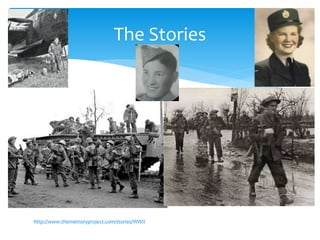
http://www.thememoryproject.com/stories/WWII
The Stories
 National Resources Mobilization Act
 Population of 10,000,000
 Sent 1,000,000 into uniform
 50,000 killed
 30,000 as merchant marines
 No Anglo/Franco balance—recall events of Great War
 QC opposed unless Canada invaded
 QC sent only about half of the numbers of others
 50,000 Francophone served but in Anglo units
 1944 conscription needed
 Called Zombies—60,000
 Not to go overseas—13,000 did go overseas
 2400+ saw combat with some killed
Enlistments and Conscription
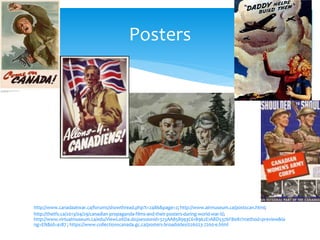
http://www.canadaatwar.ca/forums/showthread.php?t=2486&page=2; http://www.airmuseum.ca/postscan.html;
http://thetfs.ca/2013/04/29/canadian-propaganda-films-and-their-posters-during-world-war-ii/;
http://www.virtualmuseum.ca/edu/ViewLoitDa.do;jsessionid=325AA858993C618962E1ABD5376FB081?method=preview&la
ng=EN&id=4187 ; https://www.collectionscanada.gc.ca/posters-broadsides/026023-7200-e.html
Posters
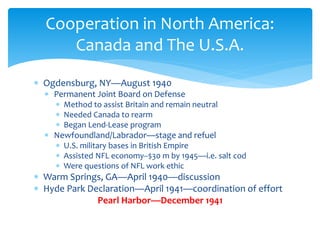
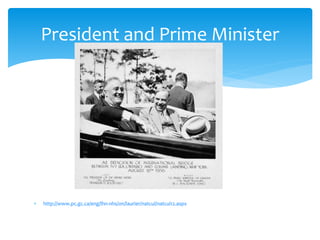
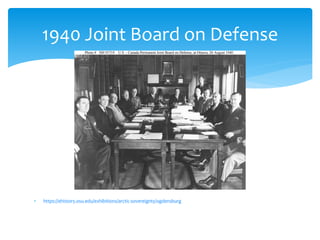
 Ogdensburg, NY—August 1940
 Permanent Joint Board on Defense
 Method to assist Britain and remain neutral
 Needed Canada to rearm
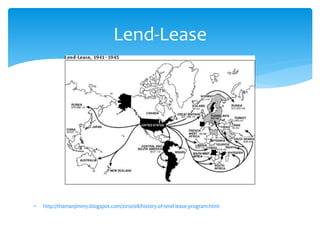
 Began Lend-Lease program
 Newfoundland/Labrador—stage and refuel
 U.S. military bases in British Empire
 Assisted NFL economy--$30 m by 1945—i.e. salt cod
 Were questions of NFL work ethic
 Warm Springs, GA—April 1940—discussion
 Hyde Park Declaration—April 1941—coordination of effort
Pearl Harbor—December 1941
Cooperation in North America:
Canada and The U.S.A.
 http://www.pc.gc.ca/eng/lhn-nhs/on/laurier/natcul/natcul12.aspx
President and Prime Minister
 https://ehistory.osu.edu/exhibitions/arctic-sovereignty/ogdensburg
1940 Joint Board on Defense
 http://thamanjimmy.blogspot.com/2010/08/history-of-lend-lease-program.html
Lend-Lease
 Quebec 1943 and 1944
 Included Churchill in these meetings
 Initiated talks for
 Alaskan highway
 Oil pipeline
 Founding member of United Nations
Continued Meetings
 FDR, Churchill, and King
 No trenches this war
 Air force more powerful role
 Commander—General McNaughton
 Military served for entire war—unlike World War I
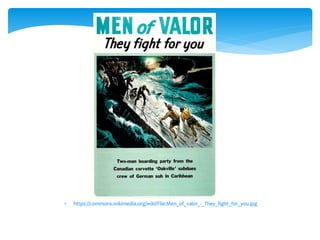
 Royal Canadian Navy—convoys to Europe
 Canada in Italy and northern Europe—few in Pacific
Battle Front
Military Contribution
 Training
 131,000+ trained on Canadian soil [72,800+ Canadians]
 Camp Borden, ON
 Bombers
https://en.wikipedia.org/wiki/History_of_the_Royal_Canadian_Air_Force
RCAF
 https://commons.wikimedia.org/wiki/File:Men_of_valor_-_They_fight_for_you.jpg
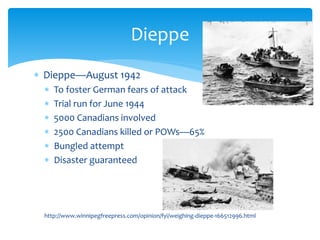
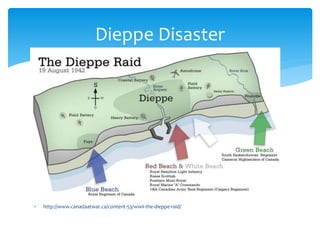
 Dieppe—August 1942
 To foster German fears of attack
 Trial run for June 1944
 5000 Canadians involved
 2500 Canadians killed or POWs—65%
 Bungled attempt
 Disaster guaranteed
http://www.winnipegfreepress.com/opinion/fyi/weighing-dieppe-166512996.html
Dieppe
 http://www.canadaatwar.ca/content-53/wwii-the-dieppe-raid/
Dieppe Disaster
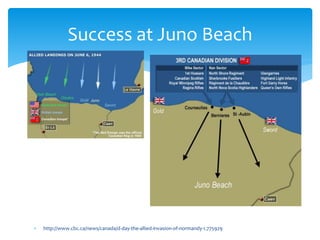
 D-Day—June 6, 1944
 Almost two years after disaster at Dieppe
 Juno Beach—site of Canadian troops landing
 Much more successful than Dieppe
D-Day
 http://www.cbc.ca/news/canada/d-day-the-allied-invasion-of-normandy-1.775929
Success at Juno Beach
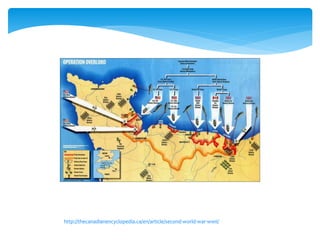
http://thecanadianencyclopedia.ca/en/article/second-world-war-wwii/
 Canada 3rd largest navy
 Canada 4th largest air force
 Canada 5th largest army
Canada Looked Good
By the end of World War II
 Politics
 Financing the war effort
 Primary Activities
 Secondary Activities
 Women in war effort
 Victory Gardens
 Dissidents and Internment
 Propaganda
 Culture
Home front
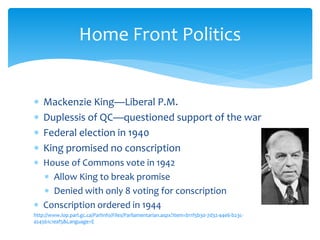
 Mackenzie King—Liberal P.M.
 Duplessis of QC—questioned support of the war
 Federal election in 1940
 King promised no conscription
 House of Commons vote in 1942
 Allow King to break promise
 Denied with only 8 voting for conscription
 Conscription ordered in 1944
http://www.lop.parl.gc.ca/ParlInfo/Files/Parliamentarian.aspx?Item=b11f5b30-7d32-44e6-b23c-
a24561c1eaf5&Language=E
Home Front Politics
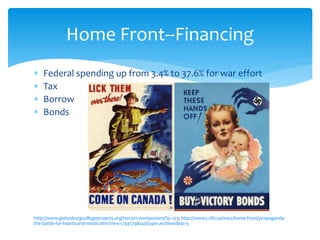
 Federal spending up from 3.4% to 37.6% for war effort
 Tax
 Borrow
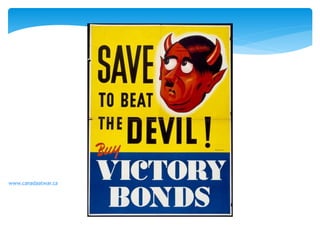
 Bonds
http://www.gettysburgcollegeprojects.org/hist301-wwIIposters/?p=123; http://www3.nfb.ca/ww2/home-front/propaganda-
the-battle-for-hearts-and-minds.htm?view=734779&subtype=archives&rp=5
Home Front--Financing
www.canadaatwar.ca
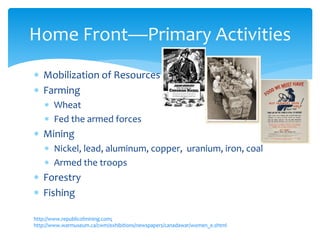
 Mobilization of Resources
 Farming
 Wheat
 Fed the armed forces
 Mining
 Nickel, lead, aluminum, copper, uranium, iron, coal
 Armed the troops
 Forestry
 Fishing
http://www.republicofmining.com;
http://www.warmuseum.ca/cwm/exhibitions/newspapers/canadawar/women_e.shtml
Home Front—Primary Activities
http://www3.nfb.ca/ww2/home-front/propaganda-the-battle-for-hearts-and-minds.htm?view=734701&subtype=archives&rp=3
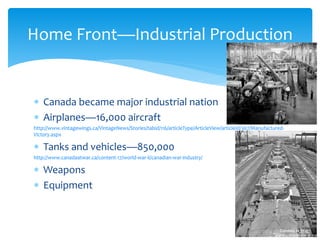
 Canada became major industrial nation
 Airplanes—16,000 aircraft
http://www.vintagewings.ca/VintageNews/Stories/tabid/116/articleType/ArticleView/articleId/367/Manufactured-
Victory.aspx
 Tanks and vehicles—850,000
http://www.canadaatwar.ca/content-17/world-war-ii/canadian-war-industry/
 Weapons
 Equipment
Home Front—Industrial Production
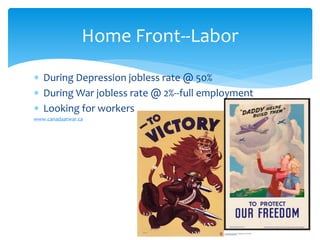
 During Depression jobless rate @ 50%
 During War jobless rate @ 2%--full employment
 Looking for workers
www.canadaatwar.ca
Home Front--Labor
 Regional disparities
 Maritimes hurt—
 U.S. competition—coal, steel, shipyards
 No crown corporations
 Labor relations
 Strikes—wages and conditions
 Union recognition in 1944
 Manpower issues—Clarence Howe mobilized
production
 Department of Munitions and Supplies
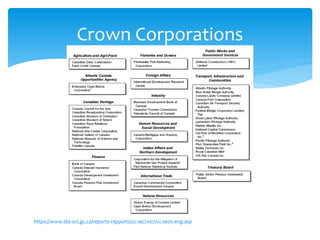
 Crown Corporations formed--28
Weaknesses in Economy
https://www.tbs-sct.gc.ca/reports-rapports/cc-se/2007/cc-se05-eng.asp
Crown Corporations
 University emphasis on medicine, science,
engineering
 Student loans if in preferred field
 Humanities students declined
 National Research Council
 Bounced back after cuts in 1930s
 Radar
 Nuclear research—nuclear reactor at Chulk River
 Jet engines in 1950s
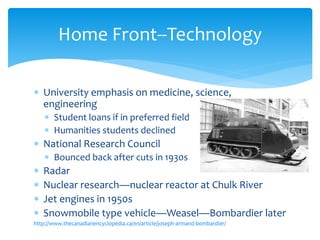
 Snowmobile type vehicle—Weasel—Bombardier later
http://www.thecanadianencyclopedia.ca/en/article/joseph-armand-bombardier/
Home Front--Technology
 Before the war
 Single women—teacher, secretary, service, retail
 After 1939 even married women worked
 50,000 in uniform—unequal work
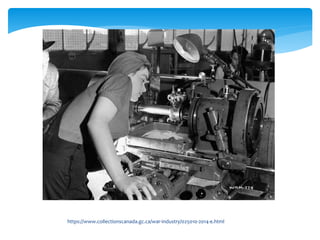
 Factory work—Bren Gun Girl [Rosie, the Riveter]
 1/3 of work force YET
 “Used to boredom of housekeeping” therefore would work in factory
 Unequal $$$
 Feared they would break down due to rigors of the work
 Rationing
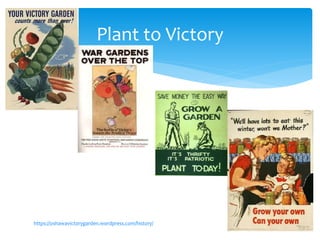
 Victory gardens
 Buy bonds
 Family Allowance Act—continues today—Mothers only
 Help pay for food, shelter, clothing
 Moms with children under 16
 Support those serving and then give up jobs upon return of vets
Women in War Era
https://www.collectionscanada.gc.ca/war-industry/025010-2014-e.html
Plant to Victory
https://oshawavictorygarden.wordpress.com/history/
 Mennonites—pacifists, CO status, alternative service
 Germans—suspect as enemy
 Ukrainians—suspect due to Soviet hatred
 Japanese-Canadians
 Issei—born in Japan or Hawaii
 Kibei—born in Canada, educated by Japanese
 Nisei—born in Canada, educated in Canada, citizens
 Frank Underhill—dismissed over “In Flander’s Field”
Dissidents and Suspects
 Canadians defeated in defense of Hong Kong
 Relocation—denied basic civil rights
 Most from BC
 Most were Canadian citizens
 Took property—farms, fishing boats—sold all; no payment
 22,000 relocated inland and forced to work and pay expenses
 Not one spy uncovered yet…
 Tried to deport until 1947
 Apology in 1980s
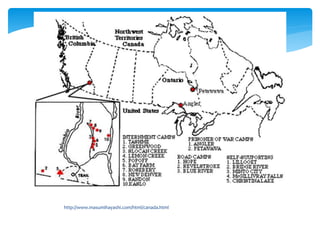
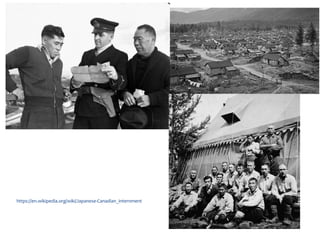
Japanese Canadians
http://www.masumihayashi.com/html/canada.html
https://en.wikipedia.org/wiki/Japanese-Canadian_internment
 Radio—chief entertainment
 Music, drama
 News of the day—Lorne Greene noon and 11 p.m.
 CBC—played politics—one side only—monopoly
 U.S. broadcasts
 Information services—propaganda
 Editorials—prevent disunity
 Citizen education—maintain hope and faith
 Films--@ 10 cents—color, musicals, Hollywood
 Government Film Commission
 National Film Board
 Cinema as pulpit—mind bending
 Intense dislike of Hollywood
 Narrations of documentaries—Lorne Greene [Voice of Doom]
http://www.thecanadianencyclopedia.ca/en/article/lorne-greene/
Home Front—Info Mgt.
 Soldiers waiting for deployment
 Blind pigs
 Gambling dens
 Dance halls
 Big bands—Oscar Peterson and jazz
 Vice and VD [STDs]
http://www.montrealites.ca/origins/2015/04/jazztown-montreal-a-history.html#.Vw5ibjArK70;
http://thejazzline.com/news/2011/03/a-piano-lesson-with-oscar-peterson/
Montreal—City of Night Life
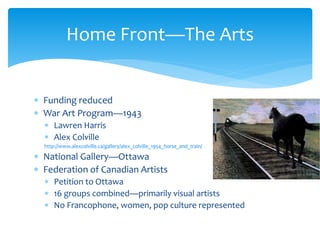
 Funding reduced
 War Art Program—1943
 Lawren Harris
 Alex Colville
http://www.alexcolville.ca/gallery/alex_colville_1954_horse_and_train/
 National Gallery—Ottawa
 Federation of Canadian Artists
 Petition to Ottawa
 16 groups combined—primarily visual artists
 No Francophone, women, pop culture represented
Home Front—The Arts
 VE Day—few Canadians left at war—May 8, 1945
 UN organization 1945
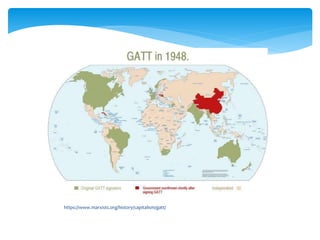
 GATT—Canada signed in 1947
 Canada: LARGEST of the lesser powers
 Shift in social policy after World War II
https://en.wikipedia.org/wiki/Flag_of_the_United_Nations
Post War Era
https://www.marxists.org/history/capitalism/gatt/
 Anonymous. “Economic Defence Geared Now to Dominion’s Needs,” The Hamilton
Spectator. September 9, 1939
 Anonymous. “The Conscription Issue,” The Globe and Mail. September 19, 1939.
 Anonymous. “More Restrictive Orders May be Passed Before Long,” The Hamilton
Spectator. November 26, 1940,
 Anonymous. “Women In Industry,” The Globe and Mail. December 26, 1941.
 Howe, C.D. “Civilians to Help By Curbing Buying,” The Globe and Mail. January 8, 1942.
 Anonymous. “$180,000,000 Family Bonus a Fantastic Proposal,” Toronto Telegram.
September 17, 1943.
 Bumstead, J. M.. The Peoples of Canada: A Post Confederation History. Don Mills, Ontario:
Oxford University Press, 2008. [pages 287-298 and 301-316]
 Fukawa, Masako, Project Leader. Internment and Redress: The Japanese Canadian
Experience. Burnaby, B.C.: The Japanese Canadian National Museum, 2011.
<http://www.japanesecanadianhistory.net/GuideExcerptsForSocialStudies11.pdf>
 Nova Scotia. Office of Legislative Counsel, Nova Scotia House of Assembly. The Statute of
Westminster, 1931. Halifax: LEGC, 2001. <http://nslegislature.ca/legc/westmins.htm>
 http://www.thememoryproject.com/stories/WWII
 http://www.warmuseum.ca/cwm/exhibitions/newspapers/canadawar/homefront_e.shtml
Resources

World War II

  • 1.
  • 2.
     Isolated  Domesticagenda only  Foreign affairs determined by Britain--colonialism  Geography isolated and insulated  Francophone saw self as autonomous Canada before 1914
  • 3.
     Canada brokeimperial ties—Statute of Westminster  Became Commonwealth Nation—1931  Began to create own foreign diplomacy  Department of External Affairs [U.S. State Dept.]  U.S. seen as potential enemy in 1920s  BTW--U.S. still did have invasion plan in 1930s Interwar Period—1918-1939
  • 4.
     Born May1934 in Ontario near Quebec border  Annette, Emilie, Yvonne, Cecile, Marie  Born two months premature—weighed total of 14#  Parents were French Catholic poor with 5 others  First set to survive infancy—”miracle babies”  Taken from parents after father signed contract with Chicago World’s Fair—protect girls from germs, kidnappers, exploitation Dionne Quintuplets
  • 5.
  • 6.
     Became Canada’slargest tourist attraction by 1937  3000 visitors each day—playground surrounded by glass  Dolls; post cards; ads for cereal, bonds, honey, soap  Admission and parking free—souvenirs pricey  Custody battle—returned home at age 9—sad life  Moved out at age 18—cut off most family contact  Emilie—nun died of seizure in 1954; Marie died 1970  3 married and divorced—children  Later lived together near Montreal on $746 total per month  Book written; questions raised  By 2000 reached settlement of $4 million  Two still survive—Annette and Cecile [2016]
  • 7.
     Every littlegirl had to have all five dolls for Christmas. http://www.museumofplay.org/online-collections/2/10/77.3253  http://www.neonatology.org/pinups/dionne.html  https://en.wikipedia.org/wiki/Dionne_quintuplets with their parents and priest--1947 Dionne Commercialism
  • 8.
    Nation obsessed withDionne’s Europe preparing for another conflict Appeasement not successful Transition to War
  • 9.
     May 1939 937 Jewish refugees  Could not dock in Cuba  Rejected by both U.S. & Canada http://www.jewishvirtuallibrary.org/jsource/Holocaust/stlouis.html Voyage of the S.S. St. Louis
  • 10.
     Canada notwelcoming—only 4000 Jewish immigrants  “None is too many”—1938 restrictions  Prime Minister King & Hitler met  Did not realize agenda of Nazi leader  Anti-Semitism especially in QC--demonstrations  Catholic  Francophone nationalistic movement  Suspicious of Jewish immigrants  Skilled professionals lost to Canada Reaction to Holocaust
  • 11.
    Canada swept intoevents  Rise of fascist and military governments in Europe  Appeasement bought some time  Canadian debated neutrality in House of Commons  Global war by 1939  Canada had little control yet knew why fighting  No grumbling  No expectation of benefit  Altruism
  • 12.
     Commonwealth status Could make own decision this war  Independent of Britain  Not like World War I http://www.thecanadianencyclopedia.ca/en/article/statute-of-westminster/ Statute of Westminster 1931
  • 13.
     Economic responsefirst  First time made independent decision  Statute of Westminster--1931  Sovereignty issue  Canada was one MAJOR ally of Britain  Symbolic delay of few days  Only a few opposed war  Pacifists  Given White Feathers  First Canadian troops arrived December 1939  U.S. and Canada—mutual defense initiatives Canada enters War
  • 14.
     1st—German invasionof Poland  3rd—Britain declares war  10th—Canada declares war with 4 voting NO  King isolationist but supported Britain  Canada became bridge between Britain and U.S. September 1939
  • 15.
  • 16.
  • 17.
     Depression toend after decade  Farming at 50% capacity  Industry at 50% capacity  Jobless rate effectively at 50%  Economic suffering gone with declaration of war  Class divisions reduced  Regional inequality not as pronounced  Political confrontation less frequent World War II Cured many Canadian Issues
  • 18.
     Support ofeffort  Volunteering for service—10,000  Unemployed had jobs again  Prime Minister King wanted limited liability  Many trained for air force in Canada  Knew why Canada fighting—more than Great War Early Stages of War
  • 19.
     Blitzkrieg—Denmark, Holland,Belgium, Norway, France  Britain hanging on barely  Canada a viable partner 1940
  • 20.
  • 21.
     National ResourcesMobilization Act  Population of 10,000,000  Sent 1,000,000 into uniform  50,000 killed  30,000 as merchant marines  No Anglo/Franco balance—recall events of Great War  QC opposed unless Canada invaded  QC sent only about half of the numbers of others  50,000 Francophone served but in Anglo units  1944 conscription needed  Called Zombies—60,000  Not to go overseas—13,000 did go overseas  2400+ saw combat with some killed Enlistments and Conscription
  • 22.
  • 23.
     Ogdensburg, NY—August1940  Permanent Joint Board on Defense  Method to assist Britain and remain neutral  Needed Canada to rearm  Began Lend-Lease program  Newfoundland/Labrador—stage and refuel  U.S. military bases in British Empire  Assisted NFL economy--$30 m by 1945—i.e. salt cod  Were questions of NFL work ethic  Warm Springs, GA—April 1940—discussion  Hyde Park Declaration—April 1941—coordination of effort Pearl Harbor—December 1941 Cooperation in North America: Canada and The U.S.A.
  • 24.
  • 25.
  • 26.
  • 27.
     Quebec 1943and 1944  Included Churchill in these meetings  Initiated talks for  Alaskan highway  Oil pipeline  Founding member of United Nations Continued Meetings
  • 28.
     FDR, Churchill,and King  No trenches this war  Air force more powerful role  Commander—General McNaughton  Military served for entire war—unlike World War I  Royal Canadian Navy—convoys to Europe  Canada in Italy and northern Europe—few in Pacific Battle Front Military Contribution
  • 29.
     Training  131,000+trained on Canadian soil [72,800+ Canadians]  Camp Borden, ON  Bombers https://en.wikipedia.org/wiki/History_of_the_Royal_Canadian_Air_Force RCAF
  • 30.
  • 31.
     Dieppe—August 1942 To foster German fears of attack  Trial run for June 1944  5000 Canadians involved  2500 Canadians killed or POWs—65%  Bungled attempt  Disaster guaranteed http://www.winnipegfreepress.com/opinion/fyi/weighing-dieppe-166512996.html Dieppe
  • 32.
  • 33.
     D-Day—June 6,1944  Almost two years after disaster at Dieppe  Juno Beach—site of Canadian troops landing  Much more successful than Dieppe D-Day
  • 34.
  • 35.
  • 36.
     Canada 3rdlargest navy  Canada 4th largest air force  Canada 5th largest army Canada Looked Good By the end of World War II
  • 37.
     Politics  Financingthe war effort  Primary Activities  Secondary Activities  Women in war effort  Victory Gardens  Dissidents and Internment  Propaganda  Culture Home front
  • 38.
     Mackenzie King—LiberalP.M.  Duplessis of QC—questioned support of the war  Federal election in 1940  King promised no conscription  House of Commons vote in 1942  Allow King to break promise  Denied with only 8 voting for conscription  Conscription ordered in 1944 http://www.lop.parl.gc.ca/ParlInfo/Files/Parliamentarian.aspx?Item=b11f5b30-7d32-44e6-b23c- a24561c1eaf5&Language=E Home Front Politics
  • 39.
     Federal spendingup from 3.4% to 37.6% for war effort  Tax  Borrow  Bonds http://www.gettysburgcollegeprojects.org/hist301-wwIIposters/?p=123; http://www3.nfb.ca/ww2/home-front/propaganda- the-battle-for-hearts-and-minds.htm?view=734779&subtype=archives&rp=5 Home Front--Financing
  • 40.
  • 41.
     Mobilization ofResources  Farming  Wheat  Fed the armed forces  Mining  Nickel, lead, aluminum, copper, uranium, iron, coal  Armed the troops  Forestry  Fishing http://www.republicofmining.com; http://www.warmuseum.ca/cwm/exhibitions/newspapers/canadawar/women_e.shtml Home Front—Primary Activities
  • 42.
  • 43.
     Canada becamemajor industrial nation  Airplanes—16,000 aircraft http://www.vintagewings.ca/VintageNews/Stories/tabid/116/articleType/ArticleView/articleId/367/Manufactured- Victory.aspx  Tanks and vehicles—850,000 http://www.canadaatwar.ca/content-17/world-war-ii/canadian-war-industry/  Weapons  Equipment Home Front—Industrial Production
  • 44.
     During Depressionjobless rate @ 50%  During War jobless rate @ 2%--full employment  Looking for workers www.canadaatwar.ca Home Front--Labor
  • 45.
     Regional disparities Maritimes hurt—  U.S. competition—coal, steel, shipyards  No crown corporations  Labor relations  Strikes—wages and conditions  Union recognition in 1944  Manpower issues—Clarence Howe mobilized production  Department of Munitions and Supplies  Crown Corporations formed--28 Weaknesses in Economy
  • 46.
  • 47.
     University emphasison medicine, science, engineering  Student loans if in preferred field  Humanities students declined  National Research Council  Bounced back after cuts in 1930s  Radar  Nuclear research—nuclear reactor at Chulk River  Jet engines in 1950s  Snowmobile type vehicle—Weasel—Bombardier later http://www.thecanadianencyclopedia.ca/en/article/joseph-armand-bombardier/ Home Front--Technology
  • 48.
     Before thewar  Single women—teacher, secretary, service, retail  After 1939 even married women worked  50,000 in uniform—unequal work  Factory work—Bren Gun Girl [Rosie, the Riveter]  1/3 of work force YET  “Used to boredom of housekeeping” therefore would work in factory  Unequal $$$  Feared they would break down due to rigors of the work  Rationing  Victory gardens  Buy bonds  Family Allowance Act—continues today—Mothers only  Help pay for food, shelter, clothing  Moms with children under 16  Support those serving and then give up jobs upon return of vets Women in War Era
  • 49.
  • 50.
  • 51.
     Mennonites—pacifists, COstatus, alternative service  Germans—suspect as enemy  Ukrainians—suspect due to Soviet hatred  Japanese-Canadians  Issei—born in Japan or Hawaii  Kibei—born in Canada, educated by Japanese  Nisei—born in Canada, educated in Canada, citizens  Frank Underhill—dismissed over “In Flander’s Field” Dissidents and Suspects
  • 52.
     Canadians defeatedin defense of Hong Kong  Relocation—denied basic civil rights  Most from BC  Most were Canadian citizens  Took property—farms, fishing boats—sold all; no payment  22,000 relocated inland and forced to work and pay expenses  Not one spy uncovered yet…  Tried to deport until 1947  Apology in 1980s Japanese Canadians
  • 53.
  • 54.
  • 55.
     Radio—chief entertainment Music, drama  News of the day—Lorne Greene noon and 11 p.m.  CBC—played politics—one side only—monopoly  U.S. broadcasts  Information services—propaganda  Editorials—prevent disunity  Citizen education—maintain hope and faith  Films--@ 10 cents—color, musicals, Hollywood  Government Film Commission  National Film Board  Cinema as pulpit—mind bending  Intense dislike of Hollywood  Narrations of documentaries—Lorne Greene [Voice of Doom] http://www.thecanadianencyclopedia.ca/en/article/lorne-greene/ Home Front—Info Mgt.
  • 56.
     Soldiers waitingfor deployment  Blind pigs  Gambling dens  Dance halls  Big bands—Oscar Peterson and jazz  Vice and VD [STDs] http://www.montrealites.ca/origins/2015/04/jazztown-montreal-a-history.html#.Vw5ibjArK70; http://thejazzline.com/news/2011/03/a-piano-lesson-with-oscar-peterson/ Montreal—City of Night Life
  • 57.
     Funding reduced War Art Program—1943  Lawren Harris  Alex Colville http://www.alexcolville.ca/gallery/alex_colville_1954_horse_and_train/  National Gallery—Ottawa  Federation of Canadian Artists  Petition to Ottawa  16 groups combined—primarily visual artists  No Francophone, women, pop culture represented Home Front—The Arts
  • 58.
     VE Day—fewCanadians left at war—May 8, 1945  UN organization 1945  GATT—Canada signed in 1947  Canada: LARGEST of the lesser powers  Shift in social policy after World War II https://en.wikipedia.org/wiki/Flag_of_the_United_Nations Post War Era
  • 59.
  • 60.
     Anonymous. “EconomicDefence Geared Now to Dominion’s Needs,” The Hamilton Spectator. September 9, 1939  Anonymous. “The Conscription Issue,” The Globe and Mail. September 19, 1939.  Anonymous. “More Restrictive Orders May be Passed Before Long,” The Hamilton Spectator. November 26, 1940,  Anonymous. “Women In Industry,” The Globe and Mail. December 26, 1941.  Howe, C.D. “Civilians to Help By Curbing Buying,” The Globe and Mail. January 8, 1942.  Anonymous. “$180,000,000 Family Bonus a Fantastic Proposal,” Toronto Telegram. September 17, 1943.  Bumstead, J. M.. The Peoples of Canada: A Post Confederation History. Don Mills, Ontario: Oxford University Press, 2008. [pages 287-298 and 301-316]  Fukawa, Masako, Project Leader. Internment and Redress: The Japanese Canadian Experience. Burnaby, B.C.: The Japanese Canadian National Museum, 2011. <http://www.japanesecanadianhistory.net/GuideExcerptsForSocialStudies11.pdf>  Nova Scotia. Office of Legislative Counsel, Nova Scotia House of Assembly. The Statute of Westminster, 1931. Halifax: LEGC, 2001. <http://nslegislature.ca/legc/westmins.htm>  http://www.thememoryproject.com/stories/WWII  http://www.warmuseum.ca/cwm/exhibitions/newspapers/canadawar/homefront_e.shtml Resources

Editor's Notes

  • #7 Quintland hospital here 3 million tourists visited [1934-1943] Hollywood exploitation—four movies Dolls marketed
  • #8 Dolls [pbs.org] 3 more sons born after quints Annette and Cecile remain
  • #10 http://www.jewishvirtuallibrary.org/jsource/Holocaust/stlouis.html