THE KOREAN WAR
Setting the Scene
“America’s forgotten war”
Americans struggled to push
back the Communists, who
had made huge advances
Both sides dug into their
positions
“sitting war”
Roots
Chinese Civil War
Foreign powers exerted influence on and
held some small possessions of Chinese
territory
Japan and Germany were involved
Japan got control of German
possessions there after WWI, increasing
Japanese power in China
China called for a stronger, more
independent country
Democracy, nationalism, or
communism
Nationalist Party
Nationalists in the north
(Chiang Kai-shek)
Communists in the south (Mao
Zedong) around Shanghai
This led to a civil war in 1927
when Chiang sent troops to
attack the Communists and
their supporters
Mao
Gained support for the Communist cause
by redistributing land to the peasants
and offering the schooling and health
care.
This division continued for a long time
between the groups, after WWII
Nationalists lost support b/c of their
harsh treatment of the population, high
taxes, and corruption
Mao’s land reforms and his promise of
equality and military victories led
Communists to power in 1949
Nationalists fled to Taiwan
Dividing Korea
Before WWI, Japan also annexed
the Korean peninsula
Harsh rule by the Japanese
Koreans hoped that the defeat of
Japan would lead to restoration of
their own power
WWII ended before the plans for
Korean independence could be
worked out
Major Players
Kim Il Sung: unify Korea under
Communism. Ruled from 1948
to 1994.
Father of Kim Jong-Il. He ruled
from 1994 to 2011
Syngman Rhee: anti-
communist dictator.
Family Lineage
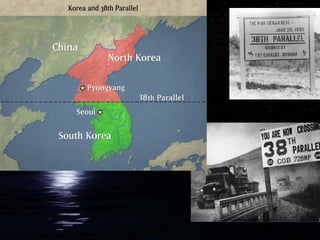
38th Parallel
Allies agreed on a temporary solution
Soviet soldiers accepted the
surrender of Japanese troops north of
the 38th parallel, which was the
latitude line running across Korea at
the midpoint of the peninsula
Americans did the same south of the
parallel
It was never meant to be permanent
It created a Soviet-occupied northern
zone and an American occupied
southern zone
Korean War
Koreans wanted to unify their nation
on both sides of the line
North Korean troops streamed across
the 38th parallel, hoping to reunite
Korea by force
Americans thought this was Soviet-
led, a case of aggression
Truman felt that if the Americans did
not respond, Communism would
spread
He believed WWIII would start if the
US did not intervene
UN Police Action
The UN blocked Communist
China’s admission to the UN in
1949
Soviets walked out in protest
Thus could not exercise its veto
power when Truman brought up
the issue of North Korean
aggression to the UN
The US gained unanimous
approval for resolutions that
branded North Korea as an
aggressor
Truman’s steps
Protected Taiwan
Ordered US air and naval support
for the South Koreans
Sent ground troops in
He did NOT go to Congress and
ask for a declaration of war, but
Congress was very supportive
UN set up 16 nations to contribute
troops or arms, but the US was
80% of the force
Douglas MacArthur
MacArthur was Truman’s
choice to lead the UN forces in
Korea
Based in Japan
Responsible for establishing
western democracy there and
for creating Japan’s new
democratic constitution
North Korean advance
North Korean troops swept through
South Korea in a few weeks
MacArthur defended Pusan (SE
South Korea), and then landed
troops at Inchon (NW South Korea)
and attacked enemy supply lines
from behind
The strategy worked, and the
North Koreans fled back across the
38th parallel
United Nations Police Action
July
1950
Commander-in-
Chief of the
United Nations
Command.
August
1950
China’s warning
China was concerned that the
South Koreans and Americans
would take power
They threatened the US not to
advance any further
MacArthur ignored them
“Home by Christmas” drive: Nov.
24, 1950, designed to drive the
enemy across the North Korean
border at the Yalu River in to China
and end the war
That didn’t work...
Chinese troops poured across
the Yalu River into North
Korea to take the offensive
Chinese and North Korean
troops pushed the UN forces
back into South Korea
Led to a stalemate
MacArthur’s next steps
Wanted to open a second front to
break stalemate
He wanted Jiang’s forces at
Taiwan to return to the Chinese
mainland to attack the Chinese
Communists
Truman was opposed to this,
fearing it could lead to a
widespread war in Asia
The letter
MacArthur sent a letter to House
Minority Leader Joseph Martin in
March 1951
Attacked the president’s policies
Martin made the letter public
On April 11th, Truman fired
MacArthur for insubordination
He received a hero’s welcome
when he came back
United Nations Police Action
October-
November 1950
November-
January 1951
Until July 1953:
Truce Line
War continues...
The war dragged on for over two
more years
Truman now very unpopular, did not
have a good approval rating
Eisenhower came in, wanted peace
talks
Ike threatened to use atomic
weapons
A truce was signed in 1953, leaving
Korea divided at about the 38th
parallel
Effects of the war
36,000 American soldiers killed
103,000 wounded
Limited results
Communist forces were pushed
back
Containment occurred without
nuclear war
Other effects...
Korean War was the first in which
white and African Americans served
in the same units
Huge increase in military spending
By 1960, 1/2 of budget went to
defense
1/2 million soldiers stationed around
the world: permanent mobilization
Military-industrial complex: employed
3.5 million Americans by 1960: kept
the arsenal going
Effects
Military Industrial
Complex
Lost any chance
of positive political
relations with
China.
Public
dissatisfaction
with not being the
“winners”.
Desegregated
military units.

Korean War

  • 1.
  • 3.
    Setting the Scene “America’sforgotten war” Americans struggled to push back the Communists, who had made huge advances Both sides dug into their positions “sitting war”
  • 4.
    Roots Chinese Civil War Foreignpowers exerted influence on and held some small possessions of Chinese territory Japan and Germany were involved Japan got control of German possessions there after WWI, increasing Japanese power in China China called for a stronger, more independent country Democracy, nationalism, or communism
  • 5.
    Nationalist Party Nationalists inthe north (Chiang Kai-shek) Communists in the south (Mao Zedong) around Shanghai This led to a civil war in 1927 when Chiang sent troops to attack the Communists and their supporters
  • 6.
    Mao Gained support forthe Communist cause by redistributing land to the peasants and offering the schooling and health care. This division continued for a long time between the groups, after WWII Nationalists lost support b/c of their harsh treatment of the population, high taxes, and corruption Mao’s land reforms and his promise of equality and military victories led Communists to power in 1949 Nationalists fled to Taiwan
  • 7.
    Dividing Korea Before WWI,Japan also annexed the Korean peninsula Harsh rule by the Japanese Koreans hoped that the defeat of Japan would lead to restoration of their own power WWII ended before the plans for Korean independence could be worked out
  • 8.
    Major Players Kim IlSung: unify Korea under Communism. Ruled from 1948 to 1994. Father of Kim Jong-Il. He ruled from 1994 to 2011 Syngman Rhee: anti- communist dictator.
  • 9.
  • 10.
    38th Parallel Allies agreedon a temporary solution Soviet soldiers accepted the surrender of Japanese troops north of the 38th parallel, which was the latitude line running across Korea at the midpoint of the peninsula Americans did the same south of the parallel It was never meant to be permanent It created a Soviet-occupied northern zone and an American occupied southern zone
  • 12.
    Korean War Koreans wantedto unify their nation on both sides of the line North Korean troops streamed across the 38th parallel, hoping to reunite Korea by force Americans thought this was Soviet- led, a case of aggression Truman felt that if the Americans did not respond, Communism would spread He believed WWIII would start if the US did not intervene
  • 13.
    UN Police Action TheUN blocked Communist China’s admission to the UN in 1949 Soviets walked out in protest Thus could not exercise its veto power when Truman brought up the issue of North Korean aggression to the UN The US gained unanimous approval for resolutions that branded North Korea as an aggressor
  • 14.
    Truman’s steps Protected Taiwan OrderedUS air and naval support for the South Koreans Sent ground troops in He did NOT go to Congress and ask for a declaration of war, but Congress was very supportive UN set up 16 nations to contribute troops or arms, but the US was 80% of the force
  • 15.
    Douglas MacArthur MacArthur wasTruman’s choice to lead the UN forces in Korea Based in Japan Responsible for establishing western democracy there and for creating Japan’s new democratic constitution
  • 16.
    North Korean advance NorthKorean troops swept through South Korea in a few weeks MacArthur defended Pusan (SE South Korea), and then landed troops at Inchon (NW South Korea) and attacked enemy supply lines from behind The strategy worked, and the North Koreans fled back across the 38th parallel
  • 18.
    United Nations PoliceAction July 1950 Commander-in- Chief of the United Nations Command. August 1950
  • 19.
    China’s warning China wasconcerned that the South Koreans and Americans would take power They threatened the US not to advance any further MacArthur ignored them “Home by Christmas” drive: Nov. 24, 1950, designed to drive the enemy across the North Korean border at the Yalu River in to China and end the war
  • 20.
    That didn’t work... Chinesetroops poured across the Yalu River into North Korea to take the offensive Chinese and North Korean troops pushed the UN forces back into South Korea Led to a stalemate
  • 21.
    MacArthur’s next steps Wantedto open a second front to break stalemate He wanted Jiang’s forces at Taiwan to return to the Chinese mainland to attack the Chinese Communists Truman was opposed to this, fearing it could lead to a widespread war in Asia
  • 22.
    The letter MacArthur senta letter to House Minority Leader Joseph Martin in March 1951 Attacked the president’s policies Martin made the letter public On April 11th, Truman fired MacArthur for insubordination He received a hero’s welcome when he came back
  • 23.
    United Nations PoliceAction October- November 1950 November- January 1951 Until July 1953: Truce Line
  • 24.
    War continues... The wardragged on for over two more years Truman now very unpopular, did not have a good approval rating Eisenhower came in, wanted peace talks Ike threatened to use atomic weapons A truce was signed in 1953, leaving Korea divided at about the 38th parallel
  • 25.
    Effects of thewar 36,000 American soldiers killed 103,000 wounded Limited results Communist forces were pushed back Containment occurred without nuclear war
  • 26.
    Other effects... Korean Warwas the first in which white and African Americans served in the same units Huge increase in military spending By 1960, 1/2 of budget went to defense 1/2 million soldiers stationed around the world: permanent mobilization Military-industrial complex: employed 3.5 million Americans by 1960: kept the arsenal going
  • 27.
    Effects Military Industrial Complex Lost anychance of positive political relations with China. Public dissatisfaction with not being the “winners”. Desegregated military units.