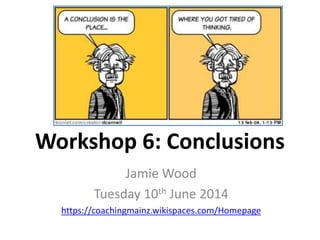
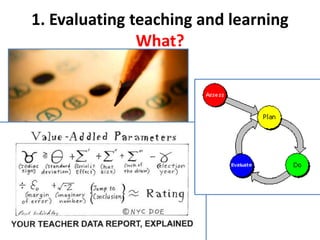
Workshop 6: Conclusions
Jamie Wood
Tuesday 10th June 2014
https://coachingmainz.wikispaces.com/Homepage
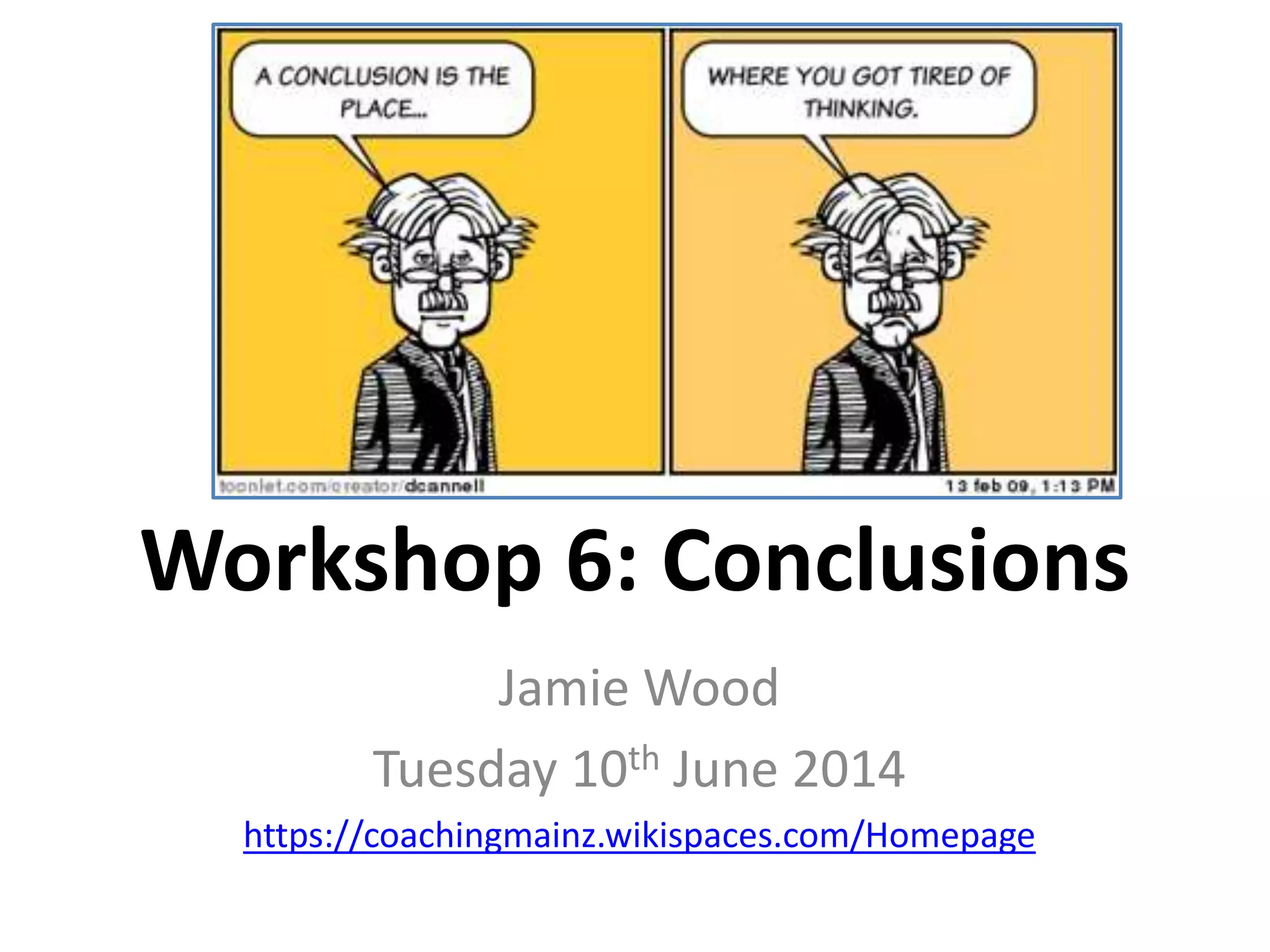
1 practice, 1 theory
1. Evaluating learning
2. Threshold concepts
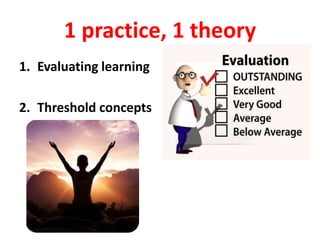
1. Evaluating teaching and learning
What?
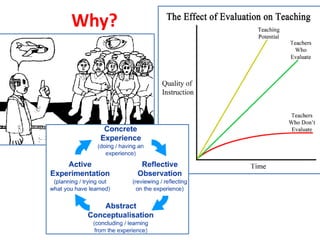
Why?
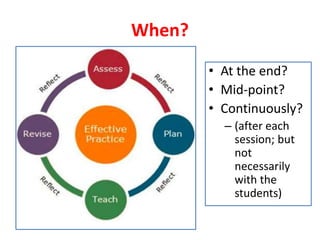
When?
• At the end?
• Mid-point?
• Continuously?
– (after each
session; but
not
necessarily
with the
students)
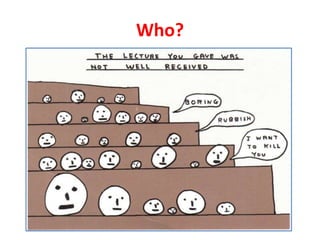
Who?
Who knows best?
– Students
• Students experience more teaching of different types (=
breadth), including in school
• Some are trainee teachers (in Germany)
– Teachers
• Have depth of knowledge and experience
• Have expert disciplinary knowledge and skills
• Have a better understanding of what the overall aim of
T&L is within the discipline
– You…
But…
• “Difficult” topics are often the most
important/ significant (often with hindsight)
– A course that students do not seem to like is not
necessarily a ‘bad’ course
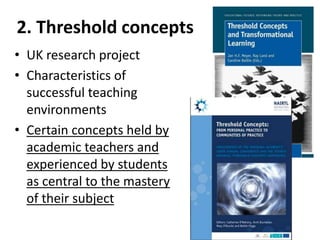
2. Threshold concepts
• UK research project
• Characteristics of
successful teaching
environments
• Certain concepts held by
academic teachers and
experienced by students
as central to the mastery
of their subject
Threshold concepts (i)
• Conceptual gateways/ ‘portals’/
‘bottlenecks’
• Must be passed through (often with
difficultly) to arrive at new understandings
• Involve knowledge, understanding, skills,
practices, dispositions (so, not just
‘concepts’)
• Key to progress within discipline
• Hard to unlearn
• ‘The important feature of a threshold concept
is that it alters the way in which you think
about a subject. So it is not necessarily the
same as a "key", "core", "central" or even
"very important" idea or fact. [...] Nor is it an
instant insight […] they often have to be
worked at very hard.’
(www.doceo.co.uk/tools/threshold_3.htm)
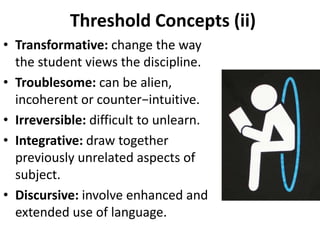
Threshold Concepts (ii)
• Transformative: change the way
the student views the discipline.
• Troublesome: can be alien,
incoherent or counter−intuitive.
• Irreversible: difficult to unlearn.
• Integrative: draw together
previously unrelated aspects of
subject.
• Discursive: involve enhanced and
extended use of language.
• ‘Easy or difficult, obvious or counter to common
sense, neutral or threatening, threshold concepts
are what you need to grasp to join a
community—the community of people who
understand a particular subject. And if we as
teachers want to get others to join this
community, then helping them to understand
(and even to commit themselves to) is the crucial
and critical task.’
(www.bedspce.org.uk/threshold_4.htm)
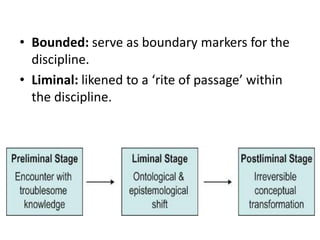
• Bounded: serve as boundary markers for the
discipline.
• Liminal: likened to a ‘rite of passage’ within
the discipline.
Example 1: Opportunity Cost in
Economics
• issue of comparing choices fundamental to
Economics: how individuals, groups, and societies
make choices, esp. when faced with the reality that
resources and alternatives are limited; no-one can
have everything, and in most cases the ‘constraints’
faced by chooser are quite severe and binding
• opportunity cost
– expresses basic relationship between scarcity and choice
– captures idea that choices can be compared; that every
choice (including not choosing) means rejecting
alternatives
– value placed on the rejected option by the chooser = the
obstacle to choice; what must be considered, evaluated
and ultimately rejected before the preferred option is
chosen
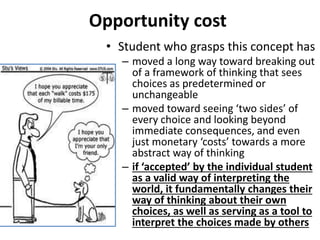
Opportunity cost
• Student who grasps this concept has
– moved a long way toward breaking out
of a framework of thinking that sees
choices as predetermined or
unchangeable
– moved toward seeing ‘two sides’ of
every choice and looking beyond
immediate consequences, and even
just monetary ‘costs’ towards a more
abstract way of thinking
– if ‘accepted’ by the individual student
as a valid way of interpreting the
world, it fundamentally changes their
way of thinking about their own
choices, as well as serving as a tool to
interpret the choices made by others
What might threshold concepts be in
Theology?
• For (limited) literature see:
http://www.ee.ucl.ac.uk/~mflanaga/thresholds.html#relig
• ‘tacit constructs that often sit behind explicit
domain [= subject] knowledge, and may
therefore operate as unrecognised, or at least
unacknowledged, assumptions in a tutor’s
teaching. Critically, […] it is these threshold
concepts that are the real drivers for the core
concepts and discourses within a discipline, and
things that must be made explicit to students if
they are to think effectively in the ways of that
discipline.’
(www.ukcle.ac.uk/resources/directions/previous/
issue17/threshold/)
How might we enable students to
better grasp these concepts?
3 final points
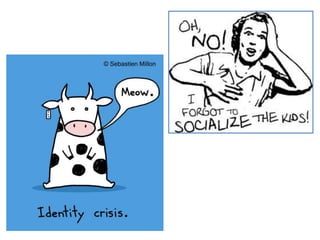
• I learnt: Identity: an under-appreciated
element of T&L
• I observed: Feedback: a small ‘genau’ goes a
long way in class
• I think: Alignment: is key
Your final points
Final feedback forms
References
• Comprehensive online bibliography on threshold concepts (general
and subject-specific advice):
– Threshold Concepts: Undergraduate Teaching, Postgraduate Training and
Professional Development: A short introduction and bibliography (UCL
Department of Electronic and Electrical Engineering):
http://www.ee.ucl.ac.uk/~mflanaga/thresholds.html
• Some specific works:
– Land, Ray, Jan H. F. Meyer and Jan Smith, eds. (2008), Threshold Concepts
within the Disciplines (Rotterdam).
– Meyer, Jan H. F., Ray Land and Caroline Baillie, eds. (2010), Threshold
Concepts and Transformational Learning (Rotterdam).
– Meyer, Jan H. F. and Ray Land, eds. (2006), Overcoming Barriers to
Student Understanding: threshold concepts and troublesome knowledge
(London and New York).
– Wuetherick B. and E. Loeffler (2013), Threshold Concepts and Decoding
the Humanities: A Case Study of a Threshold Concept in Art
History, Threshold Concepts: From Personal Practice to Communities of
Practice (Dublin), pp. 118-122

Workshop 6 - Conclusions

  • 1.
    Workshop 6: Conclusions JamieWood Tuesday 10th June 2014 https://coachingmainz.wikispaces.com/Homepage
  • 2.
    1 practice, 1theory 1. Evaluating learning 2. Threshold concepts
  • 3.
    1. Evaluating teachingand learning What?
  • 4.
  • 5.
    When? • At theend? • Mid-point? • Continuously? – (after each session; but not necessarily with the students)
  • 6.
  • 7.
    Who knows best? –Students • Students experience more teaching of different types (= breadth), including in school • Some are trainee teachers (in Germany) – Teachers • Have depth of knowledge and experience • Have expert disciplinary knowledge and skills • Have a better understanding of what the overall aim of T&L is within the discipline – You…
  • 8.
    But… • “Difficult” topicsare often the most important/ significant (often with hindsight) – A course that students do not seem to like is not necessarily a ‘bad’ course
  • 9.
    2. Threshold concepts •UK research project • Characteristics of successful teaching environments • Certain concepts held by academic teachers and experienced by students as central to the mastery of their subject
  • 10.
    Threshold concepts (i) •Conceptual gateways/ ‘portals’/ ‘bottlenecks’ • Must be passed through (often with difficultly) to arrive at new understandings • Involve knowledge, understanding, skills, practices, dispositions (so, not just ‘concepts’) • Key to progress within discipline • Hard to unlearn
  • 11.
    • ‘The importantfeature of a threshold concept is that it alters the way in which you think about a subject. So it is not necessarily the same as a "key", "core", "central" or even "very important" idea or fact. [...] Nor is it an instant insight […] they often have to be worked at very hard.’ (www.doceo.co.uk/tools/threshold_3.htm)
  • 12.
    Threshold Concepts (ii) •Transformative: change the way the student views the discipline. • Troublesome: can be alien, incoherent or counter−intuitive. • Irreversible: difficult to unlearn. • Integrative: draw together previously unrelated aspects of subject. • Discursive: involve enhanced and extended use of language.
  • 13.
    • ‘Easy ordifficult, obvious or counter to common sense, neutral or threatening, threshold concepts are what you need to grasp to join a community—the community of people who understand a particular subject. And if we as teachers want to get others to join this community, then helping them to understand (and even to commit themselves to) is the crucial and critical task.’ (www.bedspce.org.uk/threshold_4.htm)
  • 14.
    • Bounded: serveas boundary markers for the discipline. • Liminal: likened to a ‘rite of passage’ within the discipline.
  • 16.
    Example 1: OpportunityCost in Economics • issue of comparing choices fundamental to Economics: how individuals, groups, and societies make choices, esp. when faced with the reality that resources and alternatives are limited; no-one can have everything, and in most cases the ‘constraints’ faced by chooser are quite severe and binding • opportunity cost – expresses basic relationship between scarcity and choice – captures idea that choices can be compared; that every choice (including not choosing) means rejecting alternatives – value placed on the rejected option by the chooser = the obstacle to choice; what must be considered, evaluated and ultimately rejected before the preferred option is chosen
  • 17.
    Opportunity cost • Studentwho grasps this concept has – moved a long way toward breaking out of a framework of thinking that sees choices as predetermined or unchangeable – moved toward seeing ‘two sides’ of every choice and looking beyond immediate consequences, and even just monetary ‘costs’ towards a more abstract way of thinking – if ‘accepted’ by the individual student as a valid way of interpreting the world, it fundamentally changes their way of thinking about their own choices, as well as serving as a tool to interpret the choices made by others
  • 18.
    What might thresholdconcepts be in Theology? • For (limited) literature see: http://www.ee.ucl.ac.uk/~mflanaga/thresholds.html#relig
  • 19.
    • ‘tacit constructsthat often sit behind explicit domain [= subject] knowledge, and may therefore operate as unrecognised, or at least unacknowledged, assumptions in a tutor’s teaching. Critically, […] it is these threshold concepts that are the real drivers for the core concepts and discourses within a discipline, and things that must be made explicit to students if they are to think effectively in the ways of that discipline.’ (www.ukcle.ac.uk/resources/directions/previous/ issue17/threshold/)
  • 20.
    How might weenable students to better grasp these concepts?
  • 21.
    3 final points •I learnt: Identity: an under-appreciated element of T&L • I observed: Feedback: a small ‘genau’ goes a long way in class • I think: Alignment: is key
  • 22.
  • 23.
  • 24.
    References • Comprehensive onlinebibliography on threshold concepts (general and subject-specific advice): – Threshold Concepts: Undergraduate Teaching, Postgraduate Training and Professional Development: A short introduction and bibliography (UCL Department of Electronic and Electrical Engineering): http://www.ee.ucl.ac.uk/~mflanaga/thresholds.html • Some specific works: – Land, Ray, Jan H. F. Meyer and Jan Smith, eds. (2008), Threshold Concepts within the Disciplines (Rotterdam). – Meyer, Jan H. F., Ray Land and Caroline Baillie, eds. (2010), Threshold Concepts and Transformational Learning (Rotterdam). – Meyer, Jan H. F. and Ray Land, eds. (2006), Overcoming Barriers to Student Understanding: threshold concepts and troublesome knowledge (London and New York). – Wuetherick B. and E. Loeffler (2013), Threshold Concepts and Decoding the Humanities: A Case Study of a Threshold Concept in Art History, Threshold Concepts: From Personal Practice to Communities of Practice (Dublin), pp. 118-122