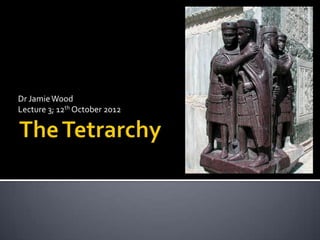
Dr Jamie Wood
Lecture 3; 12th October 2012
   To provide an overview of the
    main historical actors and events
    of the Tetrarchy
   To focus on the figure and role of
    Diocletian
   To pick out key themes of the
    Tetrarchic period
   To assess the extent to which the
    Tetrarchy was a key turning point
    in history of later Roman Empire
   End of 3rd C crisis, rise of Diocletian and the Tetrarchy
   Themes (1)
     Administration/ bureaucracy
     Military
--------------------------------------------------
 Groupwork: 3rd century historians
 Themes (2)
     Economy
     Religion
   Visual sources
   Breakdown of the Tetrarchy
   Conclusion
   Military
     Diocletian defeats his rivals
     Military reforms
     Invasions cease (or are defeated)
   Government
     Development of new system: the Tetrarchy
     Sharing of power
     Reorganisation of bureaucracy and administration
   Economic reforms
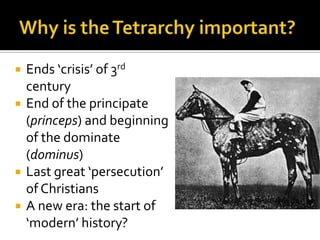
   Ends ‘crisis’ of 3rd
    century
   End of the principate
    (princeps) and beginning
    of the dominate
    (dominus)
   Last great ‘persecution’
    of Christians
   A new era: the start of
    ‘modern’ history?
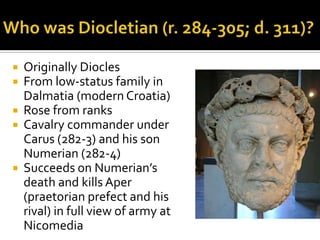
 Originally Diocles
 From low-status family in
  Dalmatia (modern Croatia)
 Rose from ranks
 Cavalry commander under
  Carus (282-3) and his son
  Numerian (282-4)
 Succeeds on Numerian’s
  death and kills Aper
  (praetorian prefect and his
  rival) in full view of army at
  Nicomedia
   This man [= Diocletian] then, having ascended the
    tribunal was hailed as Augustus, and when someone
    asked how Numerian had been slain, he drew his sword
    and pointing to Aper, the prefect of the guard, he drove
    it through him, saying as he did so, “It is he who
    contrived Numerian's death”. So Aper, a man who lived
    an evil life and in accordance with vicious counsels, met
    with the end that his ways deserved. My grandfather
    used to relate that he was present at this assembly
    when Aper was slain by the hand of Diocletian; and he
    used to say that Diocletian, after slaying him, shouted,
    “Well may you boast, Aper, ‘Tis by the hand of the
    mighty Aeneas you perish.’ (Aeneid, x.830)”
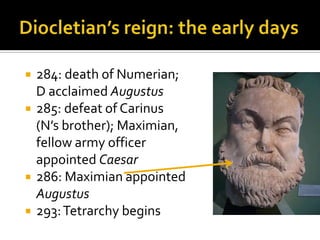
   284: death of Numerian;
    D acclaimed Augustus
   285: defeat of Carinus
    (N’s brother); Maximian,
    fellow army officer
    appointed Caesar
   286: Maximian appointed
    Augustus
   293: Tetrarchy begins
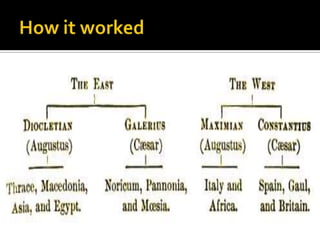
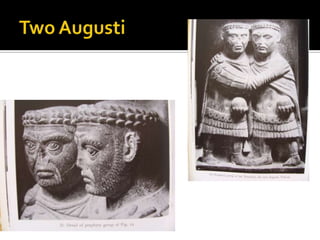
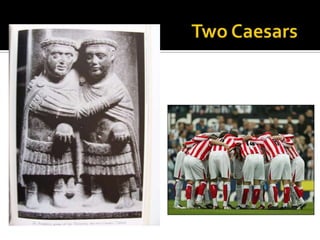
   Established by Diocletian and Maximian in 293:
     Galerius and Constantius I Chlorus appointed
     Caesares
   Rule of four
     from Greek: four (tetra) and rule (arch)
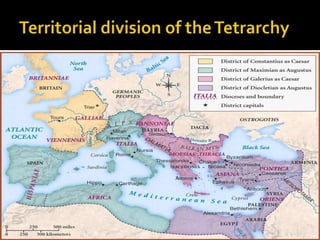
   Division of empire into east and west, with sub-
    division in each
   Lasted (with changes of personnel) until ca. 313
    when civil war left Constantine I in west and
    Licinius in east
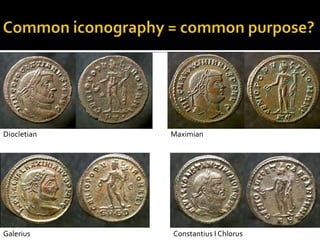
Diocletian   Maximian


Galerius     Constantius I Chlorus
   Small imperial administrative system of early
    empire

   Change in the cities
     Civic system in earlier empire
     Tax raising and tax farming
     Euergetism
   Keith Hopkins (‘Conquest By
    Book’, in Beard et al. (eds.),
    Literacy in the Roman World, JRA
    Supplement 3; Ann Arbor, 1991)
    argued that writing, like money,
    was a medium of exchange – in
    information and knowledge –
    which helped to unify Empire
     Emergence of legal and
      documentary culture as the
      Roman Empire expanded
     Resultant process of
      professionalization and
      bureaucratization (as we have
      already seen)
   Chain of command linked civil administrators
    directly to emperor (via councils/ departments)
   Professionalised hierarchy with elaborate
    system of honours
   Each province has separate civil and military
    administration (secret service developed)
   Increases number of provinces (50 -> 100)
   Number of officials increased (15k -> 30k)
   System of taxation developed to meet costs of
    increased administration
‘In his greed and anxiety he [Diocletian] turned the whole world
upside down. He appointed three men to share his rule, dividing the
world into four parts and multiplying the armies, since each of the
four strove to have a far larger number of troops than previous
emperors had had when they were governing the state alone. The
number of recipients began to exceed the number of contributors by
so much that, with farmers’ resources exhausted by the enormous
requisitions , fields became deserted and cultivated land was turned
into forest. To ensure terror was universal, provinces too were cut
into fragments; many governors and even more officials were
imposed on individual regions, almost on individual cities, and to
these were added numerous accountants, controllers, and prefects’
deputies. The activities of all these people were very rarely civil; they
engaged only in repeated condemnations and confiscations, and in
exacting endless resources – and the exactions were not just
frequent, they were incessant, and involved insupportable injustices.
And how could the arrangements for raising soldiers be endured?’
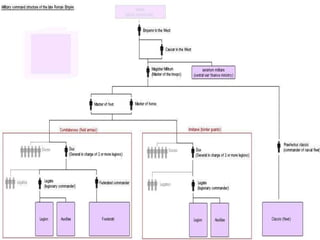
   Increased size of army
   Renewed border defences
   Developed mobile field army
    (comitatenses)
   Military commands made smaller
   Military and administrative
    offices separated
   Clear chain of command
    developed (focussed on emperor)
   Taxes raised to pay for increased
    military
   “By the forethought of Diocletian, the
    frontiers of the empire everywhere were
    covered, as I have stated, with cities,
    garrisons and fortifications which housed the
    whole army. Consequently, it was impossible
    for the barbarians to cross the frontier
    because they were confronted at every point
    by forces capable of resisting their attacks.”
     Z goes on to criticise Constantine for abandoning
     this system
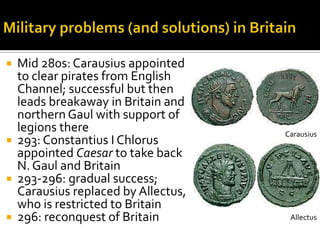
 Mid 280s: Carausius appointed
  to clear pirates from English
  Channel; successful but then
  leads breakaway in Britain and
  northern Gaul with support of
  legions there                     Carausius
 293: Constantius I Chlorus
  appointed Caesar to take back
  N. Gaul and Britain
 293-296: gradual success;
  Carausius replaced by Allectus,
  who is restricted to Britain
 296: reconquest of Britain         Allectus
25
1.   Cassius Dio’s Roman History
2.   Historia Augusta
3.   Herodian
 In your group prepare a short presentation that provides the
    following information about your source
        Date of composition (esp. in relation to events described)
        Author(s) (who they are, where they are from)
        What it’s about (e.g. recurrent themes/ topics)
        Issues (e.g. viewpoint or biases of the author/ history of the
         source’s transmission or survival)
 One member of the group needs to write this up into a
  short (readable) summary which I will type up and add to
  the PowerPoint slides on VITAL.
   ca. 164-229 AD (at least that is when he stops writing)
   Wrote 80 volumes of his Roman History covering 1400
    years from Aeneas and the foundation of Rome to 229
    AD. It is written in Attic Greek.
   It survives mainly as extracts in later works by other
    people (i.e. is fragmentary)
   Dio served as a senator under Commodus and was consul
    under Severus Alexander: so he has an elite viewpoint
   Religion is a strong theme. He places a lot of importance
    on the supernatural. His first work, written before the
    History, was about dreams and portents. However there
    is no mention of Christianity. Did it not matter to him?
   Dio spent 10 years researching and 12 years writing – he
    had a lot of sources to draw on
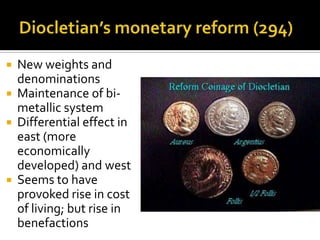
 New weights and
  denominations
 Maintenance of bi-
  metallic system
 Differential effect in
  east (more
  economically
  developed) and west
 Seems to have
  provoked rise in cost
  of living; but rise in
  benefactions
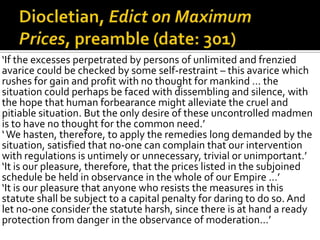
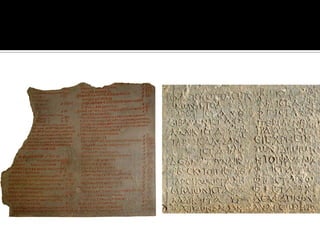
‘If the excesses perpetrated by persons of unlimited and frenzied
avarice could be checked by some self-restraint – this avarice which
rushes for gain and profit with no thought for mankind … the
situation could perhaps be faced with dissembling and silence, with
the hope that human forbearance might alleviate the cruel and
pitiable situation. But the only desire of these uncontrolled madmen
is to have no thought for the common need.’
‘ We hasten, therefore, to apply the remedies long demanded by the
situation, satisfied that no-one can complain that our intervention
with regulations is untimely or unnecessary, trivial or unimportant.’
‘It is our pleasure, therefore, that the prices listed in the subjoined
schedule be held in observance in the whole of our Empire …’
‘It is our pleasure that anyone who resists the measures in this
statute shall be subject to a capital penalty for daring to do so. And
let no-one consider the statute harsh, since there is at hand a ready
protection from danger in the observance of moderation…’
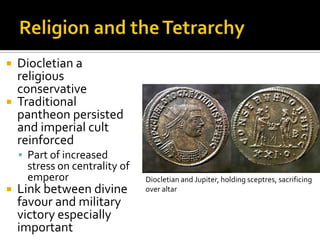
 Diocletian a
  religious
  conservative
 Traditional
  pantheon persisted
  and imperial cult
  reinforced
     Part of increased
      stress on centrality of
      emperor                   Diocletian and Jupiter, holding sceptres, sacrificing
   Link between divine         over altar
    favour and military
    victory especially
    important
   Actions against:
     Manichees (eastern dualist sect)
      ▪ D = in charge of the East; conflict with Persia
      ▪ Laws against Manichees in late 290s and 300s
     Christians
      ▪ 303-304: Great Persecution
      ▪ Initial attempt to root out Christians from army, bureaucracy and
        imperial household seems to have grown into general attempt to
        exterminate Christians
   Objections to these religions:
     Novelty
     Alien origins (esp. Manichees)
     Exclusivist opposition to traditional Roman religions/ morals
   But is it ‘persecution’ or ‘prosecution’?
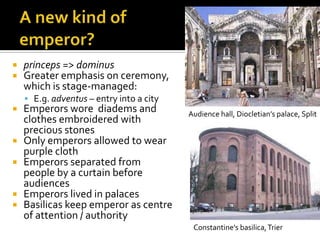
   princeps => dominus
   Greater emphasis on ceremony,
    which is stage-managed:
     E.g. adventus – entry into a city
   Emperors wore diadems and             Audience hall, Diocletian’s palace, Split
    clothes embroidered with
    precious stones
   Only emperors allowed to wear
    purple cloth
   Emperors separated from
    people by a curtain before
    audiences
   Emperors lived in palaces
   Basilicas keep emperor as centre
    of attention / authority
                                           Constantine’s basilica, Trier
   304: D suffers serious illness
   304-5: Galerius persuades/ forces D and M to
    abdicate (in 305); both retire
   Galerius becomes Augustusi in east and
    Constantius I in west
     Severus and Maximin (both closely associated with
      Galerius) declared Caesars
     Constantine (son of Constantius I Chlorus) and
      Maxentius (son of Maximian) are ignored
    = TROUBLE
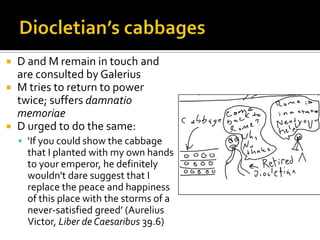
   D and M remain in touch and
    are consulted by Galerius
   M tries to return to power
    twice; suffers damnatio
    memoriae
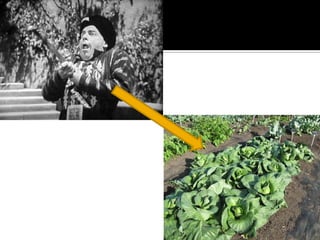
   D urged to do the same:
     ‘If you could show the cabbage
      that I planted with my own hands
      to your emperor, he definitely
      wouldn't dare suggest that I
      replace the peace and happiness
      of this place with the storms of a
      never-satisfied greed’ (Aurelius
      Victor, Liber de Caesaribus 39.6)
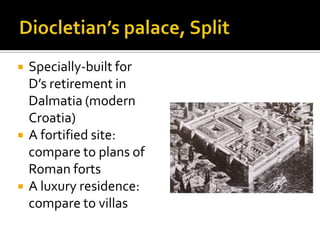
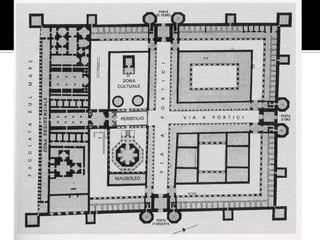
   Specially-built for
    D’s retirement in
    Dalmatia (modern
    Croatia)
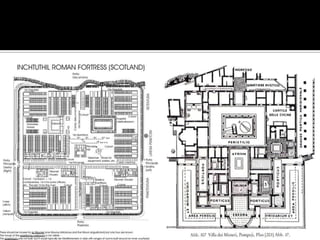
   A fortified site:
    compare to plans of
    Roman forts
   A luxury residence:
    compare to villas
   To what extent is the Tetrarchic system (solely)
    the work of Diocletian (and Maximian)?
     It barely outlasted D’s abdication...
   Is the Tetrarchy something radically new or
    simply an intensification of trends we have
    already witnessed, like the 3rd century crisis?
       Bureaucratisation
       Militarisation
       Exaltation of emperor
       Policing of deviance (move towards monotheism?)
   Read: Christopher Kelly (1994), ‘Late Roman
    Bureaucracy: Going through the files’, in A.
    Bowman and G. Woolf, eds., Literacy and power
    in the ancient world (Cambridge: Cambridge
    University Press), pp. 161-176. [uploaded to
    VITAL]

     In two week’s time we will look at the breakdown of
      the Tetrarchy, the short-lived ‘Second Tetrarchy’ and
      the success of Constantine and his Dynasty

The Tetrarchy

  • 1.
    Dr Jamie Wood Lecture3; 12th October 2012
  • 4.
    To provide an overview of the main historical actors and events of the Tetrarchy  To focus on the figure and role of Diocletian  To pick out key themes of the Tetrarchic period  To assess the extent to which the Tetrarchy was a key turning point in history of later Roman Empire
  • 5.
    End of 3rd C crisis, rise of Diocletian and the Tetrarchy  Themes (1)  Administration/ bureaucracy  Military --------------------------------------------------  Groupwork: 3rd century historians  Themes (2)  Economy  Religion  Visual sources  Breakdown of the Tetrarchy  Conclusion
  • 6.
    Military  Diocletian defeats his rivals  Military reforms  Invasions cease (or are defeated)  Government  Development of new system: the Tetrarchy  Sharing of power  Reorganisation of bureaucracy and administration  Economic reforms
  • 7.
    Ends ‘crisis’ of 3rd century  End of the principate (princeps) and beginning of the dominate (dominus)  Last great ‘persecution’ of Christians  A new era: the start of ‘modern’ history?
  • 8.
     Originally Diocles From low-status family in Dalmatia (modern Croatia)  Rose from ranks  Cavalry commander under Carus (282-3) and his son Numerian (282-4)  Succeeds on Numerian’s death and kills Aper (praetorian prefect and his rival) in full view of army at Nicomedia
  • 9.
    This man [= Diocletian] then, having ascended the tribunal was hailed as Augustus, and when someone asked how Numerian had been slain, he drew his sword and pointing to Aper, the prefect of the guard, he drove it through him, saying as he did so, “It is he who contrived Numerian's death”. So Aper, a man who lived an evil life and in accordance with vicious counsels, met with the end that his ways deserved. My grandfather used to relate that he was present at this assembly when Aper was slain by the hand of Diocletian; and he used to say that Diocletian, after slaying him, shouted, “Well may you boast, Aper, ‘Tis by the hand of the mighty Aeneas you perish.’ (Aeneid, x.830)”
  • 10.
    284: death of Numerian; D acclaimed Augustus  285: defeat of Carinus (N’s brother); Maximian, fellow army officer appointed Caesar  286: Maximian appointed Augustus  293: Tetrarchy begins
  • 11.
    Established by Diocletian and Maximian in 293:  Galerius and Constantius I Chlorus appointed Caesares  Rule of four  from Greek: four (tetra) and rule (arch)  Division of empire into east and west, with sub- division in each  Lasted (with changes of personnel) until ca. 313 when civil war left Constantine I in west and Licinius in east
  • 16.
    Diocletian Maximian Galerius Constantius I Chlorus
  • 17.
    Small imperial administrative system of early empire  Change in the cities  Civic system in earlier empire  Tax raising and tax farming  Euergetism
  • 18.
    Keith Hopkins (‘Conquest By Book’, in Beard et al. (eds.), Literacy in the Roman World, JRA Supplement 3; Ann Arbor, 1991) argued that writing, like money, was a medium of exchange – in information and knowledge – which helped to unify Empire  Emergence of legal and documentary culture as the Roman Empire expanded  Resultant process of professionalization and bureaucratization (as we have already seen)
  • 19.
    Chain of command linked civil administrators directly to emperor (via councils/ departments)  Professionalised hierarchy with elaborate system of honours  Each province has separate civil and military administration (secret service developed)  Increases number of provinces (50 -> 100)  Number of officials increased (15k -> 30k)  System of taxation developed to meet costs of increased administration
  • 20.
    ‘In his greedand anxiety he [Diocletian] turned the whole world upside down. He appointed three men to share his rule, dividing the world into four parts and multiplying the armies, since each of the four strove to have a far larger number of troops than previous emperors had had when they were governing the state alone. The number of recipients began to exceed the number of contributors by so much that, with farmers’ resources exhausted by the enormous requisitions , fields became deserted and cultivated land was turned into forest. To ensure terror was universal, provinces too were cut into fragments; many governors and even more officials were imposed on individual regions, almost on individual cities, and to these were added numerous accountants, controllers, and prefects’ deputies. The activities of all these people were very rarely civil; they engaged only in repeated condemnations and confiscations, and in exacting endless resources – and the exactions were not just frequent, they were incessant, and involved insupportable injustices. And how could the arrangements for raising soldiers be endured?’
  • 21.
    Increased size of army  Renewed border defences  Developed mobile field army (comitatenses)  Military commands made smaller  Military and administrative offices separated  Clear chain of command developed (focussed on emperor)  Taxes raised to pay for increased military
  • 23.
    “By the forethought of Diocletian, the frontiers of the empire everywhere were covered, as I have stated, with cities, garrisons and fortifications which housed the whole army. Consequently, it was impossible for the barbarians to cross the frontier because they were confronted at every point by forces capable of resisting their attacks.”  Z goes on to criticise Constantine for abandoning this system
  • 24.
     Mid 280s:Carausius appointed to clear pirates from English Channel; successful but then leads breakaway in Britain and northern Gaul with support of legions there Carausius  293: Constantius I Chlorus appointed Caesar to take back N. Gaul and Britain  293-296: gradual success; Carausius replaced by Allectus, who is restricted to Britain  296: reconquest of Britain Allectus
  • 25.
  • 26.
    1. Cassius Dio’s Roman History 2. Historia Augusta 3. Herodian In your group prepare a short presentation that provides the following information about your source  Date of composition (esp. in relation to events described)  Author(s) (who they are, where they are from)  What it’s about (e.g. recurrent themes/ topics)  Issues (e.g. viewpoint or biases of the author/ history of the source’s transmission or survival) One member of the group needs to write this up into a short (readable) summary which I will type up and add to the PowerPoint slides on VITAL.
  • 27.
    ca. 164-229 AD (at least that is when he stops writing)  Wrote 80 volumes of his Roman History covering 1400 years from Aeneas and the foundation of Rome to 229 AD. It is written in Attic Greek.  It survives mainly as extracts in later works by other people (i.e. is fragmentary)  Dio served as a senator under Commodus and was consul under Severus Alexander: so he has an elite viewpoint  Religion is a strong theme. He places a lot of importance on the supernatural. His first work, written before the History, was about dreams and portents. However there is no mention of Christianity. Did it not matter to him?  Dio spent 10 years researching and 12 years writing – he had a lot of sources to draw on
  • 30.
     New weightsand denominations  Maintenance of bi- metallic system  Differential effect in east (more economically developed) and west  Seems to have provoked rise in cost of living; but rise in benefactions
  • 31.
    ‘If the excessesperpetrated by persons of unlimited and frenzied avarice could be checked by some self-restraint – this avarice which rushes for gain and profit with no thought for mankind … the situation could perhaps be faced with dissembling and silence, with the hope that human forbearance might alleviate the cruel and pitiable situation. But the only desire of these uncontrolled madmen is to have no thought for the common need.’ ‘ We hasten, therefore, to apply the remedies long demanded by the situation, satisfied that no-one can complain that our intervention with regulations is untimely or unnecessary, trivial or unimportant.’ ‘It is our pleasure, therefore, that the prices listed in the subjoined schedule be held in observance in the whole of our Empire …’ ‘It is our pleasure that anyone who resists the measures in this statute shall be subject to a capital penalty for daring to do so. And let no-one consider the statute harsh, since there is at hand a ready protection from danger in the observance of moderation…’
  • 33.
     Diocletian a religious conservative  Traditional pantheon persisted and imperial cult reinforced  Part of increased stress on centrality of emperor Diocletian and Jupiter, holding sceptres, sacrificing  Link between divine over altar favour and military victory especially important
  • 34.
    Actions against:  Manichees (eastern dualist sect) ▪ D = in charge of the East; conflict with Persia ▪ Laws against Manichees in late 290s and 300s  Christians ▪ 303-304: Great Persecution ▪ Initial attempt to root out Christians from army, bureaucracy and imperial household seems to have grown into general attempt to exterminate Christians  Objections to these religions:  Novelty  Alien origins (esp. Manichees)  Exclusivist opposition to traditional Roman religions/ morals  But is it ‘persecution’ or ‘prosecution’?
  • 35.
    princeps => dominus  Greater emphasis on ceremony, which is stage-managed:  E.g. adventus – entry into a city  Emperors wore diadems and Audience hall, Diocletian’s palace, Split clothes embroidered with precious stones  Only emperors allowed to wear purple cloth  Emperors separated from people by a curtain before audiences  Emperors lived in palaces  Basilicas keep emperor as centre of attention / authority Constantine’s basilica, Trier
  • 36.
    304: D suffers serious illness  304-5: Galerius persuades/ forces D and M to abdicate (in 305); both retire  Galerius becomes Augustusi in east and Constantius I in west  Severus and Maximin (both closely associated with Galerius) declared Caesars  Constantine (son of Constantius I Chlorus) and Maxentius (son of Maximian) are ignored = TROUBLE
  • 38.
    D and M remain in touch and are consulted by Galerius  M tries to return to power twice; suffers damnatio memoriae  D urged to do the same:  ‘If you could show the cabbage that I planted with my own hands to your emperor, he definitely wouldn't dare suggest that I replace the peace and happiness of this place with the storms of a never-satisfied greed’ (Aurelius Victor, Liber de Caesaribus 39.6)
  • 39.
    Specially-built for D’s retirement in Dalmatia (modern Croatia)  A fortified site: compare to plans of Roman forts  A luxury residence: compare to villas
  • 42.
    To what extent is the Tetrarchic system (solely) the work of Diocletian (and Maximian)?  It barely outlasted D’s abdication...  Is the Tetrarchy something radically new or simply an intensification of trends we have already witnessed, like the 3rd century crisis?  Bureaucratisation  Militarisation  Exaltation of emperor  Policing of deviance (move towards monotheism?)
  • 43.
    Read: Christopher Kelly (1994), ‘Late Roman Bureaucracy: Going through the files’, in A. Bowman and G. Woolf, eds., Literacy and power in the ancient world (Cambridge: Cambridge University Press), pp. 161-176. [uploaded to VITAL]  In two week’s time we will look at the breakdown of the Tetrarchy, the short-lived ‘Second Tetrarchy’ and the success of Constantine and his Dynasty