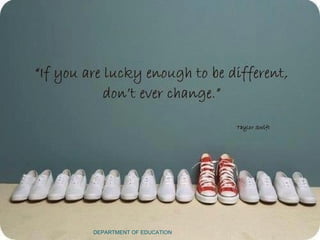
DEPARTMENT OF EDUCATION
OBJECTIVES:
In this session, the participants will
be able to:
1.Discuss the basic principles of
Differentiated Instruction (DI);
2.Identify activities suited to each
component of Differentiated
Instruction (DI);
3.Identify activities that respond to
learners’ needs.
ACTIVITY: FACT OR BLUFF
• Choose your TEAM LEADER and
RAPPORTEUR.
• Discuss within your group if each statement
FOLLOWS THE PRINCIPLES OF
DIFFERENTIATED INSTRUCTION (DI).
• Write FACT if the statement is TRUE and
BLUFF if otherwise.
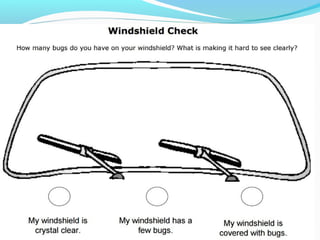
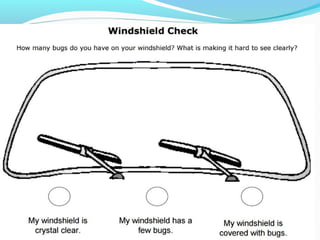
• Finally, draw an image of windshield like
what is shown below.
DEPARTMENT OF EDUCATION
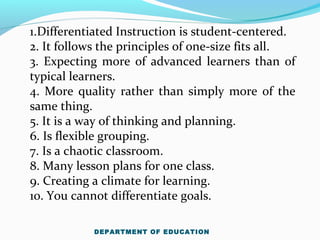
1.Differentiated Instruction is student-centered.
2. It follows the principles of one-size fits all.
3. Expecting more of advanced learners than of
typical learners.
4. More quality rather than simply more of the
same thing.
5. It is a way of thinking and planning.
6. Is flexible grouping.
7. Is a chaotic classroom.
8. Many lesson plans for one class.
9. Creating a climate for learning.
10. You cannot differentiate goals.
DEPARTMENT OF EDUCATION
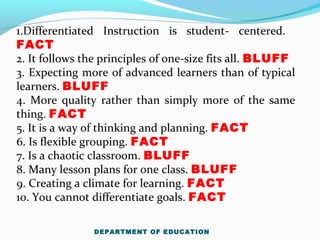
1.Differentiated Instruction is student- centered.
FACT
2. It follows the principles of one-size fits all. BLUFF
3. Expecting more of advanced learners than of typical
learners. BLUFF
4. More quality rather than simply more of the same
thing. FACT
5. It is a way of thinking and planning. FACT
6. Is flexible grouping. FACT
7. Is a chaotic classroom. BLUFF
8. Many lesson plans for one class. BLUFF
9. Creating a climate for learning. FACT
10. You cannot differentiate goals. FACT
DEPARTMENT OF EDUCATION
ANALYSIS
(FLEXIBLE INSTRUCTION
RESPONSIVE to
LEARNERS)
DIFFERENTIATED
INSTRUCTION
DEPARTMENT OF EDUCATION
1985-”Differential Education” for
gifted & talented coined by Virgil
Ward (U of Virginia)
1995 popularized by Carol Ann
Tomlinson (U of Virginia)
DEPARTMENT OF EDUCATION
FOR A BIT OF HISTORY
THEORETICAL BASES OF D.I.
Vygotsky, 1896-1934: Zone of
Proximal Development;
Scaffolding
Jerome Bruner on interest and
organization of learning
DEPARTMENT OF EDUCATION
Howard Gardner: Multiple
Intelligences, 1983
Honey & Mumford, 1982;
Myer Briggs, Dunn & Dunn,
etc.: Learning Styles
DEPARTMENT OF EDUCATION
DIFFERENTIATED INSTRUCTION
Is a systematic approach to planning
curriculum and instruction for
academically diverse learners…
with the goals of honoring each
student’s learning needs and
maximizing each student’s
learning capacity.
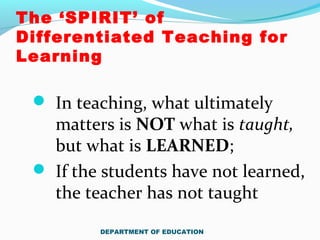
The ‘SPIRIT’ of
Differentiated Teaching for
Learning
 In teaching, what ultimately
matters is NOT what is taught,
but what is LEARNED;
 If the students have not learned,
the teacher has not taught
DEPARTMENT OF EDUCATION
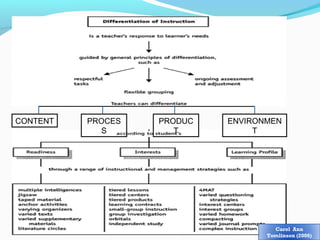
CONTENT PROCES
S
PRODUC
T
ENVIRONMEN
T
Carol Ann
Tomlinson (2006)
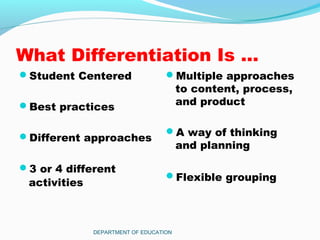
What Differentiation Is …
Student Centered
Best practices
Different approaches
3 or 4 different
activities
Multiple approaches
to content, process,
and product
A way of thinking
and planning
Flexible grouping
DEPARTMENT OF EDUCATION
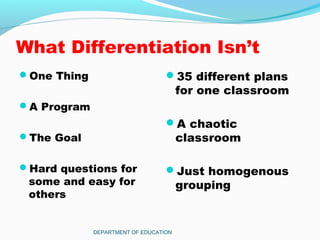
What Differentiation Isn’t
One Thing
A Program
The Goal
Hard questions for
some and easy for
others
35 different plans
for one classroom
A chaotic
classroom
Just homogenous
grouping
DEPARTMENT OF EDUCATION
How to start?
Do a formative assessment
Create an individual profile of each of
his/her student in each class he/she is
handling.
Using the results of the assessment,
teachers can modify/differentiate
content, process or product along with
the learning area.
DEPARTMENT OF EDUCATION
According to Tomlinson
(2006), TEACHERS can
DIFFERENTIATE
INSTRUCTION through FOUR
WAYS:
Content:– what the
student needs to learn
or how the student will
get access to the
information.
Examples of differentiating content
include the following:
Using reading materials at varying
readability levels;
Using spelling or vocabulary lists at
readiness levels of students;
Presenting ideas through both auditory
and visual means;
Meeting with small groups to re-teach an
idea or skill for struggling learners, or to
extend the thinking or skills of advanced
learners.
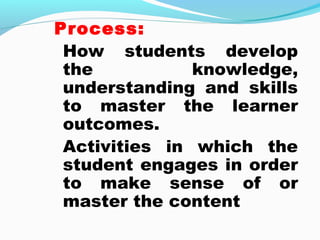
Process:
How students develop
the knowledge,
understanding and skills
to master the learner
outcomes.
Activities in which the
student engages in order
to make sense of or
master the content
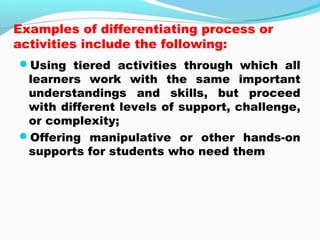
Examples of differentiating process or
activities include the following:
Using tiered activities through which all
learners work with the same important
understandings and skills, but proceed
with different levels of support, challenge,
or complexity;
Offering manipulative or other hands-on
supports for students who need them
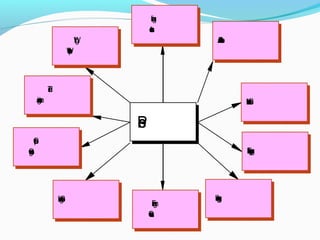
Process
Flexiblegrouping
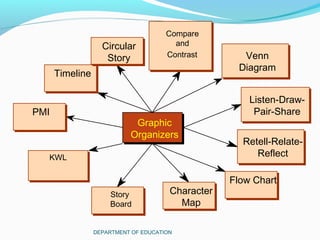
Graphic
Organizers
Tiered
assignments
AnchorActivities
Framing
Questions
LearningLogsLearningCentres
Learning
contracts
LiteratureCircles
Writing
Workshops
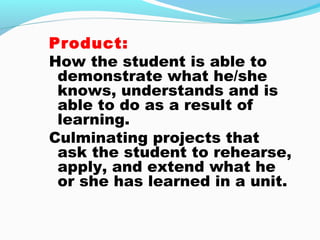
Product:
How the student is able to
demonstrate what he/she
knows, understands and is
able to do as a result of
learning.
Culminating projects that
ask the student to rehearse,
apply, and extend what he
or she has learned in a unit.
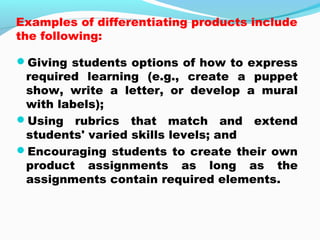
Examples of differentiating products include
the following:
Giving students options of how to express
required learning (e.g., create a puppet
show, write a letter, or develop a mural
with labels);
Using rubrics that match and extend
students' varied skills levels; and
Encouraging students to create their own
product assignments as long as the
assignments contain required elements.
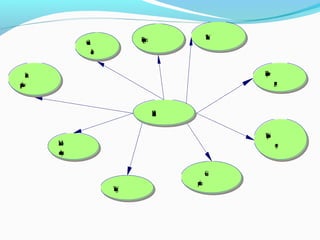
Products
Developgames Writebooks
Givea
presentation
Writeasong
Conducta
debate
Makeavideo
documentary
Presenta
puppetshow
Writeaphoto
essay
Developweb
pages
Learning Environment:
the way the classroom
works and feels.
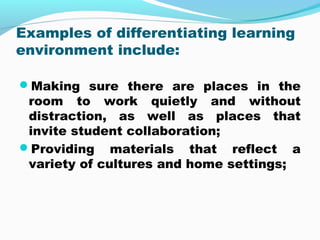
Examples of differentiating learning
environment include:
Making sure there are places in the
room to work quietly and without
distraction, as well as places that
invite student collaboration;
Providing materials that reflect a
variety of cultures and home settings;
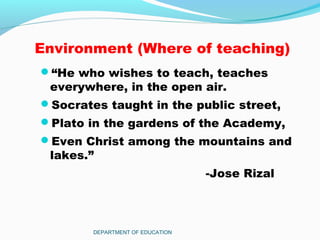
Environment (Where of teaching)
“He who wishes to teach, teaches
everywhere, in the open air.
Socrates taught in the public street,
Plato in the gardens of the Academy,
Even Christ among the mountains and
lakes.”
-Jose Rizal
DEPARTMENT OF EDUCATION
Graphic
Organizers
Flow Chart
KWL
Timeline
Venn
Diagram
Character
Map
Story
Board
Circular
Story
Compare
and
Contrast
Listen-Draw-
Pair-SharePMI
Retell-Relate-
Reflect
DEPARTMENT OF EDUCATION
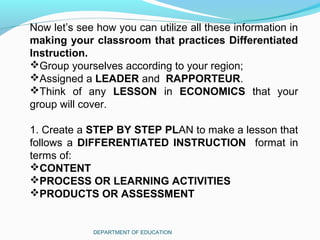
Now let’s see how you can utilize all these information in
making your classroom that practices Differentiated
Instruction.
Group yourselves according to your region;
Assigned a LEADER and RAPPORTEUR.
Think of any LESSON in ECONOMICS that your
group will cover.
1. Create a STEP BY STEP PLAN to make a lesson that
follows a DIFFERENTIATED INSTRUCTION format in
terms of:
CONTENT
PROCESS OR LEARNING ACTIVITIES
PRODUCTS OR ASSESSMENT
DEPARTMENT OF EDUCATION
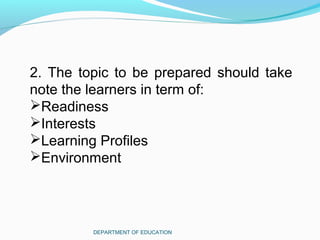
2. The topic to be prepared should take
note the learners in term of:
Readiness
Interests
Learning Profiles
Environment
 
DEPARTMENT OF EDUCATION

Differentiated instruction-editted