
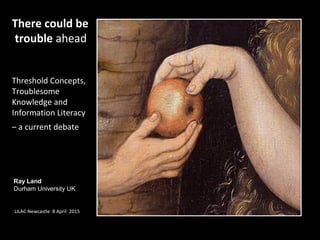


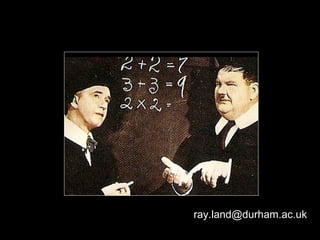
There could be
trouble ahead
Threshold Concepts,
Troublesome
Knowledge and
Information Literacy
– a current debate
LILAC Newcastle 8 April 2015
Ray Land
Durham University UK
Framework for Information Literacy for
Higher Education
..it is based on a cluster of interconnected core concepts,
with flexible options for implementation, rather than on a
set of standards, learning outcomes, or any prescriptive
enumeration of skills. At the heart of this Framework are
conceptual understandings that organize many other
concepts and ideas about information, research, and
scholarship into a coherent whole’
(ACRL 2015).
The ACRL approach
• How are librarians in the USA appropriating the notion of
threshold concepts (TCs)?
• What are the 6 identified TCs thresholds into?
• What might be the implications of this new Framework?
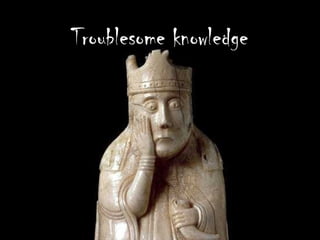
Troublesome knowledge
Venturing into
strange places
The student is perforce
required to venture into new
places, strange places,
anxiety-provoking places .
This is part of the point of
higher education. If there
was no anxiety, it is difficult
to believe that we could be
in the presence of a higher
education.
(Barnett 2007: 147)
Pedagogies of uncertainty
In these settings, the presence of emotion, even a
modicum of passion, is quite striking--as is its absence in
other settings. I would say that without a certain amount
of anxiety and risk, there's a limit to how much learning
occurs.
One must have something at stake. No emotional
investment, no intellectual or formational yield.
(Shulman 2005:4)
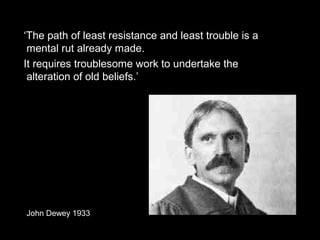
‘The path of least resistance and least trouble is a
mental rut already made.
It requires troublesome work to undertake the
alteration of old beliefs.’
John Dewey 1933
Real learning requires
stepping into the unknown,
which initiates a rupture in
knowing...
By definition, all TC
scholarship is concerned
(directly or indirectly) with
encountering the unknown.
Schwartzman 2010 p.38
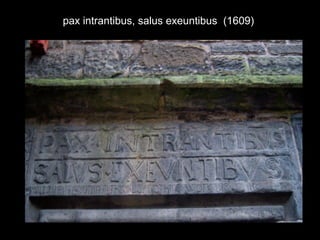
pax intrantibus, salus exeuntibus (1609)
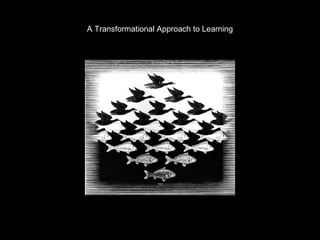
A Transformational Approach to Learning
I am part of all that I have me
Yet all experience is an arch wh
Gleams that untravell’d world,
whose marg
For ever and for ever when I m
Tennyson ‘Ulysses’
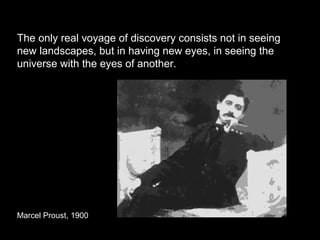
The only real voyage of discovery consists not in seeing
new landscapes, but in having new eyes, in seeing the
universe with the eyes of another.
Marcel Proust, 1900
• Threshold concepts
• Liminality
• Troublesome knowledge
• Episteme (the underlying game)
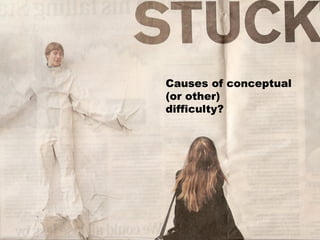
Causes of conceptual
(or other)
difficulty?
The role of the teacher is to arrange
victories for the students
Quintilian 35-100 AD
The prevailing discourse of ‘outcomes’,
‘alignment’ and ‘achievement’ has, from
critical perspectives, been deemed to
serve managerialist imperatives without
necessarily engaging discipline-based
academics in significant
reconceptualisation or review of their
practice.
(cf.Newton, 2000).
Academics’ own definitions of quality would
seem to remain predominantly discipline-
centred
(cf. Henkel, 2000:106).
Notion that within specific disciplines there exist
significant ‘threshold concepts’, leading to new
and previously inaccessible ways of thinking
about something.
(Meyer and Land, 2003).
‘Concept?’
‘a unit of thought or element of knowledge
that allows us to organize experience’
Janet Gail Donald (2001)
‘Learning to Think: Disciplinary Perspectives’
James Joyce’s ‘epiphany’
— the ‘revelation of the whatness of a thing’.
But threshold concepts are both more
constructed and re-constitutive than revelatory,
and not necessarily sudden.
(ευρηκα!)
Akin to a portal, a liminal space, opening up a
new and previously inaccessible way of
thinking about something.
Represents a transformed way of
understanding, or interpreting, or viewing
something without which the learner finds it
difficult to progress, within the curriculum as
formulated.
Threshold Concepts
Threshold Concepts
As a consequence of comprehending a
threshold concept there may thus be a
transformed internal view of subject matter,
subject landscape, or even world view.
Such a transformed view or landscape may
represent how people ‘think’ in a particular
discipline, or how they perceive, apprehend,
or experience particular phenomena within
that discipline, or more generally.
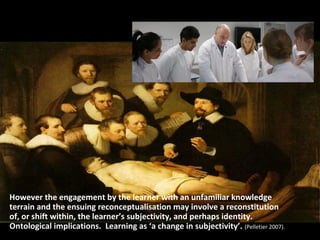
However the engagement by the learner with an unfamiliar knowledge
terrain and the ensuing reconceptualisation may involve a reconstitution
of, or shift within, the learner’s subjectivity, and perhaps identity.
Ontological implications. Learning as ‘a change in subjectivity’. (Pelletier 2007).
Liminality
• a transformative state that
engages existing certainties
and renders them
problematic, and fluid
• a suspended state in which
understanding can
approximate to a kind of
mimicry or lack of authenticity
• liminality as unsettling –
sense of loss
• Q. Did you feel the same as student 1?
• Second student: Yeah. I felt lost.
• Q. In lecture times as well?
• Second student: You know, I understood the concept
for about let’s say 10 seconds, yes yes, I got that and
then suddenly, no no, I didn’t get that, you know,
suddenly, like this.
from G. Cousin, Journal of Learning Development Feb
2010
• “There are some things you learn, you suddenly
think, wow, suddenly everything seems different…
you now see the world quite differently”.
Marine biology
Osmosis is counter-intuitive, it goes the opposite
way. When does it click? When you study marine fish
in 2nd
or 3rd
year, you see what would happen; it’s in a
relevant situation. In first year you do mechanisms in
blocks and there’s no relevance
Taylor 2008, p. 191
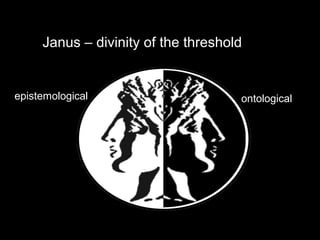
Janus – divinity of the threshold
epistemological ontological
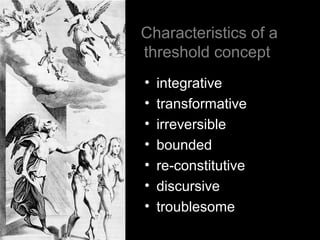
Characteristics of a
threshold concept
• integrative
• transformative
• irreversible
• bounded
• re-constitutive
• discursive
• troublesome
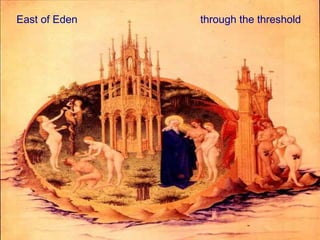
East of Eden through the threshold
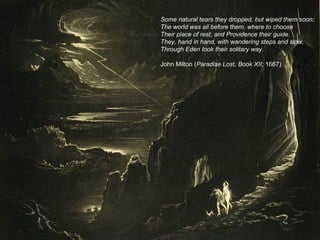
Some natural tears they dropped, but wiped them soon;
The world was all before them, where to choose
Their place of rest, and Providence their guide.
They, hand in hand, with wandering steps and slow,
Through Eden took their solitary way.
John Milton (Paradise Lost, Book XII; 1667)
Examples
• Pure Maths – ‘complex number, a limit’, the Fourier transform’
• Literary Studies – ‘signification, deconstruction, ethical reading’
• Economics – ‘opportunity cost, price, elasticity’
• Design – ‘Confidence to challenge’
• Computer Science – ‘Object Oriented programming’, ‘Y and Recursion’
• Exercise Physiology – ‘metabolism’
• Law - ‘precedence’
• Accounting - ‘depreciation’
• Biology, Psychology - ‘evolution’
• Politics – ‘the state’
• Engineering – ‘reactive power’, ‘spin’
• Military – ‘Legitimised Use of Violence’
• Comparative Religion– ‘Biblical texts as Literary Texts’
• Plant Science ‘Photoprotection’
• Health Science – ‘Care’
• Physics – ‘Gravity’, ‘Measurement Uncertainty’
• Geology - ‘Geologic Time’
Transactional curriculum inquiry
(Cousin 2009, pp. 201-212)
• What do academics consider to be fundamental to a
grasp of their subject?
• What do students find difficult to grasp?
• What curriculum design interventions can support
mastery of these difficulties?
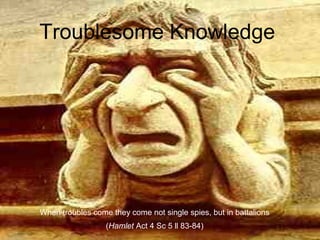
When troubles come they come not single spies, but in battalions
(Hamlet Act 4 Sc 5 ll 83-84)
Troublesome Knowledge
looking for trouble
• Knowledge is troublesome for a variety of reasons
(Perkins 2006). It might be alien, inert, tacit,
conceptually difficult, counter-intuitive, characterised
by an inaccessible ‘underlying game’, or
characterised by supercomplexity.
• such troublesomeness and disquietude is purposeful,
as it is the provoker of change that cannot be
assimilated, and hence is the instigator of new
learning and new ontological possibility.
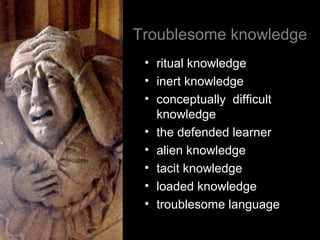
Troublesome knowledge
• ritual knowledge
• inert knowledge
• conceptually difficult
knowledge
• the defended learner
• alien knowledge
• tacit knowledge
• loaded knowledge
• troublesome language
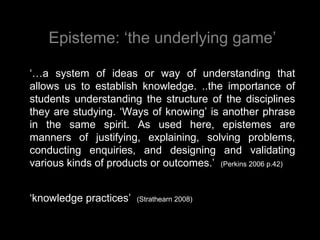
Episteme: ‘the underlying game’
‘…a system of ideas or way of understanding that
allows us to establish knowledge. ..the importance of
students understanding the structure of the disciplines
they are studying. ‘Ways of knowing’ is another phrase
in the same spirit. As used here, epistemes are
manners of justifying, explaining, solving problems,
conducting enquiries, and designing and validating
various kinds of products or outcomes.’ (Perkins 2006 p.42)
‘knowledge practices’ (Strathearn 2008)
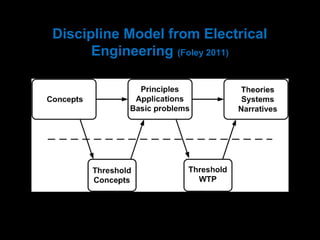
Discipline Model from Electrical
Engineering (Foley 2011)
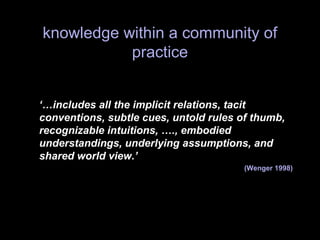
knowledge within a community of
practice
‘…includes all the implicit relations, tacit
conventions, subtle cues, untold rules of thumb,
recognizable intuitions, …., embodied
understandings, underlying assumptions, and
shared world view.’
(Wenger 1998)
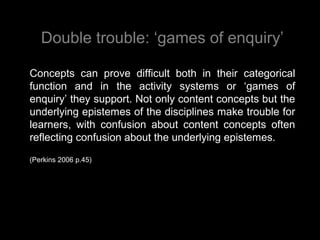
Double trouble: ‘games of enquiry’
Concepts can prove difficult both in their categorical
function and in the activity systems or ‘games of
enquiry’ they support. Not only content concepts but the
underlying epistemes of the disciplines make trouble for
learners, with confusion about content concepts often
reflecting confusion about the underlying epistemes.
(Perkins 2006 p.45)
Intellectual uncertainty
‘Intellectual uncertainty is not necessarily or simply a
negative experience, a dead-end sense of not
knowing, or of indeterminacy. It is just as well an
experience of something open, generative,
exhilarating, (the trembling of what remains
undecidable). I wish to suggest that ‘intellectual
uncertainty’ is ..a crucial dimension of any teaching
worthy of the name.’
(Royle 2003 : 52)
Considerations for Course
(ReDesign)
• Jewels in the Curriculum
• Importance of Engagement
• Listening for Understanding
• Reconstitution of Self
• Recursiveness
• Tolerating Uncertainty
• The Dynamics of Assessment
• The Underlying Game
IL Framework TCs
1 Authority Is Constructed and Contextual
Information resources reflect their creators’ expertise and credibility,
and are evaluated based on the information need and the context in
which the information will be used. Authority is constructed in that
various communities may recognize different types of authority. It is
contextual in that the information need may help to determine the level
of authority required.
2 Information Creation as a Process
Information in any format is produced to convey a message and is
shared via a selected delivery method. The iterative processes of
researching, creating, revising, and disseminating information vary, and
the resulting product reflects these differences.
3 Information Has Value
Information possesses several dimensions of value, including as a
commodity, as a means of education, as a means to influence, and as a
means of negotiating and understanding the world. Legal and
socioeconomic interests influence information production and
dissemination.
4 Research as Inquiry
Research is iterative and depends upon asking increasingly complex or
new questions whose answers in turn develop additional questions or
lines of inquiry in any field.
5 Scholarship as Conversation
Communities of scholars, researchers, or professionals engage in
sustained discourse with new insights and discoveries occurring over
time as a result of varied perspectives and interpretations.
6 Searching as Strategic Exploration
Searching for information is often nonlinear and iterative, requiring the
evaluation of a range of information sources and the mental flexibility to
pursue alternate avenues as new understanding develops.
Necessary and sufficient?
Sheila Webber (Sheffield University):
‘Information Literacy is a thing in itself – a different way of
seeing’
Bill Johnston (Strathclyde University)
‘Information itself may well constitute a threshold concept’
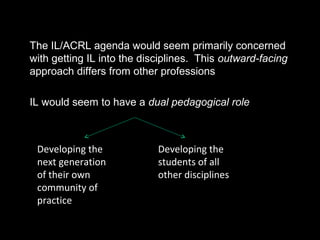
The IL/ACRL agenda would seem primarily concerned
with getting IL into the disciplines. This outward-facing
approach differs from other professions
IL would seem to have a dual pedagogical role
Developing the
next generation
of their own
community of
practice
Developing the
students of all
other disciplines
Issues
• What are the ACRL Frames gateways into? Generic
understandings? (Townsend et al 2011)
• TCs is an analytical approach concerned with conceptual
and ontological transformation. IL (eg Oakleaf 2014)
seems committed to outcomes and skills as well as
dispositions
• IL claims an interdisciplinary approach (Brunetti et al
2014) but would seem more cross-disciplinary
• What are the pedagogical realities of this in terms of what
can be achieved in a one hour session?
The next phase
• Perhaps IL practice needs to adopt a more strategic
approach in terms of gaining more purchase (and time)
within the curriculum
• It might for example exploit the culture of Inquiry Based
Learning (IBL) with its emphasis on criticality, and making
sense of risk, uncertainty, complexity, risk and speed
• IT already goes with the grain of research culture, beloved
of disciplines
The expanding
framework
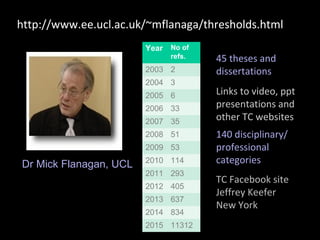
http://www.ee.ucl.ac.uk/~mflanaga/thresholds.html
Year No of
refs.
2003 2
2004 3
2005 6
2006 33
2007 35
2008 51
2009 53
2010 114
2011 293
2012 405
2013 637
2014 834
2015 11312
45 theses and
dissertations
Links to video, ppt
presentations and
other TC websites
78
discipilinary/subject
categories
Dr Mick Flanagan, UCL
140 disciplinary/
professional
categories
TC Facebook site
Jeffrey Keefer
New York
References
• Brunetti, K., Hofer, A. R. and Townsend, L. (2014). Interdisciplinarity and
information literacy Instruction: A threshold concepts approach. In C.
O’Mahoney, A. Buchanan, M. O’Rourke, & B. Higgs (Eds.), Threshold concepts:
From personal practice to communities of practice, Proceedings of the
National Academy's Sixth Annual Conference and the Fourth Biennial
Threshold Concepts Conference (pp. 89-93), Cork, Ireland: NAIRTL.
http://www.nairtl.ie/documents/EPub_2012Proceedings.pdf#page=99
• Oakleaf, M. (2014). A roadmap for assessing student learning using the new
Framework for Information Literacy for Higher Education. Journal of academic
librarianship, 40, 510–514.
• Townsend, L., Brunetti, K. and Hofer, A., (2011). Threshold concepts and
information literacy. Portal: libraries and the academy, 11 (3), 853-869.
ray.land@durham.ac.uk

‘There could be trouble ahead’. Threshold Concepts, Troublesome Knowledge and Information Literacy – a current debate - Ray Land

  • 2.
    There could be troubleahead Threshold Concepts, Troublesome Knowledge and Information Literacy – a current debate LILAC Newcastle 8 April 2015 Ray Land Durham University UK
  • 3.
    Framework for InformationLiteracy for Higher Education ..it is based on a cluster of interconnected core concepts, with flexible options for implementation, rather than on a set of standards, learning outcomes, or any prescriptive enumeration of skills. At the heart of this Framework are conceptual understandings that organize many other concepts and ideas about information, research, and scholarship into a coherent whole’ (ACRL 2015).
  • 4.
    The ACRL approach •How are librarians in the USA appropriating the notion of threshold concepts (TCs)? • What are the 6 identified TCs thresholds into? • What might be the implications of this new Framework?
  • 5.
  • 6.
    Venturing into strange places Thestudent is perforce required to venture into new places, strange places, anxiety-provoking places . This is part of the point of higher education. If there was no anxiety, it is difficult to believe that we could be in the presence of a higher education. (Barnett 2007: 147)
  • 7.
    Pedagogies of uncertainty Inthese settings, the presence of emotion, even a modicum of passion, is quite striking--as is its absence in other settings. I would say that without a certain amount of anxiety and risk, there's a limit to how much learning occurs. One must have something at stake. No emotional investment, no intellectual or formational yield. (Shulman 2005:4)
  • 8.
    ‘The path ofleast resistance and least trouble is a mental rut already made. It requires troublesome work to undertake the alteration of old beliefs.’ John Dewey 1933
  • 9.
    Real learning requires steppinginto the unknown, which initiates a rupture in knowing... By definition, all TC scholarship is concerned (directly or indirectly) with encountering the unknown. Schwartzman 2010 p.38
  • 10.
    pax intrantibus, salusexeuntibus (1609)
  • 12.
  • 13.
    I am partof all that I have me Yet all experience is an arch wh Gleams that untravell’d world, whose marg For ever and for ever when I m Tennyson ‘Ulysses’
  • 14.
    The only realvoyage of discovery consists not in seeing new landscapes, but in having new eyes, in seeing the universe with the eyes of another. Marcel Proust, 1900
  • 15.
    • Threshold concepts •Liminality • Troublesome knowledge • Episteme (the underlying game)
  • 16.
    Causes of conceptual (orother) difficulty?
  • 17.
    The role ofthe teacher is to arrange victories for the students Quintilian 35-100 AD
  • 18.
    The prevailing discourseof ‘outcomes’, ‘alignment’ and ‘achievement’ has, from critical perspectives, been deemed to serve managerialist imperatives without necessarily engaging discipline-based academics in significant reconceptualisation or review of their practice. (cf.Newton, 2000).
  • 19.
    Academics’ own definitionsof quality would seem to remain predominantly discipline- centred (cf. Henkel, 2000:106).
  • 20.
    Notion that withinspecific disciplines there exist significant ‘threshold concepts’, leading to new and previously inaccessible ways of thinking about something. (Meyer and Land, 2003).
  • 21.
    ‘Concept?’ ‘a unit ofthought or element of knowledge that allows us to organize experience’ Janet Gail Donald (2001) ‘Learning to Think: Disciplinary Perspectives’
  • 22.
    James Joyce’s ‘epiphany’ —the ‘revelation of the whatness of a thing’. But threshold concepts are both more constructed and re-constitutive than revelatory, and not necessarily sudden. (ευρηκα!)
  • 23.
    Akin to aportal, a liminal space, opening up a new and previously inaccessible way of thinking about something. Represents a transformed way of understanding, or interpreting, or viewing something without which the learner finds it difficult to progress, within the curriculum as formulated. Threshold Concepts
  • 24.
    Threshold Concepts As aconsequence of comprehending a threshold concept there may thus be a transformed internal view of subject matter, subject landscape, or even world view. Such a transformed view or landscape may represent how people ‘think’ in a particular discipline, or how they perceive, apprehend, or experience particular phenomena within that discipline, or more generally.
  • 25.
    However the engagementby the learner with an unfamiliar knowledge terrain and the ensuing reconceptualisation may involve a reconstitution of, or shift within, the learner’s subjectivity, and perhaps identity. Ontological implications. Learning as ‘a change in subjectivity’. (Pelletier 2007).
  • 26.
    Liminality • a transformativestate that engages existing certainties and renders them problematic, and fluid • a suspended state in which understanding can approximate to a kind of mimicry or lack of authenticity • liminality as unsettling – sense of loss
  • 27.
    • Q. Didyou feel the same as student 1? • Second student: Yeah. I felt lost. • Q. In lecture times as well? • Second student: You know, I understood the concept for about let’s say 10 seconds, yes yes, I got that and then suddenly, no no, I didn’t get that, you know, suddenly, like this. from G. Cousin, Journal of Learning Development Feb 2010
  • 28.
    • “There aresome things you learn, you suddenly think, wow, suddenly everything seems different… you now see the world quite differently”.
  • 29.
    Marine biology Osmosis iscounter-intuitive, it goes the opposite way. When does it click? When you study marine fish in 2nd or 3rd year, you see what would happen; it’s in a relevant situation. In first year you do mechanisms in blocks and there’s no relevance Taylor 2008, p. 191
  • 30.
    Janus – divinityof the threshold epistemological ontological
  • 31.
    Characteristics of a thresholdconcept • integrative • transformative • irreversible • bounded • re-constitutive • discursive • troublesome
  • 32.
    East of Edenthrough the threshold
  • 33.
    Some natural tearsthey dropped, but wiped them soon; The world was all before them, where to choose Their place of rest, and Providence their guide. They, hand in hand, with wandering steps and slow, Through Eden took their solitary way. John Milton (Paradise Lost, Book XII; 1667)
  • 35.
    Examples • Pure Maths– ‘complex number, a limit’, the Fourier transform’ • Literary Studies – ‘signification, deconstruction, ethical reading’ • Economics – ‘opportunity cost, price, elasticity’ • Design – ‘Confidence to challenge’ • Computer Science – ‘Object Oriented programming’, ‘Y and Recursion’ • Exercise Physiology – ‘metabolism’ • Law - ‘precedence’ • Accounting - ‘depreciation’ • Biology, Psychology - ‘evolution’ • Politics – ‘the state’ • Engineering – ‘reactive power’, ‘spin’ • Military – ‘Legitimised Use of Violence’ • Comparative Religion– ‘Biblical texts as Literary Texts’ • Plant Science ‘Photoprotection’ • Health Science – ‘Care’ • Physics – ‘Gravity’, ‘Measurement Uncertainty’ • Geology - ‘Geologic Time’
  • 36.
    Transactional curriculum inquiry (Cousin2009, pp. 201-212) • What do academics consider to be fundamental to a grasp of their subject? • What do students find difficult to grasp? • What curriculum design interventions can support mastery of these difficulties?
  • 37.
    When troubles comethey come not single spies, but in battalions (Hamlet Act 4 Sc 5 ll 83-84) Troublesome Knowledge
  • 38.
    looking for trouble •Knowledge is troublesome for a variety of reasons (Perkins 2006). It might be alien, inert, tacit, conceptually difficult, counter-intuitive, characterised by an inaccessible ‘underlying game’, or characterised by supercomplexity. • such troublesomeness and disquietude is purposeful, as it is the provoker of change that cannot be assimilated, and hence is the instigator of new learning and new ontological possibility.
  • 39.
    Troublesome knowledge • ritualknowledge • inert knowledge • conceptually difficult knowledge • the defended learner • alien knowledge • tacit knowledge • loaded knowledge • troublesome language
  • 40.
    Episteme: ‘the underlyinggame’ ‘…a system of ideas or way of understanding that allows us to establish knowledge. ..the importance of students understanding the structure of the disciplines they are studying. ‘Ways of knowing’ is another phrase in the same spirit. As used here, epistemes are manners of justifying, explaining, solving problems, conducting enquiries, and designing and validating various kinds of products or outcomes.’ (Perkins 2006 p.42) ‘knowledge practices’ (Strathearn 2008)
  • 41.
    Discipline Model fromElectrical Engineering (Foley 2011)
  • 42.
    knowledge within acommunity of practice ‘…includes all the implicit relations, tacit conventions, subtle cues, untold rules of thumb, recognizable intuitions, …., embodied understandings, underlying assumptions, and shared world view.’ (Wenger 1998)
  • 43.
    Double trouble: ‘gamesof enquiry’ Concepts can prove difficult both in their categorical function and in the activity systems or ‘games of enquiry’ they support. Not only content concepts but the underlying epistemes of the disciplines make trouble for learners, with confusion about content concepts often reflecting confusion about the underlying epistemes. (Perkins 2006 p.45)
  • 44.
    Intellectual uncertainty ‘Intellectual uncertaintyis not necessarily or simply a negative experience, a dead-end sense of not knowing, or of indeterminacy. It is just as well an experience of something open, generative, exhilarating, (the trembling of what remains undecidable). I wish to suggest that ‘intellectual uncertainty’ is ..a crucial dimension of any teaching worthy of the name.’ (Royle 2003 : 52)
  • 45.
    Considerations for Course (ReDesign) •Jewels in the Curriculum • Importance of Engagement • Listening for Understanding • Reconstitution of Self • Recursiveness • Tolerating Uncertainty • The Dynamics of Assessment • The Underlying Game
  • 46.
    IL Framework TCs 1Authority Is Constructed and Contextual Information resources reflect their creators’ expertise and credibility, and are evaluated based on the information need and the context in which the information will be used. Authority is constructed in that various communities may recognize different types of authority. It is contextual in that the information need may help to determine the level of authority required.
  • 47.
    2 Information Creationas a Process Information in any format is produced to convey a message and is shared via a selected delivery method. The iterative processes of researching, creating, revising, and disseminating information vary, and the resulting product reflects these differences. 3 Information Has Value Information possesses several dimensions of value, including as a commodity, as a means of education, as a means to influence, and as a means of negotiating and understanding the world. Legal and socioeconomic interests influence information production and dissemination.
  • 48.
    4 Research asInquiry Research is iterative and depends upon asking increasingly complex or new questions whose answers in turn develop additional questions or lines of inquiry in any field. 5 Scholarship as Conversation Communities of scholars, researchers, or professionals engage in sustained discourse with new insights and discoveries occurring over time as a result of varied perspectives and interpretations. 6 Searching as Strategic Exploration Searching for information is often nonlinear and iterative, requiring the evaluation of a range of information sources and the mental flexibility to pursue alternate avenues as new understanding develops.
  • 49.
    Necessary and sufficient? SheilaWebber (Sheffield University): ‘Information Literacy is a thing in itself – a different way of seeing’ Bill Johnston (Strathclyde University) ‘Information itself may well constitute a threshold concept’
  • 50.
    The IL/ACRL agendawould seem primarily concerned with getting IL into the disciplines. This outward-facing approach differs from other professions IL would seem to have a dual pedagogical role Developing the next generation of their own community of practice Developing the students of all other disciplines
  • 51.
    Issues • What arethe ACRL Frames gateways into? Generic understandings? (Townsend et al 2011) • TCs is an analytical approach concerned with conceptual and ontological transformation. IL (eg Oakleaf 2014) seems committed to outcomes and skills as well as dispositions • IL claims an interdisciplinary approach (Brunetti et al 2014) but would seem more cross-disciplinary • What are the pedagogical realities of this in terms of what can be achieved in a one hour session?
  • 52.
    The next phase •Perhaps IL practice needs to adopt a more strategic approach in terms of gaining more purchase (and time) within the curriculum • It might for example exploit the culture of Inquiry Based Learning (IBL) with its emphasis on criticality, and making sense of risk, uncertainty, complexity, risk and speed • IT already goes with the grain of research culture, beloved of disciplines
  • 53.
    The expanding framework http://www.ee.ucl.ac.uk/~mflanaga/thresholds.html Year Noof refs. 2003 2 2004 3 2005 6 2006 33 2007 35 2008 51 2009 53 2010 114 2011 293 2012 405 2013 637 2014 834 2015 11312 45 theses and dissertations Links to video, ppt presentations and other TC websites 78 discipilinary/subject categories Dr Mick Flanagan, UCL 140 disciplinary/ professional categories TC Facebook site Jeffrey Keefer New York
  • 55.
    References • Brunetti, K.,Hofer, A. R. and Townsend, L. (2014). Interdisciplinarity and information literacy Instruction: A threshold concepts approach. In C. O’Mahoney, A. Buchanan, M. O’Rourke, & B. Higgs (Eds.), Threshold concepts: From personal practice to communities of practice, Proceedings of the National Academy's Sixth Annual Conference and the Fourth Biennial Threshold Concepts Conference (pp. 89-93), Cork, Ireland: NAIRTL. http://www.nairtl.ie/documents/EPub_2012Proceedings.pdf#page=99 • Oakleaf, M. (2014). A roadmap for assessing student learning using the new Framework for Information Literacy for Higher Education. Journal of academic librarianship, 40, 510–514. • Townsend, L., Brunetti, K. and Hofer, A., (2011). Threshold concepts and information literacy. Portal: libraries and the academy, 11 (3), 853-869.
  • 56.