FOSTERING
INDEPENDENT LEARNING
   Pearson Learning Summit
          Jon Mladic
      Rasmussen College
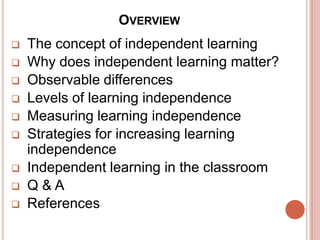
OVERVIEW
   The concept of independent learning
   Why does independent learning matter?
   Observable differences
   Levels of learning independence
   Measuring learning independence
   Strategies for increasing learning
    independence
   Independent learning in the classroom
   Q&A
   References
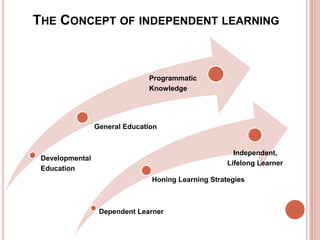
THE CONCEPT OF INDEPENDENT LEARNING


                               Programmatic
                               Knowledge


                 General Education


                                                       Independent,
 Developmental
                                                     Lifelong Learner
 Education
                                Honing Learning Strategies


                  Dependent Learner
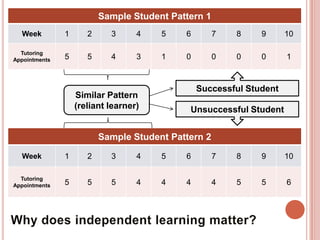
Sample Student Pattern 1
  Week         1      2     3      4   5    6        7   8    9      10

  Tutoring
Appointments   5      5     4      3   1    0        0   0    0      1


                                                Successful Student
                   Similar Pattern
                   (reliant learner)         Unsuccessful Student


                          Sample Student Pattern 2

  Week         1      2     3      4   5    6        7   8    9      10

  Tutoring
Appointments   5      5     5      4   4    4        4   5    5      6
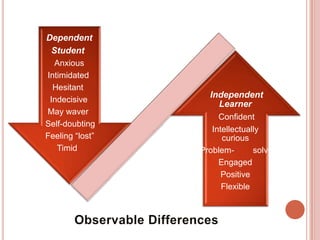
Dependent
 Student
  Anxious
Intimidated
  Hesitant
                   Independent
 Indecisive
                     Learner
May waver
                      Confident
Self-doubting
                    Intellectually
Feeling “lost”         curious
   Timid         Problem-       solver
                      Engaged
                       Positive
                       Flexible
STAGES OF LEARNING INDEPENDENCE
                             Level One
       Students observe and mimic problem-solving techniques


                             Level Two
 Students have a basic understanding of independent learning habits


                            Level Three
   Students function well independently on material they understand


                             Level Four
Students utilize a small number of problem-solving strategies effectively


                             Level Five
 Students select the best of a multitude of problem-solving strategies
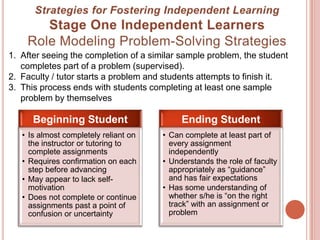
1. After seeing the completion of a similar sample problem, the student
   completes part of a problem (supervised).
2. Faculty / tutor starts a problem and students attempts to finish it.
3. This process ends with students completing at least one sample
   problem by themselves

      Beginning Student                     Ending Student
   • Is almost completely reliant on   • Can complete at least part of
     the instructor or tutoring to       every assignment
     complete assignments                independently
   • Requires confirmation on each     • Understands the role of faculty
     step before advancing               appropriately as “guidance”
   • May appear to lack self-            and has fair expectations
     motivation                        • Has some understanding of
   • Does not complete or continue       whether s/he is “on the right
     assignments past a point of         track” with an assignment or
     confusion or uncertainty            problem
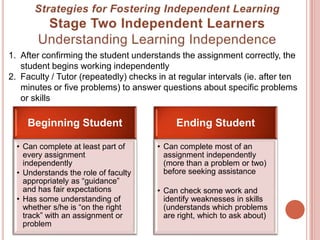
1. After confirming the student understands the assignment correctly, the
   student begins working independently
2. Faculty / Tutor (repeatedly) checks in at regular intervals (ie. after ten
   minutes or five problems) to answer questions about specific problems
   or skills

     Beginning Student                      Ending Student

  • Can complete at least part of      • Can complete most of an
    every assignment                     assignment independently
    independently                        (more than a problem or two)
  • Understands the role of faculty      before seeking assistance
    appropriately as “guidance”
    and has fair expectations          • Can check some work and
  • Has some understanding of            identify weaknesses in skills
    whether s/he is “on the right        (understands which problems
    track” with an assignment or         are right, which to ask about)
    problem
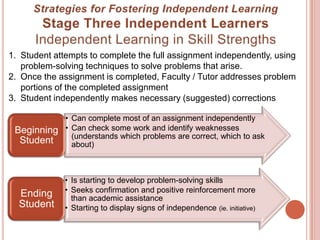
1. Student attempts to complete the full assignment independently, using
   problem-solving techniques to solve problems that arise.
2. Once the assignment is completed, Faculty / Tutor addresses problem
   portions of the completed assignment
3. Student independently makes necessary (suggested) corrections

              • Can complete most of an assignment independently
 Beginning    • Can check some work and identify weaknesses
                (understands which problems are correct, which to ask
  Student       about)


              • Is starting to develop problem-solving skills
              • Seeks confirmation and positive reinforcement more
  Ending        than academic assistance
  Student     • Starting to display signs of independence (ie. initiative)
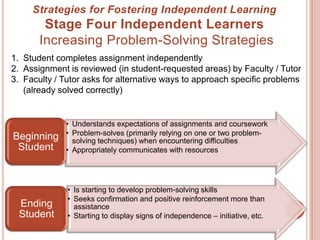
Strategies for Fostering Independent Learning
        Stage Four Independent Learners
       Increasing Problem-Solving Strategies
1. Student completes assignment independently
2. Assignment is reviewed (in student-requested areas) by Faculty / Tutor
3. Faculty / Tutor asks for alternative ways to approach specific problems
   (already solved correctly)


              • Understands expectations of assignments and coursework
              • Problem-solves (primarily relying on one or two problem-
Beginning       solving techniques) when encountering difficulties
 Student      • Appropriately communicates with resources


              • Is starting to develop problem-solving skills
              • Seeks confirmation and positive reinforcement more than
 Ending         assistance
 Student      • Starting to display signs of independence – initiative, etc.
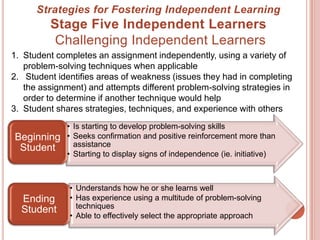
Strategies for Fostering Independent Learning
         Stage Five Independent Learners
          Challenging Independent Learners
1. Student completes an assignment independently, using a variety of
   problem-solving techniques when applicable
2. Student identifies areas of weakness (issues they had in completing
   the assignment) and attempts different problem-solving strategies in
   order to determine if another technique would help
3. Student shares strategies, techniques, and experience with others
              • Is starting to develop problem-solving skills
Beginning     • Seeks confirmation and positive reinforcement more than
 Student        assistance
              • Starting to display signs of independence (ie. initiative)


              • Understands how he or she learns well
  Ending      • Has experience using a multitude of problem-solving
  Student       techniques
              • Able to effectively select the appropriate approach
INDEPENDENT LEARNING HABITS
        Level 1                     Level 2                       Level 3                     Level 4                      Level 5
• Student completes two      • Student is able to         • Student is able to         •Student is comfortable     •Student is comfortable
or fewer problems before     complete two or more         complete most (70%) of       completing an entire        and confident in
seeking assistance           problems (or part of an      an assignment                assignment                  completing all coursework
•Student seeks assistance    assignment) on his/her       independently before         independently, as long      independently
on all or most (100%-75%)    own before seeking           seeking assistance           as assistance is            • Student completes all
assignments in a course      assistance                   • Student seeks assistance   available as needed         assignments
• Student immediately        • Student seeks assistance   on half or fewer (50%-       • Student completes         independently, at times
 seeks assistance when       on most (50-75%)             25%) of the assignments      most assignments            working with others to
 encountering a difficulty   assignments in a course      in a course                  independently, seeking      lead efforts to build
• Student struggles with     • When encountering          • When encountering          assistance for only 1%-     collaborative learning
most concepts and            difficulties, the student    difficulties, the student    25% of coursework           experiences
assignments in subject       attempts at least one        attempts at least two        • Student may struggle      • When struggling with a
area                         problem-solving              problem-solving              to select the appropriate   problem or assignment,
• Student works on most      technique before seeking     techniques before            problem-solving             student effectively selects
or all assignments in the    assistance                   requiring assistance         technique, but has          one or more problem-
presence of a tutor or       • Student has a basic        • Student has an average     multiple to select from     solving techniques. These
faculty member               understanding of the main    understanding of the         when struggling             lead to problem
• Student has few            concepts in the subject      course content material      • Student has a good        resolution
successful learning habits   area                         • Student has some           understanding of            • Student has an excellent
and struggles to             • Student sometimes          understanding of             him/herself as a learner    understanding of how
understand connection        struggles to understand      him/herself as a learner     and the habits which        s/he learns and improves
between current habits       him/herself as a learner     and caused for previously    have led to earned          as a student over time
and academic                 and reasons for earning a    earned grades on             grades on assignments
performance                  specific grade on an         assignments
                             assignment


                                                                                                                                                 12
LEARNING OBJECTIVES THAT
LEAD TO INDEPENDENT LEARNING


             Concept-Based
       (addresses a long-term need)


              Skill-Specific
        (addresses a course need)


           Assignment-Specific
 (addresses an immediate [homework] need)
INDEPENDENT LEARNING – RESULTS
   INCREASES IN LEVELS OF INDEPENDENT LEARNING

        October Tutoring Appointments – 3.47 average score
Level 1        Level 2       Level 3       Level 4       Level 5
 8.3%           13.8%        53.13%        30.55%        23.61%

     November Tutoring Appointments – 3.89 average score
Level 1        Level 2       Level 3       Level 4       Level 5
2.08%           8.3%         20.83%        35.42%        33.33%

     December Tutoring Appointments – 3.93 average score
Level 1        Level 2       Level 3       Level 4       Level 5

7.10%           7.10%        14.29%        28.57%        42.86%
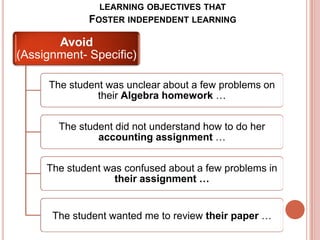
LEARNING OBJECTIVES THAT
             FOSTER INDEPENDENT LEARNING

       Avoid
(Assignment- Specific)

     The student was unclear about a few problems on
               their Algebra homework …


       The student did not understand how to do her
               accounting assignment …


     The student was confused about a few problems in
                   their assignment …


      The student wanted me to review their paper …
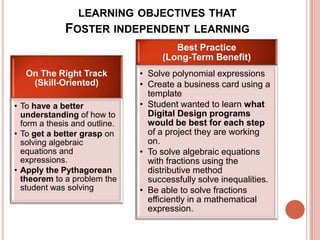
LEARNING OBJECTIVES THAT
             FOSTER INDEPENDENT LEARNING
                                       Best Practice
                                    (Long-Term Benefit)
   On The Right Track          • Solve polynomial expressions
    (Skill-Oriented)           • Create a business card using a
                                 template
• To have a better             • Student wanted to learn what
  understanding of how to        Digital Design programs
  form a thesis and outline.     would be best for each step
• To get a better grasp on       of a project they are working
  solving algebraic              on.
  equations and                • To solve algebraic equations
  expressions.                   with fractions using the
• Apply the Pythagorean          distributive method
  theorem to a problem the       successfully solve inequalities.
  student was solving          • Be able to solve fractions
                                 efficiently in a mathematical
                                 expression.
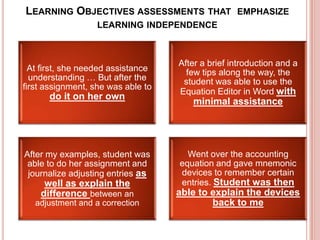
LEARNING OBJECTIVES ASSESSMENTS THAT EMPHASIZE
                   LEARNING INDEPENDENCE


                                    After a brief introduction and a
  At first, she needed assistance     few tips along the way, the
  understanding … But after the      student was able to use the
first assignment, she was able to
                                    Equation Editor in Word with
      do it on her own
                                       minimal assistance


After my examples, student was        Went over the accounting
 able to do her assignment and      equation and gave mnemonic
 journalize adjusting entries as    devices to remember certain
     well as explain the            entries. Student was then
    difference between an           able to explain the devices
   adjustment and a correction              back to me
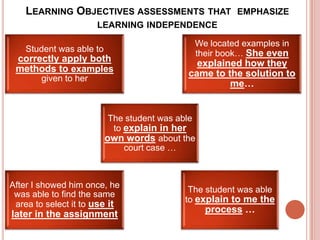
LEARNING OBJECTIVES ASSESSMENTS THAT EMPHASIZE
                       LEARNING INDEPENDENCE

                                              We located examples in
    Student was able to                       their book… She even
 correctly apply both                          explained how they
 methods to examples                         came to the solution to
        given to her
                                                      me…


                           The student was able
                            to explain in her
                          own words about the
                               court case …


After I showed him once, he
                                             The student was able
 was able to find the same
                                            to explain to me the
 area to select it to use it
later in the assignment                           process …
CLASSROOM APPLICABILITY
                     Skill – Focused Learning Objectives

                                                      Conclude        Write (a)
                                   Compose
Understand          Write an                         with a final      unified,
                                   supporting
 the basic          effective                          point or      coherent,
                                   details for
 parts of a           topic                         transition to     and well-
                                    the main
paragraph           sentence                           another       developed
                                      idea
                                                     main idea      paragraph(s)


                                      Work with
                                      support to
                                     brainstorm                        Through
                      Through
                                     supporting     Independently       support
                     support, be
  Observe or                           details.       compose a      (review first
                       able to
 identify areas                    Independently       complete          draft),
                   independently
of strength in a                      compose         paragraph     Effectively edit
                      compose
piece of writing                     supporting         (of five    and revise own
                      coherent
                                    sentences for     sentences)       and peer
                     sentences
                                     paragraph                          writing


                   Process – Focused Learning Objectives
Q&A


        Jon Mladic
Jon.Mladic@Rasmussen.edu
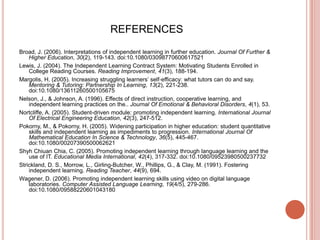
REFERENCES
Broad, J. (2006). Interpretations of independent learning in further education. Journal Of Further &
    Higher Education, 30(2), 119-143. doi:10.1080/03098770600617521
Lewis, J. (2004). The Independent Learning Contract System: Motivating Students Enrolled in
    College Reading Courses. Reading Improvement, 41(3), 188-194.
Margolis, H. (2005). Increasing struggling learners’ self‐efficacy: what tutors can do and say.
    Mentoring & Tutoring: Partnership In Learning, 13(2), 221-238.
    doi:10.1080/13611260500105675
Nelson, J., & Johnson, A. (1996). Effects of direct instruction, cooperative learning, and
    independent learning practices on the.. Journal Of Emotional & Behavioral Disorders, 4(1), 53.
Nortcliffe, A. (2005). Student-driven module: promoting independent learning. International Journal
    Of Electrical Engineering Education, 42(3), 247-512.
Pokorny, M., & Pokorny, H. (2005). Widening participation in higher education: student quantitative
    skills and independent learning as impediments to progression. International Journal Of
    Mathematical Education In Science & Technology, 36(5), 445-467.
    doi:10.1080/00207390500062621
Shyh Chiuan Chia, C. (2005). Promoting independent learning through language learning and the
    use of IT. Educational Media International, 42(4), 317-332. doi:10.1080/09523980500237732
Strickland, D. S., Morrow, L., Girling-Butcher, W., Phillips, G., & Clay, M. (1991). Fostering
    independent learning. Reading Teacher, 44(9), 694.
Wagener, D. (2006). Promoting independent learning skills using video on digital language
    laboratories. Computer Assisted Language Learning, 19(4/5), 279-286.
    doi:10.1080/09588220601043180

Fostering Independent Learning

  • 1.
    FOSTERING INDEPENDENT LEARNING Pearson Learning Summit Jon Mladic Rasmussen College
  • 2.
    OVERVIEW  The concept of independent learning  Why does independent learning matter?  Observable differences  Levels of learning independence  Measuring learning independence  Strategies for increasing learning independence  Independent learning in the classroom  Q&A  References
  • 3.
    THE CONCEPT OFINDEPENDENT LEARNING Programmatic Knowledge General Education Independent, Developmental Lifelong Learner Education Honing Learning Strategies Dependent Learner
  • 4.
    Sample Student Pattern1 Week 1 2 3 4 5 6 7 8 9 10 Tutoring Appointments 5 5 4 3 1 0 0 0 0 1 Successful Student Similar Pattern (reliant learner) Unsuccessful Student Sample Student Pattern 2 Week 1 2 3 4 5 6 7 8 9 10 Tutoring Appointments 5 5 5 4 4 4 4 5 5 6
  • 5.
    Dependent Student Anxious Intimidated Hesitant Independent Indecisive Learner May waver Confident Self-doubting Intellectually Feeling “lost” curious Timid Problem- solver Engaged Positive Flexible
  • 6.
    STAGES OF LEARNINGINDEPENDENCE Level One Students observe and mimic problem-solving techniques Level Two Students have a basic understanding of independent learning habits Level Three Students function well independently on material they understand Level Four Students utilize a small number of problem-solving strategies effectively Level Five Students select the best of a multitude of problem-solving strategies
  • 7.
    1. After seeingthe completion of a similar sample problem, the student completes part of a problem (supervised). 2. Faculty / tutor starts a problem and students attempts to finish it. 3. This process ends with students completing at least one sample problem by themselves Beginning Student Ending Student • Is almost completely reliant on • Can complete at least part of the instructor or tutoring to every assignment complete assignments independently • Requires confirmation on each • Understands the role of faculty step before advancing appropriately as “guidance” • May appear to lack self- and has fair expectations motivation • Has some understanding of • Does not complete or continue whether s/he is “on the right assignments past a point of track” with an assignment or confusion or uncertainty problem
  • 8.
    1. After confirmingthe student understands the assignment correctly, the student begins working independently 2. Faculty / Tutor (repeatedly) checks in at regular intervals (ie. after ten minutes or five problems) to answer questions about specific problems or skills Beginning Student Ending Student • Can complete at least part of • Can complete most of an every assignment assignment independently independently (more than a problem or two) • Understands the role of faculty before seeking assistance appropriately as “guidance” and has fair expectations • Can check some work and • Has some understanding of identify weaknesses in skills whether s/he is “on the right (understands which problems track” with an assignment or are right, which to ask about) problem
  • 9.
    1. Student attemptsto complete the full assignment independently, using problem-solving techniques to solve problems that arise. 2. Once the assignment is completed, Faculty / Tutor addresses problem portions of the completed assignment 3. Student independently makes necessary (suggested) corrections • Can complete most of an assignment independently Beginning • Can check some work and identify weaknesses (understands which problems are correct, which to ask Student about) • Is starting to develop problem-solving skills • Seeks confirmation and positive reinforcement more Ending than academic assistance Student • Starting to display signs of independence (ie. initiative)
  • 10.
    Strategies for FosteringIndependent Learning Stage Four Independent Learners Increasing Problem-Solving Strategies 1. Student completes assignment independently 2. Assignment is reviewed (in student-requested areas) by Faculty / Tutor 3. Faculty / Tutor asks for alternative ways to approach specific problems (already solved correctly) • Understands expectations of assignments and coursework • Problem-solves (primarily relying on one or two problem- Beginning solving techniques) when encountering difficulties Student • Appropriately communicates with resources • Is starting to develop problem-solving skills • Seeks confirmation and positive reinforcement more than Ending assistance Student • Starting to display signs of independence – initiative, etc.
  • 11.
    Strategies for FosteringIndependent Learning Stage Five Independent Learners Challenging Independent Learners 1. Student completes an assignment independently, using a variety of problem-solving techniques when applicable 2. Student identifies areas of weakness (issues they had in completing the assignment) and attempts different problem-solving strategies in order to determine if another technique would help 3. Student shares strategies, techniques, and experience with others • Is starting to develop problem-solving skills Beginning • Seeks confirmation and positive reinforcement more than Student assistance • Starting to display signs of independence (ie. initiative) • Understands how he or she learns well Ending • Has experience using a multitude of problem-solving Student techniques • Able to effectively select the appropriate approach
  • 12.
    INDEPENDENT LEARNING HABITS Level 1 Level 2 Level 3 Level 4 Level 5 • Student completes two • Student is able to • Student is able to •Student is comfortable •Student is comfortable or fewer problems before complete two or more complete most (70%) of completing an entire and confident in seeking assistance problems (or part of an an assignment assignment completing all coursework •Student seeks assistance assignment) on his/her independently before independently, as long independently on all or most (100%-75%) own before seeking seeking assistance as assistance is • Student completes all assignments in a course assistance • Student seeks assistance available as needed assignments • Student immediately • Student seeks assistance on half or fewer (50%- • Student completes independently, at times seeks assistance when on most (50-75%) 25%) of the assignments most assignments working with others to encountering a difficulty assignments in a course in a course independently, seeking lead efforts to build • Student struggles with • When encountering • When encountering assistance for only 1%- collaborative learning most concepts and difficulties, the student difficulties, the student 25% of coursework experiences assignments in subject attempts at least one attempts at least two • Student may struggle • When struggling with a area problem-solving problem-solving to select the appropriate problem or assignment, • Student works on most technique before seeking techniques before problem-solving student effectively selects or all assignments in the assistance requiring assistance technique, but has one or more problem- presence of a tutor or • Student has a basic • Student has an average multiple to select from solving techniques. These faculty member understanding of the main understanding of the when struggling lead to problem • Student has few concepts in the subject course content material • Student has a good resolution successful learning habits area • Student has some understanding of • Student has an excellent and struggles to • Student sometimes understanding of him/herself as a learner understanding of how understand connection struggles to understand him/herself as a learner and the habits which s/he learns and improves between current habits him/herself as a learner and caused for previously have led to earned as a student over time and academic and reasons for earning a earned grades on grades on assignments performance specific grade on an assignments assignment 12
  • 13.
    LEARNING OBJECTIVES THAT LEADTO INDEPENDENT LEARNING Concept-Based (addresses a long-term need) Skill-Specific (addresses a course need) Assignment-Specific (addresses an immediate [homework] need)
  • 14.
    INDEPENDENT LEARNING –RESULTS INCREASES IN LEVELS OF INDEPENDENT LEARNING October Tutoring Appointments – 3.47 average score Level 1 Level 2 Level 3 Level 4 Level 5 8.3% 13.8% 53.13% 30.55% 23.61% November Tutoring Appointments – 3.89 average score Level 1 Level 2 Level 3 Level 4 Level 5 2.08% 8.3% 20.83% 35.42% 33.33% December Tutoring Appointments – 3.93 average score Level 1 Level 2 Level 3 Level 4 Level 5 7.10% 7.10% 14.29% 28.57% 42.86%
  • 15.
    LEARNING OBJECTIVES THAT FOSTER INDEPENDENT LEARNING Avoid (Assignment- Specific) The student was unclear about a few problems on their Algebra homework … The student did not understand how to do her accounting assignment … The student was confused about a few problems in their assignment … The student wanted me to review their paper …
  • 16.
    LEARNING OBJECTIVES THAT FOSTER INDEPENDENT LEARNING Best Practice (Long-Term Benefit) On The Right Track • Solve polynomial expressions (Skill-Oriented) • Create a business card using a template • To have a better • Student wanted to learn what understanding of how to Digital Design programs form a thesis and outline. would be best for each step • To get a better grasp on of a project they are working solving algebraic on. equations and • To solve algebraic equations expressions. with fractions using the • Apply the Pythagorean distributive method theorem to a problem the successfully solve inequalities. student was solving • Be able to solve fractions efficiently in a mathematical expression.
  • 17.
    LEARNING OBJECTIVES ASSESSMENTSTHAT EMPHASIZE LEARNING INDEPENDENCE After a brief introduction and a At first, she needed assistance few tips along the way, the understanding … But after the student was able to use the first assignment, she was able to Equation Editor in Word with do it on her own minimal assistance After my examples, student was Went over the accounting able to do her assignment and equation and gave mnemonic journalize adjusting entries as devices to remember certain well as explain the entries. Student was then difference between an able to explain the devices adjustment and a correction back to me
  • 18.
    LEARNING OBJECTIVES ASSESSMENTSTHAT EMPHASIZE LEARNING INDEPENDENCE We located examples in Student was able to their book… She even correctly apply both explained how they methods to examples came to the solution to given to her me… The student was able to explain in her own words about the court case … After I showed him once, he The student was able was able to find the same to explain to me the area to select it to use it later in the assignment process …
  • 19.
    CLASSROOM APPLICABILITY Skill – Focused Learning Objectives Conclude Write (a) Compose Understand Write an with a final unified, supporting the basic effective point or coherent, details for parts of a topic transition to and well- the main paragraph sentence another developed idea main idea paragraph(s) Work with support to brainstorm Through Through supporting Independently support support, be Observe or details. compose a (review first able to identify areas Independently complete draft), independently of strength in a compose paragraph Effectively edit compose piece of writing supporting (of five and revise own coherent sentences for sentences) and peer sentences paragraph writing Process – Focused Learning Objectives
  • 20.
    Q&A Jon Mladic Jon.Mladic@Rasmussen.edu
  • 21.
    REFERENCES Broad, J. (2006).Interpretations of independent learning in further education. Journal Of Further & Higher Education, 30(2), 119-143. doi:10.1080/03098770600617521 Lewis, J. (2004). The Independent Learning Contract System: Motivating Students Enrolled in College Reading Courses. Reading Improvement, 41(3), 188-194. Margolis, H. (2005). Increasing struggling learners’ self‐efficacy: what tutors can do and say. Mentoring & Tutoring: Partnership In Learning, 13(2), 221-238. doi:10.1080/13611260500105675 Nelson, J., & Johnson, A. (1996). Effects of direct instruction, cooperative learning, and independent learning practices on the.. Journal Of Emotional & Behavioral Disorders, 4(1), 53. Nortcliffe, A. (2005). Student-driven module: promoting independent learning. International Journal Of Electrical Engineering Education, 42(3), 247-512. Pokorny, M., & Pokorny, H. (2005). Widening participation in higher education: student quantitative skills and independent learning as impediments to progression. International Journal Of Mathematical Education In Science & Technology, 36(5), 445-467. doi:10.1080/00207390500062621 Shyh Chiuan Chia, C. (2005). Promoting independent learning through language learning and the use of IT. Educational Media International, 42(4), 317-332. doi:10.1080/09523980500237732 Strickland, D. S., Morrow, L., Girling-Butcher, W., Phillips, G., & Clay, M. (1991). Fostering independent learning. Reading Teacher, 44(9), 694. Wagener, D. (2006). Promoting independent learning skills using video on digital language laboratories. Computer Assisted Language Learning, 19(4/5), 279-286. doi:10.1080/09588220601043180

Editor's Notes

  • #8 The key habit of a level one learner is that the student has very little confidence and / or few problem-solving skills. When a level one student encounters something they do not understand, they stop. They simply do not finish the problem or assignment.
  • #9 A major distinction between level one and level two is the ability to complete an assignment without stopping when encountering a problem. They may not problem-solve well, but they attempt to problem-solve and continue to completion to the best of their ability.
  • #10 Level three is really where students start to see academic success. A key distinction of a level three learner is that these students can – with some accuracy - identify which portions of an assignment they need help on, and which they are confident they did correctly.
  • #11 A trademark of the level four learner is that these students rely heavily on one or two specific problem-solving strategies. This allows them to meet current academic needs, but may not entirely prepare this student for increased challenges in the future (which require additional problem-solving strategies)
  • #12 The key distinguishing characteristic of level five learners is that they have had success implementing a range of problem-solving strategies, and have learned how to effectively select the appropriate strategy in given situations.
  • #13 Provide as a handout