Charlotte Danielson
A Framework for Teaching
Domain 2
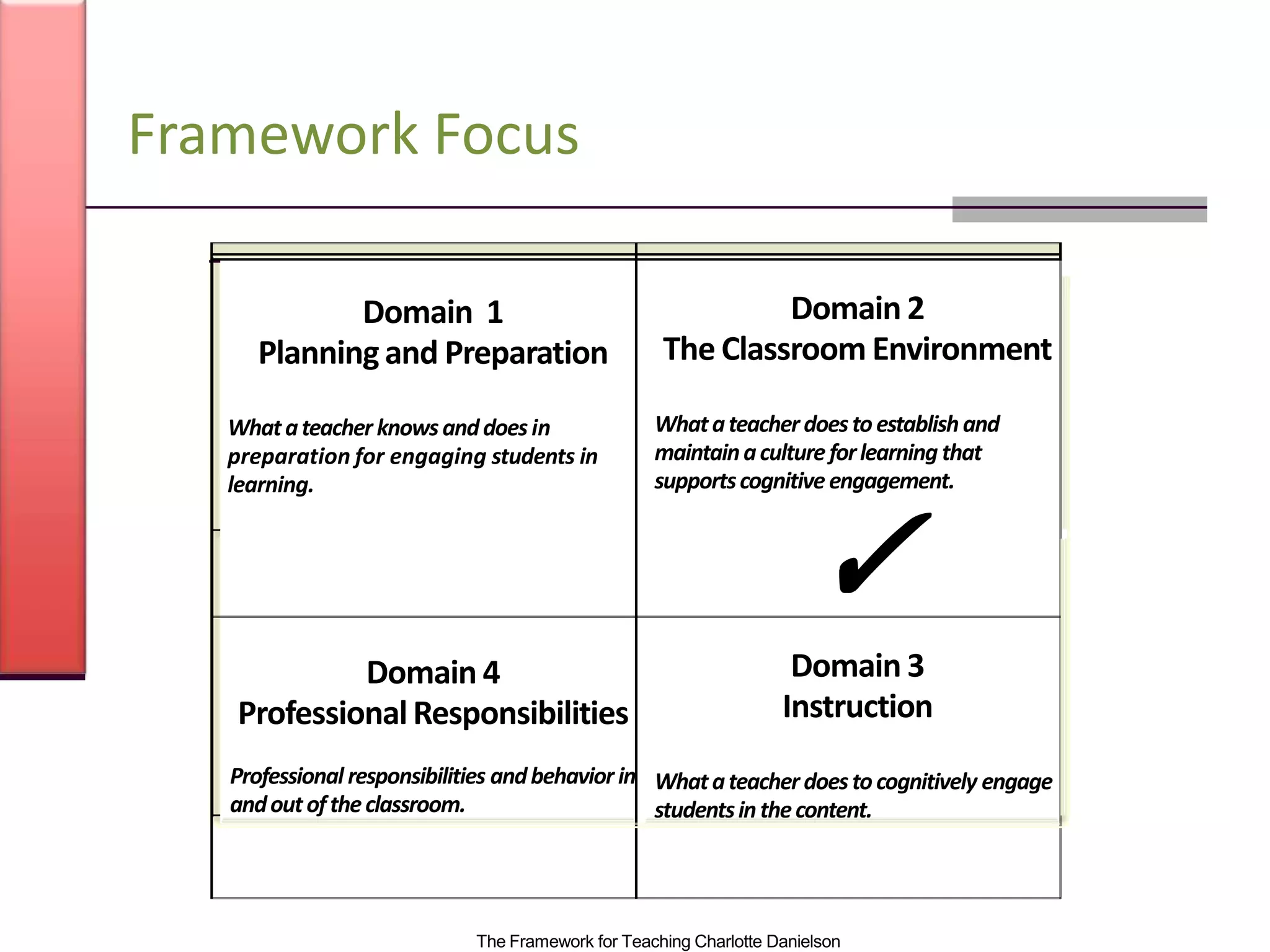
Framework Focus
Domain 1
Planningand Preparation
Whatateacher knowsanddoes in
preparation for engaging students in
learning.
Domain 2
The Classroom Environment
Whatateacher doestoestablishand
maintainaculture forlearning that
supportscognitive engagement.
✓
Domain 4
ProfessionalResponsibilities
Professional responsibilities andbehavior in
andoutoftheclassroom.
Domain 3
Instruction
Whatateacher doestocognitively engage
studentsinthecontent.
•
The Framework for Teaching Charlotte Danielson
Constructivist Approach
• “…all human beings-
adults as well as children-
it is the learner who does
the learning.”
• “People remember an
experience based on
what their pre-existing
knowledge and cognitive
structures allow them to
absorb-regardless of a
teacher’s intentions or
the quality of an
explanation.”
• “…the activities…must be
“minds on”.
• The Framework for
Teaching is based upon
this approach.
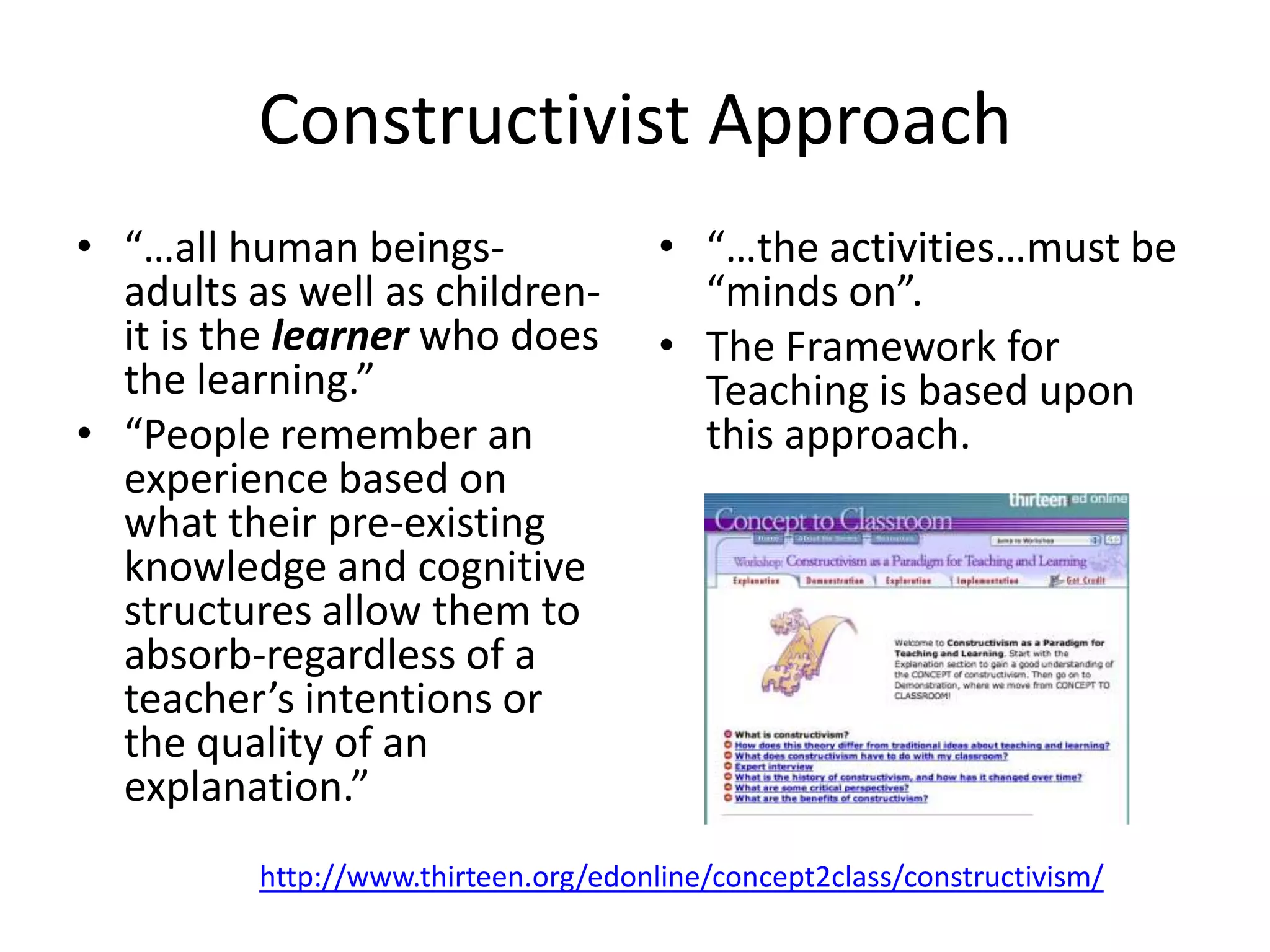
http://www.thirteen.org/edonline/concept2class/constructivism/
Remember this saying…
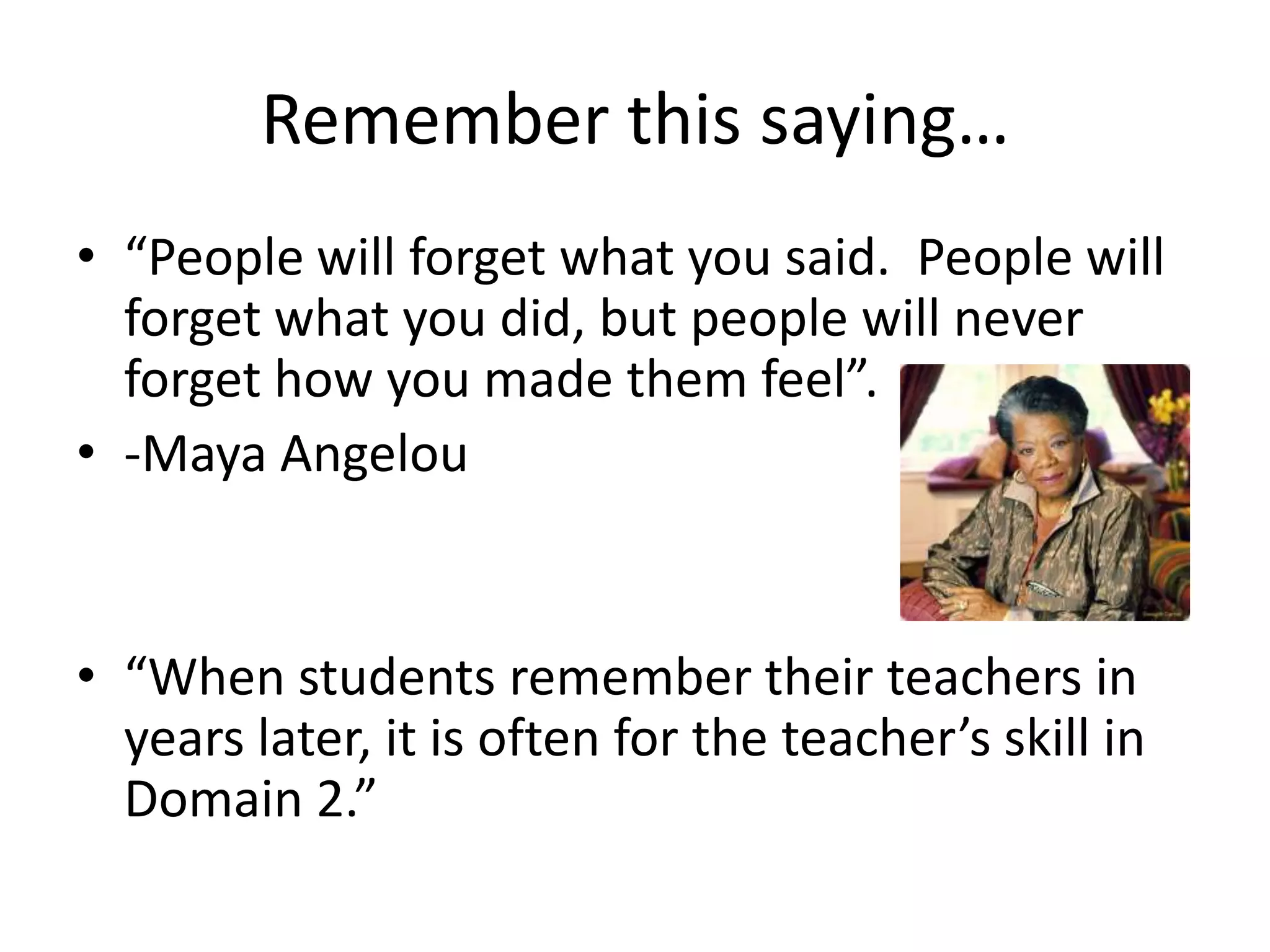
• “People will forget what you said. People will
forget what you did, but people will never
forget how you made them feel”.
• -Maya Angelou
• “When students remember their teachers in
years later, it is often for the teacher’s skill in
Domain 2.”
Domain 2
The Classroom Environment
-5 Components
• 2a: Creating an Environment of Respect and
Rapport
• 2b: Establishing a Culture for Learning
• 2c: Managing Classroom Procedures
• 2d: Managing Student Behavior
• 2e: Organizing Physical Space
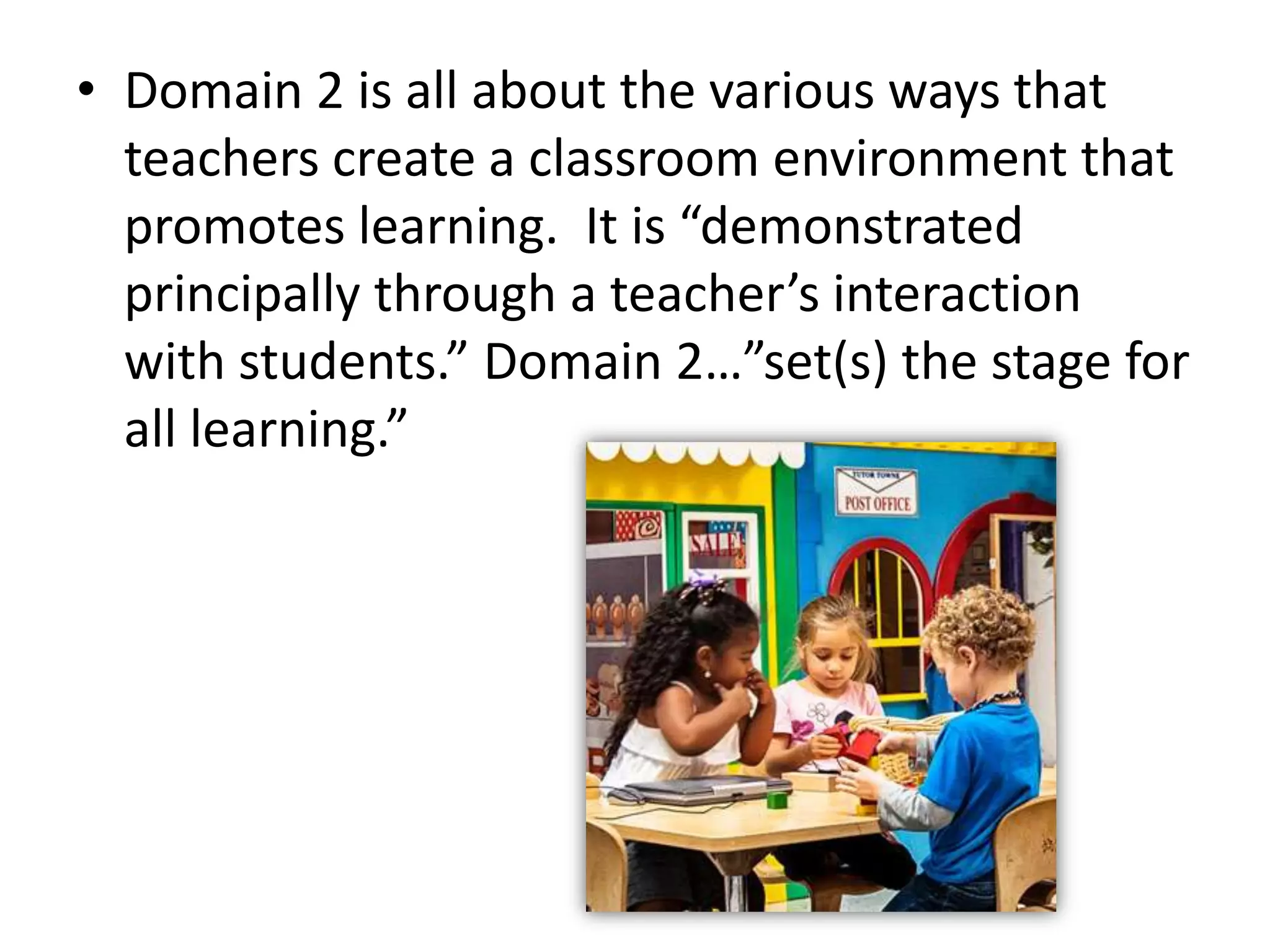
• Domain 2 is all about the various ways that
teachers create a classroom environment that
promotes learning. It is “demonstrated
principally through a teacher’s interaction
with students.” Domain 2…”set(s) the stage for
all learning.”
2a: Creating an Environment of
Respect and Rapport
• Teacher interaction with the students
• Student interaction with other students
• “Students feel respected by the teacher and
their peers, they believe that the teacher
cares about them and their learning.”
• “Students themselves will ensure standards of
civility”.
What response would you give?
• If a student offers an idea, or a response to a
teacher’s question that is so far off base as to
promote laughter from the other students?
http://www.youtube.com/watch?v=44GzGk75vb0
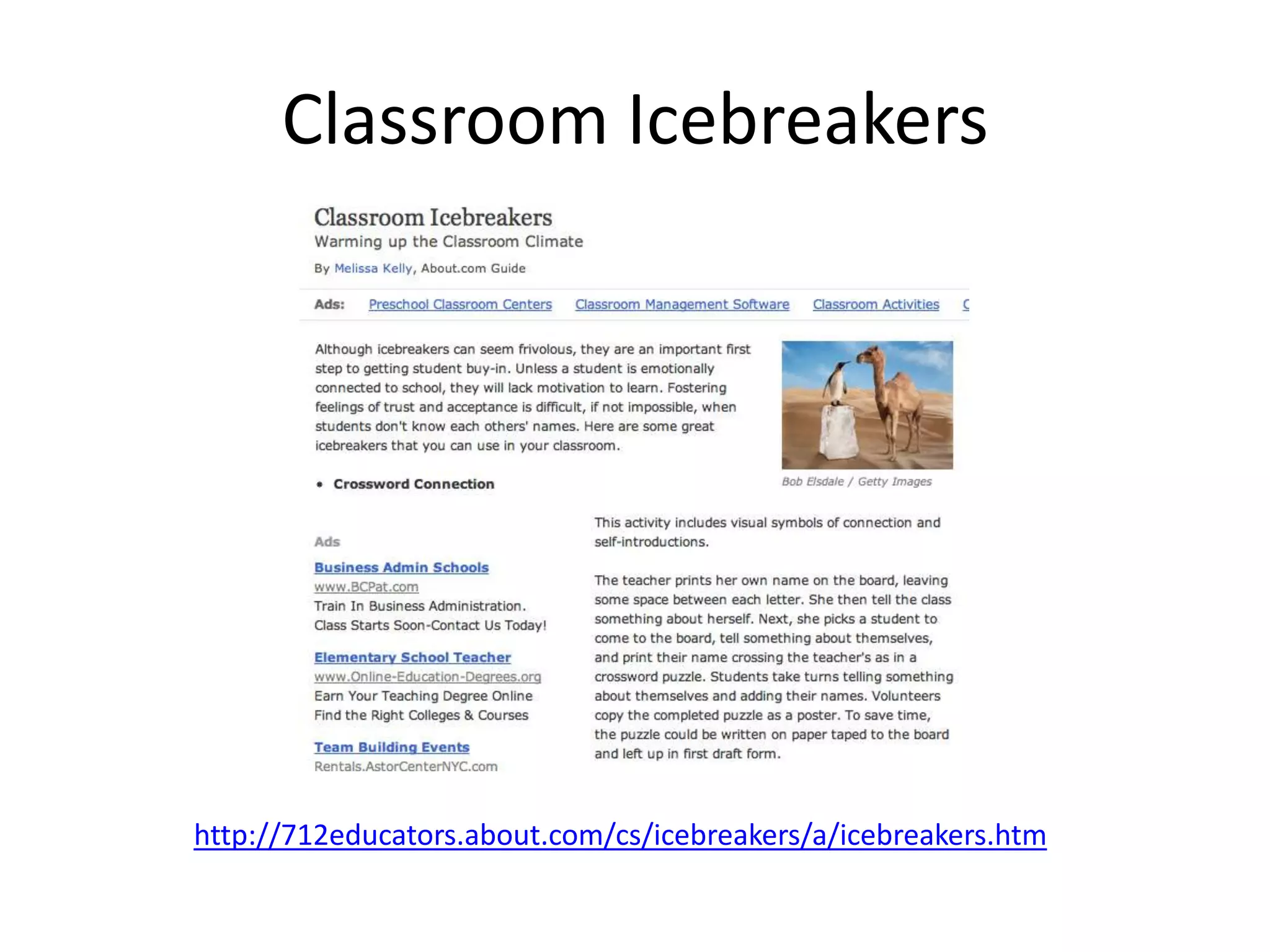
Classroom Icebreakers
http://712educators.about.com/cs/icebreakers/a/icebreakers.htm
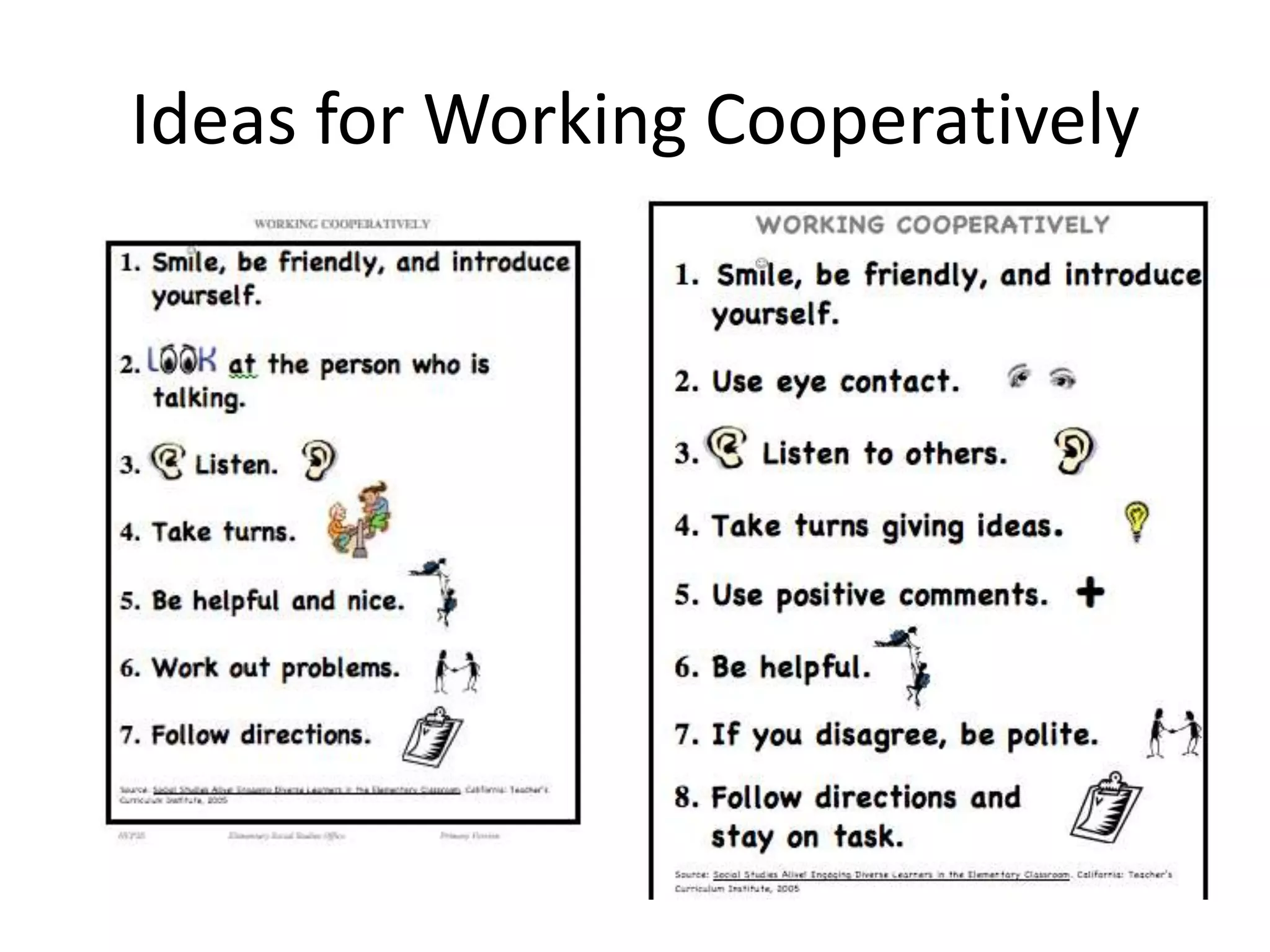
Ideas for Working Cooperatively
2b: Establishing a Culture for Learning
• “A “culture for learning” refers to the atmosphere
in the classroom and reflects the importance of
the work undertaken by both students and
teachers”.
• Classroom characteristics include:
• “high energy”
• It’s “cool” to be smart, and good ideas are valued
• It’s safe to take risks
• Students “believe that their teacher has a high
regard for their abilities”.
2b: Establishing a Culture for Learning
• If we truly believe…
• All children can and will learn
• Parents want and deserve the best education
for their children; deserving our full support in
the co-education of their children
• We are all learners – teachers and students
alike
Honor Roll Assembly?
• Student recognition for academic
achievement
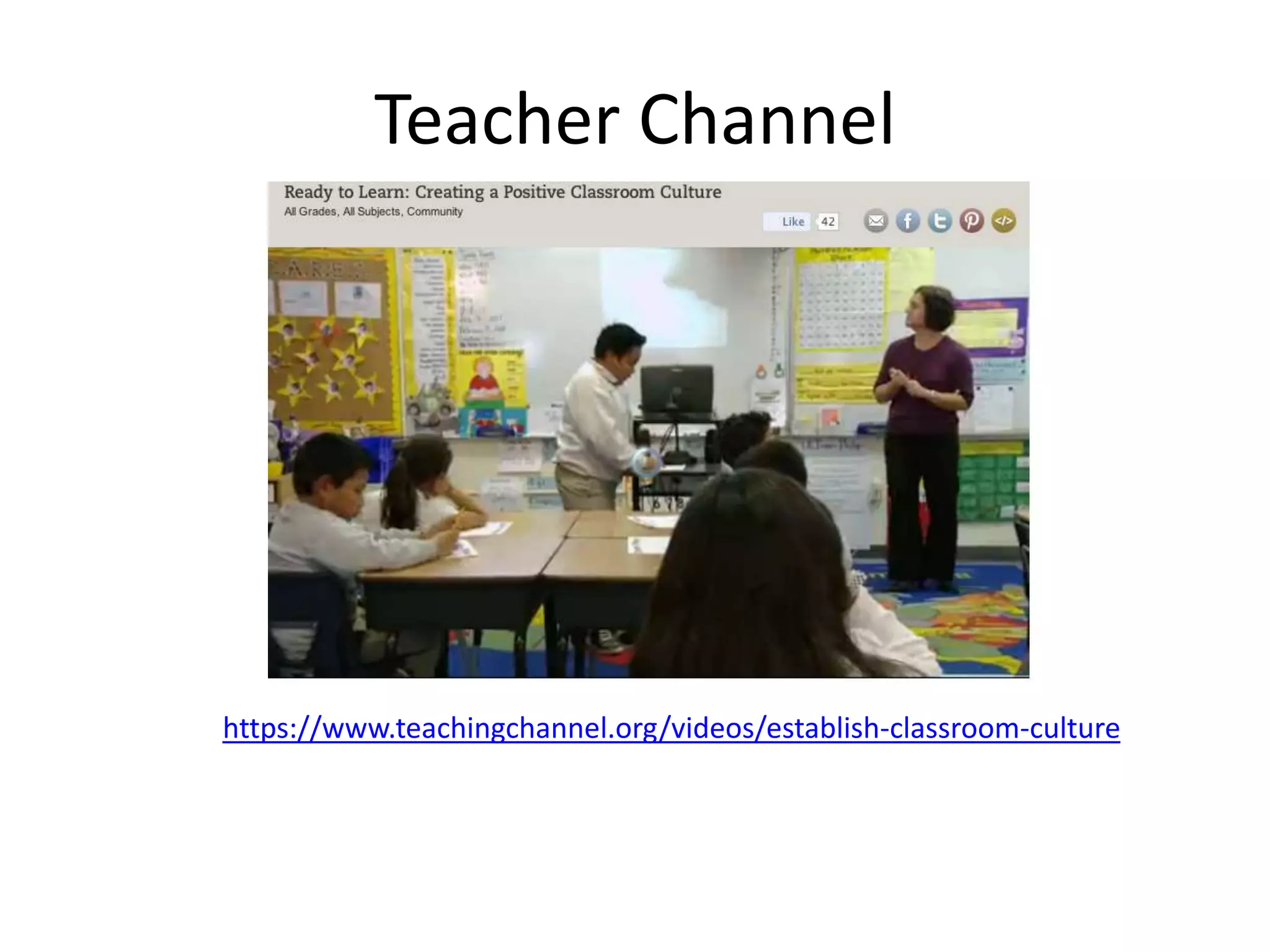
Teacher Channel
https://www.teachingchannel.org/videos/establish-classroom-culture
What is a “Positive Classroom
Climate”?
• Classroom climate refers to the prevailing
mood, attitudes, standards, and tone that you
and your students feel when they are in your
classroom.
• A negative classroom climate can feel hostile,
chaotic, and out of control.
• A positive classroom climate feels safe,
respectful, welcoming, and supportive of
student learning.
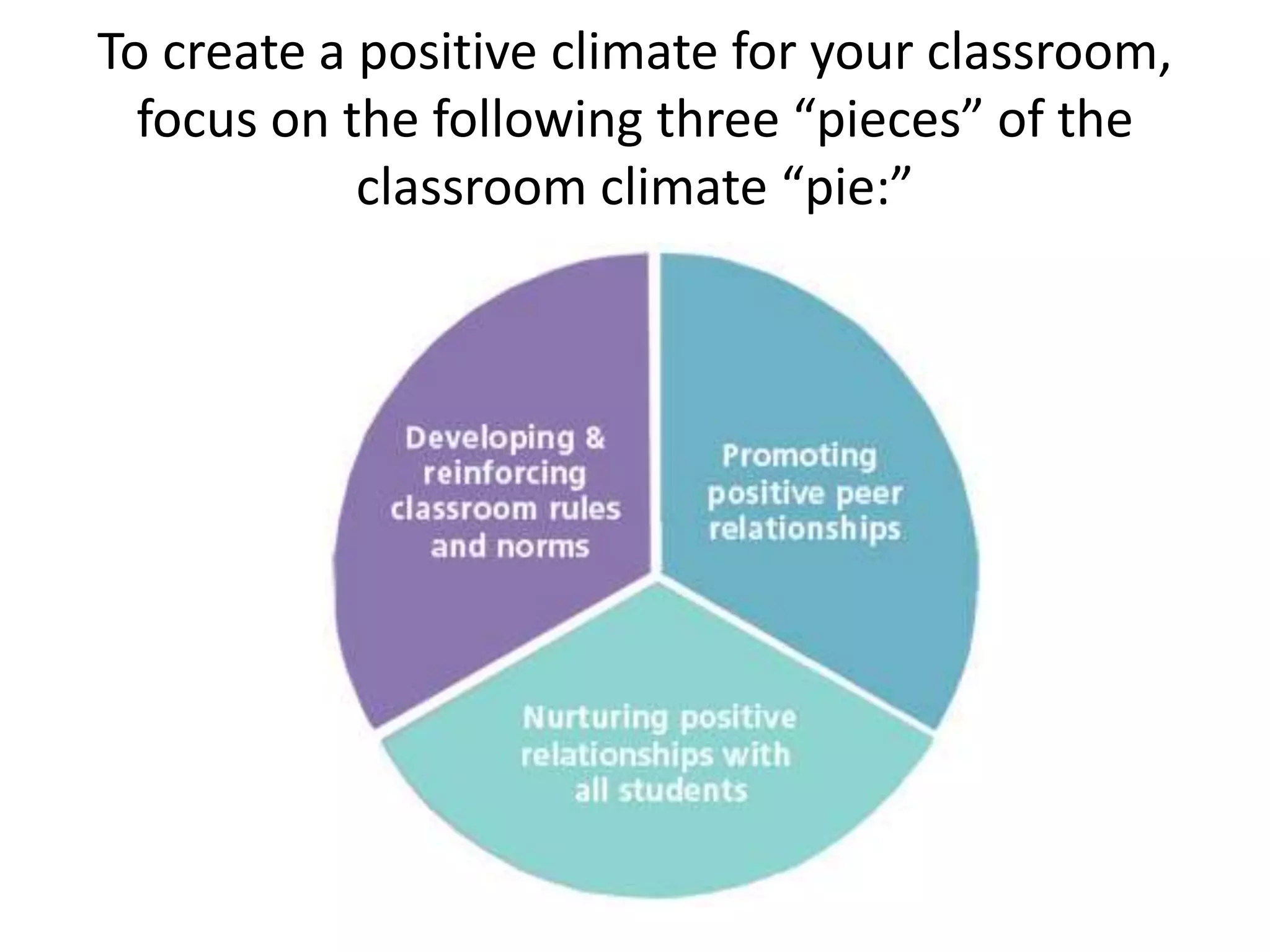
To create a positive climate for your classroom,
focus on the following three “pieces” of the
classroom climate “pie:”
Develop Classroom Rules
• Develop and reinforce classroom rules and
norms that clearly support safe and respectful
behavior. Having classroom rules helps you create
a predictable, safe learning environment for your
students. Rules give your students clear
boundaries and opportunities to practice self-
regulation and make good choices. When
students feel safe and respected both
emotionally and physically, they are able to focus
better on learning.
Promote Positive Peer Relationships
• You want to create an environment where your students support and are kind to
one another. Some ways you can do this are:
• Notice and reinforce casual positive interactions between students on a daily basis.
• Deliberately plan relationship-building activities and games that encourage
positive interactions. These can be long-term projects, or short and simple games
designed for students to get to know each other better.
• Pay attention to the social dynamics of your classroom. Do some students have
trouble making friends? Do some students have trouble getting along with others?
Who has a lot of friends? Who has few friends? Interviewing your students one-
on-one can help you identify students that have stronger or weaker social
connections. This can inform your seating arrangements, guide your grouping and
pairing decisions, and assist you in helping students form new networks of friends.
• Have class meetings. Class meetings provide a safe environment in which students
can discuss with you and each other topics that are important to them. You and
your students can get to know each other better and build relationships through
open discussions on subjects like: Following Rules, How to Get Help, Including
Others, Solving Problems, etc. This helps create a positive classroom climate built
on trust and respect.
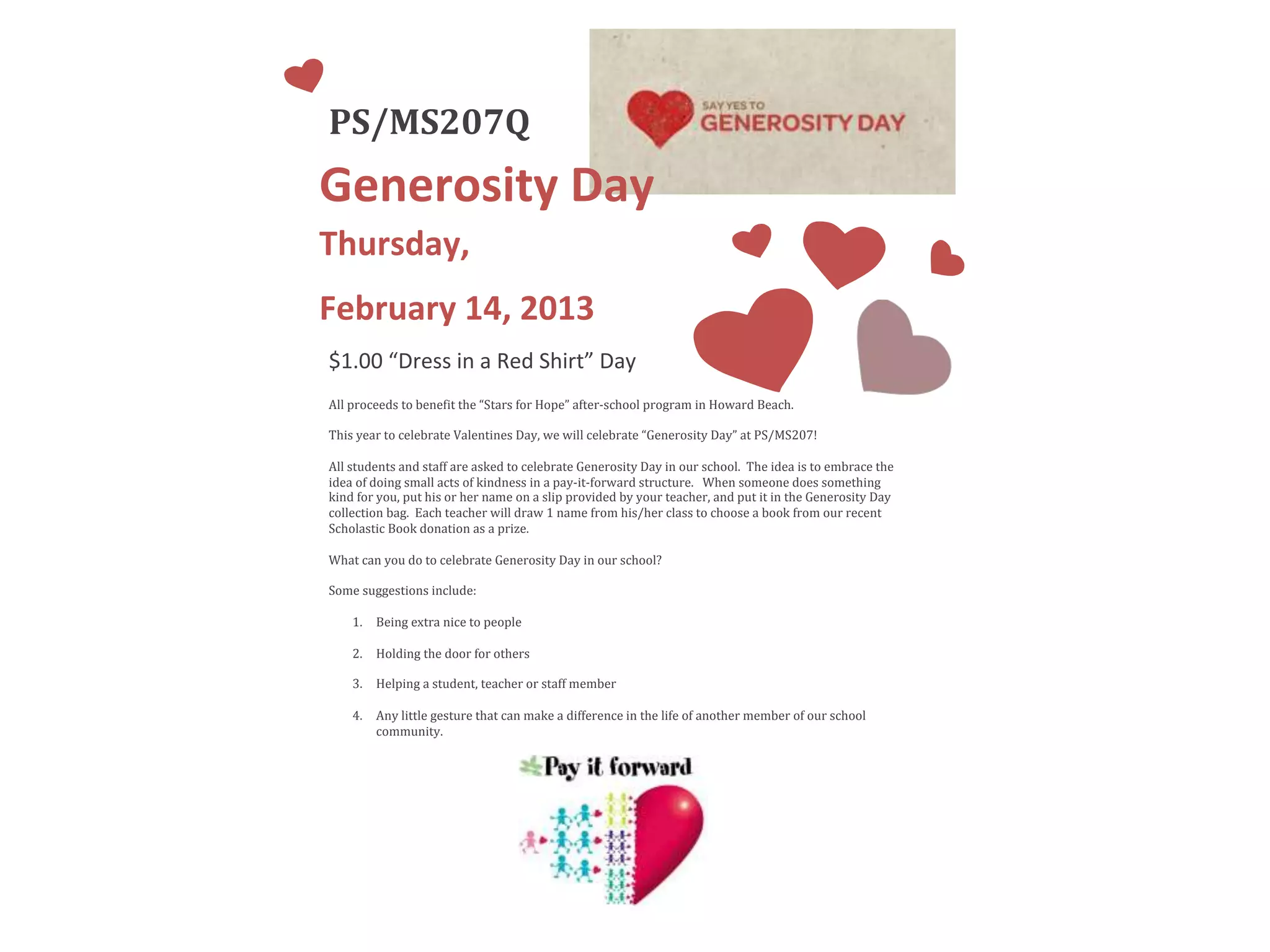
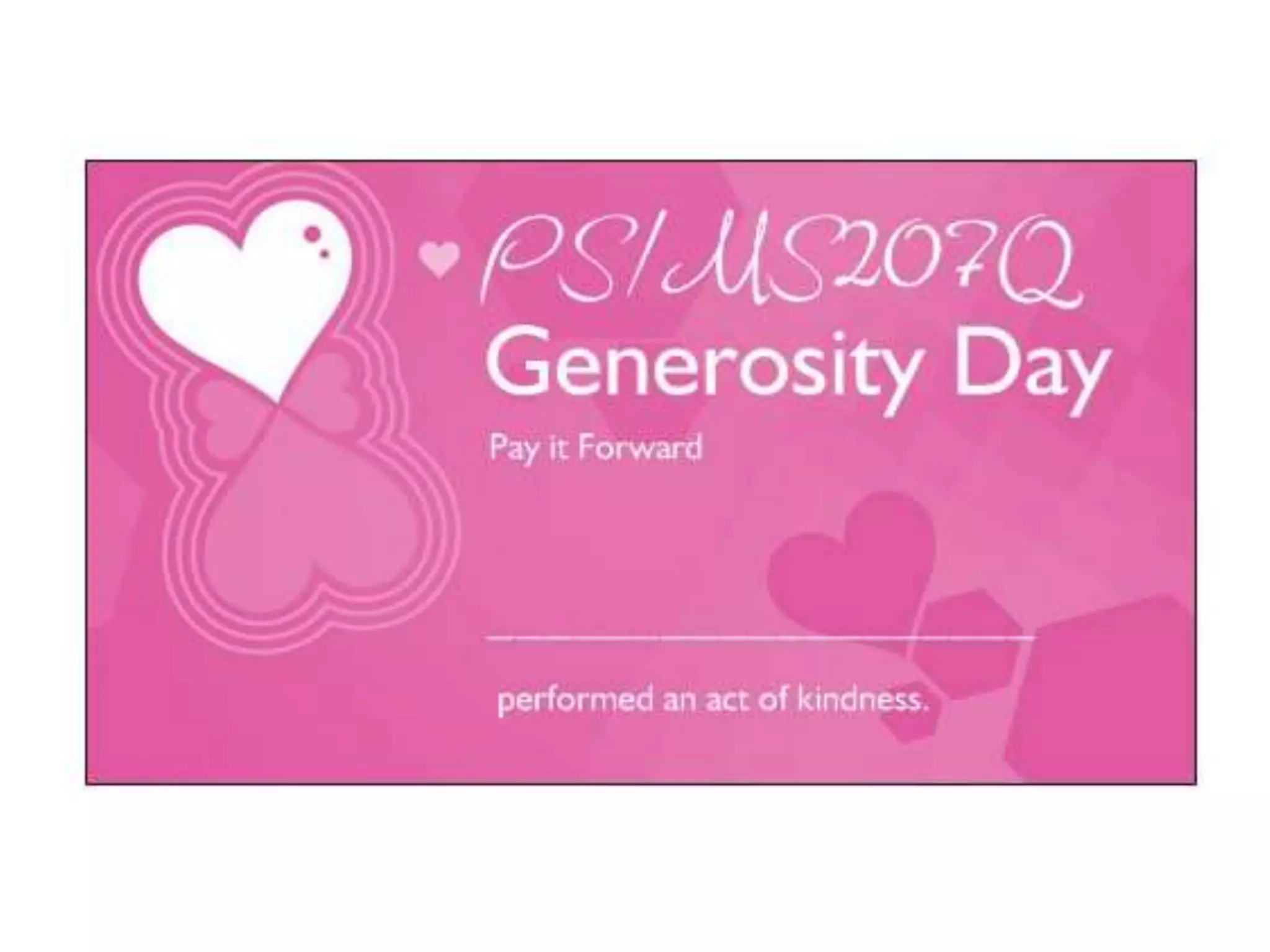
PS/MS207Q
Generosity Day
Thursday,
February 14, 2013
$1.00 “Dress in a Red Shirt” Day
All proceeds to benefit the “Stars for Hope” after-school program in Howard Beach.
This year to celebrate Valentines Day, we will celebrate “Generosity Day” at PS/MS207!
All students and staff are asked to celebrate Generosity Day in our school. The idea is to embrace the
idea of doing small acts of kindness in a pay-it-forward structure. When someone does something
kind for you, put his or her name on a slip provided by your teacher, and put it in the Generosity Day
collection bag. Each teacher will draw 1 name from his/her class to choose a book from our recent
Scholastic Book donation as a prize.
What can you do to celebrate Generosity Day in our school?
Some suggestions include:
1. Being extra nice to people
2. Holding the door for others
3. Helping a student, teacher or staff member
4. Any little gesture that can make a difference in the life of another member of our school
community.
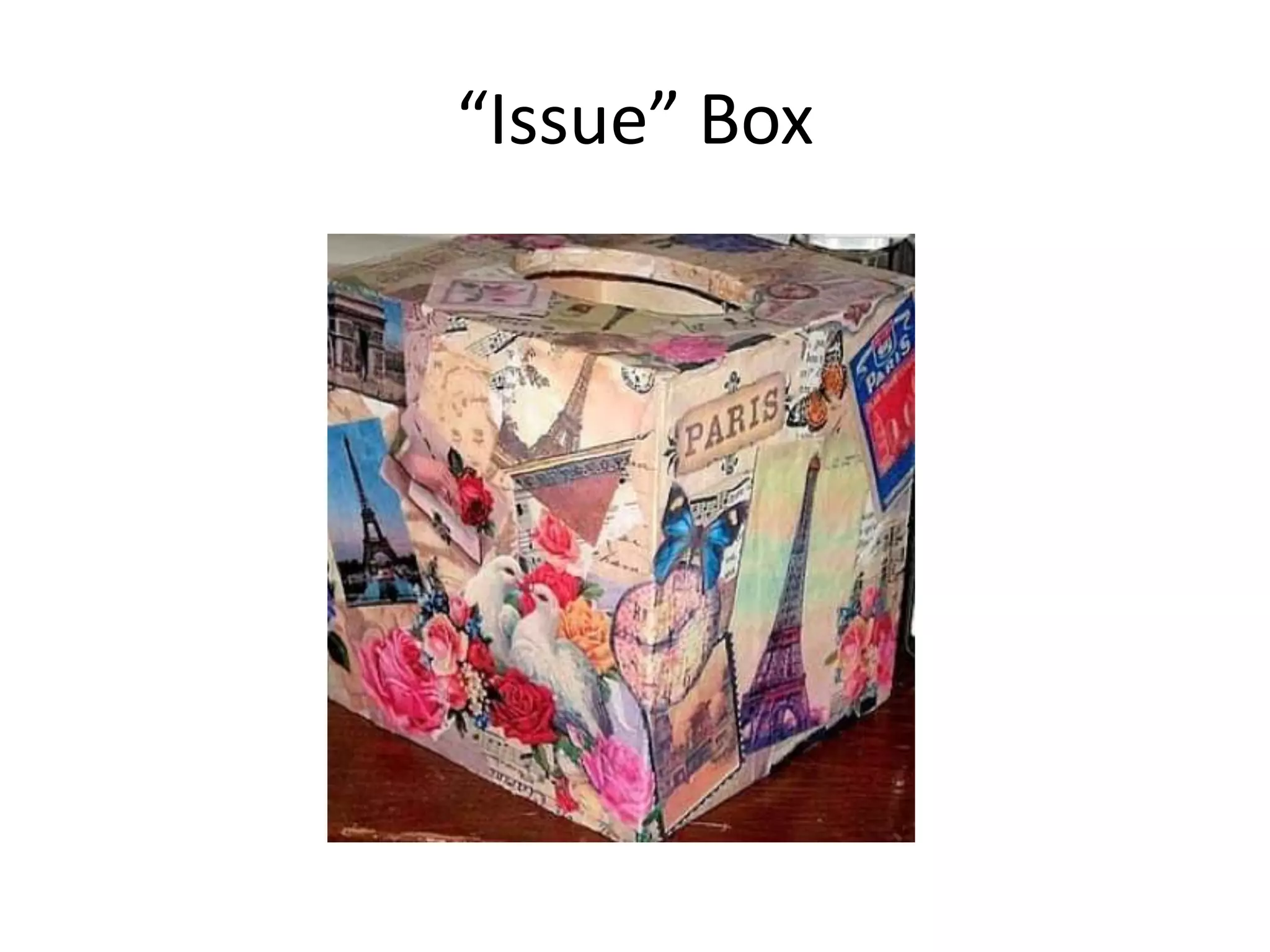
“Issue” Box
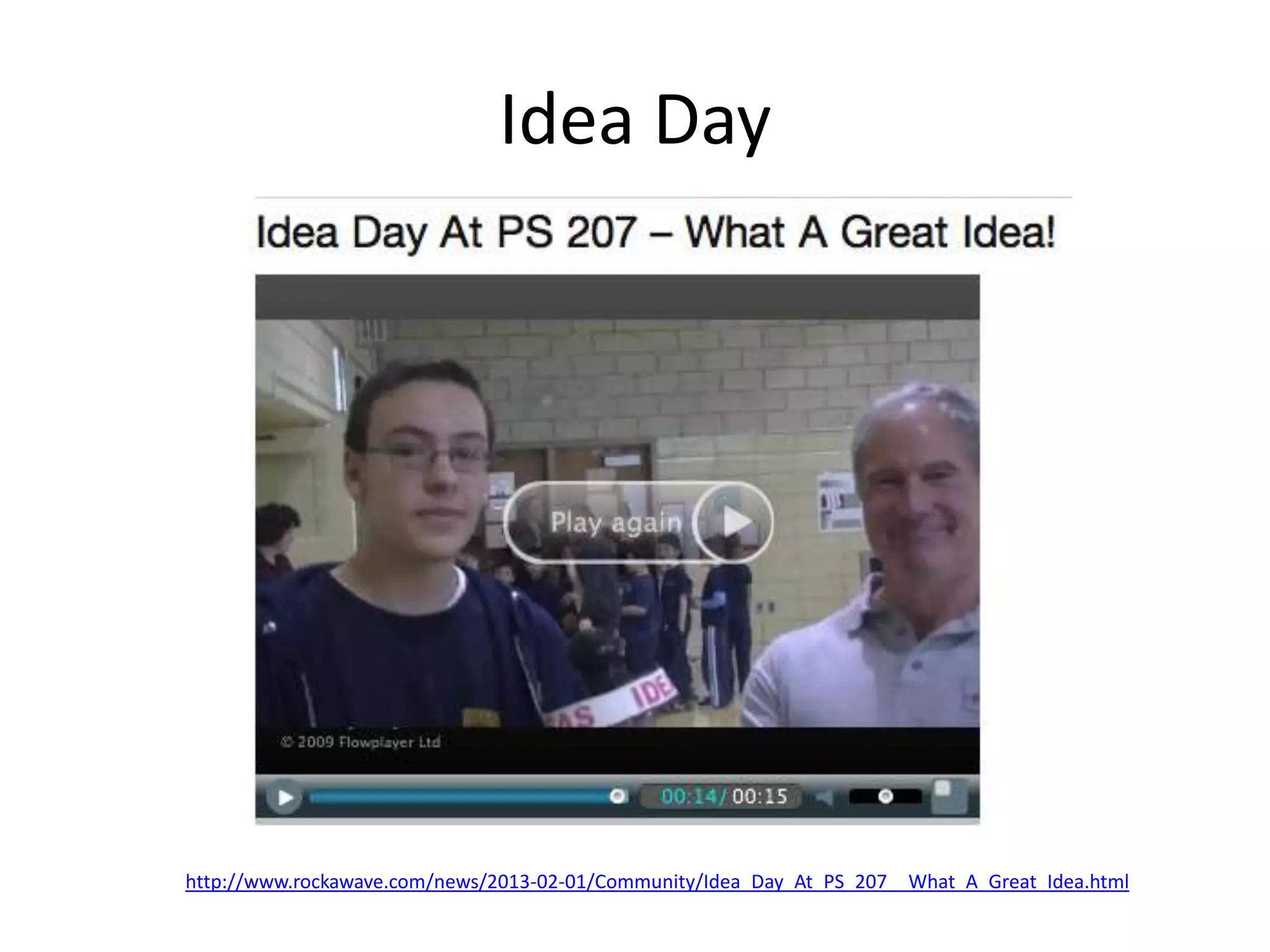
Idea Day
http://www.rockawave.com/news/2013-02-01/Community/Idea_Day_At_PS_207__What_A_Great_Idea.html
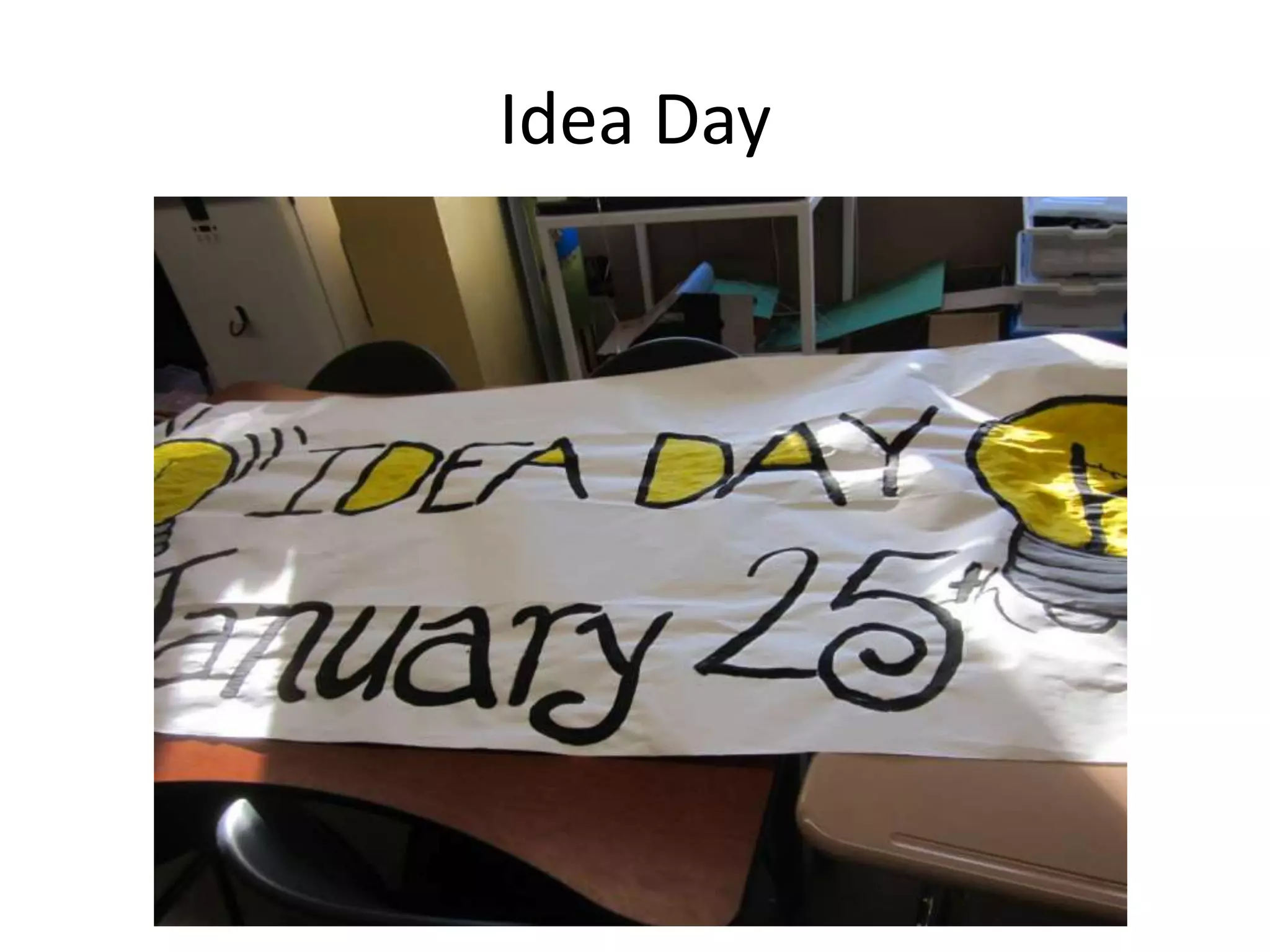
Idea Day
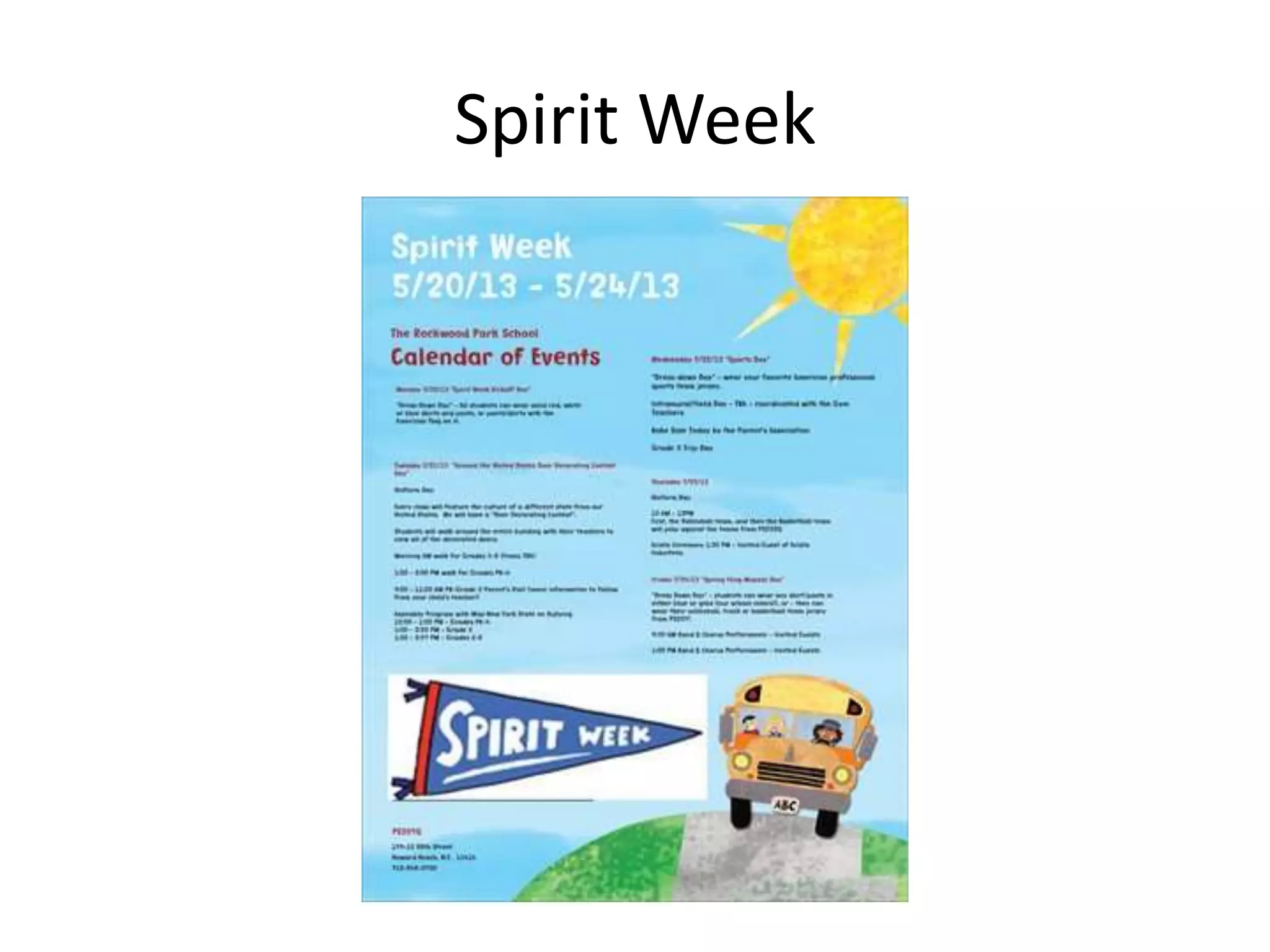
Spirit Week
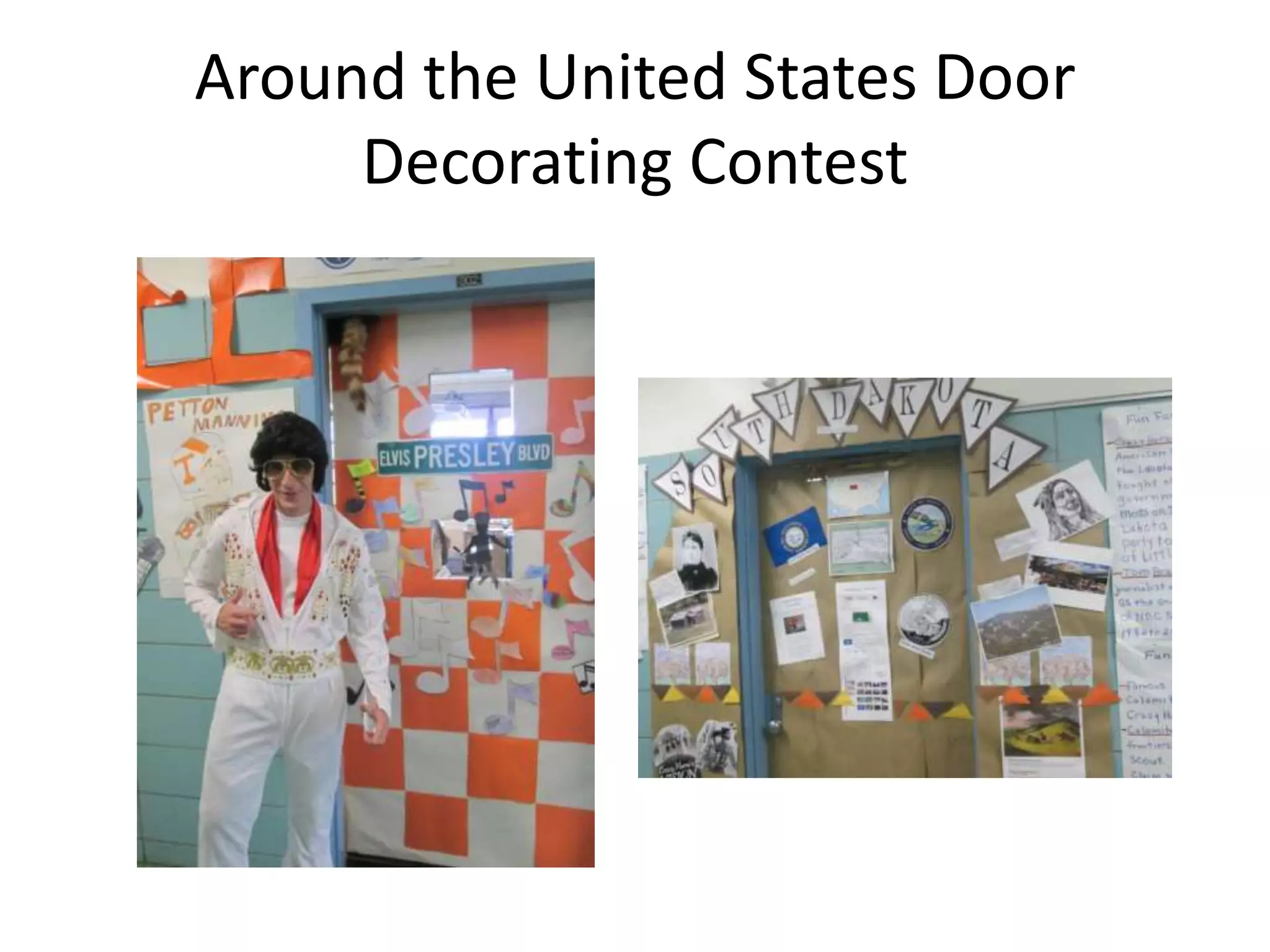
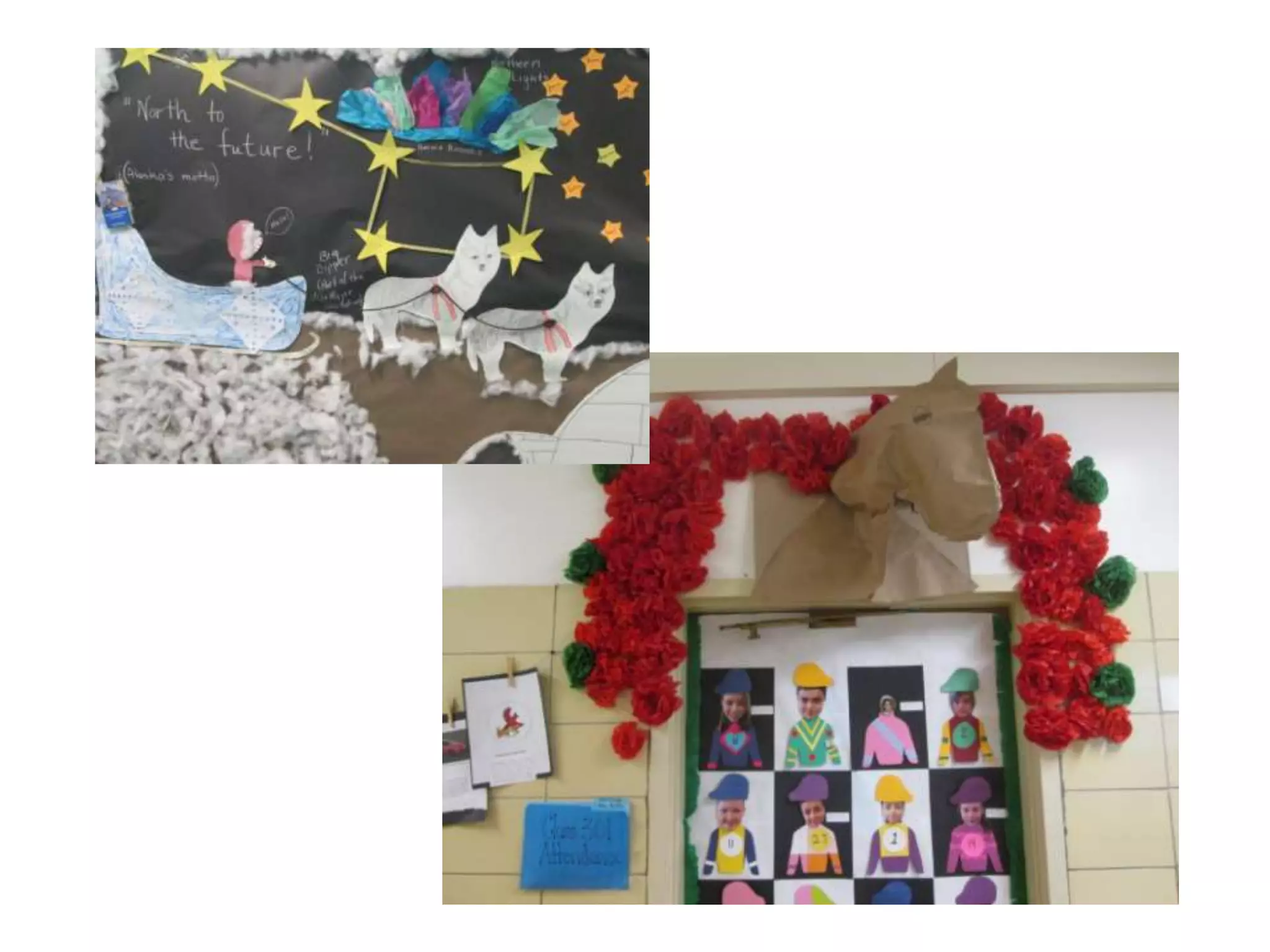
Around the United States Door
Decorating Contest
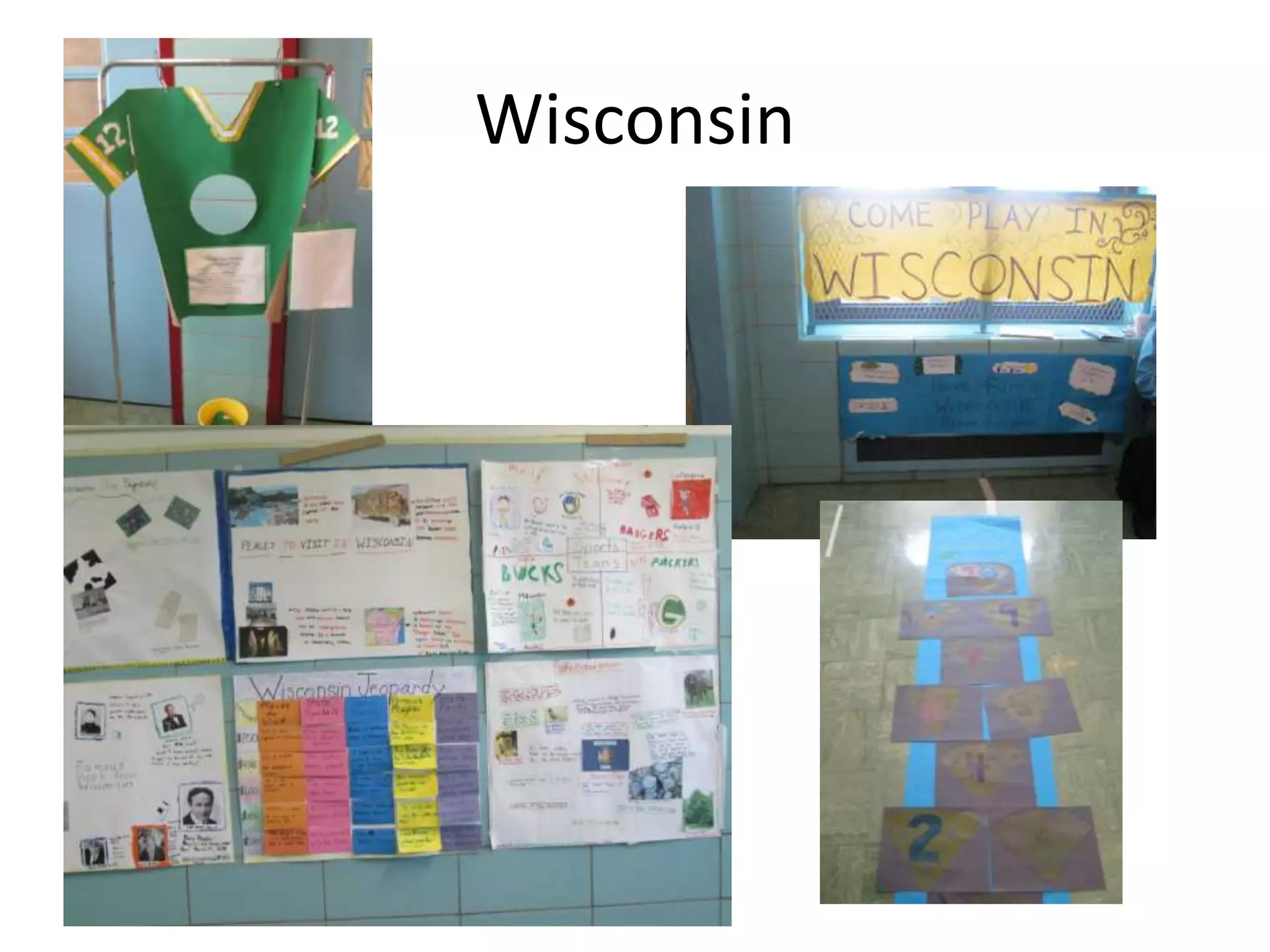
Wisconsin
Nurture positive relationships with all
students
• You need to let your students know that you not only care about their
progress in the classroom, you also care about them as human beings.
Some ways you can do this are:
• Greet your students by name every time they walk in the door. This lets
them know that you notice and care that they are there.
• Use warm, inclusive behaviors with your face, body and words each day.
Smile! Ask, “How are you feeling?” Look at your students. Notice and
reinforce their positive behaviors with encouraging words.
• Ask your students personal questions that will help you get to know them
and what’s happening in their lives outside of school. “How was your
soccer game last night?” “Is your grandma feeling better?”
• Notice changes in students’ physical and emotional behaviors. Changes
may indicate a student is in need of additional emotional support. Provide
or find support for that student as needed.
• Spend and keep track of individual time with each one of your students
over a set duration (such as each month).
ABC News: What makes a great
Teacher?
http://www.youtube.com/watch?v=7bIQ4-3XSxU
2c: Managing Classroom Procedures
• Students themselves…”will take the initiative
in implementing, or even improving, the
routines and procedures.”
• “materials and supplies are well managed.”
• Routines are established for every operation
in the classroom (i.e., paper distribution)
• School emergency procedures
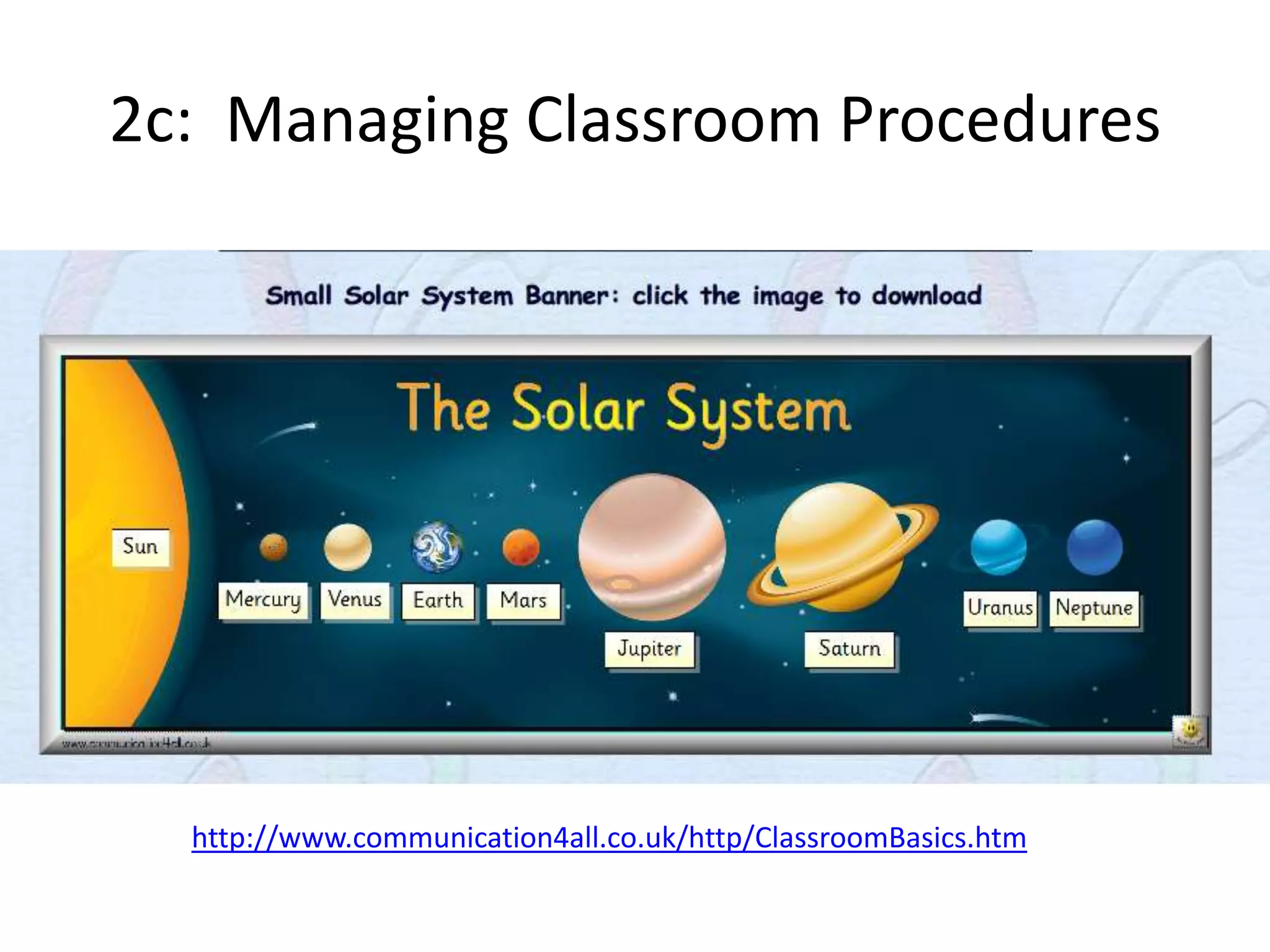
2c: Managing Classroom Procedures
http://www.communication4all.co.uk/http/ClassroomBasics.htm
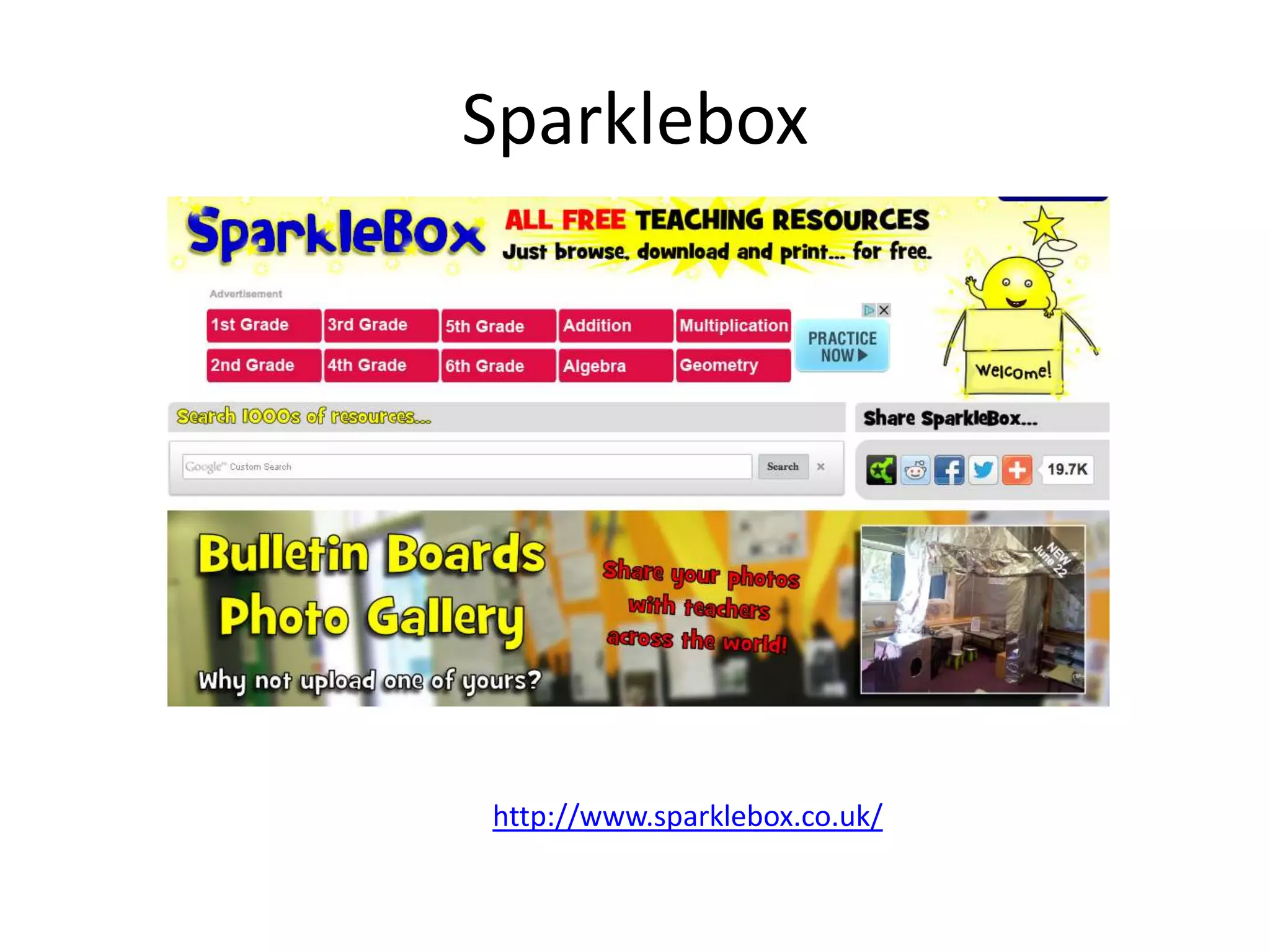
Sparklebox
http://www.sparklebox.co.uk/
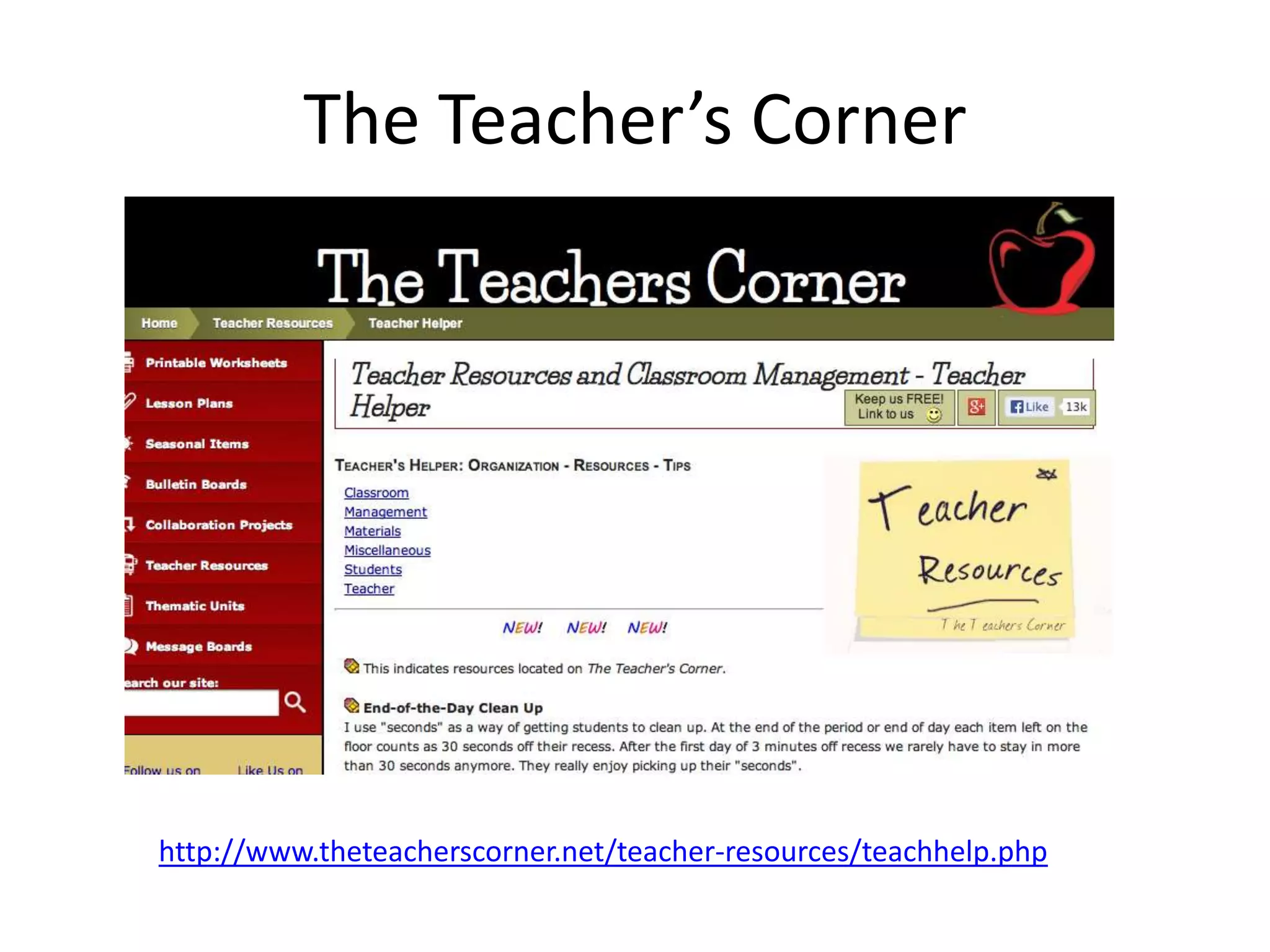
The Teacher’s Corner
http://www.theteacherscorner.net/teacher-resources/teachhelp.php
2d: Managing Student Behavior
• Students themselves…”will ensure compliance
with the standards of conduct.”
• “As any parent knows, children are not born
being nice to one another.”
2d: Managing Student Behavior
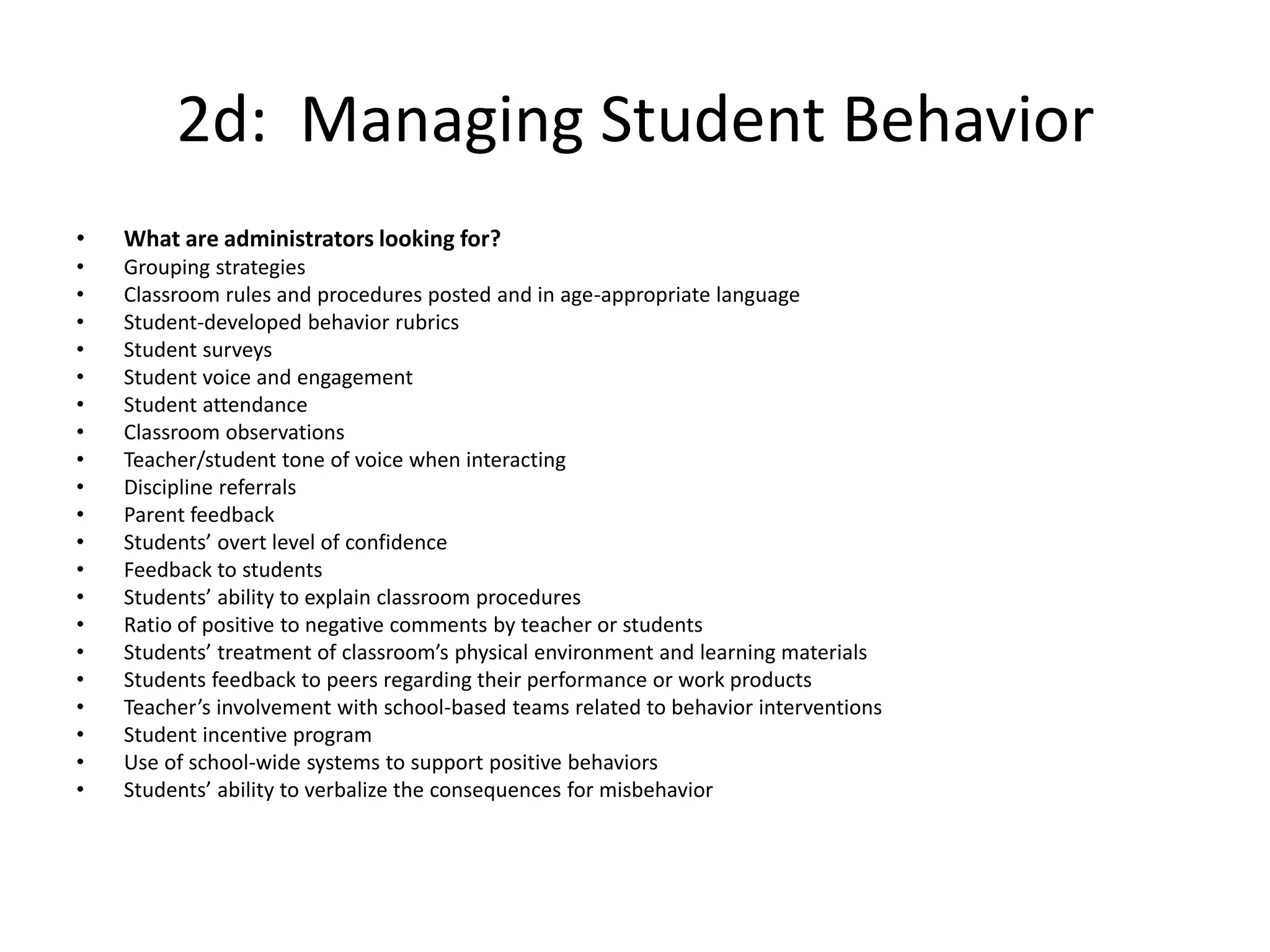
• What are administrators looking for?
• Grouping strategies
• Classroom rules and procedures posted and in age-appropriate language
• Student-developed behavior rubrics
• Student surveys
• Student voice and engagement
• Student attendance
• Classroom observations
• Teacher/student tone of voice when interacting
• Discipline referrals
• Parent feedback
• Students’ overt level of confidence
• Feedback to students
• Students’ ability to explain classroom procedures
• Ratio of positive to negative comments by teacher or students
• Students’ treatment of classroom’s physical environment and learning materials
• Students feedback to peers regarding their performance or work products
• Teacher’s involvement with school-based teams related to behavior interventions
• Student incentive program
• Use of school-wide systems to support positive behaviors
• Students’ ability to verbalize the consequences for misbehavior
NYC DOE Discipline Code
http://schools.nyc.gov/nr/rdonlyres/f7da5e8d-c065-44ff-a16f-55f491c0b9e7/0/disccode20122013final.pdf
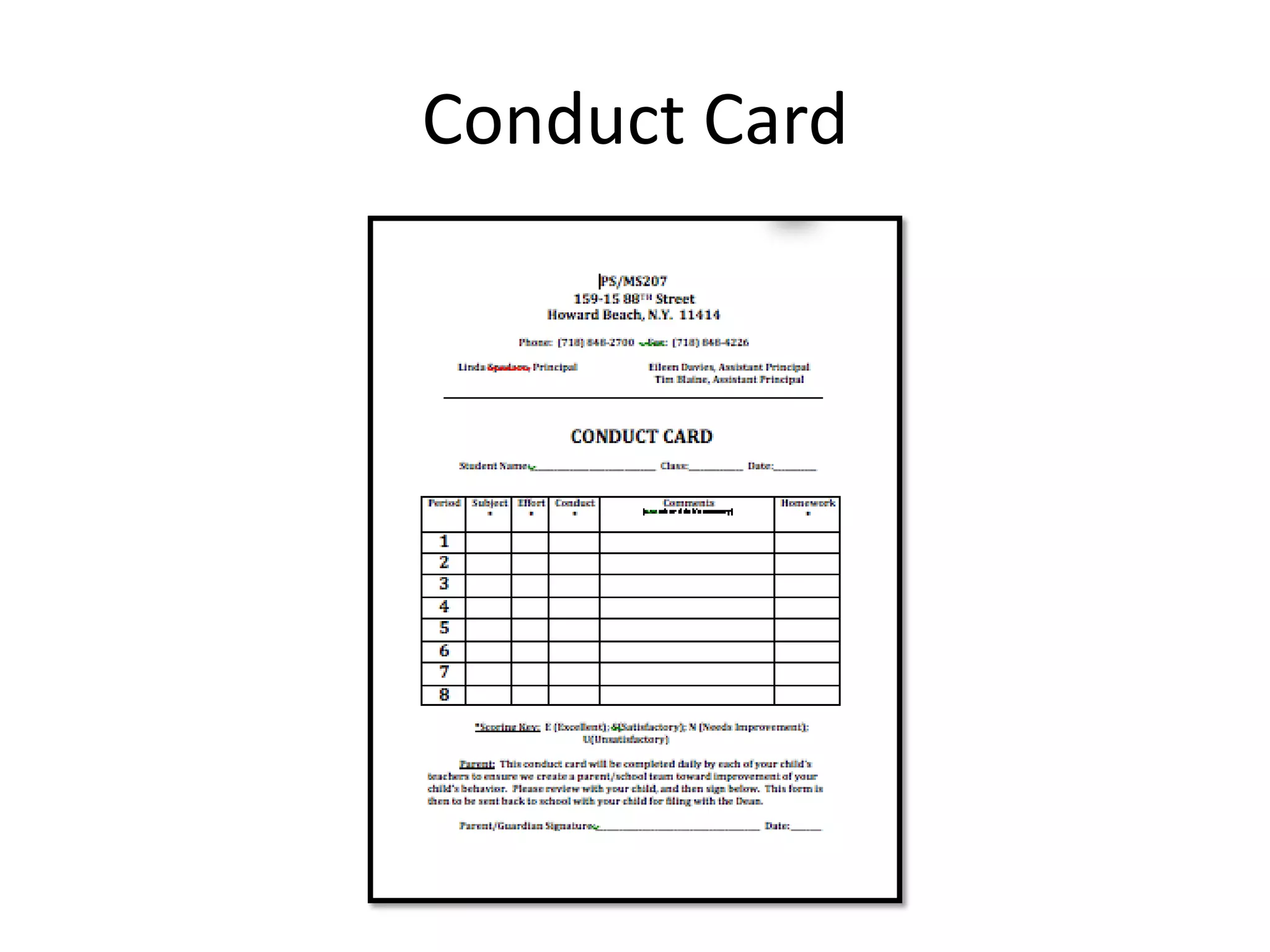
Conduct Card
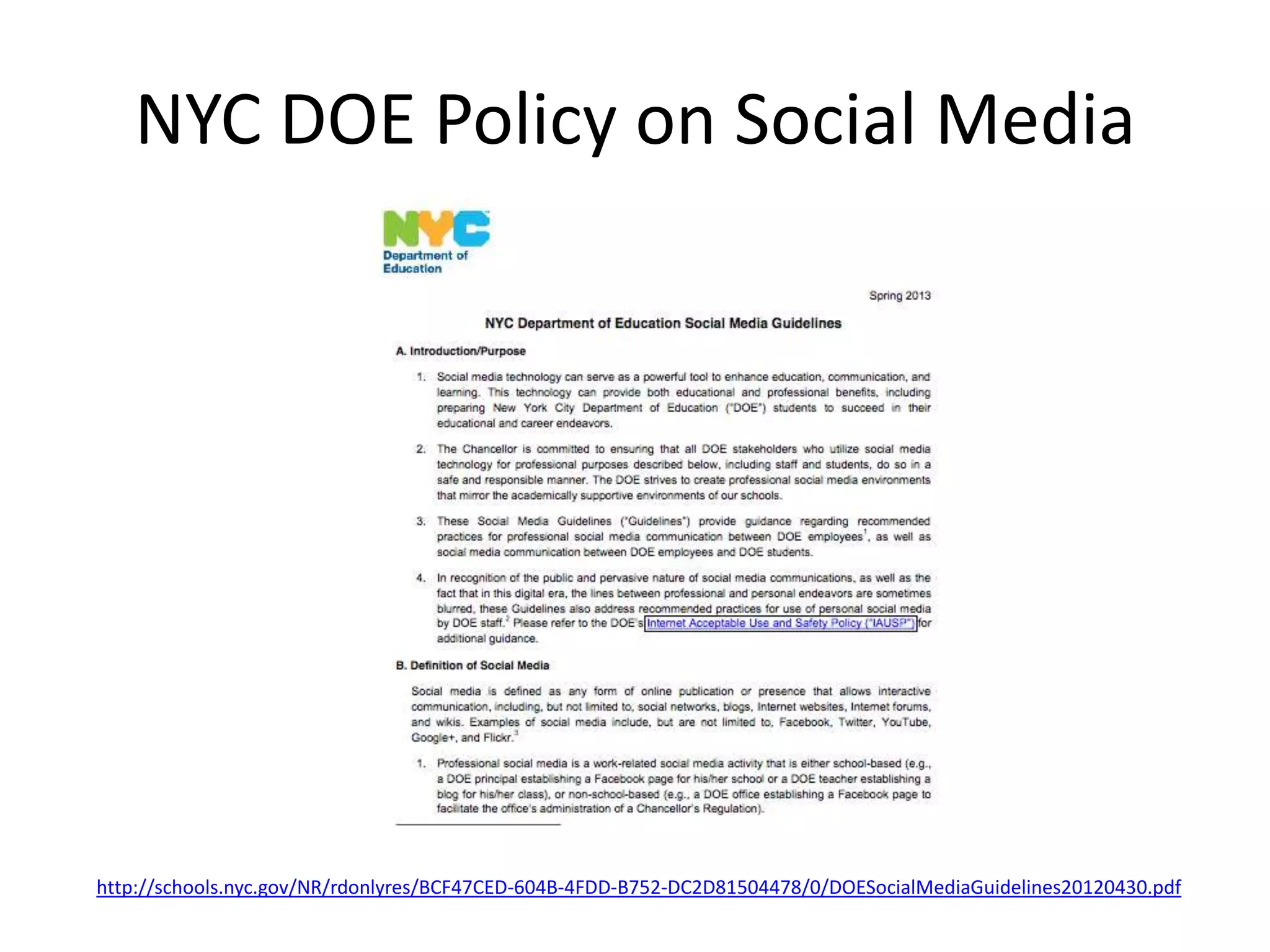
NYC DOE Policy on Social Media
http://schools.nyc.gov/NR/rdonlyres/BCF47CED-604B-4FDD-B752-DC2D81504478/0/DOESocialMediaGuidelines20120430.pdf
Teacher Roles
• “Teachers who excel in Domain 2…never
forget their proper role as adults, so they
don’t try to be pals.”
• “Students regard them as a special sort of
friend, a protector, a challenger, someone who
will permit no harm.”
2e: Organizing Physical Space
• Students themselves…”may make suggestions
for how the room arrangement could better
support their learning.”
• Classroom must be safe – no dangling wires
• This will be interesting for those who travel
from class-to-class with a rolling cart.
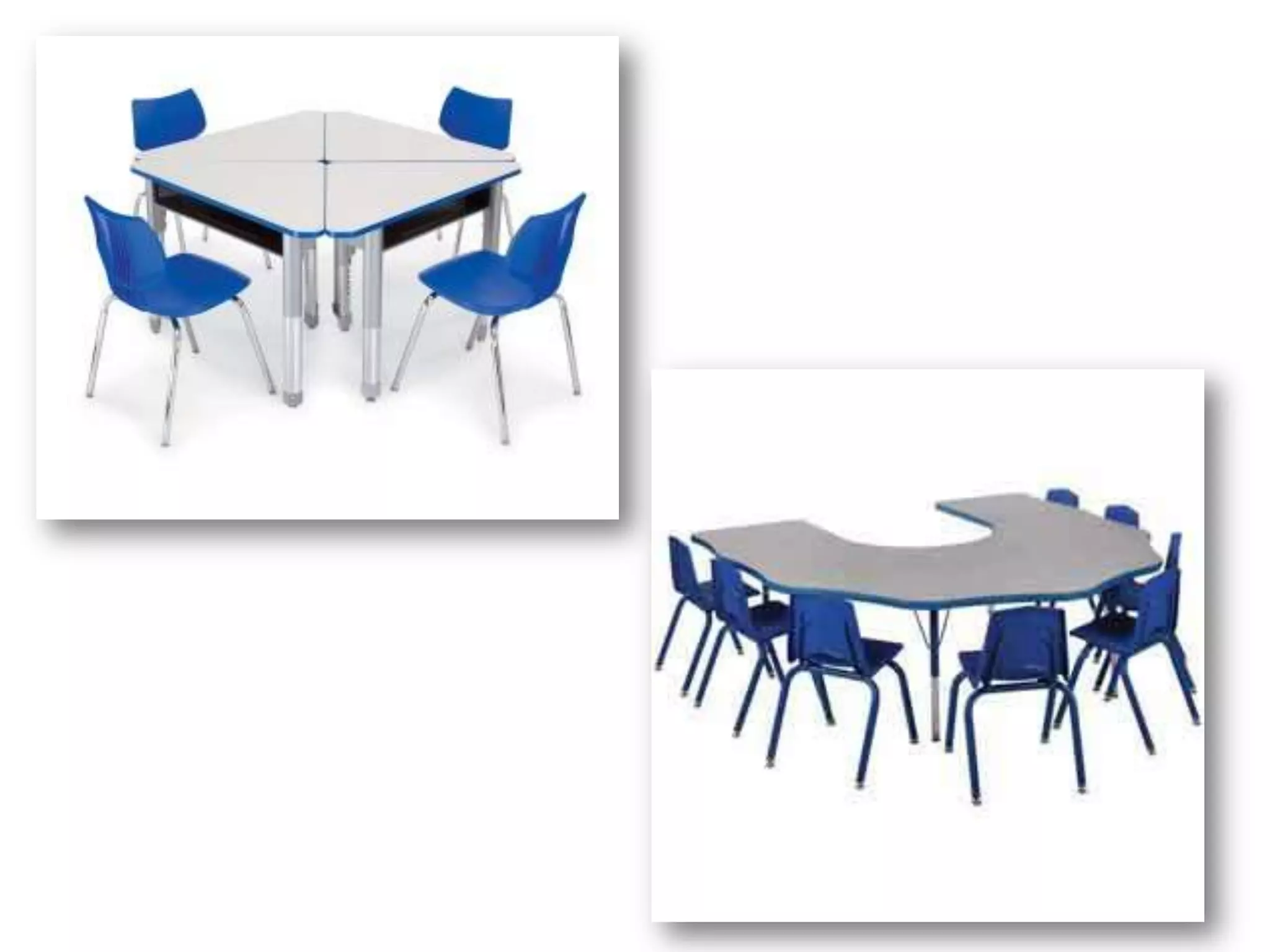
Physical Environment Includes:
• Desk Arrangements
• Student Placement
• Classroom Decoration
• Music in the classroom
Pinterest
• Classroom Layout and Design
• Classroom-set-up-desk-arrangements
• Classroom set up ideas
• Classroom Arrangements
• Classroom arrangement ideas
• Classroom organization and arrangement
ideas
• Classroom decorating ideas
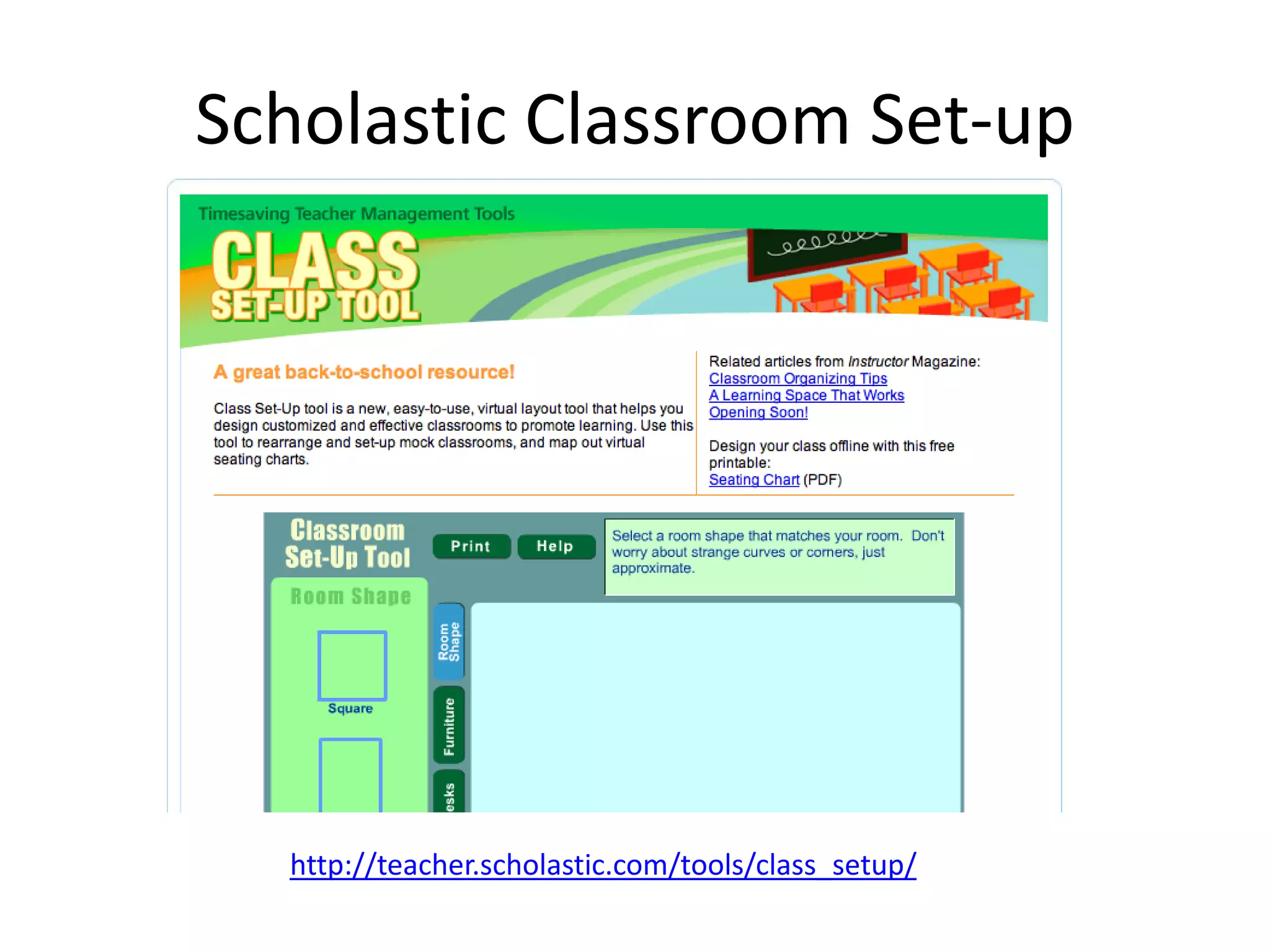
Scholastic Classroom Set-up
http://teacher.scholastic.com/tools/class_setup/
Student Placement
• Place easily distracted students away from
each other, doorways, windows and areas of
high traffic.
• Preferably, place to one side of the classroom,
close to the front.
• An inclusive classroom should place students
in areas of the class best suited to their needs.
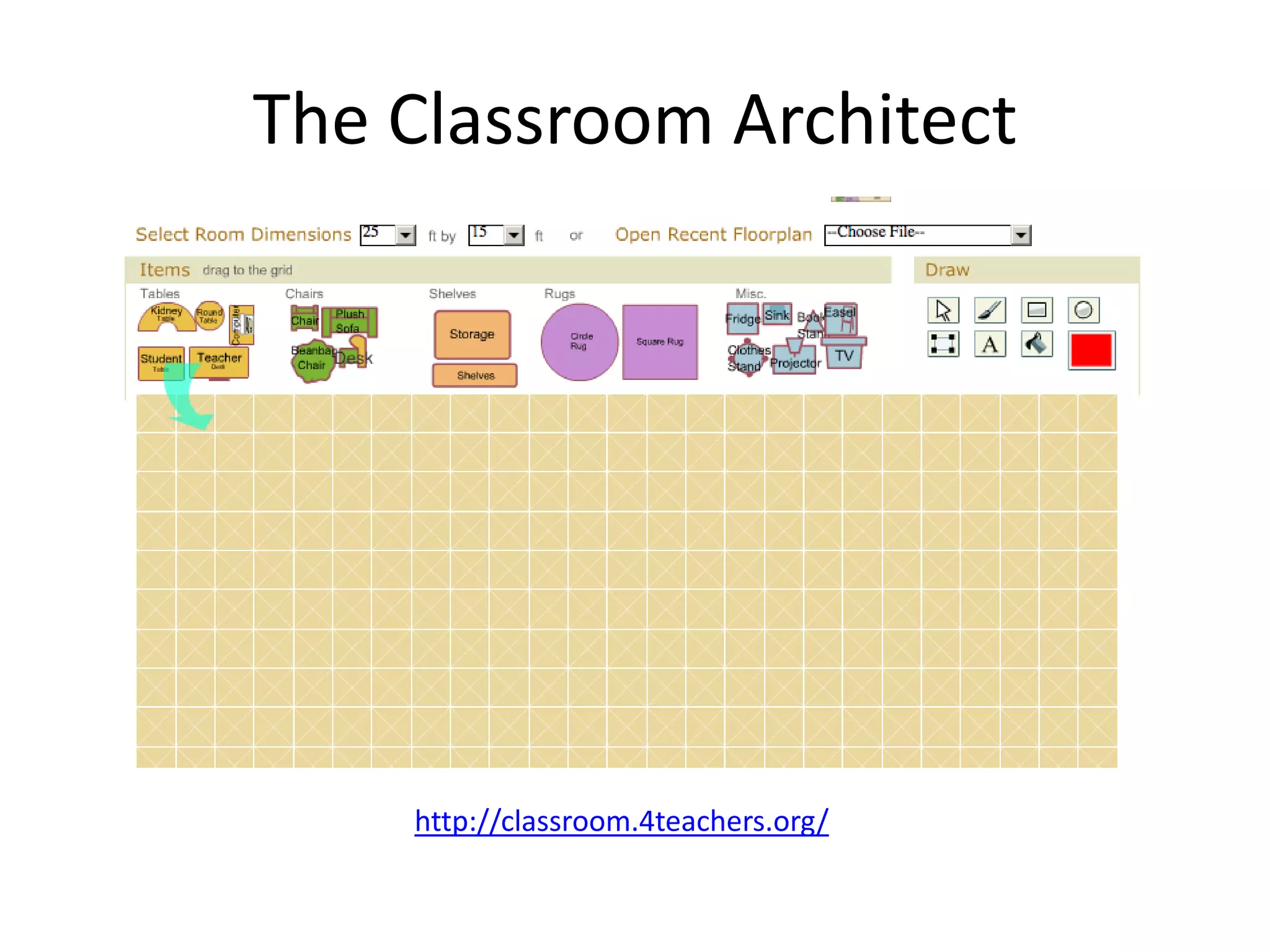
The Classroom Architect
http://classroom.4teachers.org/
Classroom Decoration
• Students like to see their work displayed.
• Class-made posters help students develop a
sense of belonging.
• Make the environment inviting

Danielson domain2

  • 1.
    Charlotte Danielson A Frameworkfor Teaching Domain 2
  • 2.
    Framework Focus Domain 1 PlanningandPreparation Whatateacher knowsanddoes in preparation for engaging students in learning. Domain 2 The Classroom Environment Whatateacher doestoestablishand maintainaculture forlearning that supportscognitive engagement. ✓ Domain 4 ProfessionalResponsibilities Professional responsibilities andbehavior in andoutoftheclassroom. Domain 3 Instruction Whatateacher doestocognitively engage studentsinthecontent. • The Framework for Teaching Charlotte Danielson
  • 3.
    Constructivist Approach • “…allhuman beings- adults as well as children- it is the learner who does the learning.” • “People remember an experience based on what their pre-existing knowledge and cognitive structures allow them to absorb-regardless of a teacher’s intentions or the quality of an explanation.” • “…the activities…must be “minds on”. • The Framework for Teaching is based upon this approach. http://www.thirteen.org/edonline/concept2class/constructivism/
  • 4.
    Remember this saying… •“People will forget what you said. People will forget what you did, but people will never forget how you made them feel”. • -Maya Angelou • “When students remember their teachers in years later, it is often for the teacher’s skill in Domain 2.”
  • 5.
    Domain 2 The ClassroomEnvironment -5 Components • 2a: Creating an Environment of Respect and Rapport • 2b: Establishing a Culture for Learning • 2c: Managing Classroom Procedures • 2d: Managing Student Behavior • 2e: Organizing Physical Space
  • 6.
    • Domain 2is all about the various ways that teachers create a classroom environment that promotes learning. It is “demonstrated principally through a teacher’s interaction with students.” Domain 2…”set(s) the stage for all learning.”
  • 7.
    2a: Creating anEnvironment of Respect and Rapport • Teacher interaction with the students • Student interaction with other students • “Students feel respected by the teacher and their peers, they believe that the teacher cares about them and their learning.” • “Students themselves will ensure standards of civility”.
  • 8.
    What response wouldyou give? • If a student offers an idea, or a response to a teacher’s question that is so far off base as to promote laughter from the other students?
  • 9.
  • 10.
  • 11.
    Ideas for WorkingCooperatively
  • 12.
    2b: Establishing aCulture for Learning • “A “culture for learning” refers to the atmosphere in the classroom and reflects the importance of the work undertaken by both students and teachers”. • Classroom characteristics include: • “high energy” • It’s “cool” to be smart, and good ideas are valued • It’s safe to take risks • Students “believe that their teacher has a high regard for their abilities”.
  • 13.
    2b: Establishing aCulture for Learning • If we truly believe… • All children can and will learn • Parents want and deserve the best education for their children; deserving our full support in the co-education of their children • We are all learners – teachers and students alike
  • 14.
    Honor Roll Assembly? •Student recognition for academic achievement
  • 15.
  • 16.
    What is a“Positive Classroom Climate”? • Classroom climate refers to the prevailing mood, attitudes, standards, and tone that you and your students feel when they are in your classroom. • A negative classroom climate can feel hostile, chaotic, and out of control. • A positive classroom climate feels safe, respectful, welcoming, and supportive of student learning.
  • 17.
    To create apositive climate for your classroom, focus on the following three “pieces” of the classroom climate “pie:”
  • 18.
    Develop Classroom Rules •Develop and reinforce classroom rules and norms that clearly support safe and respectful behavior. Having classroom rules helps you create a predictable, safe learning environment for your students. Rules give your students clear boundaries and opportunities to practice self- regulation and make good choices. When students feel safe and respected both emotionally and physically, they are able to focus better on learning.
  • 20.
    Promote Positive PeerRelationships • You want to create an environment where your students support and are kind to one another. Some ways you can do this are: • Notice and reinforce casual positive interactions between students on a daily basis. • Deliberately plan relationship-building activities and games that encourage positive interactions. These can be long-term projects, or short and simple games designed for students to get to know each other better. • Pay attention to the social dynamics of your classroom. Do some students have trouble making friends? Do some students have trouble getting along with others? Who has a lot of friends? Who has few friends? Interviewing your students one- on-one can help you identify students that have stronger or weaker social connections. This can inform your seating arrangements, guide your grouping and pairing decisions, and assist you in helping students form new networks of friends. • Have class meetings. Class meetings provide a safe environment in which students can discuss with you and each other topics that are important to them. You and your students can get to know each other better and build relationships through open discussions on subjects like: Following Rules, How to Get Help, Including Others, Solving Problems, etc. This helps create a positive classroom climate built on trust and respect.
  • 21.
    PS/MS207Q Generosity Day Thursday, February 14,2013 $1.00 “Dress in a Red Shirt” Day All proceeds to benefit the “Stars for Hope” after-school program in Howard Beach. This year to celebrate Valentines Day, we will celebrate “Generosity Day” at PS/MS207! All students and staff are asked to celebrate Generosity Day in our school. The idea is to embrace the idea of doing small acts of kindness in a pay-it-forward structure. When someone does something kind for you, put his or her name on a slip provided by your teacher, and put it in the Generosity Day collection bag. Each teacher will draw 1 name from his/her class to choose a book from our recent Scholastic Book donation as a prize. What can you do to celebrate Generosity Day in our school? Some suggestions include: 1. Being extra nice to people 2. Holding the door for others 3. Helping a student, teacher or staff member 4. Any little gesture that can make a difference in the life of another member of our school community.
  • 27.
  • 28.
  • 29.
  • 30.
  • 31.
    Around the UnitedStates Door Decorating Contest
  • 33.
  • 34.
    Nurture positive relationshipswith all students • You need to let your students know that you not only care about their progress in the classroom, you also care about them as human beings. Some ways you can do this are: • Greet your students by name every time they walk in the door. This lets them know that you notice and care that they are there. • Use warm, inclusive behaviors with your face, body and words each day. Smile! Ask, “How are you feeling?” Look at your students. Notice and reinforce their positive behaviors with encouraging words. • Ask your students personal questions that will help you get to know them and what’s happening in their lives outside of school. “How was your soccer game last night?” “Is your grandma feeling better?” • Notice changes in students’ physical and emotional behaviors. Changes may indicate a student is in need of additional emotional support. Provide or find support for that student as needed. • Spend and keep track of individual time with each one of your students over a set duration (such as each month).
  • 35.
    ABC News: Whatmakes a great Teacher? http://www.youtube.com/watch?v=7bIQ4-3XSxU
  • 36.
    2c: Managing ClassroomProcedures • Students themselves…”will take the initiative in implementing, or even improving, the routines and procedures.” • “materials and supplies are well managed.” • Routines are established for every operation in the classroom (i.e., paper distribution) • School emergency procedures
  • 37.
    2c: Managing ClassroomProcedures http://www.communication4all.co.uk/http/ClassroomBasics.htm
  • 38.
  • 39.
  • 40.
    2d: Managing StudentBehavior • Students themselves…”will ensure compliance with the standards of conduct.” • “As any parent knows, children are not born being nice to one another.”
  • 41.
    2d: Managing StudentBehavior • What are administrators looking for? • Grouping strategies • Classroom rules and procedures posted and in age-appropriate language • Student-developed behavior rubrics • Student surveys • Student voice and engagement • Student attendance • Classroom observations • Teacher/student tone of voice when interacting • Discipline referrals • Parent feedback • Students’ overt level of confidence • Feedback to students • Students’ ability to explain classroom procedures • Ratio of positive to negative comments by teacher or students • Students’ treatment of classroom’s physical environment and learning materials • Students feedback to peers regarding their performance or work products • Teacher’s involvement with school-based teams related to behavior interventions • Student incentive program • Use of school-wide systems to support positive behaviors • Students’ ability to verbalize the consequences for misbehavior
  • 42.
    NYC DOE DisciplineCode http://schools.nyc.gov/nr/rdonlyres/f7da5e8d-c065-44ff-a16f-55f491c0b9e7/0/disccode20122013final.pdf
  • 43.
  • 44.
    NYC DOE Policyon Social Media http://schools.nyc.gov/NR/rdonlyres/BCF47CED-604B-4FDD-B752-DC2D81504478/0/DOESocialMediaGuidelines20120430.pdf
  • 45.
    Teacher Roles • “Teacherswho excel in Domain 2…never forget their proper role as adults, so they don’t try to be pals.” • “Students regard them as a special sort of friend, a protector, a challenger, someone who will permit no harm.”
  • 46.
    2e: Organizing PhysicalSpace • Students themselves…”may make suggestions for how the room arrangement could better support their learning.” • Classroom must be safe – no dangling wires • This will be interesting for those who travel from class-to-class with a rolling cart.
  • 47.
    Physical Environment Includes: •Desk Arrangements • Student Placement • Classroom Decoration • Music in the classroom
  • 49.
    Pinterest • Classroom Layoutand Design • Classroom-set-up-desk-arrangements • Classroom set up ideas • Classroom Arrangements • Classroom arrangement ideas • Classroom organization and arrangement ideas • Classroom decorating ideas
  • 50.
  • 51.
    Student Placement • Placeeasily distracted students away from each other, doorways, windows and areas of high traffic. • Preferably, place to one side of the classroom, close to the front. • An inclusive classroom should place students in areas of the class best suited to their needs.
  • 52.
  • 53.
    Classroom Decoration • Studentslike to see their work displayed. • Class-made posters help students develop a sense of belonging. • Make the environment inviting