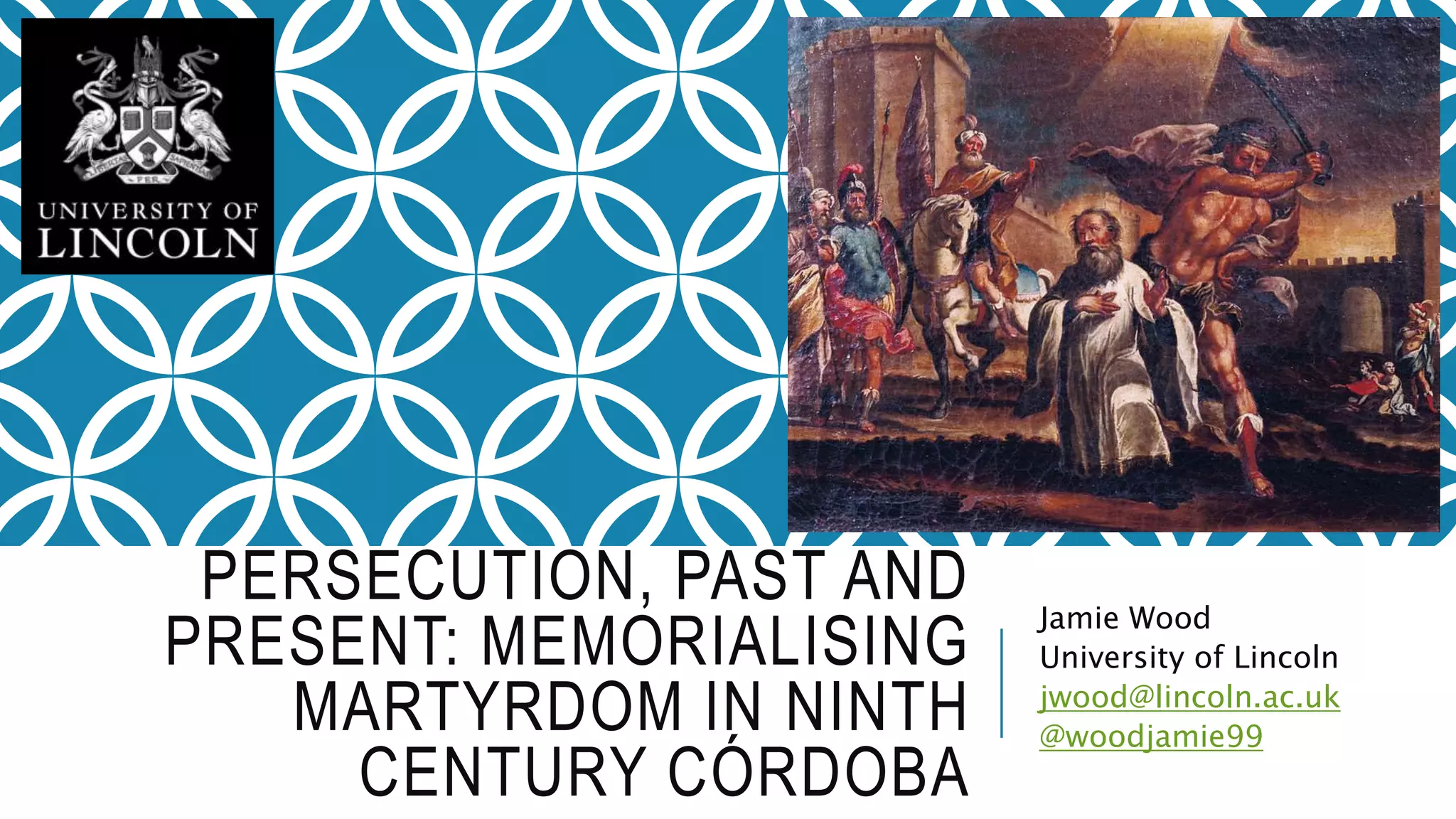
PERSECUTION, PAST AND
PRESENT: MEMORIALISING
MARTYRDOM IN NINTH
CENTURY CÓRDOBA
Jamie Wood
University of Lincoln
jwood@lincoln.ac.uk
@woodjamie99
STRUCTURE
Introduction
Martyr memorials in late antique and early medieval
Cordoba
Historical examples and the martyr apologists
Memorials and memorialisation and the apologists
Relics and the cultivation of networks
Conclusion
INTRODUCTION
“the kinetic energy powering Christian life
in Africa”
[Brent Shaw, Sacred Violence. African Christians and Sectarian Hatred in the
Age of Augustine (Cambridge: Cambridge University Press, 2011), p. 587]
“impulse to claim an illustrious ancestry”
[P. Castillo Maldonado, “Angelorum Participes: The Cult of the Saints in Late
Antique Spain”, in Hispania in late antiquity: current perspectives, eds. K.
Bowes and M. Kulikowski (Leiden: Brill, 2005), pp. 153-154 and 187-188]
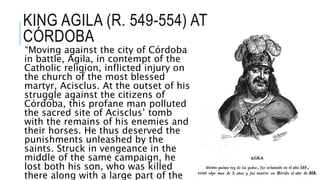
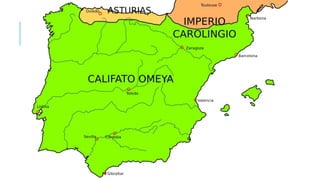
KING AGILA (R. 549-554) AT
CÓRDOBA
“Moving against the city of Córdoba
in battle, Agila, in contempt of the
Catholic religion, inflicted injury on
the church of the most blessed
martyr, Acisclus. At the outset of his
struggle against the citizens of
Córdoba, this profane man polluted
the sacred site of Acisclus’ tomb
with the remains of his enemies and
their horses. He thus deserved the
punishments unleashed by the
saints. Struck in vengeance in the
middle of the same campaign, he
lost both his son, who was killed
there along with a large part of the
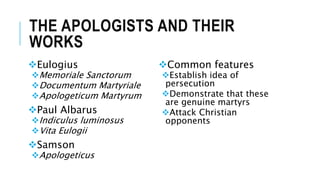
THE APOLOGISTS AND THEIR
WORKS
Eulogius
Memoriale Sanctorum
Documentum Martyriale
Apologeticum Martyrum
Paul Albarus
Indiculus luminosus
Vita Eulogii
Samson
Apologeticus
Common features
Establish idea of
persecution
Demonstrate that these
are genuine martyrs
Attack Christian
opponents
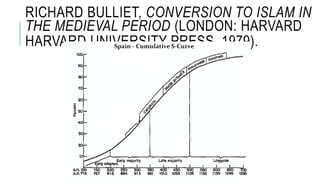
RICHARD BULLIET, CONVERSION TO ISLAM IN
THE MEDIEVAL PERIOD (LONDON: HARVARD
HARVARD UNIVERSITY PRESS, 1979).
RECENT SCHOLARSHIP
Cyrille Aillet, Les Mozarabes. Christianisme, islamisation et arabisation en péninsule
ibérique (IXe-XIIe siècle) [Bibliothèque de la Casa de Velázquez, volume XLV] (Madrid:
Casa de Velázquez, 2010).
Jessica A. Coope, “Religious and Cultural Conversion to Islam in Ninth-Century Umayyad
Córdoba”, Journal of World History 4 (1993): 47-68
Jessica A. Coope, The Martyrs of Córdoba: Community and Family Conflict in an Age of
Mass Conversion (Lincoln, Nebraska: University of Nebraska Press, 1995).
Ann Christys, Christians in Al-Andalus (711-1000) (Richmond: Curzon, 2002).
Alwyn Harrison, “Behind the Curve: Bulliet and Conversion to Islam in al-Andalus
Revisited”, Al-Masaq: Journal of the Medieval Mediterranean 24 (2012): 35-51.
Janina M. Safran, Defining Boundaries in Al-Andalus: Muslims, Christians, and Jews in
Islamic Iberia (Ithaca: Cornell University Press, 2013).
Charles L. Tieszen, Christian Identity amid Islam in Medieval Spain (Leiden: Brill, 2013),
MEMORIES AND MEMORIALS
OF MARTYRDOM IN LATE
ANTIQUE AND VISIGOTHIC
CÓRDOBA
“Corduba will give Acisclus
and Zoilus and her three
crowns [= Faustus, Januarius
and Martialis]”.
[Prudentius, Peristephanon, IV.19-20]
C. García Rodríguez, El culto de
los santos en España romana y
visigoda (Madrid: Consejo de
Investigaciones Cientificas,
Instituto Enrique Flórez, 1966),
pp. 220-231
Mark A. Handley, Death, Society
and Culture: Inscriptions and
Epitaphs in Gaul and Spain, AD
300-750 [BAR International
Series, volume MCXXXV]
(Oxford: Archaeopress, 2003)
Isabel Sánchez Ramos, “La
cristianización de las necrópolis
de Cordvba. Fuentes escritas y
testimonios arqueológicos”,
Archivo Español de Arqueología
80 (2007): 191-206
Purificación Ubric Rabaneda, La
iglesia en la Hispania del siglo V
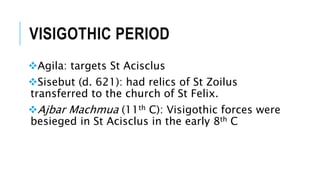
VISIGOTHIC PERIOD
Agila: targets St Acisclus
Sisebut (d. 621): had relics of St Zoilus
transferred to the church of St Felix.
Ajbar Machmua (11th C): Visigothic forces were
besieged in St Acisclus in the early 8th C
IBERIAN BISHOPS AND THE CULT OF THE
SAINTS“the role of martyrs as patrons, intercessors and healers was […]
little challenged”
[Handley, Death, Society and Culture, 149-151]
inventio (discovery) of relics of St Zoilus recorded in passio
(dated to the late-eighth or early-ninth century)
Bishop Agapius in the early-seventh century
discovery of Zoilus’ body
Agapius repeatedly kissed the relics, his teeth fell out and he was
reprimanded by the saint the following night
[Passio Zoili 6-7, ed. P. Riesco Chueca, Pasionario Hispánico: Introducción, edición crítica y traducción
(Seville: Universidad de Sevilla, 1995), pp. 246-249]
PASSIONES AND THE LITURGY
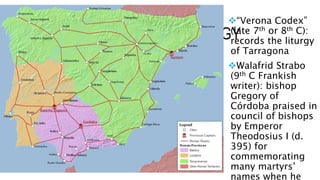
“Verona Codex”
(late 7th or 8th C):
records the liturgy
of Tarragona
Walafrid Strabo
(9th C Frankish
writer): bishop
Gregory of
Córdoba praised in
council of bishops
by Emperor
Theodosius I (d.
395) for
commemorating
many martyrs’
names when he
MAKING MARTYRS THROUGH
HISTORICAL EXAMPLES IN NINTH-
CENTURY CÓRDOBA
“And those things which he had asked with tears of
the martyrs, and which he had scattered as a prayer
through all his writings, he won by his life of
holiness”.
[Albarus, Vita Eulogii 11]
“for the holy virgins Flora and Mary, imprisoned for
their faith, he wrote his Documentum martyriale in
one book, in which with strong encouragement he
fortified them for martyrdom, and both in person and
by correspondence taught them to despise death [...].”
ISTORIA DE MAHOMET
M. C. Díaz y Díaz, “Los textos antimahometanos más
antiguos en códices españoles”, Archives d'histoire
doctrinale et littéraire du moyen âge 45 (1970): 149-164
J. Moorhead, “The earliest Christian theological response to
Islam”, Religion 11 (1981): 265-274
K. B. Wolf, “The earliest Spanish Christian views of Islam”,
Church History 55 (1986), pp. 281-293
“Now […] it remains to give thanks to the King of ages
who from the beginning of the faith has adorned his
church with martyrs, has given strength to the weary,
and has brought to eternal glory those who put no
trust in themselves.”
[Albarus, Vita Eulogii 17]
“he secured a heavenly episcopate when he was joined
to Christ through the glory of martyrdom”
[Albarus, Vita Eulogii 10]
PARALLELS WITH PRUDENTIUS
Passion of Eulalia
Eulogius, Memoriale Sanctorum
defiant attitudes of martyrs towards judge
entry into prison
physical punishments and torture
moment of death
crown of the martyr
negative labelling of opponents of martyr or author
[Mª Jesús Aldana García and Pedro Herrera Roldan, “Prudencio entre los mozárabes
cordobeses: algunos testimonios”, Latomus 56 (1997): 765-783]
“Blessed are those that are persecuted
for righteousness’ sake, for theirs is
the kingdom of heaven” (Matt. 5:10)
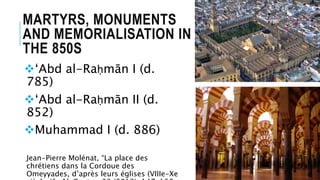
MARTYRS, MONUMENTS
AND MEMORIALISATION IN
THE 850S
‘Abd al-Raḥmān I (d.
785)
‘Abd al-Raḥmān II (d.
852)
Muhammad I (d. 886)
Jean-Pierre Molénat, “La place des
chrétiens dans la Cordoue des
Omeyyades, d’après leurs églises (VIIIe-Xe
LAYING THE MARTYRS TO REST
St Christopher: Felix, Gumesindus and Servus Dei
The “three crowns”: Sabigotho
St Genesius: Liliosa and Leocritia
St Acisclus: Flora, Maria, Sisenandus and Perfectus
St Zoilus: Eulogius, Leovigild and Christopher
The monk Argimirus: interred next to the tombs of St
Acisclus and St Perfectus (the first martyr recorded by
Eulogius)
POSTERITY
“In these books he described in a
distinguished style the passion of each
martyr, and with considerable fullness he
published for future generations all that
was done and said in the case of the
martyrs of God.”
[Albarus, Vita Eulogii 5]
INTERCESSION
“And so, great martyr of
God bearing the sweet
name of Eulogius, hear your
Albarus calling to you; and
as here on earth you held
me fast in your heart with
love, so make me your
servant in heaven. I shall
urge you no words but your
own as intercession.”
[Albarus, Vita Eulogii 18]
APOLOGETICS, RELICS AND THE
CULTIVATION OF MARTYR NETWORKS
BEYOND AL-ANDALUS
858: Frankish monks acquire relics of Aurelius, George and
Sabigotho.
[Frank Reiss, "From Aachen to Al-Andalus: the journey of Deacon Bodo (823-876)",
Early Medieval Europe 13 (2005) 131-157; Ann Christys, “St-Germain des-Prés, St
Vincent and the martyrs of Cordoba”, Early Medieval Europe 7 (1998): 199-216.]
 851: Eulogius writes to Bishop Wiliesindus of Pamplona
promised relics of Zoilus and Acisclus
mentions Wiliesindus’ votive promise to construct a basilica to
Acisclus to ensure the intercession of God and the protection of the
saints
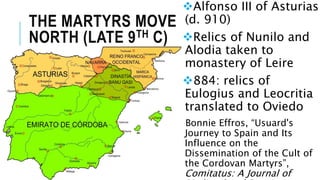
THE MARTYRS MOVE
NORTH (LATE 9TH C)
Alfonso III of Asturias
(d. 910)
Relics of Nunilo and
Alodia taken to
monastery of Leire
884: relics of
Eulogius and Leocritia
translated to Oviedo
Bonnie Effros, “Usuard's
Journey to Spain and Its
Influence on the
Dissemination of the Cult of
the Cordovan Martyrs”,
Comitatus: A Journal of

Persecution, past and present: memorialising martyrdom in ninth century Córdoba

  • 1.
    PERSECUTION, PAST AND PRESENT:MEMORIALISING MARTYRDOM IN NINTH CENTURY CÓRDOBA Jamie Wood University of Lincoln jwood@lincoln.ac.uk @woodjamie99
  • 2.
    STRUCTURE Introduction Martyr memorials inlate antique and early medieval Cordoba Historical examples and the martyr apologists Memorials and memorialisation and the apologists Relics and the cultivation of networks Conclusion
  • 3.
    INTRODUCTION “the kinetic energypowering Christian life in Africa” [Brent Shaw, Sacred Violence. African Christians and Sectarian Hatred in the Age of Augustine (Cambridge: Cambridge University Press, 2011), p. 587] “impulse to claim an illustrious ancestry” [P. Castillo Maldonado, “Angelorum Participes: The Cult of the Saints in Late Antique Spain”, in Hispania in late antiquity: current perspectives, eds. K. Bowes and M. Kulikowski (Leiden: Brill, 2005), pp. 153-154 and 187-188]
  • 4.
    KING AGILA (R.549-554) AT CÓRDOBA “Moving against the city of Córdoba in battle, Agila, in contempt of the Catholic religion, inflicted injury on the church of the most blessed martyr, Acisclus. At the outset of his struggle against the citizens of Córdoba, this profane man polluted the sacred site of Acisclus’ tomb with the remains of his enemies and their horses. He thus deserved the punishments unleashed by the saints. Struck in vengeance in the middle of the same campaign, he lost both his son, who was killed there along with a large part of the
  • 6.
    THE APOLOGISTS ANDTHEIR WORKS Eulogius Memoriale Sanctorum Documentum Martyriale Apologeticum Martyrum Paul Albarus Indiculus luminosus Vita Eulogii Samson Apologeticus Common features Establish idea of persecution Demonstrate that these are genuine martyrs Attack Christian opponents
  • 7.
    RICHARD BULLIET, CONVERSIONTO ISLAM IN THE MEDIEVAL PERIOD (LONDON: HARVARD HARVARD UNIVERSITY PRESS, 1979).
  • 8.
    RECENT SCHOLARSHIP Cyrille Aillet,Les Mozarabes. Christianisme, islamisation et arabisation en péninsule ibérique (IXe-XIIe siècle) [Bibliothèque de la Casa de Velázquez, volume XLV] (Madrid: Casa de Velázquez, 2010). Jessica A. Coope, “Religious and Cultural Conversion to Islam in Ninth-Century Umayyad Córdoba”, Journal of World History 4 (1993): 47-68 Jessica A. Coope, The Martyrs of Córdoba: Community and Family Conflict in an Age of Mass Conversion (Lincoln, Nebraska: University of Nebraska Press, 1995). Ann Christys, Christians in Al-Andalus (711-1000) (Richmond: Curzon, 2002). Alwyn Harrison, “Behind the Curve: Bulliet and Conversion to Islam in al-Andalus Revisited”, Al-Masaq: Journal of the Medieval Mediterranean 24 (2012): 35-51. Janina M. Safran, Defining Boundaries in Al-Andalus: Muslims, Christians, and Jews in Islamic Iberia (Ithaca: Cornell University Press, 2013). Charles L. Tieszen, Christian Identity amid Islam in Medieval Spain (Leiden: Brill, 2013),
  • 9.
    MEMORIES AND MEMORIALS OFMARTYRDOM IN LATE ANTIQUE AND VISIGOTHIC CÓRDOBA “Corduba will give Acisclus and Zoilus and her three crowns [= Faustus, Januarius and Martialis]”. [Prudentius, Peristephanon, IV.19-20]
  • 10.
    C. García Rodríguez,El culto de los santos en España romana y visigoda (Madrid: Consejo de Investigaciones Cientificas, Instituto Enrique Flórez, 1966), pp. 220-231 Mark A. Handley, Death, Society and Culture: Inscriptions and Epitaphs in Gaul and Spain, AD 300-750 [BAR International Series, volume MCXXXV] (Oxford: Archaeopress, 2003) Isabel Sánchez Ramos, “La cristianización de las necrópolis de Cordvba. Fuentes escritas y testimonios arqueológicos”, Archivo Español de Arqueología 80 (2007): 191-206 Purificación Ubric Rabaneda, La iglesia en la Hispania del siglo V
  • 11.
    VISIGOTHIC PERIOD Agila: targetsSt Acisclus Sisebut (d. 621): had relics of St Zoilus transferred to the church of St Felix. Ajbar Machmua (11th C): Visigothic forces were besieged in St Acisclus in the early 8th C
  • 12.
    IBERIAN BISHOPS ANDTHE CULT OF THE SAINTS“the role of martyrs as patrons, intercessors and healers was […] little challenged” [Handley, Death, Society and Culture, 149-151] inventio (discovery) of relics of St Zoilus recorded in passio (dated to the late-eighth or early-ninth century) Bishop Agapius in the early-seventh century discovery of Zoilus’ body Agapius repeatedly kissed the relics, his teeth fell out and he was reprimanded by the saint the following night [Passio Zoili 6-7, ed. P. Riesco Chueca, Pasionario Hispánico: Introducción, edición crítica y traducción (Seville: Universidad de Sevilla, 1995), pp. 246-249]
  • 13.
    PASSIONES AND THELITURGY “Verona Codex” (late 7th or 8th C): records the liturgy of Tarragona Walafrid Strabo (9th C Frankish writer): bishop Gregory of Córdoba praised in council of bishops by Emperor Theodosius I (d. 395) for commemorating many martyrs’ names when he
  • 14.
    MAKING MARTYRS THROUGH HISTORICALEXAMPLES IN NINTH- CENTURY CÓRDOBA “And those things which he had asked with tears of the martyrs, and which he had scattered as a prayer through all his writings, he won by his life of holiness”. [Albarus, Vita Eulogii 11] “for the holy virgins Flora and Mary, imprisoned for their faith, he wrote his Documentum martyriale in one book, in which with strong encouragement he fortified them for martyrdom, and both in person and by correspondence taught them to despise death [...].”
  • 15.
    ISTORIA DE MAHOMET M.C. Díaz y Díaz, “Los textos antimahometanos más antiguos en códices españoles”, Archives d'histoire doctrinale et littéraire du moyen âge 45 (1970): 149-164 J. Moorhead, “The earliest Christian theological response to Islam”, Religion 11 (1981): 265-274 K. B. Wolf, “The earliest Spanish Christian views of Islam”, Church History 55 (1986), pp. 281-293
  • 16.
    “Now […] itremains to give thanks to the King of ages who from the beginning of the faith has adorned his church with martyrs, has given strength to the weary, and has brought to eternal glory those who put no trust in themselves.” [Albarus, Vita Eulogii 17] “he secured a heavenly episcopate when he was joined to Christ through the glory of martyrdom” [Albarus, Vita Eulogii 10]
  • 17.
    PARALLELS WITH PRUDENTIUS Passionof Eulalia Eulogius, Memoriale Sanctorum defiant attitudes of martyrs towards judge entry into prison physical punishments and torture moment of death crown of the martyr negative labelling of opponents of martyr or author [Mª Jesús Aldana García and Pedro Herrera Roldan, “Prudencio entre los mozárabes cordobeses: algunos testimonios”, Latomus 56 (1997): 765-783]
  • 18.
    “Blessed are thosethat are persecuted for righteousness’ sake, for theirs is the kingdom of heaven” (Matt. 5:10)
  • 19.
    MARTYRS, MONUMENTS AND MEMORIALISATIONIN THE 850S ‘Abd al-Raḥmān I (d. 785) ‘Abd al-Raḥmān II (d. 852) Muhammad I (d. 886) Jean-Pierre Molénat, “La place des chrétiens dans la Cordoue des Omeyyades, d’après leurs églises (VIIIe-Xe
  • 20.
    LAYING THE MARTYRSTO REST St Christopher: Felix, Gumesindus and Servus Dei The “three crowns”: Sabigotho St Genesius: Liliosa and Leocritia St Acisclus: Flora, Maria, Sisenandus and Perfectus St Zoilus: Eulogius, Leovigild and Christopher The monk Argimirus: interred next to the tombs of St Acisclus and St Perfectus (the first martyr recorded by Eulogius)
  • 21.
    POSTERITY “In these bookshe described in a distinguished style the passion of each martyr, and with considerable fullness he published for future generations all that was done and said in the case of the martyrs of God.” [Albarus, Vita Eulogii 5]
  • 22.
    INTERCESSION “And so, greatmartyr of God bearing the sweet name of Eulogius, hear your Albarus calling to you; and as here on earth you held me fast in your heart with love, so make me your servant in heaven. I shall urge you no words but your own as intercession.” [Albarus, Vita Eulogii 18]
  • 23.
    APOLOGETICS, RELICS ANDTHE CULTIVATION OF MARTYR NETWORKS BEYOND AL-ANDALUS 858: Frankish monks acquire relics of Aurelius, George and Sabigotho. [Frank Reiss, "From Aachen to Al-Andalus: the journey of Deacon Bodo (823-876)", Early Medieval Europe 13 (2005) 131-157; Ann Christys, “St-Germain des-Prés, St Vincent and the martyrs of Cordoba”, Early Medieval Europe 7 (1998): 199-216.]  851: Eulogius writes to Bishop Wiliesindus of Pamplona promised relics of Zoilus and Acisclus mentions Wiliesindus’ votive promise to construct a basilica to Acisclus to ensure the intercession of God and the protection of the saints
  • 24.
    THE MARTYRS MOVE NORTH(LATE 9TH C) Alfonso III of Asturias (d. 910) Relics of Nunilo and Alodia taken to monastery of Leire 884: relics of Eulogius and Leocritia translated to Oviedo Bonnie Effros, “Usuard's Journey to Spain and Its Influence on the Dissemination of the Cult of the Cordovan Martyrs”, Comitatus: A Journal of