BY-
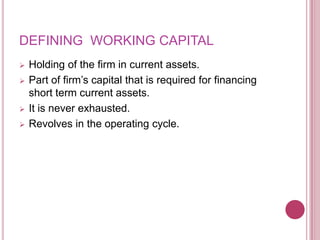
DEFINING WORKING CAPITAL
   Holding of the firm in current assets.
   Part of firm’s capital that is required for financing
    short term current assets.
   It is never exhausted.
   Revolves in the operating cycle.
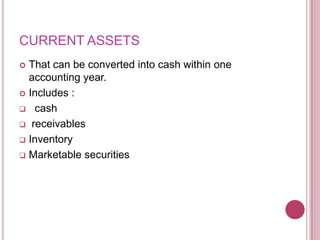
CURRENT ASSETS
 That can be converted into cash within one
  accounting year.
 Includes :

 cash

 receivables

 Inventory

 Marketable securities
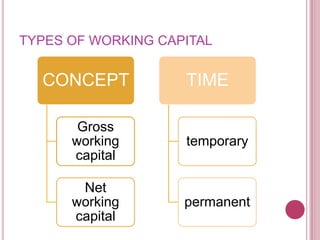
TYPES OF WORKING CAPITAL


  CONCEPT           TIME

       Gross
      working       temporary
      capital

       Net
      working       permanent
      capital
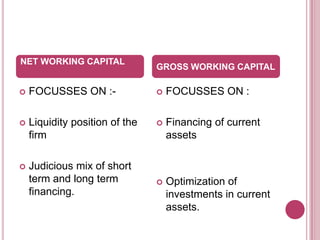
NET WORKING CAPITAL
                                GROSS WORKING CAPITAL

   FOCUSSES ON :-                 FOCUSSES ON :

   Liquidity position of the      Financing of current
    firm                            assets

   Judicious mix of short
    term and long term             Optimization of
    financing.                      investments in current
                                    assets.
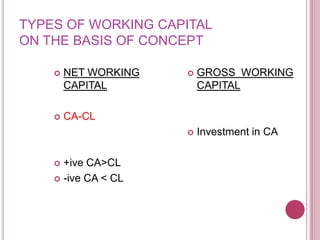
TYPES OF WORKING CAPITAL
ON THE BASIS OF CONCEPT

       NET WORKING      GROSS WORKING
        CAPITAL           CAPITAL

       CA-CL
                         Investment in CA

     +ive CA>CL
     -ive CA < CL
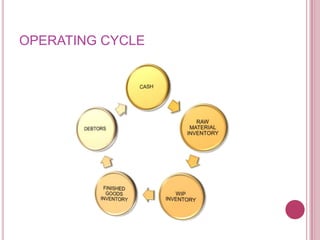
OPERATING CYCLE
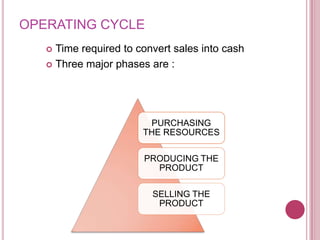
OPERATING CYCLE
    Time required to convert sales into cash
    Three major phases are :


                        PURCHASING
                       THE RESOURCES

                       PRODUCING THE
                         PRODUCT

                         SELLING THE
                          PRODUCT
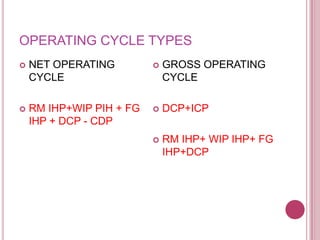
OPERATING CYCLE TYPES
   NET OPERATING            GROSS OPERATING
    CYCLE                     CYCLE

   RM IHP+WIP PIH + FG      DCP+ICP
    IHP + DCP - CDP
                             RM IHP+ WIP IHP+ FG
                              IHP+DCP
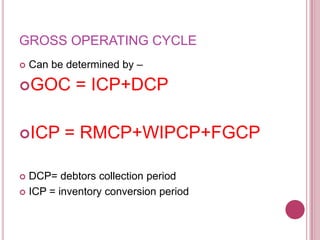
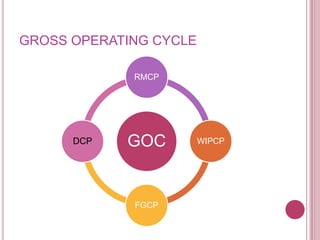
GROSS OPERATING CYCLE
   Can be determined by –

GOC         = ICP+DCP

ICP      = RMCP+WIPCP+FGCP

 DCP= debtors collection period
 ICP = inventory conversion period
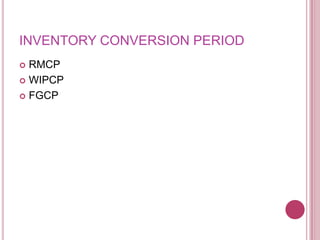
INVENTORY CONVERSION PERIOD
 RMCP
 WIPCP

 FGCP
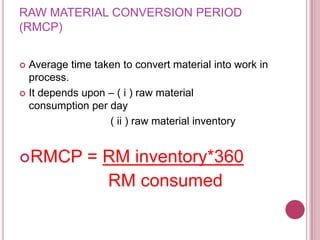
RAW MATERIAL CONVERSION PERIOD
(RMCP)


 Average time taken to convert material into work in
  process.
 It depends upon – ( i ) raw material
  consumption per day
                  ( ii ) raw material inventory


RMCP         = RM inventory*360
                RM consumed
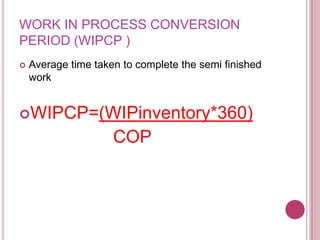
WORK IN PROCESS CONVERSION
PERIOD (WIPCP )
   Average time taken to complete the semi finished
    work


WIPCP=(WIPinventory*360)
                     COP
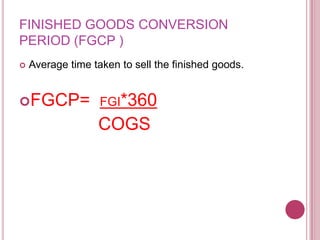
FINISHED GOODS CONVERSION
PERIOD (FGCP )
   Average time taken to sell the finished goods.


FGCP= FGI*360
                  COGS
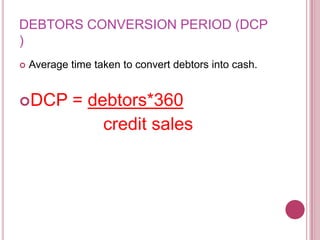
DEBTORS CONVERSION PERIOD (DCP
)
   Average time taken to convert debtors into cash.


DCP         = debtors*360
                 credit sales
GROSS OPERATING CYCLE

             RMCP


      DCP   GOC         WIPCP


             FGCP
NET OPERATING CYCLE


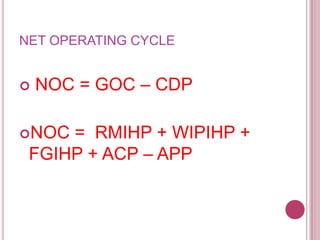
   NOC = GOC – CDP

NOC = RMIHP + WIPIHP +
 FGIHP + ACP – APP
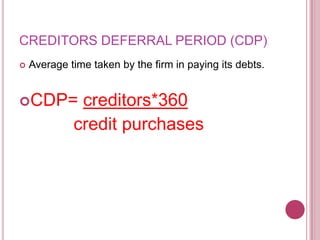
CREDITORS DEFERRAL PERIOD (CDP)
   Average time taken by the firm in paying its debts.


CDP=         creditors*360
             credit purchases
PERMANENT AND TEMPORARY
WORKING CAPITAL

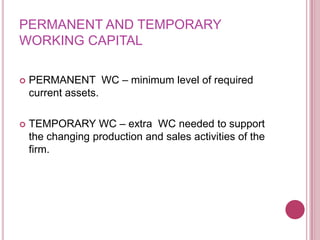
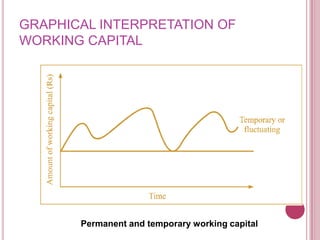
   PERMANENT WC – minimum level of required
    current assets.

   TEMPORARY WC – extra WC needed to support
    the changing production and sales activities of the
    firm.
GRAPHICAL INTERPRETATION OF
WORKING CAPITAL


       Permanent and temporary working capital
DETERMINANTS OF WORKING CAPITAL
   Nature of business
   Market and demand conditions
   Technology and manufacturing policy
   Credit policy
   Availability of credit from suppliers
   Operating efficiency
   Price level changes
ISSUES IN WORKING CAPITAL
MANAGEMENT
   Current assets to fixed assets ratio


   Liquidity Vs profitability – RISK RETURN
    TRADE OFF

 THE     COST TRADE--OFF
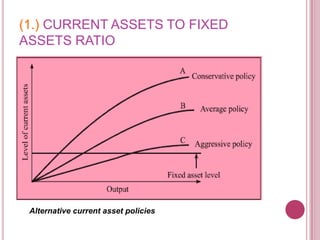
(1.) CURRENT ASSETS TO FIXED
ASSETS RATIO


 Alternative current asset policies
CURRENT ASSETS TO FIXED ASSETS
RATIO
 Optimum level of current assets so that the wealth
  of the shareholders is maximized.
 APPROACHES TO DETERMINE OPTIMUM
  LEVEL OF CA/FA RATIO
         - conservative
         - aggressive
         - moderate
CA/FA RATIO APPROACHES
( CONSTANT LEVEL OF FIXED ASSETS )

   CONSERVATIVE            AGGRESSIVE

   Higher CA/FA ratio
                            Lower CA/FA
                             ratio
 Higher liquidity
 Lower risk

 Lower return            Higher risk
                          Poor liquidity
                          Higher return
(2.)THE COST TRADE--OFF


        Cost Trade-off
THE COST TRADE OFF
 cost of liquidity :
 If a firm’s level of CA is very high it has excessive
  liquidity.
 Its return on assets is very low because funds are
  tied up in idle stocks which earns nothing.
 Cost of illiquidity:

 Cost of holding insufficient current assets.
OPTIMUM LEVEL OF CURRENT ASSETS
 With the level of CA the cost of liquidity increases
  while the cost of illiquidity decreases.
 The firm should maintain current assets at that level
  where the sum of these two cost is minimized.
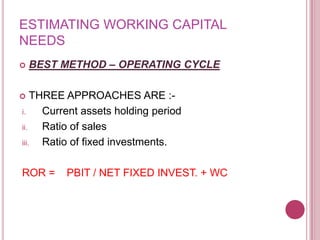
ESTIMATING WORKING CAPITAL
NEEDS
   BEST METHOD – OPERATING CYCLE

   THREE APPROACHES ARE :-
i.    Current assets holding period
ii.   Ratio of sales
iii.  Ratio of fixed investments.

ROR =    PBIT / NET FIXED INVEST. + WC
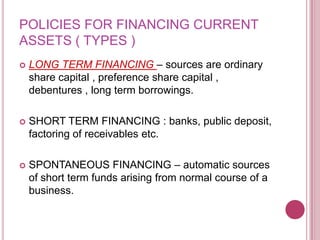
POLICIES FOR FINANCING CURRENT
ASSETS ( TYPES )
   LONG TERM FINANCING – sources are ordinary
    share capital , preference share capital ,
    debentures , long term borrowings.

   SHORT TERM FINANCING : banks, public deposit,
    factoring of receivables etc.

   SPONTANEOUS FINANCING – automatic sources
    of short term funds arising from normal course of a
    business.
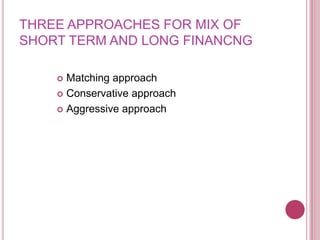
THREE APPROACHES FOR MIX OF
SHORT TERM AND LONG FINANCNG

     Matching approach
     Conservative approach

     Aggressive approach
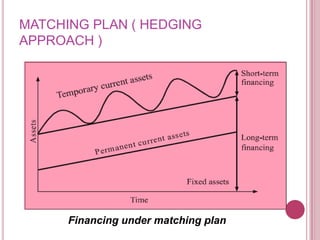
MATCHING PLAN ( HEDGING
APPROACH )


      Financing under matching plan
MATCHING APPROACH
   Firm can adopt a financial plan that matches the
    expected life of assets.

   Long term financing – fixed assets

   Short term financing – variable current assets.
CONSERVATIVE APPROACH


         Conservative financing
CONSERVATIVE APPROACH
 Financing policy depends more on long term funds.
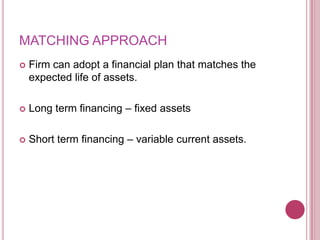
 The firm finances its permanent current assets and
  also a part of temporary current assets with long
  term financing.
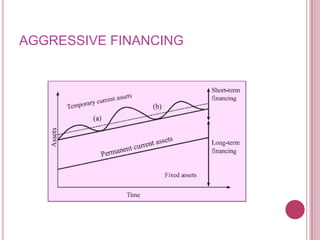
AGGRESSIVE FINANCING
AGGRESSIVE APPROACH
 When a firm relies more on short term financing.
 Permanent fixed assets are also financed with short
  term funds.
(3.) RISK RETURN TRADE OFF
   If firm wants to use short term financing it must
    determine it its portion in total financing.

 Short term financing is preferred because:
         cost advantage
         flexibility
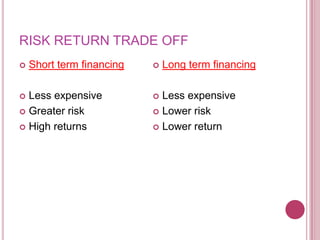
RISK RETURN TRADE OFF
   Short term financing      Long term financing

 Less expensive            Less expensive
 Greater risk              Lower risk

 High returns              Lower return

Working capital management

  • 1.
  • 2.
    DEFINING WORKING CAPITAL  Holding of the firm in current assets.  Part of firm’s capital that is required for financing short term current assets.  It is never exhausted.  Revolves in the operating cycle.
  • 3.
    CURRENT ASSETS  Thatcan be converted into cash within one accounting year.  Includes :  cash  receivables  Inventory  Marketable securities
  • 4.
    TYPES OF WORKINGCAPITAL CONCEPT TIME Gross working temporary capital Net working permanent capital
  • 5.
    NET WORKING CAPITAL GROSS WORKING CAPITAL  FOCUSSES ON :-  FOCUSSES ON :  Liquidity position of the  Financing of current firm assets  Judicious mix of short term and long term  Optimization of financing. investments in current assets.
  • 6.
    TYPES OF WORKINGCAPITAL ON THE BASIS OF CONCEPT  NET WORKING  GROSS WORKING CAPITAL CAPITAL  CA-CL  Investment in CA  +ive CA>CL  -ive CA < CL
  • 7.
  • 8.
    OPERATING CYCLE  Time required to convert sales into cash  Three major phases are : PURCHASING THE RESOURCES PRODUCING THE PRODUCT SELLING THE PRODUCT
  • 9.
    OPERATING CYCLE TYPES  NET OPERATING  GROSS OPERATING CYCLE CYCLE  RM IHP+WIP PIH + FG  DCP+ICP IHP + DCP - CDP  RM IHP+ WIP IHP+ FG IHP+DCP
  • 10.
    GROSS OPERATING CYCLE  Can be determined by – GOC = ICP+DCP ICP = RMCP+WIPCP+FGCP  DCP= debtors collection period  ICP = inventory conversion period
  • 11.
    INVENTORY CONVERSION PERIOD RMCP  WIPCP  FGCP
  • 12.
    RAW MATERIAL CONVERSIONPERIOD (RMCP)  Average time taken to convert material into work in process.  It depends upon – ( i ) raw material consumption per day ( ii ) raw material inventory RMCP = RM inventory*360 RM consumed
  • 13.
    WORK IN PROCESSCONVERSION PERIOD (WIPCP )  Average time taken to complete the semi finished work WIPCP=(WIPinventory*360) COP
  • 14.
    FINISHED GOODS CONVERSION PERIOD(FGCP )  Average time taken to sell the finished goods. FGCP= FGI*360 COGS
  • 15.
    DEBTORS CONVERSION PERIOD(DCP )  Average time taken to convert debtors into cash. DCP = debtors*360 credit sales
  • 16.
    GROSS OPERATING CYCLE RMCP DCP GOC WIPCP FGCP
  • 17.
    NET OPERATING CYCLE  NOC = GOC – CDP NOC = RMIHP + WIPIHP + FGIHP + ACP – APP
  • 18.
    CREDITORS DEFERRAL PERIOD(CDP)  Average time taken by the firm in paying its debts. CDP= creditors*360 credit purchases
  • 19.
    PERMANENT AND TEMPORARY WORKINGCAPITAL  PERMANENT WC – minimum level of required current assets.  TEMPORARY WC – extra WC needed to support the changing production and sales activities of the firm.
  • 20.
    GRAPHICAL INTERPRETATION OF WORKINGCAPITAL Permanent and temporary working capital
  • 21.
    DETERMINANTS OF WORKINGCAPITAL  Nature of business  Market and demand conditions  Technology and manufacturing policy  Credit policy  Availability of credit from suppliers  Operating efficiency  Price level changes
  • 22.
    ISSUES IN WORKINGCAPITAL MANAGEMENT  Current assets to fixed assets ratio  Liquidity Vs profitability – RISK RETURN TRADE OFF  THE COST TRADE--OFF
  • 23.
    (1.) CURRENT ASSETSTO FIXED ASSETS RATIO Alternative current asset policies
  • 24.
    CURRENT ASSETS TOFIXED ASSETS RATIO  Optimum level of current assets so that the wealth of the shareholders is maximized.  APPROACHES TO DETERMINE OPTIMUM LEVEL OF CA/FA RATIO - conservative - aggressive - moderate
  • 25.
    CA/FA RATIO APPROACHES (CONSTANT LEVEL OF FIXED ASSETS )  CONSERVATIVE  AGGRESSIVE  Higher CA/FA ratio  Lower CA/FA ratio  Higher liquidity  Lower risk  Lower return  Higher risk  Poor liquidity  Higher return
  • 26.
  • 27.
    THE COST TRADEOFF  cost of liquidity :  If a firm’s level of CA is very high it has excessive liquidity.  Its return on assets is very low because funds are tied up in idle stocks which earns nothing.  Cost of illiquidity:  Cost of holding insufficient current assets.
  • 28.
    OPTIMUM LEVEL OFCURRENT ASSETS  With the level of CA the cost of liquidity increases while the cost of illiquidity decreases.  The firm should maintain current assets at that level where the sum of these two cost is minimized.
  • 29.
    ESTIMATING WORKING CAPITAL NEEDS  BEST METHOD – OPERATING CYCLE  THREE APPROACHES ARE :- i. Current assets holding period ii. Ratio of sales iii. Ratio of fixed investments. ROR = PBIT / NET FIXED INVEST. + WC
  • 30.
    POLICIES FOR FINANCINGCURRENT ASSETS ( TYPES )  LONG TERM FINANCING – sources are ordinary share capital , preference share capital , debentures , long term borrowings.  SHORT TERM FINANCING : banks, public deposit, factoring of receivables etc.  SPONTANEOUS FINANCING – automatic sources of short term funds arising from normal course of a business.
  • 31.
    THREE APPROACHES FORMIX OF SHORT TERM AND LONG FINANCNG  Matching approach  Conservative approach  Aggressive approach
  • 32.
    MATCHING PLAN (HEDGING APPROACH ) Financing under matching plan
  • 33.
    MATCHING APPROACH  Firm can adopt a financial plan that matches the expected life of assets.  Long term financing – fixed assets  Short term financing – variable current assets.
  • 34.
    CONSERVATIVE APPROACH Conservative financing
  • 35.
    CONSERVATIVE APPROACH  Financingpolicy depends more on long term funds.  The firm finances its permanent current assets and also a part of temporary current assets with long term financing.
  • 36.
  • 37.
    AGGRESSIVE APPROACH  Whena firm relies more on short term financing.  Permanent fixed assets are also financed with short term funds.
  • 38.
    (3.) RISK RETURNTRADE OFF  If firm wants to use short term financing it must determine it its portion in total financing.  Short term financing is preferred because:  cost advantage  flexibility
  • 39.
    RISK RETURN TRADEOFF  Short term financing  Long term financing  Less expensive  Less expensive  Greater risk  Lower risk  High returns  Lower return