Working Capital Management
Over view of working capital management.
Cash and marketable securities management.
Accounts receivable and inventory
management.
Short-term financing
Overview of WorkingCapital
Management
• Working Capital Concepts
• Working Capital Issues
• Financing Current Assets: Short-Term
and Long-Term Mix
• Combining Liability Structure and
Current Asset Decisions
4.
Working capital Introduction
•Working capital typically means the firm’s
holding of current or short-term assets such
as cash, receivables, inventory and
marketable securities.
• These items are also referred to as
circulating capital
• Corporate executives devote a considerable
amount of attention to the management of
working capital.
5.
What is workingcapital?
Current assets, which represent the
portion of investment that circulates from one
form to another in the ordinary conduct of
business.
Current assets, commonly called working
capital
6.
Working Capital Concepts
NetWorking Capital: (
(Current Assets- Current
Liabilities) The difference between Current
assets and current liabilities is called working capital.
If current assets > current liabilites is called surplus
or vice a versa. This is one measure of the extent to
which the firm is protected from liquidity problems
Gross Working Capital
The firm’s investment in current assets. like cash
and marketable securities, receivables, and
inventory).
7.
Working Capital Management
WorkingCapital Management
The administration of the firm’s current
assets and the financing needed to support
current assets is called working capital
management or short term financial
management.
Simply management of current assets
and current liabilities.
8.
Significance of WorkingCapital
Management
• In a typical manufacturing firm, current assets
exceed one-half of total assets.
• Excessive levels can result in a substandard
Return on Investment (ROI).
• Current liabilities are the principal source of
external financing for small firms.
• Requires continuous, day-to-day managerial
supervision.
• Working capital management affects the
company’s risk, return, and share price.
9.
Working Capital Issues
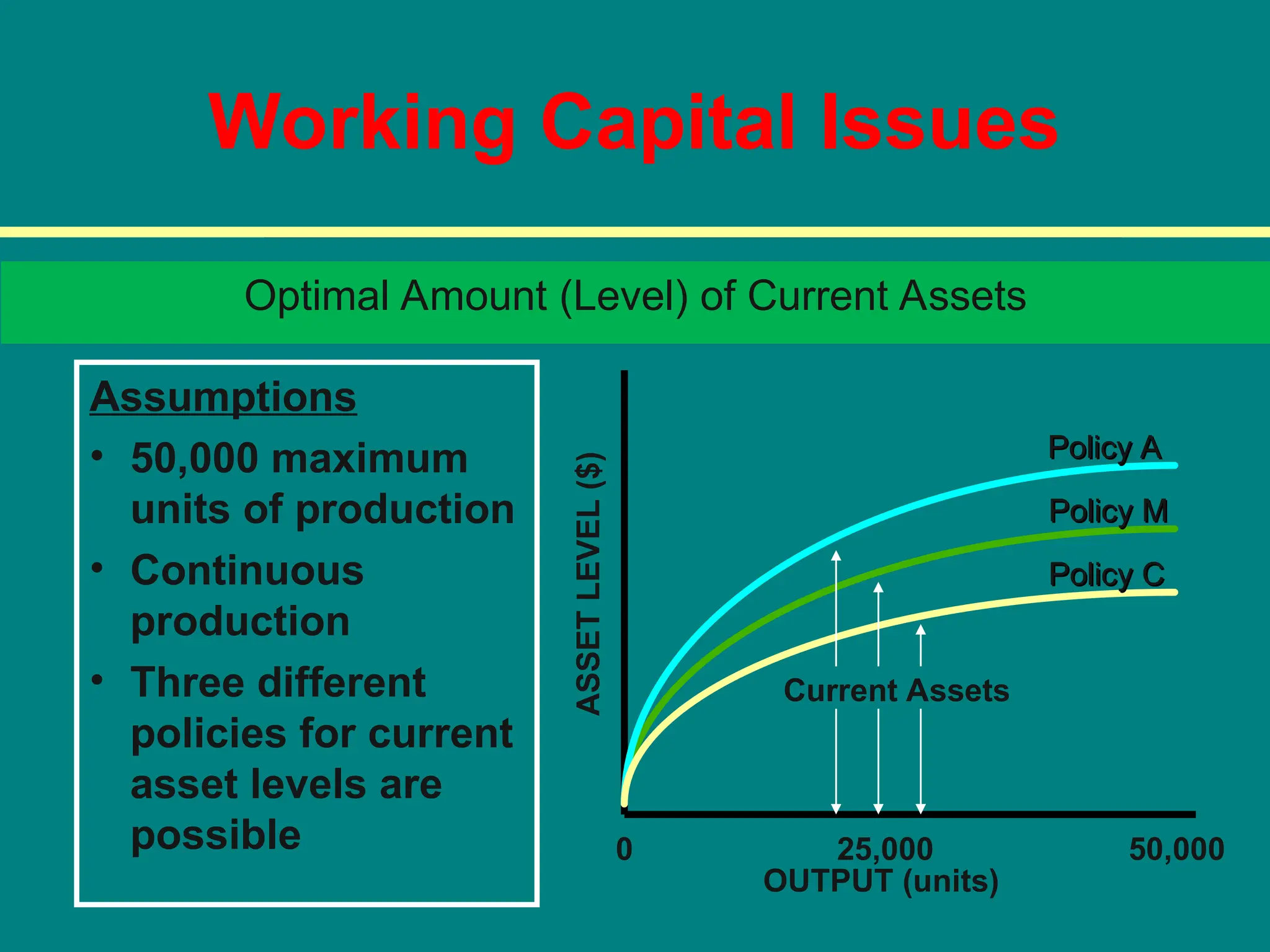
Assumptions
•50,000 maximum
units of production
• Continuous
production
• Three different
policies for current
asset levels are
possible
Optimal Amount (Level) of Current Assets
0 25,000 50,000
OUTPUT (units)
ASSET
LEVEL
($)
Current Assets
Policy C
Policy C
Policy A
Policy A
Policy M
Policy M
10.
Impact on Liquidity
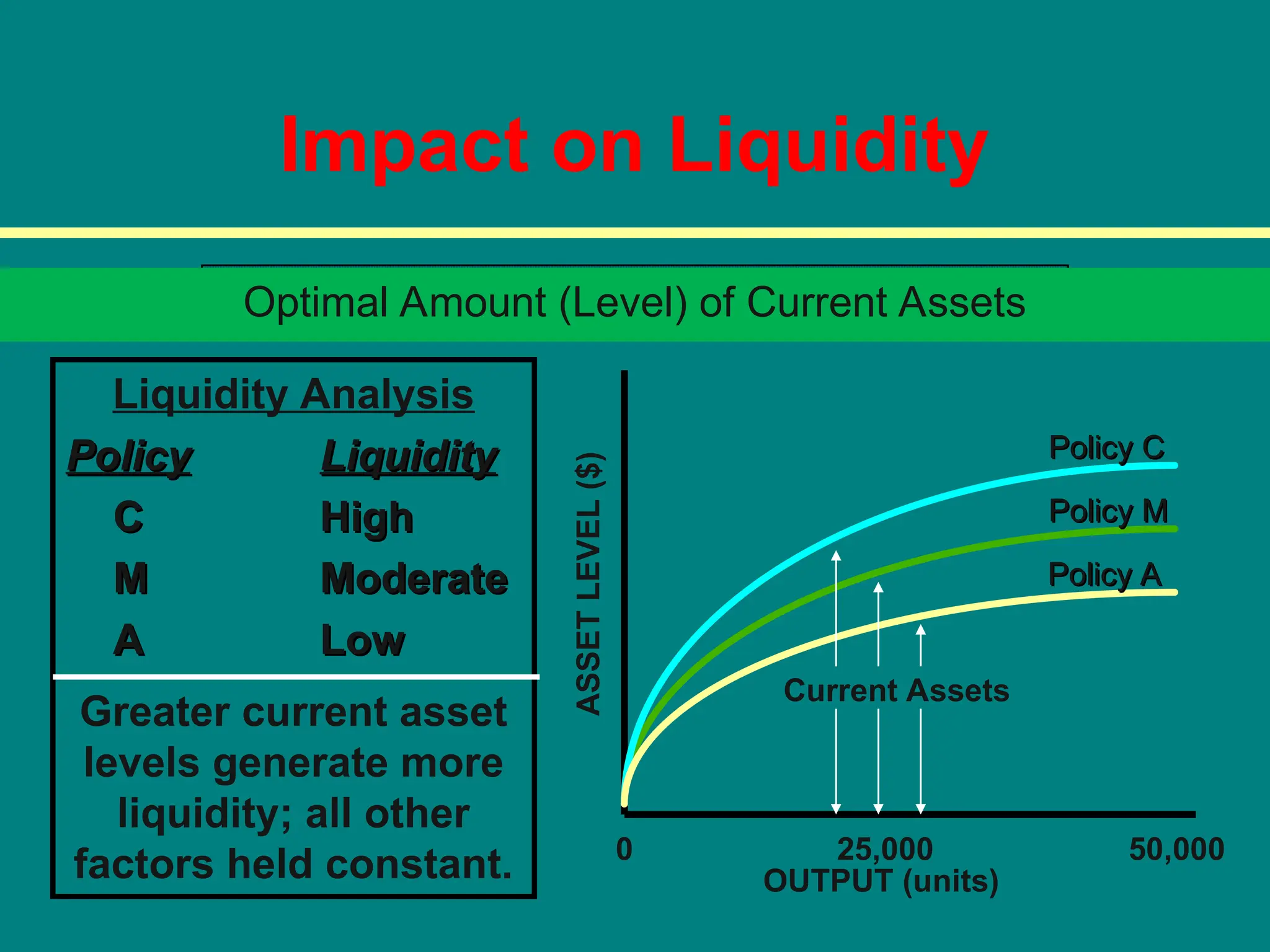
LiquidityAnalysis
Policy
Policy Liquidity
Liquidity
C
C High
High
M
M Moderate
Moderate
A
A Low
Low
Greater current asset
levels generate more
liquidity; all other
factors held constant.
Optimal Amount (Level) of Current Assets
0 25,000 50,000
OUTPUT (units)
ASSET
LEVEL
($)
Current Assets
Policy A
Policy A
Policy C
Policy C
Policy M
Policy M
11.
Impact on ExpectedProfitability
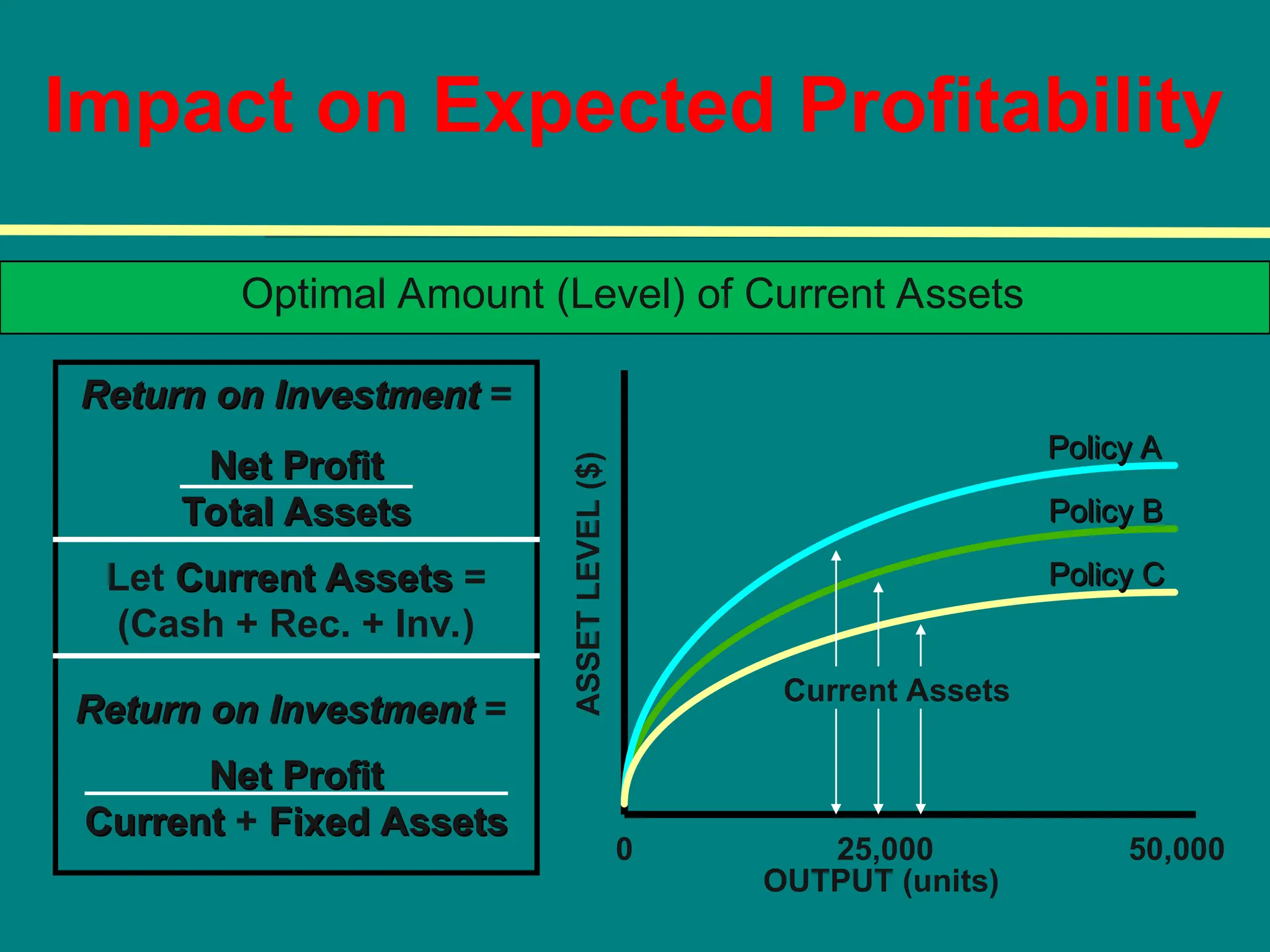
Return on Investment
Return on Investment =
Net Profit
Net Profit
Total Assets
Total Assets
Let Current Assets
Current Assets =
(Cash + Rec. + Inv.)
Return on Investment
Return on Investment =
Net Profit
Net Profit
Current
Current + Fixed Assets
Fixed Assets
Optimal Amount (Level) of Current Assets
0 25,000 50,000
OUTPUT (units)
ASSET
LEVEL
($)
Current Assets
Policy C
Policy C
Policy A
Policy A
Policy B
Policy B
12.
Impact on ExpectedProfitability
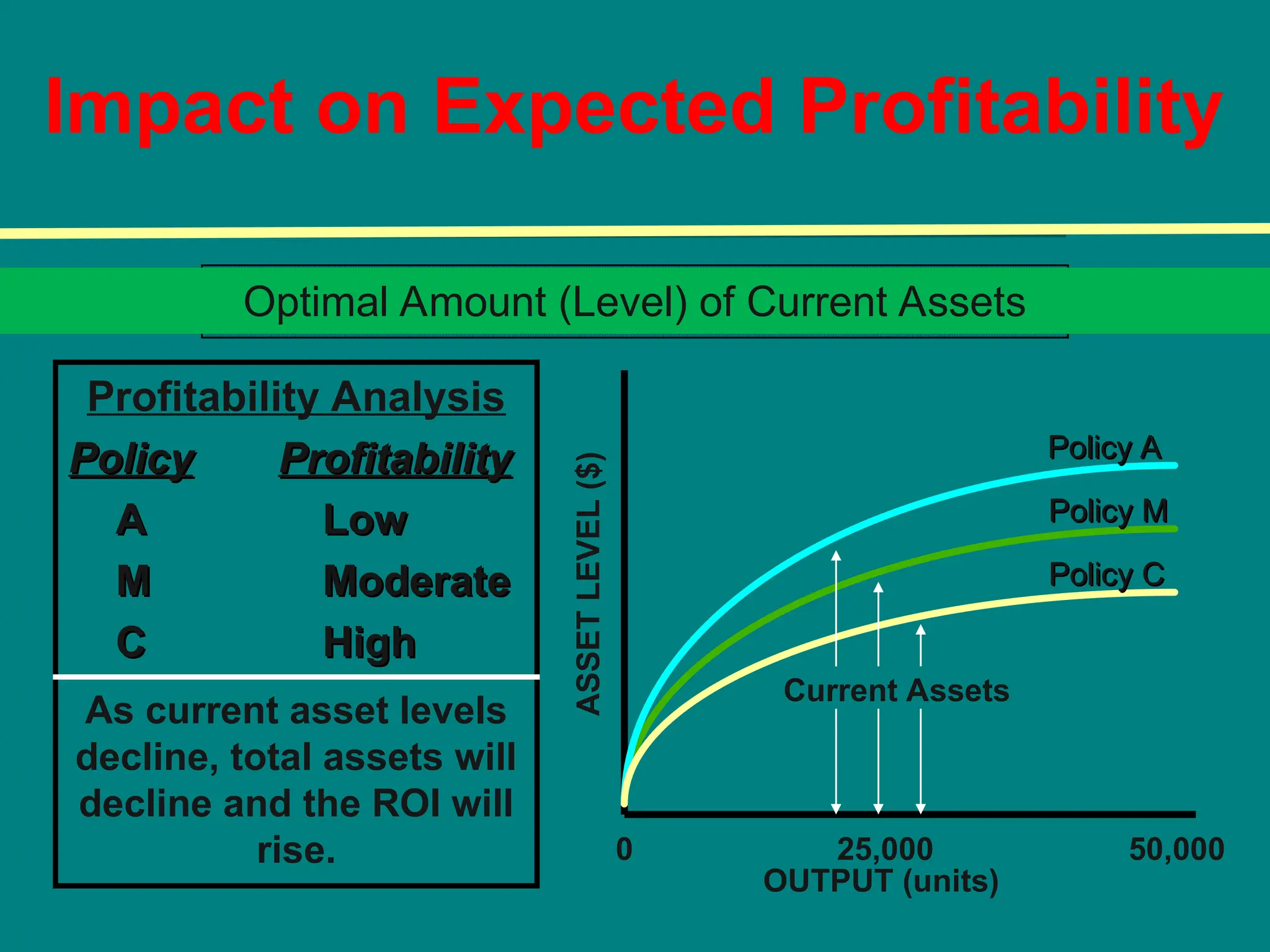
Profitability Analysis
Policy
Policy Profitability
Profitability
A
A Low
Low
M
M Moderate
Moderate
C
C High
High
As current asset levels
decline, total assets will
decline and the ROI will
rise.
Optimal Amount (Level) of Current Assets
0 25,000 50,000
OUTPUT (units)
ASSET
LEVEL
($)
Current Assets
Policy C
Policy C
Policy A
Policy A
Policy M
Policy M
13.
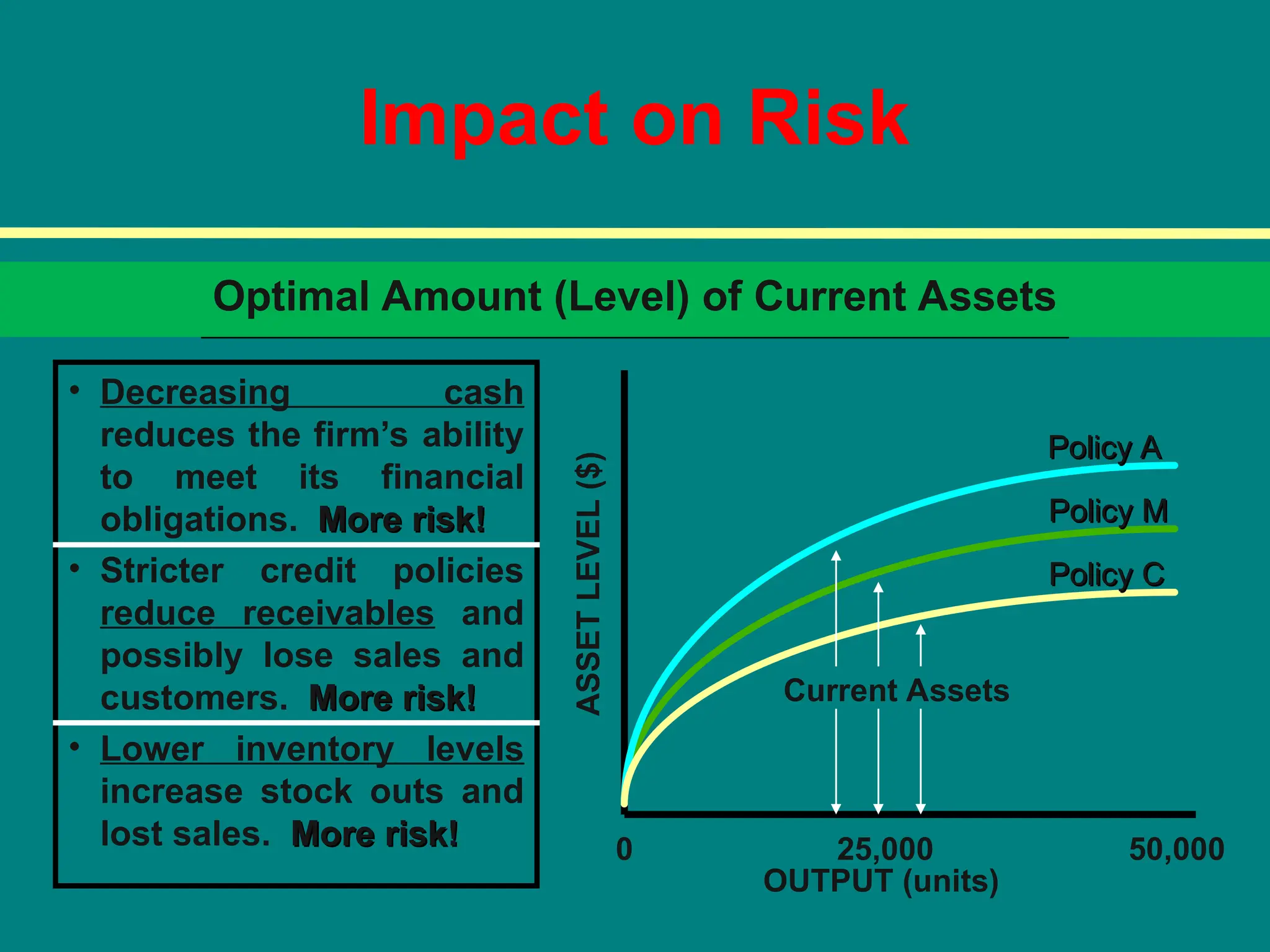
Impact on Risk
•Decreasing cash
reduces the firm’s ability
to meet its financial
obligations. More risk!
More risk!
• Stricter credit policies
reduce receivables and
possibly lose sales and
customers. More risk!
More risk!
• Lower inventory levels
increase stock outs and
lost sales. More risk!
More risk!
Optimal Amount (Level) of Current Assets
0 25,000 50,000
OUTPUT (units)
ASSET
LEVEL
($)
Current Assets
Policy C
Policy C
Policy A
Policy A
Policy M
Policy M
14.
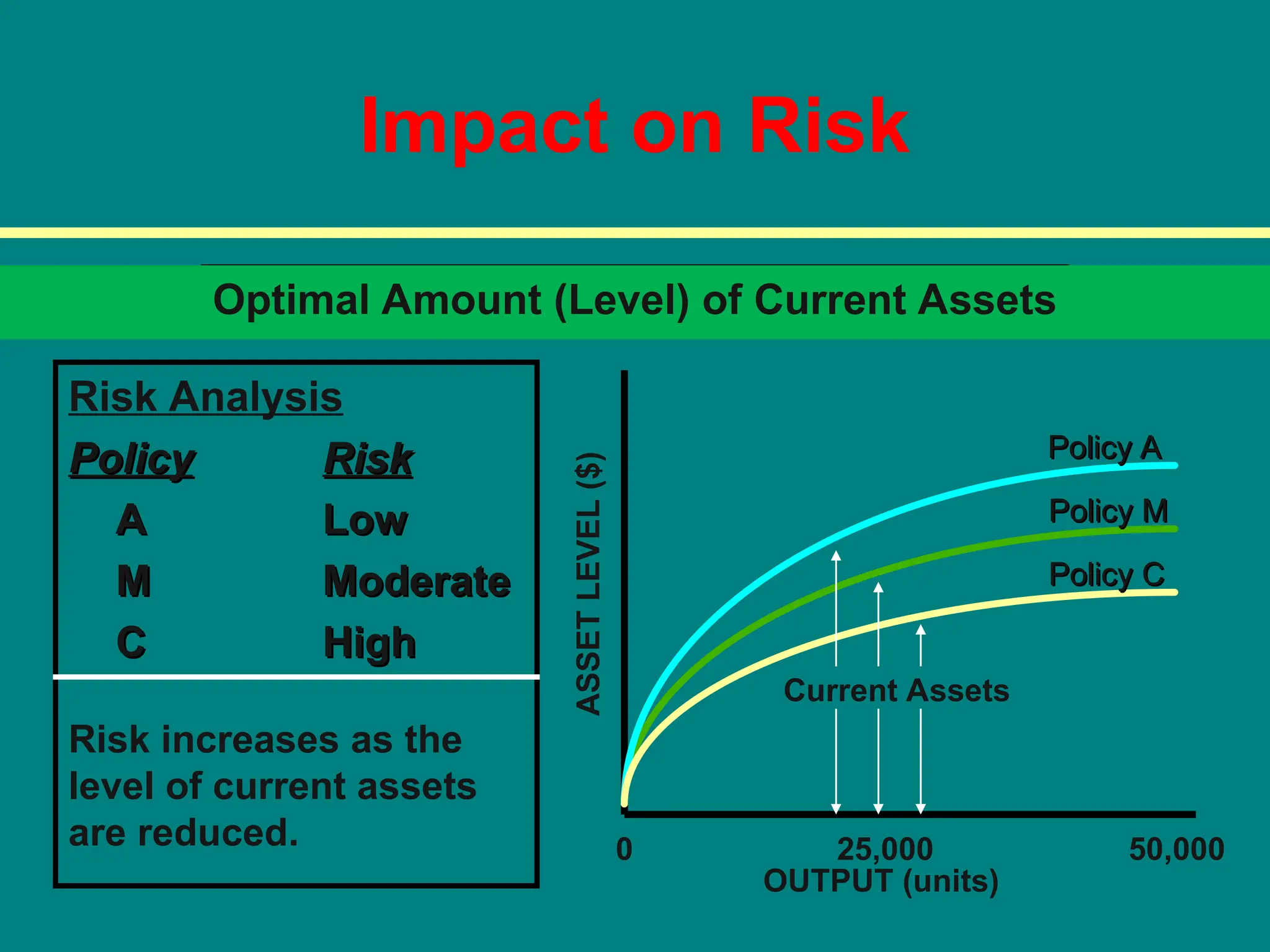
Impact on Risk
RiskAnalysis
Policy
Policy Risk
Risk
A
A Low
Low
M
M Moderate
Moderate
C
C High
High
Risk increases as the
level of current assets
are reduced.
Optimal Amount (Level) of Current Assets
0 25,000 50,000
OUTPUT (units)
ASSET
LEVEL
($)
Current Assets
Policy C
Policy C
Policy A
Policy A
Policy M
Policy M
15.
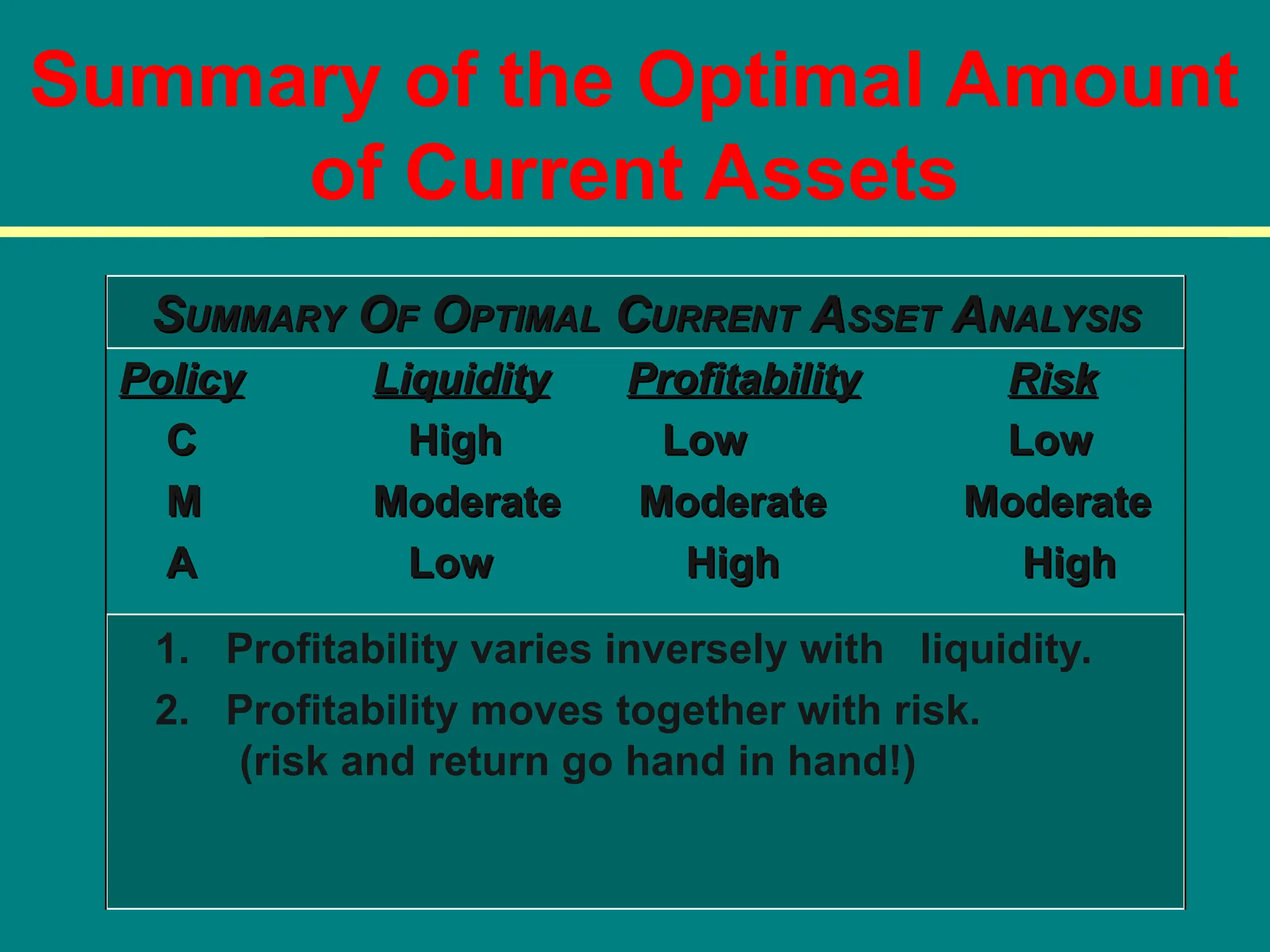
Summary of theOptimal Amount
of Current Assets
S
SUMMARY
UMMARY O
OF
F O
OPTIMAL
PTIMAL C
CURRENT
URRENT A
ASSET
SSET A
ANALYSIS
NALYSIS
Policy
Policy Liquidity
Liquidity Profitability
Profitability Risk
Risk
C
C High
High Low
Low Low
Low
M
M Moderate
Moderate Moderate
Moderate Moderate
Moderate
A
A Low
Low High
High High
High
1. Profitability varies inversely with liquidity.
2. Profitability moves together with risk.
(risk and return go hand in hand!)
16.
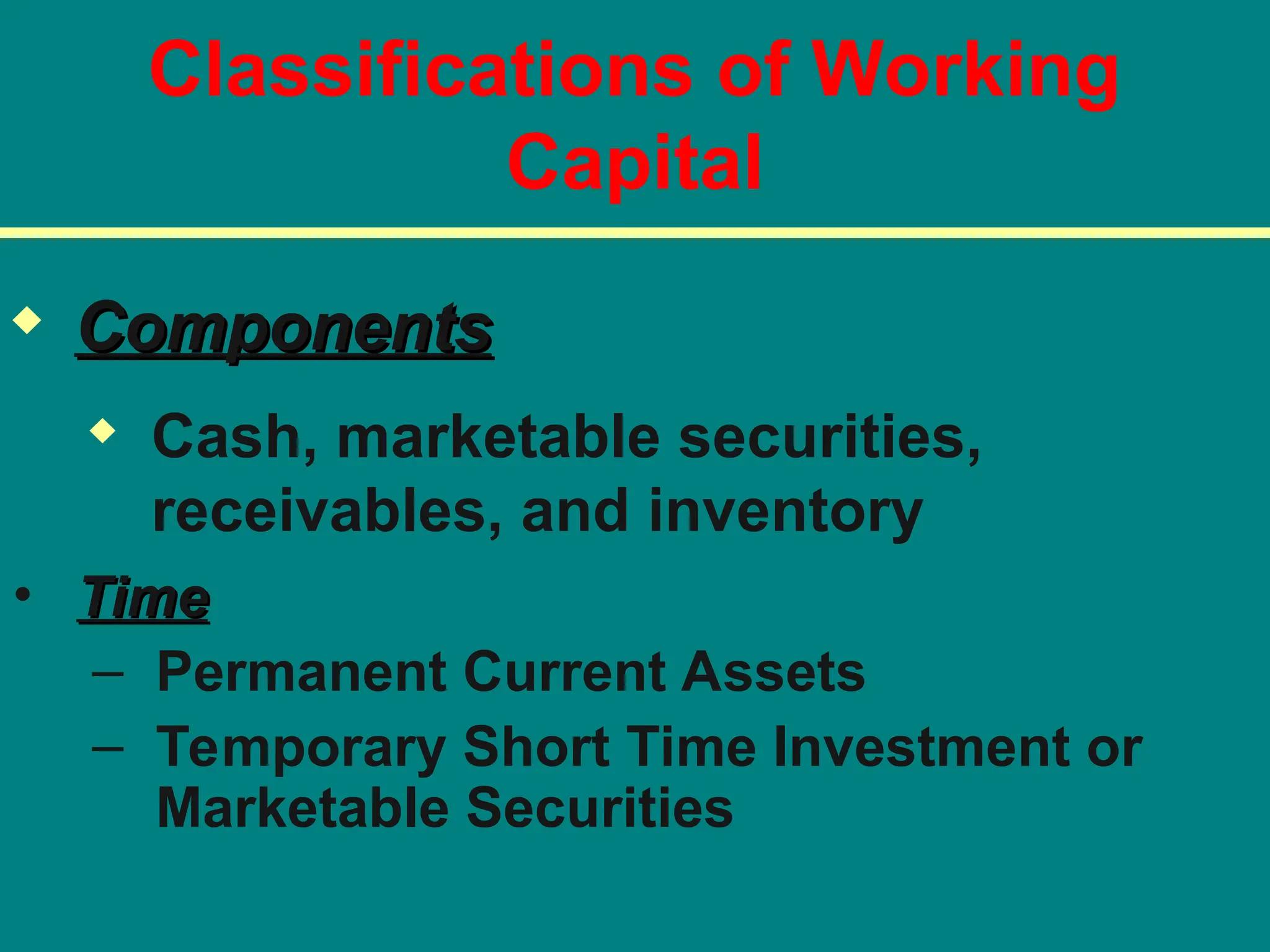
Classifications of Working
Capital
•Time
Time
– Permanent Current Assets
– Temporary Short Time Investment or
Marketable Securities
Components
Components
Cash, marketable securities,
receivables, and inventory
17.
Permanent Working Capital
Theamount of current assets required to meet a firm’s
long-term minimum needs. You might call this “bare bones”
working capital.
Permanent working capital is similar to the firm’s fixed
assets in two important respects. First, the dollar investment
is long term, despite the seeming contradiction that the
assets being financed are called “current.” Second, for a
growing firm, the level of permanent work ing capital needed
will increase over time in the same way that a firm’s fixed
assets will need to increase over time. However, permanent
working capital is different from fixed assets in one very
important respect – it is constantly changing.
18.
Temporary Working Capital
Theamount of current assets that varies with
seasonal requirements.
Like permanent working capital, temporary
working capital also consists of current assets in a
constantly changing form. However, because the
need for this portion of the firm’s total current
assets is seasonal, we may want to consider
financing this level of current assets from a source
which can itself be seasonal or temporary in nature.
19.
Financing Current Assets:Short-Term
and Long-Term Mix
Spontaneous Financing
Spontaneous Financing:
: Trade credit, and
other payables and accruals, that arise
spontaneously in the firm’s day-to-day
operations.
– Based on policies regarding payment for
purchases, labor, taxes, and other expenses.
– We are concerned with managing non-
spontaneous financing of assets.
20.
Hedging (or MaturityMatching)
Approach
A method of financing where each asset would
be offset with a financing instrument of the same
approximate maturity.
21.
Financing Needs and
theHedging Approach
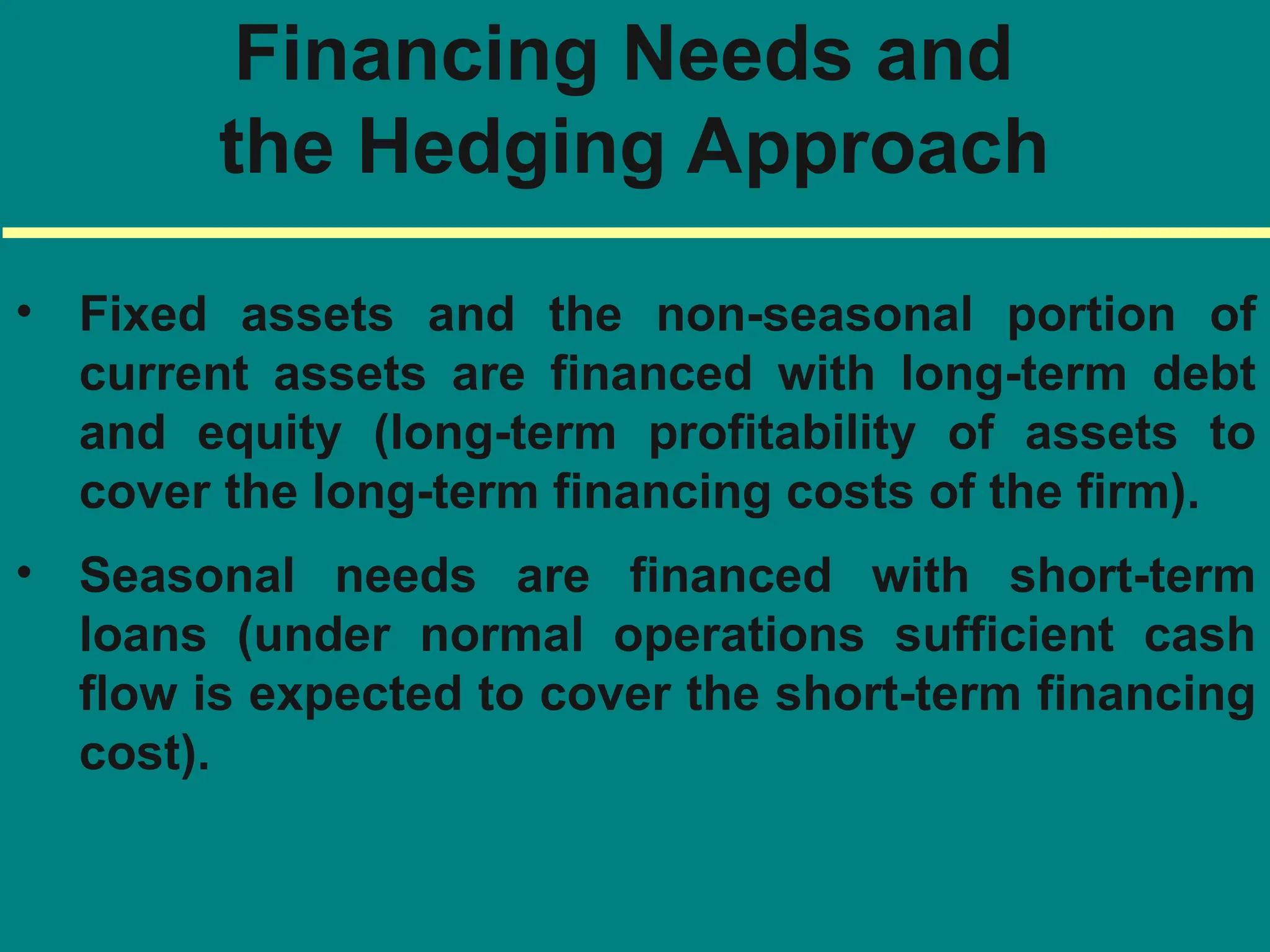
• Fixed assets and the non-seasonal portion of
current assets are financed with long-term debt
and equity (long-term profitability of assets to
cover the long-term financing costs of the firm).
• Seasonal needs are financed with short-term
loans (under normal operations sufficient cash
flow is expected to cover the short-term financing
cost).
22.
Self-Liquidating Nature of
Short-TermLoans
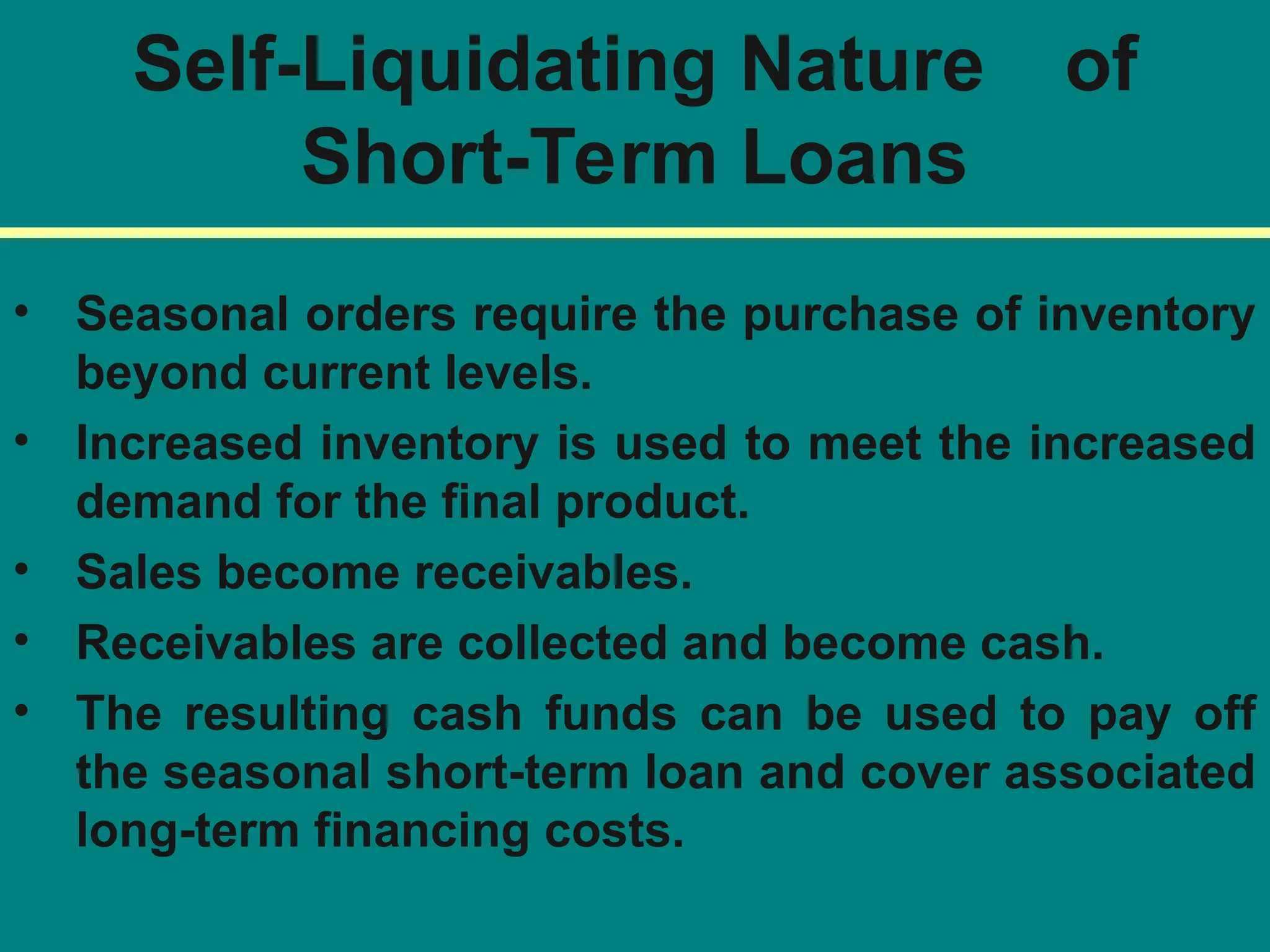
• Seasonal orders require the purchase of inventory
beyond current levels.
• Increased inventory is used to meet the increased
demand for the final product.
• Sales become receivables.
• Receivables are collected and become cash.
• The resulting cash funds can be used to pay off
the seasonal short-term loan and cover associated
long-term financing costs.
23.
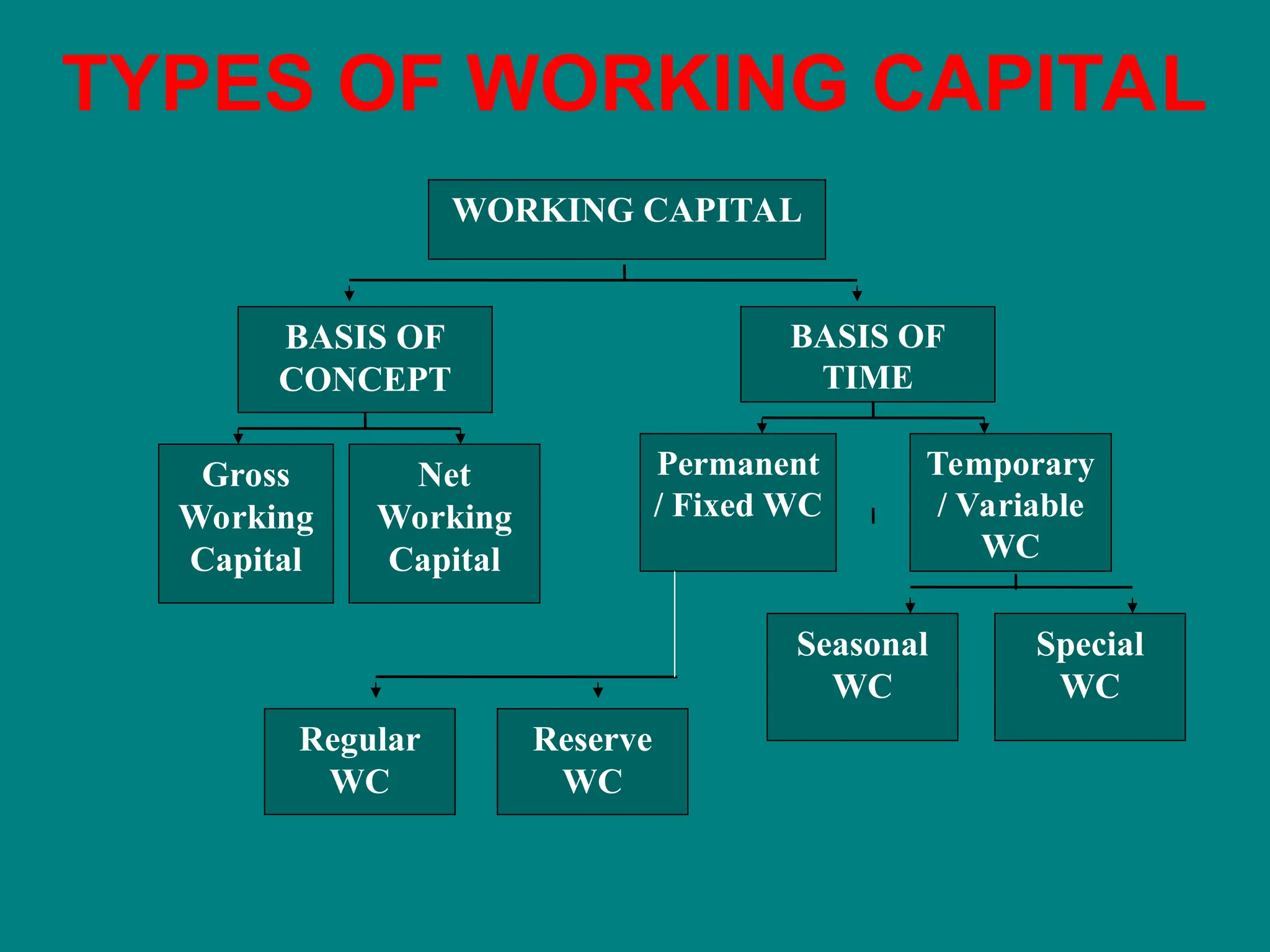
TYPES OF WORKINGCAPITAL
WORKING CAPITAL
BASIS OF
CONCEPT
BASIS OF
TIME
Gross
Working
Capital
Net
Working
Capital
Permanent
/ Fixed WC
Temporary
/ Variable
WC
Regular
WC
Reserve
WC
Special
WC
Seasonal
WC
24.
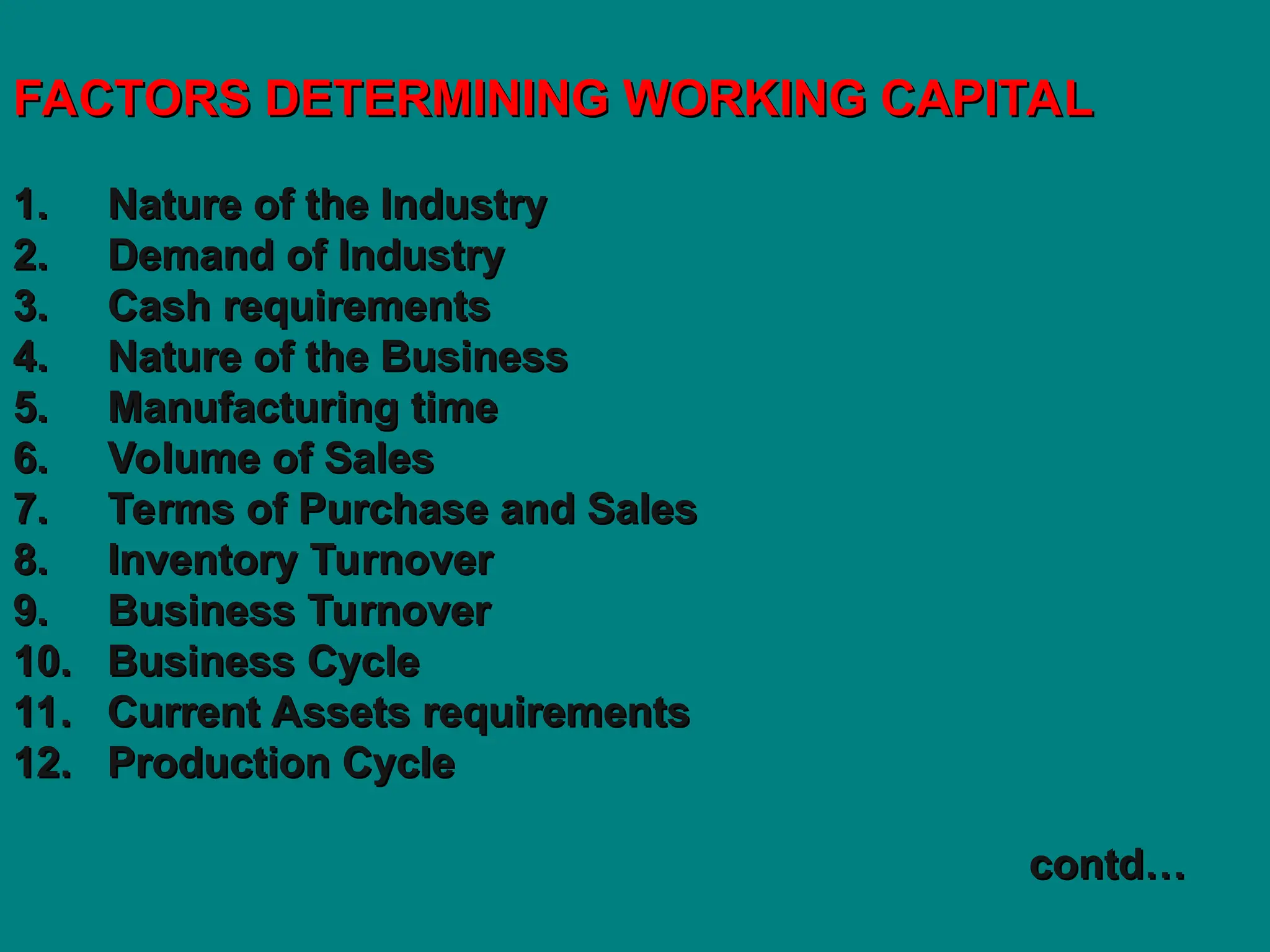
FACTORS DETERMINING WORKINGCAPITAL
FACTORS DETERMINING WORKING CAPITAL
1. Nature of the Industry
1. Nature of the Industry
2. Demand of Industry
2. Demand of Industry
3. Cash requirements
3. Cash requirements
4. Nature of the Business
4. Nature of the Business
5. Manufacturing time
5. Manufacturing time
6. Volume of Sales
6. Volume of Sales
7. Terms of Purchase and Sales
7. Terms of Purchase and Sales
8. Inventory Turnover
8. Inventory Turnover
9. Business Turnover
9. Business Turnover
10. Business Cycle
10. Business Cycle
11. Current Assets requirements
11. Current Assets requirements
12. Production Cycle
12. Production Cycle
contd…
contd…
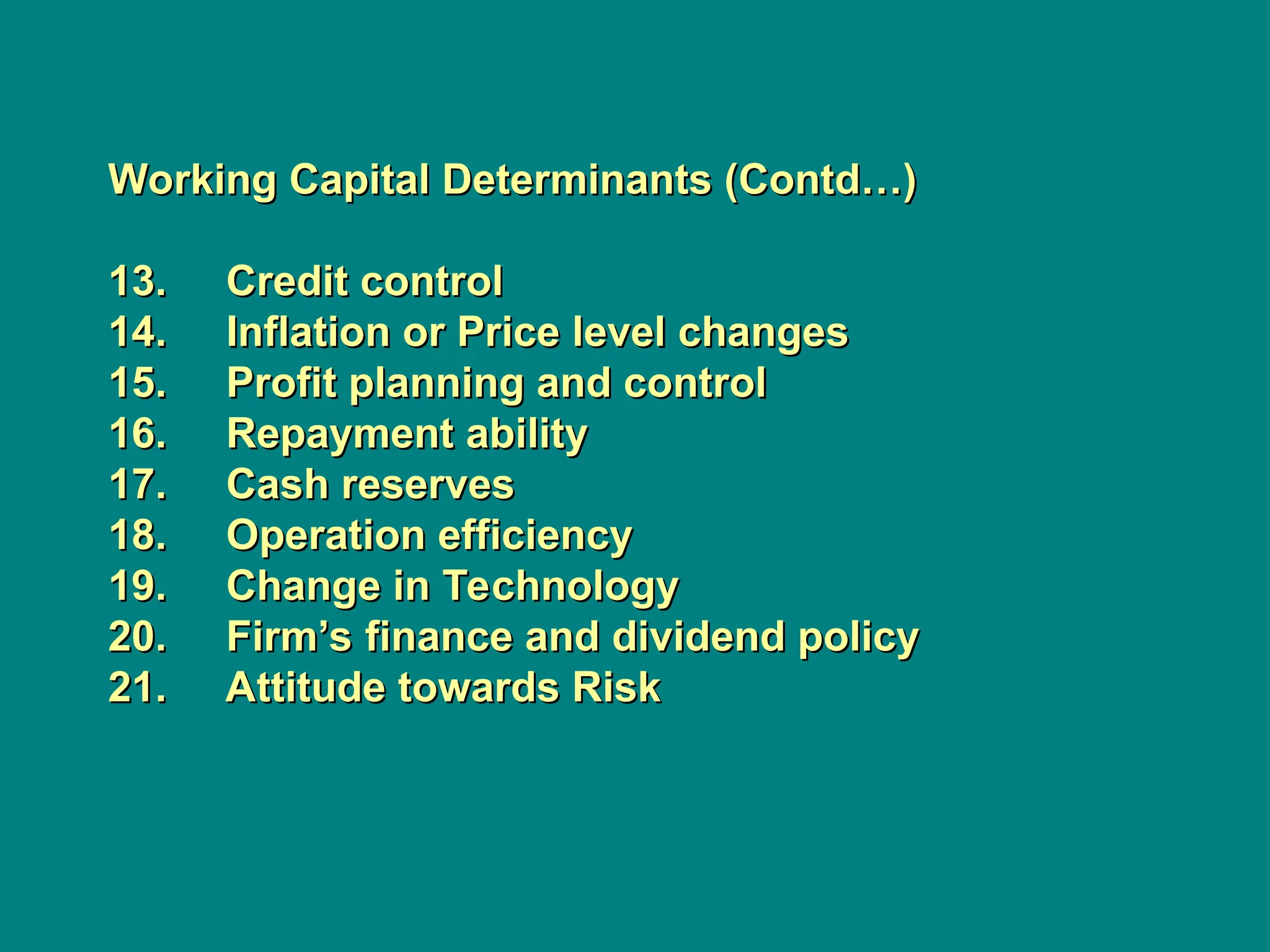
25.
Working Capital Determinants(Contd…)
Working Capital Determinants (Contd…)
13. Credit control
13. Credit control
14. Inflation or Price level changes
14. Inflation or Price level changes
15. Profit planning and control
15. Profit planning and control
16. Repayment ability
16. Repayment ability
17. Cash reserves
17. Cash reserves
18. Operation efficiency
18. Operation efficiency
19. Change in Technology
19. Change in Technology
20. Firm’s finance and dividend policy
20. Firm’s finance and dividend policy
21. Attitude towards Risk
21. Attitude towards Risk
26.
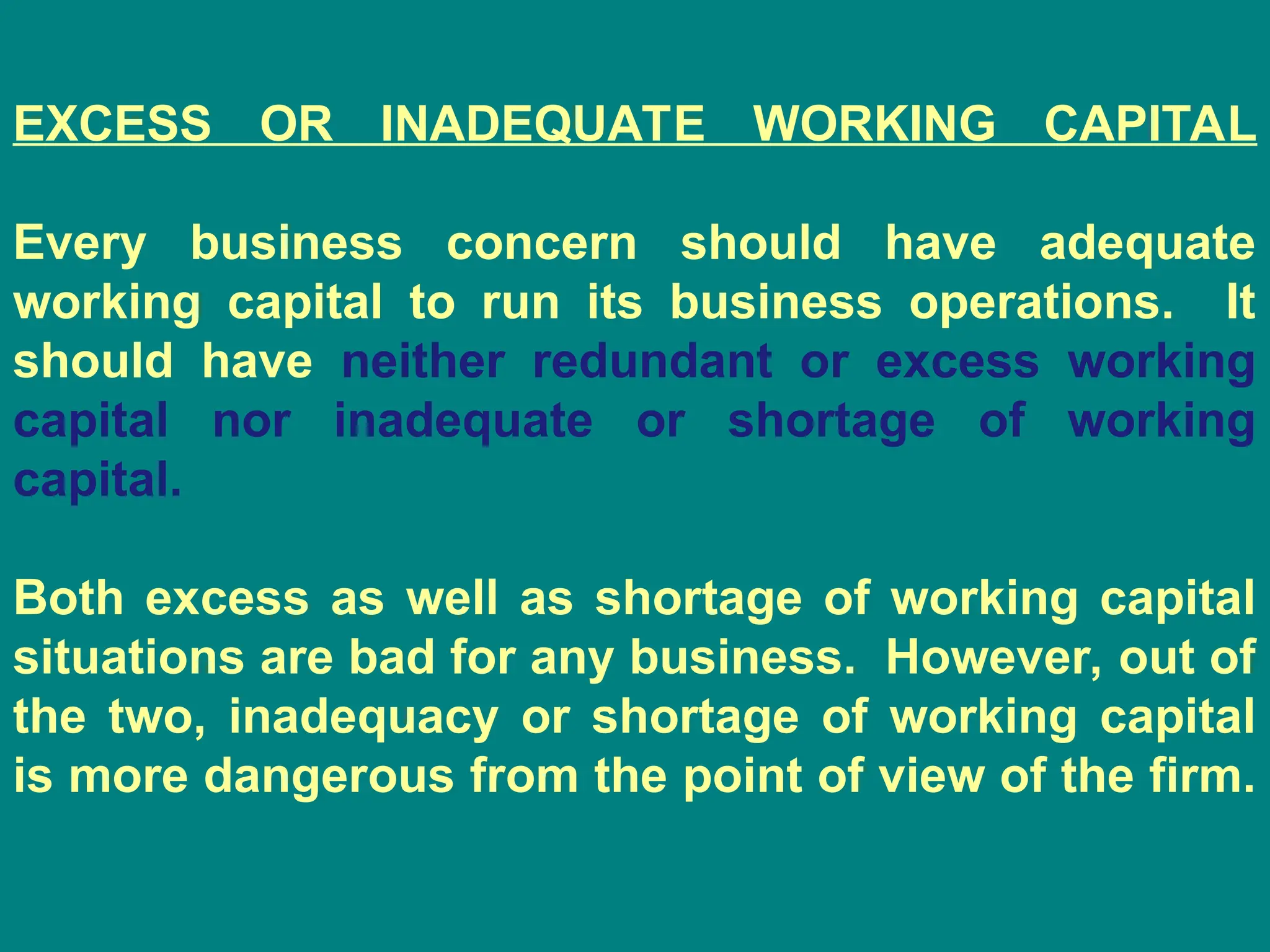
EXCESS OR INADEQUATEWORKING CAPITAL
Every business concern should have adequate
working capital to run its business operations. It
should have neither redundant or excess working
capital nor inadequate or shortage of working
capital.
Both excess as well as shortage of working capital
situations are bad for any business. However, out of
the two, inadequacy or shortage of working capital
is more dangerous from the point of view of the firm.
27.
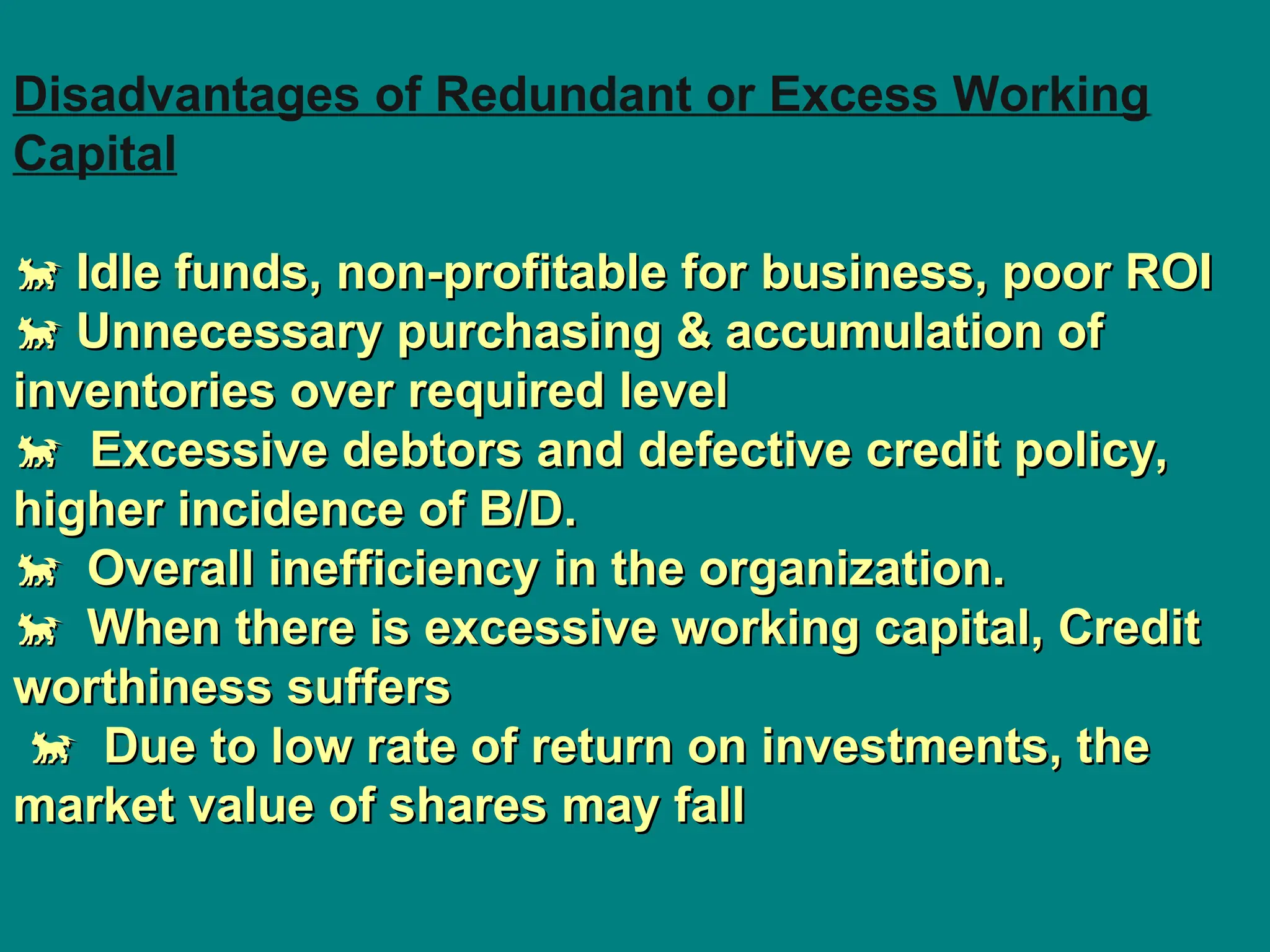
Disadvantages of Redundantor Excess Working
Capital
Idle funds, non-profitable for business, poor ROI
Idle funds, non-profitable for business, poor ROI
Unnecessary purchasing & accumulation of
Unnecessary purchasing & accumulation of
inventories over required level
inventories over required level
Excessive debtors and defective credit policy,
Excessive debtors and defective credit policy,
higher incidence of B/D.
higher incidence of B/D.
Overall inefficiency in the organization.
Overall inefficiency in the organization.
When there is excessive working capital, Credit
When there is excessive working capital, Credit
worthiness suffers
worthiness suffers
Due to low rate of return on investments, the
Due to low rate of return on investments, the
market value of shares may fall
market value of shares may fall
28.
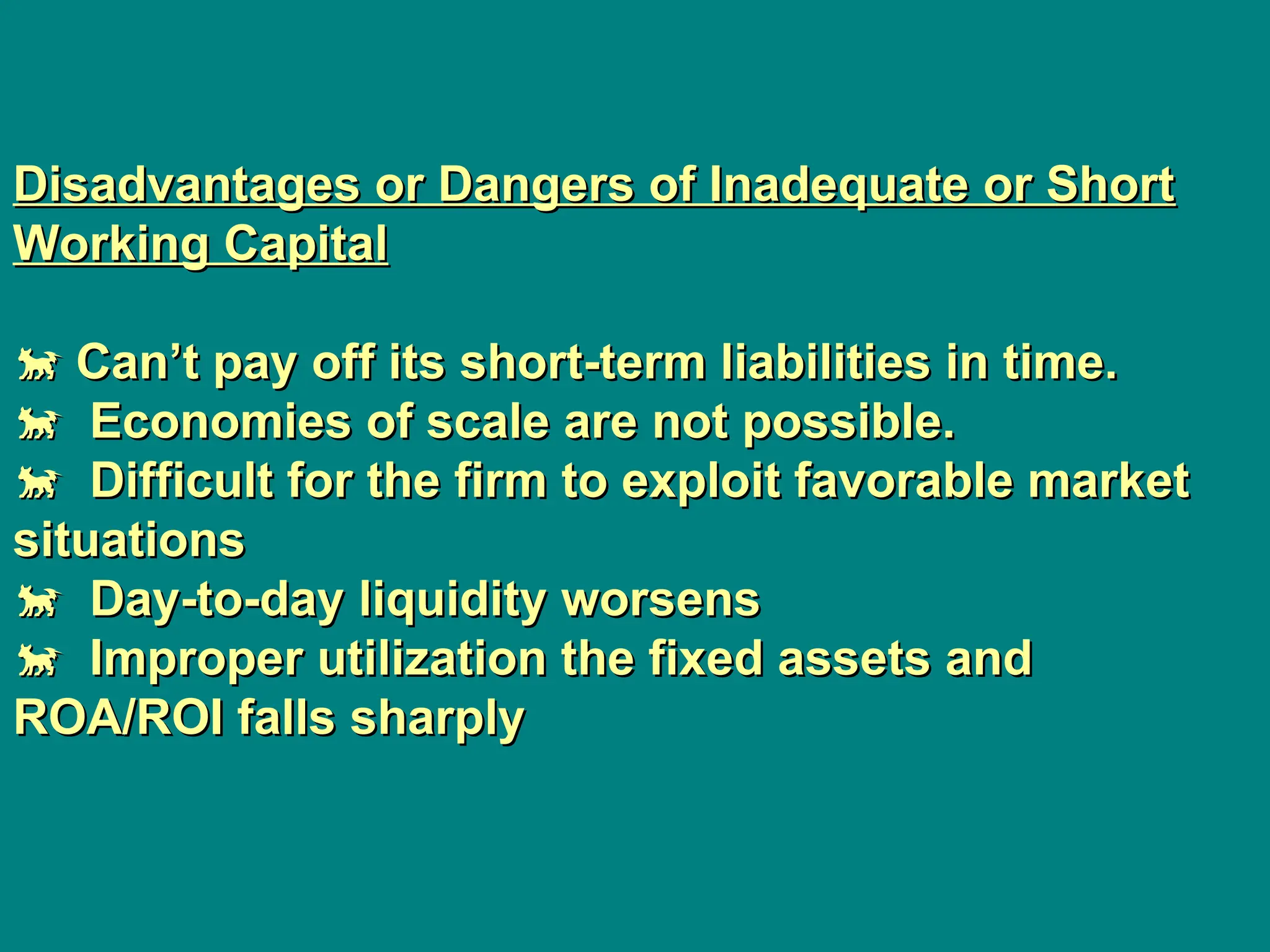
Disadvantages or Dangersof Inadequate or Short
Disadvantages or Dangers of Inadequate or Short
Working Capital
Working Capital
Can’t pay off its short-term liabilities in time.
Can’t pay off its short-term liabilities in time.
Economies of scale are not possible.
Economies of scale are not possible.
Difficult for the firm to exploit favorable market
Difficult for the firm to exploit favorable market
situations
situations
Day-to-day liquidity worsens
Day-to-day liquidity worsens
Improper utilization the fixed assets and
Improper utilization the fixed assets and
ROA/ROI falls sharply
ROA/ROI falls sharply
29.
MANAGEMENT OF WORKINGCAPITAL ( WCM )
MANAGEMENT OF WORKING CAPITAL ( WCM )
Management of working capital is concerned with
Management of working capital is concerned with
the problems that arise in attempting to manage the
the problems that arise in attempting to manage the
current assets, the current liabilities and the inter-
current assets, the current liabilities and the inter-
relationship that exists between them.
relationship that exists between them. In other
In other
words, it refers to all aspects of administration of CA
words, it refers to all aspects of administration of CA
and CL.
and CL.
Working Capital Management Policies of a firm have
Working Capital Management Policies of a firm have
a great effect on its
a great effect on its profitability, liquidity and
profitability, liquidity and
structural health of the organization.
structural health of the organization.