INTRODUCTION TO
THE WORK STUDY
INTRODUCTION TO WORK STUDY &
INDUSTRIAL ENGINEERING
• Work Study is the systematic examination of the methods
of carrying on activities so as to improve the effective use
of resources and to set up standards of performance for the
activities being carried out.
• Industrial Engineering is a branch of engineering which
deals with the optimization of complex processes or
systems. It is concerned with the development,
improvement, implementation and evaluation of integrated
systems
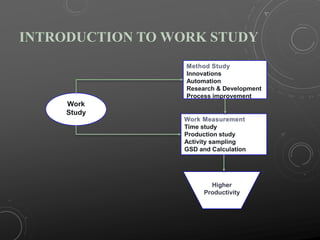
INTRODUCTION TO WORK STUDY
Work
Study
Method Study
Innovations
Automation
Research & Development
Process improvement
Work Measurement
Time study
Production study
Activity sampling
GSD and Calculation
Higher
Productivity
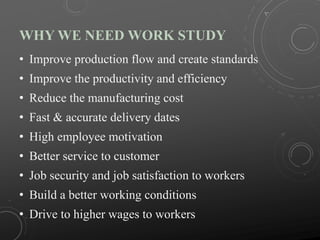
WHY WE NEED WORK STUDY
• Improve production flow and create standards
• Improve the productivity and efficiency
• Reduce the manufacturing cost
• Fast & accurate delivery dates
• High employee motivation
• Better service to customer
• Job security and job satisfaction to workers
• Build a better working conditions
• Drive to higher wages to workers
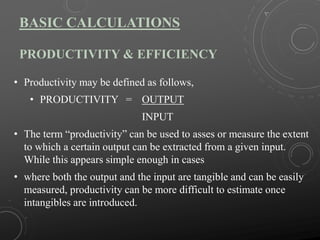
BASIC CALCULATIONS
PRODUCTIVITY & EFFICIENCY
• Productivity may be defined as follows,
• PRODUCTIVITY = OUTPUT
INPUT
• The term “productivity” can be used to asses or measure the extent
to which a certain output can be extracted from a given input.
While this appears simple enough in cases
• where both the output and the input are tangible and can be easily
measured, productivity can be more difficult to estimate once
intangibles are introduced.
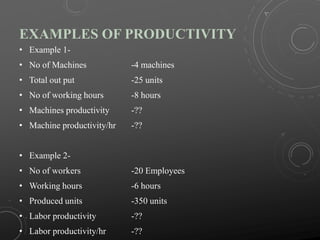
EXAMPLES OF PRODUCTIVITY
• Example 1-
• No of Machines -4 machines
• Total out put -25 units
• No of working hours -8 hours
• Machines productivity -??
• Machine productivity/hr -??
• Example 2-
• No of workers -20 Employees
• Working hours -6 hours
• Produced units -350 units
• Labor productivity -??
• Labor productivity/hr -??
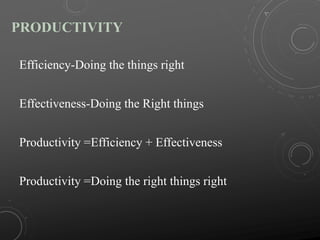
PRODUCTIVITY
Efficiency-Doing the things right
Effectiveness-Doing the Right things
Productivity =Efficiency + Effectiveness
Productivity =Doing the right things right
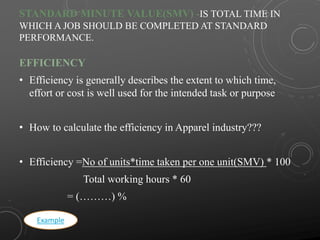
STANDARD MINUTE VALUE(SMV) -IS TOTAL TIME IN
WHICH A JOB SHOULD BE COMPLETED AT STANDARD
PERFORMANCE.
EFFICIENCY
• Efficiency is generally describes the extent to which time,
effort or cost is well used for the intended task or purpose
• How to calculate the efficiency in Apparel industry???
• Efficiency =No of units*time taken per one unit(SMV) * 100
Total working hours * 60
= (………) %
Example
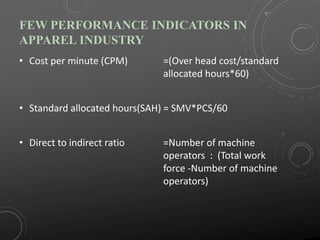
FEW PERFORMANCE INDICATORS IN
APPAREL INDUSTRY
• Cost per minute (CPM) =(Over head cost/standard
allocated hours*60)
• Standard allocated hours(SAH) = SMV*PCS/60
• Direct to indirect ratio =Number of machine
operators : (Total work
force -Number of machine
operators)
WORK MEASUREMENT
The application of techniques designed to establish
the time for a qualified work to carry out a specified
job at a defined level of performance
THE USES OF WORK MEASUREMENT
• To compare effectiveness of alternative methods
• To balance the work among the members of teams, in association
with multiple activity charts, so that, as nearly as possible, each
member has a task taking an equal time to perform
• Use of Standards in Incentive schemes
• To determine, in association with worker and machine multiple
activity charts, the number of machines an operative can run
• To provide basis for Production planning & control
• To provide information for labor-cost control and to enable
standard cost to be fixed and maintain.
THE TECHNIQUES OF WORK
MEASUREMENT
Direct work measurement techniques
• Time Study
• Production Study
• Activity Sampling
THE TECHNIQUES OF WORK
MEASUREMENT
In-direct work measurement techniques
• Estimating
• Pre-determined Motion Time System –PMTS
(MTM/GSD)
• Standard data
TIME STUDY
Time study is a work measurement technique for
recording the time of performing a specific job or its
elements carried out under specific condition and for
analyzing the data so as to obtain the time necessary for
an operator to carry out at a defined rate of performance
TIME STUDY
• A qualified worker is one who has acquired the skill,
knowledge and other attributes to carry out the work
in hand to satisfactory standards of quantity, quality
and safety.
• An element is a distinct part of a specified job
selected for convenience of observation, measurement
and analysis
• A work cycle is the sequence of elements which are
required to perform a job or yield a unit of production.
The sequence may sometimes include occasional
elements
STANDARD RATING
• The work study person has to have some means of
assessing the rate of working of the operative he or
she is observing and of relating it to standard pace.
This process is known as rating.
• Rating is the assessment of the worker’s rate of
working relative to the observer’s concept of the
rate corresponding to standard pace.
STANDARD PERFORMANCE
• Standard performance is the rate of output which
qualified workers will naturally achieve without
over-exertion as an average over the working day
or shift, provided that they know and adhere to the
specified method and provided that they are
motivated to apply themselves to their work –this
performance is denoted as 100 on the standard
rating and performance scale.
• Standard minute value(SMV) is total time in
which a job should be completed at Standard
performance.
TYPES OF ALLOWANCES
• Personal allowances
• Fatigue allowances
• Contingency allowances
• Machine delay allowances
• Bundle Handling Time (BHT)
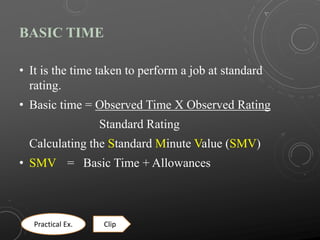
BASIC TIME
• It is the time taken to perform a job at standard
rating.
• Basic time = Observed Time X Observed Rating
Standard Rating
Calculating the Standard Minute Value (SMV)
• SMV = Basic Time + Allowances
Practical Ex. Clip
PRODUCTION STUDY
• A continuous study of relatively lengthy duration
often extending over a period of one or more
shifts, taken with the objective of checking an
existing or proposed standard time or obtaining
other information affecting the rate of output.
ACTIVITY SAMPLING
• A technique in which a large number of
observations are made over a period of time of one
or a group machines, processes or workers
• Observation records what is happening at that
instance
• Relies upon statistical theory of sampling and
probability theory
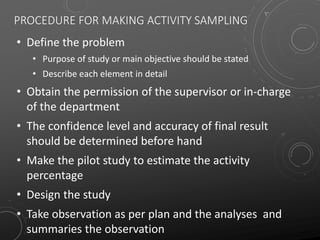
PROCEDURE FOR MAKING ACTIVITY SAMPLING
• Define the problem
• Purpose of study or main objective should be stated
• Describe each element in detail
• Obtain the permission of the supervisor or in-charge
of the department
• The confidence level and accuracy of final result
should be determined before hand
• Make the pilot study to estimate the activity
percentage
• Design the study
• Take observation as per plan and the analyses and
summaries the observation
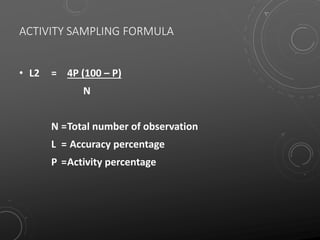
ACTIVITY SAMPLING FORMULA
• L2 = 4P (100 – P)
N
N =Total number of observation
L = Accuracy percentage
P =Activity percentage
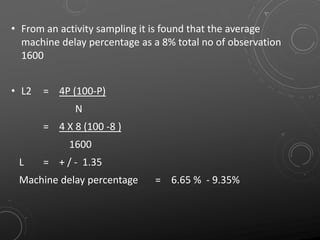
• From an activity sampling it is found that the average
machine delay percentage as a 8% total no of observation
1600
• L2 = 4P (100-P)
N
= 4 X 8 (100 -8 )
1600
L = + / - 1.35
Machine delay percentage = 6.65 % - 9.35%
Thanks

Introduction to Work Study .ppt

  • 1.
  • 2.
    INTRODUCTION TO WORKSTUDY & INDUSTRIAL ENGINEERING • Work Study is the systematic examination of the methods of carrying on activities so as to improve the effective use of resources and to set up standards of performance for the activities being carried out. • Industrial Engineering is a branch of engineering which deals with the optimization of complex processes or systems. It is concerned with the development, improvement, implementation and evaluation of integrated systems
  • 3.
    INTRODUCTION TO WORKSTUDY Work Study Method Study Innovations Automation Research & Development Process improvement Work Measurement Time study Production study Activity sampling GSD and Calculation Higher Productivity
  • 4.
    WHY WE NEEDWORK STUDY • Improve production flow and create standards • Improve the productivity and efficiency • Reduce the manufacturing cost • Fast & accurate delivery dates • High employee motivation • Better service to customer • Job security and job satisfaction to workers • Build a better working conditions • Drive to higher wages to workers
  • 5.
    BASIC CALCULATIONS PRODUCTIVITY &EFFICIENCY • Productivity may be defined as follows, • PRODUCTIVITY = OUTPUT INPUT • The term “productivity” can be used to asses or measure the extent to which a certain output can be extracted from a given input. While this appears simple enough in cases • where both the output and the input are tangible and can be easily measured, productivity can be more difficult to estimate once intangibles are introduced.
  • 6.
    EXAMPLES OF PRODUCTIVITY •Example 1- • No of Machines -4 machines • Total out put -25 units • No of working hours -8 hours • Machines productivity -?? • Machine productivity/hr -?? • Example 2- • No of workers -20 Employees • Working hours -6 hours • Produced units -350 units • Labor productivity -?? • Labor productivity/hr -??
  • 7.
    PRODUCTIVITY Efficiency-Doing the thingsright Effectiveness-Doing the Right things Productivity =Efficiency + Effectiveness Productivity =Doing the right things right
  • 8.
    STANDARD MINUTE VALUE(SMV)-IS TOTAL TIME IN WHICH A JOB SHOULD BE COMPLETED AT STANDARD PERFORMANCE. EFFICIENCY • Efficiency is generally describes the extent to which time, effort or cost is well used for the intended task or purpose • How to calculate the efficiency in Apparel industry??? • Efficiency =No of units*time taken per one unit(SMV) * 100 Total working hours * 60 = (………) % Example
  • 9.
    FEW PERFORMANCE INDICATORSIN APPAREL INDUSTRY • Cost per minute (CPM) =(Over head cost/standard allocated hours*60) • Standard allocated hours(SAH) = SMV*PCS/60 • Direct to indirect ratio =Number of machine operators : (Total work force -Number of machine operators)
  • 10.
    WORK MEASUREMENT The applicationof techniques designed to establish the time for a qualified work to carry out a specified job at a defined level of performance
  • 11.
    THE USES OFWORK MEASUREMENT • To compare effectiveness of alternative methods • To balance the work among the members of teams, in association with multiple activity charts, so that, as nearly as possible, each member has a task taking an equal time to perform • Use of Standards in Incentive schemes • To determine, in association with worker and machine multiple activity charts, the number of machines an operative can run • To provide basis for Production planning & control • To provide information for labor-cost control and to enable standard cost to be fixed and maintain.
  • 12.
    THE TECHNIQUES OFWORK MEASUREMENT Direct work measurement techniques • Time Study • Production Study • Activity Sampling
  • 13.
    THE TECHNIQUES OFWORK MEASUREMENT In-direct work measurement techniques • Estimating • Pre-determined Motion Time System –PMTS (MTM/GSD) • Standard data
  • 14.
    TIME STUDY Time studyis a work measurement technique for recording the time of performing a specific job or its elements carried out under specific condition and for analyzing the data so as to obtain the time necessary for an operator to carry out at a defined rate of performance
  • 15.
    TIME STUDY • Aqualified worker is one who has acquired the skill, knowledge and other attributes to carry out the work in hand to satisfactory standards of quantity, quality and safety. • An element is a distinct part of a specified job selected for convenience of observation, measurement and analysis • A work cycle is the sequence of elements which are required to perform a job or yield a unit of production. The sequence may sometimes include occasional elements
  • 16.
    STANDARD RATING • Thework study person has to have some means of assessing the rate of working of the operative he or she is observing and of relating it to standard pace. This process is known as rating. • Rating is the assessment of the worker’s rate of working relative to the observer’s concept of the rate corresponding to standard pace.
  • 17.
    STANDARD PERFORMANCE • Standardperformance is the rate of output which qualified workers will naturally achieve without over-exertion as an average over the working day or shift, provided that they know and adhere to the specified method and provided that they are motivated to apply themselves to their work –this performance is denoted as 100 on the standard rating and performance scale. • Standard minute value(SMV) is total time in which a job should be completed at Standard performance.
  • 18.
    TYPES OF ALLOWANCES •Personal allowances • Fatigue allowances • Contingency allowances • Machine delay allowances • Bundle Handling Time (BHT)
  • 19.
    BASIC TIME • Itis the time taken to perform a job at standard rating. • Basic time = Observed Time X Observed Rating Standard Rating Calculating the Standard Minute Value (SMV) • SMV = Basic Time + Allowances Practical Ex. Clip
  • 20.
    PRODUCTION STUDY • Acontinuous study of relatively lengthy duration often extending over a period of one or more shifts, taken with the objective of checking an existing or proposed standard time or obtaining other information affecting the rate of output.
  • 21.
    ACTIVITY SAMPLING • Atechnique in which a large number of observations are made over a period of time of one or a group machines, processes or workers • Observation records what is happening at that instance • Relies upon statistical theory of sampling and probability theory
  • 22.
    PROCEDURE FOR MAKINGACTIVITY SAMPLING • Define the problem • Purpose of study or main objective should be stated • Describe each element in detail • Obtain the permission of the supervisor or in-charge of the department • The confidence level and accuracy of final result should be determined before hand • Make the pilot study to estimate the activity percentage • Design the study • Take observation as per plan and the analyses and summaries the observation
  • 23.
    ACTIVITY SAMPLING FORMULA •L2 = 4P (100 – P) N N =Total number of observation L = Accuracy percentage P =Activity percentage
  • 24.
    • From anactivity sampling it is found that the average machine delay percentage as a 8% total no of observation 1600 • L2 = 4P (100-P) N = 4 X 8 (100 -8 ) 1600 L = + / - 1.35 Machine delay percentage = 6.65 % - 9.35%
  • 26.