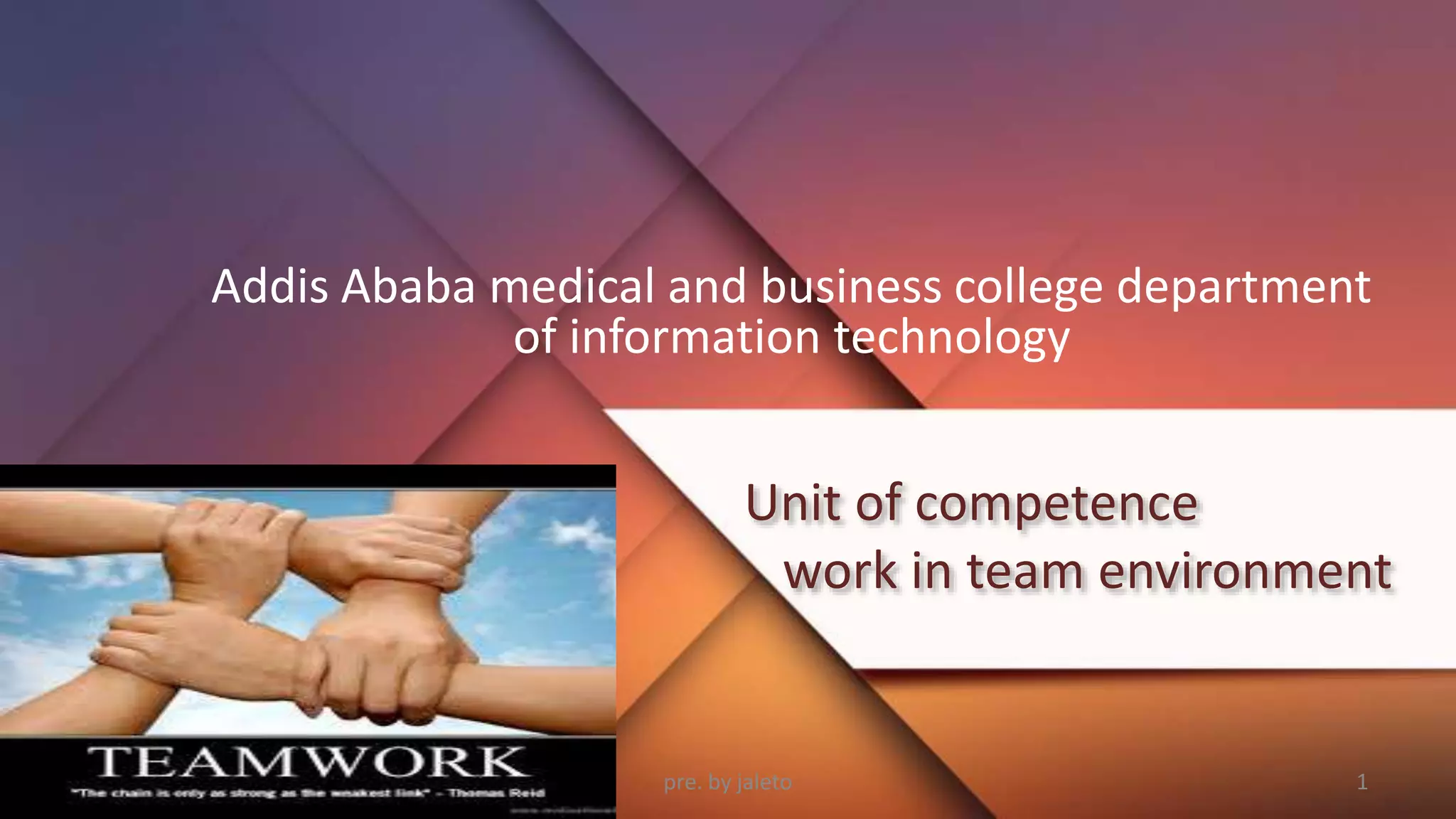
Unit of competence
work in team environment
Addis Ababa medical and business college department
of information technology
1
pre. by jaleto
introduction
• Identify role and objective of the team from available sources
of information.
• Identify team parameters, reporting relationships and
responsibilities from team discussions and appropriate
external sources
2
pre. by jaleto
Cont…
• These guidelines provide an overview of
three main aspects of group work. These
are:
• 1. Working as a team – overview of why
group work is important
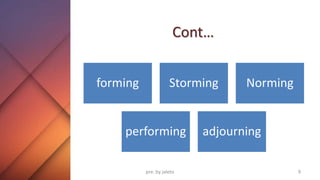
• 2. Stages in group development – forming,
storming, norming, performing and
mourning
• 3. Roles in groups – important behaviors in
effective teams
3
pre. by jaleto
. Working as a team
• Why work in teams? There are several
good reasons:
• Research shows that we all learn
effectively from each other. Hence, your
teams should be learning teams, with the
focus on helping each other to learn.
• Teams are much more effective than
individuals for work on complex projects.
4
pre. by jaleto
CONT…
• Why do some groups accomplish very little, while others
achieve much more?
• This difference stems very much from the processes
within the group - its inner dynamics or workings. The
features of an effective team include:
• combined group effort of all members
• Clear goals
• Group members focused on learning
• Mutual trust and support
• Open communication
• Democratic processes.
5
pre. by jaleto
Cont…
• Making the most of your team
• There are many advantages of working collaboratively
with other students. To make the most of your
experience as a team member, remember to:
• Become actively. Don't wait for another team member to
do all the work.
• Share - open communication and the contribution of ideas
and information is essential for successful and highly
performing teams.
• Learn to work cooperatively. The success of your team will
depend on helping each other.
6
pre. by jaleto
Cont…
Meet with your group members regularly.
• Ask your tutor for frequent feedback -
that's the tutor's role
 Maintain a sense of humour - keep
things in perspective.
• Hang in there - developing a good team
is hard work and demands commitment
from all team members.
7
pre. by jaleto
Group/ Team/ development
• There is strong evidence that
groups/Team/ pass through a sequence of
five stages of development. These are
sometimes defined as:
• Forming, or coming together
• Storming, or conflict
• Norming, or working out the rules
• Performing, or getting the job done
• Mourning, or breaking up
8
pre. by jaleto
Cont…
forming Storming Norming
performing adjourning
9
pre. by jaleto
Forming stage
• The forming stage involves a period of
orientation. Uncertainty is high during this
stage, and people are looking for leadership
and authority. A member who asserts
authority or is knowledgeable may be looked
to take control
• This stage is always coming together
10
pre. by jaleto
Storming stage
• This stage is the stage of conflict.
• The storming stage is the most difficult and critical stage
• to pass through. It is a period marked by conflict and
competition as individual personalities emerge. Team
performance may actually decrease in this stage because
energy is put into unproductive activities. Members may
disagree on team goals, and subgroups and cliques may form
around strong personalities or areas of agreement. To get
through this stage, members must work to overcome
obstacles, to accept individual differences, and to work
through conflicting ideas on team tasks and goals. Teams can
get bogged down in this stage. Failure to address conflicts may
result in long-term problems.
11
pre. by jaleto
Norming stage
• Set as a rule for team a members.
• If teams get through the storming stage,
conflict is resolved and some degree of unity
emerges. In the Norming stage, consensus
develops around who the leader or leaders
are, and individual member’s roles.
Interpersonal differences begin to be resolved,
and a sense of cohesion and unity emerges.
Team performance increases during this stage
as members learn to cooperate and begin to
focus on team goals.
12
pre. by jaleto
Performing stage
• In the performing stage, consensus and cooperation have
been well-established and the team is mature, organized, and
well-functioning.
• In this stage, group morale and loyalty are high, and the group
is characterized by trust, experience, intimacy, and
competence.
• There is a clear and stable structure, and members are
committed to the team’s mission. Problems and conflicts still
emerge, but they are dealt with constructively. (We will
discuss the role of conflict and conflict resolution in the next
section). The team is focused on problem solving and meeting
team goals.
13
pre. by jaleto
Adjourning stage
• In the adjourning stage, most of the team’s goals have
been accomplished. The emphasis is on wrapping up
final tasks and documenting the effort and results. As
the work load is diminished, individual members may
be reassigned to other teams, and the team disbands.
There may be regret as the team ends, so a ceremonial
acknowledgement of the work and success of the team
can be helpful. If the team is a standing committee with
ongoing responsibility, members may be replaced by
new people and the team can go back to a forming or
storming stage and repeat the development process.
14
pre. by jaleto
SMART
15
pre. by jaleto
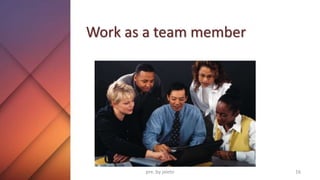
Work as a team member
16
pre. by jaleto
coaching
• coaching is a process that aims to improve
performance and focuses on the ‘here and
now’ rather than on the distant past or
future.
• While there are many different models of
coaching, here we are not considering the
‘coach as expert’ but, instead, the coach as
a facilitator of learning.
17
pre. by jaleto
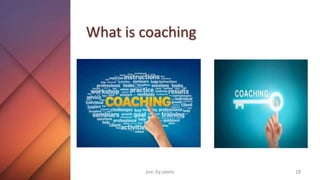
What is coaching
18
pre. by jaleto
Cont…
19
pre. by jaleto
What might be the purpose of the
coaching?
• The overall purpose of coaching may be one or more of
the following:
• To increase product knowledge
• To address a legally-imposed compliance requirement
• To increase workplace safety
• To reduce wastage
• To increase productivity
• To raise service delivery standards
• To change an existing skill to one required or preferred
by the employer
• To prepare the learner for extra duties, promotion or
additional responsibilities.
20
pre. by jaleto
BENEFITS OF TEAM WORK
• Effective teamwork has a number of benefits - to the
organization, to the team and, not least, to the individuals
within the team.
• The way that people work in teams is just as important as
their individual performance.
This includes their capacity not only to work within their own
team but also to have good inter-team relationships.
• Working in such an environment helps build high staff morale
and improved work performance.
21
pre. by jaleto
The end!
22
pre. by jaleto

Work in team environment

  • 1.
    Unit of competence workin team environment Addis Ababa medical and business college department of information technology 1 pre. by jaleto
  • 2.
    introduction • Identify roleand objective of the team from available sources of information. • Identify team parameters, reporting relationships and responsibilities from team discussions and appropriate external sources 2 pre. by jaleto
  • 3.
    Cont… • These guidelinesprovide an overview of three main aspects of group work. These are: • 1. Working as a team – overview of why group work is important • 2. Stages in group development – forming, storming, norming, performing and mourning • 3. Roles in groups – important behaviors in effective teams 3 pre. by jaleto
  • 4.
    . Working asa team • Why work in teams? There are several good reasons: • Research shows that we all learn effectively from each other. Hence, your teams should be learning teams, with the focus on helping each other to learn. • Teams are much more effective than individuals for work on complex projects. 4 pre. by jaleto
  • 5.
    CONT… • Why dosome groups accomplish very little, while others achieve much more? • This difference stems very much from the processes within the group - its inner dynamics or workings. The features of an effective team include: • combined group effort of all members • Clear goals • Group members focused on learning • Mutual trust and support • Open communication • Democratic processes. 5 pre. by jaleto
  • 6.
    Cont… • Making themost of your team • There are many advantages of working collaboratively with other students. To make the most of your experience as a team member, remember to: • Become actively. Don't wait for another team member to do all the work. • Share - open communication and the contribution of ideas and information is essential for successful and highly performing teams. • Learn to work cooperatively. The success of your team will depend on helping each other. 6 pre. by jaleto
  • 7.
    Cont… Meet with yourgroup members regularly. • Ask your tutor for frequent feedback - that's the tutor's role  Maintain a sense of humour - keep things in perspective. • Hang in there - developing a good team is hard work and demands commitment from all team members. 7 pre. by jaleto
  • 8.
    Group/ Team/ development •There is strong evidence that groups/Team/ pass through a sequence of five stages of development. These are sometimes defined as: • Forming, or coming together • Storming, or conflict • Norming, or working out the rules • Performing, or getting the job done • Mourning, or breaking up 8 pre. by jaleto
  • 9.
  • 10.
    Forming stage • Theforming stage involves a period of orientation. Uncertainty is high during this stage, and people are looking for leadership and authority. A member who asserts authority or is knowledgeable may be looked to take control • This stage is always coming together 10 pre. by jaleto
  • 11.
    Storming stage • Thisstage is the stage of conflict. • The storming stage is the most difficult and critical stage • to pass through. It is a period marked by conflict and competition as individual personalities emerge. Team performance may actually decrease in this stage because energy is put into unproductive activities. Members may disagree on team goals, and subgroups and cliques may form around strong personalities or areas of agreement. To get through this stage, members must work to overcome obstacles, to accept individual differences, and to work through conflicting ideas on team tasks and goals. Teams can get bogged down in this stage. Failure to address conflicts may result in long-term problems. 11 pre. by jaleto
  • 12.
    Norming stage • Setas a rule for team a members. • If teams get through the storming stage, conflict is resolved and some degree of unity emerges. In the Norming stage, consensus develops around who the leader or leaders are, and individual member’s roles. Interpersonal differences begin to be resolved, and a sense of cohesion and unity emerges. Team performance increases during this stage as members learn to cooperate and begin to focus on team goals. 12 pre. by jaleto
  • 13.
    Performing stage • Inthe performing stage, consensus and cooperation have been well-established and the team is mature, organized, and well-functioning. • In this stage, group morale and loyalty are high, and the group is characterized by trust, experience, intimacy, and competence. • There is a clear and stable structure, and members are committed to the team’s mission. Problems and conflicts still emerge, but they are dealt with constructively. (We will discuss the role of conflict and conflict resolution in the next section). The team is focused on problem solving and meeting team goals. 13 pre. by jaleto
  • 14.
    Adjourning stage • Inthe adjourning stage, most of the team’s goals have been accomplished. The emphasis is on wrapping up final tasks and documenting the effort and results. As the work load is diminished, individual members may be reassigned to other teams, and the team disbands. There may be regret as the team ends, so a ceremonial acknowledgement of the work and success of the team can be helpful. If the team is a standing committee with ongoing responsibility, members may be replaced by new people and the team can go back to a forming or storming stage and repeat the development process. 14 pre. by jaleto
  • 15.
  • 16.
    Work as ateam member 16 pre. by jaleto
  • 17.
    coaching • coaching isa process that aims to improve performance and focuses on the ‘here and now’ rather than on the distant past or future. • While there are many different models of coaching, here we are not considering the ‘coach as expert’ but, instead, the coach as a facilitator of learning. 17 pre. by jaleto
  • 18.
  • 19.
  • 20.
    What might bethe purpose of the coaching? • The overall purpose of coaching may be one or more of the following: • To increase product knowledge • To address a legally-imposed compliance requirement • To increase workplace safety • To reduce wastage • To increase productivity • To raise service delivery standards • To change an existing skill to one required or preferred by the employer • To prepare the learner for extra duties, promotion or additional responsibilities. 20 pre. by jaleto
  • 21.
    BENEFITS OF TEAMWORK • Effective teamwork has a number of benefits - to the organization, to the team and, not least, to the individuals within the team. • The way that people work in teams is just as important as their individual performance. This includes their capacity not only to work within their own team but also to have good inter-team relationships. • Working in such an environment helps build high staff morale and improved work performance. 21 pre. by jaleto
  • 22.