CLEAN AND MAINTAIN KITCHEN
EQUIPMENT AND UTENSILS
DEDY WIJAYANTO
Clean Kitchen Premises
 1.1 Identify the areas that may require cleaning in a kitchen premises
environment and the frequency of cleaning for each identified area
 1.2 Select appropriate cleaning utensils and chemicals
 1.3 Implement cleaning procedures in accordance with enterprise and
legislated requirements
 1.4 Identify and address cleaning and sanitizing needs that arise in
addition to scheduled cleaning requirements
 1.5 Store cleaning items and chemicals, and clean where applicable, after
cleaning has been completed
 1.6 Follow emergency first aid procedures in the event of a cleaning-
related incident or accident
Purpose of Food Safety Plan (FSP)
FSP Cleaning Schedule
The cleaning schedule will determine:
• When EVERYTHING is to be cleaned
• How it is to be clean
• Who is to clean
• How often everything will be cleaned
• What chemicals and equipment are to be used when cleaning
• Advice on OH&S equipment to be used when using cleaning chemicals
Identify areas to be cleaned
Areas to be cleaned
• Floor of the kitchen
• Workbenches fixed and/or mobile
• Storerooms, shelving, floor, walls and ceilings
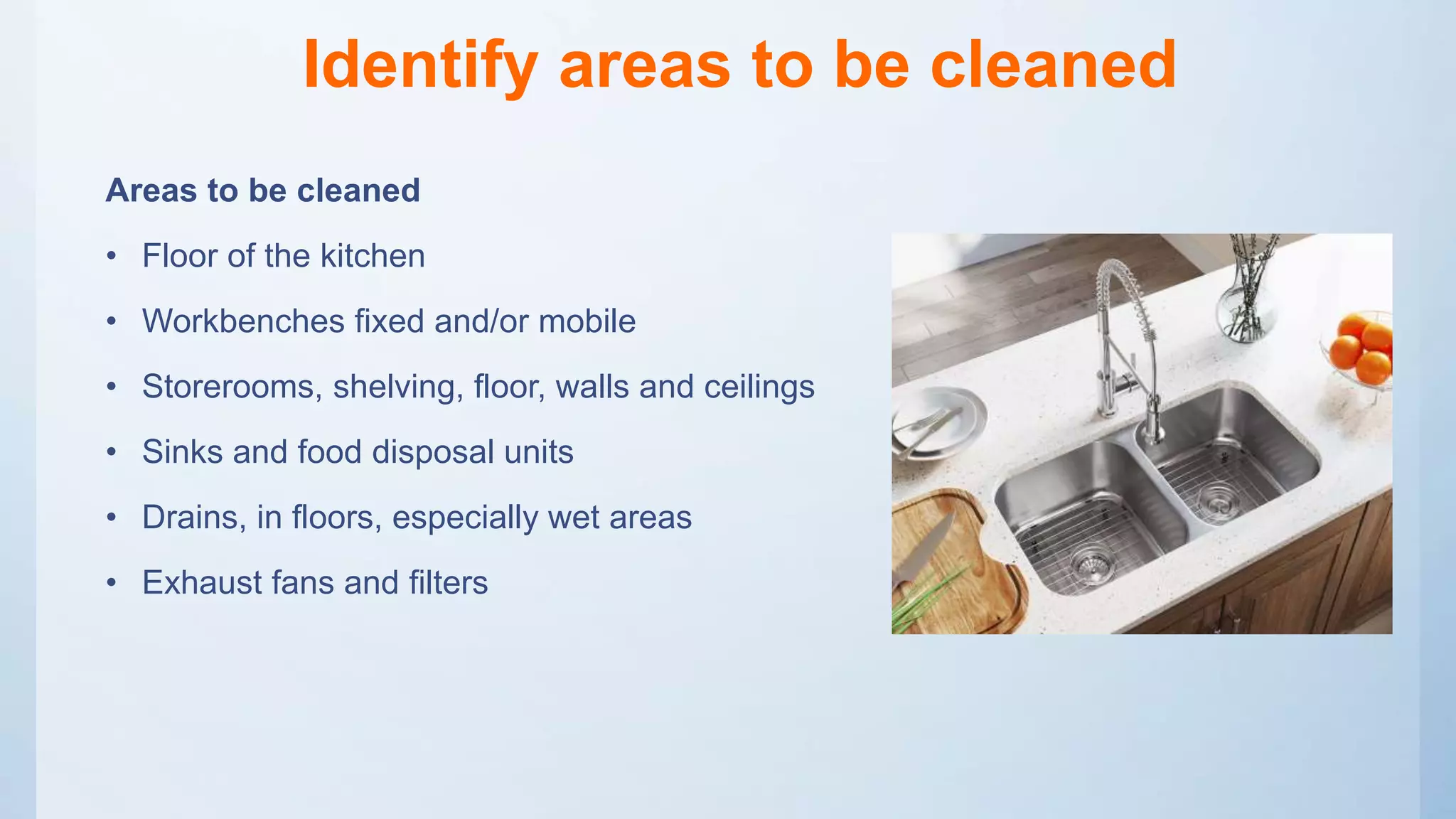
• Sinks and food disposal units
• Drains, in floors, especially wet areas
• Exhaust fans and filters
Identify areas to be cleaned
Areas to be cleaned
• Air conditioning outlets
• Light covers
• Staff change rooms
• Garbage storage areas
• Stock receiving areas
• Grease traps
• Walls
Select cleaning equipment
Types of equipment
Mops
Brooms and brushes
Cloths and sponges
Buckets
Protective gloves
Protective face masks
Warning signs
Select cleaning equipment
Types of equipment
• Garbage receptacles
• Vacuum cleaners
• Scrubbing machines
Select cleaning equipment
Personal Protective Equipment
• Hand gloves
 Eye goggles
 Aprons
 Footwear
 Airways Protection
Chemicals
Chemicals used for cleaning in food areas
• General detergent
• Dishwasher detergent
• Floor cleaner
• Drain cleaner
• Bleach
• Oven cleaner
• Grill cleaner
• Sanitisers
Principles of cleaning
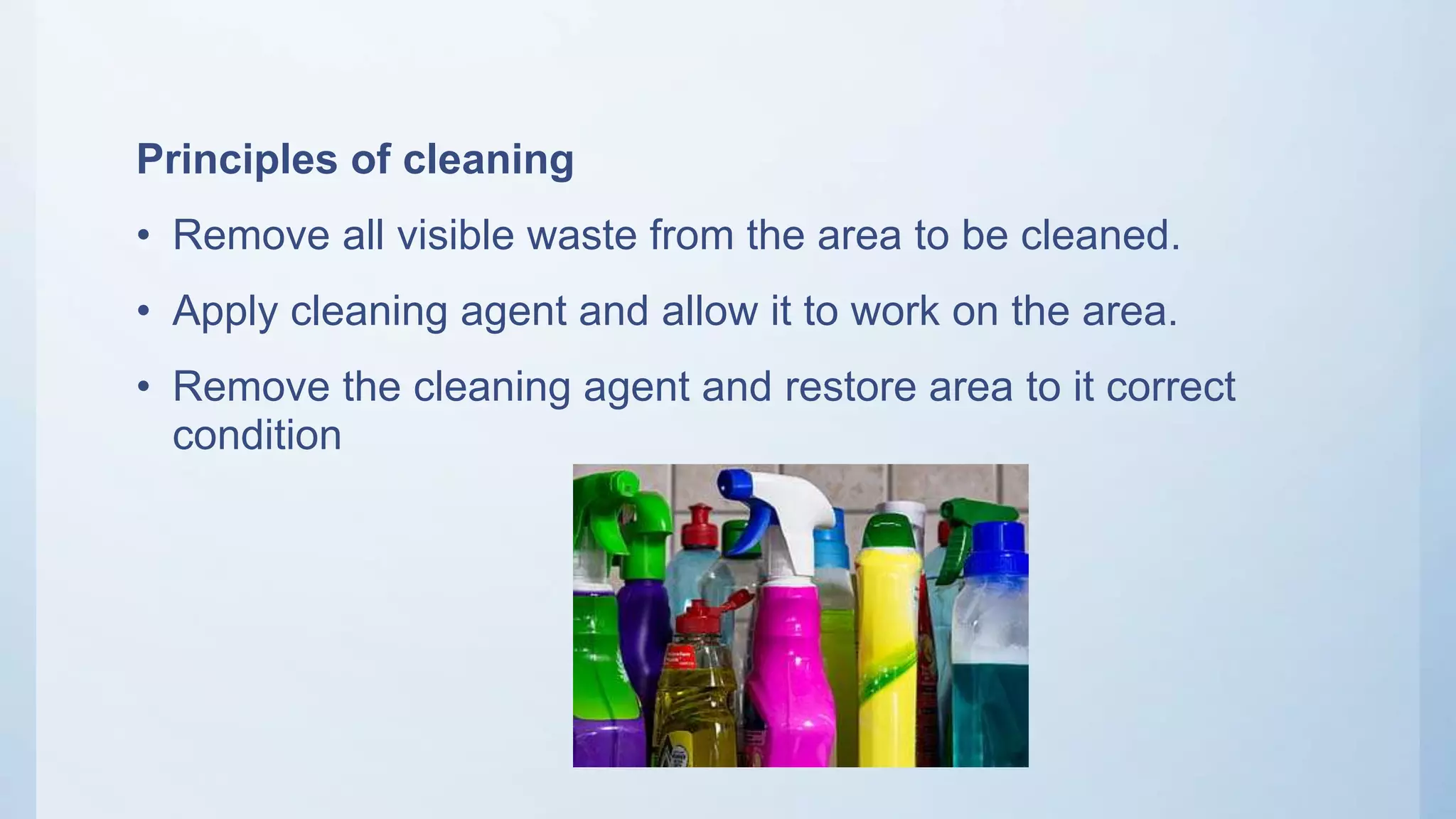
• Remove all visible waste from the area to be cleaned.
• Apply cleaning agent and allow it to work on the area.
• Remove the cleaning agent and restore area to it correct
condition
Process of cleaning
Principles of cleaning
• Remove all visible waste from the area to be cleaned.
• Apply cleaning agent and allow it to work on the area.
• Remove the cleaning agent and restore area to it correct
condition
Implement cleaning procedures
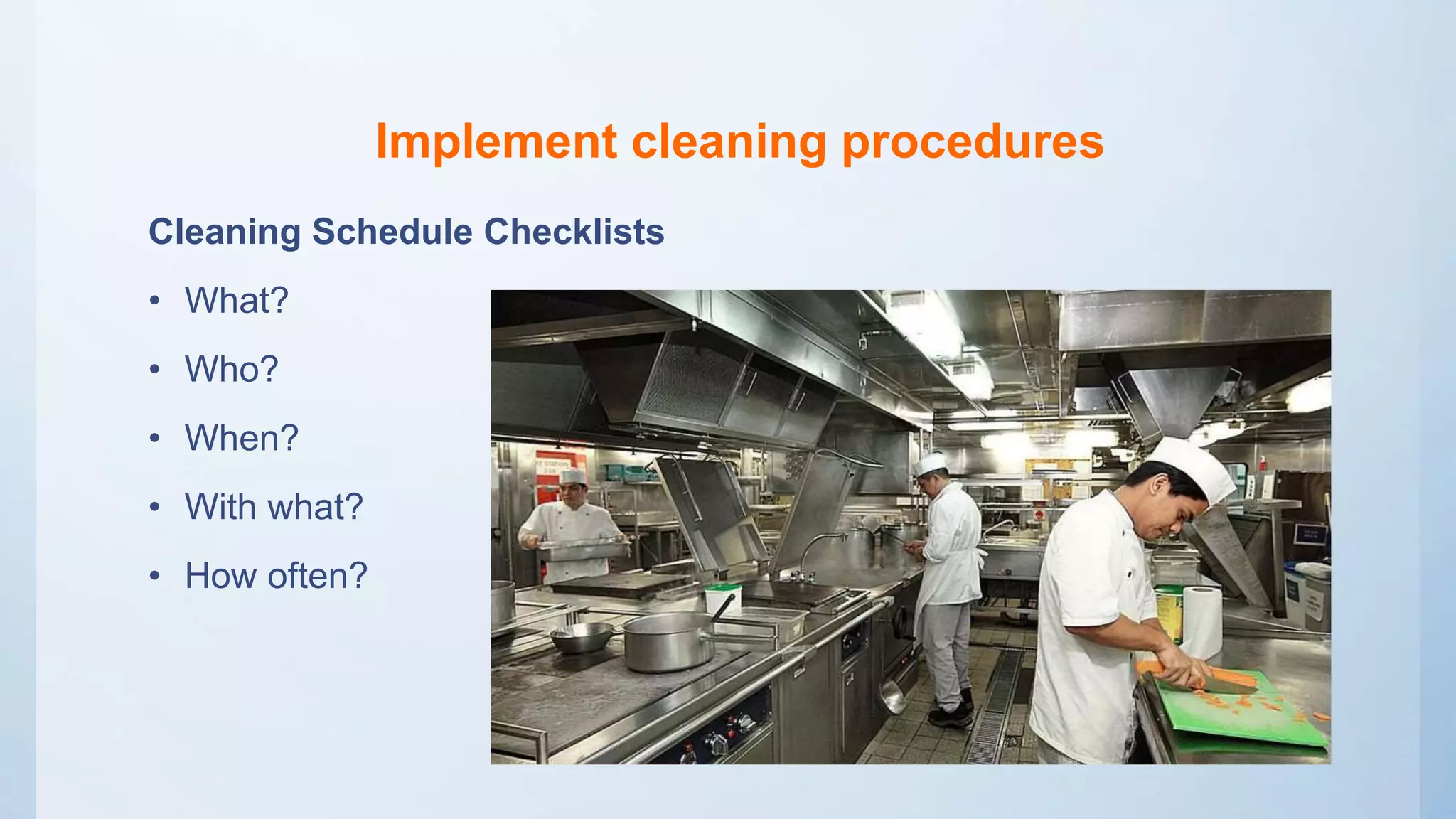
Cleaning Schedule Checklists
• What?
• Who?
• When?
• With what?
• How often?
Implement cleaning procedures
Material safety data sheet (MSDS)
A material safety data sheet (MSDS) is an important aspect of
occupational safety and health:
• What information is contained within a MSDS?
Material safety data sheet (MSDS)
• Physical data
• Toxicity or potential hazards
• Health effects
• Procedures for safe use
• First aid
Material safety data sheet (MSDS)
• Reactivity
• Storage
• Disposal
• Protective equipment
• Spill-handling procedures
Workbenches
• Remove any materials that are visible
• Wash with hot water with detergent
• Hot water is to soften any fats and the detergent will help remove the fats
• Scour with cloth or fibrous material to break up debris that is adhered to surface
• Rinse with hot water
• Allow surface to air dry
• Apply sanitiser and use to manufacturers’ instruction on MSDS sheet
Cleaning steps
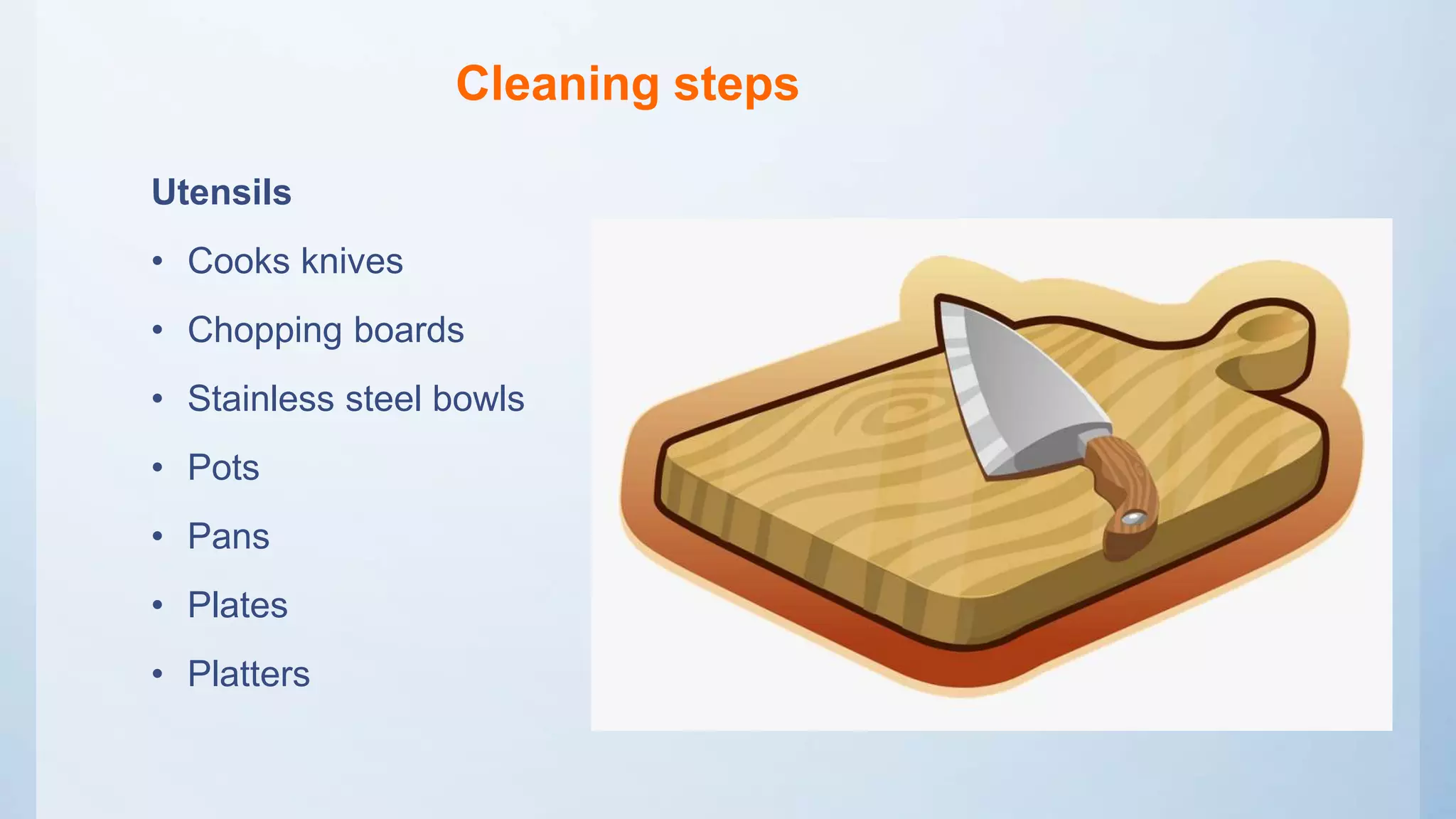
Utensils
• Cooks knives
• Chopping boards
• Stainless steel bowls
• Pots
• Pans
• Plates
• Platters
Floors
• These will need to be cleaned on a daily basis.
• Basic cleaning will be sweeping once or twice a day.
• Floors in food production will have to be cleaned more
regularly
Storage areas
• Cool storage -
refrigeration
• Freezer Storage
• Dry stores
Sinks
• Hand washing sinks
• Food washing sinks
• General purpose cleaning sinks
• Floor washing sink
Drains
• Covers removed
• Washed and sanitised
• Any trapped debris removed before cleaning
• If drains are cleaned on regular basis there is no need to dry them
• They will air dry
Walls of food production areas
• These will need to be cleaned as needed
• Cleaned on a weekly or fortnightly basis as stated in FSP
• Higher than this can be cleaned on a 3 month cycle or as needed
Air filters and vents
• Over stoves and ovens
• Air conditioning
• Air flow vents in walls
Staff change rooms
• While this is not as higher priority as the food production area it is still an area
that needs to be checked and cleaned regularly, daily
• Staff might leave food there
• Possible infestation of pests of some type
• Smells tend to build
Garbage bins and Garbage storage areas
• Use plastic liners
• Wash bins every time they are emptied
• Cleaned on a daily basis
• Allowed to air dry
• Relined with clean plastic liner
• Lid replaced
Work Instruction or Job Safety Analysis Sheets
A Work Instruction (WI), Job Safety Analysis (JSA) or SOP (Standard Operating
Procedure) may be provided by the employer to assist in cleaning and in the
application of chemicals:
• What information is provided?
• Where can these sheets be accessed?
Additional cleaning required
Breakages
• Unexpected and not part of cleaning schedule
• Immediate response required
Spillages
• Unexpected and not part of cleaning schedule
• Immediate response required
Allowances have to be made to all schedules for the unexpected.
Store cleaning items
Condition
• Clean ready for later use
Position
• Close to the kitchen
Responsibility
• Last person to use
Store cleaning chemicals
Condition
• Secured in container it was delivered
Position
• Chemical storage area
• Sealed
Responsibility
• Last person to use
General storage conditions
Keep in a storeroom away from other products
A register should be maintained to record items
The store room must be well lit and ventilated
The room should only be used for storing chemicals
Heavy containers must be stored on lower shelves
Keep containers well sealed and labelled
General storage conditions
• Have MSDS and first aid directions posted in the area
• First aid resources to support possible treatment requirements
• Keep away from a naked flame or excessive heat
• Product usage charts should be close to the chemicals for easy and clear
reference purposes
• Instructions for safe chemical handling must be poste
• Necessary PPE should be present
General storage conditions
• Never store chemicals or cleaning agents in food containers
• Never store chemicals with food
• Do not allow customers to come into
contact with chemicals
• Never mix chemicals together
• Ensure measuring devices for chemicals are not used for
any other purpose.
Emergency first aid procedures
Emergency first aid procedures may include:
• Notifying internal first aid officers of emergencies
• Contacting external emergency services for assistance
• Administering basic first aid for minor cuts, bruises, abrasions, burns
and scalds
Additional requirements:
• Material Safety Data Sheets
• Internal First Aid officers
• Correct use and storage of chemicals
• Applying appropriate first aid measures in emergency situation
• International language signage
• Photo signage and instructions
Condition
• Fully stocked
Position
• Easy access to staff
Responsibility
• Enterprise
Summary:
• Identify Areas to be cleaned
• Cleaning utensils to be used
• Chemicals to be used
• Cleaning procedures
• Additional cleaning
• Store cleaning equipment
• Emergency First Aid
Clean and maintain kitchen equipment and utensils

Clean and maintain kitchen equipment and utensils

  • 1.
    CLEAN AND MAINTAINKITCHEN EQUIPMENT AND UTENSILS DEDY WIJAYANTO
  • 2.
    Clean Kitchen Premises 1.1 Identify the areas that may require cleaning in a kitchen premises environment and the frequency of cleaning for each identified area  1.2 Select appropriate cleaning utensils and chemicals  1.3 Implement cleaning procedures in accordance with enterprise and legislated requirements  1.4 Identify and address cleaning and sanitizing needs that arise in addition to scheduled cleaning requirements  1.5 Store cleaning items and chemicals, and clean where applicable, after cleaning has been completed  1.6 Follow emergency first aid procedures in the event of a cleaning- related incident or accident
  • 3.
    Purpose of FoodSafety Plan (FSP) FSP Cleaning Schedule The cleaning schedule will determine: • When EVERYTHING is to be cleaned • How it is to be clean • Who is to clean • How often everything will be cleaned • What chemicals and equipment are to be used when cleaning • Advice on OH&S equipment to be used when using cleaning chemicals
  • 4.
    Identify areas tobe cleaned Areas to be cleaned • Floor of the kitchen • Workbenches fixed and/or mobile • Storerooms, shelving, floor, walls and ceilings • Sinks and food disposal units • Drains, in floors, especially wet areas • Exhaust fans and filters
  • 5.
    Identify areas tobe cleaned Areas to be cleaned • Air conditioning outlets • Light covers • Staff change rooms • Garbage storage areas • Stock receiving areas • Grease traps • Walls
  • 6.
    Select cleaning equipment Typesof equipment Mops Brooms and brushes Cloths and sponges Buckets Protective gloves Protective face masks Warning signs
  • 7.
    Select cleaning equipment Typesof equipment • Garbage receptacles • Vacuum cleaners • Scrubbing machines
  • 8.
    Select cleaning equipment PersonalProtective Equipment • Hand gloves  Eye goggles  Aprons  Footwear  Airways Protection
  • 9.
    Chemicals Chemicals used forcleaning in food areas • General detergent • Dishwasher detergent • Floor cleaner • Drain cleaner • Bleach • Oven cleaner • Grill cleaner • Sanitisers
  • 10.
    Principles of cleaning •Remove all visible waste from the area to be cleaned. • Apply cleaning agent and allow it to work on the area. • Remove the cleaning agent and restore area to it correct condition
  • 11.
    Process of cleaning Principlesof cleaning • Remove all visible waste from the area to be cleaned. • Apply cleaning agent and allow it to work on the area. • Remove the cleaning agent and restore area to it correct condition
  • 12.
    Implement cleaning procedures CleaningSchedule Checklists • What? • Who? • When? • With what? • How often?
  • 13.
    Implement cleaning procedures Materialsafety data sheet (MSDS) A material safety data sheet (MSDS) is an important aspect of occupational safety and health: • What information is contained within a MSDS?
  • 14.
    Material safety datasheet (MSDS) • Physical data • Toxicity or potential hazards • Health effects • Procedures for safe use • First aid
  • 15.
    Material safety datasheet (MSDS) • Reactivity • Storage • Disposal • Protective equipment • Spill-handling procedures
  • 16.
    Workbenches • Remove anymaterials that are visible • Wash with hot water with detergent • Hot water is to soften any fats and the detergent will help remove the fats • Scour with cloth or fibrous material to break up debris that is adhered to surface • Rinse with hot water • Allow surface to air dry • Apply sanitiser and use to manufacturers’ instruction on MSDS sheet
  • 17.
    Cleaning steps Utensils • Cooksknives • Chopping boards • Stainless steel bowls • Pots • Pans • Plates • Platters
  • 18.
    Floors • These willneed to be cleaned on a daily basis. • Basic cleaning will be sweeping once or twice a day. • Floors in food production will have to be cleaned more regularly
  • 19.
    Storage areas • Coolstorage - refrigeration • Freezer Storage • Dry stores
  • 20.
    Sinks • Hand washingsinks • Food washing sinks • General purpose cleaning sinks • Floor washing sink
  • 21.
    Drains • Covers removed •Washed and sanitised • Any trapped debris removed before cleaning • If drains are cleaned on regular basis there is no need to dry them • They will air dry
  • 22.
    Walls of foodproduction areas • These will need to be cleaned as needed • Cleaned on a weekly or fortnightly basis as stated in FSP • Higher than this can be cleaned on a 3 month cycle or as needed
  • 23.
    Air filters andvents • Over stoves and ovens • Air conditioning • Air flow vents in walls
  • 24.
    Staff change rooms •While this is not as higher priority as the food production area it is still an area that needs to be checked and cleaned regularly, daily • Staff might leave food there • Possible infestation of pests of some type • Smells tend to build
  • 25.
    Garbage bins andGarbage storage areas • Use plastic liners • Wash bins every time they are emptied • Cleaned on a daily basis • Allowed to air dry • Relined with clean plastic liner • Lid replaced
  • 26.
    Work Instruction orJob Safety Analysis Sheets A Work Instruction (WI), Job Safety Analysis (JSA) or SOP (Standard Operating Procedure) may be provided by the employer to assist in cleaning and in the application of chemicals: • What information is provided? • Where can these sheets be accessed?
  • 27.
    Additional cleaning required Breakages •Unexpected and not part of cleaning schedule • Immediate response required Spillages • Unexpected and not part of cleaning schedule • Immediate response required Allowances have to be made to all schedules for the unexpected.
  • 28.
    Store cleaning items Condition •Clean ready for later use Position • Close to the kitchen Responsibility • Last person to use
  • 29.
    Store cleaning chemicals Condition •Secured in container it was delivered Position • Chemical storage area • Sealed Responsibility • Last person to use
  • 30.
    General storage conditions Keepin a storeroom away from other products A register should be maintained to record items The store room must be well lit and ventilated The room should only be used for storing chemicals Heavy containers must be stored on lower shelves Keep containers well sealed and labelled
  • 31.
    General storage conditions •Have MSDS and first aid directions posted in the area • First aid resources to support possible treatment requirements • Keep away from a naked flame or excessive heat • Product usage charts should be close to the chemicals for easy and clear reference purposes • Instructions for safe chemical handling must be poste • Necessary PPE should be present
  • 32.
    General storage conditions •Never store chemicals or cleaning agents in food containers • Never store chemicals with food • Do not allow customers to come into contact with chemicals • Never mix chemicals together • Ensure measuring devices for chemicals are not used for any other purpose.
  • 33.
    Emergency first aidprocedures Emergency first aid procedures may include: • Notifying internal first aid officers of emergencies • Contacting external emergency services for assistance • Administering basic first aid for minor cuts, bruises, abrasions, burns and scalds
  • 34.
    Additional requirements: • MaterialSafety Data Sheets • Internal First Aid officers • Correct use and storage of chemicals • Applying appropriate first aid measures in emergency situation • International language signage • Photo signage and instructions
  • 35.
    Condition • Fully stocked Position •Easy access to staff Responsibility • Enterprise
  • 36.
    Summary: • Identify Areasto be cleaned • Cleaning utensils to be used • Chemicals to be used • Cleaning procedures • Additional cleaning • Store cleaning equipment • Emergency First Aid