First aid for fracture
-Anushka Ninama
  What is fracture?
• A broken or cracked bone
• Occurs when pressure is
applied to bone 
• Occurs with / without
displacement of bone
fragments
Causes of fracture
•Direct force
•Indirect force
•Force of muscular
action
•Force of ligaments
    Types
• Open fracture: Skin breaks
causing open wound
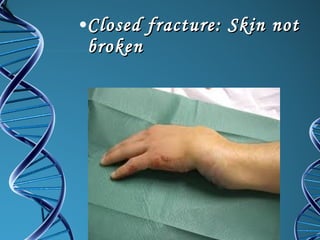
•Closed fracture: Skin not
broken 
• Complicated fractures: Damage
of adjacent organs
• Stress fracture: Hairline crack due
to repeated stress
• Greenstick fracture: In
children's flexible bones
Classification
    Symptoms
•Severe pain 
•Difficulty in movement
•Swelling/ bruising /
bleeding 
•Deformity / abnormal
twist of limb
•Tenderness on applying
First-aid
•Depends on type &
location of fracture
For open fractures
•Control bleeding
before treatment
•Rinse and dress the
wound
For open / closed fractures
• Check the breathing 
• Calm the person 
• Examine for other injuries
• Immobilize the broken
wound 
• Apply ice to reduce pain /
swelling
• Consult a doctor 
Using bandages
•Do not apply over the
fracture
•Bandaging should be
fairly firm
•Place padding
material
Using splints
• Rigid enough
• Wide enough
• Should be long enough
• Well padded
• Best applied over the
clothing
• Raise the injured part
    DO NOT
•Massage the affected
area
•Straighten the broken
bone 
•Move without support to
broken bone
•Move joints above /
Prevention
•Wear protective pads /
helmets when driving
•Teach children / practice,
safe habits
Aims of first-aid
•To prevent further
damage
•To reduce pain
• To make patient
comfortable
•To get medical aid at
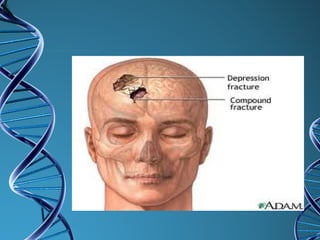
Skull fracture
• Damage to bone may not
appear to be significant
• Fracture crown of the skull
caused by a direct blow
• Fracture base of the skull
caused by indirect force
Recognition
•Wound or bruise on the
head.
•Soft area or depression
on the scalp.
•Bruising or swelling
behind one ear.
•Bruising around one or
both eyes.
•Clear fluid or watery
blood coming from the
nose or an ear.
•Blood in the white of
the eye.
•Distortion or lack of
symmetry of the head or
face.
•Progressive
Your aims
•To maintain an open
airway.
•To arrange urgent
removal of the casualty
to hospital.
Treatment
If the casualty is conscious:
• Help them to lie down.
• Do not turn the head in case
there is a neck injury.
• Control any bleeding from the
scalp by applying pressure
around the wound.
• Look for and treat any other
•If there is discharge
from an ear, cover the
ear with a sterile
dressing or clean pad,
lightly secured with a
bandage. Do not plug
the ear.
•Monitor and record
vital signs - level of
response, pulse, and
If the casualty is unconscious:
• Open the airway using the jaw
thrust method and check for
breathing
• Be prepared to give chest
compressions and rescue
breaths if needed.
• If the position in which the
casualty was found prevents
maintenance of an open airway
or you fail to open it using the
Spine fracture
• # Spine is very serious
injury.
• Damage to the spinal cord
can result in loss of power
and sensation in the parts
below the injured area.
• A mild injury can be made
worse by incorrect
RECOGNITION
• Casualty may inform that
tenderness around the affected
part of the back.
• Can feel shooting pains or
electric shocks in limbs and
around the back.
• Is unable to feel or move legs
if the injury is in the lower
back or to move any limb at all
Treatment

• Advice the casualty not to
move.
• Support the head in the neutral
position by placing your hands
over his ears, and use rolled-up
coats or blankets to protect
and splint the head, neck and
shoulders.
• Cover the casualty with a
blanket.
IMPORTANT
• Do not move the casualty
unless life is in danger.
• Unconscious casualty with
spinal injury must be placed in
the RECOVERY POSITION,
to protect the airway.
• The position should be modified
to keep the head and trunk
aligned at all times.
Jaw fracture
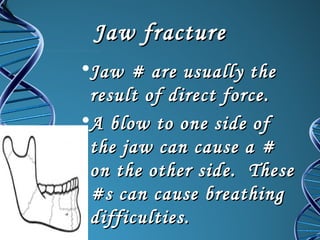
•Jaw # are usually the
result of direct force.
•A blow to one side of
the jaw can cause a #
on the other side. These
#s can cause breathing
difficulties.
RECOGNITION
• The casualty finds it
difficulty to speak, chew or
swallow without increased
pain.
• There may be dribbling and
blood stained saliva if there is
a mouth wound.
• Displaced teeth in the mouth.
• Swelling and /or unevenness
Treatment
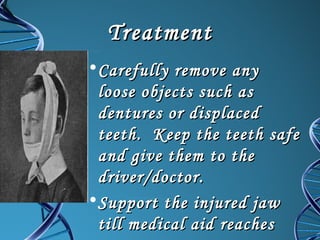
• Carefully remove any
loose objects such as
dentures or displaced
teeth. Keep the teeth safe
and give them to the
driver/doctor.
• Support the injured jaw
till medical aid reaches
IMPORTANT
If the casualty is seriously
injured or unconscious but
breathing normally, Place
the casualty in RECOVERY
POSITION with the
injured side down and a
soft pad under the head to
keep the weight off the
COLLAR BONE
•# collar bone (clavicle)
is due to a fall on to an
out-stretched hand
where the force is
transmitted along the
forearm and upper arm
to the collar bone.
RECOGNITION
• The casualty supports her
arm on the injured side and
inclining the head towards
the injury to relieve the
pain.
• The casualty is reluctant to
move the arm on the injured
side.
Treatment
• Help the casualty position
his arm on the injured side
so that his fingertips are
almost resting on the
opposite shoulder.
• Support the arm in an
elevation sling and place
soft padding between upper
arm and chest.
•Secure the limb to
the casualty’s chest
by applying a broadfold bandage over
the sling and right
around the body.
•Take the casualty to
the hospital.
Upper limb fracture
• Pain, tenderness, inability
to use the arm, deformity,
swelling and possible
bruising.
• The casualty is probably
supporting the hand,
forearm, and elbow of the
injured arm with the other
Treatment
• If possible gently bend the
casualty’s arm at the elbow
so that his forearm is
across his chest and place
soft padding between the #
site and the body.
• Support the arm with an
arm sling.
•For additional support,
secure the casualty’s arm
to his trunk by applying
a broad-fold bandage
right around his arm and
trunk.. Avoid # site.
•Take the casualty to the
hospital.
IMPORTANT
• Never bend the arm
forcefully.
• Check the circulation after
bandaging by looking at
the fingers; Relax the sling
if necessary.
If the arm can not be bent
•Help the casualty to
lie down with his arm
by his side or wherever
it is most comfortable
for him.
•Carefully place soft
padding between the
injured limb and the
casualty’s body and
apply three broad-fold
bandages around the
arm and the body,
avoiding the # site.
Ribs fracture
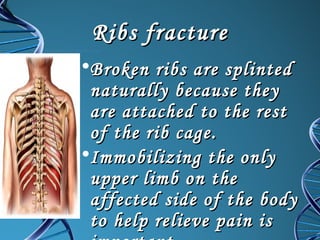
•Broken ribs are splinted
naturally because they
are attached to the rest
of the rib cage.
•Immobilizing the only
upper limb on the
affected side of the body
to help relieve pain is
RECOGNITION
• Features of # can be noticed.
• The casualty may tell you that
he feels very sharp pain in his
side, worsened by deep breaths
or coughing.
• Highly tender area around the
affected ribs.
• He can hear a crackling
sound.
Treatment
•Help the casualty
to sit down and
support the arm on
his injured side in
an arm sling.
•If breathing is
affected
•Help the casualty
into a half sitting
position so that he is
leaning towards his
injured side.
•Support the arm on
the injured side with
IMPORTANT
•Chest injuries
involving damage to
several ribs or the
lungs are more serious
and require urgent
medical attention
because there may be
Pelvis fracture
• #Pelvis must be handled with
great care because there may be
internal injuries.
• The casualty may tell that she is
unable to move the lower part of
her body without extreme pain
and that the area around pelvis is
tender and uncomfortable.
• Unable to stand.
• If # is complicated, urine may be
blood stained or signs of internal
Treatment
• Help the casualty to lie on his
back with legs straight or with
knees slightly bent with a cushion
under them, the most comfortable
position.
• Place some soft padding between
the knees and ankles.
• Tie the feet and ankles together
with a narrow –fold bandage, and
place a broad-fold bandage around
Lower limb fracture
• Pain, swelling, loss of
mobility and shock.
• If # is below the knee – the
foot may have fallen to one
side although knee is
straight.
• If # is above the knee the
limb may look shorter or the
Treatment
•Steady and support
the limb if necessary
get an assistant and
treat the wounds.
•Holding the ankle and
foot, apply gentle
traction, carefully
pulling in the long axis
of the limb to bring it
into its normal line.
•Continue supporting
and using the natural
hollows, place
bandages at the knees,
above and below the
#site and under
ankles.
•Bring the sound limb
alongside and place soft
padding between the legs
so that bandages do not
displace the bones.
•Tie the knots on the
uninjured side, starting
at the ankles, knee and
below the # site.
Important
•When traction is
being applied, if any
resistance is felt,
stop immediately.
Never leave a
casualty’s lower limb
Femur fracture
• Steady and support the limb and
treat any wounds.
• Apply and maintain gentle
traction by holding the casualty’s
knee. Bring the injured leg into a
straight line by pulling in the long
axis of the limb from the ankle.
• Support the injured leg at the
ankle and using the natural
hollows gently place the bandages
under the casualty’s legs at the
knees, above and below the # and
under the ankles.
Knee fracture
• The knee cap can be broken by
a direct blow or split by
violent muscular pull from
thigh muscles.
• All knee injuries are painful
and it may be difficult to tell
whether a person has a broken
knee cap or has damaged
cartilage or ligament.
Recognition
• The general features of # are
present.
• The casualty may tell that the
knee is extremely painful, and
unable to lift the leg or foot
off the ground.
• You may notice that the knee
is bent and any attempt to
straighten it increases the
Treatment
• Help the casualty lie down and
steady the leg in the position the
casualty finds the most
comfortable. Place a small pillow
in the hollow under the knee and
around the knee.
• Bandaging is not essential but the
casualty may find it more
comfortable. Bandage the knee
with cotton wool padding and
Important
•Do not force the
leg straight.
Dislocation
• A dislocation is a separation
of two bones where they meet
at a joint. (Joints are areas
where two bones come
together.) A dislocated bone
is no longer in its normal
position, which may result in
damage to ligaments, nerves,
and blood vessels.
Dislocation
• A dislocation is a separation
of two bones where they meet
at a joint. (Joints are areas
where two bones come
together.) A dislocated bone is
no longer in its normal
position, which may result in
damage to ligaments, nerves,
and blood vessels.
Joints
• Junction of two or more
bones
• Immovable joints ; fused
together
• Movable joints 3 types• 1) ball and socket joints
Considerations
•It may be hard to tell a
dislocated bone from a
broken bone. Both are
emergency situations
and require the same
first aid treatment.
• Most dislocations, if treated
early, will not result in
permanent injury.
• Injuries to the surrounding
ligaments generally take 3 - 6
weeks to heal. Sometimes,
surgery to repair a torn
ligament is needed.
• Injuries to nerves and blood
vessels may result in more
long-term or permanent
Important
• Once a joint has been
dislocated, it is more likely
to happen again. Follow-up
with an orthopedic surgeon
is recommended after a
dislocation.
Causes
•Dislocations are
usually caused by a
sudden impact to the
joint. This usually
occurs following a
blow, fall, or other
trauma.
Symptoms
• Accompanied by numbness or
tingling at the joint or
beyond it
• Intensely painful, especially
if you try to use the joint or
bear weight on it
• Limited in movement
• Swollen or bruised
• Visibly out of place,
•

Treatment

check the airway, breathing, and
circulation. If necessary, begin
rescue breathing , CPR , or
bleeding control.
• Do not move the person if you
think that the head, back, or leg
has been injured.
• If the skin is broken, take steps
to prevent infection. Do not
blow on the wound. Rinse the
area gently to remove obvious
• Splint or sling the injury
in the position in which
you found it. Do not move
the joint. Be sure to
immobilize the area above
and below the injured
joint.
• Check the blood
circulation.
• Apply ice packs to ease
Do not
• move the person unless the
injury has been completely
immobilized.
• move a person with an
injured hip, pelvis, or
upper leg unless it is
absolutely necessary. If
you are the only rescuer
Continued …….
• attempt to straighten a
misshapen bone or joint or
to change its position.
• test a misshapen bone or
joint for loss of function.
• give the person anything
by mouth.
Prevention
• Preventing injuries in children:
• Create a safe environment around
your home.
• Pay careful attention to
preventing falls by gating
stairways and keeping windows
closed and locked.
• Supervise children carefully. There
is no substitute for close
supervision no matter how safe the
environment or situation appears
to be.
• Preventing dislocations in
adults:
• Avoid falls by not standing
on chairs, countertops, or
other unstable objects.
• Eliminate throw rugs,
especially for the elderly.
• Wear protective gear when
participating in contact
sports.
Shoulder dislocation
•The shoulders are the
most common joint in the
body to dislocate. The
arm is moved away from
the body (abducted) and
externally rotated
(turning the forearm,
Symptoms
• The main symptom of a
shoulder dislocation is severe
pain at the shoulder joint.
• The patient will have great
difficulty moving your arm
even a little bit.
• If the shoulder is touched from
the side, it feels mushy, as if
the underlying bone is gone
Treatment
• If a sling is not available,
rig one by tying a long piece
of cloth in a circle (a bed
sheet or towel may do
nicely).
• A pillow placed between
the arm and body may also
help support the injured
Hip dislocation
•Causes
•High-speed motor vehicle
collisions (MVCs) are by
far the leading cause of
hip dislocations. Falls
from significant height
and sports-related injury
are also among the top
causes. 
Recognition
•Posterior: The hip is
flexed, internally
rotated, and adducted.
•Anterior: The hip is
minimally flexed,
externally rotated and
markedly abducted
• Patients with a hip dislocation
have severely limited range of
motion. 
• movements are extremely
painful & restricted
•
Treatment
• Don't delay medical
care.
• Don't move the joint.
• Put ice on the injured
joint
Elbow Dislocation
•The elbow joint, formed
where these 3 bones meet,
becomes dislocated, or
out of joint.
Causes
•usually a fall
Symptoms
• Severe pain in the elbow,
swelling, and inability to
bend your arm are all signs of
an elbow dislocation.
• In some cases, you may lose
feeling in your hand or no
longer have a pulse (can't
feel your heartbeat in your
wrist).
• Arteries and nerves run by
your elbow, so it is possible
Treatment
•put ice on the elbow
•check pulse.
•Check If any feeling of
numbness results, see a
doctor immediately.
Sprains
•The ligaments are
anchored to bone on
each side of the joint. If
a ligament is stretched
or torn, the injury is
called a sprain.
Symptoms
•Pain
•Swelling
•Bruise
•Difficulty to move the
joint
Treatment

• RICE
• Rest the injured part. Pain is
the body's signal to not move an
injury.
• Ice the injury. This will limit
the swelling and help with the
spasm.
• Compress the injured area. This
again, limits the swelling. Be
careful not to apply a wrap so
tightly that it might act as a
tourniquet and cut off the blood
supply.
• Elevate the injured part. This
Strains
• A strain occurs when the muscle
tendon unit is stretched or torn.
The most common reason is the
overuse and stretching of the
muscle. The damage may occur in
three areas:
The muscle itself may tear.
The area where the muscle and
tendon blend can tear.
The tendon may tear partially or
Symptoms
• Pain
• Spasm
• Swelling
Treatment
• RICE
Cramps
• Cramp is a sudden ,
involuntary & painful
contraction of muscle or
group of muscles.
Causes
• Poor muscle co-ordination
during exercise
• Chilling following or during
exercise
• Loss of salts in sweating
• Diarrhoea or persistent
vomiting
• During sleep
• Anaerobic metabolism of
Symptoms
• Pain
• Feeling of tightness in the
affected area
• Contracted muscles cannot
relax
Treatment
• Straighten the affected part of
the body
• Massage
First aid for fracture

First aid for fracture

  • 1.
    First aid forfracture -Anushka Ninama
  • 2.
      What isfracture? • A broken or cracked bone • Occurs when pressure is applied to bone  • Occurs with / without displacement of bone fragments
  • 3.
    Causes of fracture •Directforce •Indirect force •Force of muscular action •Force of ligaments
  • 4.
        Types • Openfracture: Skin breaks causing open wound
  • 5.
  • 6.
    • Complicated fractures:Damage of adjacent organs
  • 7.
    • Stress fracture:Hairline crack due to repeated stress
  • 8.
    • Greenstick fracture:In children's flexible bones
  • 9.
  • 10.
        Symptoms •Severe pain  •Difficultyin movement •Swelling/ bruising / bleeding  •Deformity / abnormal twist of limb •Tenderness on applying
  • 11.
    First-aid •Depends on type& location of fracture
  • 12.
    For open fractures •Controlbleeding before treatment •Rinse and dress the wound
  • 13.
    For open /closed fractures • Check the breathing  • Calm the person  • Examine for other injuries • Immobilize the broken wound  • Apply ice to reduce pain / swelling • Consult a doctor 
  • 14.
    Using bandages •Do notapply over the fracture •Bandaging should be fairly firm •Place padding material
  • 15.
    Using splints • Rigidenough • Wide enough • Should be long enough • Well padded • Best applied over the clothing • Raise the injured part
  • 18.
        DO NOT •Massagethe affected area •Straighten the broken bone  •Move without support to broken bone •Move joints above /
  • 19.
    Prevention •Wear protective pads/ helmets when driving •Teach children / practice, safe habits
  • 20.
    Aims of first-aid •Toprevent further damage •To reduce pain • To make patient comfortable •To get medical aid at
  • 21.
    Skull fracture • Damageto bone may not appear to be significant • Fracture crown of the skull caused by a direct blow • Fracture base of the skull caused by indirect force
  • 23.
    Recognition •Wound or bruiseon the head. •Soft area or depression on the scalp. •Bruising or swelling behind one ear. •Bruising around one or both eyes.
  • 24.
    •Clear fluid orwatery blood coming from the nose or an ear. •Blood in the white of the eye. •Distortion or lack of symmetry of the head or face. •Progressive
  • 25.
    Your aims •To maintainan open airway. •To arrange urgent removal of the casualty to hospital.
  • 26.
    Treatment If the casualtyis conscious: • Help them to lie down. • Do not turn the head in case there is a neck injury. • Control any bleeding from the scalp by applying pressure around the wound. • Look for and treat any other
  • 27.
    •If there isdischarge from an ear, cover the ear with a sterile dressing or clean pad, lightly secured with a bandage. Do not plug the ear. •Monitor and record vital signs - level of response, pulse, and
  • 28.
    If the casualtyis unconscious: • Open the airway using the jaw thrust method and check for breathing • Be prepared to give chest compressions and rescue breaths if needed. • If the position in which the casualty was found prevents maintenance of an open airway or you fail to open it using the
  • 29.
    Spine fracture • #Spine is very serious injury. • Damage to the spinal cord can result in loss of power and sensation in the parts below the injured area. • A mild injury can be made worse by incorrect
  • 32.
    RECOGNITION • Casualty mayinform that tenderness around the affected part of the back. • Can feel shooting pains or electric shocks in limbs and around the back. • Is unable to feel or move legs if the injury is in the lower back or to move any limb at all
  • 33.
    Treatment • Advice thecasualty not to move. • Support the head in the neutral position by placing your hands over his ears, and use rolled-up coats or blankets to protect and splint the head, neck and shoulders. • Cover the casualty with a blanket.
  • 36.
    IMPORTANT • Do notmove the casualty unless life is in danger. • Unconscious casualty with spinal injury must be placed in the RECOVERY POSITION, to protect the airway. • The position should be modified to keep the head and trunk aligned at all times.
  • 37.
    Jaw fracture •Jaw #are usually the result of direct force. •A blow to one side of the jaw can cause a # on the other side. These #s can cause breathing difficulties.
  • 38.
    RECOGNITION • The casualtyfinds it difficulty to speak, chew or swallow without increased pain. • There may be dribbling and blood stained saliva if there is a mouth wound. • Displaced teeth in the mouth. • Swelling and /or unevenness
  • 39.
    Treatment • Carefully removeany loose objects such as dentures or displaced teeth. Keep the teeth safe and give them to the driver/doctor. • Support the injured jaw till medical aid reaches
  • 40.
    IMPORTANT If the casualtyis seriously injured or unconscious but breathing normally, Place the casualty in RECOVERY POSITION with the injured side down and a soft pad under the head to keep the weight off the
  • 41.
    COLLAR BONE •# collarbone (clavicle) is due to a fall on to an out-stretched hand where the force is transmitted along the forearm and upper arm to the collar bone.
  • 42.
    RECOGNITION • The casualtysupports her arm on the injured side and inclining the head towards the injury to relieve the pain. • The casualty is reluctant to move the arm on the injured side.
  • 44.
    Treatment • Help thecasualty position his arm on the injured side so that his fingertips are almost resting on the opposite shoulder. • Support the arm in an elevation sling and place soft padding between upper arm and chest.
  • 45.
    •Secure the limbto the casualty’s chest by applying a broadfold bandage over the sling and right around the body. •Take the casualty to the hospital.
  • 46.
    Upper limb fracture •Pain, tenderness, inability to use the arm, deformity, swelling and possible bruising. • The casualty is probably supporting the hand, forearm, and elbow of the injured arm with the other
  • 48.
    Treatment • If possiblegently bend the casualty’s arm at the elbow so that his forearm is across his chest and place soft padding between the # site and the body. • Support the arm with an arm sling.
  • 49.
    •For additional support, securethe casualty’s arm to his trunk by applying a broad-fold bandage right around his arm and trunk.. Avoid # site. •Take the casualty to the hospital.
  • 50.
    IMPORTANT • Never bendthe arm forcefully. • Check the circulation after bandaging by looking at the fingers; Relax the sling if necessary.
  • 51.
    If the armcan not be bent •Help the casualty to lie down with his arm by his side or wherever it is most comfortable for him.
  • 52.
    •Carefully place soft paddingbetween the injured limb and the casualty’s body and apply three broad-fold bandages around the arm and the body, avoiding the # site.
  • 53.
    Ribs fracture •Broken ribsare splinted naturally because they are attached to the rest of the rib cage. •Immobilizing the only upper limb on the affected side of the body to help relieve pain is
  • 54.
    RECOGNITION • Features of# can be noticed. • The casualty may tell you that he feels very sharp pain in his side, worsened by deep breaths or coughing. • Highly tender area around the affected ribs. • He can hear a crackling sound.
  • 55.
    Treatment •Help the casualty tosit down and support the arm on his injured side in an arm sling.
  • 56.
    •If breathing is affected •Helpthe casualty into a half sitting position so that he is leaning towards his injured side. •Support the arm on the injured side with
  • 57.
    IMPORTANT •Chest injuries involving damageto several ribs or the lungs are more serious and require urgent medical attention because there may be
  • 58.
    Pelvis fracture • #Pelvismust be handled with great care because there may be internal injuries. • The casualty may tell that she is unable to move the lower part of her body without extreme pain and that the area around pelvis is tender and uncomfortable. • Unable to stand. • If # is complicated, urine may be blood stained or signs of internal
  • 60.
    Treatment • Help thecasualty to lie on his back with legs straight or with knees slightly bent with a cushion under them, the most comfortable position. • Place some soft padding between the knees and ankles. • Tie the feet and ankles together with a narrow –fold bandage, and place a broad-fold bandage around
  • 62.
    Lower limb fracture •Pain, swelling, loss of mobility and shock. • If # is below the knee – the foot may have fallen to one side although knee is straight. • If # is above the knee the limb may look shorter or the
  • 63.
    Treatment •Steady and support thelimb if necessary get an assistant and treat the wounds.
  • 68.
    •Holding the ankleand foot, apply gentle traction, carefully pulling in the long axis of the limb to bring it into its normal line.
  • 69.
    •Continue supporting and usingthe natural hollows, place bandages at the knees, above and below the #site and under ankles.
  • 70.
    •Bring the soundlimb alongside and place soft padding between the legs so that bandages do not displace the bones. •Tie the knots on the uninjured side, starting at the ankles, knee and below the # site.
  • 71.
    Important •When traction is beingapplied, if any resistance is felt, stop immediately. Never leave a casualty’s lower limb
  • 72.
    Femur fracture • Steadyand support the limb and treat any wounds. • Apply and maintain gentle traction by holding the casualty’s knee. Bring the injured leg into a straight line by pulling in the long axis of the limb from the ankle. • Support the injured leg at the ankle and using the natural hollows gently place the bandages under the casualty’s legs at the knees, above and below the # and under the ankles.
  • 75.
    Knee fracture • Theknee cap can be broken by a direct blow or split by violent muscular pull from thigh muscles. • All knee injuries are painful and it may be difficult to tell whether a person has a broken knee cap or has damaged cartilage or ligament.
  • 77.
    Recognition • The generalfeatures of # are present. • The casualty may tell that the knee is extremely painful, and unable to lift the leg or foot off the ground. • You may notice that the knee is bent and any attempt to straighten it increases the
  • 78.
    Treatment • Help thecasualty lie down and steady the leg in the position the casualty finds the most comfortable. Place a small pillow in the hollow under the knee and around the knee. • Bandaging is not essential but the casualty may find it more comfortable. Bandage the knee with cotton wool padding and
  • 79.
    Important •Do not forcethe leg straight.
  • 80.
    Dislocation • A dislocationis a separation of two bones where they meet at a joint. (Joints are areas where two bones come together.) A dislocated bone is no longer in its normal position, which may result in damage to ligaments, nerves, and blood vessels.
  • 81.
    Dislocation • A dislocationis a separation of two bones where they meet at a joint. (Joints are areas where two bones come together.) A dislocated bone is no longer in its normal position, which may result in damage to ligaments, nerves, and blood vessels.
  • 82.
    Joints • Junction oftwo or more bones • Immovable joints ; fused together • Movable joints 3 types• 1) ball and socket joints
  • 83.
    Considerations •It may behard to tell a dislocated bone from a broken bone. Both are emergency situations and require the same first aid treatment.
  • 84.
    • Most dislocations,if treated early, will not result in permanent injury. • Injuries to the surrounding ligaments generally take 3 - 6 weeks to heal. Sometimes, surgery to repair a torn ligament is needed. • Injuries to nerves and blood vessels may result in more long-term or permanent
  • 85.
    Important • Once ajoint has been dislocated, it is more likely to happen again. Follow-up with an orthopedic surgeon is recommended after a dislocation.
  • 86.
    Causes •Dislocations are usually causedby a sudden impact to the joint. This usually occurs following a blow, fall, or other trauma.
  • 87.
    Symptoms • Accompanied bynumbness or tingling at the joint or beyond it • Intensely painful, especially if you try to use the joint or bear weight on it • Limited in movement • Swollen or bruised • Visibly out of place,
  • 88.
    • Treatment check the airway,breathing, and circulation. If necessary, begin rescue breathing , CPR , or bleeding control. • Do not move the person if you think that the head, back, or leg has been injured. • If the skin is broken, take steps to prevent infection. Do not blow on the wound. Rinse the area gently to remove obvious
  • 89.
    • Splint orsling the injury in the position in which you found it. Do not move the joint. Be sure to immobilize the area above and below the injured joint. • Check the blood circulation. • Apply ice packs to ease
  • 90.
    Do not • movethe person unless the injury has been completely immobilized. • move a person with an injured hip, pelvis, or upper leg unless it is absolutely necessary. If you are the only rescuer
  • 91.
    Continued ……. • attemptto straighten a misshapen bone or joint or to change its position. • test a misshapen bone or joint for loss of function. • give the person anything by mouth.
  • 92.
    Prevention • Preventing injuriesin children: • Create a safe environment around your home. • Pay careful attention to preventing falls by gating stairways and keeping windows closed and locked. • Supervise children carefully. There is no substitute for close supervision no matter how safe the environment or situation appears to be.
  • 93.
    • Preventing dislocationsin adults: • Avoid falls by not standing on chairs, countertops, or other unstable objects. • Eliminate throw rugs, especially for the elderly. • Wear protective gear when participating in contact sports.
  • 94.
    Shoulder dislocation •The shouldersare the most common joint in the body to dislocate. The arm is moved away from the body (abducted) and externally rotated (turning the forearm,
  • 96.
    Symptoms • The mainsymptom of a shoulder dislocation is severe pain at the shoulder joint. • The patient will have great difficulty moving your arm even a little bit. • If the shoulder is touched from the side, it feels mushy, as if the underlying bone is gone
  • 99.
    Treatment • If asling is not available, rig one by tying a long piece of cloth in a circle (a bed sheet or towel may do nicely). • A pillow placed between the arm and body may also help support the injured
  • 101.
    Hip dislocation •Causes •High-speed motorvehicle collisions (MVCs) are by far the leading cause of hip dislocations. Falls from significant height and sports-related injury are also among the top causes. 
  • 103.
    Recognition •Posterior: The hipis flexed, internally rotated, and adducted. •Anterior: The hip is minimally flexed, externally rotated and markedly abducted
  • 105.
    • Patients witha hip dislocation have severely limited range of motion.  • movements are extremely painful & restricted •
  • 107.
    Treatment • Don't delaymedical care. • Don't move the joint. • Put ice on the injured joint
  • 108.
    Elbow Dislocation •The elbowjoint, formed where these 3 bones meet, becomes dislocated, or out of joint.
  • 109.
  • 110.
    Symptoms • Severe painin the elbow, swelling, and inability to bend your arm are all signs of an elbow dislocation. • In some cases, you may lose feeling in your hand or no longer have a pulse (can't feel your heartbeat in your wrist). • Arteries and nerves run by your elbow, so it is possible
  • 112.
    Treatment •put ice onthe elbow •check pulse. •Check If any feeling of numbness results, see a doctor immediately.
  • 113.
    Sprains •The ligaments are anchoredto bone on each side of the joint. If a ligament is stretched or torn, the injury is called a sprain.
  • 114.
  • 115.
    Treatment • RICE • Restthe injured part. Pain is the body's signal to not move an injury. • Ice the injury. This will limit the swelling and help with the spasm. • Compress the injured area. This again, limits the swelling. Be careful not to apply a wrap so tightly that it might act as a tourniquet and cut off the blood supply. • Elevate the injured part. This
  • 119.
    Strains • A strainoccurs when the muscle tendon unit is stretched or torn. The most common reason is the overuse and stretching of the muscle. The damage may occur in three areas: The muscle itself may tear. The area where the muscle and tendon blend can tear. The tendon may tear partially or
  • 120.
  • 121.
  • 122.
    Cramps • Cramp isa sudden , involuntary & painful contraction of muscle or group of muscles.
  • 124.
    Causes • Poor muscleco-ordination during exercise • Chilling following or during exercise • Loss of salts in sweating • Diarrhoea or persistent vomiting • During sleep • Anaerobic metabolism of
  • 125.
    Symptoms • Pain • Feelingof tightness in the affected area • Contracted muscles cannot relax
  • 126.
    Treatment • Straighten theaffected part of the body • Massage