NLP Research Today …
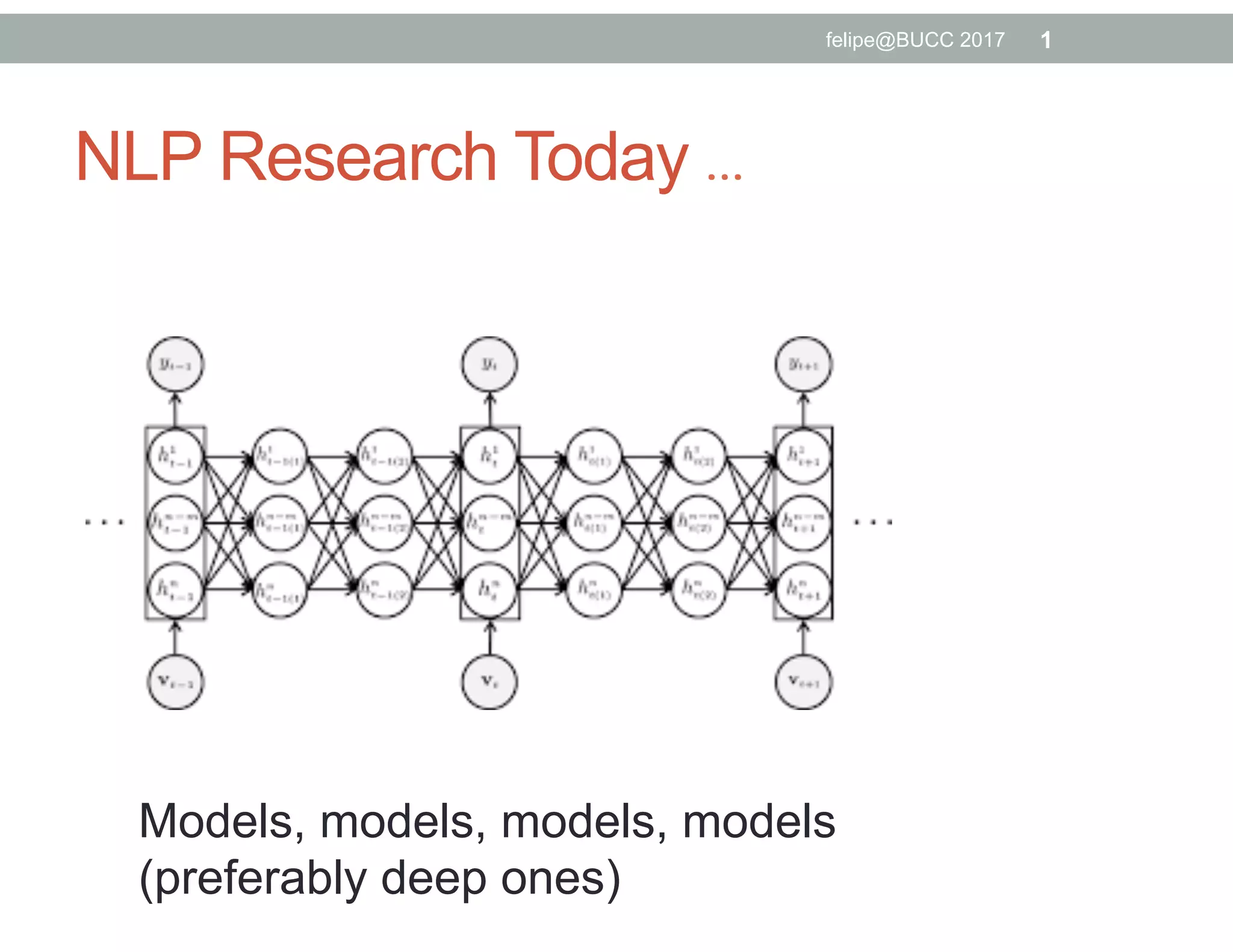
Models, models, models, models
(preferably deep ones)
1felipe@BUCC 2017
But User Matters too
• Not much reflected in current evaluation
protocols
• e.g. how useful is a model that can identify the
translation of frequent words at an accuracy
of 40% ?
• Smart evaluations do exist though
• (Sharoff et al., 2006) for translating difficult MWEs
2felipe@BUCC 2017
3felipe@BUCC 2017
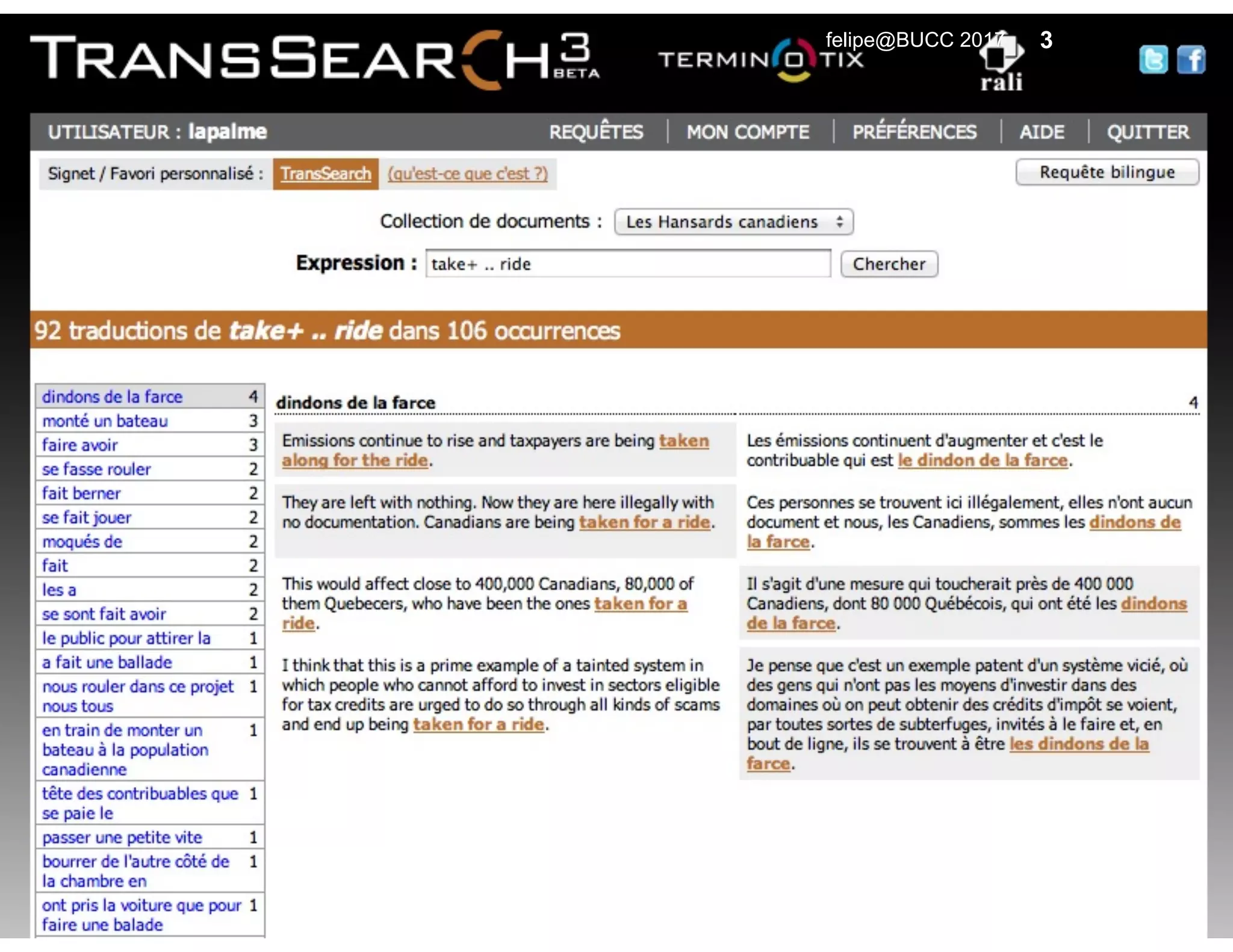
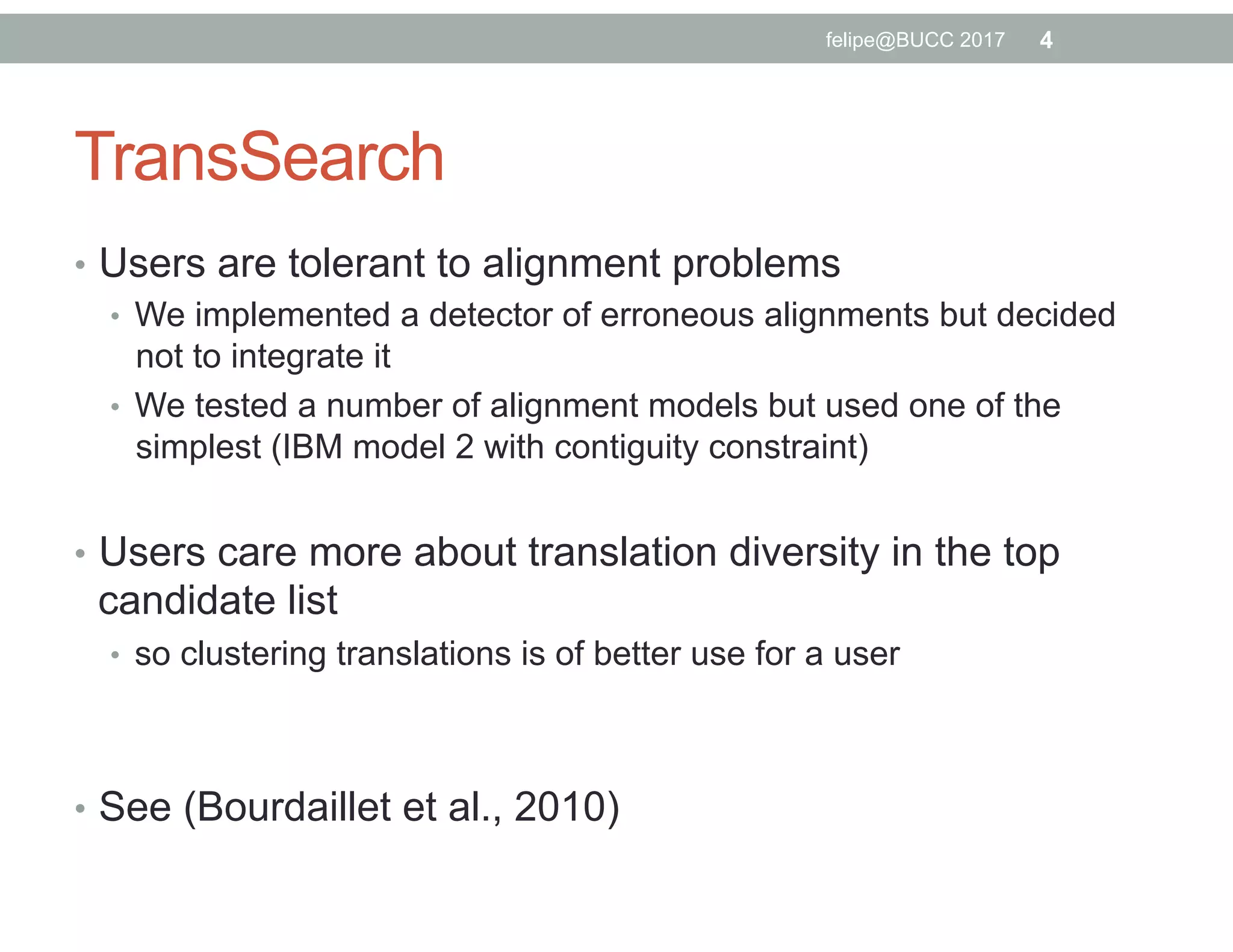
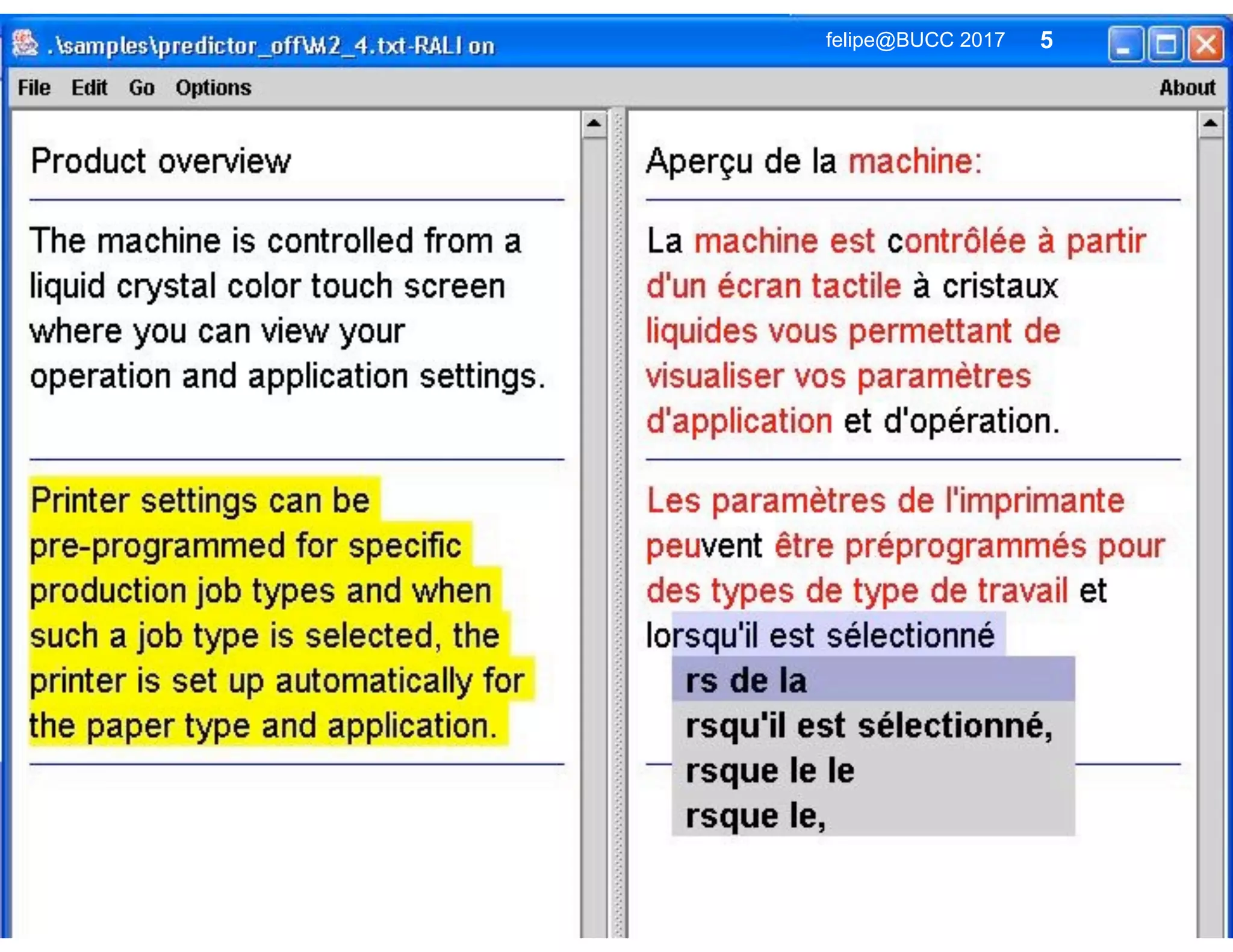
TransSearch
•  Users are tolerant to alignment problems
•  We implemented a detector of erroneous alignments but decided
not to integrate it
•  We tested a number of alignment models but used one of the
simplest (IBM model 2 with contiguity constraint)
•  Users care more about translation diversity in the top
candidate list
•  so clustering translations is of better use for a user
•  See (Bourdaillet et al., 2010)
4felipe@BUCC 2017
5felipe@BUCC 2017
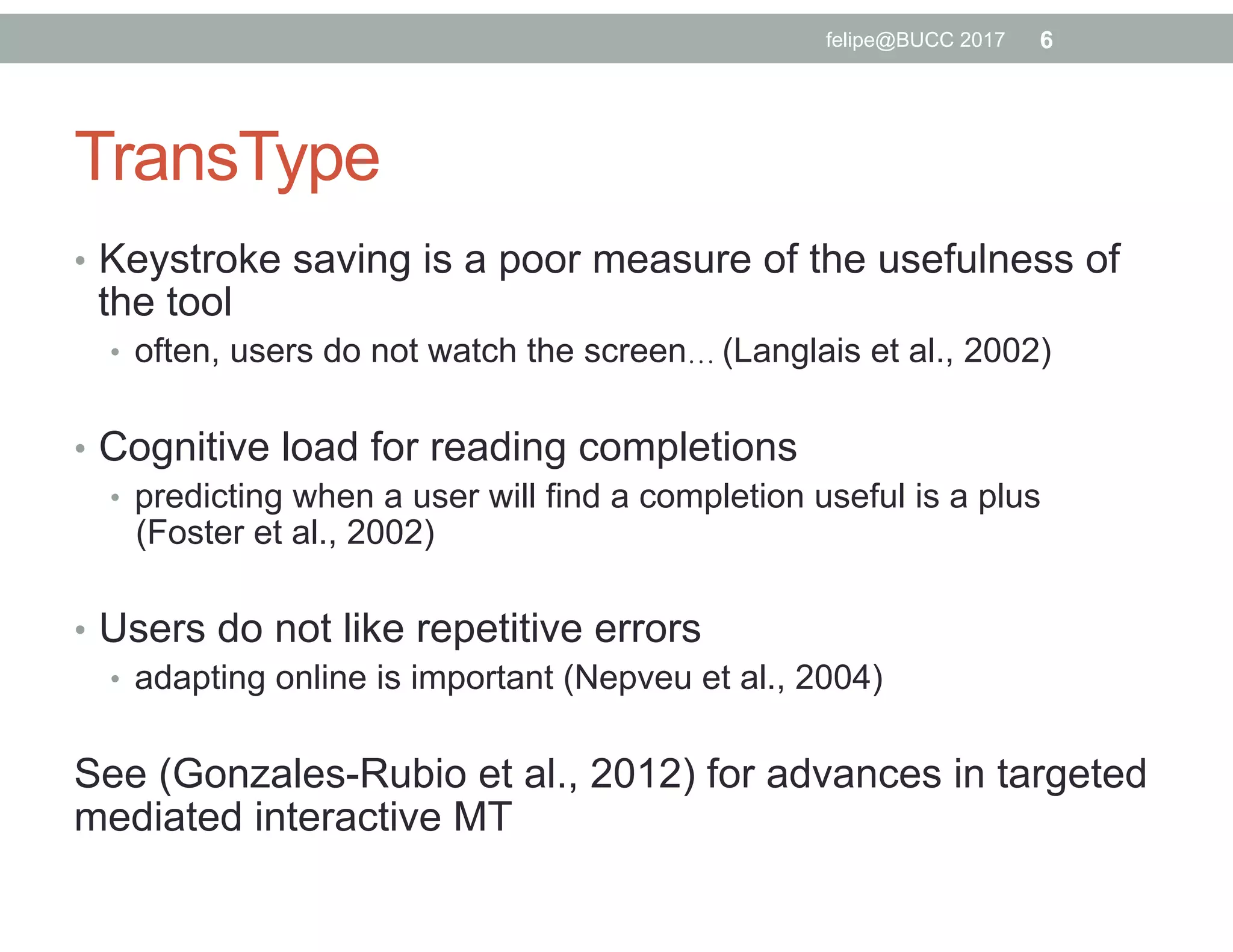
TransType
•  Keystroke saving is a poor measure of the usefulness of
the tool
•  often, users do not watch the screen… (Langlais et al., 2002)
•  Cognitive load for reading completions
•  predicting when a user will find a completion useful is a plus
(Foster et al., 2002)
•  Users do not like repetitive errors
•  adapting online is important (Nepveu et al., 2004)
See (Gonzales-Rubio et al., 2012) for advances in targeted
mediated interactive MT
6felipe@BUCC 2017
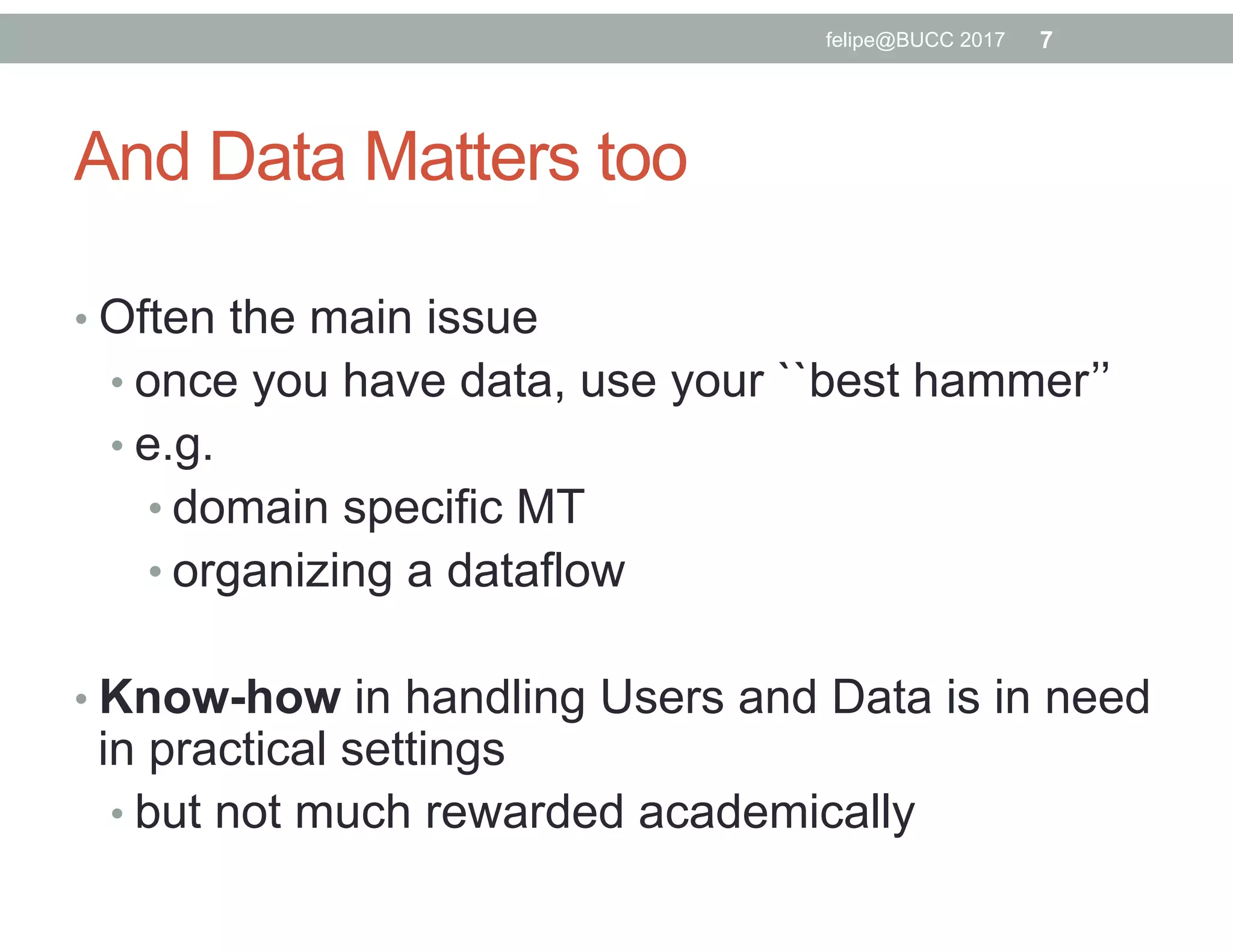
And Data Matters too
• Often the main issue
• once you have data, use your ``best hammer’’
• e.g.
• domain specific MT
• organizing a dataflow
• Know-how in handling Users and Data is in need
in practical settings
• but not much rewarded academically
7felipe@BUCC 2017
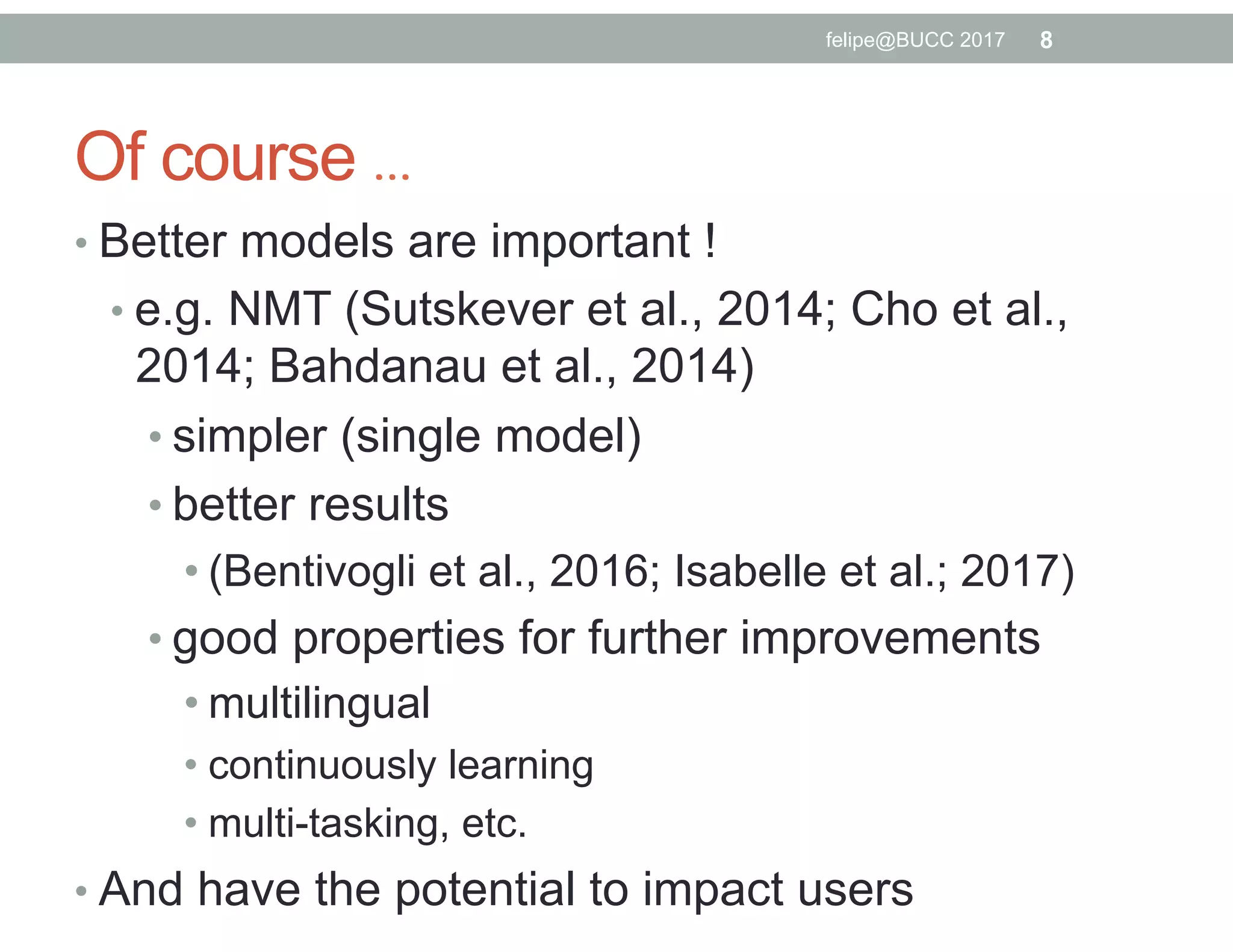
Of course …
• Better models are important !
• e.g. NMT (Sutskever et al., 2014; Cho et al.,
2014; Bahdanau et al., 2014)
• simpler (single model)
• better results
• (Bentivogli et al., 2016; Isabelle et al.; 2017)
• good properties for further improvements
• multilingual
• continuously learning
• multi-tasking, etc.
• And have the potential to impact users
8felipe@BUCC 2017
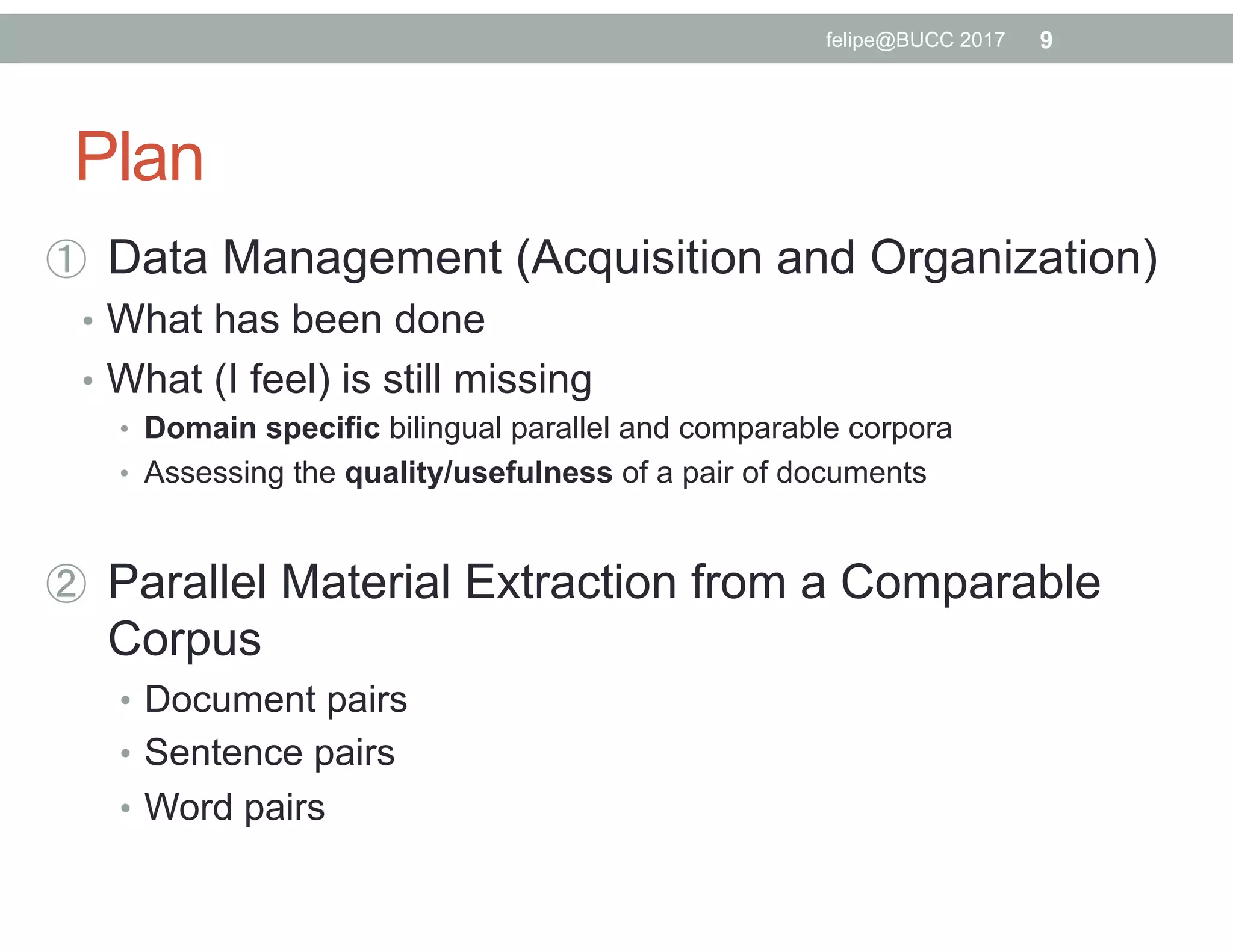
Plan
  Data Management (Acquisition and Organization)
•  What has been done
•  What (I feel) is still missing
•  Domain specific bilingual parallel and comparable corpora
•  Assessing the quality/usefulness of a pair of documents
  Parallel Material Extraction from a Comparable
Corpus
•  Document pairs
•  Sentence pairs
•  Word pairs
9felipe@BUCC 2017
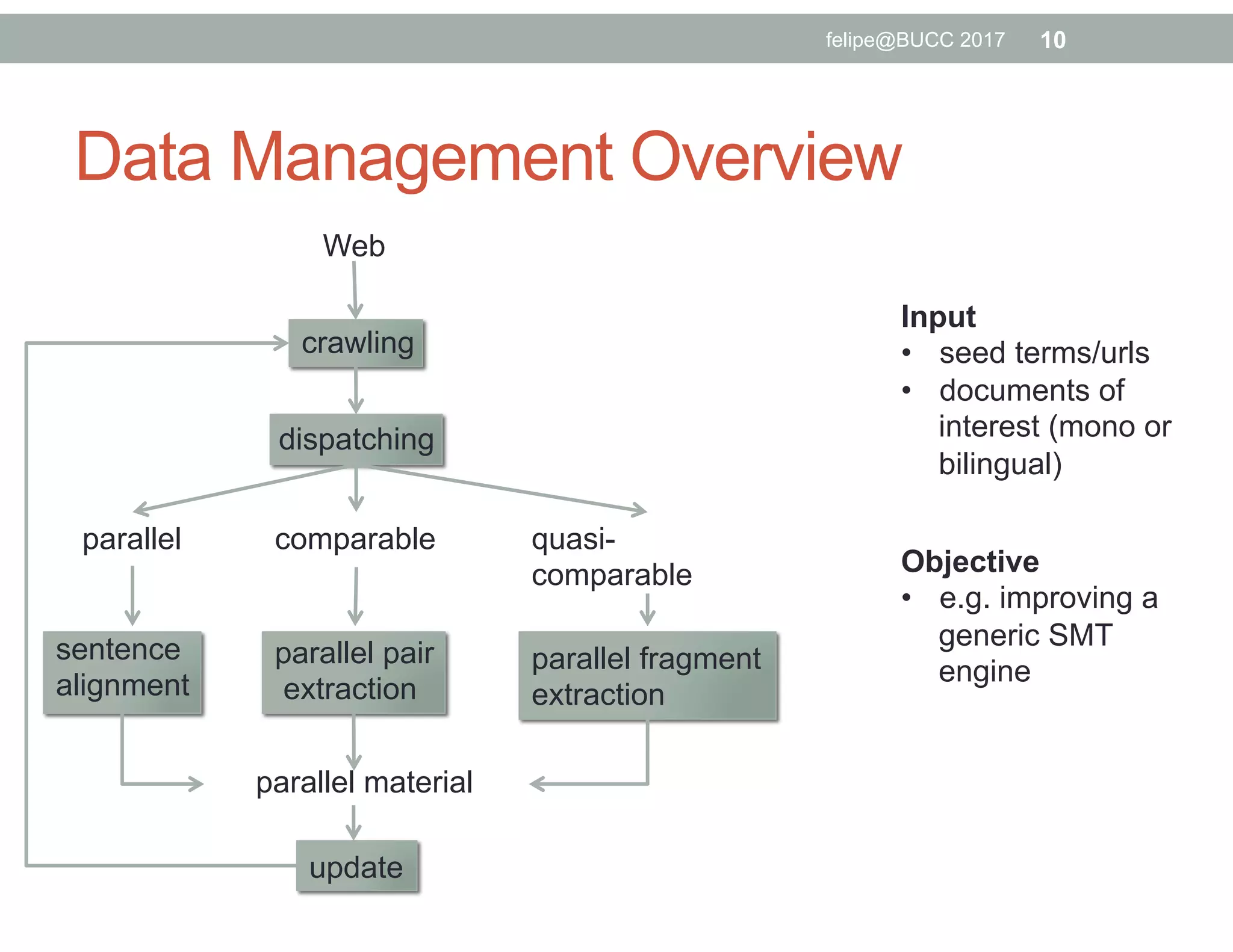
Data Management Overview
Web
felipe@BUCC 2017 10
crawling
dispatching
parallel quasi-
comparable
comparable
sentence
alignment
parallel pair
extraction
parallel fragment
extraction
parallel material
update
Input
•  seed terms/urls
•  documents of
interest (mono or
bilingual)
Objective
•  e.g. improving a
generic SMT
engine
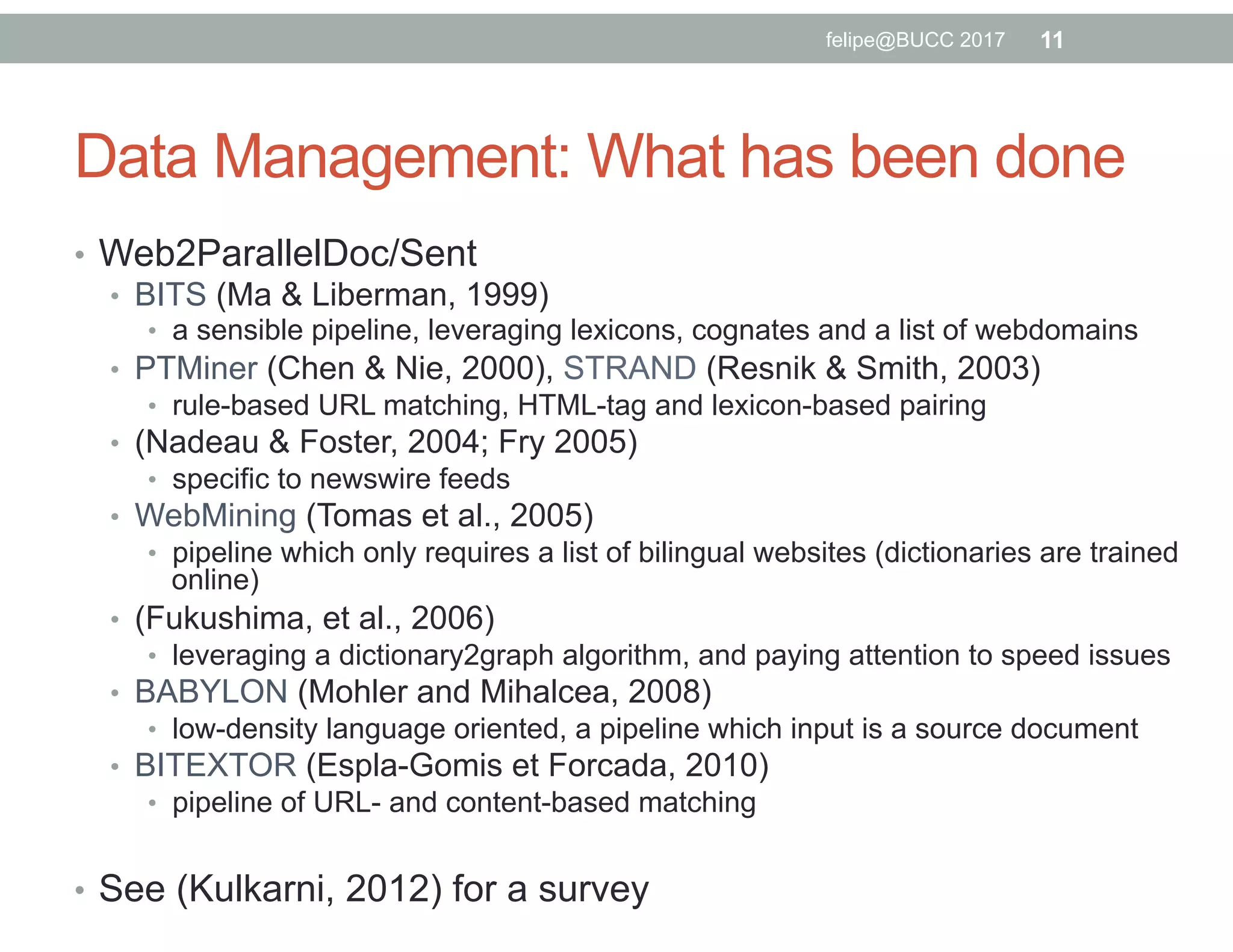
Data Management: What has been done
•  Web2ParallelDoc/Sent
•  BITS (Ma & Liberman, 1999)
•  a sensible pipeline, leveraging lexicons, cognates and a list of webdomains
•  PTMiner (Chen & Nie, 2000), STRAND (Resnik & Smith, 2003)
•  rule-based URL matching, HTML-tag and lexicon-based pairing
•  (Nadeau & Foster, 2004; Fry 2005)
•  specific to newswire feeds
•  WebMining (Tomas et al., 2005)
•  pipeline which only requires a list of bilingual websites (dictionaries are trained
online)
•  (Fukushima, et al., 2006)
•  leveraging a dictionary2graph algorithm, and paying attention to speed issues
•  BABYLON (Mohler and Mihalcea, 2008)
•  low-density language oriented, a pipeline which input is a source document
•  BITEXTOR (Espla-Gomis et Forcada, 2010)
•  pipeline of URL- and content-based matching
•  See (Kulkarni, 2012) for a survey
11felipe@BUCC 2017
Data Management: What has been done
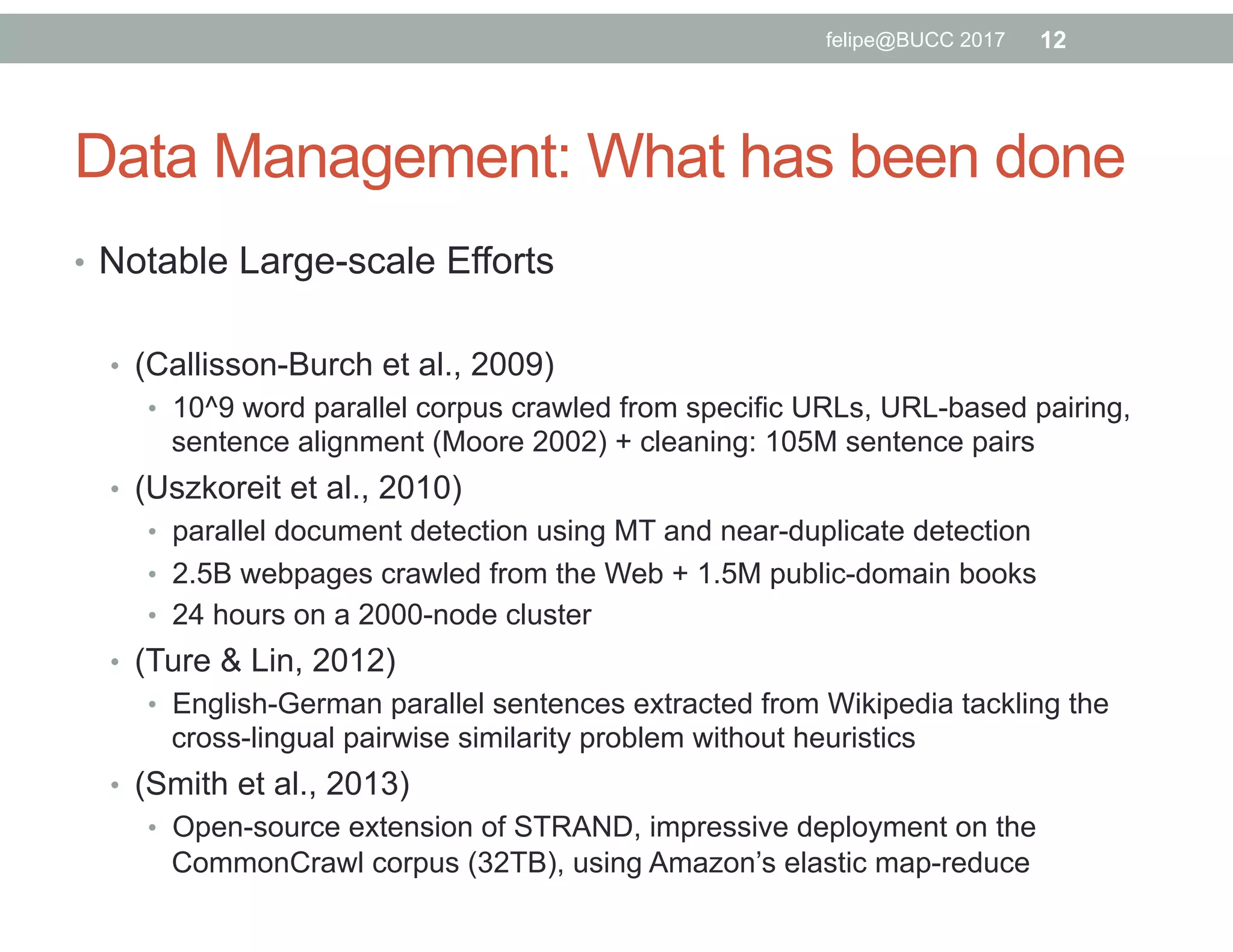
•  Notable Large-scale Efforts
•  (Callisson-Burch et al., 2009)
•  10^9 word parallel corpus crawled from specific URLs, URL-based pairing,
sentence alignment (Moore 2002) + cleaning: 105M sentence pairs
•  (Uszkoreit et al., 2010)
•  parallel document detection using MT and near-duplicate detection
•  2.5B webpages crawled from the Web + 1.5M public-domain books
•  24 hours on a 2000-node cluster
•  (Ture & Lin, 2012)
•  English-German parallel sentences extracted from Wikipedia tackling the
cross-lingual pairwise similarity problem without heuristics
•  (Smith et al., 2013)
•  Open-source extension of STRAND, impressive deployment on the
CommonCrawl corpus (32TB), using Amazon’s elastic map-reduce
12felipe@BUCC 2017
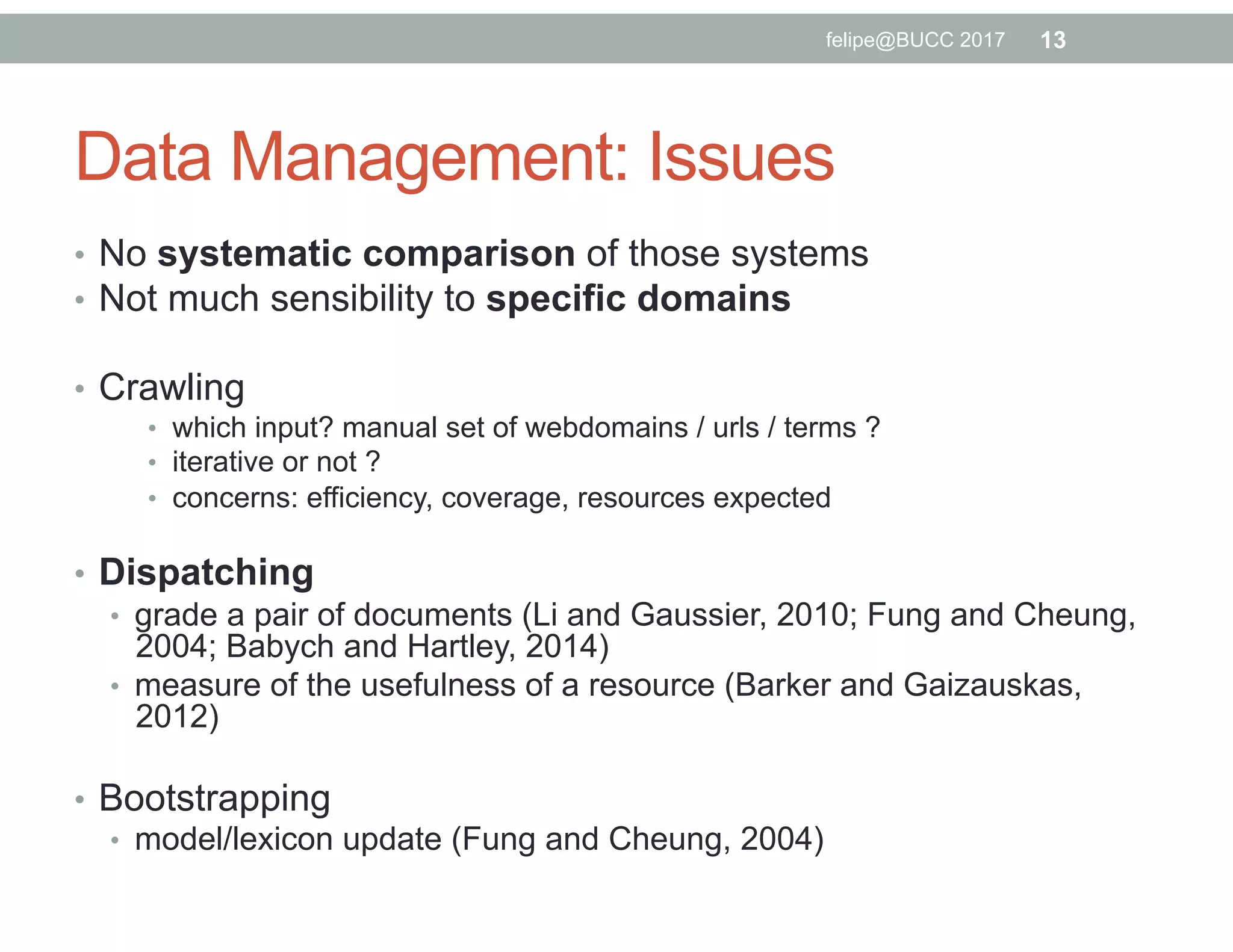
Data Management: Issues
•  No systematic comparison of those systems
•  Not much sensibility to specific domains
•  Crawling
•  which input? manual set of webdomains / urls / terms ?
•  iterative or not ?
•  concerns: efficiency, coverage, resources expected
•  Dispatching
•  grade a pair of documents (Li and Gaussier, 2010; Fung and Cheung,
2004; Babych and Hartley, 2014)
•  measure of the usefulness of a resource (Barker and Gaizauskas,
2012)
•  Bootstrapping
•  model/lexicon update (Fung and Cheung, 2004)
felipe@BUCC 2017 13
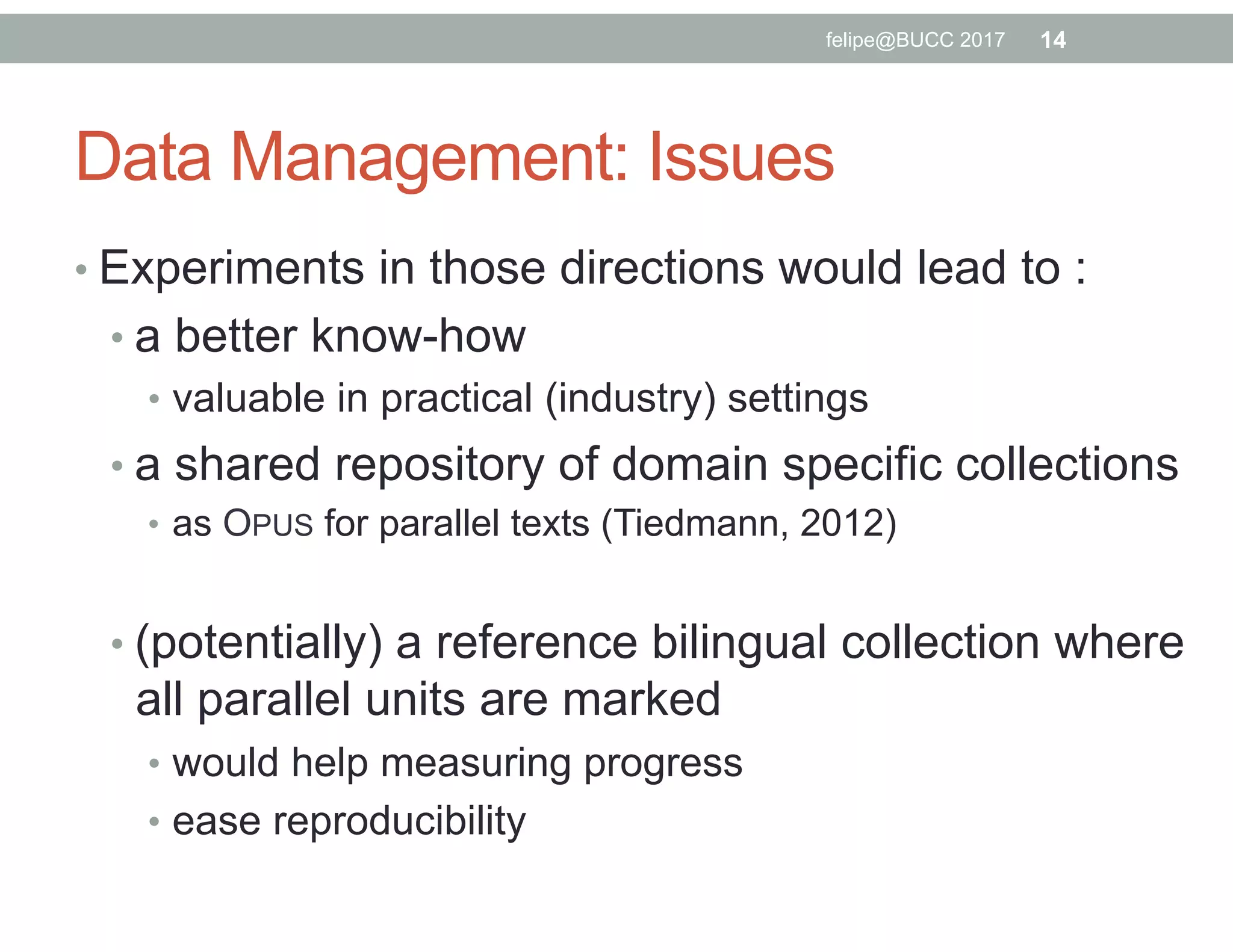
• Experiments in those directions would lead to :
• a better know-how
•  valuable in practical (industry) settings
• a shared repository of domain specific collections
•  as OPUS for parallel texts (Tiedmann, 2012)
• (potentially) a reference bilingual collection where
all parallel units are marked
•  would help measuring progress
•  ease reproducibility
felipe@BUCC 2017 14
Data Management: Issues
About Domain Specific CC
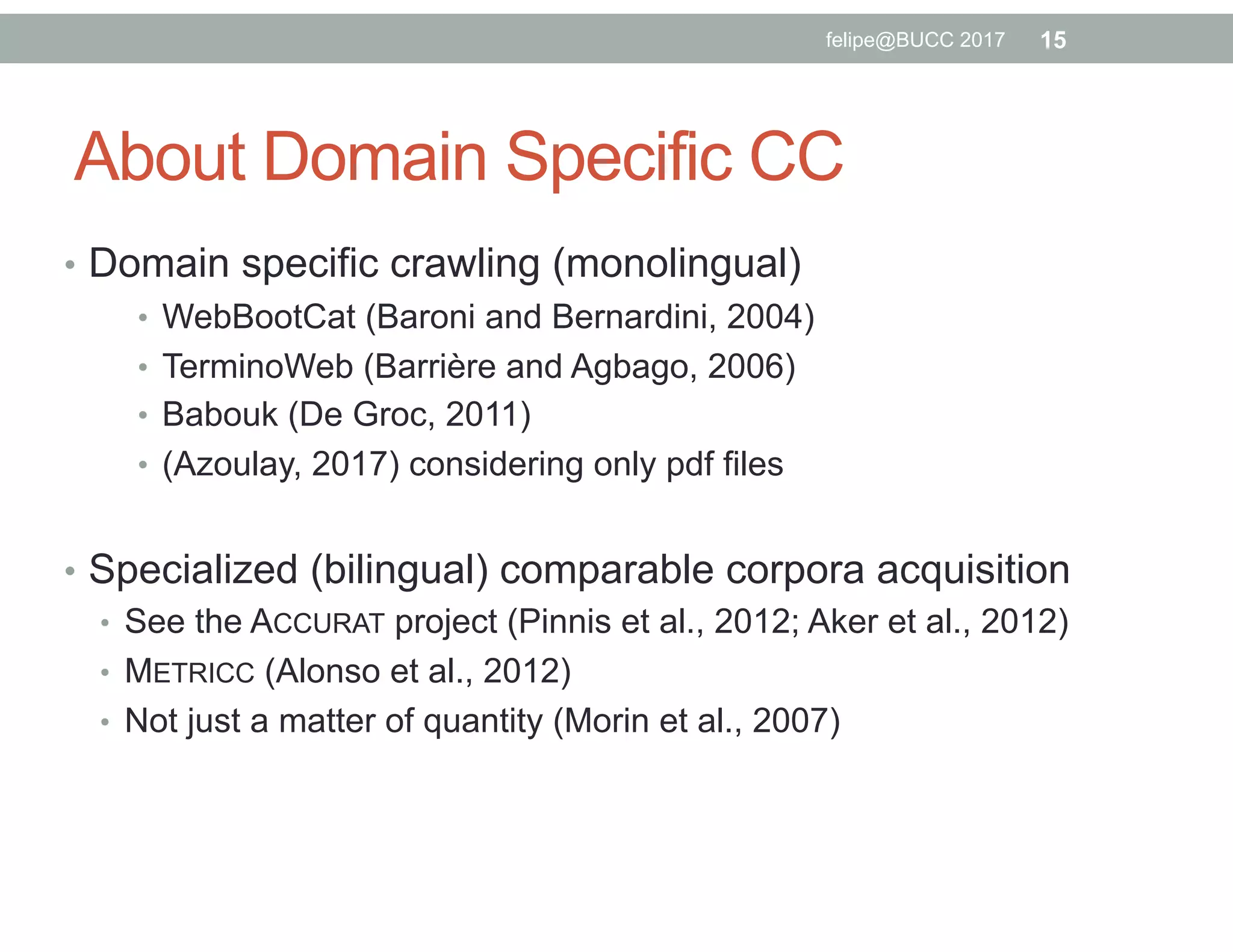
•  Domain specific crawling (monolingual)
•  WebBootCat (Baroni and Bernardini, 2004)
•  TerminoWeb (Barrière and Agbago, 2006)
•  Babouk (De Groc, 2011)
•  (Azoulay, 2017) considering only pdf files
•  Specialized (bilingual) comparable corpora acquisition
•  See the ACCURAT project (Pinnis et al., 2012; Aker et al., 2012)
•  METRICC (Alonso et al., 2012)
•  Not just a matter of quantity (Morin et al., 2007)
15felipe@BUCC 2017
Plan
  Data Management (Acquisition and Organization)
•  What has been done
•  What (I feel) is still missing
•  Domain specific bilingual parallel and comparable corpora
•  Assessing the quality/usefulness of a pair of documents
  Parallel Material Extraction from a Comparable
Corpus
•  Document pairs
•  Sentence pairs
•  Word pairs
16felipe@BUCC 2017
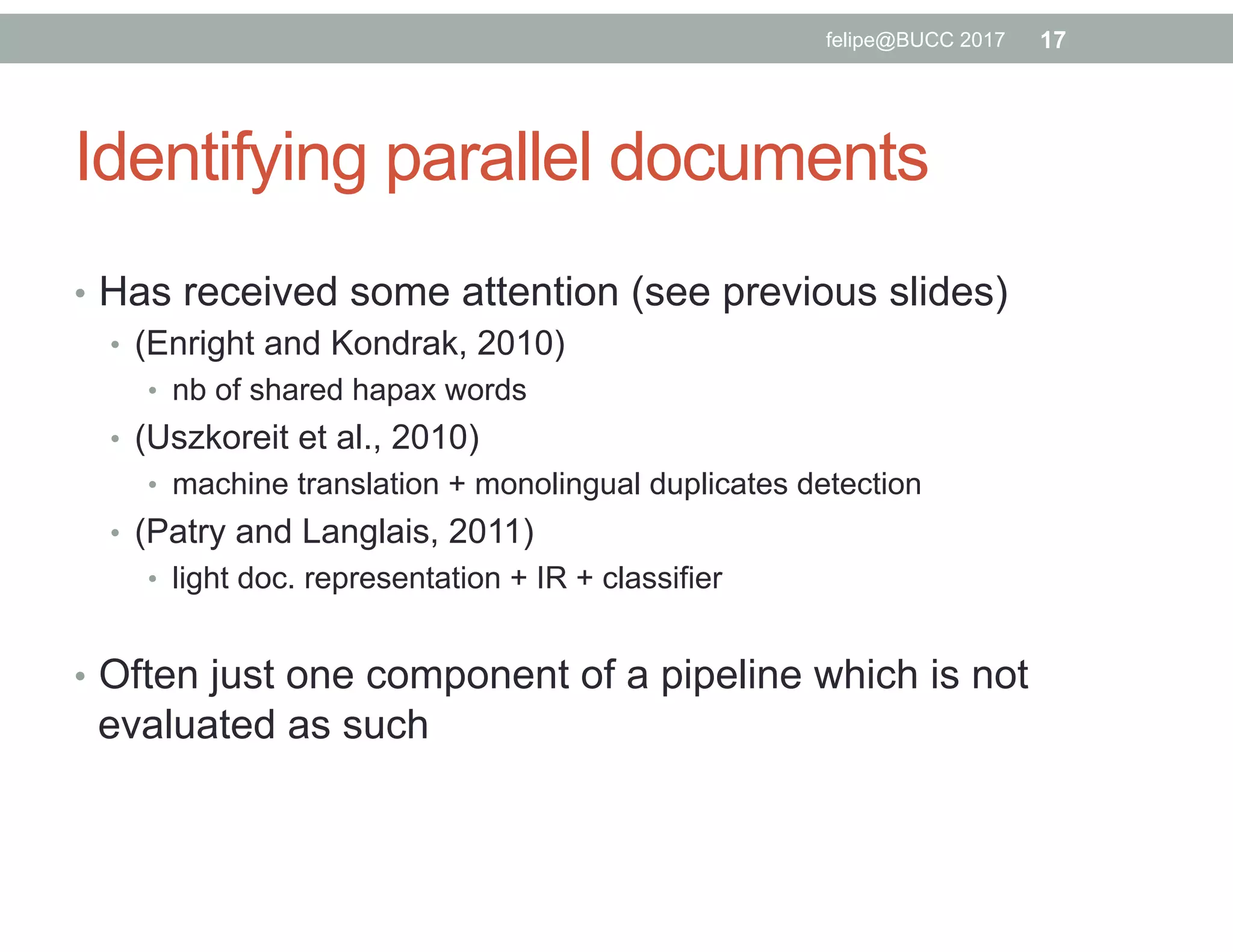
Identifying parallel documents
•  Has received some attention (see previous slides)
•  (Enright and Kondrak, 2010)
•  nb of shared hapax words
•  (Uszkoreit et al., 2010)
•  machine translation + monolingual duplicates detection
•  (Patry and Langlais, 2011)
•  light doc. representation + IR + classifier
•  Often just one component of a pipeline which is not
evaluated as such
17felipe@BUCC 2017
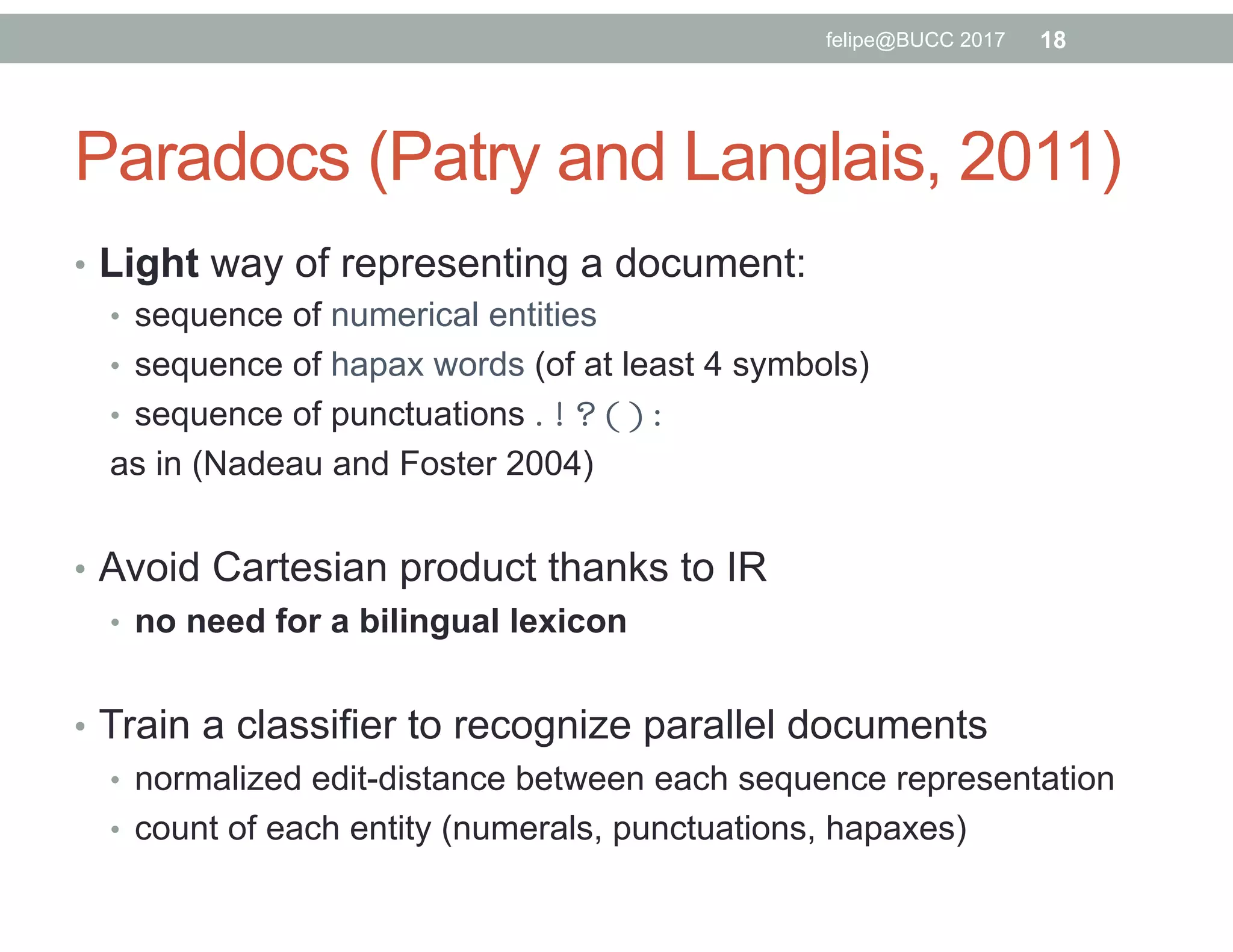
Paradocs (Patry and Langlais, 2011)
•  Light way of representing a document:
•  sequence of numerical entities
•  sequence of hapax words (of at least 4 symbols)
•  sequence of punctuations . ! ? ( ) :
as in (Nadeau and Foster 2004)
•  Avoid Cartesian product thanks to IR
•  no need for a bilingual lexicon
•  Train a classifier to recognize parallel documents
•  normalized edit-distance between each sequence representation
•  count of each entity (numerals, punctuations, hapaxes)
18felipe@BUCC 2017
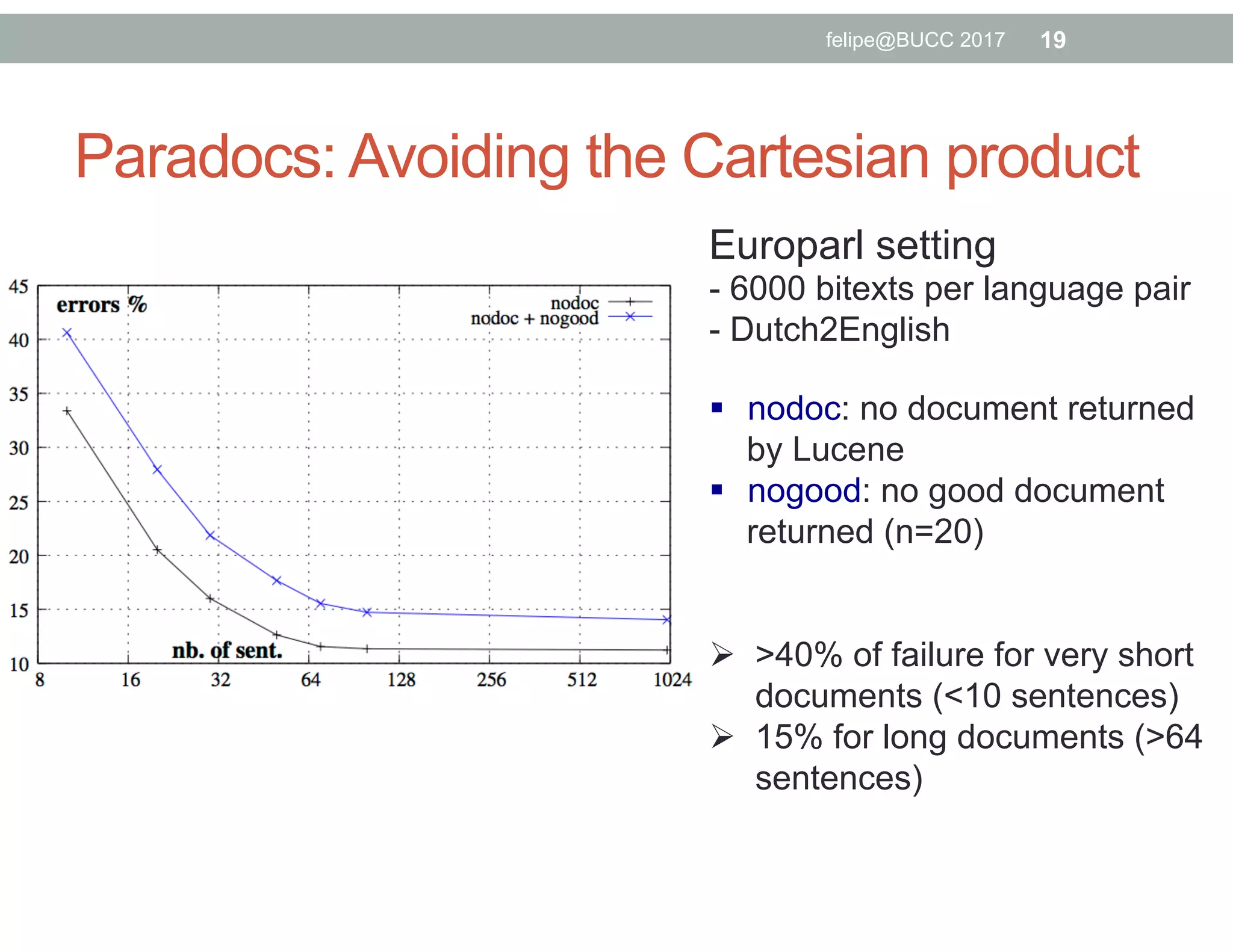
Paradocs: Avoiding the Cartesian product
Europarl setting
- 6000 bitexts per language pair
- Dutch2English
§  nodoc: no document returned
by Lucene
§  nogood: no good document
returned (n=20)
Ø  >40% of failure for very short
documents (<10 sentences)
Ø  15% for long documents (>64
sentences)
19felipe@BUCC 2017
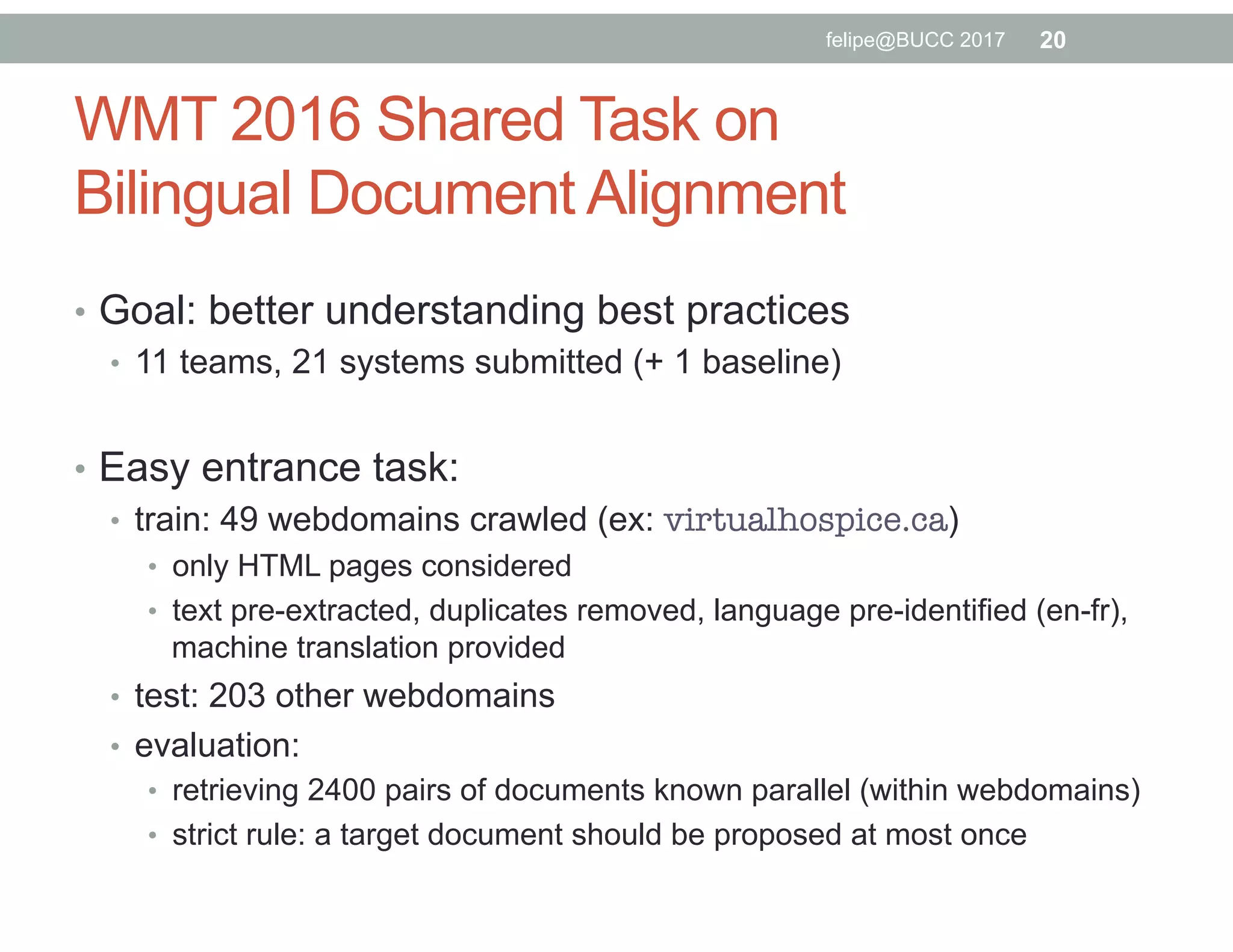
WMT 2016 Shared Task on
Bilingual Document Alignment
•  Goal: better understanding best practices
•  11 teams, 21 systems submitted (+ 1 baseline)
•  Easy entrance task:
•  train: 49 webdomains crawled (ex: virtualhospice.ca)
•  only HTML pages considered
•  text pre-extracted, duplicates removed, language pre-identified (en-fr),
machine translation provided
•  test: 203 other webdomains
•  evaluation:
•  retrieving 2400 pairs of documents known parallel (within webdomains)
•  strict rule: a target document should be proposed at most once
20felipe@BUCC 2017
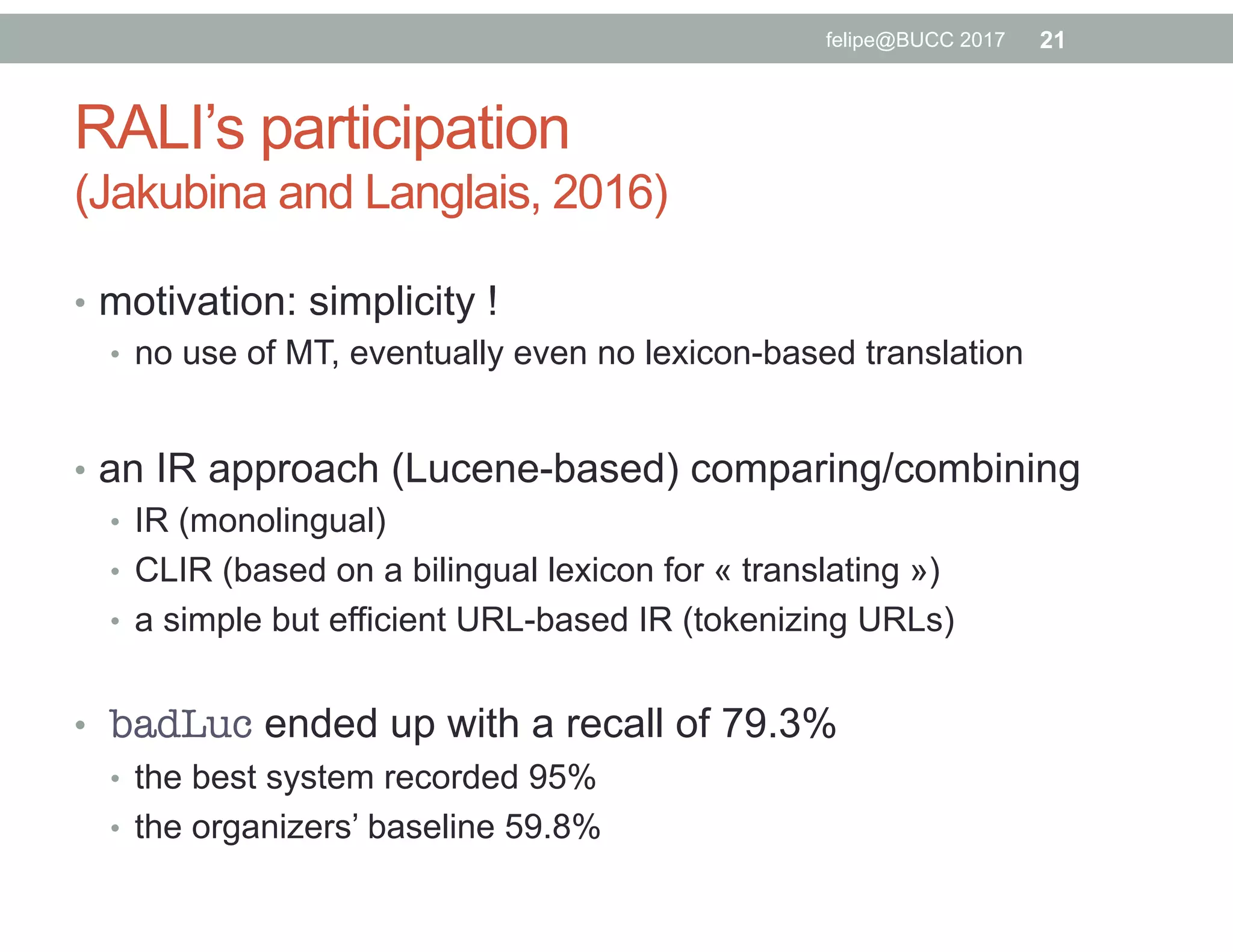
RALI’s participation
(Jakubina and Langlais, 2016)
•  motivation: simplicity !
•  no use of MT, eventually even no lexicon-based translation
•  an IR approach (Lucene-based) comparing/combining
•  IR (monolingual)
•  CLIR (based on a bilingual lexicon for « translating »)
•  a simple but efficient URL-based IR (tokenizing URLs)
•  badLuc ended up with a recall of 79.3%
•  the best system recorded 95%
•  the organizers’ baseline 59.8%
21felipe@BUCC 2017
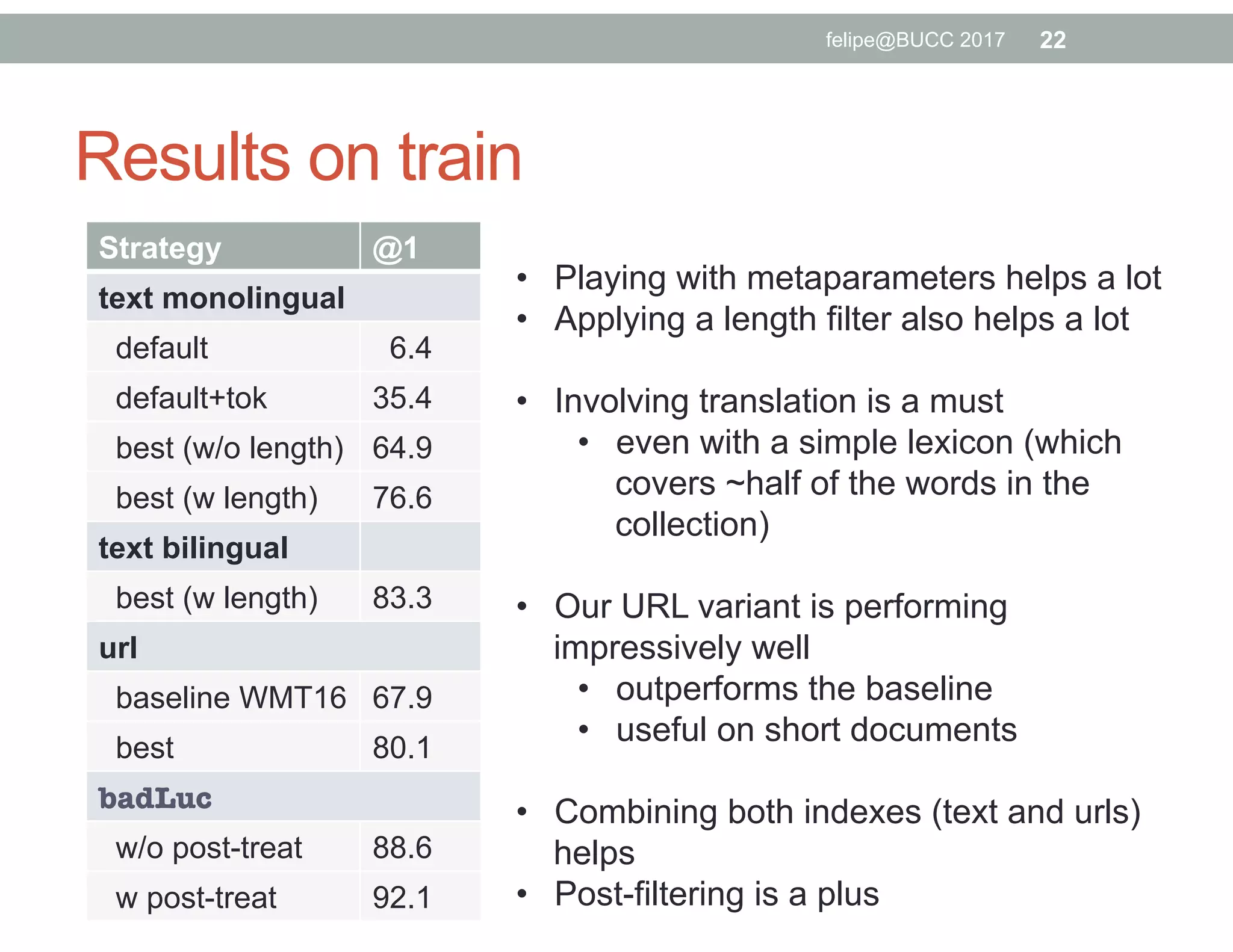
Results on train
Strategy @1
text monolingual
default 6.4
default+tok 35.4
best (w/o length) 64.9
best (w length) 76.6
text bilingual
best (w length) 83.3
url
baseline WMT16 67.9
best 80.1
badLuc
w/o post-treat 88.6
w post-treat 92.1
•  Playing with metaparameters helps a lot
•  Applying a length filter also helps a lot
•  Involving translation is a must
•  even with a simple lexicon (which
covers ~half of the words in the
collection)
•  Our URL variant is performing
impressively well
•  outperforms the baseline
•  useful on short documents
•  Combining both indexes (text and urls)
helps
•  Post-filtering is a plus
22felipe@BUCC 2017
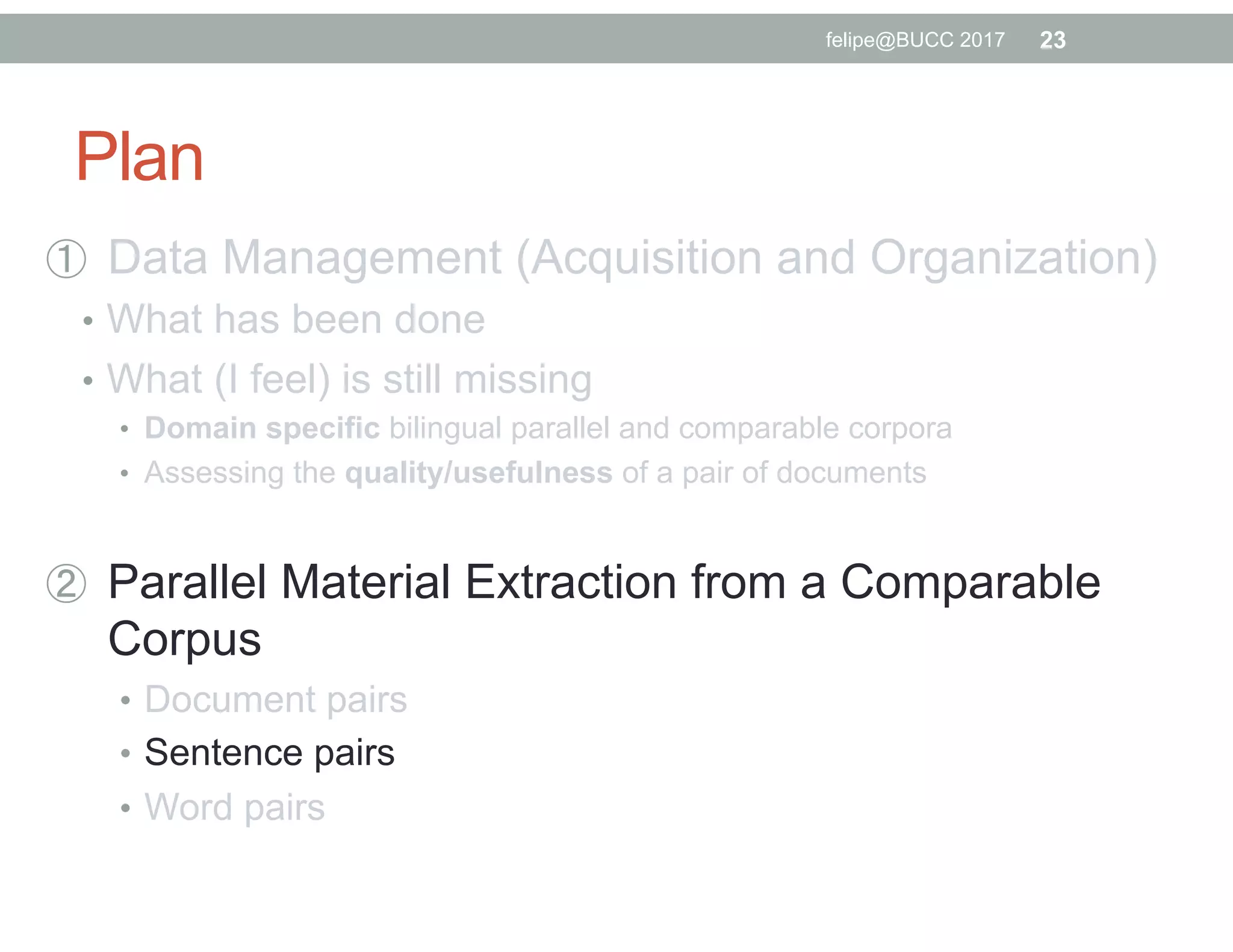
Plan
  Data Management (Acquisition and Organization)
•  What has been done
•  What (I feel) is still missing
•  Domain specific bilingual parallel and comparable corpora
•  Assessing the quality/usefulness of a pair of documents
  Parallel Material Extraction from a Comparable
Corpus
•  Document pairs
•  Sentence pairs
•  Word pairs
23felipe@BUCC 2017
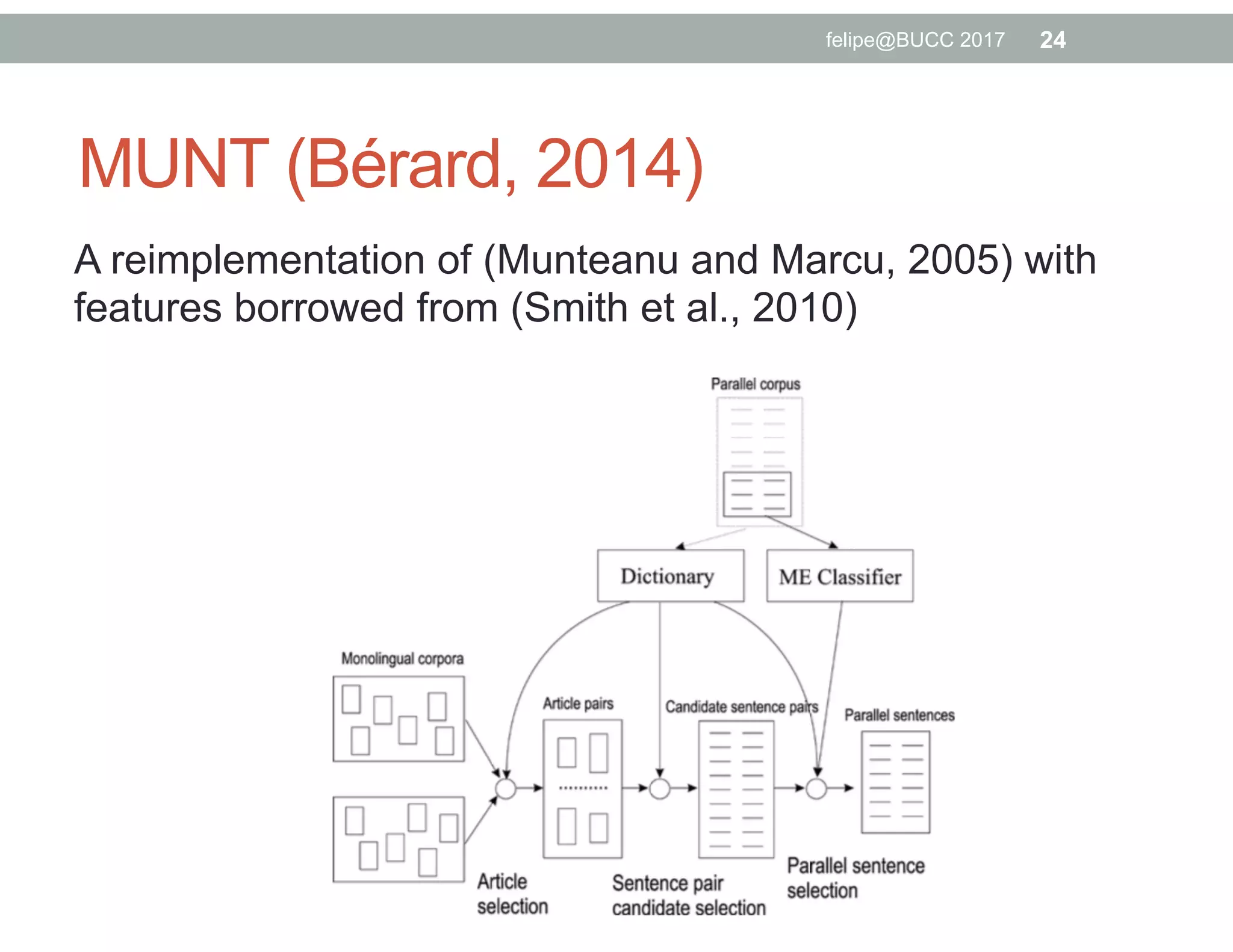
MUNT (Bérard, 2014)
A reimplementation of (Munteanu and Marcu, 2005) with
features borrowed from (Smith et al., 2010)
24felipe@BUCC 2017
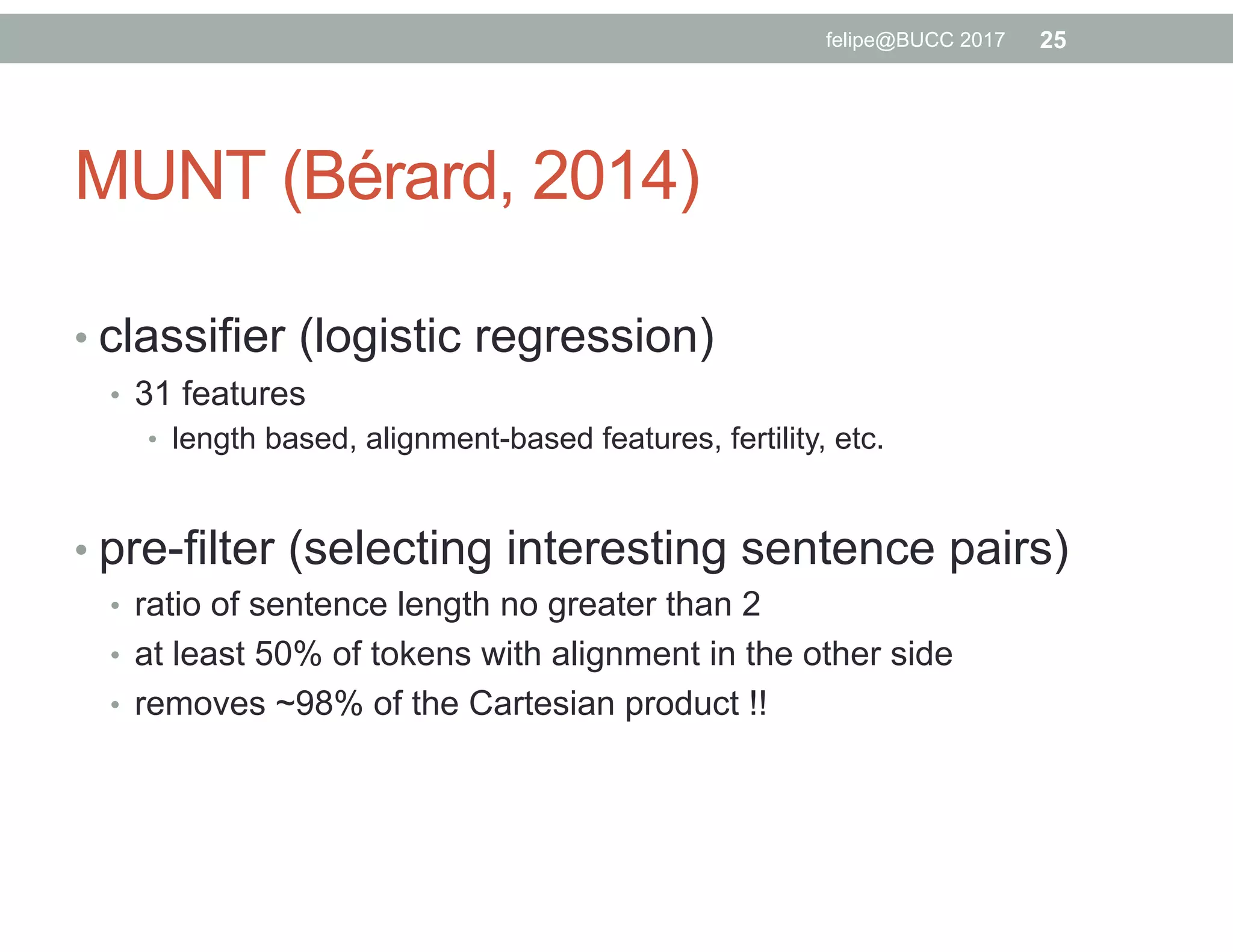
MUNT (Bérard, 2014)
• classifier (logistic regression)
•  31 features
•  length based, alignment-based features, fertility, etc.
• pre-filter (selecting interesting sentence pairs)
•  ratio of sentence length no greater than 2
•  at least 50% of tokens with alignment in the other side
•  removes ~98% of the Cartesian product !!
25felipe@BUCC 2017
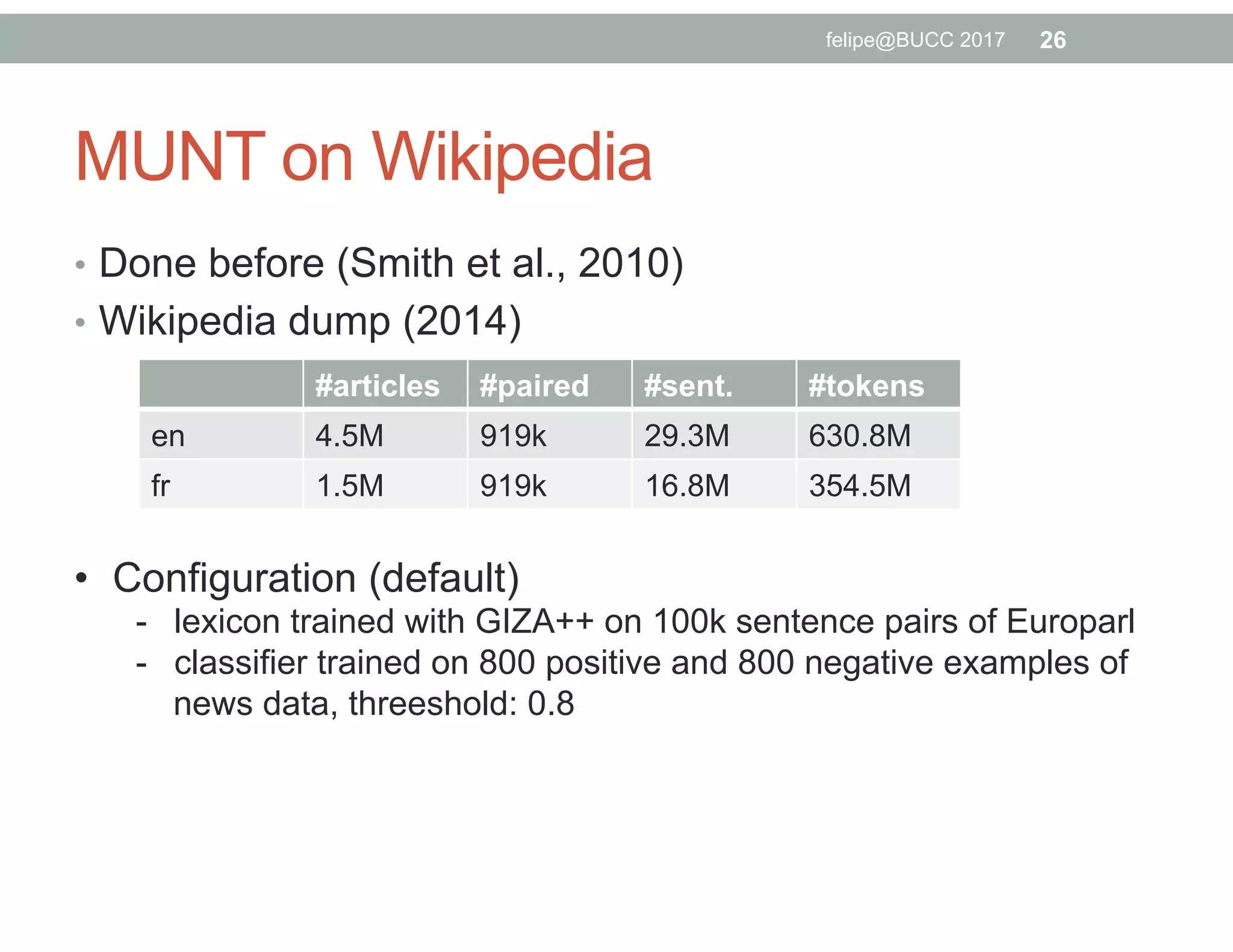
MUNT on Wikipedia
•  Done before (Smith et al., 2010)
•  Wikipedia dump (2014)
felipe@BUCC 2017 26
#articles #paired #sent. #tokens
en 4.5M 919k 29.3M 630.8M
fr 1.5M 919k 16.8M 354.5M
•  Configuration (default)
-  lexicon trained with GIZA++ on 100k sentence pairs of Europarl
-  classifier trained on 800 positive and 800 negative examples of
news data, threeshold: 0.8
MUNT on Wikipedia
felipe@BUCC 2017 27
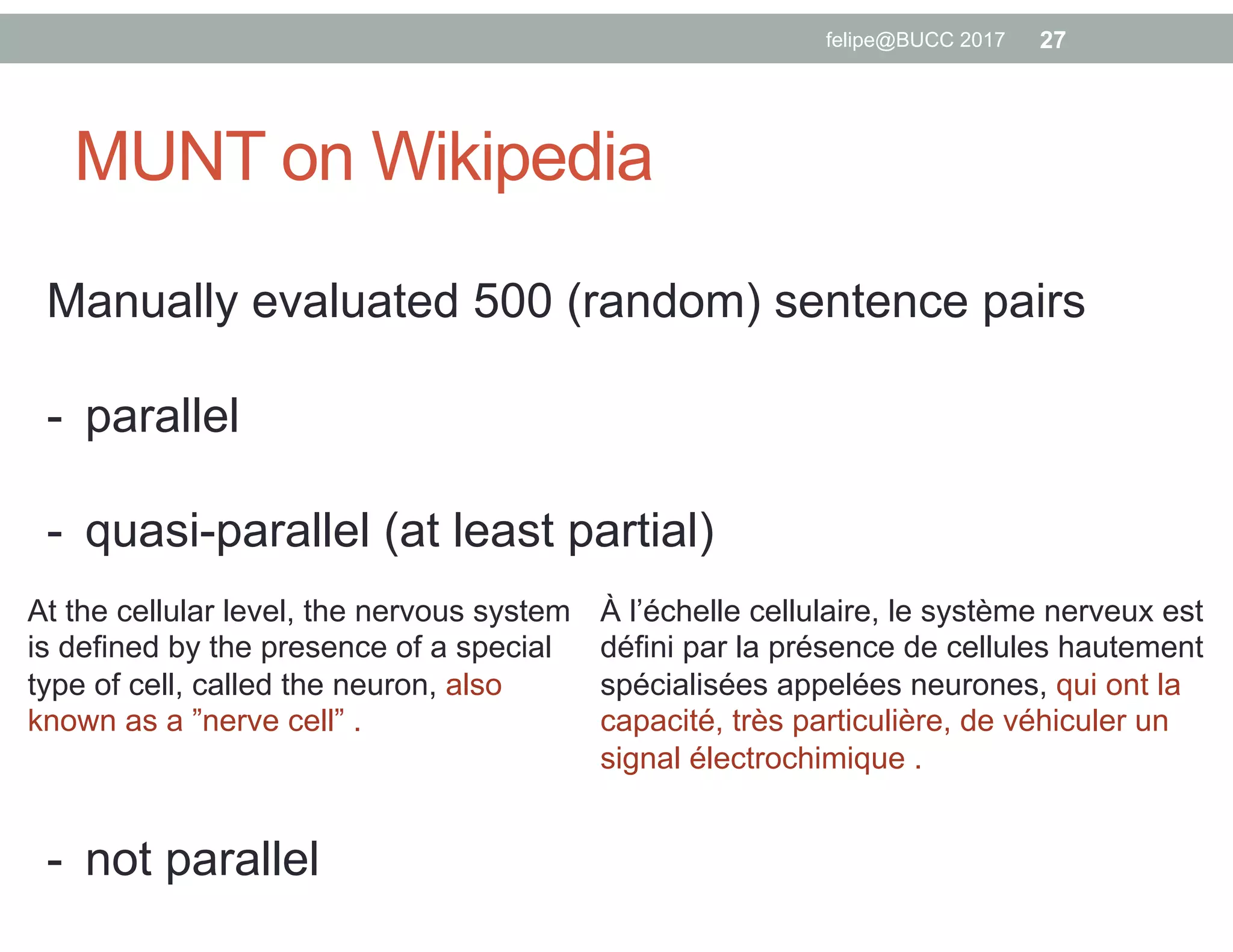
Manually evaluated 500 (random) sentence pairs
-  parallel
-  quasi-parallel (at least partial)
-  not parallel
At the cellular level, the nervous system
is defined by the presence of a special
type of cell, called the neuron, also
known as a ”nerve cell” .
À l’échelle cellulaire, le système nerveux est
défini par la présence de cellules hautement
spécialisées appelées neurones, qui ont la
capacité, très particulière, de véhiculer un
signal électrochimique .
MUNT on Wikipedia
felipe@BUCC 2017 28
grade %
parallel 71
quasi-parallel 15
not parallel 14
We tried something odd:
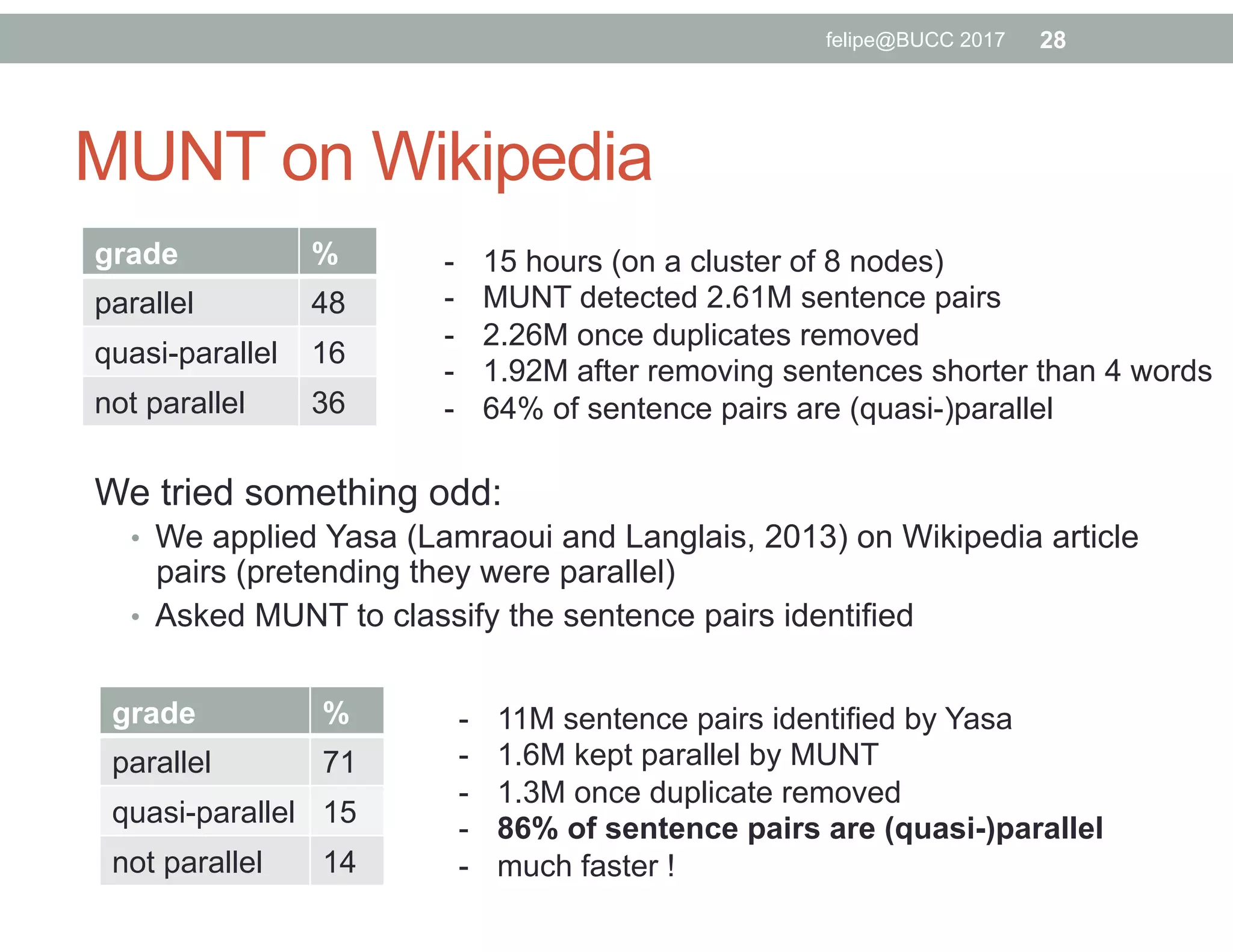
•  We applied Yasa (Lamraoui and Langlais, 2013) on Wikipedia article
pairs (pretending they were parallel)
•  Asked MUNT to classify the sentence pairs identified
grade %
parallel 48
quasi-parallel 16
not parallel 36
-  11M sentence pairs identified by Yasa
-  1.6M kept parallel by MUNT
-  1.3M once duplicate removed
-  86% of sentence pairs are (quasi-)parallel
-  much faster !
-  15 hours (on a cluster of 8 nodes)
-  MUNT detected 2.61M sentence pairs
-  2.26M once duplicates removed
-  1.92M after removing sentences shorter than 4 words
-  64% of sentence pairs are (quasi-)parallel
Munt on Wikipedia
felipe@BUCC 2017 29
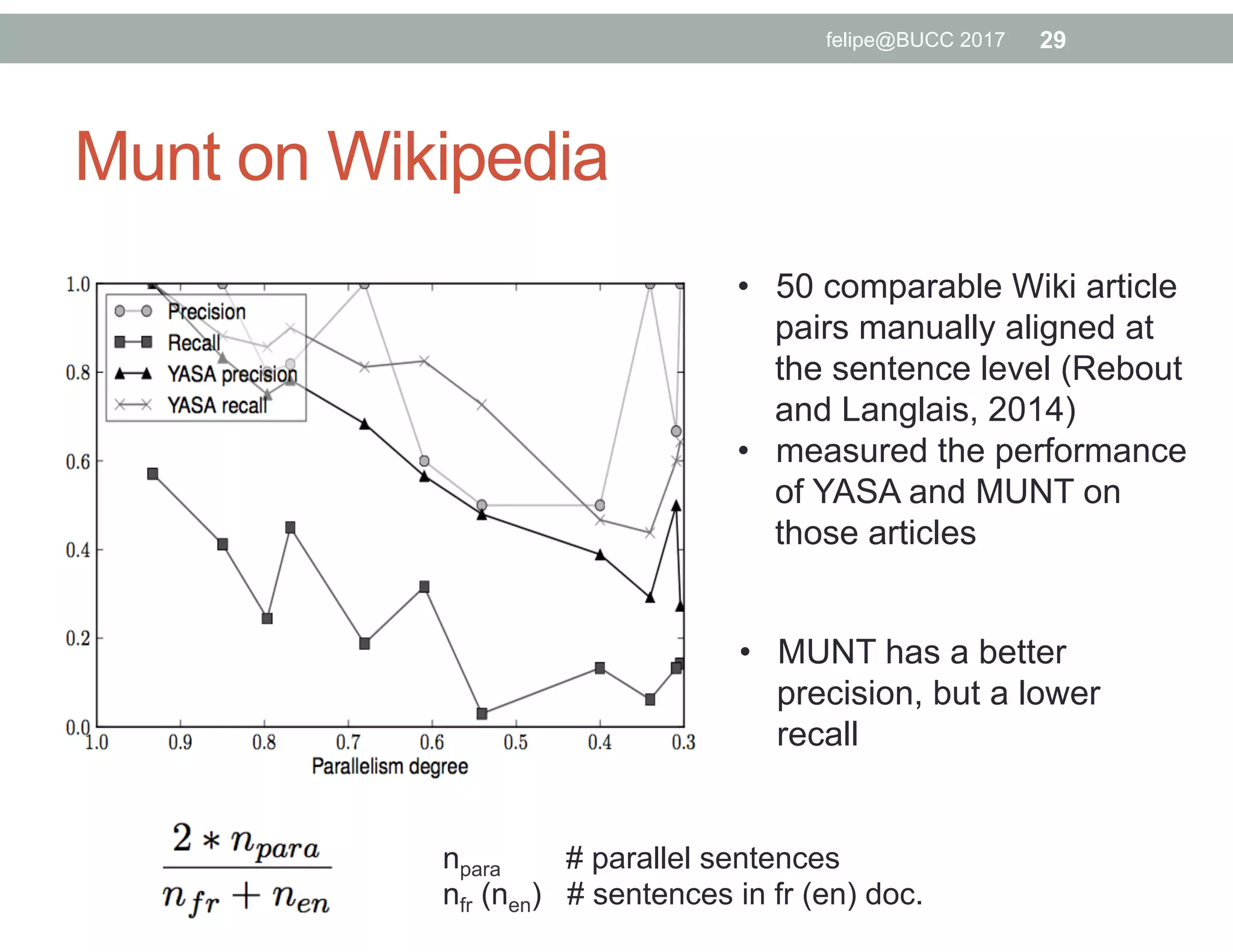
•  50 comparable Wiki article
pairs manually aligned at
the sentence level (Rebout
and Langlais, 2014)
•  measured the performance
of YASA and MUNT on
those articles
•  MUNT has a better
precision, but a lower
recall
npara # parallel sentences
nfr (nen) # sentences in fr (en) doc.
BUCC 2017 Shared Task
(Zweigenbaum et al., 2016)
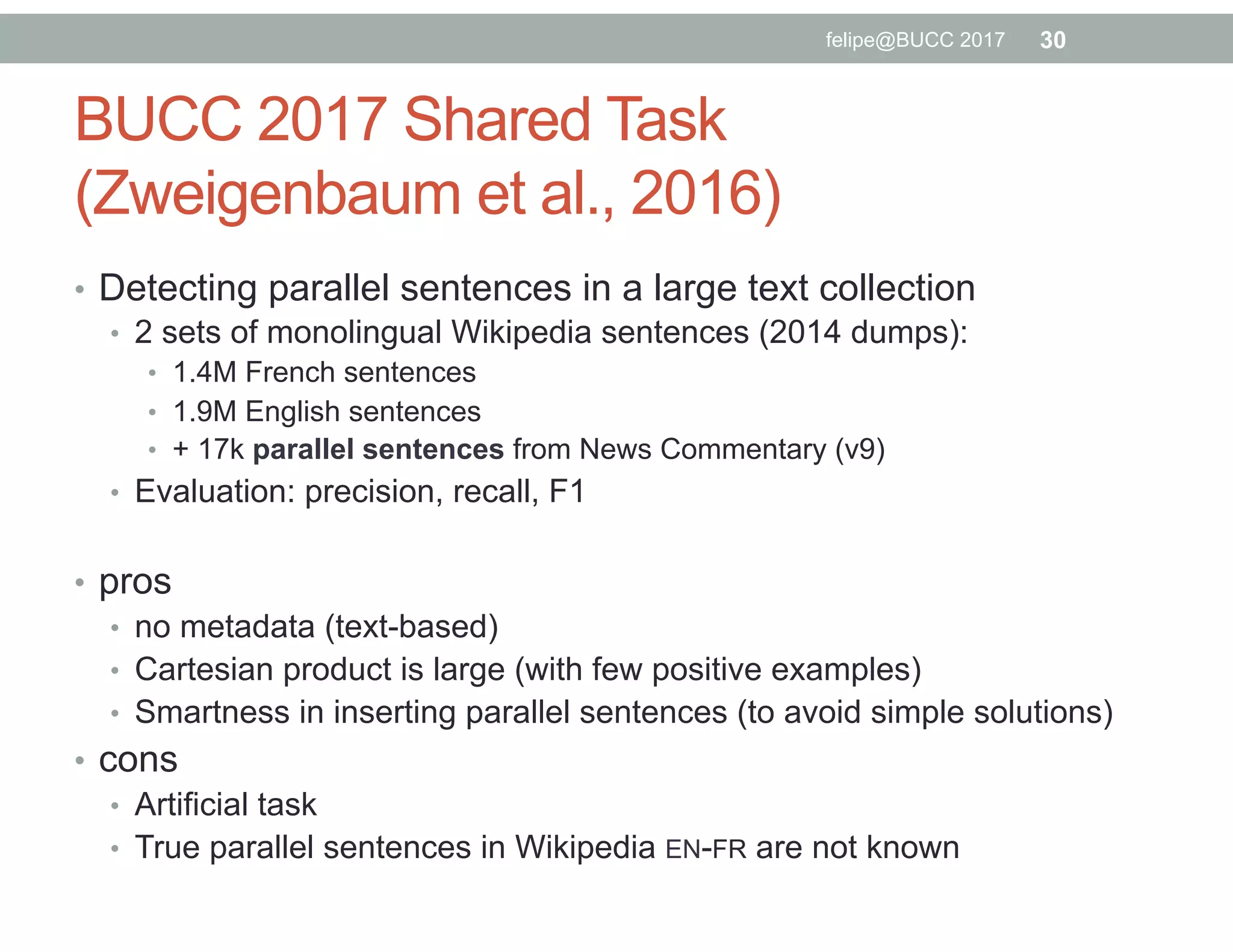
•  Detecting parallel sentences in a large text collection
•  2 sets of monolingual Wikipedia sentences (2014 dumps):
•  1.4M French sentences
•  1.9M English sentences
•  + 17k parallel sentences from News Commentary (v9)
•  Evaluation: precision, recall, F1
•  pros
•  no metadata (text-based)
•  Cartesian product is large (with few positive examples)
•  Smartness in inserting parallel sentences (to avoid simple solutions)
•  cons
•  Artificial task
•  True parallel sentences in Wikipedia EN-FR are not known
30felipe@BUCC 2017
RALI’s participation
31felipe@BUCC 2017
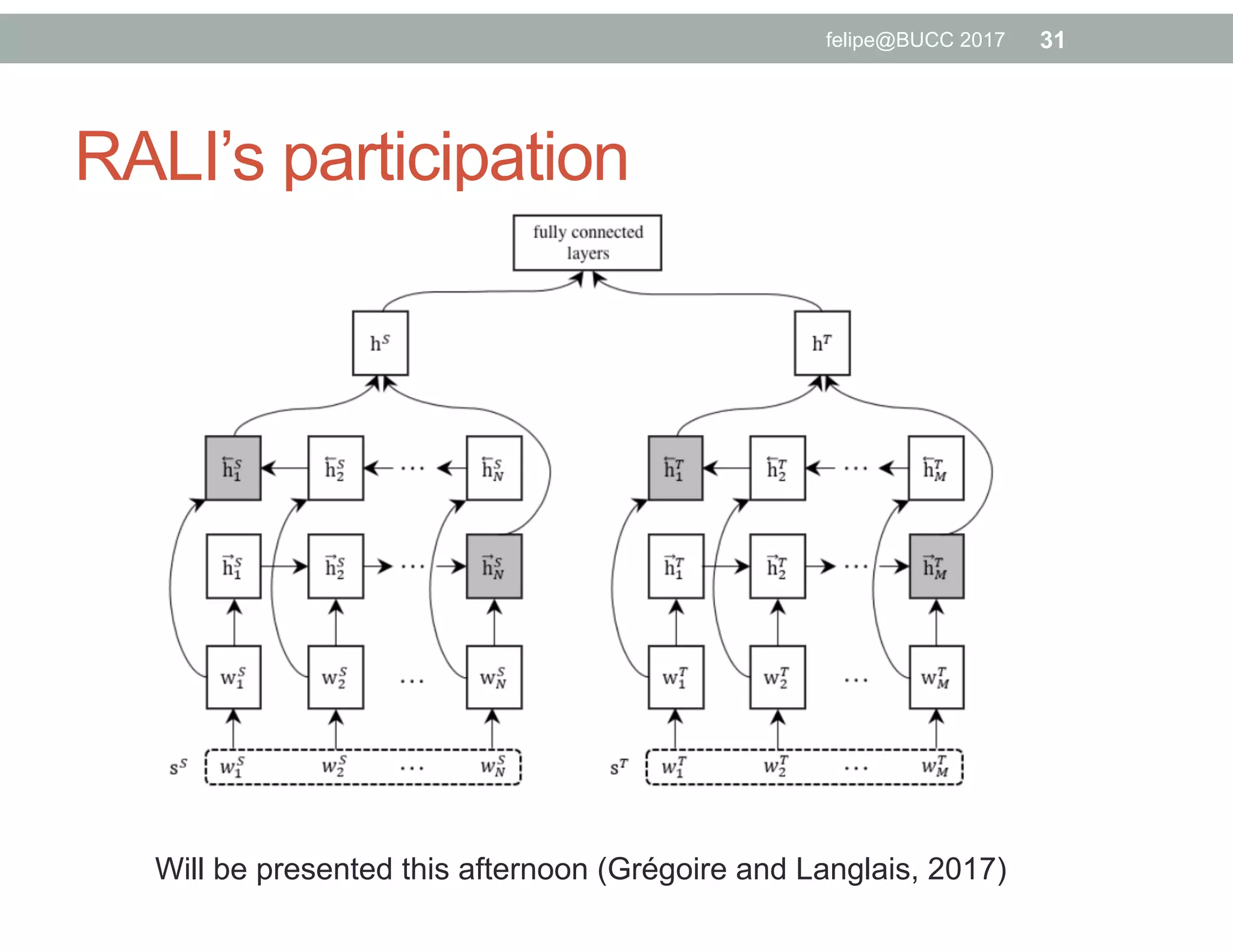
Will be presented this afternoon (Grégoire and Langlais, 2017)
RALI’s participation
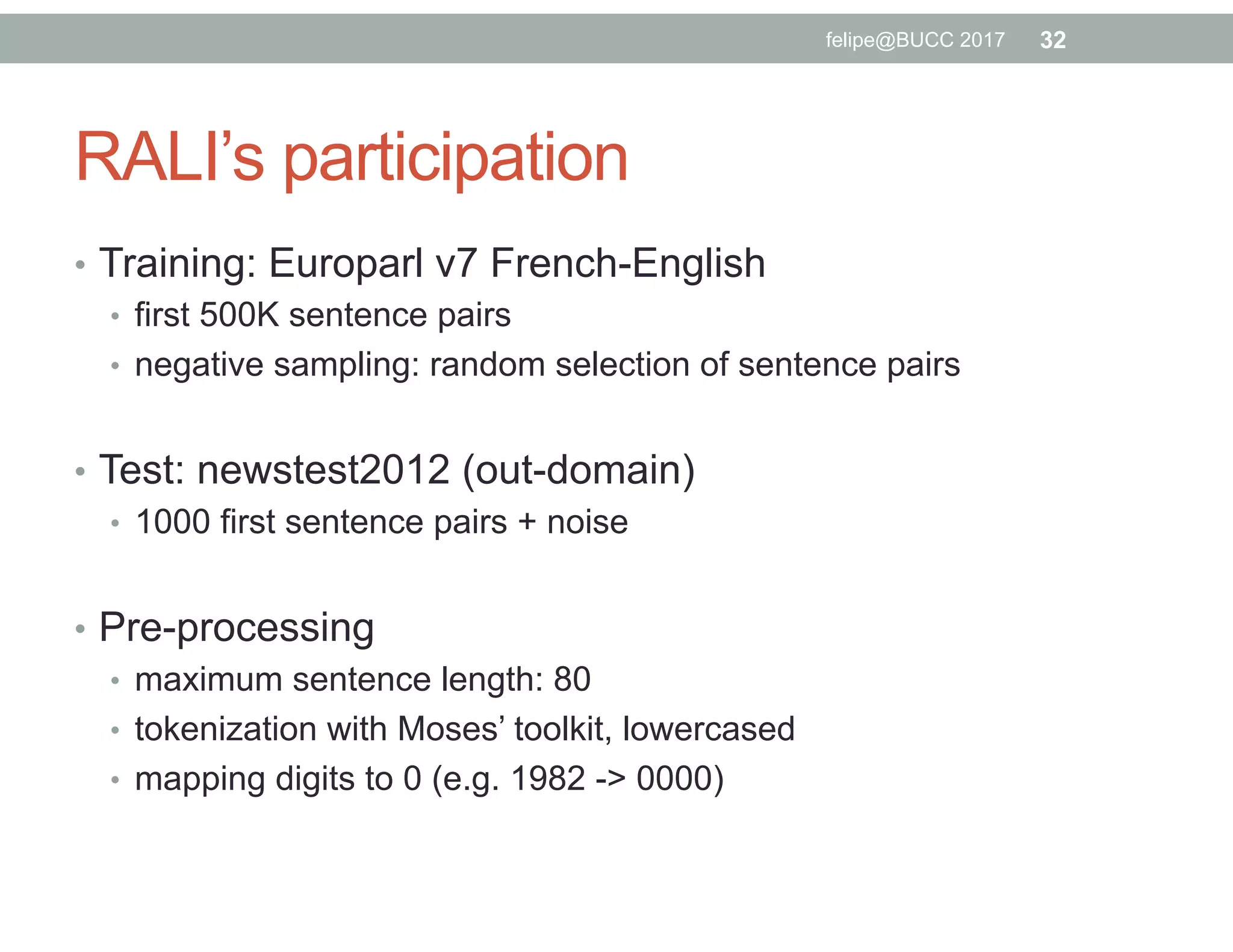
•  Training: Europarl v7 French-English
•  first 500K sentence pairs
•  negative sampling: random selection of sentence pairs
•  Test: newstest2012 (out-domain)
•  1000 first sentence pairs + noise
•  Pre-processing
•  maximum sentence length: 80
•  tokenization with Moses’ toolkit, lowercased
•  mapping digits to 0 (e.g. 1982 -> 0000)
32felipe@BUCC 2017
RALI’s participation
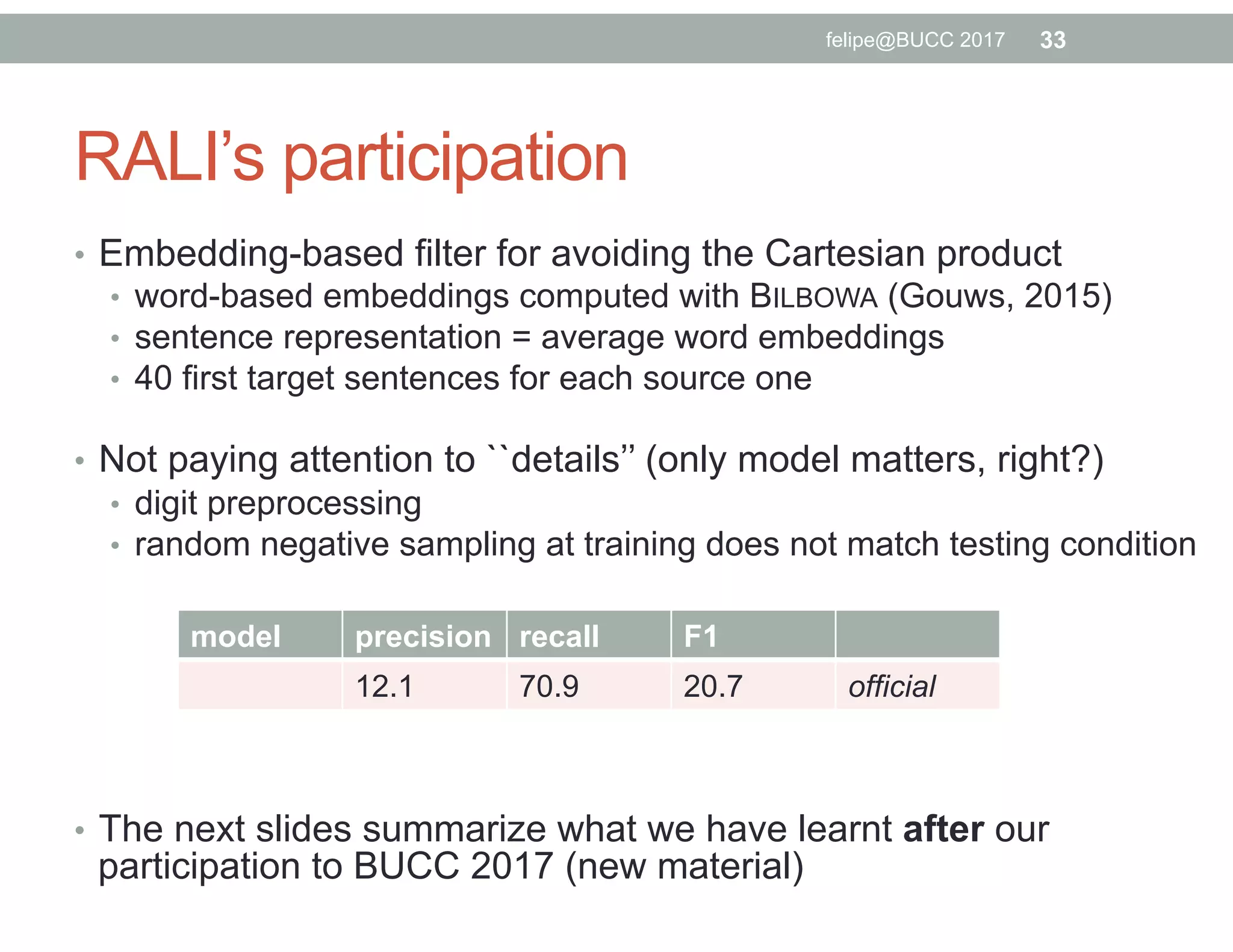
•  Embedding-based filter for avoiding the Cartesian product
•  word-based embeddings computed with BILBOWA (Gouws, 2015)
•  sentence representation = average word embeddings
•  40 first target sentences for each source one
•  Not paying attention to ``details’’ (only model matters, right?)
•  digit preprocessing
•  random negative sampling at training does not match testing condition
•  The next slides summarize what we have learnt after our
participation to BUCC 2017 (new material)
model precision recall F1
12.1 70.9 20.7 official
33felipe@BUCC 2017
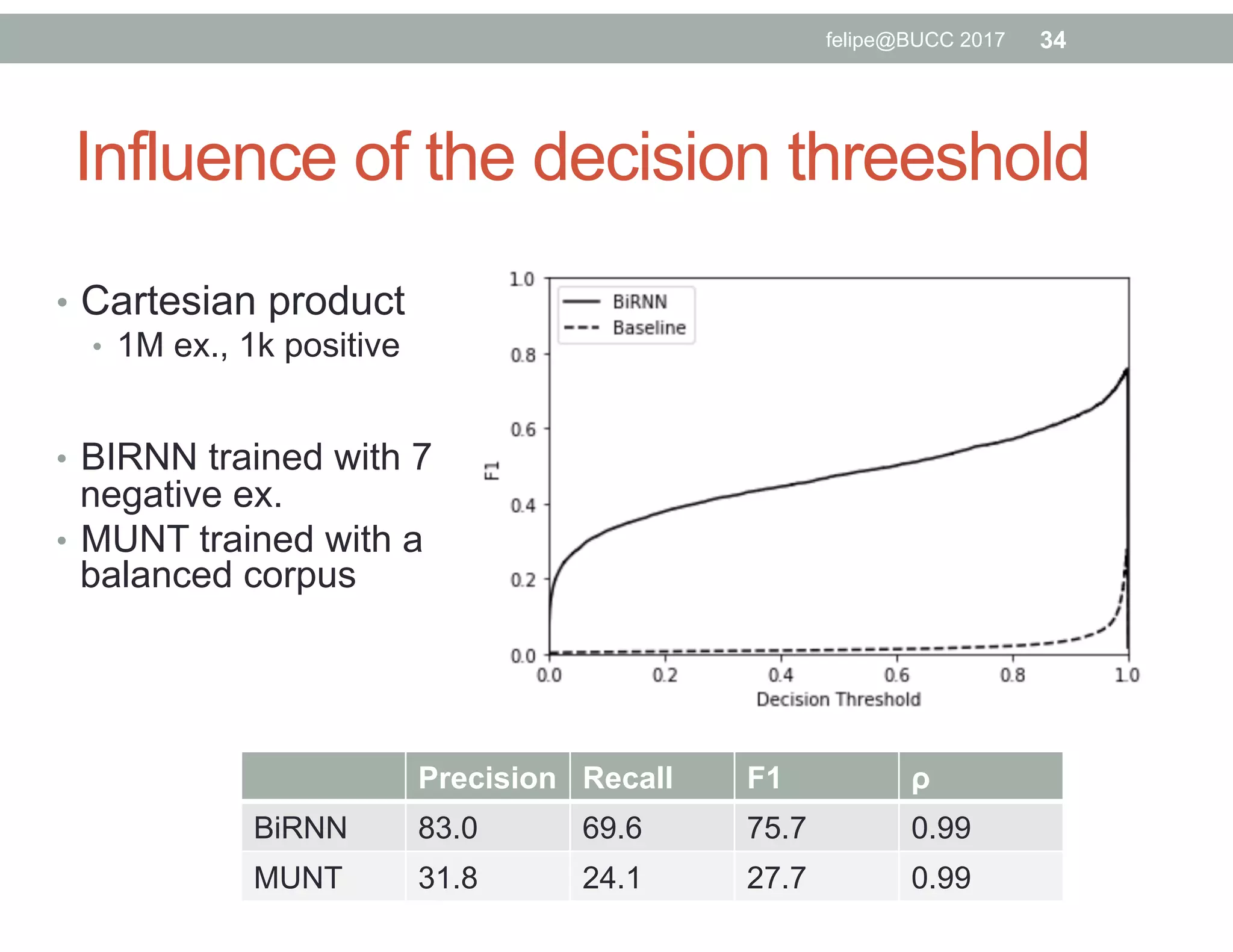
Influence of the decision threeshold
•  Cartesian product
•  1M ex., 1k positive
•  BIRNN trained with 7
negative ex.
•  MUNT trained with a
balanced corpus
Precision Recall F1 ρ
BiRNN 83.0 69.6 75.7 0.99
MUNT 31.8 24.1 27.7 0.99
34felipe@BUCC 2017
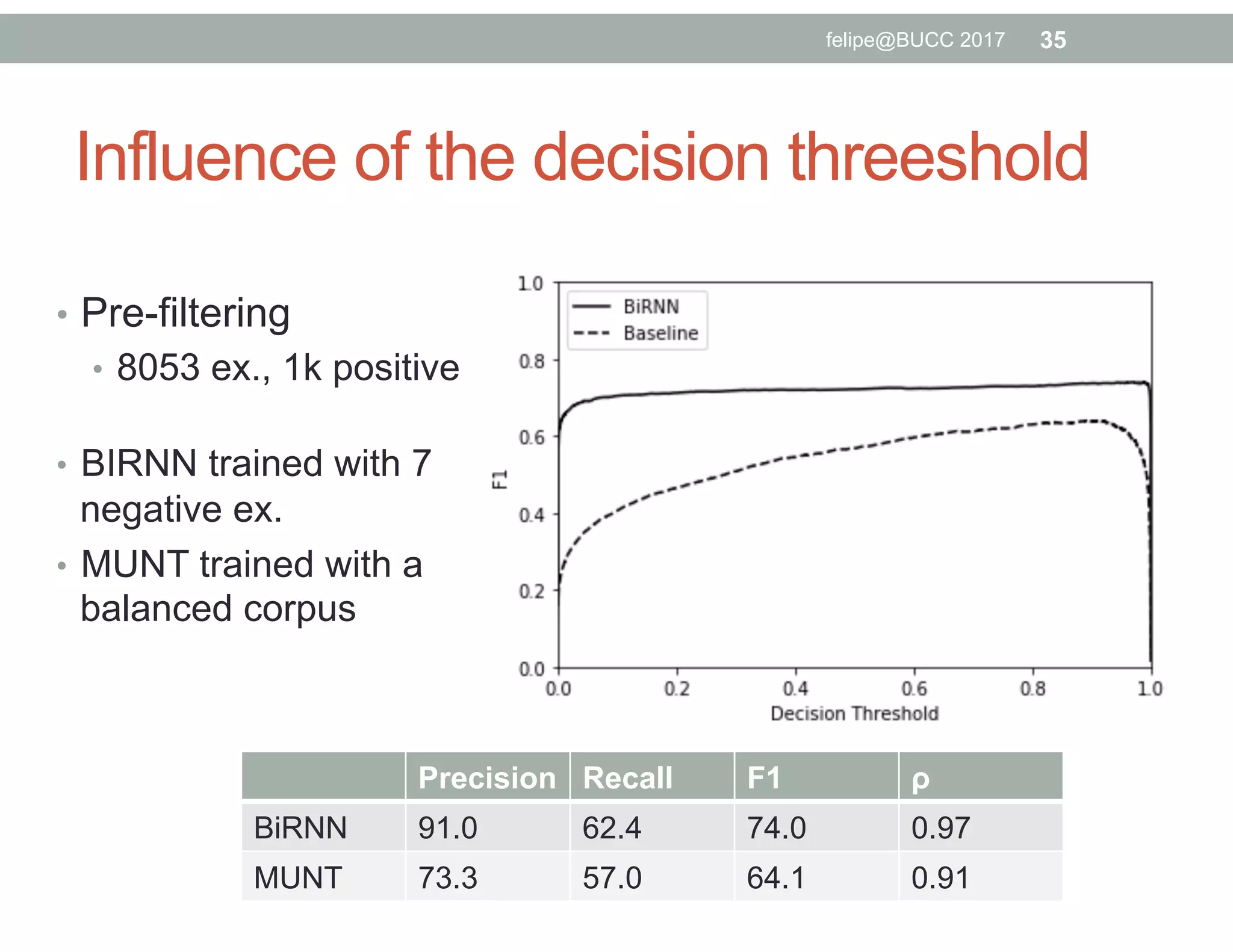
Influence of the decision threeshold
•  Pre-filtering
•  8053 ex., 1k positive
•  BIRNN trained with 7
negative ex.
•  MUNT trained with a
balanced corpus
Precision Recall F1 ρ
BiRNN 91.0 62.4 74.0 0.97
MUNT 73.3 57.0 64.1 0.91
35felipe@BUCC 2017
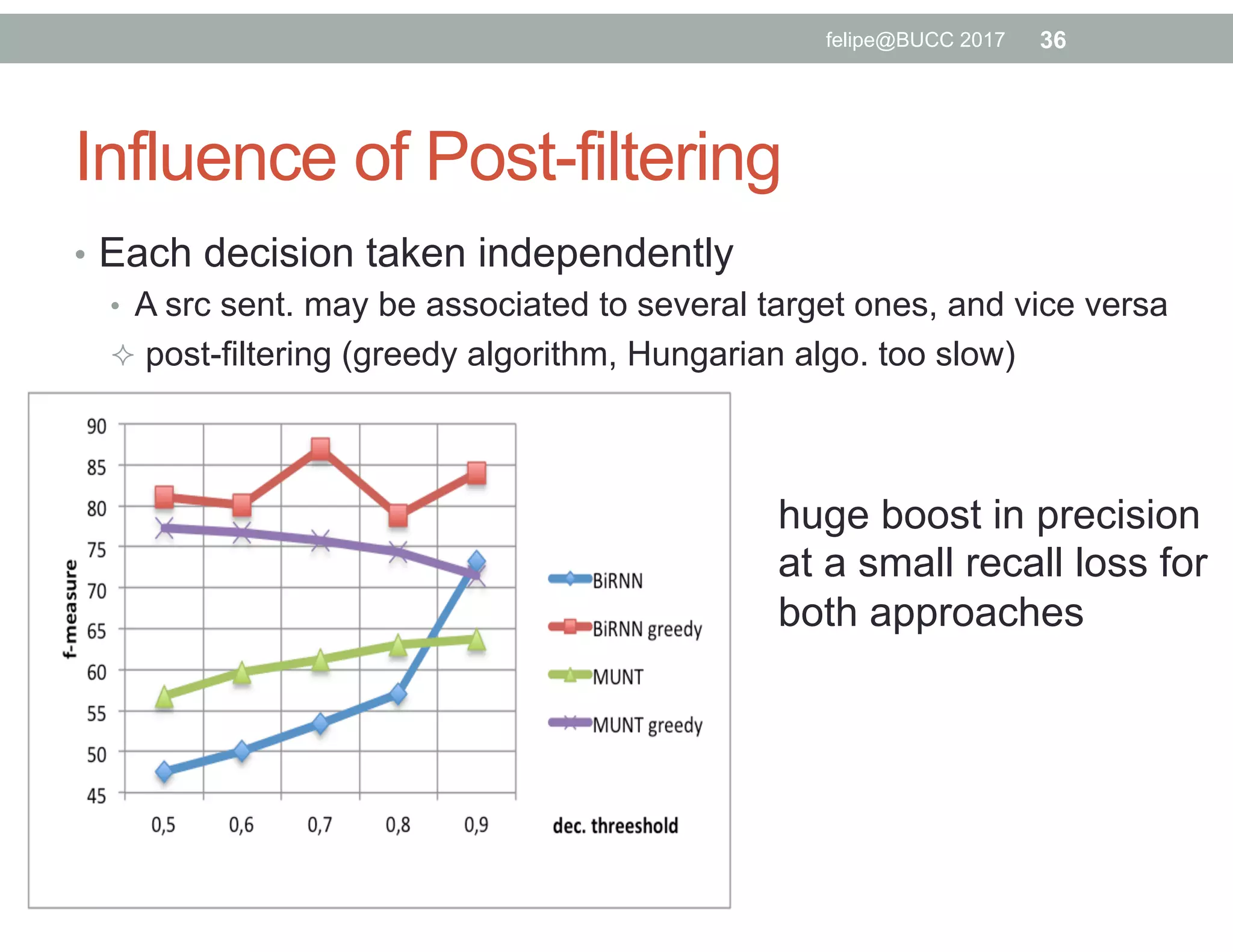
Influence of Post-filtering
•  Each decision taken independently
•  A src sent. may be associated to several target ones, and vice versa
²  post-filtering (greedy algorithm, Hungarian algo. too slow)
huge boost in precision
at a small recall loss for
both approaches
36felipe@BUCC 2017
Plan
  Data Management (Acquisition and Organization)
•  What has been done
•  What (I feel) is still missing
•  Domain specific bilingual parallel and comparable corpora
•  Assessing the quality/usefulness of a pair of documents
  Parallel Material Extraction from a Comparable
Corpus
•  Document pairs
•  Sentence pairs
•  Word pairs
37felipe@BUCC 2017
Bilingual Lexicon Induction
•  Received a lot of attention
•  Pioneering works: (Rapp, 1995; Fung, 1995)
•  See (Sharoff et al., 2013)
•  Revisited as a way to measure the quality of word
embeddings
•  Seminal work of (Mikolov et al., 2013)
•  Comprehensive comparisons
•  (Levy et al., 2014, 2017; Upadhyay et al., 2016)
38felipe@BUCC 2017
Bilingual Lexicon Induction
(Jakubina & Langlais; 2016)
•  We thoroughly revisited those approaches:
•  (Rapp, 1995)
•  (Mikolov et al. 2013)
•  training the projection matrix with the toolkit of (Dinu and Baroni, 2015)
•  (Faruqui and Dyer, 2014)
•  and a few others, but without success
•  investigating their meta-parameters
•  paying attention to the frequency of the terms
•  after (Pekar et al, 2006)
•  showing their complementarity
39felipe@BUCC 2017
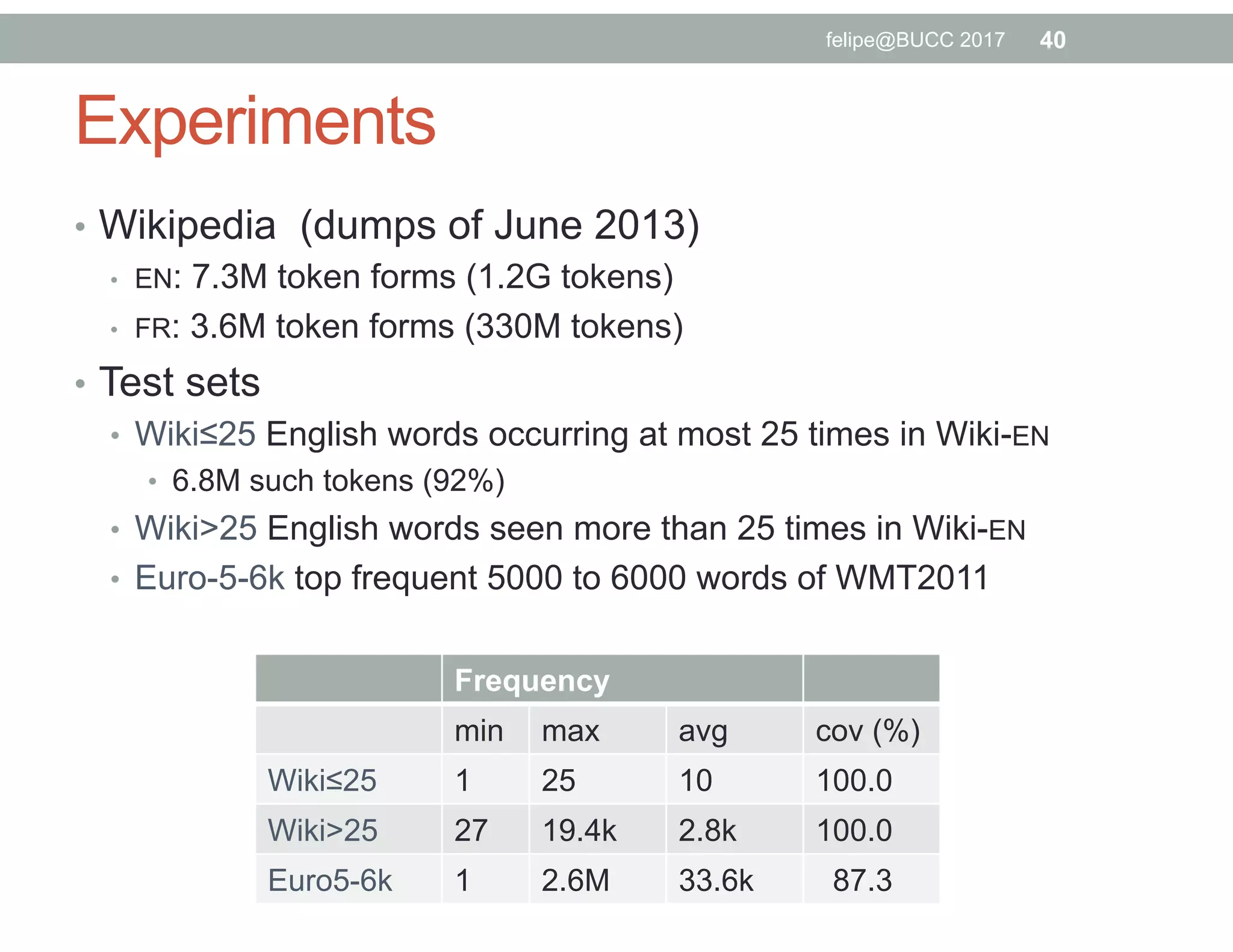
Experiments
•  Wikipedia (dumps of June 2013)
•  EN: 7.3M token forms (1.2G tokens)
•  FR: 3.6M token forms (330M tokens)
•  Test sets
•  Wiki≤25 English words occurring at most 25 times in Wiki-EN
•  6.8M such tokens (92%)
•  Wiki>25 English words seen more than 25 times in Wiki-EN
•  Euro-5-6k top frequent 5000 to 6000 words of WMT2011
Frequency
min max avg cov (%)
Wiki≤25 1 25 10 100.0
Wiki>25 27 19.4k 2.8k 100.0
Euro5-6k 1 2.6M 33.6k 87.3
40felipe@BUCC 2017
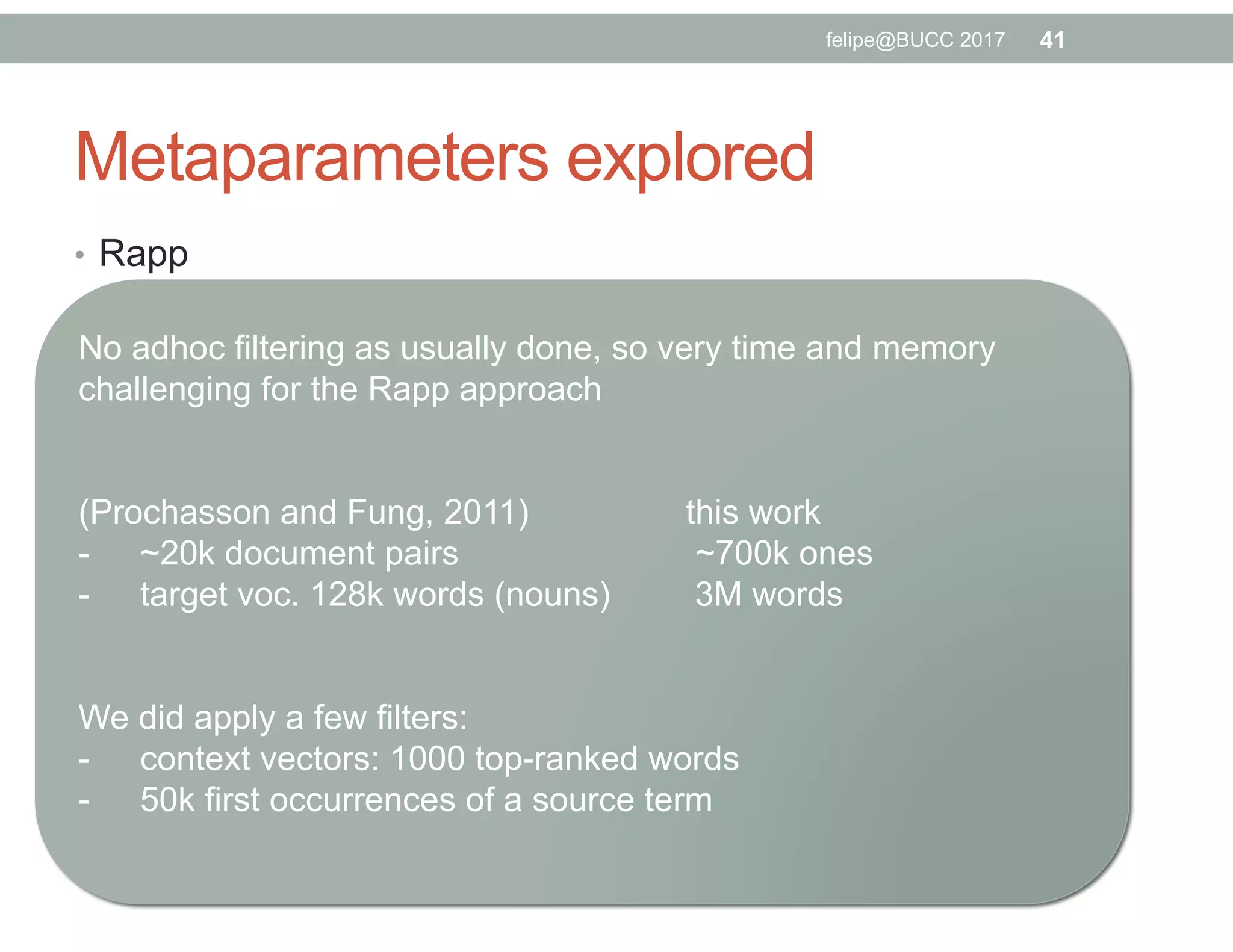
Metaparameters explored
•  Rapp
•  window size (3,7,15,31)
•  association measure (LLR, discontinuous odd-ratios)
•  projecting UNK words (yes, no)
•  similarity measure (fixed, cosine similarity)
•  seed lexicon (fixed, in-house 107k entries)
•  Word2Vec
•  skip-gram versus continuous bag-of-word
•  negative sampling (5 or 10) versus hierarchical softmax
•  window size (6,10,20,30)
•  dimension (from 50 up to 250 for SKG and 200 for CBOW)
•  seed lexicon (2k-low, 5-high, 5k-rand)
•  Faruqui & Dyer
•  ratio (0.5, 0.8 and 1.0)
•  fixed dimension (the best one for Word2Vec)
41felipe@BUCC 2017
No adhoc filtering as usually done, so very time and memory
challenging for the Rapp approach
(Prochasson and Fung, 2011) this work
-  ~20k document pairs ~700k ones
-  target voc. 128k words (nouns) 3M words
We did apply a few filters:
-  context vectors: 1000 top-ranked words
-  50k first occurrences of a source term
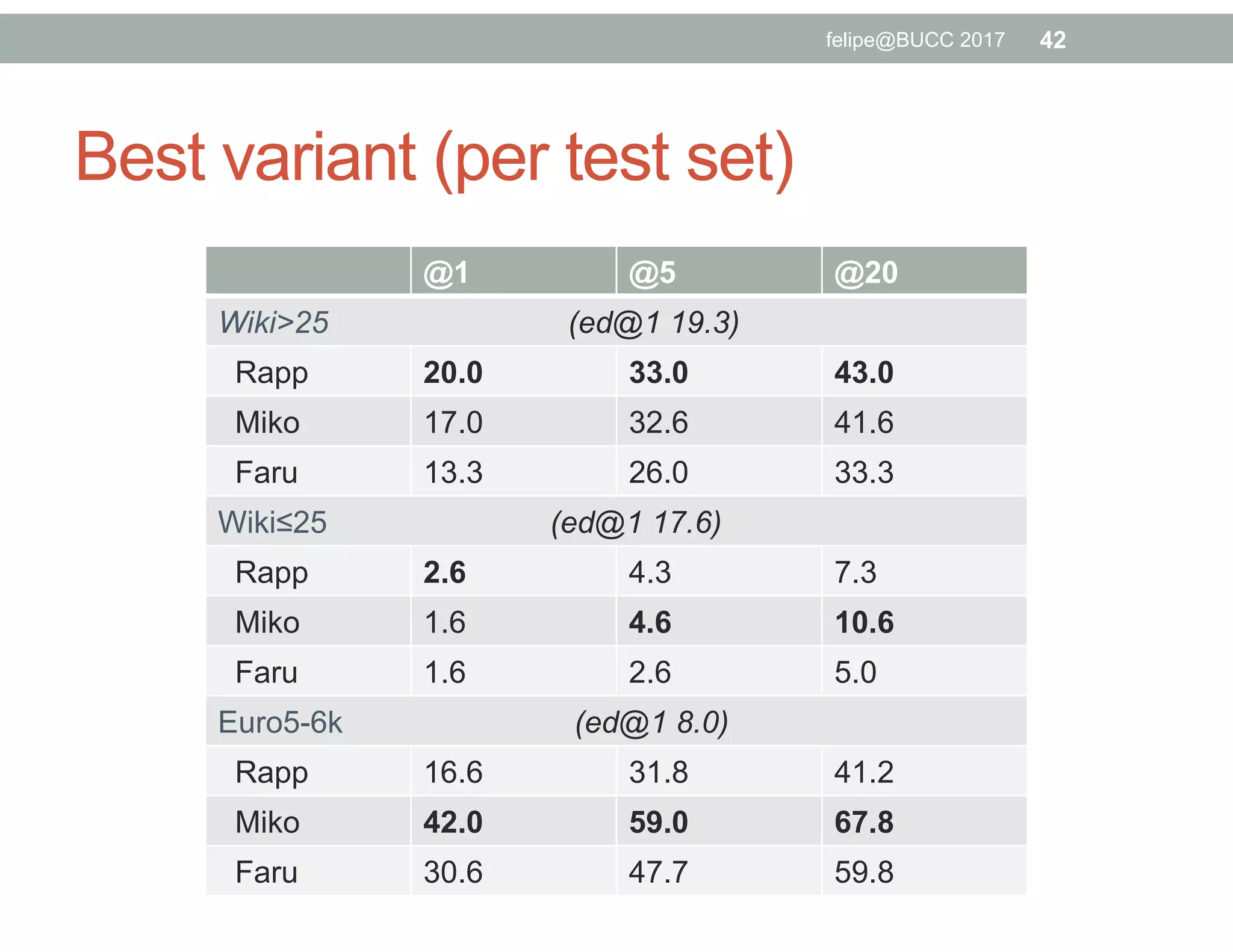
Best variant (per test set)
@1 @5 @20
Wiki>25 (ed@1 19.3)
Rapp 20.0 33.0 43.0
Miko 17.0 32.6 41.6
Faru 13.3 26.0 33.3
Wiki≤25 (ed@1 17.6)
Rapp 2.6 4.3 7.3
Miko 1.6 4.6 10.6
Faru 1.6 2.6 5.0
Euro5-6k (ed@1 8.0)
Rapp 16.6 31.8 41.2
Miko 42.0 59.0 67.8
Faru 30.6 47.7 59.8
42felipe@BUCC 2017
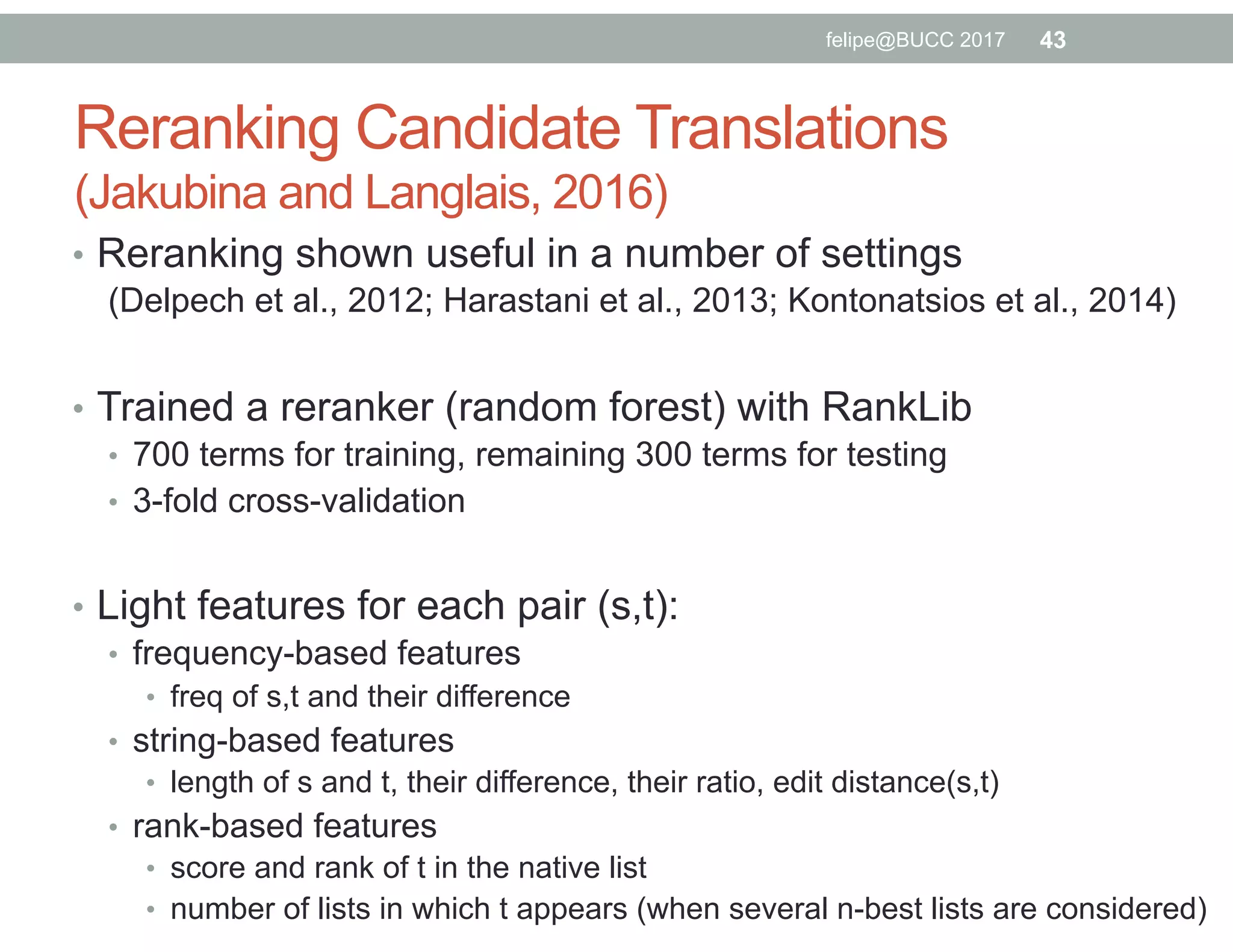
Reranking Candidate Translations
(Jakubina and Langlais, 2016)
•  Reranking shown useful in a number of settings
(Delpech et al., 2012; Harastani et al., 2013; Kontonatsios et al., 2014)
•  Trained a reranker (random forest) with RankLib
•  700 terms for training, remaining 300 terms for testing
•  3-fold cross-validation
•  Light features for each pair (s,t):
•  frequency-based features
•  freq of s,t and their difference
•  string-based features
•  length of s and t, their difference, their ratio, edit distance(s,t)
•  rank-based features
•  score and rank of t in the native list
•  number of lists in which t appears (when several n-best lists are considered)
43felipe@BUCC 2017
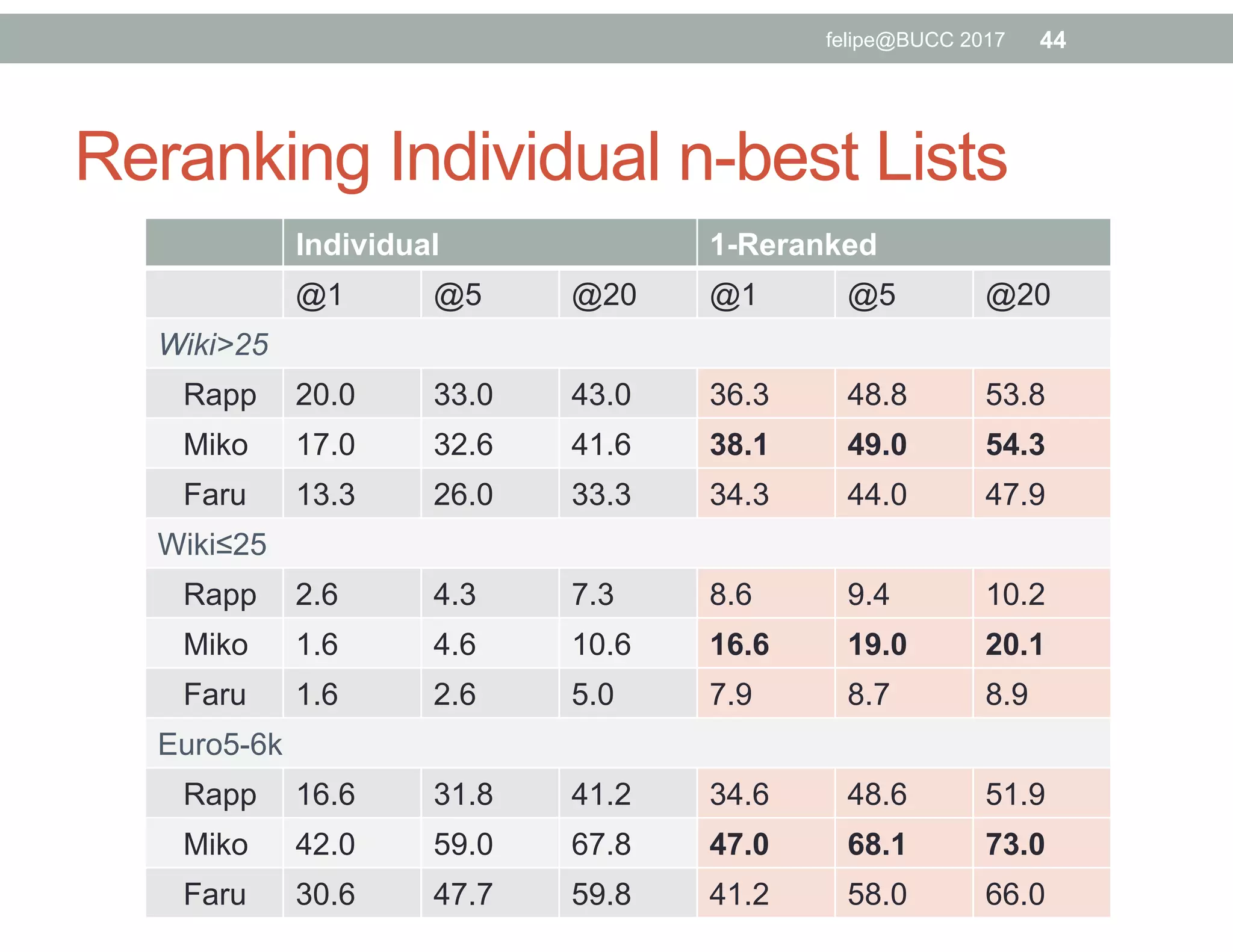
Reranking Individual n-best Lists
Individual 1-Reranked
@1 @5 @20 @1 @5 @20
Wiki>25
Rapp 20.0 33.0 43.0 36.3 48.8 53.8
Miko 17.0 32.6 41.6 38.1 49.0 54.3
Faru 13.3 26.0 33.3 34.3 44.0 47.9
Wiki≤25
Rapp 2.6 4.3 7.3 8.6 9.4 10.2
Miko 1.6 4.6 10.6 16.6 19.0 20.1
Faru 1.6 2.6 5.0 7.9 8.7 8.9
Euro5-6k
Rapp 16.6 31.8 41.2 34.6 48.6 51.9
Miko 42.0 59.0 67.8 47.0 68.1 73.0
Faru 30.6 47.7 59.8 41.2 58.0 66.0
44felipe@BUCC 2017
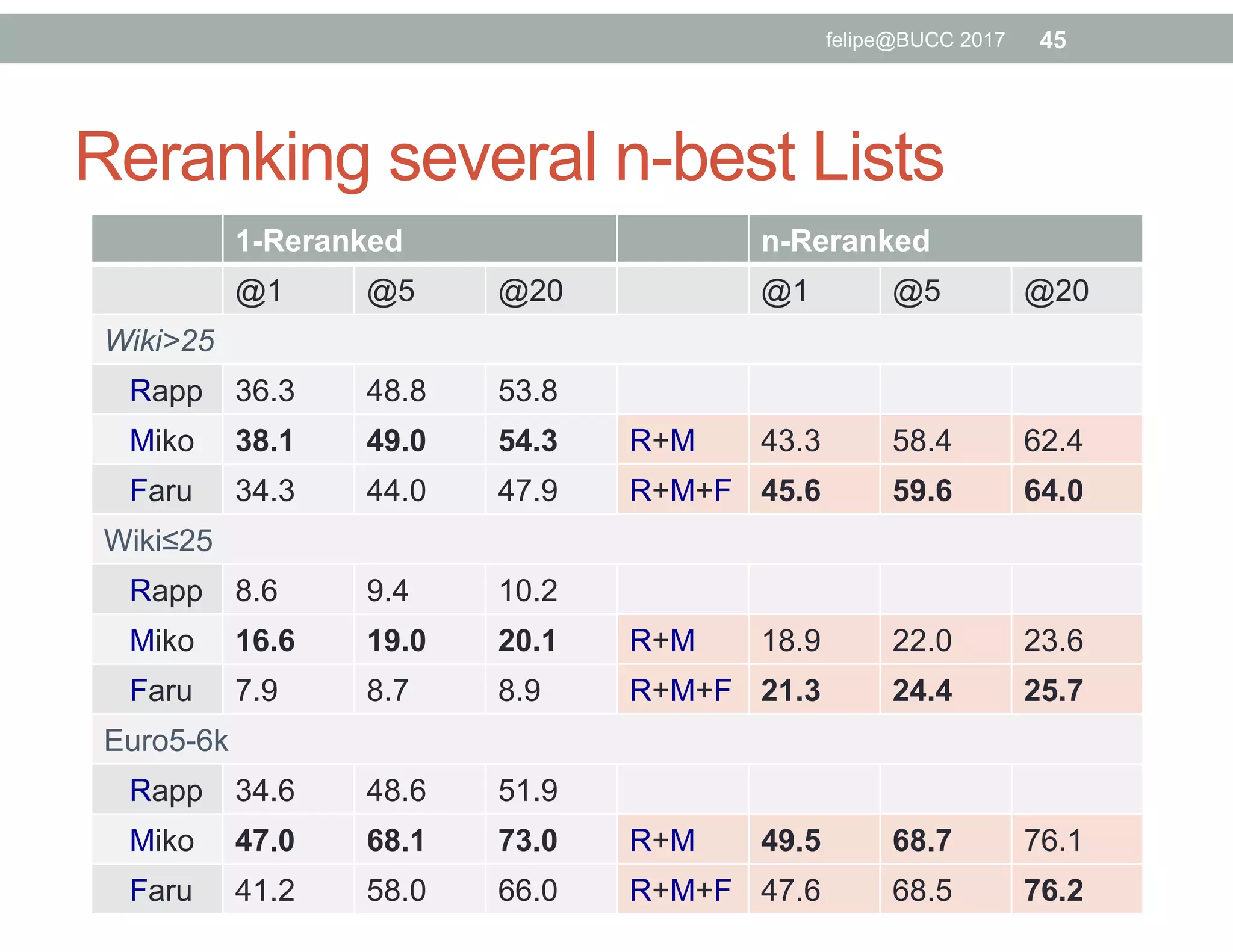
Reranking several n-best Lists
1-Reranked n-Reranked
@1 @5 @20 @1 @5 @20
Wiki>25
Rapp 36.3 48.8 53.8
Miko 38.1 49.0 54.3 R+M 43.3 58.4 62.4
Faru 34.3 44.0 47.9 R+M+F 45.6 59.6 64.0
Wiki≤25
Rapp 8.6 9.4 10.2
Miko 16.6 19.0 20.1 R+M 18.9 22.0 23.6
Faru 7.9 8.7 8.9 R+M+F 21.3 24.4 25.7
Euro5-6k
Rapp 34.6 48.6 51.9
Miko 47.0 68.1 73.0 R+M 49.5 68.7 76.1
Faru 41.2 58.0 66.0 R+M+F 47.6 68.5 76.2
45felipe@BUCC 2017
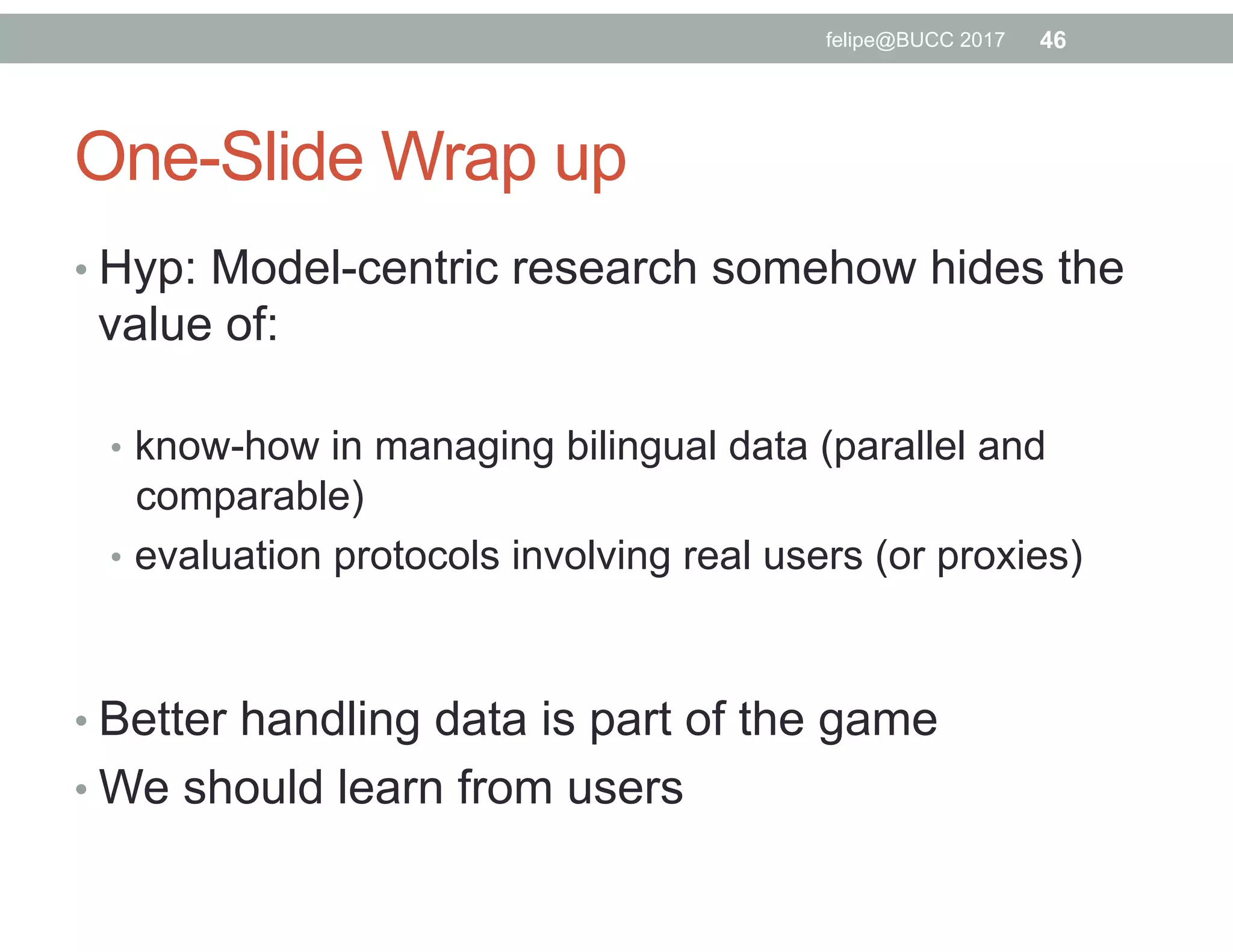
One-Slide Wrap up
• Hyp: Model-centric research somehow hides the
value of:
•  know-how in managing bilingual data (parallel and
comparable)
•  evaluation protocols involving real users (or proxies)
• Better handling data is part of the game
• We should learn from users
felipe@BUCC 2017 46
Thank you for your attention
felipe@BUCC 2017 47

Philippe Langlais - 2017 - Users and Data: The Two Neglected Children of Bilingual Natural Language Processing Research

  • 2.
    NLP Research Today… Models, models, models, models (preferably deep ones) 1felipe@BUCC 2017
  • 3.
    But User Matterstoo • Not much reflected in current evaluation protocols • e.g. how useful is a model that can identify the translation of frequent words at an accuracy of 40% ? • Smart evaluations do exist though • (Sharoff et al., 2006) for translating difficult MWEs 2felipe@BUCC 2017
  • 4.
  • 5.
    TransSearch •  Users aretolerant to alignment problems •  We implemented a detector of erroneous alignments but decided not to integrate it •  We tested a number of alignment models but used one of the simplest (IBM model 2 with contiguity constraint) •  Users care more about translation diversity in the top candidate list •  so clustering translations is of better use for a user •  See (Bourdaillet et al., 2010) 4felipe@BUCC 2017
  • 6.
  • 7.
    TransType •  Keystroke savingis a poor measure of the usefulness of the tool •  often, users do not watch the screen… (Langlais et al., 2002) •  Cognitive load for reading completions •  predicting when a user will find a completion useful is a plus (Foster et al., 2002) •  Users do not like repetitive errors •  adapting online is important (Nepveu et al., 2004) See (Gonzales-Rubio et al., 2012) for advances in targeted mediated interactive MT 6felipe@BUCC 2017
  • 8.
    And Data Matterstoo • Often the main issue • once you have data, use your ``best hammer’’ • e.g. • domain specific MT • organizing a dataflow • Know-how in handling Users and Data is in need in practical settings • but not much rewarded academically 7felipe@BUCC 2017
  • 9.
    Of course … • Bettermodels are important ! • e.g. NMT (Sutskever et al., 2014; Cho et al., 2014; Bahdanau et al., 2014) • simpler (single model) • better results • (Bentivogli et al., 2016; Isabelle et al.; 2017) • good properties for further improvements • multilingual • continuously learning • multi-tasking, etc. • And have the potential to impact users 8felipe@BUCC 2017
  • 10.
    Plan   Data Management(Acquisition and Organization) •  What has been done •  What (I feel) is still missing •  Domain specific bilingual parallel and comparable corpora •  Assessing the quality/usefulness of a pair of documents   Parallel Material Extraction from a Comparable Corpus •  Document pairs •  Sentence pairs •  Word pairs 9felipe@BUCC 2017
  • 11.
    Data Management Overview Web felipe@BUCC2017 10 crawling dispatching parallel quasi- comparable comparable sentence alignment parallel pair extraction parallel fragment extraction parallel material update Input •  seed terms/urls •  documents of interest (mono or bilingual) Objective •  e.g. improving a generic SMT engine
  • 12.
    Data Management: Whathas been done •  Web2ParallelDoc/Sent •  BITS (Ma & Liberman, 1999) •  a sensible pipeline, leveraging lexicons, cognates and a list of webdomains •  PTMiner (Chen & Nie, 2000), STRAND (Resnik & Smith, 2003) •  rule-based URL matching, HTML-tag and lexicon-based pairing •  (Nadeau & Foster, 2004; Fry 2005) •  specific to newswire feeds •  WebMining (Tomas et al., 2005) •  pipeline which only requires a list of bilingual websites (dictionaries are trained online) •  (Fukushima, et al., 2006) •  leveraging a dictionary2graph algorithm, and paying attention to speed issues •  BABYLON (Mohler and Mihalcea, 2008) •  low-density language oriented, a pipeline which input is a source document •  BITEXTOR (Espla-Gomis et Forcada, 2010) •  pipeline of URL- and content-based matching •  See (Kulkarni, 2012) for a survey 11felipe@BUCC 2017
  • 13.
    Data Management: Whathas been done •  Notable Large-scale Efforts •  (Callisson-Burch et al., 2009) •  10^9 word parallel corpus crawled from specific URLs, URL-based pairing, sentence alignment (Moore 2002) + cleaning: 105M sentence pairs •  (Uszkoreit et al., 2010) •  parallel document detection using MT and near-duplicate detection •  2.5B webpages crawled from the Web + 1.5M public-domain books •  24 hours on a 2000-node cluster •  (Ture & Lin, 2012) •  English-German parallel sentences extracted from Wikipedia tackling the cross-lingual pairwise similarity problem without heuristics •  (Smith et al., 2013) •  Open-source extension of STRAND, impressive deployment on the CommonCrawl corpus (32TB), using Amazon’s elastic map-reduce 12felipe@BUCC 2017
  • 14.
    Data Management: Issues • No systematic comparison of those systems •  Not much sensibility to specific domains •  Crawling •  which input? manual set of webdomains / urls / terms ? •  iterative or not ? •  concerns: efficiency, coverage, resources expected •  Dispatching •  grade a pair of documents (Li and Gaussier, 2010; Fung and Cheung, 2004; Babych and Hartley, 2014) •  measure of the usefulness of a resource (Barker and Gaizauskas, 2012) •  Bootstrapping •  model/lexicon update (Fung and Cheung, 2004) felipe@BUCC 2017 13
  • 15.
    • Experiments in thosedirections would lead to : • a better know-how •  valuable in practical (industry) settings • a shared repository of domain specific collections •  as OPUS for parallel texts (Tiedmann, 2012) • (potentially) a reference bilingual collection where all parallel units are marked •  would help measuring progress •  ease reproducibility felipe@BUCC 2017 14 Data Management: Issues
  • 16.
    About Domain SpecificCC •  Domain specific crawling (monolingual) •  WebBootCat (Baroni and Bernardini, 2004) •  TerminoWeb (Barrière and Agbago, 2006) •  Babouk (De Groc, 2011) •  (Azoulay, 2017) considering only pdf files •  Specialized (bilingual) comparable corpora acquisition •  See the ACCURAT project (Pinnis et al., 2012; Aker et al., 2012) •  METRICC (Alonso et al., 2012) •  Not just a matter of quantity (Morin et al., 2007) 15felipe@BUCC 2017
  • 17.
    Plan   Data Management(Acquisition and Organization) •  What has been done •  What (I feel) is still missing •  Domain specific bilingual parallel and comparable corpora •  Assessing the quality/usefulness of a pair of documents   Parallel Material Extraction from a Comparable Corpus •  Document pairs •  Sentence pairs •  Word pairs 16felipe@BUCC 2017
  • 18.
    Identifying parallel documents • Has received some attention (see previous slides) •  (Enright and Kondrak, 2010) •  nb of shared hapax words •  (Uszkoreit et al., 2010) •  machine translation + monolingual duplicates detection •  (Patry and Langlais, 2011) •  light doc. representation + IR + classifier •  Often just one component of a pipeline which is not evaluated as such 17felipe@BUCC 2017
  • 19.
    Paradocs (Patry andLanglais, 2011) •  Light way of representing a document: •  sequence of numerical entities •  sequence of hapax words (of at least 4 symbols) •  sequence of punctuations . ! ? ( ) : as in (Nadeau and Foster 2004) •  Avoid Cartesian product thanks to IR •  no need for a bilingual lexicon •  Train a classifier to recognize parallel documents •  normalized edit-distance between each sequence representation •  count of each entity (numerals, punctuations, hapaxes) 18felipe@BUCC 2017
  • 20.
    Paradocs: Avoiding theCartesian product Europarl setting - 6000 bitexts per language pair - Dutch2English §  nodoc: no document returned by Lucene §  nogood: no good document returned (n=20) Ø  >40% of failure for very short documents (<10 sentences) Ø  15% for long documents (>64 sentences) 19felipe@BUCC 2017
  • 21.
    WMT 2016 SharedTask on Bilingual Document Alignment •  Goal: better understanding best practices •  11 teams, 21 systems submitted (+ 1 baseline) •  Easy entrance task: •  train: 49 webdomains crawled (ex: virtualhospice.ca) •  only HTML pages considered •  text pre-extracted, duplicates removed, language pre-identified (en-fr), machine translation provided •  test: 203 other webdomains •  evaluation: •  retrieving 2400 pairs of documents known parallel (within webdomains) •  strict rule: a target document should be proposed at most once 20felipe@BUCC 2017
  • 22.
    RALI’s participation (Jakubina andLanglais, 2016) •  motivation: simplicity ! •  no use of MT, eventually even no lexicon-based translation •  an IR approach (Lucene-based) comparing/combining •  IR (monolingual) •  CLIR (based on a bilingual lexicon for « translating ») •  a simple but efficient URL-based IR (tokenizing URLs) •  badLuc ended up with a recall of 79.3% •  the best system recorded 95% •  the organizers’ baseline 59.8% 21felipe@BUCC 2017
  • 23.
    Results on train Strategy@1 text monolingual default 6.4 default+tok 35.4 best (w/o length) 64.9 best (w length) 76.6 text bilingual best (w length) 83.3 url baseline WMT16 67.9 best 80.1 badLuc w/o post-treat 88.6 w post-treat 92.1 •  Playing with metaparameters helps a lot •  Applying a length filter also helps a lot •  Involving translation is a must •  even with a simple lexicon (which covers ~half of the words in the collection) •  Our URL variant is performing impressively well •  outperforms the baseline •  useful on short documents •  Combining both indexes (text and urls) helps •  Post-filtering is a plus 22felipe@BUCC 2017
  • 24.
    Plan   Data Management(Acquisition and Organization) •  What has been done •  What (I feel) is still missing •  Domain specific bilingual parallel and comparable corpora •  Assessing the quality/usefulness of a pair of documents   Parallel Material Extraction from a Comparable Corpus •  Document pairs •  Sentence pairs •  Word pairs 23felipe@BUCC 2017
  • 25.
    MUNT (Bérard, 2014) Areimplementation of (Munteanu and Marcu, 2005) with features borrowed from (Smith et al., 2010) 24felipe@BUCC 2017
  • 26.
    MUNT (Bérard, 2014) • classifier(logistic regression) •  31 features •  length based, alignment-based features, fertility, etc. • pre-filter (selecting interesting sentence pairs) •  ratio of sentence length no greater than 2 •  at least 50% of tokens with alignment in the other side •  removes ~98% of the Cartesian product !! 25felipe@BUCC 2017
  • 27.
    MUNT on Wikipedia • Done before (Smith et al., 2010) •  Wikipedia dump (2014) felipe@BUCC 2017 26 #articles #paired #sent. #tokens en 4.5M 919k 29.3M 630.8M fr 1.5M 919k 16.8M 354.5M •  Configuration (default) -  lexicon trained with GIZA++ on 100k sentence pairs of Europarl -  classifier trained on 800 positive and 800 negative examples of news data, threeshold: 0.8
  • 28.
    MUNT on Wikipedia felipe@BUCC2017 27 Manually evaluated 500 (random) sentence pairs -  parallel -  quasi-parallel (at least partial) -  not parallel At the cellular level, the nervous system is defined by the presence of a special type of cell, called the neuron, also known as a ”nerve cell” . À l’échelle cellulaire, le système nerveux est défini par la présence de cellules hautement spécialisées appelées neurones, qui ont la capacité, très particulière, de véhiculer un signal électrochimique .
  • 29.
    MUNT on Wikipedia felipe@BUCC2017 28 grade % parallel 71 quasi-parallel 15 not parallel 14 We tried something odd: •  We applied Yasa (Lamraoui and Langlais, 2013) on Wikipedia article pairs (pretending they were parallel) •  Asked MUNT to classify the sentence pairs identified grade % parallel 48 quasi-parallel 16 not parallel 36 -  11M sentence pairs identified by Yasa -  1.6M kept parallel by MUNT -  1.3M once duplicate removed -  86% of sentence pairs are (quasi-)parallel -  much faster ! -  15 hours (on a cluster of 8 nodes) -  MUNT detected 2.61M sentence pairs -  2.26M once duplicates removed -  1.92M after removing sentences shorter than 4 words -  64% of sentence pairs are (quasi-)parallel
  • 30.
    Munt on Wikipedia felipe@BUCC2017 29 •  50 comparable Wiki article pairs manually aligned at the sentence level (Rebout and Langlais, 2014) •  measured the performance of YASA and MUNT on those articles •  MUNT has a better precision, but a lower recall npara # parallel sentences nfr (nen) # sentences in fr (en) doc.
  • 31.
    BUCC 2017 SharedTask (Zweigenbaum et al., 2016) •  Detecting parallel sentences in a large text collection •  2 sets of monolingual Wikipedia sentences (2014 dumps): •  1.4M French sentences •  1.9M English sentences •  + 17k parallel sentences from News Commentary (v9) •  Evaluation: precision, recall, F1 •  pros •  no metadata (text-based) •  Cartesian product is large (with few positive examples) •  Smartness in inserting parallel sentences (to avoid simple solutions) •  cons •  Artificial task •  True parallel sentences in Wikipedia EN-FR are not known 30felipe@BUCC 2017
  • 32.
    RALI’s participation 31felipe@BUCC 2017 Willbe presented this afternoon (Grégoire and Langlais, 2017)
  • 33.
    RALI’s participation •  Training:Europarl v7 French-English •  first 500K sentence pairs •  negative sampling: random selection of sentence pairs •  Test: newstest2012 (out-domain) •  1000 first sentence pairs + noise •  Pre-processing •  maximum sentence length: 80 •  tokenization with Moses’ toolkit, lowercased •  mapping digits to 0 (e.g. 1982 -> 0000) 32felipe@BUCC 2017
  • 34.
    RALI’s participation •  Embedding-basedfilter for avoiding the Cartesian product •  word-based embeddings computed with BILBOWA (Gouws, 2015) •  sentence representation = average word embeddings •  40 first target sentences for each source one •  Not paying attention to ``details’’ (only model matters, right?) •  digit preprocessing •  random negative sampling at training does not match testing condition •  The next slides summarize what we have learnt after our participation to BUCC 2017 (new material) model precision recall F1 12.1 70.9 20.7 official 33felipe@BUCC 2017
  • 35.
    Influence of thedecision threeshold •  Cartesian product •  1M ex., 1k positive •  BIRNN trained with 7 negative ex. •  MUNT trained with a balanced corpus Precision Recall F1 ρ BiRNN 83.0 69.6 75.7 0.99 MUNT 31.8 24.1 27.7 0.99 34felipe@BUCC 2017
  • 36.
    Influence of thedecision threeshold •  Pre-filtering •  8053 ex., 1k positive •  BIRNN trained with 7 negative ex. •  MUNT trained with a balanced corpus Precision Recall F1 ρ BiRNN 91.0 62.4 74.0 0.97 MUNT 73.3 57.0 64.1 0.91 35felipe@BUCC 2017
  • 37.
    Influence of Post-filtering • Each decision taken independently •  A src sent. may be associated to several target ones, and vice versa ²  post-filtering (greedy algorithm, Hungarian algo. too slow) huge boost in precision at a small recall loss for both approaches 36felipe@BUCC 2017
  • 38.
    Plan   Data Management(Acquisition and Organization) •  What has been done •  What (I feel) is still missing •  Domain specific bilingual parallel and comparable corpora •  Assessing the quality/usefulness of a pair of documents   Parallel Material Extraction from a Comparable Corpus •  Document pairs •  Sentence pairs •  Word pairs 37felipe@BUCC 2017
  • 39.
    Bilingual Lexicon Induction • Received a lot of attention •  Pioneering works: (Rapp, 1995; Fung, 1995) •  See (Sharoff et al., 2013) •  Revisited as a way to measure the quality of word embeddings •  Seminal work of (Mikolov et al., 2013) •  Comprehensive comparisons •  (Levy et al., 2014, 2017; Upadhyay et al., 2016) 38felipe@BUCC 2017
  • 40.
    Bilingual Lexicon Induction (Jakubina& Langlais; 2016) •  We thoroughly revisited those approaches: •  (Rapp, 1995) •  (Mikolov et al. 2013) •  training the projection matrix with the toolkit of (Dinu and Baroni, 2015) •  (Faruqui and Dyer, 2014) •  and a few others, but without success •  investigating their meta-parameters •  paying attention to the frequency of the terms •  after (Pekar et al, 2006) •  showing their complementarity 39felipe@BUCC 2017
  • 41.
    Experiments •  Wikipedia (dumpsof June 2013) •  EN: 7.3M token forms (1.2G tokens) •  FR: 3.6M token forms (330M tokens) •  Test sets •  Wiki≤25 English words occurring at most 25 times in Wiki-EN •  6.8M such tokens (92%) •  Wiki>25 English words seen more than 25 times in Wiki-EN •  Euro-5-6k top frequent 5000 to 6000 words of WMT2011 Frequency min max avg cov (%) Wiki≤25 1 25 10 100.0 Wiki>25 27 19.4k 2.8k 100.0 Euro5-6k 1 2.6M 33.6k 87.3 40felipe@BUCC 2017
  • 42.
    Metaparameters explored •  Rapp • window size (3,7,15,31) •  association measure (LLR, discontinuous odd-ratios) •  projecting UNK words (yes, no) •  similarity measure (fixed, cosine similarity) •  seed lexicon (fixed, in-house 107k entries) •  Word2Vec •  skip-gram versus continuous bag-of-word •  negative sampling (5 or 10) versus hierarchical softmax •  window size (6,10,20,30) •  dimension (from 50 up to 250 for SKG and 200 for CBOW) •  seed lexicon (2k-low, 5-high, 5k-rand) •  Faruqui & Dyer •  ratio (0.5, 0.8 and 1.0) •  fixed dimension (the best one for Word2Vec) 41felipe@BUCC 2017 No adhoc filtering as usually done, so very time and memory challenging for the Rapp approach (Prochasson and Fung, 2011) this work -  ~20k document pairs ~700k ones -  target voc. 128k words (nouns) 3M words We did apply a few filters: -  context vectors: 1000 top-ranked words -  50k first occurrences of a source term
  • 43.
    Best variant (pertest set) @1 @5 @20 Wiki>25 (ed@1 19.3) Rapp 20.0 33.0 43.0 Miko 17.0 32.6 41.6 Faru 13.3 26.0 33.3 Wiki≤25 (ed@1 17.6) Rapp 2.6 4.3 7.3 Miko 1.6 4.6 10.6 Faru 1.6 2.6 5.0 Euro5-6k (ed@1 8.0) Rapp 16.6 31.8 41.2 Miko 42.0 59.0 67.8 Faru 30.6 47.7 59.8 42felipe@BUCC 2017
  • 44.
    Reranking Candidate Translations (Jakubinaand Langlais, 2016) •  Reranking shown useful in a number of settings (Delpech et al., 2012; Harastani et al., 2013; Kontonatsios et al., 2014) •  Trained a reranker (random forest) with RankLib •  700 terms for training, remaining 300 terms for testing •  3-fold cross-validation •  Light features for each pair (s,t): •  frequency-based features •  freq of s,t and their difference •  string-based features •  length of s and t, their difference, their ratio, edit distance(s,t) •  rank-based features •  score and rank of t in the native list •  number of lists in which t appears (when several n-best lists are considered) 43felipe@BUCC 2017
  • 45.
    Reranking Individual n-bestLists Individual 1-Reranked @1 @5 @20 @1 @5 @20 Wiki>25 Rapp 20.0 33.0 43.0 36.3 48.8 53.8 Miko 17.0 32.6 41.6 38.1 49.0 54.3 Faru 13.3 26.0 33.3 34.3 44.0 47.9 Wiki≤25 Rapp 2.6 4.3 7.3 8.6 9.4 10.2 Miko 1.6 4.6 10.6 16.6 19.0 20.1 Faru 1.6 2.6 5.0 7.9 8.7 8.9 Euro5-6k Rapp 16.6 31.8 41.2 34.6 48.6 51.9 Miko 42.0 59.0 67.8 47.0 68.1 73.0 Faru 30.6 47.7 59.8 41.2 58.0 66.0 44felipe@BUCC 2017
  • 46.
    Reranking several n-bestLists 1-Reranked n-Reranked @1 @5 @20 @1 @5 @20 Wiki>25 Rapp 36.3 48.8 53.8 Miko 38.1 49.0 54.3 R+M 43.3 58.4 62.4 Faru 34.3 44.0 47.9 R+M+F 45.6 59.6 64.0 Wiki≤25 Rapp 8.6 9.4 10.2 Miko 16.6 19.0 20.1 R+M 18.9 22.0 23.6 Faru 7.9 8.7 8.9 R+M+F 21.3 24.4 25.7 Euro5-6k Rapp 34.6 48.6 51.9 Miko 47.0 68.1 73.0 R+M 49.5 68.7 76.1 Faru 41.2 58.0 66.0 R+M+F 47.6 68.5 76.2 45felipe@BUCC 2017
  • 47.
    One-Slide Wrap up • Hyp:Model-centric research somehow hides the value of: •  know-how in managing bilingual data (parallel and comparable) •  evaluation protocols involving real users (or proxies) • Better handling data is part of the game • We should learn from users felipe@BUCC 2017 46
  • 48.
    Thank you foryour attention felipe@BUCC 2017 47