Mr.Rahul G.Sawarkar
Asst.Professor
J.D.P.S.College,Daryapur.
Shri Shivaji Education Society Amravati
Introduction
Types of Electronic Transitions
Absorption law-Beer & Lambert law
Solvent Effects
Conjugated Dienes, Trienes & Polyenes
α,β-Unsaturated carbonyl compounds
Woodward-Fieser rules for:
Conjugated Diene
α,β-Unsaturated carbonyl compounds
References
Plan of
Lecture
UV-Visible (electronic) spectroscopy is used to measure
the multiple and aromatic conjugation within molecules.
UV Spectrum records the wavelength of an absorption
maximum and strength of absorption as defined Beer-Lambert
law.
Introduction
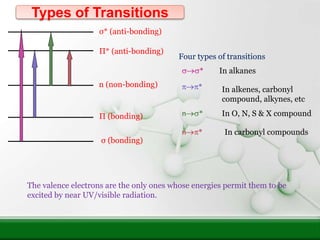
The valence electrons are the only ones whose energies permit them to be
excited by near UV/visible radiation.
σ (bonding)
П (bonding)
n (non-bonding)
σ* (anti-bonding)
П* (anti-bonding)
Four types of transitions
*
n*
n*
* In alkanes
In alkenes, carbonyl
compound, alkynes, etc
In O, N, S & X compound
In carbonyl compounds
Types of Transitions
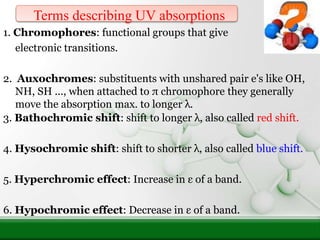
1. Chromophores: functional groups that give
electronic transitions.
2. Auxochromes: substituents with unshared pair e's like OH,
NH, SH ..., when attached to π chromophore they generally
move the absorption max. to longer λ.
3. Bathochromic shift: shift to longer λ, also called red shift.
4. Hysochromic shift: shift to shorter λ, also called blue shift.
5. Hyperchromic effect: Increase in ε of a band.
6. Hypochromic effect: Decrease in ε of a band.
Terms describing UV absorptions
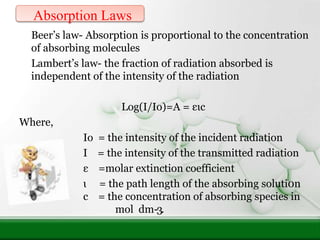
Beer’s law- Absorption is proportional to the concentration
of absorbing molecules
Lambert’s law- the fraction of radiation absorbed is
independent of the intensity of the radiation
Log(I/Io)=A = ειc
Where,
Io = the intensity of the incident radiation
I = the intensity of the transmitted radiation
ε =molar extinction coefficient
ι = the path length of the absorbing soluti0n
c = the concentration of absorbing species in
mol dm-3.
Absorption Laws
8
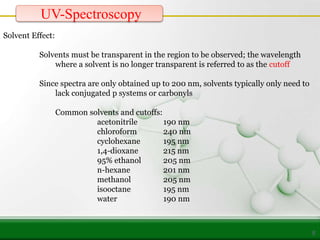
Solvent Effect:
Solvents must be transparent in the region to be observed; the wavelength
where a solvent is no longer transparent is referred to as the cutoff
Since spectra are only obtained up to 200 nm, solvents typically only need to
lack conjugated p systems or carbonyls
Common solvents and cutoffs:
acetonitrile 190 nm
chloroform 240 nm
cyclohexane 195 nm
1,4-dioxane 215 nm
95% ethanol 205 nm
n-hexane 201 nm
methanol 205 nm
isooctane 195 nm
water 190 nm
UV-Spectroscopy
9
UV Spectroscopy
Conjugated – Alkenes
The observed shifts from conjugation imply that an increase in
conjugation decreases the energy required for electronic excitation
From molecular orbital (MO) theory two atomic p orbitals, f1 and f2 from
two sp2 hybrid carbons combine to form two MOs Y1 and Y2* in ethylene
Y2*

Y1
f1 f2
10
UV Spectroscopy
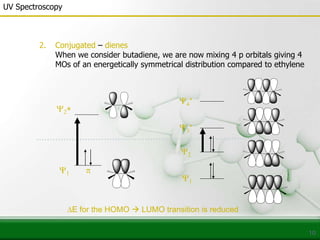
2. Conjugated – dienes
When we consider butadiene, we are now mixing 4 p orbitals giving 4
MOs of an energetically symmetrical distribution compared to ethylene
Y2*

Y1
Y1
Y2
Y3
*
Y4
*
DE for the HOMO  LUMO transition is reduced
11
UV Spectroscopy
Conjugation – Alkenes
Extending this effect out to longer conjugated systems the energy gap
becomes progressively smaller:
Energy
ethylene
butadiene
hexatriene
octatetraene
Lower energy =
Longer wavelengths
12
UV Spectroscopy
Woodward-Fieser Rules - Dienes
The rules begin with a base value for lmax of the chromophore being
observed:
acyclic butadiene = 217 nm
The incremental contribution of substituents is added to this base value
from the group tables:
Group Increment
Extended conjugation +30
Each exo-cyclic C=C +5
Alkyl +5
-OCOCH3 +0
-OR +6
-SR +30
-Cl, -Br +5
-NR2 +60
13
UV Spectroscopy
Woodward-Fieser Rules - Dienes
For example:
Isoprene - acyclic butadiene = 217 nm
one alkyl subs. + 5 nm
222 nm
Experimental value 220 nm
Allylidenecyclohexane
- acyclic butadiene = 217 nm
one exocyclic C=C + 5 nm
2 alkyl subs. +10 nm
232 nm
Experimental value 237 nm
14
UV Spectroscopy
Woodward-Fieser Rules – Cyclic Dienes
There are two major types of cyclic dienes, with two different base values
Heteroannular (transoid): Homoannular (cisoid):
e = 5,000 – 15,000 e = 12,000-28,000
base lmax = 214 base lmax = 253
The increment table is the same as for acyclic butadienes with a couple
additions:
Group Increment
Additional homoannular +39
Where both types of diene
are present, the one with
the longer l becomes the
base
15
UV Spectroscopy
Woodward-Fieser Rules – Cyclic Dienes
For example:
heteroannular diene = 214 nm
3 alkyl subs. (3 x 5) +15 nm
1 exo C=C + 5 nm
234 nm
Experimental value 235 nm
16
UV Spectroscopy
Carbonyl compound:
Enones
Carbonyls, as we have discussed have two primary electronic transitions:

*
n
Remember, the   * transition is
allowed and gives a high e, but lies
outside the routine range of UV
observation
The n  * transition is forbidden and
gives a very low e, but can routinely be
observed
17
UV Spectroscopy
Carbonyl compound:
Enones
These effects are apparent from the MO diagram for a conjugated enone:

Y1
Y2
Y3
*
Y4
*
*
n

*
n
O
O
18
UV Spectroscopy
Enones
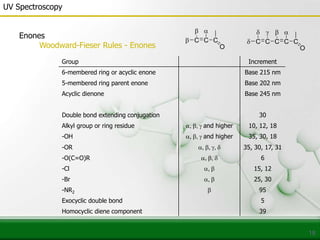
Woodward-Fieser Rules - Enones
Group Increment
6-membered ring or acyclic enone Base 215 nm
5-membered ring parent enone Base 202 nm
Acyclic dienone Base 245 nm
Double bond extending conjugation 30
Alkyl group or ring residue a, b, g and higher 10, 12, 18
-OH a, b, g and higher 35, 30, 18
-OR a, b, g, d 35, 30, 17, 31
-O(C=O)R a, b, d 6
-Cl a, b 15, 12
-Br a, b 25, 30
-NR2 b 95
Exocyclic double bond 5
Homocyclic diene component 39
C C C
b
b a
C C C
C
b a
C
g
d
d
O O
19
UV Spectroscopy
Enones
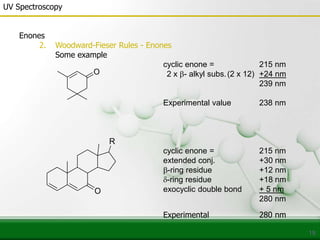
2. Woodward-Fieser Rules - Enones
Some example
cyclic enone = 215 nm
2 x b- alkyl subs.(2 x 12) +24 nm
239 nm
Experimental value 238 nm
cyclic enone = 215 nm
extended conj. +30 nm
b-ring residue +12 nm
d-ring residue +18 nm
exocyclic double bond + 5 nm
280 nm
Experimental 280 nm
O
R
O
References:
1.Introduction to Spectroscopy
By:
Donald L. Pavia
Gary M. Lampman
George S. Kriz
2.Organic Spectroscopy
By:
William Kemp
UV.pptx

UV.pptx

  • 1.
  • 2.
    Introduction Types of ElectronicTransitions Absorption law-Beer & Lambert law Solvent Effects Conjugated Dienes, Trienes & Polyenes α,β-Unsaturated carbonyl compounds Woodward-Fieser rules for: Conjugated Diene α,β-Unsaturated carbonyl compounds References Plan of Lecture
  • 3.
    UV-Visible (electronic) spectroscopyis used to measure the multiple and aromatic conjugation within molecules. UV Spectrum records the wavelength of an absorption maximum and strength of absorption as defined Beer-Lambert law. Introduction
  • 4.
    The valence electronsare the only ones whose energies permit them to be excited by near UV/visible radiation. σ (bonding) П (bonding) n (non-bonding) σ* (anti-bonding) П* (anti-bonding) Four types of transitions * n* n* * In alkanes In alkenes, carbonyl compound, alkynes, etc In O, N, S & X compound In carbonyl compounds Types of Transitions
  • 5.
    1. Chromophores: functionalgroups that give electronic transitions. 2. Auxochromes: substituents with unshared pair e's like OH, NH, SH ..., when attached to π chromophore they generally move the absorption max. to longer λ. 3. Bathochromic shift: shift to longer λ, also called red shift. 4. Hysochromic shift: shift to shorter λ, also called blue shift. 5. Hyperchromic effect: Increase in ε of a band. 6. Hypochromic effect: Decrease in ε of a band. Terms describing UV absorptions
  • 7.
    Beer’s law- Absorptionis proportional to the concentration of absorbing molecules Lambert’s law- the fraction of radiation absorbed is independent of the intensity of the radiation Log(I/Io)=A = ειc Where, Io = the intensity of the incident radiation I = the intensity of the transmitted radiation ε =molar extinction coefficient ι = the path length of the absorbing soluti0n c = the concentration of absorbing species in mol dm-3. Absorption Laws
  • 8.
    8 Solvent Effect: Solvents mustbe transparent in the region to be observed; the wavelength where a solvent is no longer transparent is referred to as the cutoff Since spectra are only obtained up to 200 nm, solvents typically only need to lack conjugated p systems or carbonyls Common solvents and cutoffs: acetonitrile 190 nm chloroform 240 nm cyclohexane 195 nm 1,4-dioxane 215 nm 95% ethanol 205 nm n-hexane 201 nm methanol 205 nm isooctane 195 nm water 190 nm UV-Spectroscopy
  • 9.
    9 UV Spectroscopy Conjugated –Alkenes The observed shifts from conjugation imply that an increase in conjugation decreases the energy required for electronic excitation From molecular orbital (MO) theory two atomic p orbitals, f1 and f2 from two sp2 hybrid carbons combine to form two MOs Y1 and Y2* in ethylene Y2*  Y1 f1 f2
  • 10.
    10 UV Spectroscopy 2. Conjugated– dienes When we consider butadiene, we are now mixing 4 p orbitals giving 4 MOs of an energetically symmetrical distribution compared to ethylene Y2*  Y1 Y1 Y2 Y3 * Y4 * DE for the HOMO  LUMO transition is reduced
  • 11.
    11 UV Spectroscopy Conjugation –Alkenes Extending this effect out to longer conjugated systems the energy gap becomes progressively smaller: Energy ethylene butadiene hexatriene octatetraene Lower energy = Longer wavelengths
  • 12.
    12 UV Spectroscopy Woodward-Fieser Rules- Dienes The rules begin with a base value for lmax of the chromophore being observed: acyclic butadiene = 217 nm The incremental contribution of substituents is added to this base value from the group tables: Group Increment Extended conjugation +30 Each exo-cyclic C=C +5 Alkyl +5 -OCOCH3 +0 -OR +6 -SR +30 -Cl, -Br +5 -NR2 +60
  • 13.
    13 UV Spectroscopy Woodward-Fieser Rules- Dienes For example: Isoprene - acyclic butadiene = 217 nm one alkyl subs. + 5 nm 222 nm Experimental value 220 nm Allylidenecyclohexane - acyclic butadiene = 217 nm one exocyclic C=C + 5 nm 2 alkyl subs. +10 nm 232 nm Experimental value 237 nm
  • 14.
    14 UV Spectroscopy Woodward-Fieser Rules– Cyclic Dienes There are two major types of cyclic dienes, with two different base values Heteroannular (transoid): Homoannular (cisoid): e = 5,000 – 15,000 e = 12,000-28,000 base lmax = 214 base lmax = 253 The increment table is the same as for acyclic butadienes with a couple additions: Group Increment Additional homoannular +39 Where both types of diene are present, the one with the longer l becomes the base
  • 15.
    15 UV Spectroscopy Woodward-Fieser Rules– Cyclic Dienes For example: heteroannular diene = 214 nm 3 alkyl subs. (3 x 5) +15 nm 1 exo C=C + 5 nm 234 nm Experimental value 235 nm
  • 16.
    16 UV Spectroscopy Carbonyl compound: Enones Carbonyls,as we have discussed have two primary electronic transitions:  * n Remember, the   * transition is allowed and gives a high e, but lies outside the routine range of UV observation The n  * transition is forbidden and gives a very low e, but can routinely be observed
  • 17.
    17 UV Spectroscopy Carbonyl compound: Enones Theseeffects are apparent from the MO diagram for a conjugated enone:  Y1 Y2 Y3 * Y4 * * n  * n O O
  • 18.
    18 UV Spectroscopy Enones Woodward-Fieser Rules- Enones Group Increment 6-membered ring or acyclic enone Base 215 nm 5-membered ring parent enone Base 202 nm Acyclic dienone Base 245 nm Double bond extending conjugation 30 Alkyl group or ring residue a, b, g and higher 10, 12, 18 -OH a, b, g and higher 35, 30, 18 -OR a, b, g, d 35, 30, 17, 31 -O(C=O)R a, b, d 6 -Cl a, b 15, 12 -Br a, b 25, 30 -NR2 b 95 Exocyclic double bond 5 Homocyclic diene component 39 C C C b b a C C C C b a C g d d O O
  • 19.
    19 UV Spectroscopy Enones 2. Woodward-FieserRules - Enones Some example cyclic enone = 215 nm 2 x b- alkyl subs.(2 x 12) +24 nm 239 nm Experimental value 238 nm cyclic enone = 215 nm extended conj. +30 nm b-ring residue +12 nm d-ring residue +18 nm exocyclic double bond + 5 nm 280 nm Experimental 280 nm O R O
  • 20.
    References: 1.Introduction to Spectroscopy By: DonaldL. Pavia Gary M. Lampman George S. Kriz 2.Organic Spectroscopy By: William Kemp