Testosterone
(Sex Hormone)
Faizan Akram
Roll # 152
Final Professional (Eve)
Faizanbwp@Hotmail.com;
Agenda
 What is Hormone
 What are sex hormone
 Testosterone (Structure)
 Mechanism of Action
 Synthesis
 SAR of Testosterone
 Therapeutic Uses
 Dose
 Adverse Effects
 References
Introduction
Generally, hormones are substances that are
secreted by the ductless glands, and only
minute amounts are necessary to produce the
various physiological reaction in the body.
Sex Hormones
 sex-hormones belong to the steroid class of compounds
and are produced in the gonads, i.e., testes in the male
and ovaries in the female. In fact, their activity seems to
be controlled and monitored by the hormones that are
produced in the anterior lobe of the pituitary glands.
Perhaps because of this inherent characteristics the sex
hormones are invariably termed as the secondary sex
hormones and the hormones of the anterior lobe of the
pituitary are called the primary sex-hormones.
Classification
Sex-hormones are usually classified under the
following three heads, namely :
(i) Androgens (Male Hormones) e.g., androsterone,
testosterone.
(ii) Oestrogens (Female or Follicular Hormones), e.g.,
oestrone, oestriol, oestradiol, stilbesterol, hexesterol.
(iii) Gestogens (The Corpus Luteum Hormones) e.g.,
progesterone.
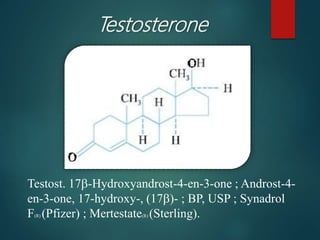
Testosterone
Testost. 17b-Hydroxyandrost-4-en-3-one ; Androst-4-
en-3-one, 17-hydroxy-, (17b)- ; BP, USP ; Synadrol
F(R) (Pfizer) ; Mertestate(R) (Sterling).
Mechanism of Action
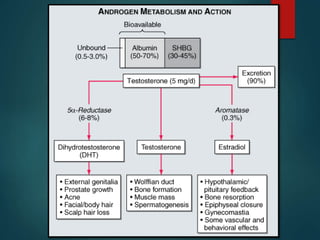
Like the estrogens and progestin's, androgens bind
to a specific nuclear receptor in a target cell.
Although testosterone itself is the active ligand in
muscle and liver, in other tissues it must be
metabolized to derivatives, such as DHT. For
example, after diffusing into the cells of the prostate,
seminal vesicles, epididymis, and skin, testosterone
is converted by 5α-reductase to DHT, which binds
to the receptor.
Synthesis
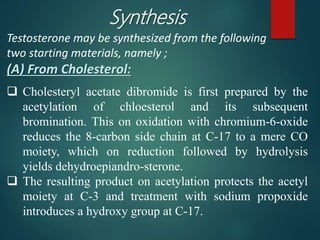
Testosterone may be synthesized from the following
two starting materials, namely ;
(A) From Cholesterol:
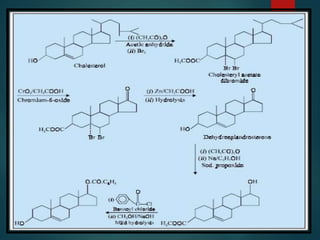
 Cholesteryl acetate dibromide is first prepared by the
acetylation of chloesterol and its subsequent
bromination. This on oxidation with chromium-6-oxide
reduces the 8-carbon side chain at C-17 to a mere CO
moiety, which on reduction followed by hydrolysis
yields dehydroepiandro-sterone.
 The resulting product on acetylation protects the acetyl
moiety at C-3 and treatment with sodium propoxide
introduces a hydroxy group at C-17.
Synthesis…..Continue
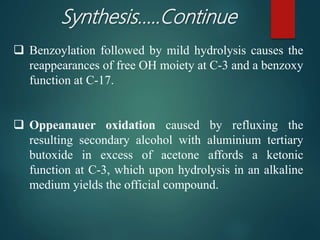
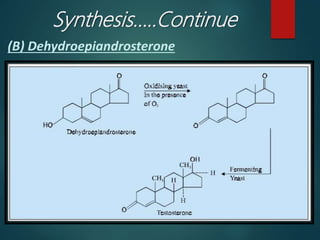
 Benzoylation followed by mild hydrolysis causes the
reappearances of free OH moiety at C-3 and a benzoxy
function at C-17.
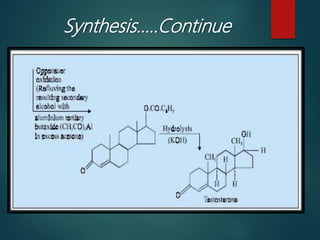
 Oppeanauer oxidation caused by refluxing the
resulting secondary alcohol with aluminium tertiary
butoxide in excess of acetone affords a ketonic
function at C-3, which upon hydrolysis in an alkaline
medium yields the official compound.
Synthesis…..Continue
(B) Dehydroepiandrosterone
SAR of Testosterone…..
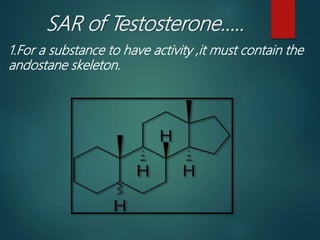
1.For a substance to have activity ,it must contain the
andostane skeleton.
SAR of Testosterone……
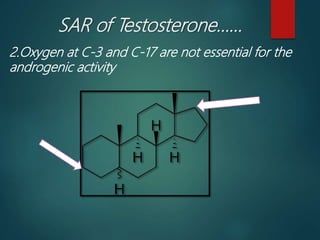
2.Oxygen at C-3 and C-17 are not essential for the
androgenic activity
SAR of Testosterone…..
3.The basic nucleus having 5-beta-androstane
which having androgenic activity ,whereas 5-alpha-
androstane having no activity.
4.There should not be chain constriction or
extension because it leads to finished the activity.
5.Introduction of 3-hydroxy group and 3-keto group
enhance the activity.
SAR of Testosterone…..
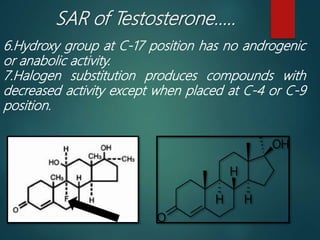
6.Hydroxy group at C-17 position has no androgenic
or anabolic activity.
7.Halogen substitution produces compounds with
decreased activity except when placed at C-4 or C-9
position.
SAR of Testosterone….
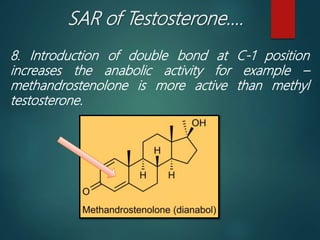
8. Introduction of double bond at C-1 position
increases the anabolic activity for example –
methandrostenolone is more active than methyl
testosterone.
SAR of Testosterone…..
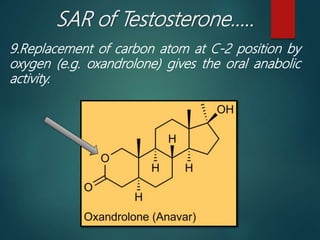
9.Replacement of carbon atom at C-2 position by
oxygen (e.g. oxandrolone) gives the oral anabolic
activity.
Dose
Dose :
For prolonged treatment, subcutaneously, 600
mg; For breast cancer up to 1.5g ;
Alternatively 10 to 30 mg per day through the buccal
administration.
Therapeutic Uses of
Testosterone
 For males with primary hypogonadism
(Testicular dysfunction).
 For Secondary hypogonadism (Failure of
hypothalamus or pituitary).
 To increase lean body mass and muscle
strength.
 Antiaging hormone (DHEA).
 Performance Enhancer.
Adverse Effects
1. In females: Androgens can cause
masculinization, acne, growth of facial hair,
deepening of the voice, male pattern baldness, and
excessive muscle development. Menstrual
irregularities may also occur.
2. In males: Excess androgens can cause priapism,
impotence, decreased spermatogenesis, and
gynecomastia. Cosmetic changes such as those
described for females may occur as well. Androgens
can also stimulate growth of the prostate.
3. In children: Androgens can cause abnormal sexual
maturation and growth disturbances resulting from
premature closing of the epiphyseal plates.
4. General effects: Androgens can increase serum LDL
and lower serum high-density lipoprotein levels.
Whether these changes in the lipid profile predispose
patients to heart disease is unknown. Androgens can
also cause fluid retention, leading to edema.
Continue…….
References
1. Medicinal Chemistry by Ashutosh Kar (6th
Edition), Page # 657.
2. Textbook of Organic Medicinal and
pharmaceutical chemistry by Wilson & Gisvold’s
(12th Edition), Page # 819.
3. Lippincott Illustrated Reviews: Pharmacology
(6th edition), page # 360
4. Foye's Principles of Medicinal Chemistry (6th
Edition).
Testosterone hormone - Medicinal Chemistry

Testosterone hormone - Medicinal Chemistry

  • 2.
    Testosterone (Sex Hormone) Faizan Akram Roll# 152 Final Professional (Eve) Faizanbwp@Hotmail.com;
  • 3.
    Agenda  What isHormone  What are sex hormone  Testosterone (Structure)  Mechanism of Action  Synthesis  SAR of Testosterone  Therapeutic Uses  Dose  Adverse Effects  References
  • 4.
    Introduction Generally, hormones aresubstances that are secreted by the ductless glands, and only minute amounts are necessary to produce the various physiological reaction in the body.
  • 5.
    Sex Hormones  sex-hormonesbelong to the steroid class of compounds and are produced in the gonads, i.e., testes in the male and ovaries in the female. In fact, their activity seems to be controlled and monitored by the hormones that are produced in the anterior lobe of the pituitary glands. Perhaps because of this inherent characteristics the sex hormones are invariably termed as the secondary sex hormones and the hormones of the anterior lobe of the pituitary are called the primary sex-hormones.
  • 6.
    Classification Sex-hormones are usuallyclassified under the following three heads, namely : (i) Androgens (Male Hormones) e.g., androsterone, testosterone. (ii) Oestrogens (Female or Follicular Hormones), e.g., oestrone, oestriol, oestradiol, stilbesterol, hexesterol. (iii) Gestogens (The Corpus Luteum Hormones) e.g., progesterone.
  • 7.
    Testosterone Testost. 17b-Hydroxyandrost-4-en-3-one ;Androst-4- en-3-one, 17-hydroxy-, (17b)- ; BP, USP ; Synadrol F(R) (Pfizer) ; Mertestate(R) (Sterling).
  • 8.
    Mechanism of Action Likethe estrogens and progestin's, androgens bind to a specific nuclear receptor in a target cell. Although testosterone itself is the active ligand in muscle and liver, in other tissues it must be metabolized to derivatives, such as DHT. For example, after diffusing into the cells of the prostate, seminal vesicles, epididymis, and skin, testosterone is converted by 5α-reductase to DHT, which binds to the receptor.
  • 10.
    Synthesis Testosterone may besynthesized from the following two starting materials, namely ; (A) From Cholesterol:  Cholesteryl acetate dibromide is first prepared by the acetylation of chloesterol and its subsequent bromination. This on oxidation with chromium-6-oxide reduces the 8-carbon side chain at C-17 to a mere CO moiety, which on reduction followed by hydrolysis yields dehydroepiandro-sterone.  The resulting product on acetylation protects the acetyl moiety at C-3 and treatment with sodium propoxide introduces a hydroxy group at C-17.
  • 11.
    Synthesis…..Continue  Benzoylation followedby mild hydrolysis causes the reappearances of free OH moiety at C-3 and a benzoxy function at C-17.  Oppeanauer oxidation caused by refluxing the resulting secondary alcohol with aluminium tertiary butoxide in excess of acetone affords a ketonic function at C-3, which upon hydrolysis in an alkaline medium yields the official compound.
  • 13.
  • 14.
  • 15.
    SAR of Testosterone….. 1.Fora substance to have activity ,it must contain the andostane skeleton.
  • 16.
    SAR of Testosterone…… 2.Oxygenat C-3 and C-17 are not essential for the androgenic activity
  • 17.
    SAR of Testosterone….. 3.Thebasic nucleus having 5-beta-androstane which having androgenic activity ,whereas 5-alpha- androstane having no activity. 4.There should not be chain constriction or extension because it leads to finished the activity. 5.Introduction of 3-hydroxy group and 3-keto group enhance the activity.
  • 18.
    SAR of Testosterone….. 6.Hydroxygroup at C-17 position has no androgenic or anabolic activity. 7.Halogen substitution produces compounds with decreased activity except when placed at C-4 or C-9 position.
  • 19.
    SAR of Testosterone…. 8.Introduction of double bond at C-1 position increases the anabolic activity for example – methandrostenolone is more active than methyl testosterone.
  • 20.
    SAR of Testosterone….. 9.Replacementof carbon atom at C-2 position by oxygen (e.g. oxandrolone) gives the oral anabolic activity.
  • 21.
    Dose Dose : For prolongedtreatment, subcutaneously, 600 mg; For breast cancer up to 1.5g ; Alternatively 10 to 30 mg per day through the buccal administration.
  • 22.
    Therapeutic Uses of Testosterone For males with primary hypogonadism (Testicular dysfunction).  For Secondary hypogonadism (Failure of hypothalamus or pituitary).  To increase lean body mass and muscle strength.  Antiaging hormone (DHEA).  Performance Enhancer.
  • 23.
    Adverse Effects 1. Infemales: Androgens can cause masculinization, acne, growth of facial hair, deepening of the voice, male pattern baldness, and excessive muscle development. Menstrual irregularities may also occur. 2. In males: Excess androgens can cause priapism, impotence, decreased spermatogenesis, and gynecomastia. Cosmetic changes such as those described for females may occur as well. Androgens can also stimulate growth of the prostate.
  • 24.
    3. In children:Androgens can cause abnormal sexual maturation and growth disturbances resulting from premature closing of the epiphyseal plates. 4. General effects: Androgens can increase serum LDL and lower serum high-density lipoprotein levels. Whether these changes in the lipid profile predispose patients to heart disease is unknown. Androgens can also cause fluid retention, leading to edema. Continue…….
  • 25.
    References 1. Medicinal Chemistryby Ashutosh Kar (6th Edition), Page # 657. 2. Textbook of Organic Medicinal and pharmaceutical chemistry by Wilson & Gisvold’s (12th Edition), Page # 819. 3. Lippincott Illustrated Reviews: Pharmacology (6th edition), page # 360 4. Foye's Principles of Medicinal Chemistry (6th Edition).