CLIMATOLOGY
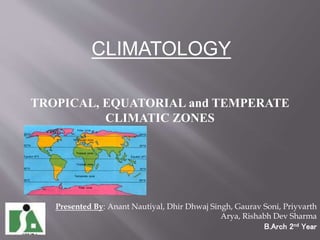
TROPICAL, EQUATORIAL and TEMPERATE
CLIMATIC ZONES
Presented By: Anant Nautiyal, Dhir Dhwaj Singh, Gaurav Soni, Priyvarth
Arya, Rishabh Dev Sharma
B.Arch 2nd Year
•Climate is the description of the long-term pattern of
weather in a particular area.
•Scientists define climate as the average weather for a
particular region and time period, usually taken over
30-years.
What is Weather???
•Weather is basically the way the atmosphere is
behaving, mainly with respect to its effects upon life
and human activities.
•Weather is visualized in terms of temperature,
humidity, precipitation, cloudiness, brightness,
visibility, wind, and atmospheric pressure, as in high
and low pressure.
What is Climate???
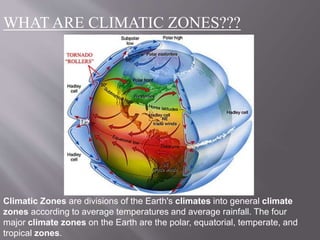
WHAT ARE CLIMATIC ZONES???
Climatic Zones are divisions of the Earth's climates into general climate
zones according to average temperatures and average rainfall. The four
major climate zones on the Earth are the polar, equatorial, temperate, and
tropical zones.
Tropical zone from 0°–23,5°
Characterstics:-
•In the regions between the equator and the tropics (Equatorial region) the Solar
radiation reaches the ground nearly vertically at noontime during almost the
entire year.
•Thereby, it is very warm in these regions.
•Through the high temperatures, more water evaporates, so that the air is often
moist.
•The resulting frequent and dense cloud cover reduces the effect of solar
radiation on ground temperature .
•Subtropics from 23,5°–40°
Characterstics:-
•The subtropics receive the highest radiation in the summer, since the sun's
angle at noon is almost vertical to the earth, whilst the cloud cover is relatively
thin.
•These regions receive less moisture, and that increases the effect of radiation.
•Therefore, most of the deserts in the world are situated in this zone.
•In the winter, the radiation in these regions decreases significantly, and it can
be temporarily very cool and moist .
Temperate Zone from 40°–60°
Characterstics:-
•In the temperate zone, the solar radiation arrives at a smaller angle,
and the average temperatures here are much cooler than in the
subtropics.
•The seasons and daylength differ significantly in the course of a
year.
•The climate is characterised by less frequent extremes, a more
regular distribution of the precipitation over the year and a longer
Vegetation period - therefore the tame "temperate".
The tropics is a region of the Earth surrounding the Equator.
It is limited in latitude by the Tropic of Cancer in the northern hemisphere at
23° 26′ 16″ N and the Tropic of Capricorn in the southern hemisphere at 23° 26′
16″ S; these latitudes correspond to the axial tilt of the Earth.
The tropics include all the areas on the Earth where the Sun reaches a
subsolar point, a point directly overhead at least once during the solar year.
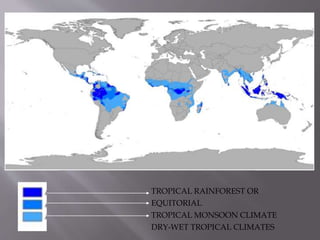
TROPICAL RAINFOREST OR
EQUITORIAL
TROPICAL MONSOON CLIMATE
DRY-WET TROPICAL CLIMATES
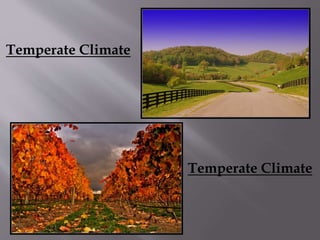
Temperate Climate
Temperate Climate
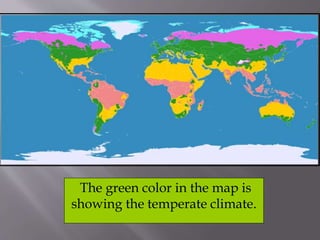
Climate map of
India.
The green color in the map is
showing the temperate climate.
•Experienced in areas located
between 100 N and S around
the Equator.
•Examples:
1.Amazon Basin
2.South East Asia
3.Congo Basin

CLIMATIC ZONES

  • 1.
    CLIMATOLOGY TROPICAL, EQUATORIAL andTEMPERATE CLIMATIC ZONES Presented By: Anant Nautiyal, Dhir Dhwaj Singh, Gaurav Soni, Priyvarth Arya, Rishabh Dev Sharma B.Arch 2nd Year
  • 2.
    •Climate is thedescription of the long-term pattern of weather in a particular area. •Scientists define climate as the average weather for a particular region and time period, usually taken over 30-years. What is Weather??? •Weather is basically the way the atmosphere is behaving, mainly with respect to its effects upon life and human activities. •Weather is visualized in terms of temperature, humidity, precipitation, cloudiness, brightness, visibility, wind, and atmospheric pressure, as in high and low pressure. What is Climate???
  • 3.
    WHAT ARE CLIMATICZONES??? Climatic Zones are divisions of the Earth's climates into general climate zones according to average temperatures and average rainfall. The four major climate zones on the Earth are the polar, equatorial, temperate, and tropical zones.
  • 4.
    Tropical zone from0°–23,5° Characterstics:- •In the regions between the equator and the tropics (Equatorial region) the Solar radiation reaches the ground nearly vertically at noontime during almost the entire year. •Thereby, it is very warm in these regions. •Through the high temperatures, more water evaporates, so that the air is often moist. •The resulting frequent and dense cloud cover reduces the effect of solar radiation on ground temperature .
  • 5.
    •Subtropics from 23,5°–40° Characterstics:- •Thesubtropics receive the highest radiation in the summer, since the sun's angle at noon is almost vertical to the earth, whilst the cloud cover is relatively thin. •These regions receive less moisture, and that increases the effect of radiation. •Therefore, most of the deserts in the world are situated in this zone. •In the winter, the radiation in these regions decreases significantly, and it can be temporarily very cool and moist .
  • 6.
    Temperate Zone from40°–60° Characterstics:- •In the temperate zone, the solar radiation arrives at a smaller angle, and the average temperatures here are much cooler than in the subtropics. •The seasons and daylength differ significantly in the course of a year. •The climate is characterised by less frequent extremes, a more regular distribution of the precipitation over the year and a longer Vegetation period - therefore the tame "temperate".
  • 7.
    The tropics isa region of the Earth surrounding the Equator. It is limited in latitude by the Tropic of Cancer in the northern hemisphere at 23° 26′ 16″ N and the Tropic of Capricorn in the southern hemisphere at 23° 26′ 16″ S; these latitudes correspond to the axial tilt of the Earth. The tropics include all the areas on the Earth where the Sun reaches a subsolar point, a point directly overhead at least once during the solar year.
  • 12.
    TROPICAL RAINFOREST OR EQUITORIAL TROPICALMONSOON CLIMATE DRY-WET TROPICAL CLIMATES
  • 13.
  • 14.
  • 15.
    The green colorin the map is showing the temperate climate.
  • 16.
    •Experienced in areaslocated between 100 N and S around the Equator. •Examples: 1.Amazon Basin 2.South East Asia 3.Congo Basin