WITRICITY 
“Wireless Electricity” 
1
Contents 
 What do you mean by Wi Tricity? 
 Need of Witricity 
 History of wireless power 
 Witricity basics 
 Detailed Principle 
 How safe is Witricity? 
 What’s the future of witricity? 
 Advantages 
 Application 
 Limitation 
2
AIM OF WIRELESS POWER 
 The Ultimate Aim of this project is Transmit 
the Power By Wireless mode which can be 
used in electrical/electronic devices for general 
use. 
3
FIRST OPERATION OF 
WITRICITY 
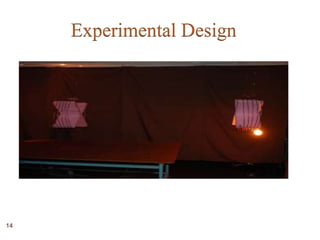
 On June 7’ 07, a team of researchers at MIT 
announced the successful operation of Witricity 
concept. 
 They had lit up a 60W with a power from a source at 
the distance of 7 feet(over 2m) with no wires. 
4 
8051.in
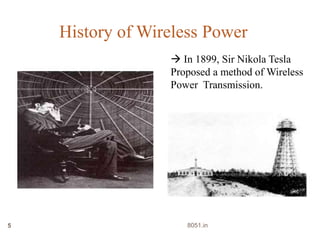
History of Wireless Power 
 In 1899, Sir Nikola Tesla 
Proposed a method of Wireless 
Power Transmission. 
5 8051.in
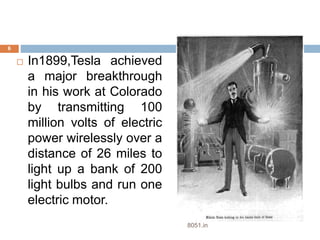
 In1899,Tesla achieved 
a major breakthrough 
in his work at Colorado 
by transmitting 100 
million volts of electric 
power wirelessly over a 
distance of 26 miles to 
light up a bank of 200 
light bulbs and run one 
electric motor. 
6 
8051.in
In Layperson’s Terms 
7 
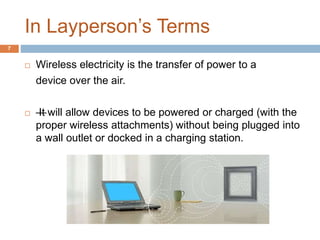
 Wireless electricity is the transfer of power to a 
device over the air. 
 — It will allow devices to be powered or charged (with the 
proper wireless attachments) without being plugged into 
a wall outlet or docked in a charging station.
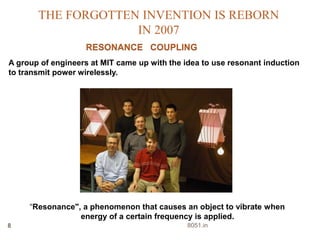
THE FORGOTTEN INVENTION IS REBORN 
IN 2007 
RESONANCE COUPLING 
A group of engineers at MIT came up with the idea to use resonant induction 
to transmit power wirelessly. 
“Resonance", a phenomenon that causes an object to vibrate when 
energy of a certain frequency is applied. 
8 8051.in
Three major types 
 Short range; Inductive Coupling 
 Medium range; Resonant Induction 
 Long range; Electromagnetic Wave Power 
Transfer 
9
Short Range Wireless Energy Transmission: 
Inductive Coupling 
 What Is Inductive Coupling? 
 Inductive Coupling is a method for short range 
wireless energy transfer. 
 Its range can vary, but it’s often very short. 
10
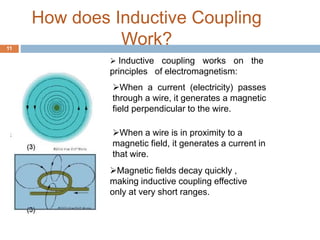
How does Inductive Coupling 
Work? 
 Inductive coupling works on the 
principles of electromagnetism: 
When a current (electricity) passes 
through a wire, it generates a magnetic 
field perpendicular to the wire. 
When a wire is in proximity to a 
magnetic field, it generates a current in 
that wire. 
Magnetic fields decay quickly , 
making inductive coupling effective 
only at very short ranges. 
11
Medium Range Wireless Energy 
Transmission: Resonant Induction 
 What Is Resonant Induction? 
 A group of engineers at MIT came up with the 
idea to use resonant induction to transmit 
power wirelessly. They deemed their result 
“WiTricity” (like Wi-Fi) . WiTricity can transmit 
electricity wirelessly at 40% efficiency to about 
7 feet. 
12
HOW WIRELESS POWER 
WORKS 
13 
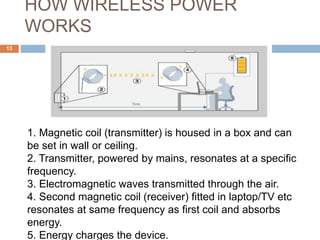
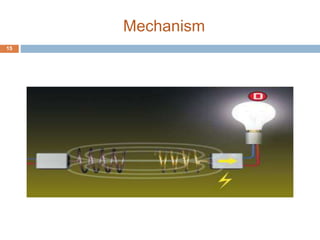
1. Magnetic coil (transmitter) is housed in a box and can 
be set in wall or ceiling. 
2. Transmitter, powered by mains, resonates at a specific 
frequency. 
3. Electromagnetic waves transmitted through the air. 
4. Second magnetic coil (receiver) fitted in laptop/TV etc 
resonates at same frequency as first coil and absorbs 
energy. 
5. Energy charges the device.
Experimental Design 
14
Mechanism 
15
Now the questions are? 
 Is WiTricity safe? 
 How much power can be transferred? 
 What about the range of transferred? 
 How efficient is WiTricity? 
 What's the Future of WiTricity? 
16
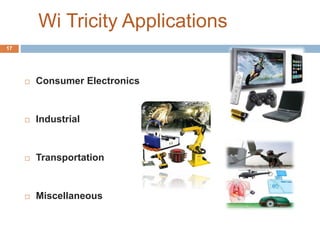
Wi Tricity Applications 
 Consumer Electronics 
 Industrial 
 Transportation 
 Miscellaneous 
17
Current Uses 
18 
 Wireless charging pads 
 Electric Toothbrushes: 
 Both of these techniques use small electric 
fields to charge the devices. 
 Haier America Digital Products group has 
already developed a HDTV that transmits 
electricity and the HD signal, making the TV 
completely wireless.
Advantages 
 Safe, fairly efficient, good range: 
 Magnetic fields interact weakly with biological 
masses (humans), 
 Efficiency can be increased with time, most of 
the 60% lost is from heat radiated from the coils. 
 Theoretically one stationary coil in a room could 
power multiple devices with receiving coils. 
 No more messy wires, and with widespread 
enough use it could even eliminate costly 
batteries. 
19
Limitations 
 The resonance condition should be satisfied and if any 
error exists, there is no possibility of power transfer. 
 If there is any possibility of very strong ferromagnetic 
material presence causes low power transfer due to 
radiation. 
20
What's the Future of WiTricity? 
 MIT's WiTricity is only 40 to 45% efficient and 
they have to be twice as efficient to 
compete with the traditional chemical 
batteries. 
 The researchers have said that in another 
five years time, they will come up with a 
WiTricity system for commercial use. 
21
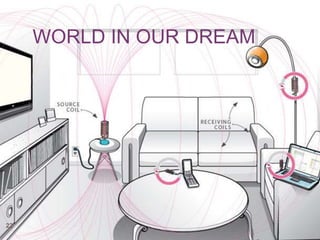
WORLD IN OUR DREAM 
22
THANK YOU

Witricity2

  • 1.
  • 2.
    Contents  Whatdo you mean by Wi Tricity?  Need of Witricity  History of wireless power  Witricity basics  Detailed Principle  How safe is Witricity?  What’s the future of witricity?  Advantages  Application  Limitation 2
  • 3.
    AIM OF WIRELESSPOWER  The Ultimate Aim of this project is Transmit the Power By Wireless mode which can be used in electrical/electronic devices for general use. 3
  • 4.
    FIRST OPERATION OF WITRICITY  On June 7’ 07, a team of researchers at MIT announced the successful operation of Witricity concept.  They had lit up a 60W with a power from a source at the distance of 7 feet(over 2m) with no wires. 4 8051.in
  • 5.
    History of WirelessPower  In 1899, Sir Nikola Tesla Proposed a method of Wireless Power Transmission. 5 8051.in
  • 6.
     In1899,Tesla achieved a major breakthrough in his work at Colorado by transmitting 100 million volts of electric power wirelessly over a distance of 26 miles to light up a bank of 200 light bulbs and run one electric motor. 6 8051.in
  • 7.
    In Layperson’s Terms 7  Wireless electricity is the transfer of power to a device over the air.  — It will allow devices to be powered or charged (with the proper wireless attachments) without being plugged into a wall outlet or docked in a charging station.
  • 8.
    THE FORGOTTEN INVENTIONIS REBORN IN 2007 RESONANCE COUPLING A group of engineers at MIT came up with the idea to use resonant induction to transmit power wirelessly. “Resonance", a phenomenon that causes an object to vibrate when energy of a certain frequency is applied. 8 8051.in
  • 9.
    Three major types  Short range; Inductive Coupling  Medium range; Resonant Induction  Long range; Electromagnetic Wave Power Transfer 9
  • 10.
    Short Range WirelessEnergy Transmission: Inductive Coupling  What Is Inductive Coupling?  Inductive Coupling is a method for short range wireless energy transfer.  Its range can vary, but it’s often very short. 10
  • 11.
    How does InductiveCoupling Work?  Inductive coupling works on the principles of electromagnetism: When a current (electricity) passes through a wire, it generates a magnetic field perpendicular to the wire. When a wire is in proximity to a magnetic field, it generates a current in that wire. Magnetic fields decay quickly , making inductive coupling effective only at very short ranges. 11
  • 12.
    Medium Range WirelessEnergy Transmission: Resonant Induction  What Is Resonant Induction?  A group of engineers at MIT came up with the idea to use resonant induction to transmit power wirelessly. They deemed their result “WiTricity” (like Wi-Fi) . WiTricity can transmit electricity wirelessly at 40% efficiency to about 7 feet. 12
  • 13.
    HOW WIRELESS POWER WORKS 13 1. Magnetic coil (transmitter) is housed in a box and can be set in wall or ceiling. 2. Transmitter, powered by mains, resonates at a specific frequency. 3. Electromagnetic waves transmitted through the air. 4. Second magnetic coil (receiver) fitted in laptop/TV etc resonates at same frequency as first coil and absorbs energy. 5. Energy charges the device.
  • 14.
  • 15.
  • 16.
    Now the questionsare?  Is WiTricity safe?  How much power can be transferred?  What about the range of transferred?  How efficient is WiTricity?  What's the Future of WiTricity? 16
  • 17.
    Wi Tricity Applications  Consumer Electronics  Industrial  Transportation  Miscellaneous 17
  • 18.
    Current Uses 18  Wireless charging pads  Electric Toothbrushes:  Both of these techniques use small electric fields to charge the devices.  Haier America Digital Products group has already developed a HDTV that transmits electricity and the HD signal, making the TV completely wireless.
  • 19.
    Advantages  Safe,fairly efficient, good range:  Magnetic fields interact weakly with biological masses (humans),  Efficiency can be increased with time, most of the 60% lost is from heat radiated from the coils.  Theoretically one stationary coil in a room could power multiple devices with receiving coils.  No more messy wires, and with widespread enough use it could even eliminate costly batteries. 19
  • 20.
    Limitations  Theresonance condition should be satisfied and if any error exists, there is no possibility of power transfer.  If there is any possibility of very strong ferromagnetic material presence causes low power transfer due to radiation. 20
  • 21.
    What's the Futureof WiTricity?  MIT's WiTricity is only 40 to 45% efficient and they have to be twice as efficient to compete with the traditional chemical batteries.  The researchers have said that in another five years time, they will come up with a WiTricity system for commercial use. 21
  • 22.
    WORLD IN OURDREAM 22
  • 23.