Witricity
(Wireless Electricity)
Presented by:
Parvindar Chaudhary
EE Department
Monad University
Hapur
INTRODUCTION
 Transfer of electricity without using connections between input and
load is termed as wireless electricity.
 This is not like wireless transmission of signals which we used in the
cell phones.
 In cell phones signals are sent in the form of micro waves whereas in
this mode of transition electricity is transferred in the form of
magnetic rays.
 These rays are not harmful to humans.
 The transfer of energy is mid range compared to direct transmission.
TYPES AND TECHNOLOGIES OF WPTTYPES AND TECHNOLOGIES OF WPT
Near-field techniques
Magnetic Coupling
Resonant Inductive Coupling
Air Ionization
Far-field techniques
Microwave Power Transmission (MPT)
LASER power transmission
NEAR FIELD ENERGY TRANSFER
Near field is a wireless transmission technique
over distances comparable to or a few times the
diameter of devices.
Near field is usually magnetic.
 Near field energy is non-radiative.
FAR FIELD ENERGY TRANSFER
Needs line-of-sight
LASER or microwave
Aims at high power transfer
RadiativeRadiative
RESONANCE INDUCTIVE
COUPLING(RIC)
Combination of inductive coupling and
resonance.
Resonance makes two objects interact very
strongly.
It is based on Near-Field energy transfer.
RIC via MAGNETIC COUPLING
RIC is highly efficient.
RIC has much greater range than magnetic
coupling.
RIC can be one-to-many, But usually Resonance
inductive coupling is one-to-one.
WITRICITY APPLICATIONS
Automatic wireless charging of cell phones at home,
in office,...while devices are in use and mobile.
Direct wireless powering of stationary devices…
eliminating expensive custom of wires and cables.
ADVANTAGES
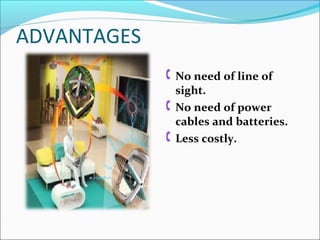
 No need of line of
sight.
 No need of power
cables and batteries.
 Less costly.
CONCLUSION
Witricity's technology is a mode of energy transfer,
relying instead on the magnetic near field.
Witricity products are being designed to comply with
applicable safety standards and regulations. Hence
witricity is technology safe. Witricity can transfer
power depends on the source and receivers.
If it is relatively close to one another, and can exceed
95%.Efficiency is primarily determined by the
distance between the power source and capture
device, however, the shape may impact the efficiency.
FLOW OF THE WORK
RANGE REQUIREMENT
Power from mains to antenna, which is made of
copper.
Resonates 10KHz (electromagnetic waves).
Tunnel up to 2m (6.5ft).
Electricity received by antenna, also resonating at
10KHz.
THANK YOUTHANK YOU

WIRELESS POWER TRANSMISSION

  • 1.
    Witricity (Wireless Electricity) Presented by: ParvindarChaudhary EE Department Monad University Hapur
  • 2.
    INTRODUCTION  Transfer ofelectricity without using connections between input and load is termed as wireless electricity.  This is not like wireless transmission of signals which we used in the cell phones.  In cell phones signals are sent in the form of micro waves whereas in this mode of transition electricity is transferred in the form of magnetic rays.  These rays are not harmful to humans.  The transfer of energy is mid range compared to direct transmission.
  • 3.
    TYPES AND TECHNOLOGIESOF WPTTYPES AND TECHNOLOGIES OF WPT Near-field techniques Magnetic Coupling Resonant Inductive Coupling Air Ionization Far-field techniques Microwave Power Transmission (MPT) LASER power transmission
  • 4.
    NEAR FIELD ENERGYTRANSFER Near field is a wireless transmission technique over distances comparable to or a few times the diameter of devices. Near field is usually magnetic.  Near field energy is non-radiative.
  • 5.
    FAR FIELD ENERGYTRANSFER Needs line-of-sight LASER or microwave Aims at high power transfer RadiativeRadiative
  • 6.
    RESONANCE INDUCTIVE COUPLING(RIC) Combination ofinductive coupling and resonance. Resonance makes two objects interact very strongly. It is based on Near-Field energy transfer.
  • 7.
    RIC via MAGNETICCOUPLING RIC is highly efficient. RIC has much greater range than magnetic coupling. RIC can be one-to-many, But usually Resonance inductive coupling is one-to-one.
  • 9.
    WITRICITY APPLICATIONS Automatic wirelesscharging of cell phones at home, in office,...while devices are in use and mobile. Direct wireless powering of stationary devices… eliminating expensive custom of wires and cables.
  • 10.
    ADVANTAGES  No needof line of sight.  No need of power cables and batteries.  Less costly.
  • 11.
    CONCLUSION Witricity's technology isa mode of energy transfer, relying instead on the magnetic near field. Witricity products are being designed to comply with applicable safety standards and regulations. Hence witricity is technology safe. Witricity can transfer power depends on the source and receivers. If it is relatively close to one another, and can exceed 95%.Efficiency is primarily determined by the distance between the power source and capture device, however, the shape may impact the efficiency.
  • 12.
  • 13.
    RANGE REQUIREMENT Power frommains to antenna, which is made of copper. Resonates 10KHz (electromagnetic waves). Tunnel up to 2m (6.5ft). Electricity received by antenna, also resonating at 10KHz.
  • 14.