M.S Rama Krishna (06-5A3)
History about supercomputers Manufacturers / Partners of Blue Gene/L Why is named as blue gene Why was it created? Who are the customers &its cost? Processors / Memory / Scalability Stepwise Structure Hardware Architecture Interconnection Network Asynchronous task dipatch sudsystem Software Advantages Applications
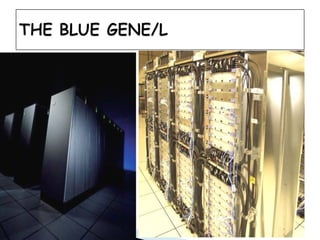
IBM’s Naval Ordnance Research  Calculator.  IBM's Blue Gene/L.
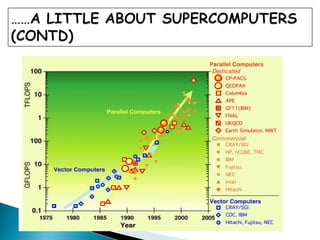
  360000000000000  floating-point  operations per  second (TFLOPS)  in March, 2005. 15,000 operations per second.
 
1999 - 100M $ PROJECT BY IBM  FOR THE US DEPT OF ENERGY (DOE) - BLUE GENE/L  - BLUE GENE/C (CYCLOPS)   - BLUE GENE/P (PETAFLOPS) 2001 - PARTNERSHIP WITH LAWRENCE  LIVEMORE NATIONAL LABORATORY  (FIRST CUSTOMER)
“ Blue”: The corporate color of IBM “ Gene”: The intended use of the Blue Gene clusters – Computational biology, specifically, protein folding
to build a new family of supercomputers optimized for bandwidth, scalability and  the ability to handle large amounts of  data while consuming a fraction of the power and floor space required by today's fastest systems.  to analyze scientific and biological problems (protein folding).

64 rack machine to Lawrence Livermore National Laboratory, California 23 Feb 2004 – 6 rack machine to ASTRON, a leading astronomy organization in the Netherlands to use IBM's Blue Gene/L supercomputer technology as the basis to develop a new type of radio telescope capable of looking back billions of years in time.  May/June 2004 – 1 rack system to Argonne National Laboratory, Illinois  Sept 2004 IBM - 4 rack Blue Gene/L supercomputer to Japan's National Institute of Advanced Industrial Science and Technology (AIST)  to investigate the shapes of proteins.  6 Jun 2005 - 4 rack machine to The Ecole Polytechnique Federale de Lausanne (EPFL), in Lausanne, Switzerland to simulate the workings of the human brain .
The initial cost was 1.5 M $/rack  The current cost is 2M $/rack  March 2005 – IBM started renting the machine for about $10,000 per week to use one-eighth of a Blue Gene/L rack.
In computer science, the  kernel  is the fundamental part of an operating system.  It is a piece of software responsible for providing secure access to the machine's hardware to various computer programs.  Since there are many programs, and access to the hardware is limited, the kernel is also responsible for deciding when and how long a program should be able to make use of a piece of hardware, which is called multiplexing. Accessing the hardware directly can be very complex, so kernels usually implement some hardware abstractions to hide complexity and provide a clean and uniform interface to the underlying hardware, which helps application programmers.
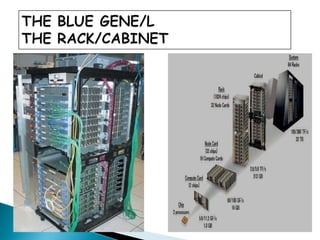
PROCESSOR 65,536 DUAL PROCESSOR NODES. 700 MHZ POWER PC 440 PROCESSOR. MEMORY 512 MB of dynamic random access memory (DRAM) per node. SCALABILITY BLUE GENE/L IS JUST THE FIRST STEP………


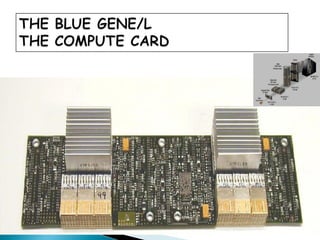
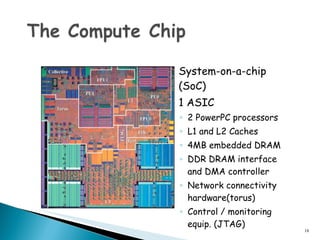
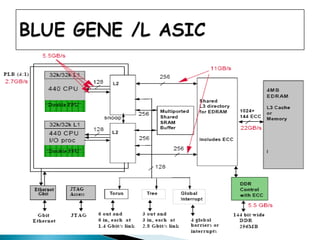
System-on-a-chip (SoC) 1 ASIC 2 PowerPC processors L1 and L2 Caches 4MB embedded DRAM DDR DRAM interface and DMA controller Network connectivity hardware(torus) Control / monitoring equip. (JTAG)
 
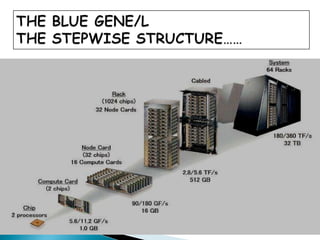
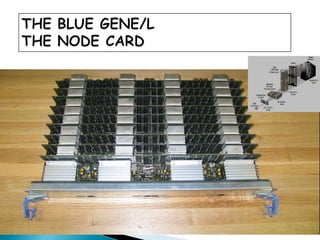
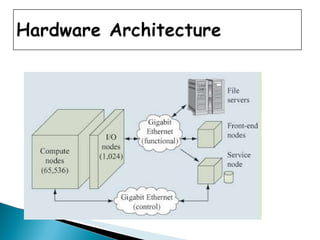
65,356  Compute nodes ASIC (Application-Specific Integrated Circuit)  ASIC includes two 32-bit PowerPC 440 processing cores, each with two 64-bit FPUs (Floating-Point Units)  compute nodes strictly handle computations  1024 i/o nodes  manages communications for a group of 64 compute nodes.  5 Network connections
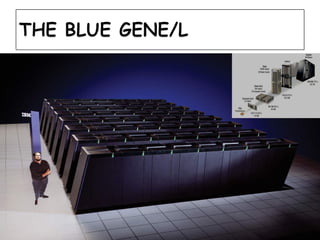
Cellular architecture Rmax of 280.6 Teraflops Rpeak of 360 Teraflops 512 MB memory per compute node, 16 TB in entire system. 800 TB of disk space 2,500 square feet
 
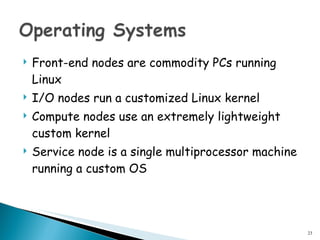
Front-end nodes are commodity PCs running Linux I/O nodes run a customized Linux kernel Compute nodes use an extremely lightweight custom kernel Service node is a single multiprocessor machine running a custom OS
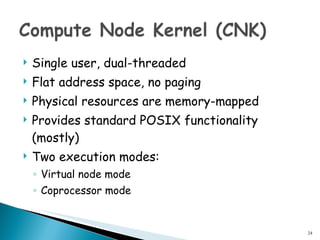
Single user, dual-threaded Flat address space, no paging Physical resources are memory-mapped Provides standard POSIX functionality (mostly) Two execution modes: Virtual node mode Coprocessor mode
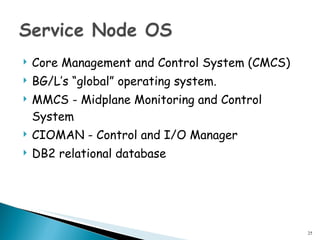
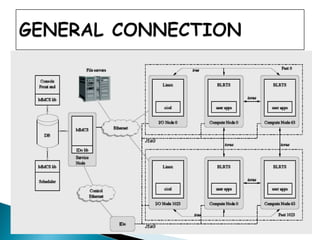
Core Management and Control System (CMCS) BG/L’s “global” operating system. MMCS - Midplane Monitoring and Control System CIOMAN - Control and I/O Manager DB2 relational database
 
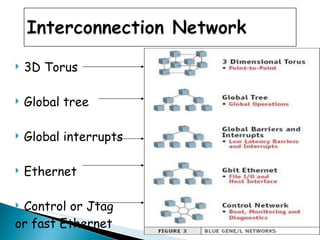
3D Torus Global tree Global interrupts Ethernet Control or Jtag or fast Ethernet
http://hpc.csie.thu.edu.tw/docs/Tutorial.pdf
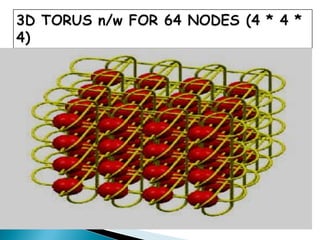
Primary connection Torus n/w connects all the 65,536 compute nodes (32 * 32 * 64). One node connects to 6 other nodes. Chosen because provides high bandwidth nearest neighbor connectivity Single node consists of single ASIC and memory. Dynamic adaptive routing.
 
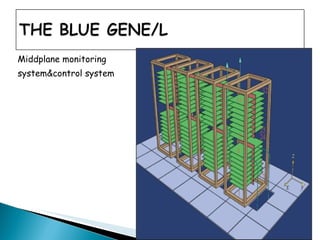
Middplane monitoring  system&control system
 
 
The main parallel programming model for BG/L is message passing using MPI (message passing interface) in C, C++, or FORTRAN. Supports global address space programming models such as Co-Array FORTRAN (CAF) and Unified Parallel C (UPC).  The I/O and external front-end nodes run Linux, and the compute nodes run a kernel that is inspired by Linux.
Scalable Less space (half of the tennis court) Heat problems most supercomputers face Speed
Memory Limitation (512 MB/node) Simple node kernel (does not support forks, threads)
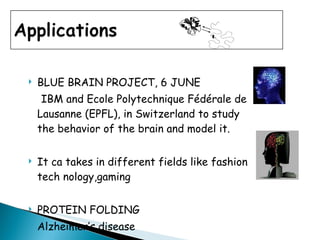
BLUE BRAIN PROJECT, 6 JUNE IBM and Ecole Polytechnique Fédérale de Lausanne (EPFL), in Switzerland to study the behavior of the brain and model it. It ca takes in different fields like fashion tech nology,gaming PROTEIN FOLDING Alzheimer’s disease
Article published in “THE STANDARD”, china’s business newspaper dated May 29 Military hopes such a development will allow pilots to control jets using their mind Allow wheelchair users to walk
BG/L shows that a cell architecture for supercomputers is feasible. Higher performance with a much smaller size and power requirements. In theory, no limits to scalability of a BlueGene system.
IBM, Journal of Research and Development, volume 49, November 2005. Goolge News. http://www.linuxworld.com/read/48131.htm http://sc-2002.org/paperpdfs/pap.pap207.pdf http://www.ipab.org/Presentation/sem04/04-02-2.pdf http://www.desy.de/dvsem/WS0405/steinmacherBurow-20050221.pdf www.scd.ucar.edu/info/UserForum/presentations/loft.ppt REDBOOKS

Rama krishna ppts for blue gene/L

  • 1.
  • 2.
    History about supercomputersManufacturers / Partners of Blue Gene/L Why is named as blue gene Why was it created? Who are the customers &its cost? Processors / Memory / Scalability Stepwise Structure Hardware Architecture Interconnection Network Asynchronous task dipatch sudsystem Software Advantages Applications
  • 3.
    IBM’s Naval OrdnanceResearch Calculator. IBM's Blue Gene/L.
  • 4.
    360000000000000 floating-point operations per second (TFLOPS) in March, 2005. 15,000 operations per second.
  • 5.
  • 6.
    1999 - 100M$ PROJECT BY IBM FOR THE US DEPT OF ENERGY (DOE) - BLUE GENE/L - BLUE GENE/C (CYCLOPS) - BLUE GENE/P (PETAFLOPS) 2001 - PARTNERSHIP WITH LAWRENCE LIVEMORE NATIONAL LABORATORY (FIRST CUSTOMER)
  • 7.
    “ Blue”: Thecorporate color of IBM “ Gene”: The intended use of the Blue Gene clusters – Computational biology, specifically, protein folding
  • 8.
    to build anew family of supercomputers optimized for bandwidth, scalability and the ability to handle large amounts of data while consuming a fraction of the power and floor space required by today's fastest systems. to analyze scientific and biological problems (protein folding).
  • 9.
    64 rack machineto Lawrence Livermore National Laboratory, California 23 Feb 2004 – 6 rack machine to ASTRON, a leading astronomy organization in the Netherlands to use IBM's Blue Gene/L supercomputer technology as the basis to develop a new type of radio telescope capable of looking back billions of years in time. May/June 2004 – 1 rack system to Argonne National Laboratory, Illinois Sept 2004 IBM - 4 rack Blue Gene/L supercomputer to Japan's National Institute of Advanced Industrial Science and Technology (AIST) to investigate the shapes of proteins. 6 Jun 2005 - 4 rack machine to The Ecole Polytechnique Federale de Lausanne (EPFL), in Lausanne, Switzerland to simulate the workings of the human brain .
  • 10.
    The initial costwas 1.5 M $/rack The current cost is 2M $/rack March 2005 – IBM started renting the machine for about $10,000 per week to use one-eighth of a Blue Gene/L rack.
  • 11.
    In computer science,the kernel is the fundamental part of an operating system. It is a piece of software responsible for providing secure access to the machine's hardware to various computer programs. Since there are many programs, and access to the hardware is limited, the kernel is also responsible for deciding when and how long a program should be able to make use of a piece of hardware, which is called multiplexing. Accessing the hardware directly can be very complex, so kernels usually implement some hardware abstractions to hide complexity and provide a clean and uniform interface to the underlying hardware, which helps application programmers.
  • 12.
    PROCESSOR 65,536 DUALPROCESSOR NODES. 700 MHZ POWER PC 440 PROCESSOR. MEMORY 512 MB of dynamic random access memory (DRAM) per node. SCALABILITY BLUE GENE/L IS JUST THE FIRST STEP………
  • 13.
  • 14.
  • 15.
  • 16.
  • 17.
  • 18.
    System-on-a-chip (SoC) 1ASIC 2 PowerPC processors L1 and L2 Caches 4MB embedded DRAM DDR DRAM interface and DMA controller Network connectivity hardware(torus) Control / monitoring equip. (JTAG)
  • 19.
  • 20.
    65,356 Computenodes ASIC (Application-Specific Integrated Circuit) ASIC includes two 32-bit PowerPC 440 processing cores, each with two 64-bit FPUs (Floating-Point Units) compute nodes strictly handle computations 1024 i/o nodes manages communications for a group of 64 compute nodes. 5 Network connections
  • 21.
    Cellular architecture Rmaxof 280.6 Teraflops Rpeak of 360 Teraflops 512 MB memory per compute node, 16 TB in entire system. 800 TB of disk space 2,500 square feet
  • 22.
  • 23.
    Front-end nodes arecommodity PCs running Linux I/O nodes run a customized Linux kernel Compute nodes use an extremely lightweight custom kernel Service node is a single multiprocessor machine running a custom OS
  • 24.
    Single user, dual-threadedFlat address space, no paging Physical resources are memory-mapped Provides standard POSIX functionality (mostly) Two execution modes: Virtual node mode Coprocessor mode
  • 25.
    Core Management andControl System (CMCS) BG/L’s “global” operating system. MMCS - Midplane Monitoring and Control System CIOMAN - Control and I/O Manager DB2 relational database
  • 26.
  • 27.
    3D Torus Globaltree Global interrupts Ethernet Control or Jtag or fast Ethernet
  • 28.
  • 29.
    Primary connection Torusn/w connects all the 65,536 compute nodes (32 * 32 * 64). One node connects to 6 other nodes. Chosen because provides high bandwidth nearest neighbor connectivity Single node consists of single ASIC and memory. Dynamic adaptive routing.
  • 30.
  • 31.
    Middplane monitoring system&control system
  • 32.
  • 33.
  • 34.
    The main parallelprogramming model for BG/L is message passing using MPI (message passing interface) in C, C++, or FORTRAN. Supports global address space programming models such as Co-Array FORTRAN (CAF) and Unified Parallel C (UPC). The I/O and external front-end nodes run Linux, and the compute nodes run a kernel that is inspired by Linux.
  • 35.
    Scalable Less space(half of the tennis court) Heat problems most supercomputers face Speed
  • 36.
    Memory Limitation (512MB/node) Simple node kernel (does not support forks, threads)
  • 37.
    BLUE BRAIN PROJECT,6 JUNE IBM and Ecole Polytechnique Fédérale de Lausanne (EPFL), in Switzerland to study the behavior of the brain and model it. It ca takes in different fields like fashion tech nology,gaming PROTEIN FOLDING Alzheimer’s disease
  • 38.
    Article published in“THE STANDARD”, china’s business newspaper dated May 29 Military hopes such a development will allow pilots to control jets using their mind Allow wheelchair users to walk
  • 39.
    BG/L shows thata cell architecture for supercomputers is feasible. Higher performance with a much smaller size and power requirements. In theory, no limits to scalability of a BlueGene system.
  • 40.
    IBM, Journal ofResearch and Development, volume 49, November 2005. Goolge News. http://www.linuxworld.com/read/48131.htm http://sc-2002.org/paperpdfs/pap.pap207.pdf http://www.ipab.org/Presentation/sem04/04-02-2.pdf http://www.desy.de/dvsem/WS0405/steinmacherBurow-20050221.pdf www.scd.ucar.edu/info/UserForum/presentations/loft.ppt REDBOOKS

Editor's Notes

  • #19 compute_chip.gif, 76%
  • #26 Machine initialization and booting System monitoring Job execution