PRESENTED BY :
SONU KUMAR
1313703
MMICT & BM
CONTENTS….
Need of Witricity
History of wireless power
Types of Wireless Energy Transfer
Applications of Witricity
What do you mean by WiTricity ?
Advantages & Disadvantages
Conclusion
References
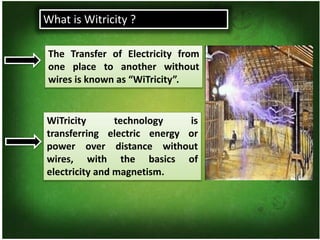
What is Witricity ?
WiTricity technology is
transferring electric energy or
power over distance without
wires, with the basics of
electricity and magnetism.
The Transfer of Electricity from
one place to another without
wires is known as “WiTricity”.
Why do we need wireless
electricity???
The need of electricity in every nook and
corner of the world.
The demand of eco-friendly power.
Requirement of efficient and reliable power.
To reduce dependence on wires and
batteries.
The ever increasing power demand.
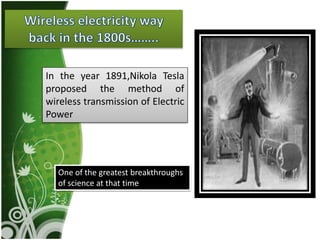
In the year 1891,Nikola Tesla
proposed the method of
wireless transmission of Electric
Power
One of the greatest breakthroughs
of science at that time
It Began to Construction in 1901 in
New York and Shut Down by 1905,
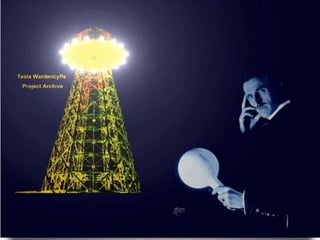
Built the wardenclyffe tower which
could broadcast power wirelessly
using far-field techniques. Called off
as it radiated power into
surroundings raising issues of
power loss
Power theft
Health concerns
A dream crashes……
The Witricity Team
In 2007,6 MIT members headed
by Marin Soljacic were able to
successfully transmit power to a
bulb within a distance of 2m at a
freq of 9.9MHz using concepts
of non radiative mid range
energy transfer .
Resonance
inductive coupling
Efficiency at that point was just
approximately 43%
Types of wireless energy transfer
techniques are:-
Short range– Inductive coupling
Mid range– Resonance Inductive
coupling
Long range-
Microwave Transmission
Uses electromagnetic induction
concept for the interdependence
of time-varying electric and
magnetic fields.
Wireless electricity makes use of
the concept-
“Oscillating electric field produces
magnetic field and oscillating
magnetic field produces electric
field”.
Resonant Inductive Coupling
Uses almost the same
concept as Inductive
coupling just that the coils
operate at resonant
frequency leading to
efficient transfer of energy
over a larger distance.
Microwave Transmission
Aims at higher power transfer over longer
distances practically in the range of some miles.
Requires a microwave source, antenna and
receptor.
operates in the frequency range of 1-40GHz.
operates at the highest efficiency at 2.45GHz.
Steps:
1.conversion of electrical to microwave energy,
2.Capturing of microwave beams by Receptor.
3.conversion of microwave to electrical energy.
Block diagram for microwave power
transmission model
Block diagram for witricity mechanism
Circuit diagram for WiTricity
demonstration
Wireless electricity in our daily life
Efficiency chart of witricity
It is observed that efficiency decreases with increase
in distance between source coil and load coil
Applications of Witricity (short range and mid range)
1.DIRECT WIRELESS POWER
No device would need wires
For TVs, toasters or any form of immobile
electronic devices.
2. AUTOMATIC WIRELESS CHARGING
Device with rechargeable batteries
charges itself.
For any form of mobile devices .
3.INDUSTRIAL
would be free of heavy installation of
wires and devoid of any hazardous
electric shock incidents.
4.TRANSPORTATION
Could charge an electric car or automobile.
Image of a Rectenna in US with diameter of about half a mile
which is important as 95% of the microwave power is received
by rectennas.US receives about 5000MW of power as a result.
Wireless power transmission and reception
using microwaves
Advantages:
Disadvantages:
1. Efficient and reliable power.
2. Creation of a shock free environment.
3. Provides solution to the ever increasing demand for power.
4. A solution to reduce e-waste- a more safe environment.
5. A more cost effective methodology for getting electricity to
your houses which includes paying less for use of power.
1.For short and mid range transfer system has to be set at the
right frequency or there would be no power transfer.
2.For long range the installation cost is high while EMI is also a
concern.
Prospects & Issues:
Conclusion:
WiTricity, if successful will definitely change the way we live.
Imagine cell phones, laptops, digital camera's getting self
charged! Engineers have got job on hand to research and
commercialize the technology. Till then, it is a wait in
anticipation.
From the discussion its clear that this idea needs awareness to
remove doubts from minds of the people about safety issues.
It requires both support from government and the people
financially and psychologically.
References:
•An article published in the Science Magazine as “Wireless Power Transfer via
Strongly coupled magnetic fields ”
•“Efficient Non-Radiative Midrange Energy Transfer” by Aristeidies karalis,
Marlin Soljacic,2006.
• http://ieeexplore.ieee.org/Xplore/
•www.WiTricity.com
•www.WiTricitypower.com
•www.techjournal.com
•www.wikipedia.org
•http://www.sciencedirect.com/science/journals
Wireless electricity by sonu

Wireless electricity by sonu

  • 2.
    PRESENTED BY : SONUKUMAR 1313703 MMICT & BM
  • 3.
    CONTENTS…. Need of Witricity Historyof wireless power Types of Wireless Energy Transfer Applications of Witricity What do you mean by WiTricity ? Advantages & Disadvantages Conclusion References
  • 4.
    What is Witricity? WiTricity technology is transferring electric energy or power over distance without wires, with the basics of electricity and magnetism. The Transfer of Electricity from one place to another without wires is known as “WiTricity”.
  • 5.
    Why do weneed wireless electricity??? The need of electricity in every nook and corner of the world. The demand of eco-friendly power. Requirement of efficient and reliable power. To reduce dependence on wires and batteries. The ever increasing power demand.
  • 8.
    In the year1891,Nikola Tesla proposed the method of wireless transmission of Electric Power One of the greatest breakthroughs of science at that time
  • 9.
    It Began toConstruction in 1901 in New York and Shut Down by 1905, Built the wardenclyffe tower which could broadcast power wirelessly using far-field techniques. Called off as it radiated power into surroundings raising issues of power loss Power theft Health concerns A dream crashes……
  • 10.
    The Witricity Team In2007,6 MIT members headed by Marin Soljacic were able to successfully transmit power to a bulb within a distance of 2m at a freq of 9.9MHz using concepts of non radiative mid range energy transfer . Resonance inductive coupling Efficiency at that point was just approximately 43%
  • 11.
    Types of wirelessenergy transfer techniques are:- Short range– Inductive coupling Mid range– Resonance Inductive coupling Long range- Microwave Transmission
  • 12.
    Uses electromagnetic induction conceptfor the interdependence of time-varying electric and magnetic fields. Wireless electricity makes use of the concept- “Oscillating electric field produces magnetic field and oscillating magnetic field produces electric field”.
  • 13.
    Resonant Inductive Coupling Usesalmost the same concept as Inductive coupling just that the coils operate at resonant frequency leading to efficient transfer of energy over a larger distance.
  • 14.
    Microwave Transmission Aims athigher power transfer over longer distances practically in the range of some miles. Requires a microwave source, antenna and receptor. operates in the frequency range of 1-40GHz. operates at the highest efficiency at 2.45GHz. Steps: 1.conversion of electrical to microwave energy, 2.Capturing of microwave beams by Receptor. 3.conversion of microwave to electrical energy.
  • 15.
    Block diagram formicrowave power transmission model
  • 16.
    Block diagram forwitricity mechanism
  • 17.
    Circuit diagram forWiTricity demonstration
  • 18.
  • 19.
    Efficiency chart ofwitricity It is observed that efficiency decreases with increase in distance between source coil and load coil
  • 20.
    Applications of Witricity(short range and mid range) 1.DIRECT WIRELESS POWER No device would need wires For TVs, toasters or any form of immobile electronic devices. 2. AUTOMATIC WIRELESS CHARGING Device with rechargeable batteries charges itself. For any form of mobile devices . 3.INDUSTRIAL would be free of heavy installation of wires and devoid of any hazardous electric shock incidents. 4.TRANSPORTATION Could charge an electric car or automobile.
  • 21.
    Image of aRectenna in US with diameter of about half a mile which is important as 95% of the microwave power is received by rectennas.US receives about 5000MW of power as a result.
  • 22.
    Wireless power transmissionand reception using microwaves
  • 23.
    Advantages: Disadvantages: 1. Efficient andreliable power. 2. Creation of a shock free environment. 3. Provides solution to the ever increasing demand for power. 4. A solution to reduce e-waste- a more safe environment. 5. A more cost effective methodology for getting electricity to your houses which includes paying less for use of power. 1.For short and mid range transfer system has to be set at the right frequency or there would be no power transfer. 2.For long range the installation cost is high while EMI is also a concern.
  • 24.
    Prospects & Issues: Conclusion: WiTricity,if successful will definitely change the way we live. Imagine cell phones, laptops, digital camera's getting self charged! Engineers have got job on hand to research and commercialize the technology. Till then, it is a wait in anticipation. From the discussion its clear that this idea needs awareness to remove doubts from minds of the people about safety issues. It requires both support from government and the people financially and psychologically.
  • 25.
    References: •An article publishedin the Science Magazine as “Wireless Power Transfer via Strongly coupled magnetic fields ” •“Efficient Non-Radiative Midrange Energy Transfer” by Aristeidies karalis, Marlin Soljacic,2006. • http://ieeexplore.ieee.org/Xplore/ •www.WiTricity.com •www.WiTricitypower.com •www.techjournal.com •www.wikipedia.org •http://www.sciencedirect.com/science/journals

Editor's Notes