Wireless Electricity
Presented By:
Obaid ur Rehman
Reg No:
BSP01183010
Contents:
 Introduction of Wireless Electricity
 History of wireless Electricity
 How it work?
 Modern research over the past years
 Application and challenges of witricity
 Advantages and Disadvantages
 Conclusion
 References
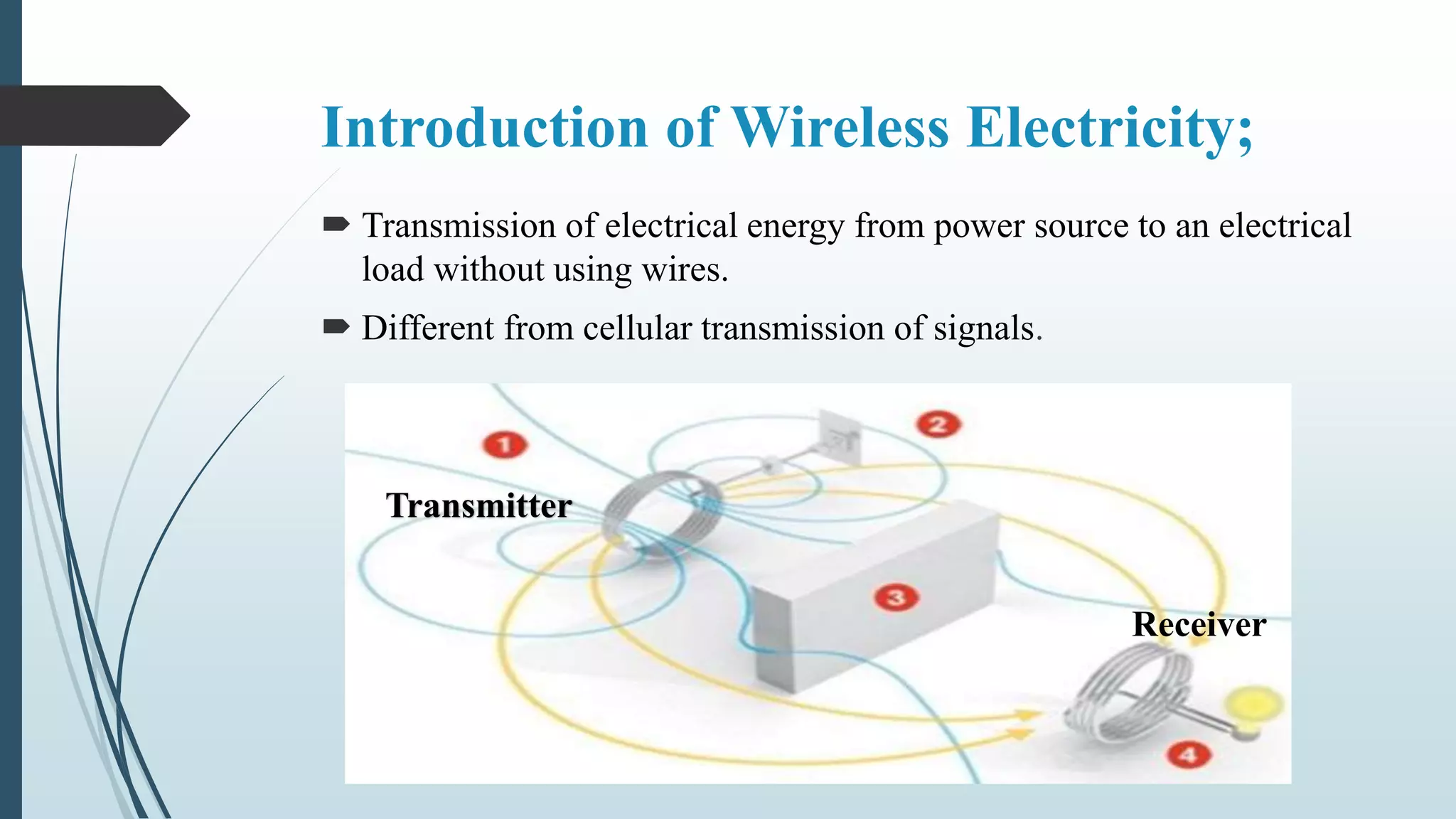
Introduction of Wireless Electricity;
 Transmission of electrical energy from power source to an electrical
load without using wires.
 Different from cellular transmission of signals.
Transmitter
Receiver
History of Wireless Electricity:
In 1899, Sir Nikola
Tesla performed the
first experiment on
Wireless Electricity.
He had put a great
effort in popularizing
the idea.
How it works ?
Wireless electricity uses the same principle as Magnetic
induction , but uses resonance to increase the range.
We know that Everything resonates at a certain frequency,
based on its shape and material.
Energy transfers easily between resonating objects.
With resonant induction, power is transmitted between two
resonating coils.
Modern research over the past years:
 Project Witricity:
 In 2007, a group of engineers at MIT (Massachusetts Institute of Technology) came up
with the idea of to use resonant induction to transmit power wirelessly.
 Engineers powered 60 watt bulb from 2 meters (7ft) at efficiency 45%.
 First practical example of WiTricity.
Challenges and Application
of Witricity:
 Witricity is an American engineering company.
 Manufactures devices for wireless energy transmission using
resonant energy transfer based on oscillating magnetic fields.
Challenges:
Design of high frequency stable oscillators.
Reducing the size of the coils used.
Cost of production.
Application:
 Electronic gadgets like laptops, mobiles,
iPod etc. can be charged wirelessly.
 Charging is automatic, without human
interception.
 The hybrid car can be charged
automatically.
 The entire lighting system can be powered
wirelessly
Wireless Electricity:
 No need of power cables and
batteries.
 Magnetic fields interact
weakly with biological
masses.
 No need of line of sight.
 Transmissions possible only in
few meters.
 There are possibility of
“Energy theft”.
 Efficiency decreases with
distance
Advantages: Disadvantages:
Conclusion:
 From an environmental standpoint , this technology could replace
disposable batteries and cords, reducing dangerous chemicals and
potential for poisoning communities.
Reference:
 https://sites.google.com/a/uw.edu/ethical-implications-of-wireless-power
 https://en.wikipedia.org/wiki/Electromagnetic_induction
Wire less electricity

Wire less electricity

  • 1.
    Wireless Electricity Presented By: Obaidur Rehman Reg No: BSP01183010
  • 2.
    Contents:  Introduction ofWireless Electricity  History of wireless Electricity  How it work?  Modern research over the past years  Application and challenges of witricity  Advantages and Disadvantages  Conclusion  References
  • 3.
    Introduction of WirelessElectricity;  Transmission of electrical energy from power source to an electrical load without using wires.  Different from cellular transmission of signals. Transmitter Receiver
  • 4.
    History of WirelessElectricity: In 1899, Sir Nikola Tesla performed the first experiment on Wireless Electricity. He had put a great effort in popularizing the idea.
  • 5.
    How it works? Wireless electricity uses the same principle as Magnetic induction , but uses resonance to increase the range. We know that Everything resonates at a certain frequency, based on its shape and material. Energy transfers easily between resonating objects. With resonant induction, power is transmitted between two resonating coils.
  • 6.
    Modern research overthe past years:  Project Witricity:  In 2007, a group of engineers at MIT (Massachusetts Institute of Technology) came up with the idea of to use resonant induction to transmit power wirelessly.  Engineers powered 60 watt bulb from 2 meters (7ft) at efficiency 45%.  First practical example of WiTricity.
  • 7.
    Challenges and Application ofWitricity:  Witricity is an American engineering company.  Manufactures devices for wireless energy transmission using resonant energy transfer based on oscillating magnetic fields. Challenges: Design of high frequency stable oscillators. Reducing the size of the coils used. Cost of production.
  • 8.
    Application:  Electronic gadgetslike laptops, mobiles, iPod etc. can be charged wirelessly.  Charging is automatic, without human interception.  The hybrid car can be charged automatically.  The entire lighting system can be powered wirelessly
  • 9.
    Wireless Electricity:  Noneed of power cables and batteries.  Magnetic fields interact weakly with biological masses.  No need of line of sight.  Transmissions possible only in few meters.  There are possibility of “Energy theft”.  Efficiency decreases with distance Advantages: Disadvantages:
  • 10.
    Conclusion:  From anenvironmental standpoint , this technology could replace disposable batteries and cords, reducing dangerous chemicals and potential for poisoning communities.
  • 11.