Lecturer: Rev. Michael Prince

WIST: Rev. M. Prince 2014

1
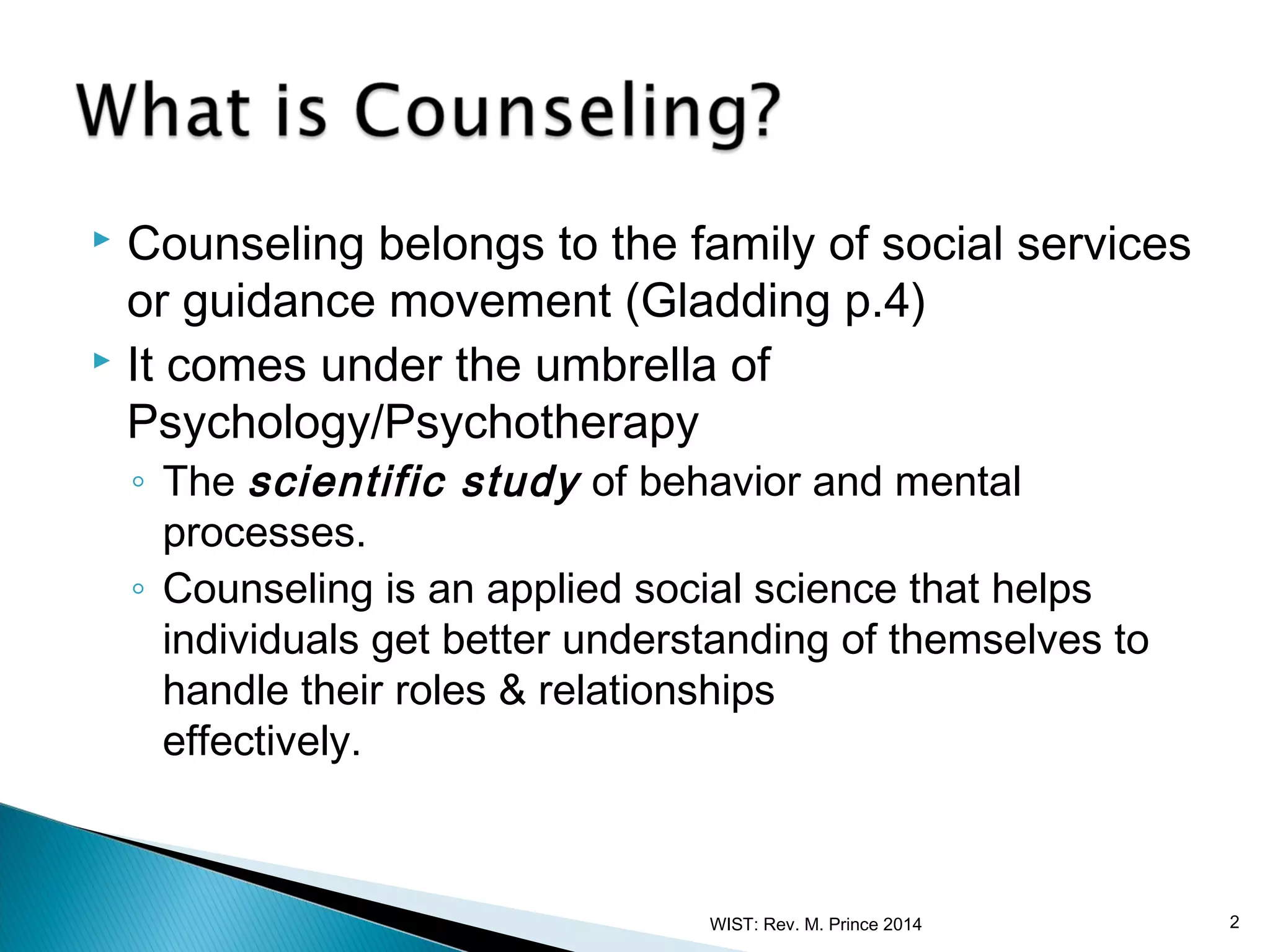
Counseling belongs to the family of social services
or guidance movement (Gladding p.4)
 It comes under the umbrella of
Psychology/Psychotherapy


◦ The scientific study of behavior and mental
processes.
◦ Counseling is an applied social science that helps
individuals get better understanding of themselves to
handle their roles & relationships
effectively.

WIST: Rev. M. Prince 2014

2
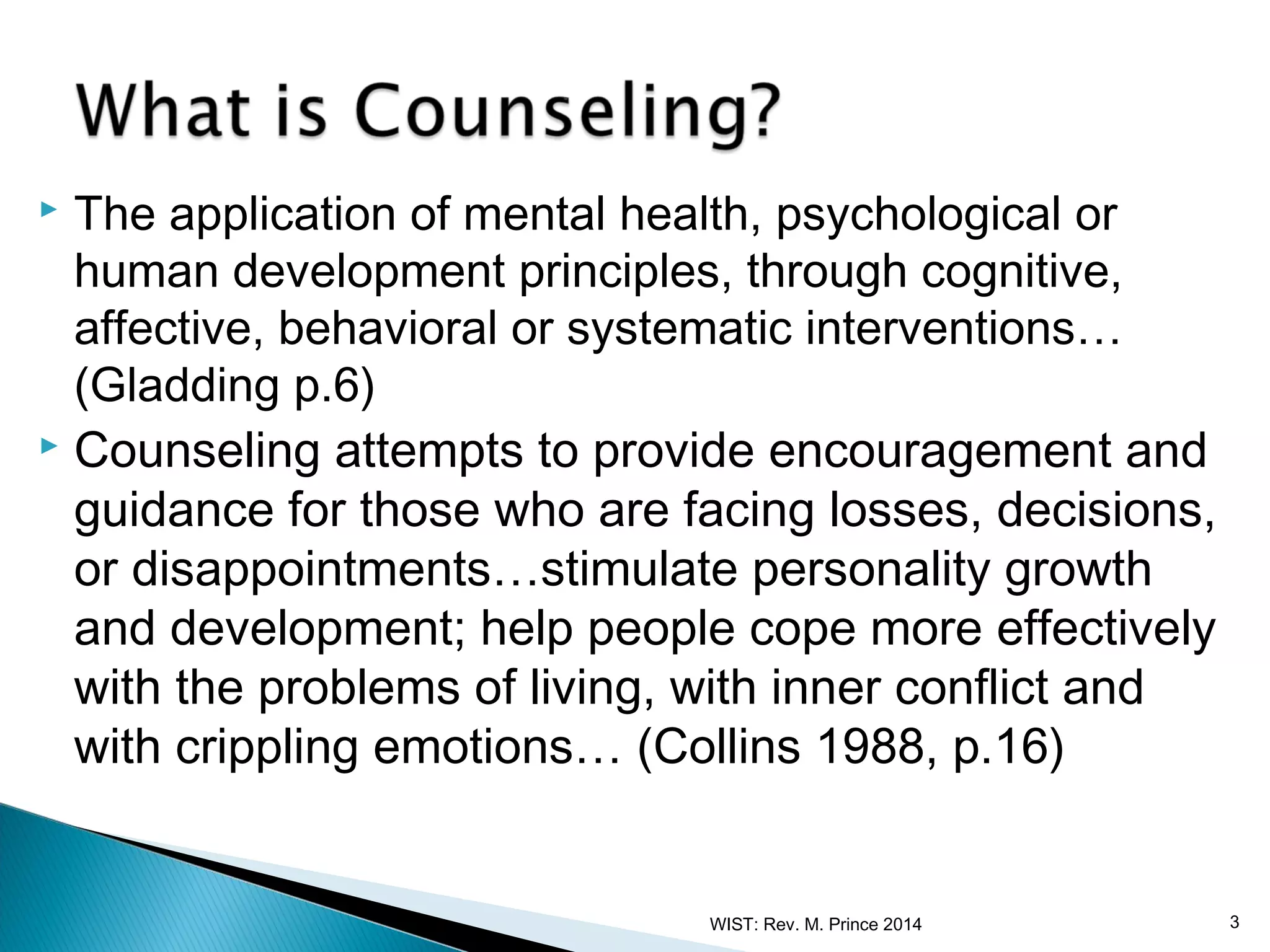
The application of mental health, psychological or
human development principles, through cognitive,
affective, behavioral or systematic interventions…
(Gladding p.6)
 Counseling attempts to provide encouragement and
guidance for those who are facing losses, decisions,
or disappointments…stimulate personality growth
and development; help people cope more effectively
with the problems of living, with inner conflict and
with crippling emotions… (Collins 1988, p.16)


WIST: Rev. M. Prince 2014

3
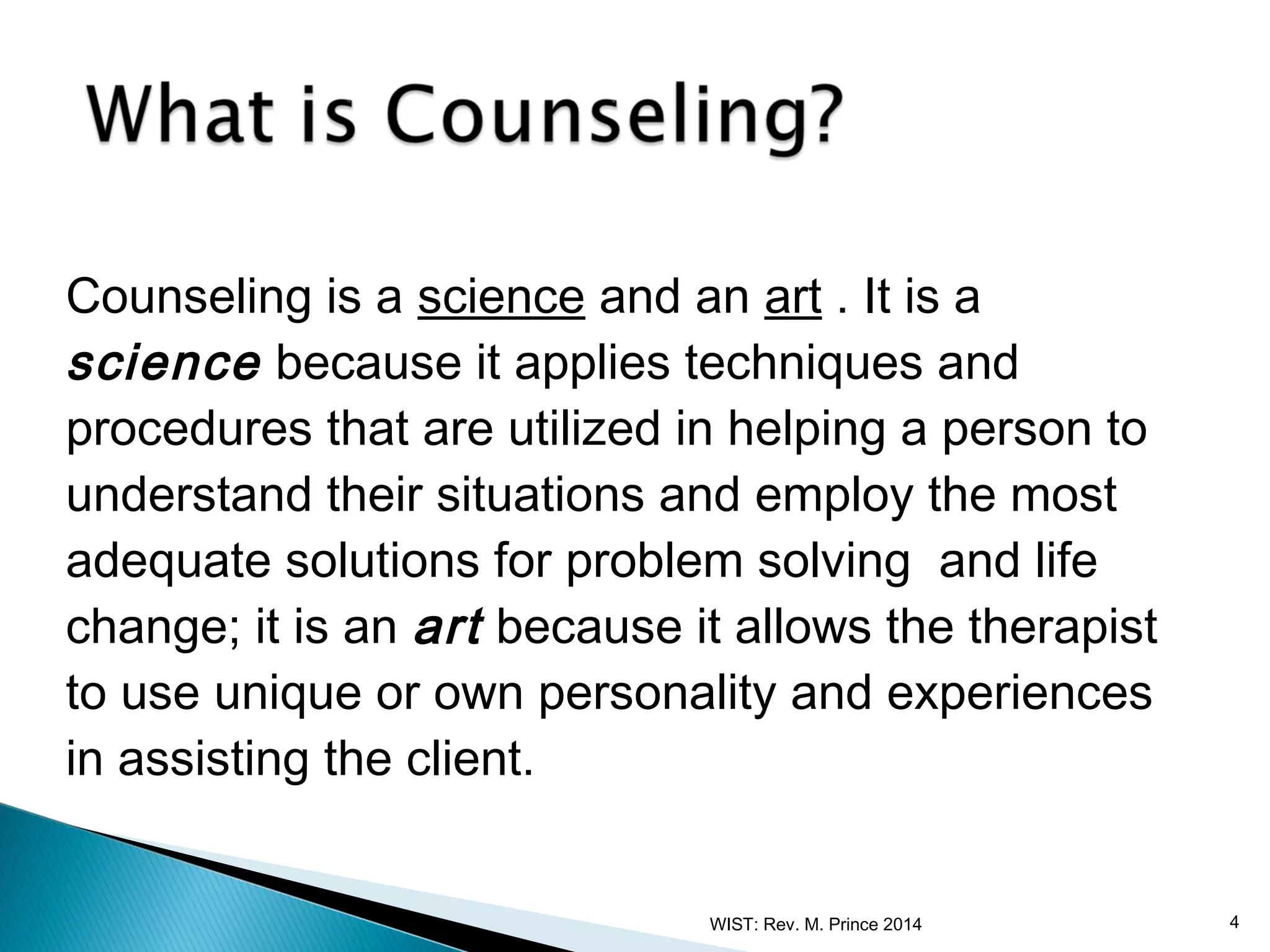
Counseling is a science and an art . It is a
science because it applies techniques and
procedures that are utilized in helping a person to
understand their situations and employ the most
adequate solutions for problem solving and life
change; it is an art because it allows the therapist
to use unique or own personality and experiences
in assisting the client.
WIST: Rev. M. Prince 2014

4


Christian Counseling is defined as an art and a
science of applying Biblical principles to treat with
clients’ issues using the rudiments of professional
counseling.

WIST: Rev. M. Prince 2014

5
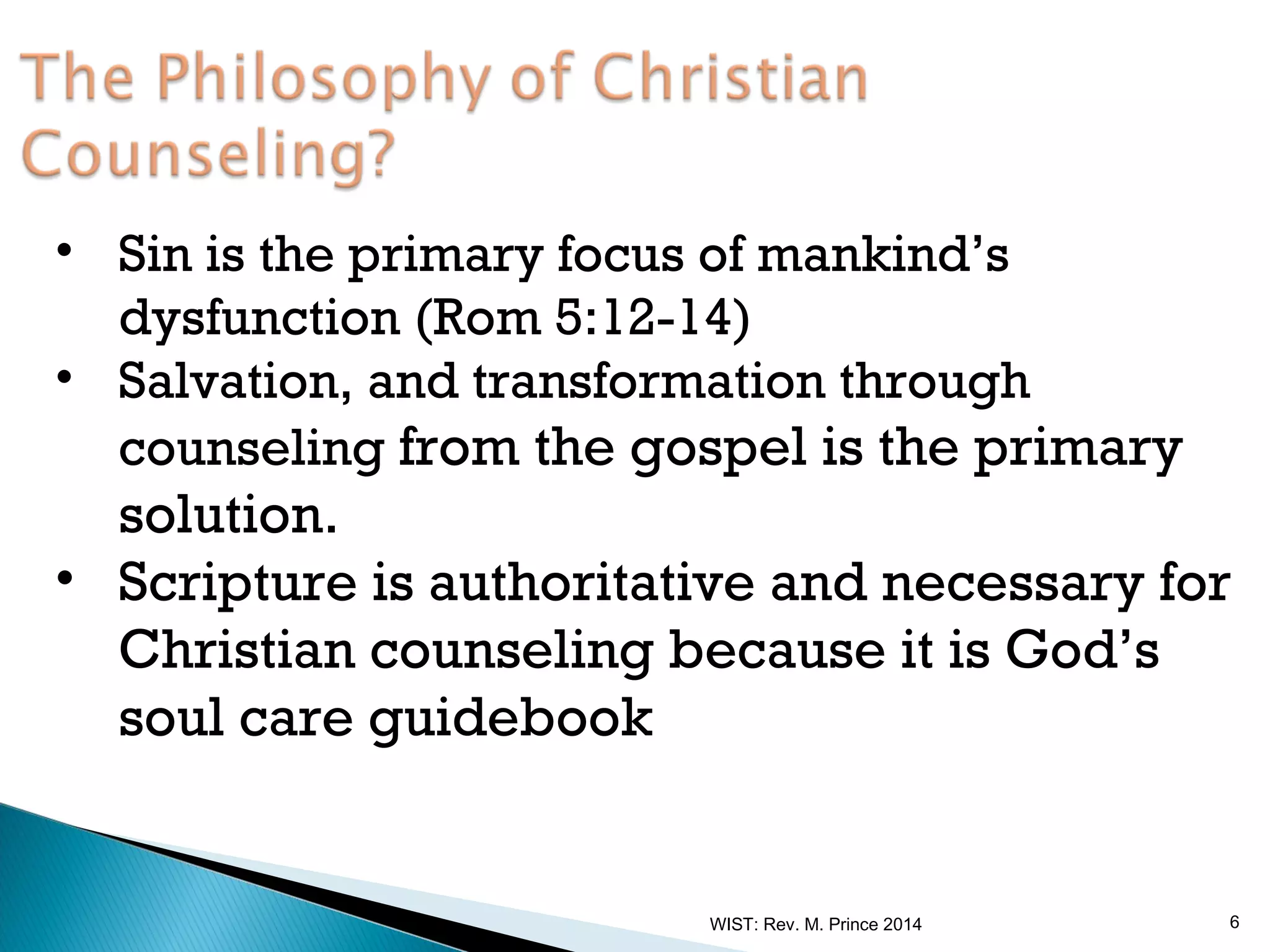
• Sin is the primary focus of mankind’s
dysfunction (Rom 5:12-14)
• Salvation, and transformation through
counseling from the gospel is the primary

solution.
• Scripture is authoritative and necessary for
Christian counseling because it is God’s
soul care guidebook

WIST: Rev. M. Prince 2014

6
WIST: Rev. M. Prince 2014

7
WIST: Rev. M. Prince 2014

8
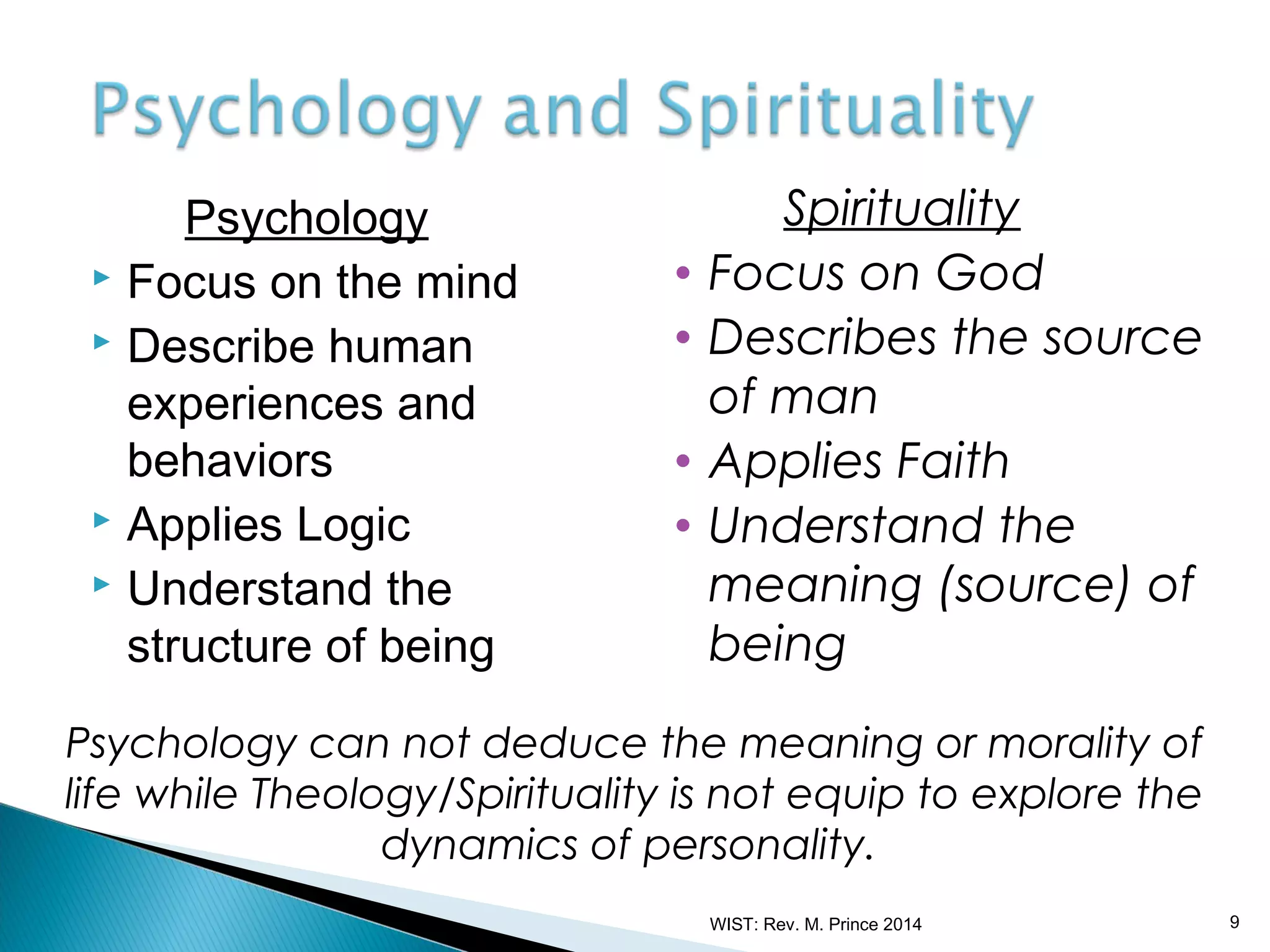
Psychology
 Focus on the mind
 Describe human
experiences and
behaviors
 Applies Logic
 Understand the
structure of being

•
•
•
•

Spirituality
Focus on God
Describes the source
of man
Applies Faith
Understand the
meaning (source) of
being

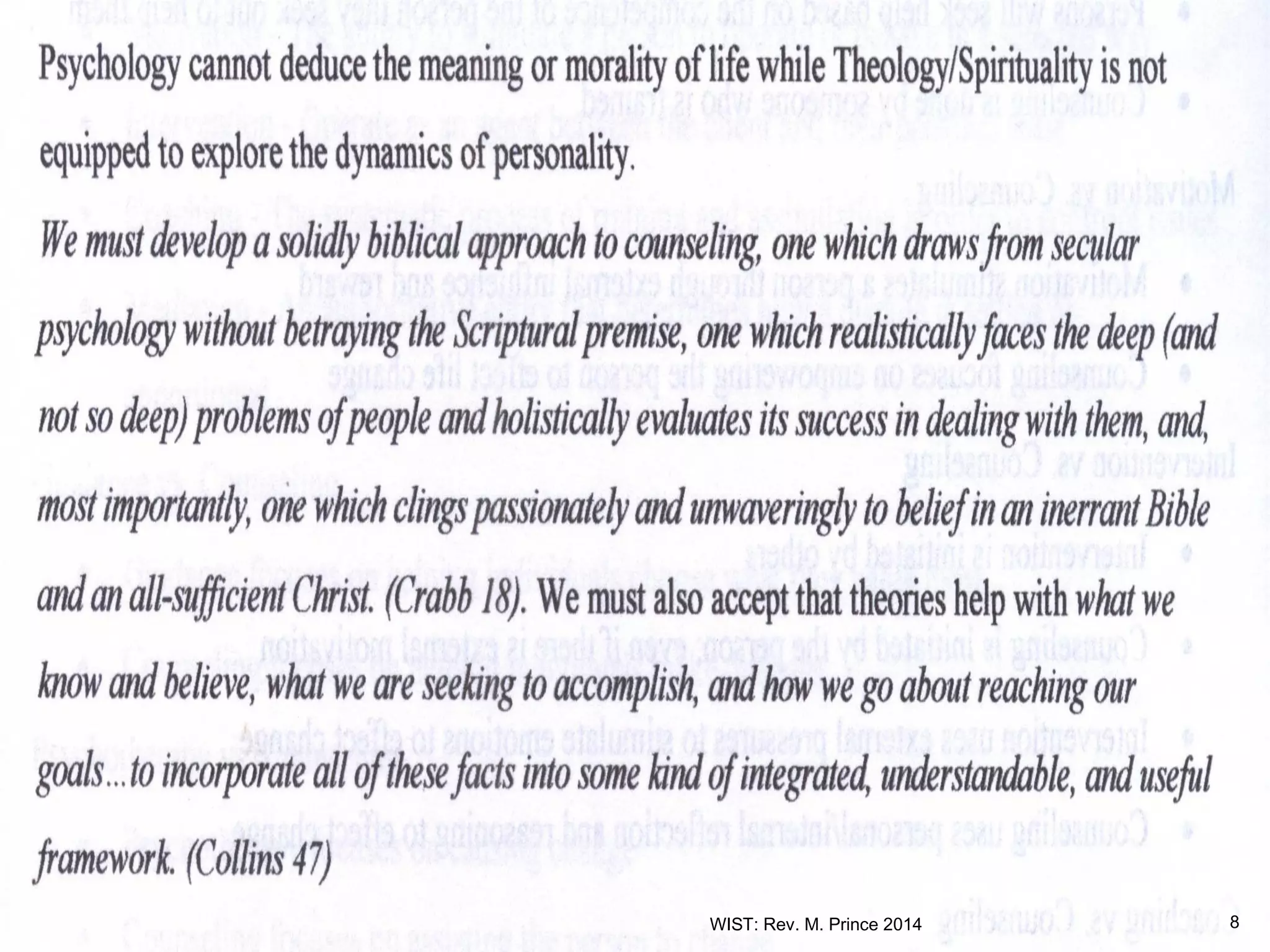
Psychology can not deduce the meaning or morality of
life while Theology/Spirituality is not equip to explore the
dynamics of personality.
WIST: Rev. M. Prince 2014

9




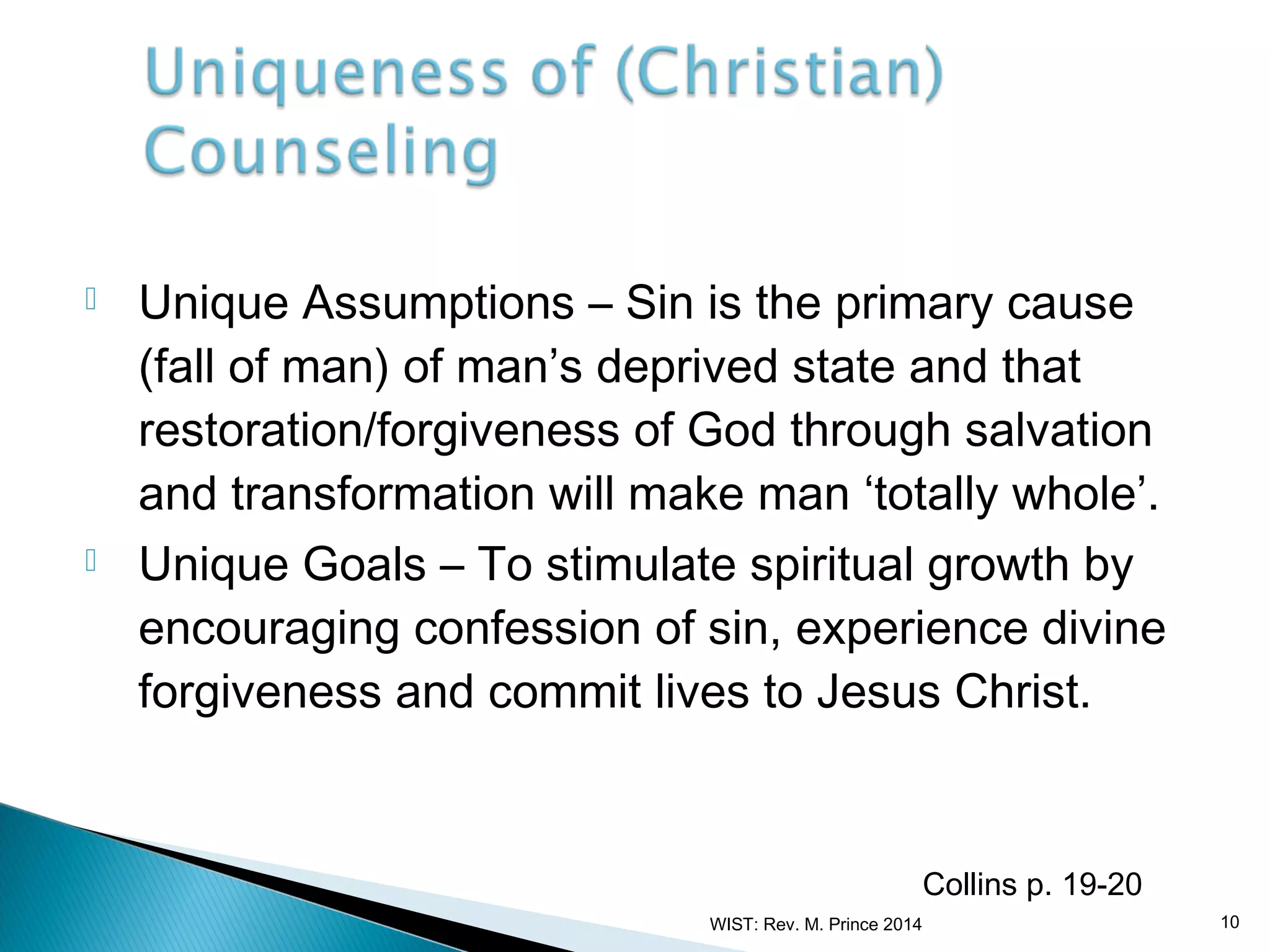
Unique Assumptions – Sin is the primary cause
(fall of man) of man’s deprived state and that
restoration/forgiveness of God through salvation
and transformation will make man ‘totally whole’.
Unique Goals – To stimulate spiritual growth by
encouraging confession of sin, experience divine
forgiveness and commit lives to Jesus Christ.

Collins p. 19-20
WIST: Rev. M. Prince 2014

10
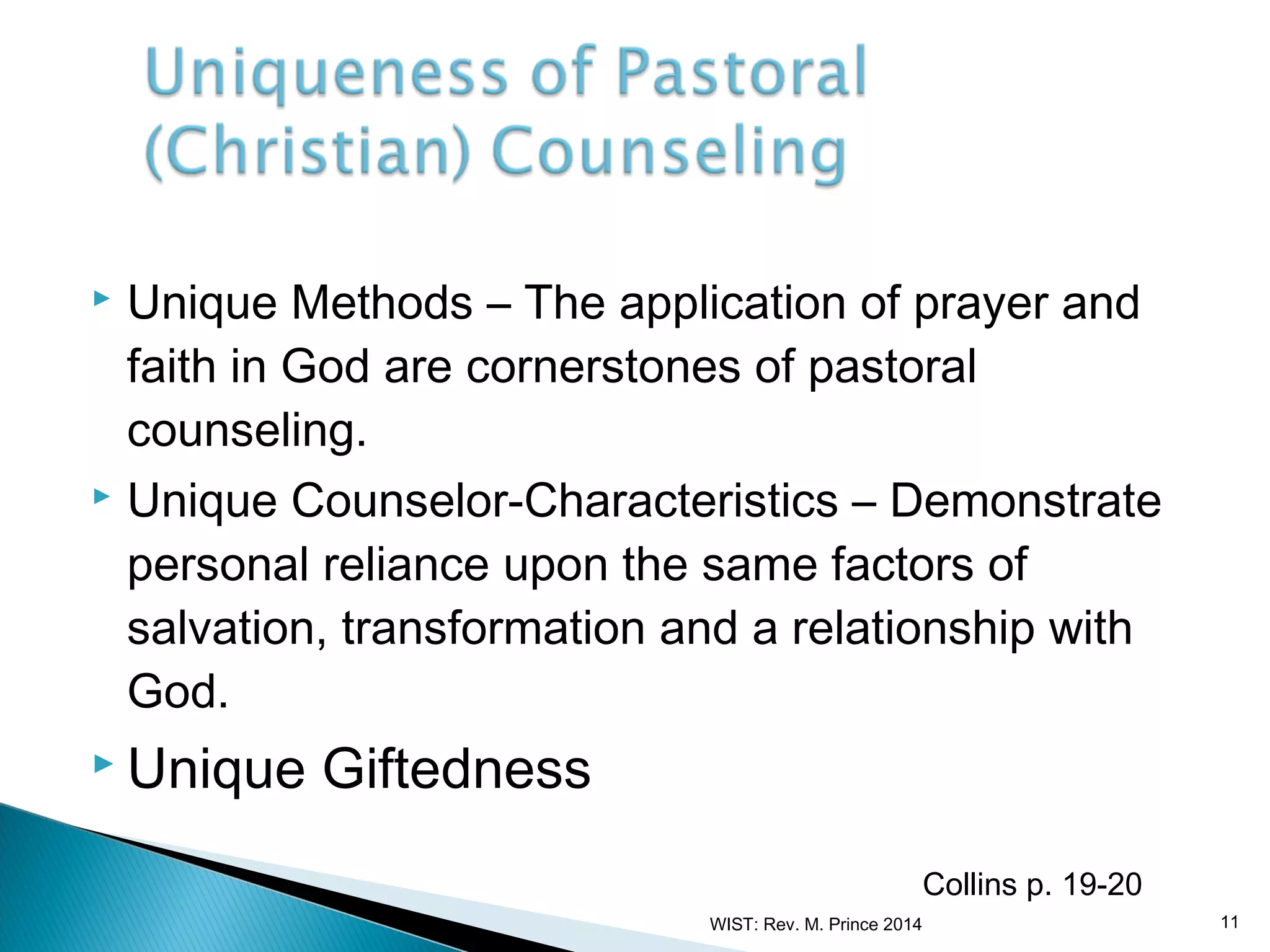
Unique Methods – The application of prayer and
faith in God are cornerstones of pastoral
counseling.
 Unique Counselor-Characteristics – Demonstrate
personal reliance upon the same factors of
salvation, transformation and a relationship with
God.


 Unique

Giftedness
Collins p. 19-20
WIST: Rev. M. Prince 2014

11
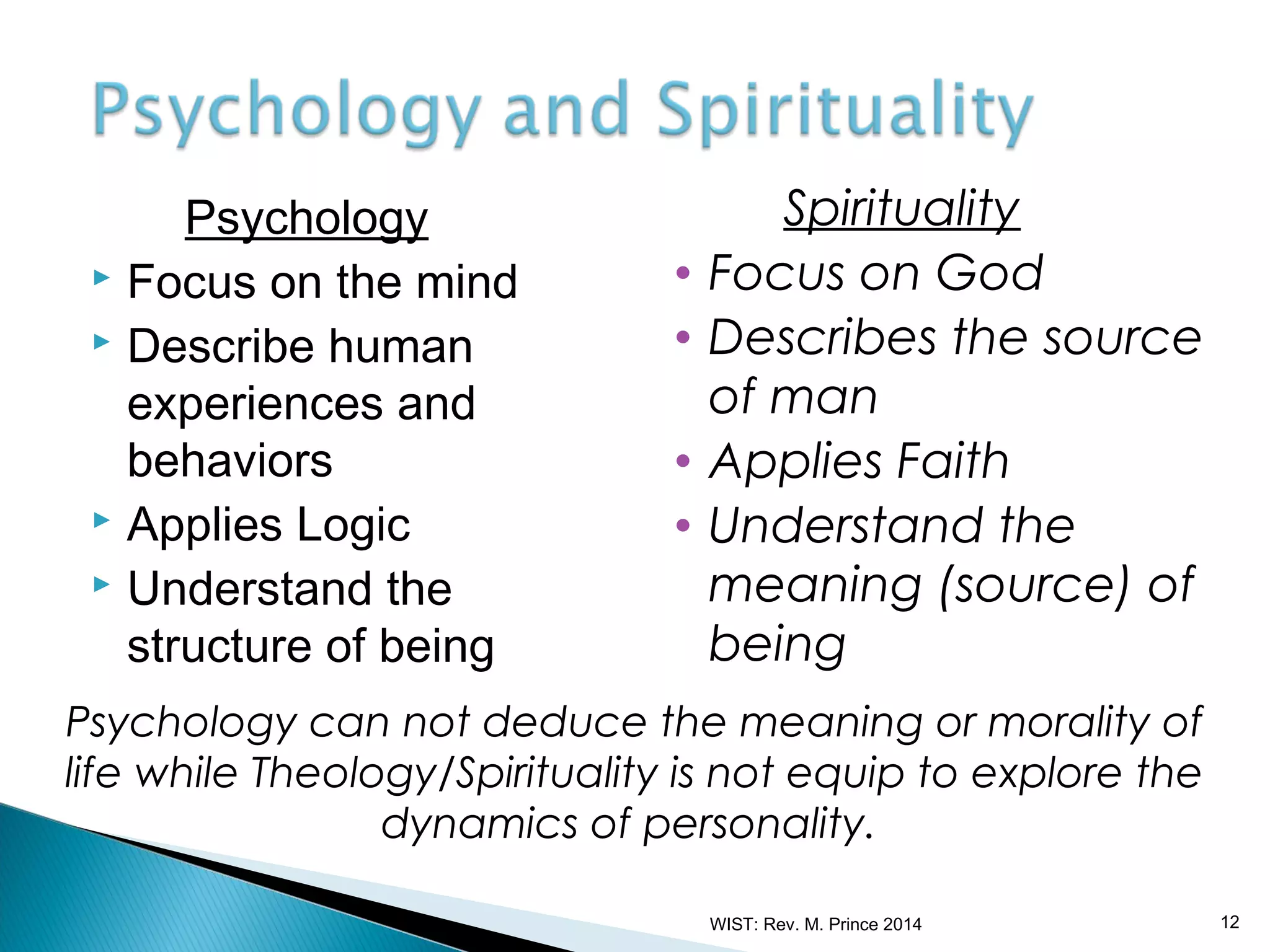
Psychology
 Focus on the mind
 Describe human
experiences and
behaviors
 Applies Logic
 Understand the
structure of being

•
•
•
•

Spirituality
Focus on God
Describes the source
of man
Applies Faith
Understand the
meaning (source) of
being

Psychology can not deduce the meaning or morality of
life while Theology/Spirituality is not equip to explore the
dynamics of personality.
WIST: Rev. M. Prince 2014

12
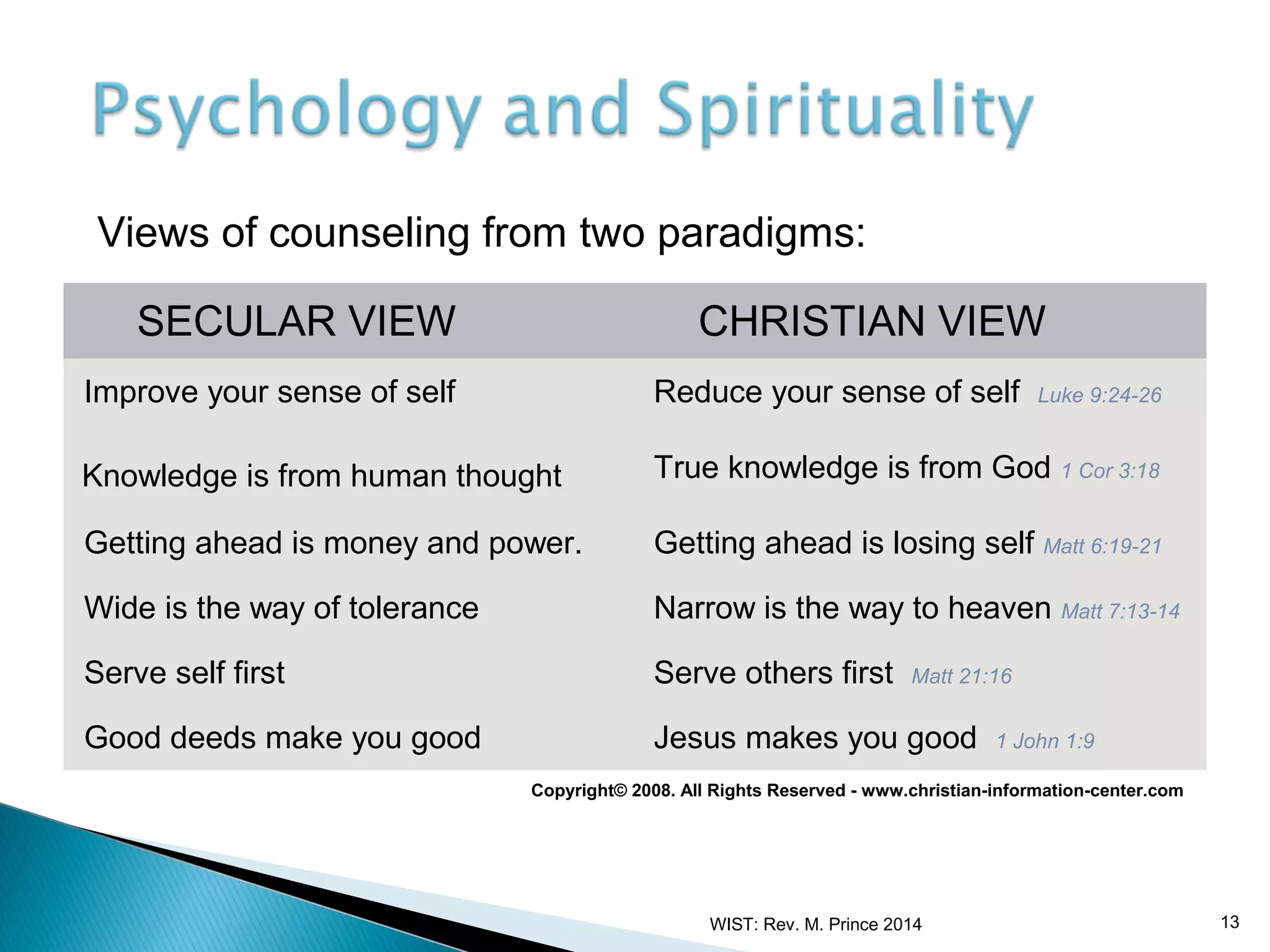
Views of counseling from two paradigms:
SECULAR VIEW

CHRISTIAN VIEW

Improve your sense of self

Reduce your sense of self

Knowledge is from human thought

True knowledge is from God 1 Cor 3:18

Getting ahead is money and power.

Getting ahead is losing self Matt 6:19-21

Wide is the way of tolerance

Narrow is the way to heaven Matt 7:13-14

Serve self first

Serve others first

Good deeds make you good

Jesus makes you good

Luke 9:24-26

Matt 21:16
1 John 1:9

Copyright© 2008. All Rights Reserved - www.christian-information-center.com

WIST: Rev. M. Prince 2014

13
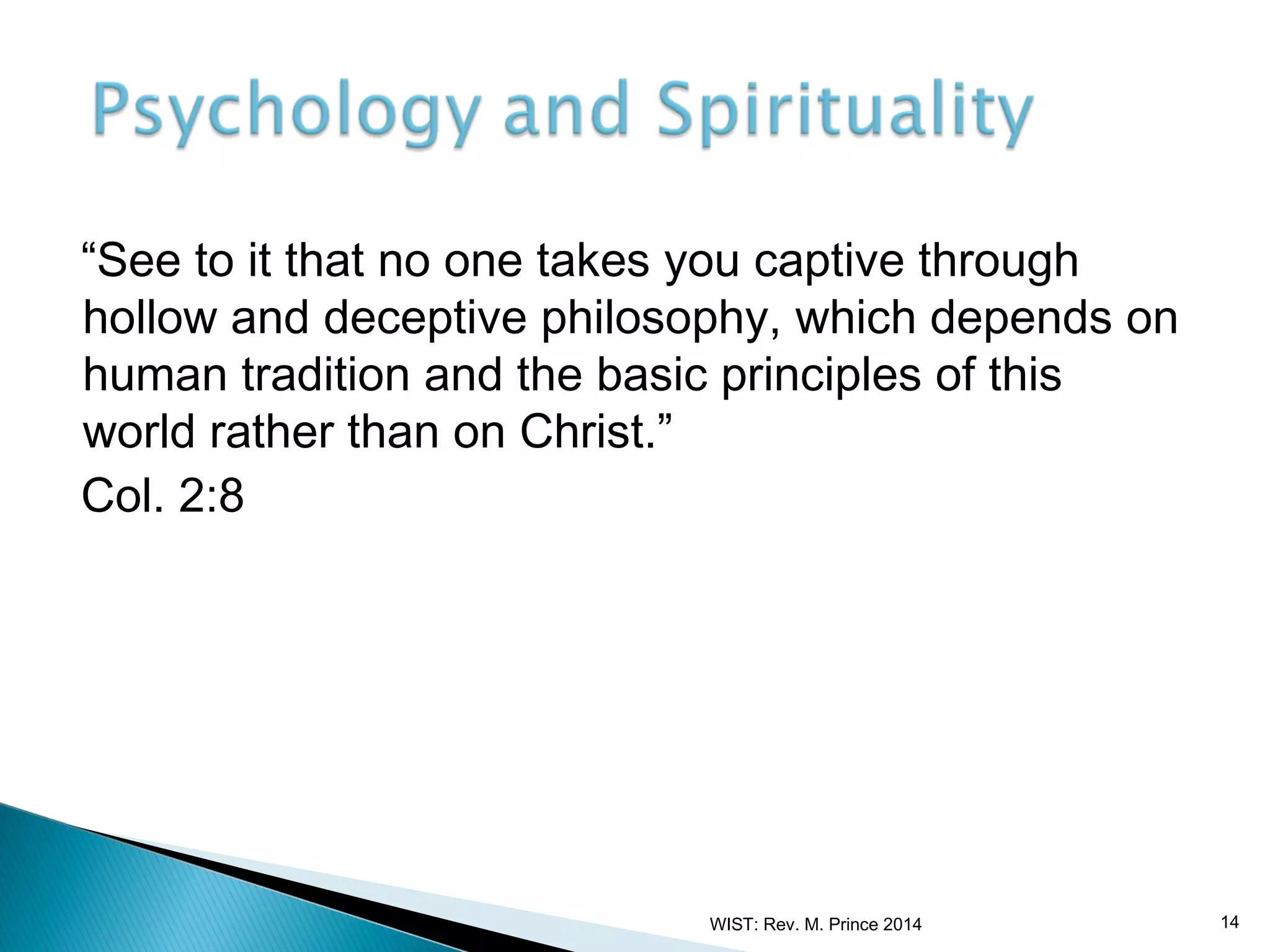
“See to it that no one takes you captive through
hollow and deceptive philosophy, which depends on
human tradition and the basic principles of this
world rather than on Christ.”
Col. 2:8

WIST: Rev. M. Prince 2014

14
WIST: Rev. M. Prince 2014

15
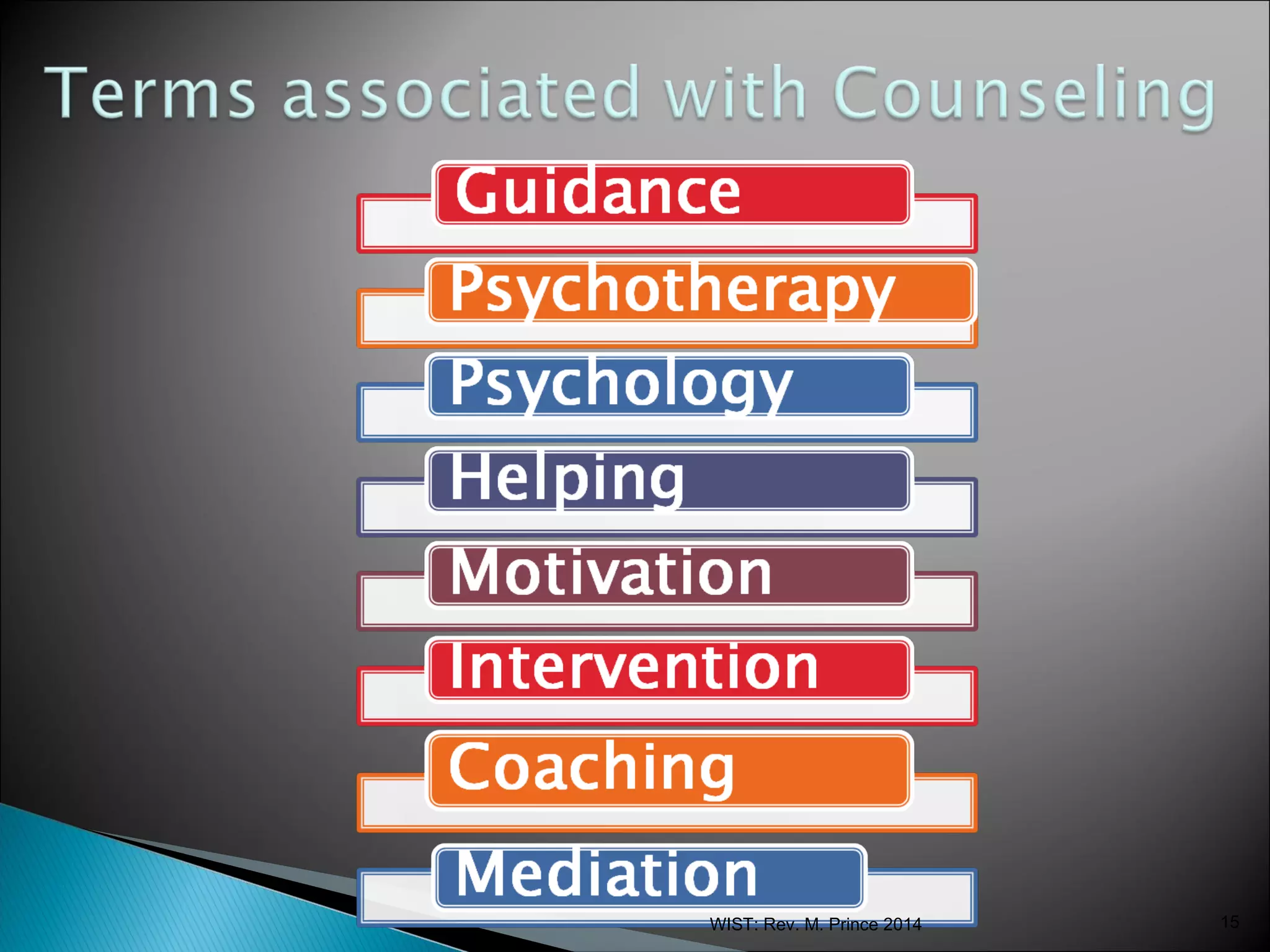
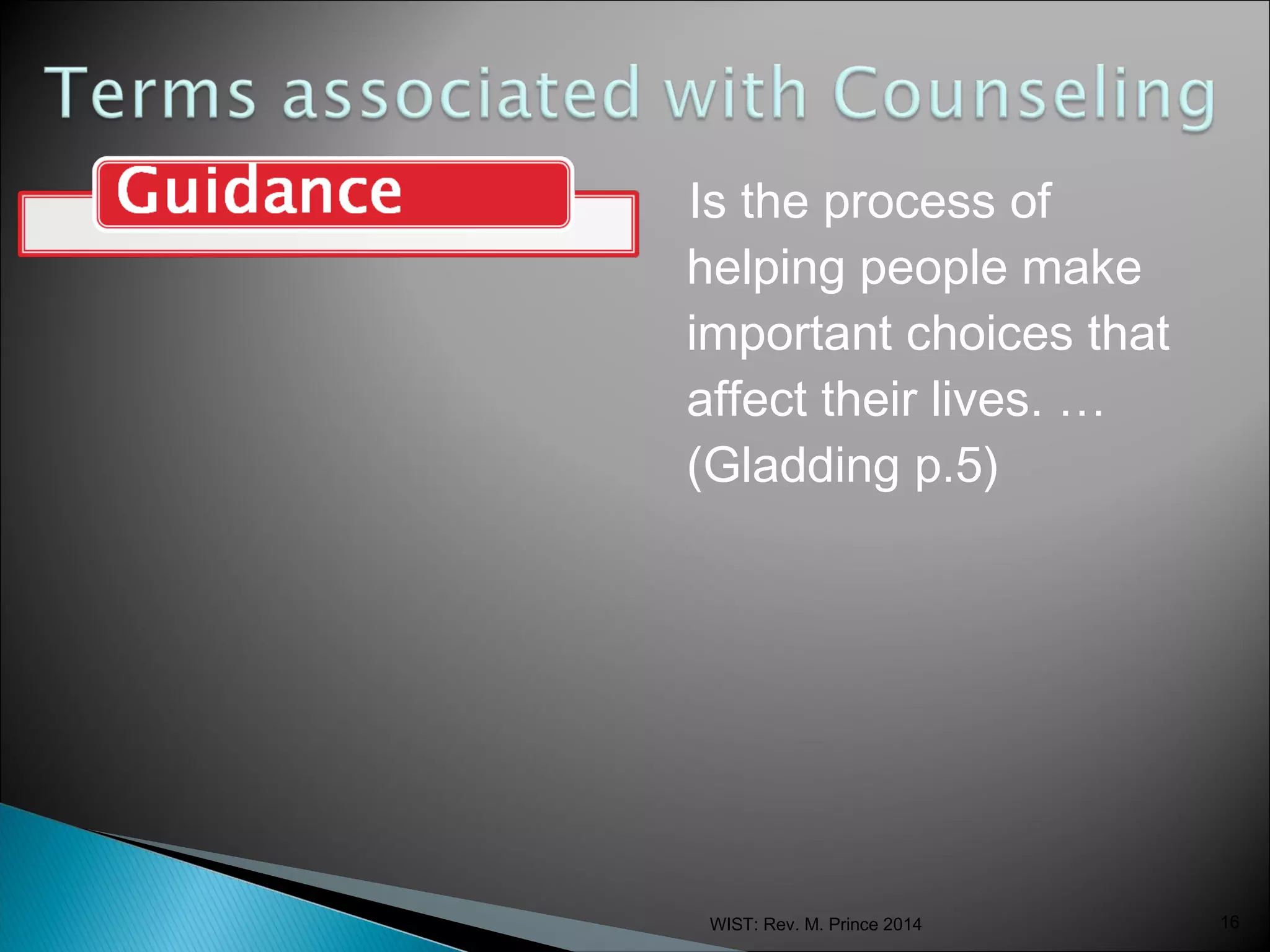
Is the process of
helping people make
important choices that
affect their lives. …
(Gladding p.5)

WIST: Rev. M. Prince 2014

16
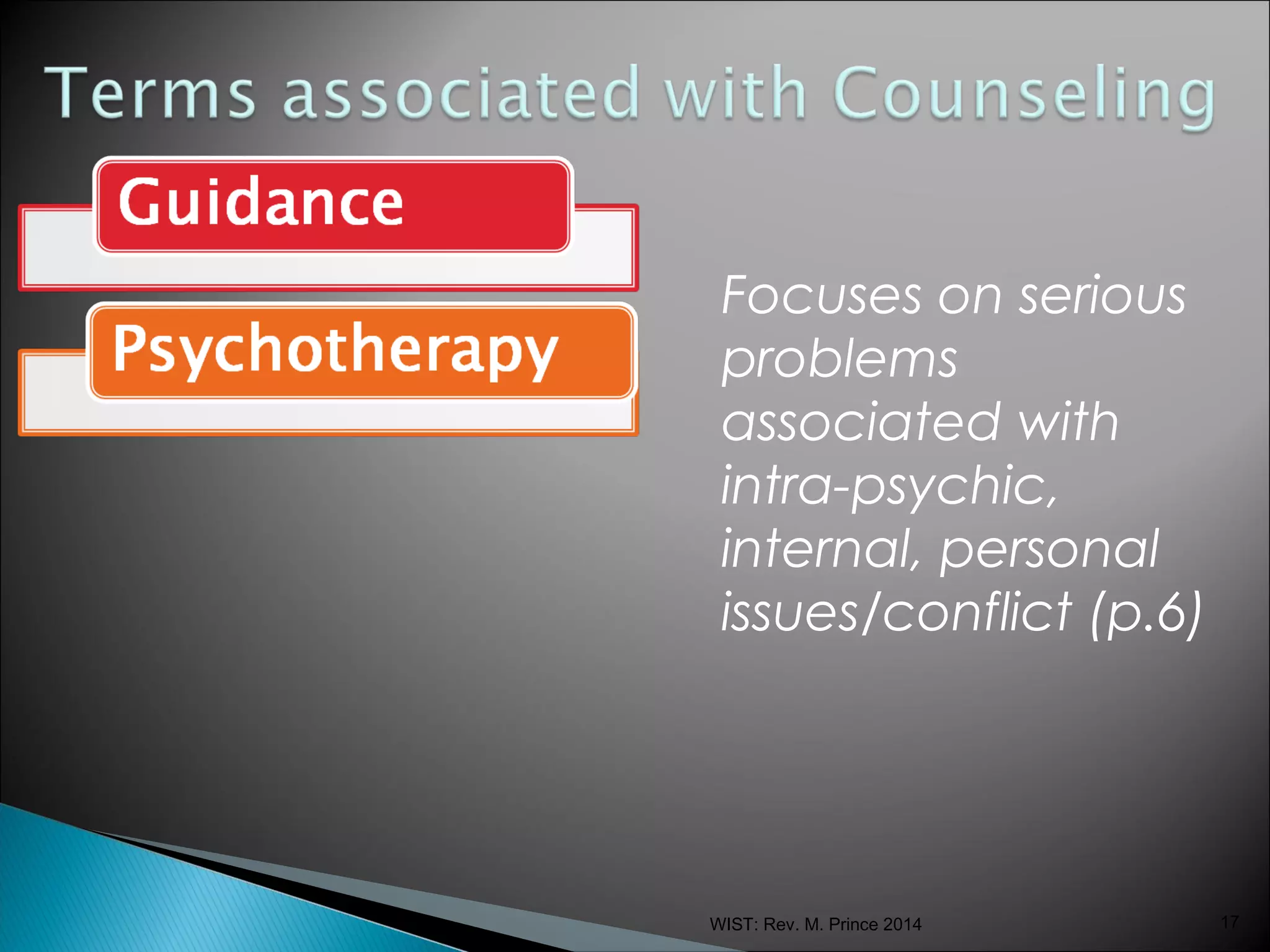
Focuses on serious
problems
associated with
intra-psychic,
internal, personal
issues/conflict (p.6)

WIST: Rev. M. Prince 2014

17
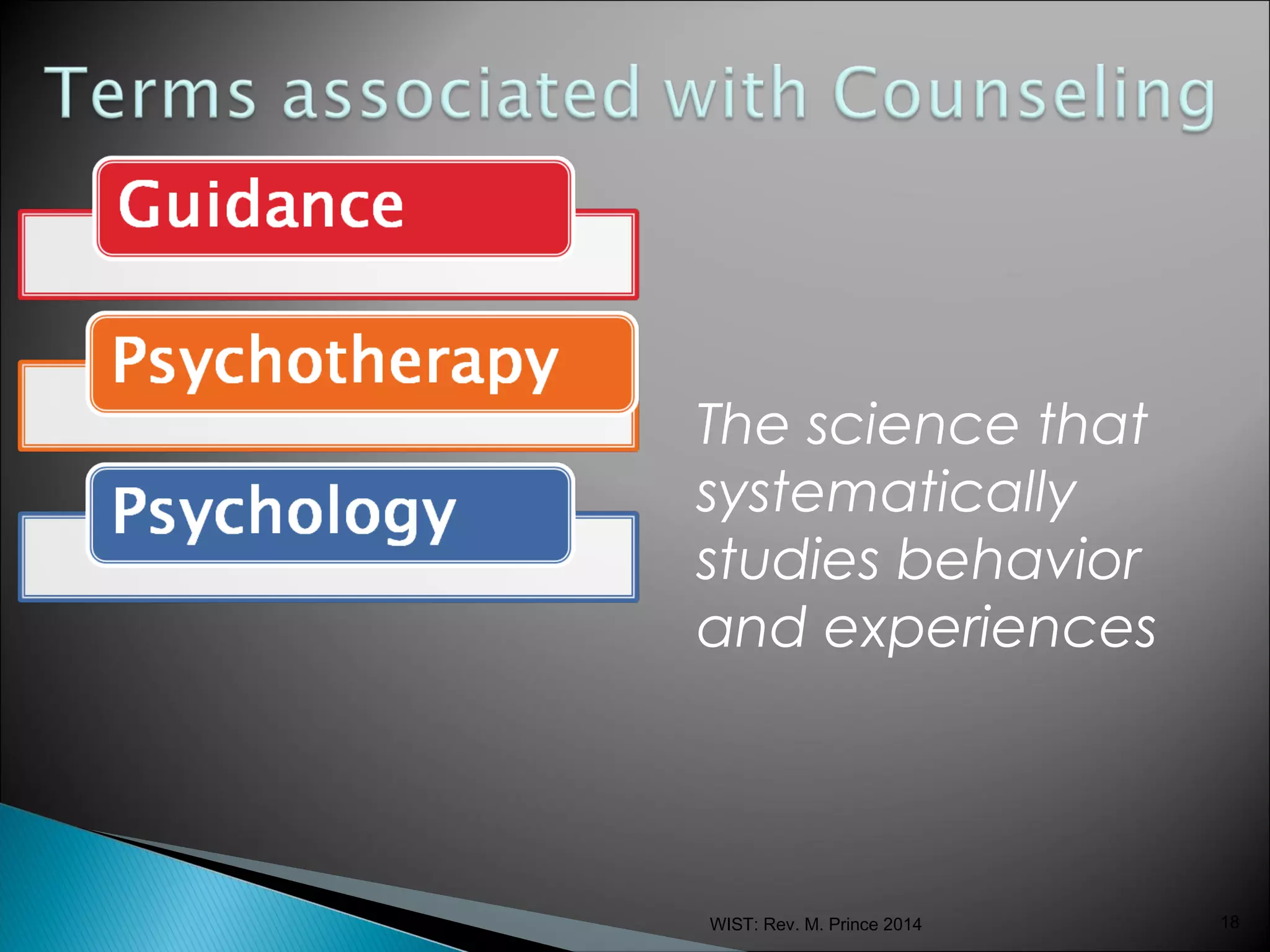
The science that
systematically
studies behavior
and experiences

WIST: Rev. M. Prince 2014

18
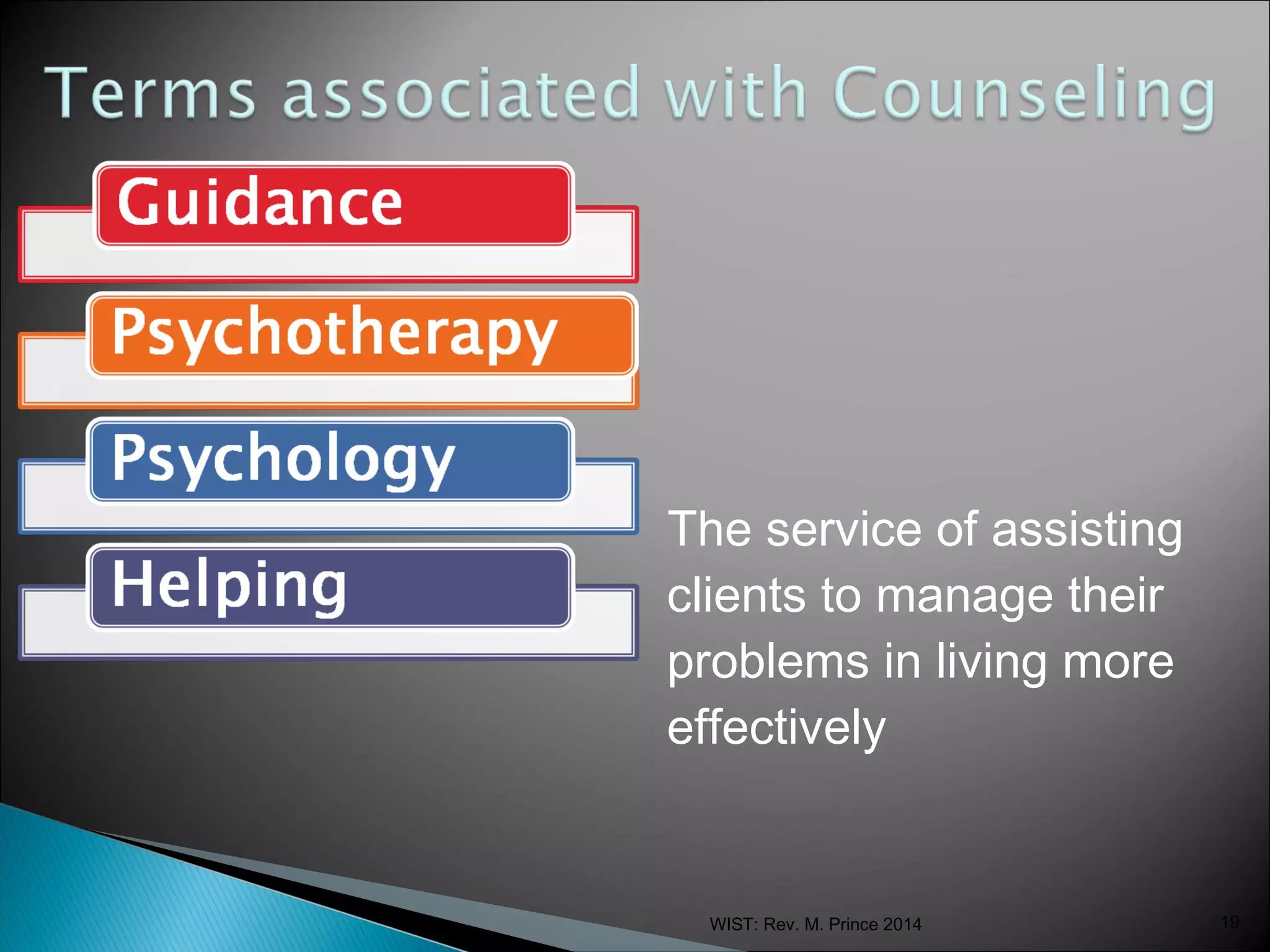
The service of assisting
clients to manage their
problems in living more
effectively

WIST: Rev. M. Prince 2014

19
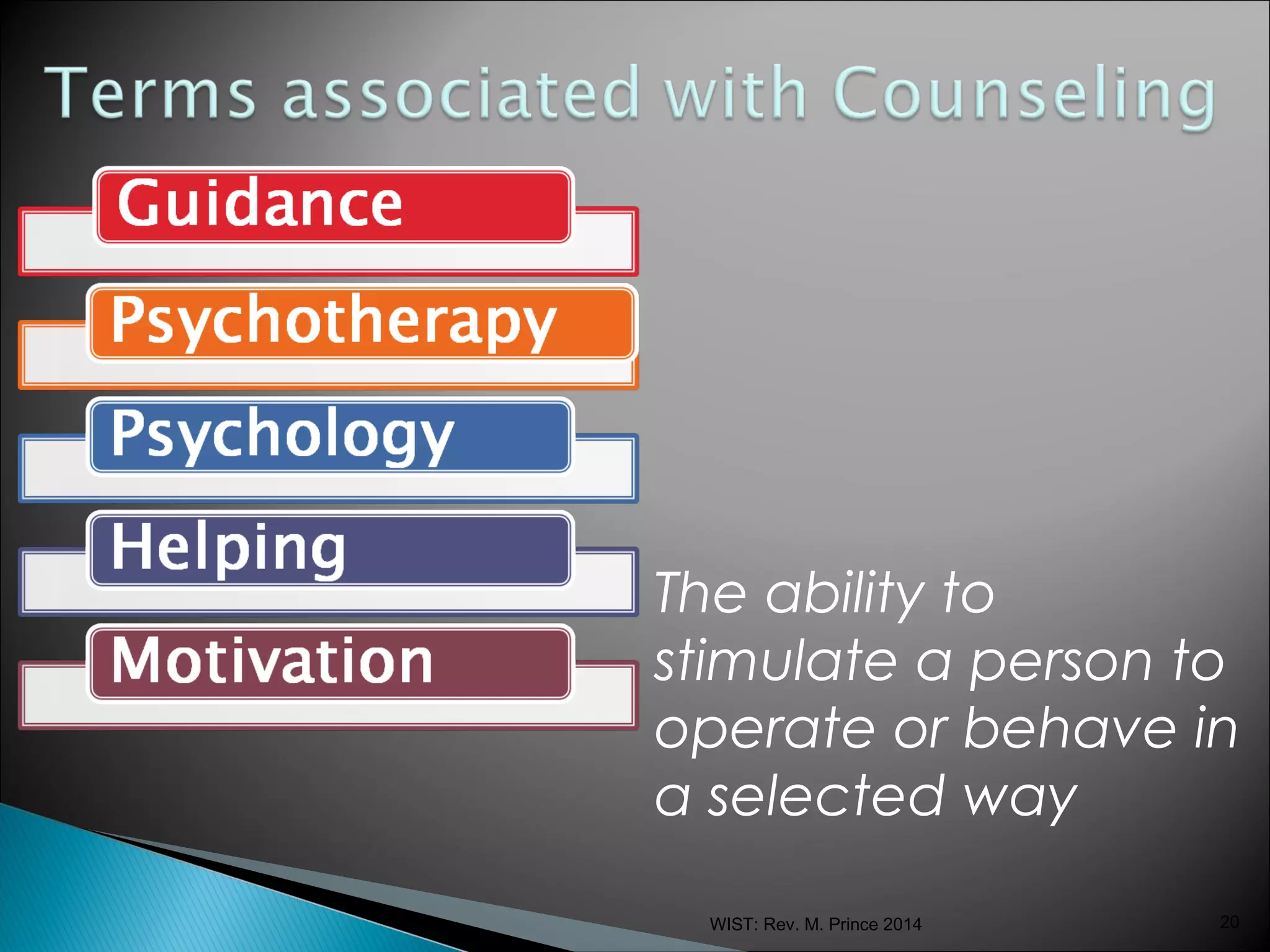
The ability to
stimulate a person to
operate or behave in
a selected way
WIST: Rev. M. Prince 2014

20
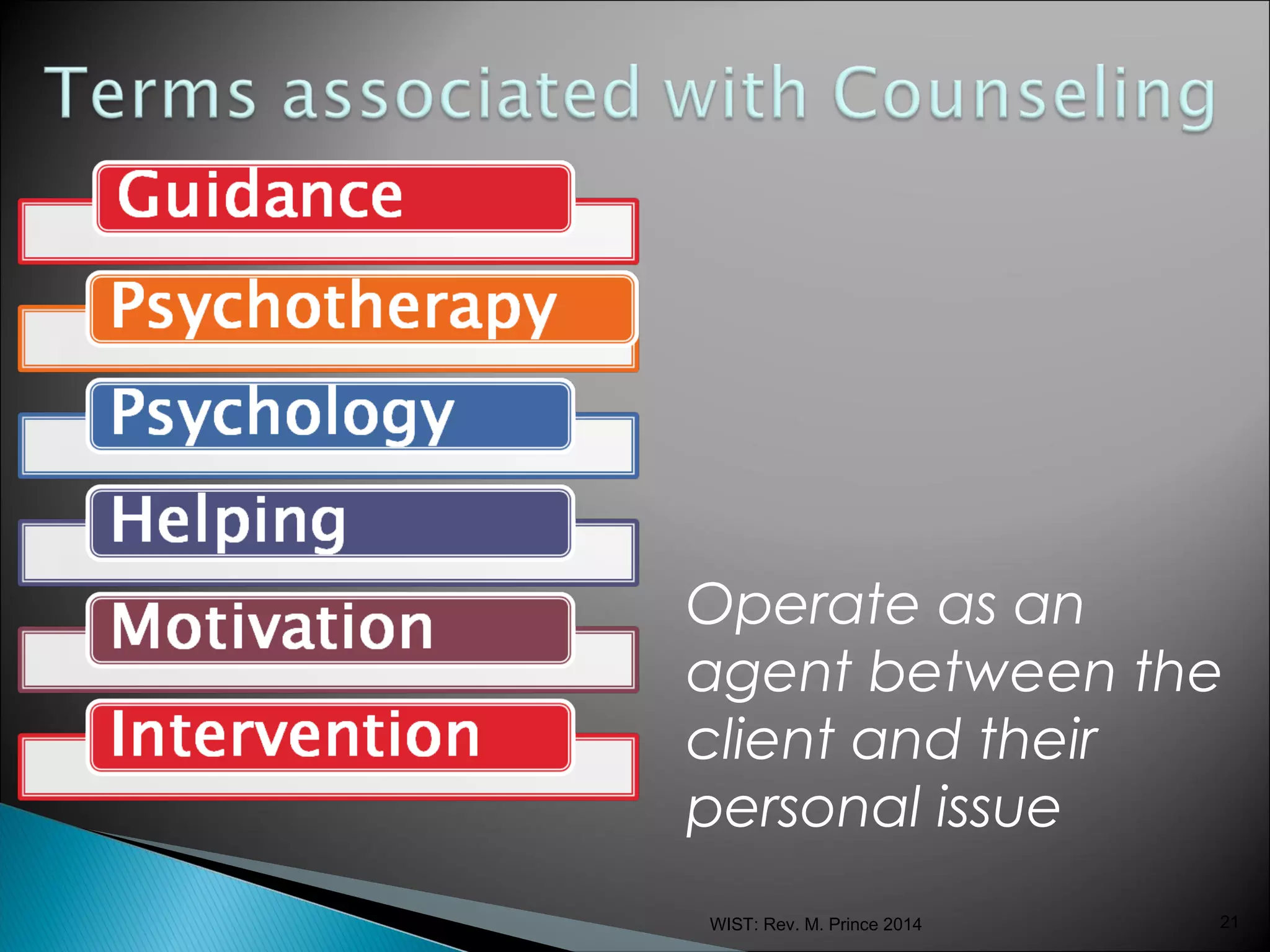
Operate as an
agent between the
client and their
personal issue
WIST: Rev. M. Prince 2014

21
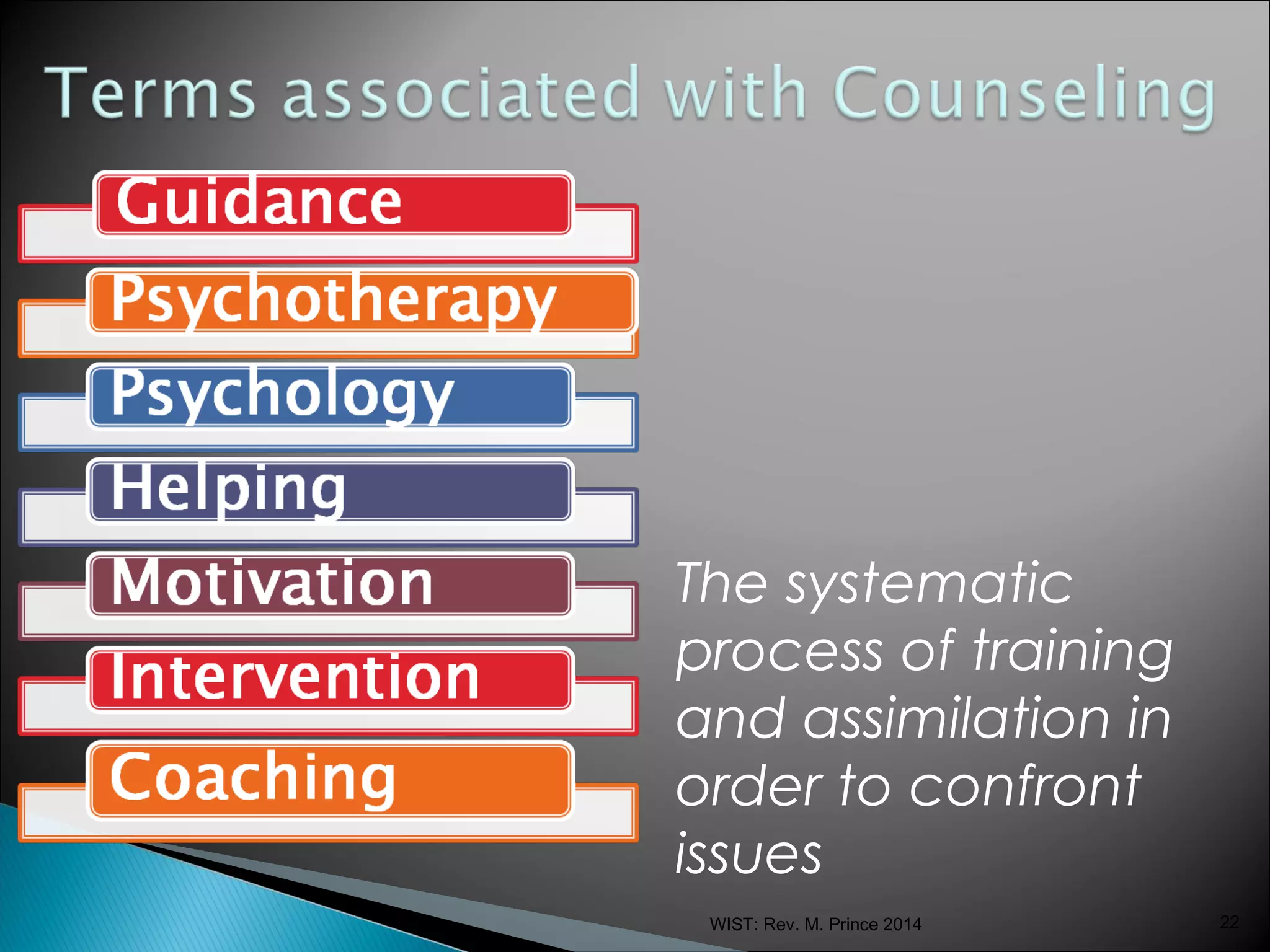
The systematic
process of training
and assimilation in
order to confront
issues
WIST: Rev. M. Prince 2014

22
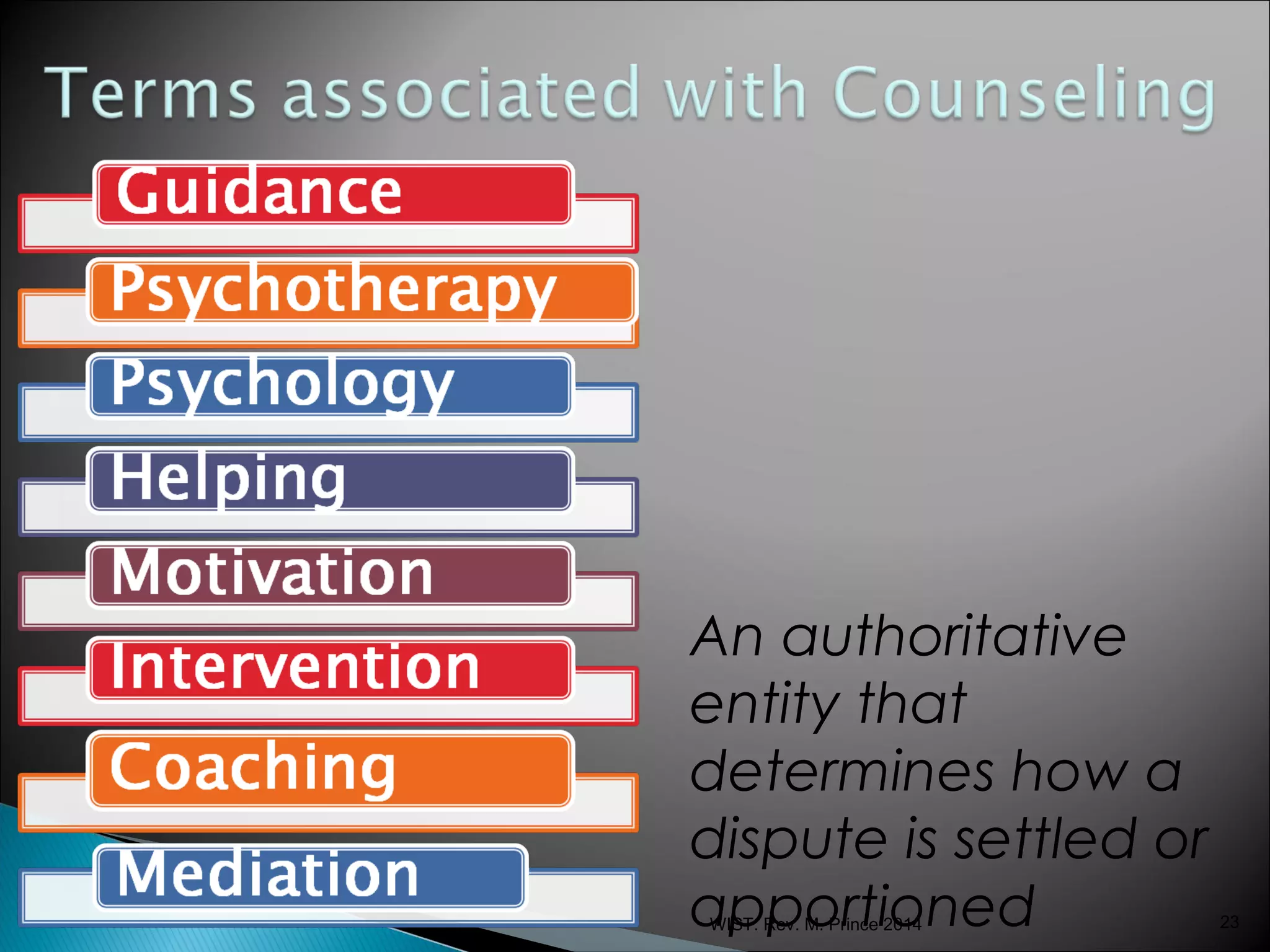
An authoritative
entity that
determines how a
dispute is settled or
apportioned
WIST: Rev. M. Prince 2014

23
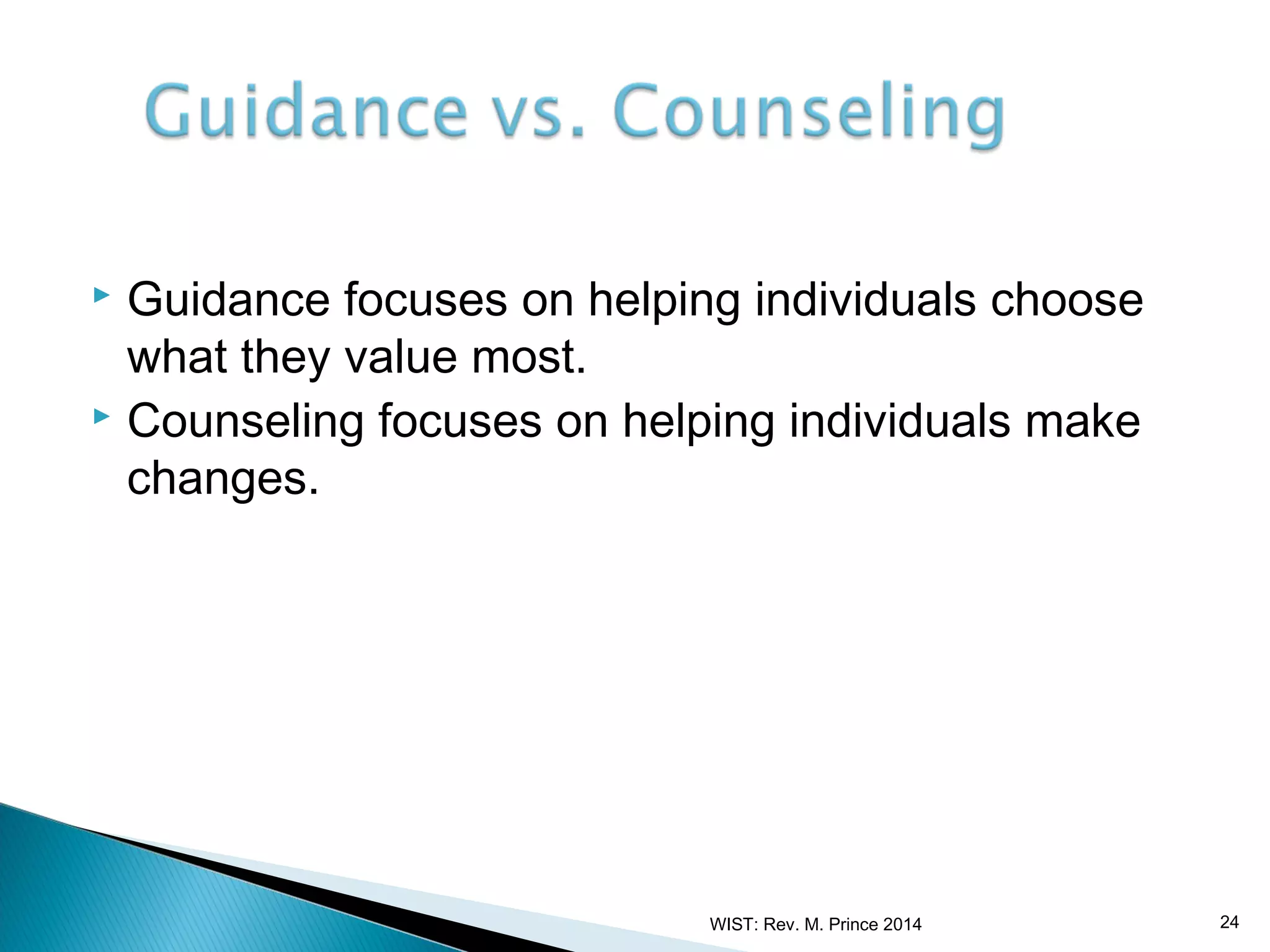
Guidance focuses on helping individuals choose
what they value most.
 Counseling focuses on helping individuals make
changes.


WIST: Rev. M. Prince 2014

24
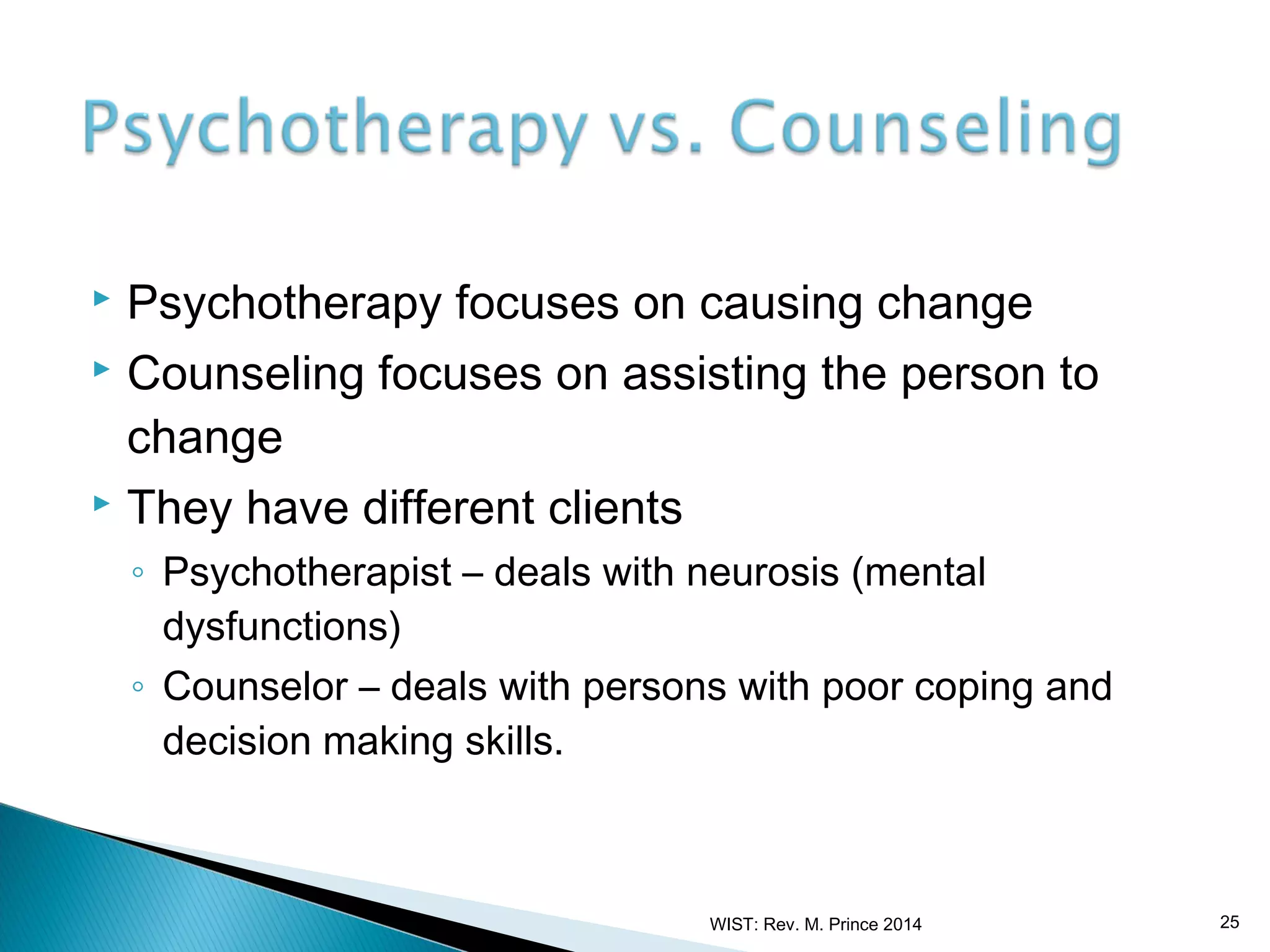
Psychotherapy focuses on causing change
 Counseling focuses on assisting the person to
change
 They have different clients


◦ Psychotherapist – deals with neurosis (mental
dysfunctions)
◦ Counselor – deals with persons with poor coping and
decision making skills.

WIST: Rev. M. Prince 2014

25







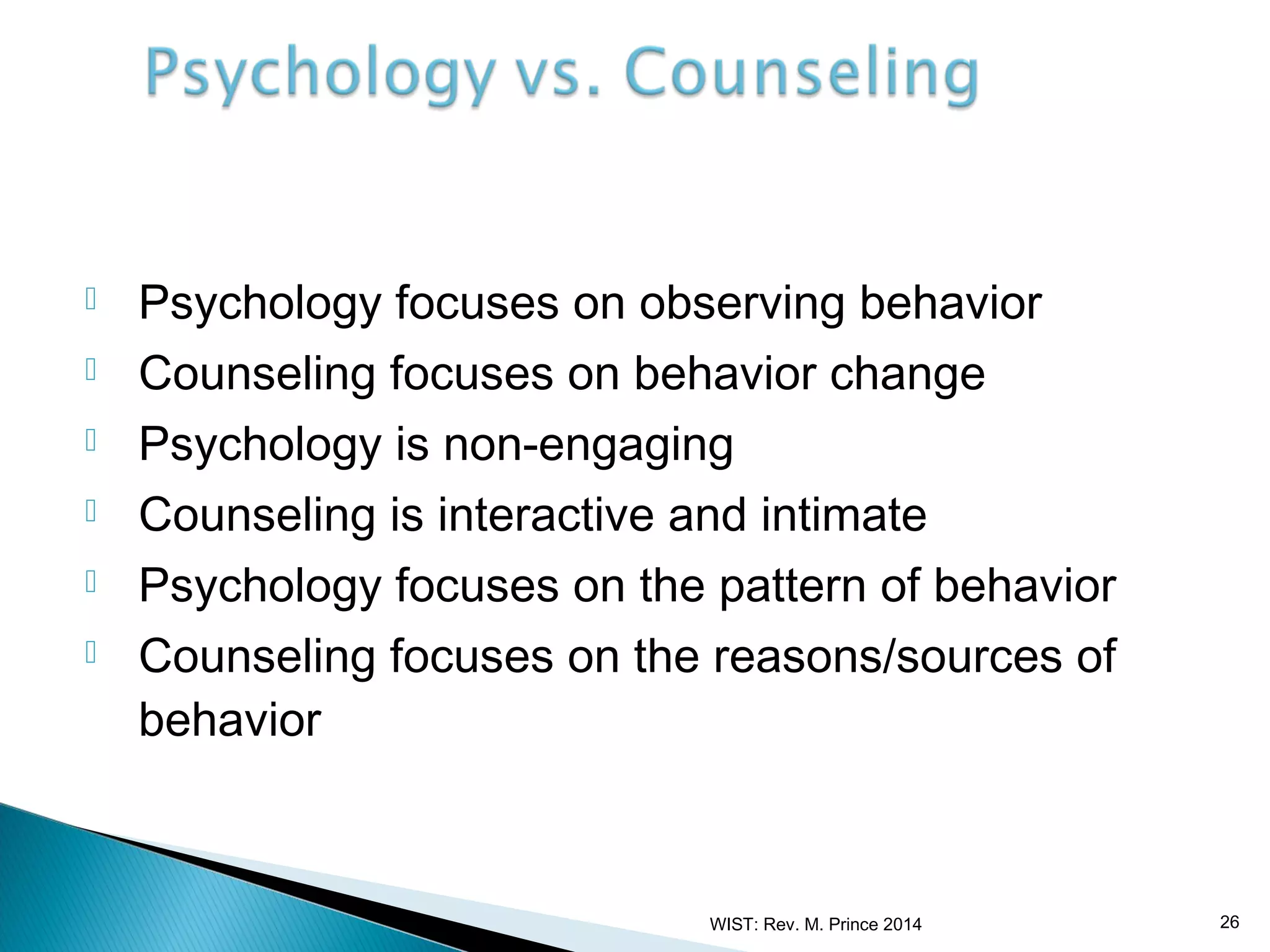
Psychology focuses on observing behavior
Counseling focuses on behavior change
Psychology is non-engaging
Counseling is interactive and intimate
Psychology focuses on the pattern of behavior
Counseling focuses on the reasons/sources of
behavior

WIST: Rev. M. Prince 2014

26
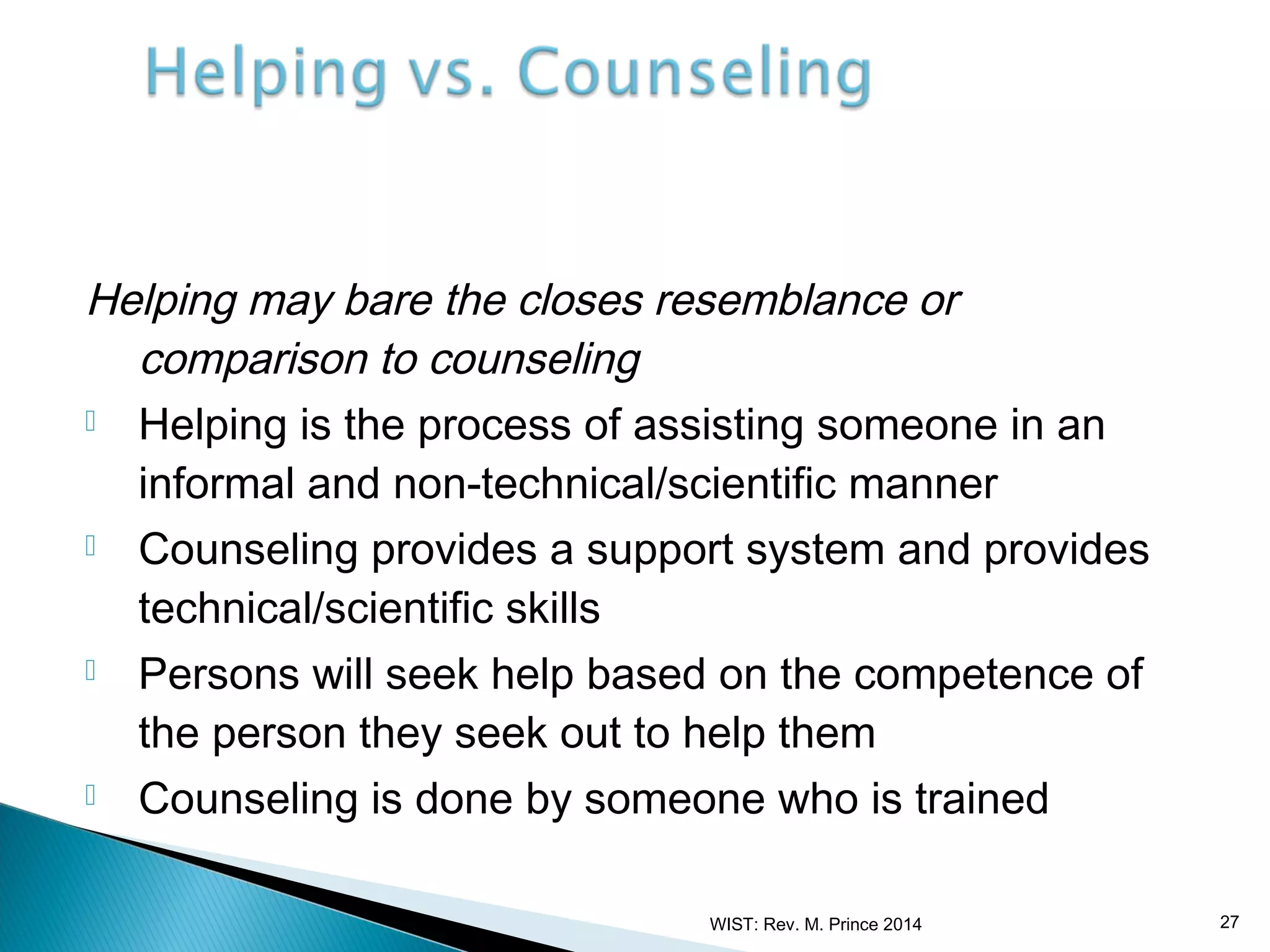
Helping may bare the closes resemblance or
comparison to counseling
 Helping is the process of assisting someone in an
informal and non-technical/scientific manner
 Counseling provides a support system and provides
technical/scientific skills
 Persons will seek help based on the competence of
the person they seek out to help them
 Counseling is done by someone who is trained
WIST: Rev. M. Prince 2014

27
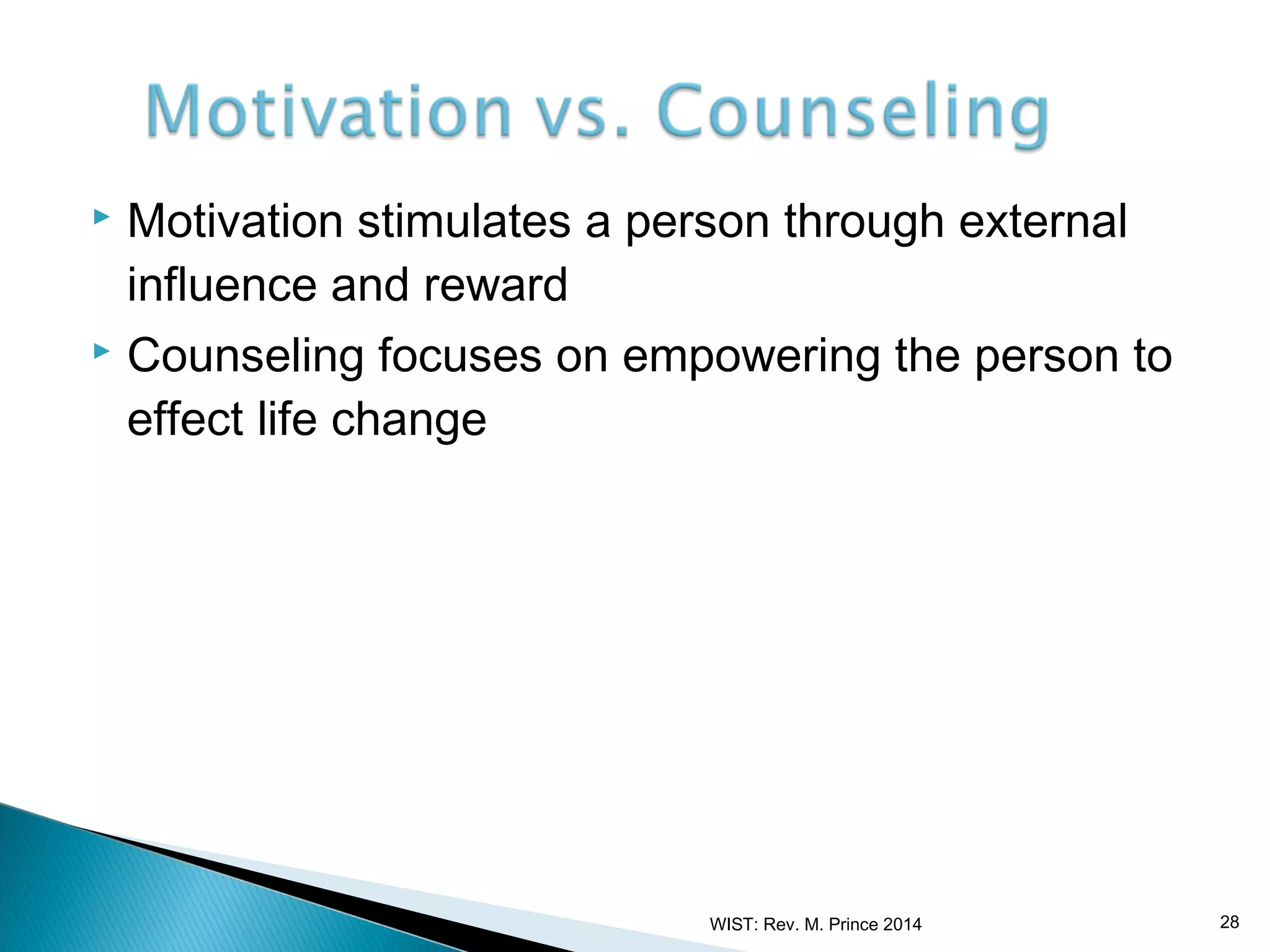
Motivation stimulates a person through external
influence and reward
 Counseling focuses on empowering the person to
effect life change


WIST: Rev. M. Prince 2014

28
Intervention is initiated by others
 Counseling is initiated by the person; even if there
is external motivation
 Intervention uses external pressures to stimulate
emotions to effect change
 Counseling uses personal/internal reflection and
reasoning to effect change


WIST: Rev. M. Prince 2014

29
Coaching provides premeditated or rehearsed
action for future events
 Counseling addresses coping skills for present
daily living
 Coaching is a form of education that assist in
anticipating probable future circumstances
 Counseling educates persons in basis skills


WIST: Rev. M. Prince 2014

30
Mediation involves a third-party making decisions
 Counseling requires the client to reach to a point
of making decisions
 Mediation focuses on present issue only
 Counseling focuses on present issue and provide
coping skills for the future


WIST: Rev. M. Prince 2014

31


Historical Background (Early Basis of Psychology)
• Greek philosophers
• Hippocrates: Focused on how to treat mental illness
• Plato (427-347BCE): Introspection and reflection—road to knowledge;
dreams and fantasies—substitute satisfactions; human condition:
physical, moral and spiritual origins
• Aristotle (384-322BCE): Considered “first psychologist” used objectivity and
reason to study knowledge
 Socrates (469 -399 BC) : Examines thoughts and feelings; introduced the
concept of introspection

• Augustine (354-430) and Aquinas (1225-1274): highlighted consciousness,
self-examination, and inquiry
• Focus on Christianity during Augustine and Aquinas times limited the
psychological nature of people
WIST: Rev. M. Prince 2014

32


Historical Background
• Descartes (1596-1650) and James Mill (1773-1836): Mind a
blank slate upon which ideas become generated.
• Europe: First experimental psychologists studied similarities
and differences of people
• E.g.,: Wundt and Galton

• 1800s in U.S.: experimental psychologists

• James Cattell & G. Stanley Hall (1st president of APA)

• Williams James’ theory of philosophical pragmatism: truth and
reality is continually constructed
• Testing: Binet, vocational assessment, personality tests
• Mesmer (mesmerize), Charcot (hypnosis)
• Psychoanalysis and Freud

WIST: Rev. M. Prince 2014

33


Historical Background (late 1800s to 1900s)
• 1892: American Psychological Association (APA) was
established.
• Other schools arise:
• Pavlov (classical conditioning); Phenomenology psychology;
Existentialism psychology; Gestalt psychology
• Sigmund Freud - Was convinced that patients difficulties were
due to mental rather than physical problems. It was as a result
of unconscious thoughts and feelings. He presented the
concept of psychoanalysis and free association.

WIST: Rev. M. Prince 2014

34


Probably influenced counseling most of all professions



Gave us the first comprehensive approaches to
counseling and therapy



Tests developed by psychologist used by early
vocational counselors and other counselors today



Research techniques



Early development of counseling skills

WIST: Rev. M. Prince 2014

35
• Diagnosis
• Illnesses may be organic
• Psychopharmacology

WIST: Rev. M. Prince 2014

36
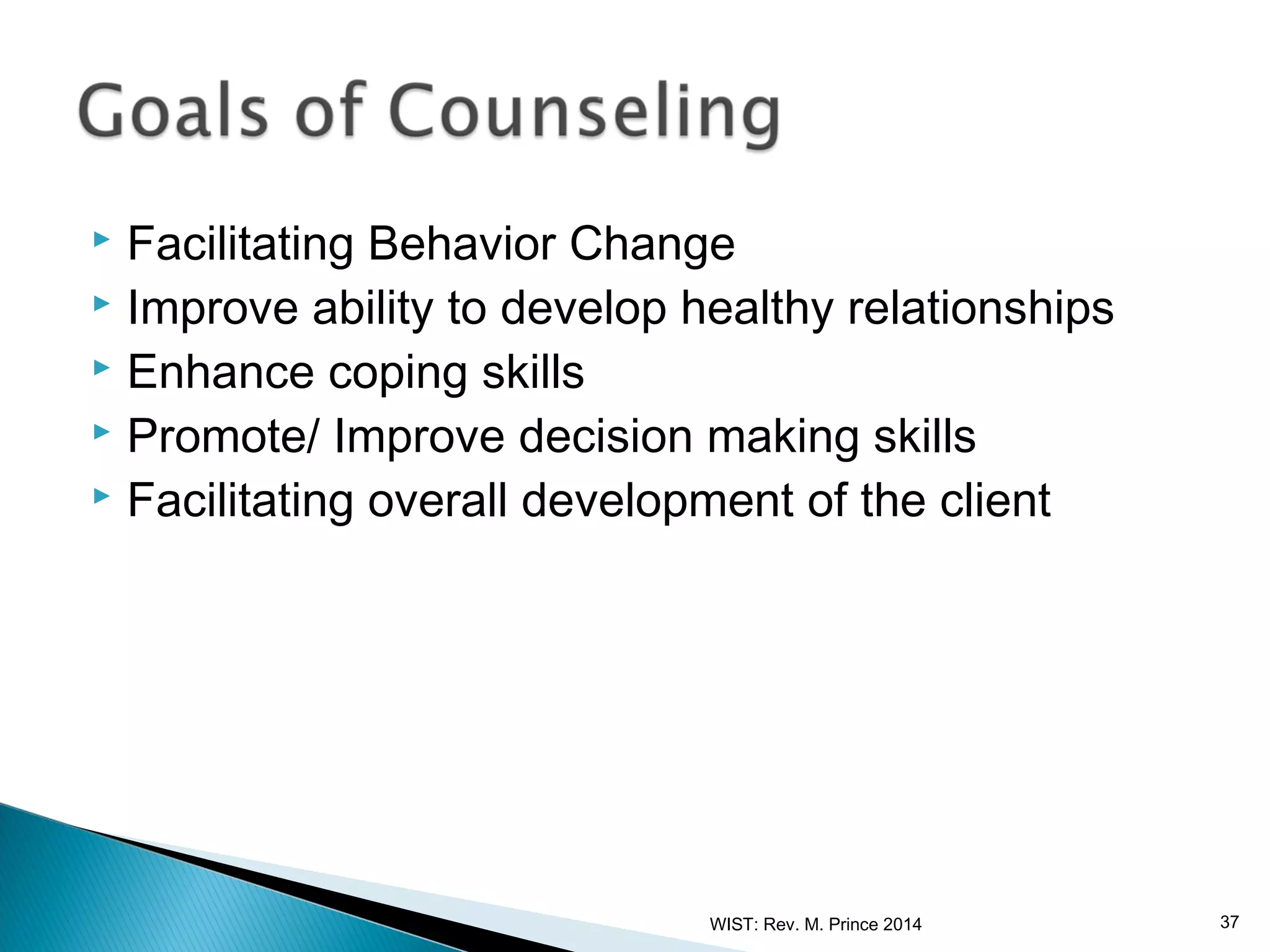
Facilitating Behavior Change
 Improve ability to develop healthy relationships
 Enhance coping skills
 Promote/ Improve decision making skills
 Facilitating overall development of the client


WIST: Rev. M. Prince 2014

37
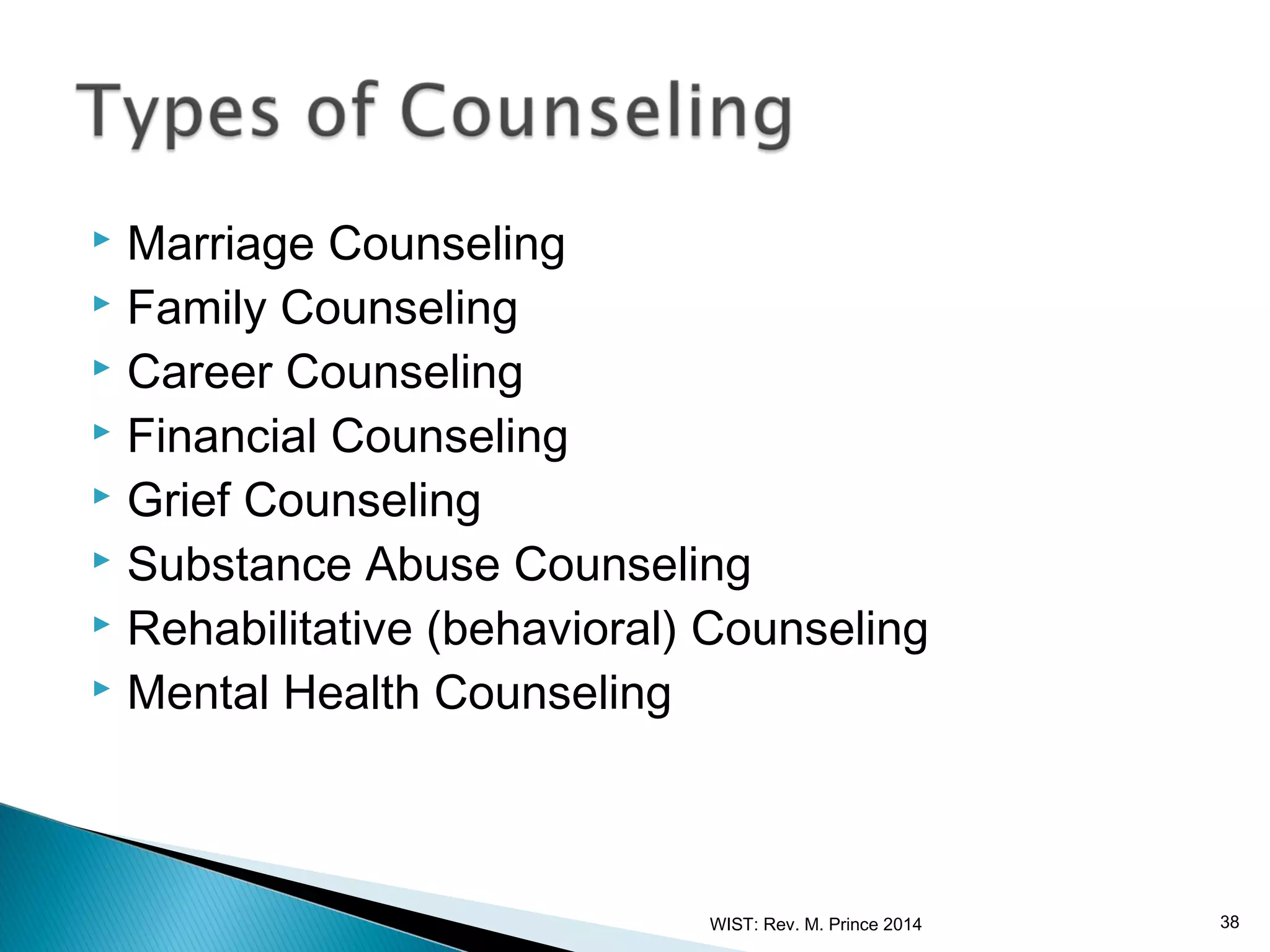
Marriage Counseling
 Family Counseling
 Career Counseling
 Financial Counseling
 Grief Counseling
 Substance Abuse Counseling
 Rehabilitative (behavioral) Counseling
 Mental Health Counseling


WIST: Rev. M. Prince 2014

38
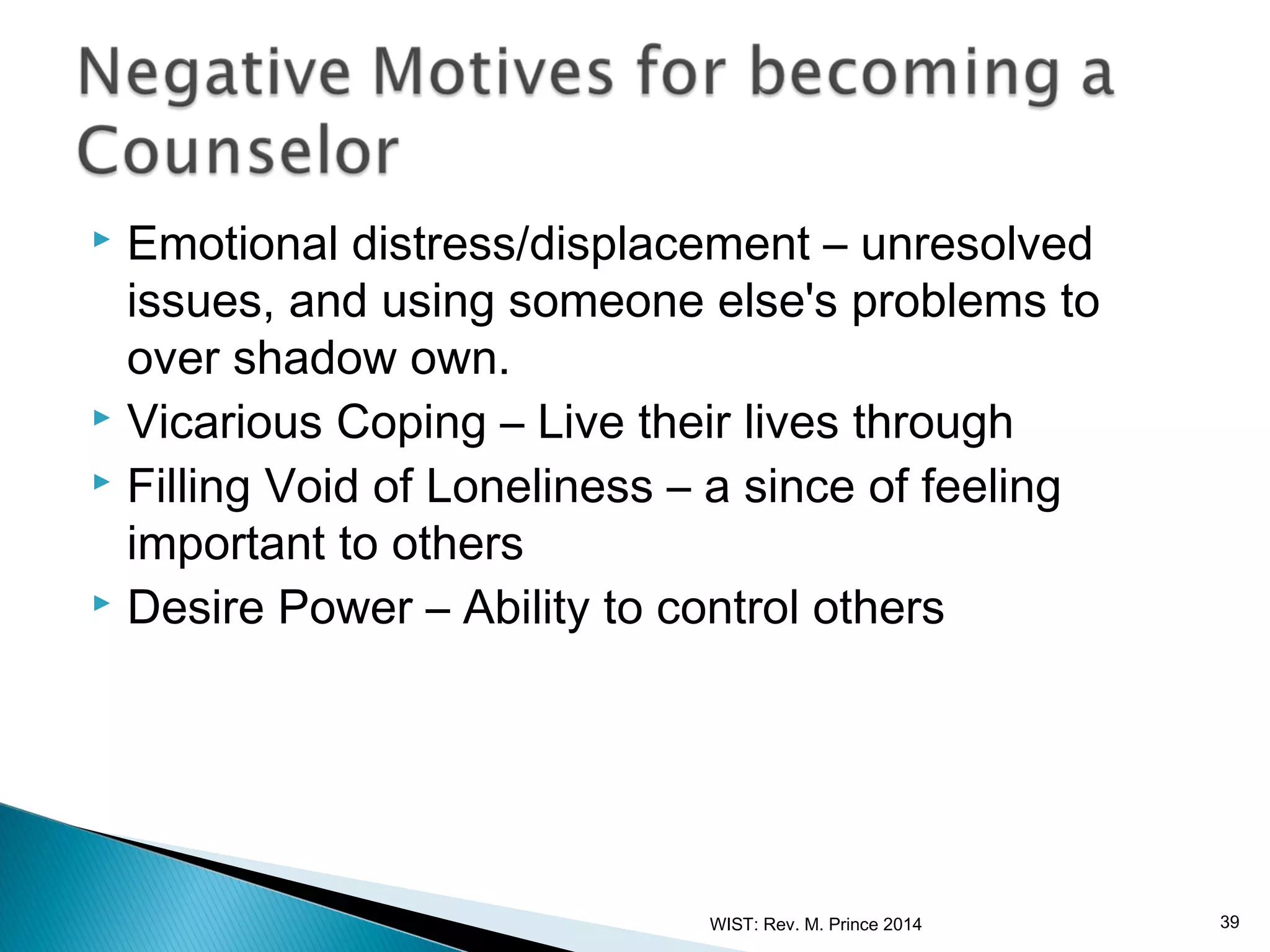
Emotional distress/displacement – unresolved
issues, and using someone else's problems to
over shadow own.
 Vicarious Coping – Live their lives through
 Filling Void of Loneliness – a since of feeling
important to others
 Desire Power – Ability to control others


WIST: Rev. M. Prince 2014

39
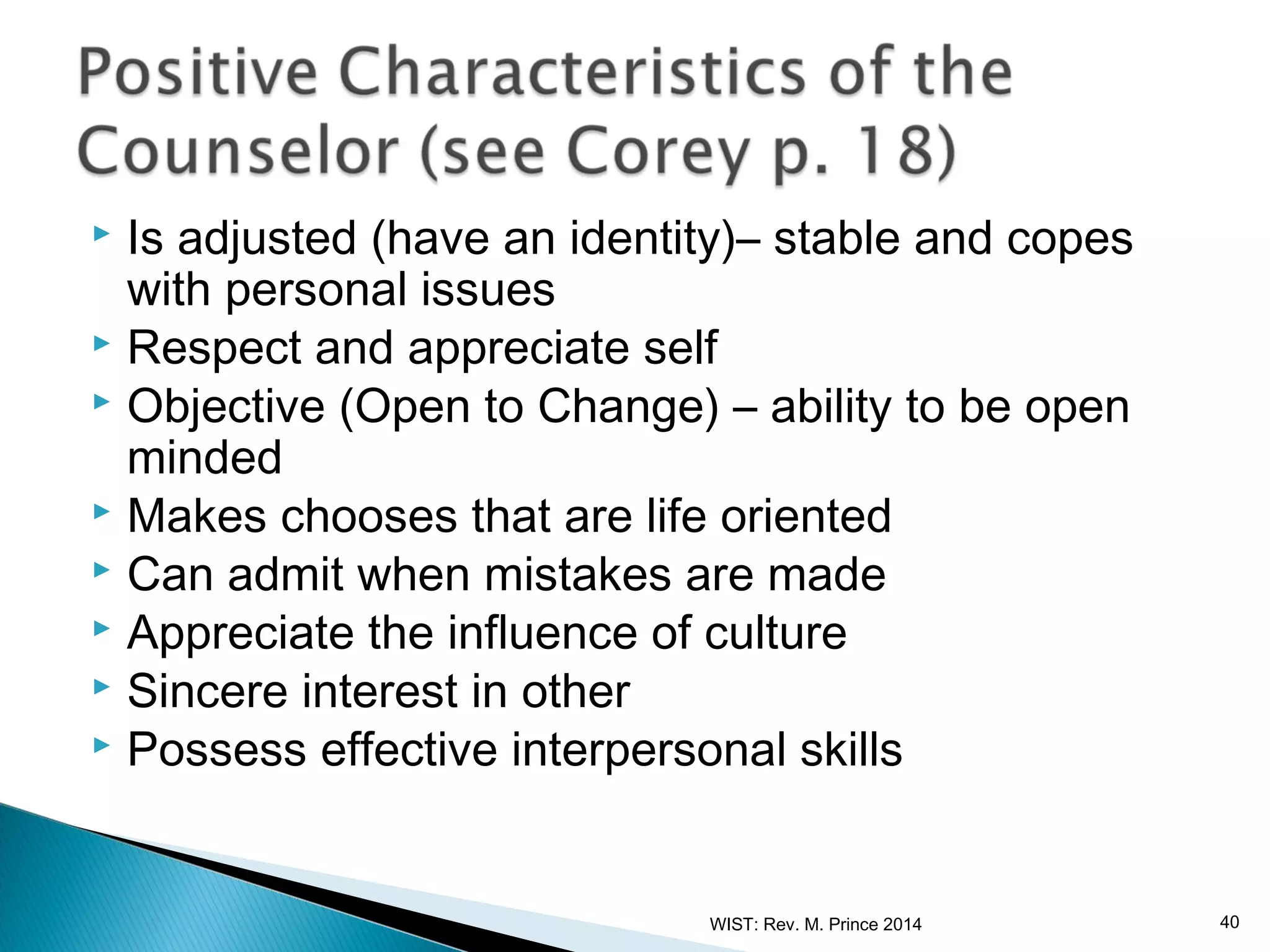
Is adjusted (have an identity)– stable and copes
with personal issues
 Respect and appreciate self
 Objective (Open to Change) – ability to be open
minded
 Makes chooses that are life oriented
 Can admit when mistakes are made
 Appreciate the influence of culture
 Sincere interest in other
 Possess effective interpersonal skills


WIST: Rev. M. Prince 2014

40
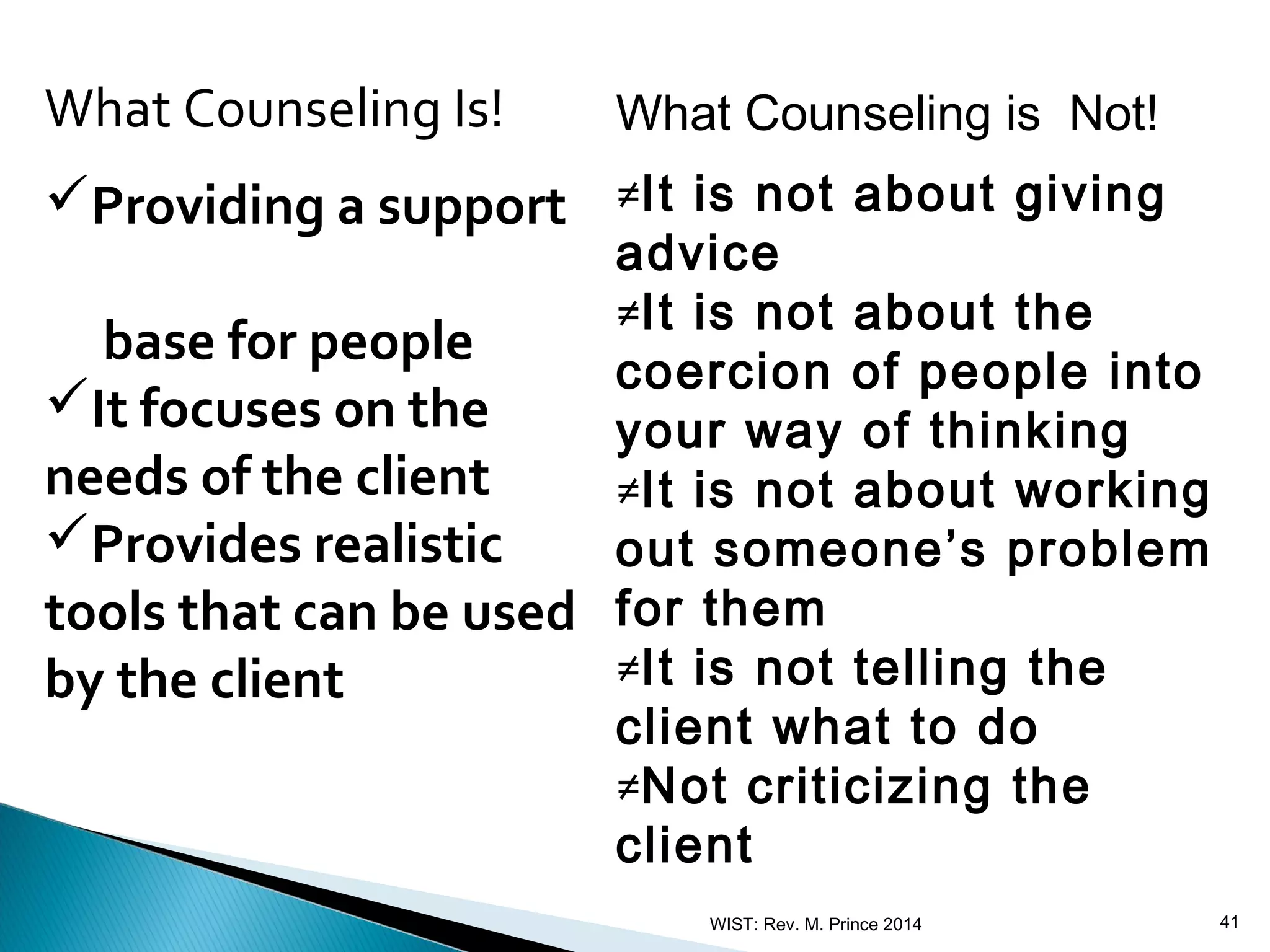
What Counseling Is!

What Counseling is Not!

Providing a support ≠It is not about giving

advice
≠It is not about the
base for people
coercion of people into
It focuses on the
your way of thinking
needs of the client
≠It is not about working
Provides realistic
out someone’s problem
tools that can be used for them
≠It is not telling the
by the client
client what to do
≠Not criticizing the
client
WIST: Rev. M. Prince 2014

41
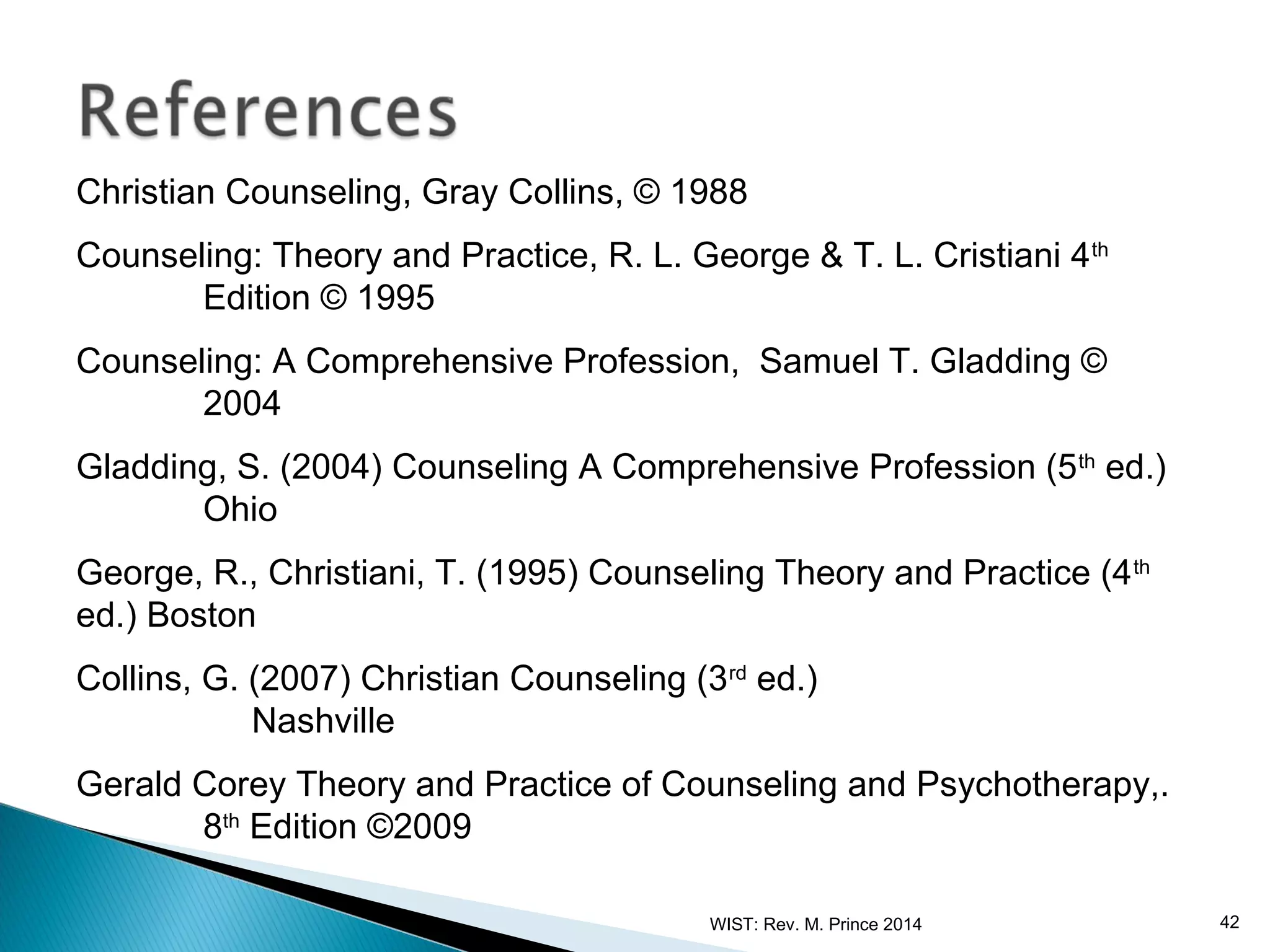
Christian Counseling, Gray Collins, © 1988
Counseling: Theory and Practice, R. L. George & T. L. Cristiani 4 th
Edition © 1995
Counseling: A Comprehensive Profession, Samuel T. Gladding ©
2004
Gladding, S. (2004) Counseling A Comprehensive Profession (5 th ed.)
Ohio
George, R., Christiani, T. (1995) Counseling Theory and Practice (4 th
ed.) Boston
Collins, G. (2007) Christian Counseling (3rd ed.)
Nashville
Gerald Corey Theory and Practice of Counseling and Psychotherapy,.
8th Edition ©2009
WIST: Rev. M. Prince 2014

42

WIST Introduction to counseling

  • 1.
    Lecturer: Rev. MichaelPrince WIST: Rev. M. Prince 2014 1
  • 2.
    Counseling belongs tothe family of social services or guidance movement (Gladding p.4)  It comes under the umbrella of Psychology/Psychotherapy  ◦ The scientific study of behavior and mental processes. ◦ Counseling is an applied social science that helps individuals get better understanding of themselves to handle their roles & relationships effectively. WIST: Rev. M. Prince 2014 2
  • 3.
    The application ofmental health, psychological or human development principles, through cognitive, affective, behavioral or systematic interventions… (Gladding p.6)  Counseling attempts to provide encouragement and guidance for those who are facing losses, decisions, or disappointments…stimulate personality growth and development; help people cope more effectively with the problems of living, with inner conflict and with crippling emotions… (Collins 1988, p.16)  WIST: Rev. M. Prince 2014 3
  • 4.
    Counseling is ascience and an art . It is a science because it applies techniques and procedures that are utilized in helping a person to understand their situations and employ the most adequate solutions for problem solving and life change; it is an art because it allows the therapist to use unique or own personality and experiences in assisting the client. WIST: Rev. M. Prince 2014 4
  • 5.
     Christian Counseling isdefined as an art and a science of applying Biblical principles to treat with clients’ issues using the rudiments of professional counseling. WIST: Rev. M. Prince 2014 5
  • 6.
    • Sin isthe primary focus of mankind’s dysfunction (Rom 5:12-14) • Salvation, and transformation through counseling from the gospel is the primary solution. • Scripture is authoritative and necessary for Christian counseling because it is God’s soul care guidebook WIST: Rev. M. Prince 2014 6
  • 7.
    WIST: Rev. M.Prince 2014 7
  • 8.
    WIST: Rev. M.Prince 2014 8
  • 9.
    Psychology  Focus onthe mind  Describe human experiences and behaviors  Applies Logic  Understand the structure of being • • • • Spirituality Focus on God Describes the source of man Applies Faith Understand the meaning (source) of being Psychology can not deduce the meaning or morality of life while Theology/Spirituality is not equip to explore the dynamics of personality. WIST: Rev. M. Prince 2014 9
  • 10.
      Unique Assumptions –Sin is the primary cause (fall of man) of man’s deprived state and that restoration/forgiveness of God through salvation and transformation will make man ‘totally whole’. Unique Goals – To stimulate spiritual growth by encouraging confession of sin, experience divine forgiveness and commit lives to Jesus Christ. Collins p. 19-20 WIST: Rev. M. Prince 2014 10
  • 11.
    Unique Methods –The application of prayer and faith in God are cornerstones of pastoral counseling.  Unique Counselor-Characteristics – Demonstrate personal reliance upon the same factors of salvation, transformation and a relationship with God.   Unique Giftedness Collins p. 19-20 WIST: Rev. M. Prince 2014 11
  • 12.
    Psychology  Focus onthe mind  Describe human experiences and behaviors  Applies Logic  Understand the structure of being • • • • Spirituality Focus on God Describes the source of man Applies Faith Understand the meaning (source) of being Psychology can not deduce the meaning or morality of life while Theology/Spirituality is not equip to explore the dynamics of personality. WIST: Rev. M. Prince 2014 12
  • 13.
    Views of counselingfrom two paradigms: SECULAR VIEW CHRISTIAN VIEW Improve your sense of self Reduce your sense of self Knowledge is from human thought True knowledge is from God 1 Cor 3:18 Getting ahead is money and power. Getting ahead is losing self Matt 6:19-21 Wide is the way of tolerance Narrow is the way to heaven Matt 7:13-14 Serve self first Serve others first Good deeds make you good Jesus makes you good Luke 9:24-26 Matt 21:16 1 John 1:9 Copyright© 2008. All Rights Reserved - www.christian-information-center.com WIST: Rev. M. Prince 2014 13
  • 14.
    “See to itthat no one takes you captive through hollow and deceptive philosophy, which depends on human tradition and the basic principles of this world rather than on Christ.” Col. 2:8 WIST: Rev. M. Prince 2014 14
  • 15.
    WIST: Rev. M.Prince 2014 15
  • 16.
    Is the processof helping people make important choices that affect their lives. … (Gladding p.5) WIST: Rev. M. Prince 2014 16
  • 17.
    Focuses on serious problems associatedwith intra-psychic, internal, personal issues/conflict (p.6) WIST: Rev. M. Prince 2014 17
  • 18.
    The science that systematically studiesbehavior and experiences WIST: Rev. M. Prince 2014 18
  • 19.
    The service ofassisting clients to manage their problems in living more effectively WIST: Rev. M. Prince 2014 19
  • 20.
    The ability to stimulatea person to operate or behave in a selected way WIST: Rev. M. Prince 2014 20
  • 21.
    Operate as an agentbetween the client and their personal issue WIST: Rev. M. Prince 2014 21
  • 22.
    The systematic process oftraining and assimilation in order to confront issues WIST: Rev. M. Prince 2014 22
  • 23.
    An authoritative entity that determineshow a dispute is settled or apportioned WIST: Rev. M. Prince 2014 23
  • 24.
    Guidance focuses onhelping individuals choose what they value most.  Counseling focuses on helping individuals make changes.  WIST: Rev. M. Prince 2014 24
  • 25.
    Psychotherapy focuses oncausing change  Counseling focuses on assisting the person to change  They have different clients  ◦ Psychotherapist – deals with neurosis (mental dysfunctions) ◦ Counselor – deals with persons with poor coping and decision making skills. WIST: Rev. M. Prince 2014 25
  • 26.
          Psychology focuses onobserving behavior Counseling focuses on behavior change Psychology is non-engaging Counseling is interactive and intimate Psychology focuses on the pattern of behavior Counseling focuses on the reasons/sources of behavior WIST: Rev. M. Prince 2014 26
  • 27.
    Helping may barethe closes resemblance or comparison to counseling  Helping is the process of assisting someone in an informal and non-technical/scientific manner  Counseling provides a support system and provides technical/scientific skills  Persons will seek help based on the competence of the person they seek out to help them  Counseling is done by someone who is trained WIST: Rev. M. Prince 2014 27
  • 28.
    Motivation stimulates aperson through external influence and reward  Counseling focuses on empowering the person to effect life change  WIST: Rev. M. Prince 2014 28
  • 29.
    Intervention is initiatedby others  Counseling is initiated by the person; even if there is external motivation  Intervention uses external pressures to stimulate emotions to effect change  Counseling uses personal/internal reflection and reasoning to effect change  WIST: Rev. M. Prince 2014 29
  • 30.
    Coaching provides premeditatedor rehearsed action for future events  Counseling addresses coping skills for present daily living  Coaching is a form of education that assist in anticipating probable future circumstances  Counseling educates persons in basis skills  WIST: Rev. M. Prince 2014 30
  • 31.
    Mediation involves athird-party making decisions  Counseling requires the client to reach to a point of making decisions  Mediation focuses on present issue only  Counseling focuses on present issue and provide coping skills for the future  WIST: Rev. M. Prince 2014 31
  • 32.
     Historical Background (EarlyBasis of Psychology) • Greek philosophers • Hippocrates: Focused on how to treat mental illness • Plato (427-347BCE): Introspection and reflection—road to knowledge; dreams and fantasies—substitute satisfactions; human condition: physical, moral and spiritual origins • Aristotle (384-322BCE): Considered “first psychologist” used objectivity and reason to study knowledge  Socrates (469 -399 BC) : Examines thoughts and feelings; introduced the concept of introspection • Augustine (354-430) and Aquinas (1225-1274): highlighted consciousness, self-examination, and inquiry • Focus on Christianity during Augustine and Aquinas times limited the psychological nature of people WIST: Rev. M. Prince 2014 32
  • 33.
     Historical Background • Descartes(1596-1650) and James Mill (1773-1836): Mind a blank slate upon which ideas become generated. • Europe: First experimental psychologists studied similarities and differences of people • E.g.,: Wundt and Galton • 1800s in U.S.: experimental psychologists • James Cattell & G. Stanley Hall (1st president of APA) • Williams James’ theory of philosophical pragmatism: truth and reality is continually constructed • Testing: Binet, vocational assessment, personality tests • Mesmer (mesmerize), Charcot (hypnosis) • Psychoanalysis and Freud WIST: Rev. M. Prince 2014 33
  • 34.
     Historical Background (late1800s to 1900s) • 1892: American Psychological Association (APA) was established. • Other schools arise: • Pavlov (classical conditioning); Phenomenology psychology; Existentialism psychology; Gestalt psychology • Sigmund Freud - Was convinced that patients difficulties were due to mental rather than physical problems. It was as a result of unconscious thoughts and feelings. He presented the concept of psychoanalysis and free association. WIST: Rev. M. Prince 2014 34
  • 35.
     Probably influenced counselingmost of all professions  Gave us the first comprehensive approaches to counseling and therapy  Tests developed by psychologist used by early vocational counselors and other counselors today  Research techniques  Early development of counseling skills WIST: Rev. M. Prince 2014 35
  • 36.
    • Diagnosis • Illnessesmay be organic • Psychopharmacology WIST: Rev. M. Prince 2014 36
  • 37.
    Facilitating Behavior Change Improve ability to develop healthy relationships  Enhance coping skills  Promote/ Improve decision making skills  Facilitating overall development of the client  WIST: Rev. M. Prince 2014 37
  • 38.
    Marriage Counseling  FamilyCounseling  Career Counseling  Financial Counseling  Grief Counseling  Substance Abuse Counseling  Rehabilitative (behavioral) Counseling  Mental Health Counseling  WIST: Rev. M. Prince 2014 38
  • 39.
    Emotional distress/displacement –unresolved issues, and using someone else's problems to over shadow own.  Vicarious Coping – Live their lives through  Filling Void of Loneliness – a since of feeling important to others  Desire Power – Ability to control others  WIST: Rev. M. Prince 2014 39
  • 40.
    Is adjusted (havean identity)– stable and copes with personal issues  Respect and appreciate self  Objective (Open to Change) – ability to be open minded  Makes chooses that are life oriented  Can admit when mistakes are made  Appreciate the influence of culture  Sincere interest in other  Possess effective interpersonal skills  WIST: Rev. M. Prince 2014 40
  • 41.
    What Counseling Is! WhatCounseling is Not! Providing a support ≠It is not about giving advice ≠It is not about the base for people coercion of people into It focuses on the your way of thinking needs of the client ≠It is not about working Provides realistic out someone’s problem tools that can be used for them ≠It is not telling the by the client client what to do ≠Not criticizing the client WIST: Rev. M. Prince 2014 41
  • 42.
    Christian Counseling, GrayCollins, © 1988 Counseling: Theory and Practice, R. L. George & T. L. Cristiani 4 th Edition © 1995 Counseling: A Comprehensive Profession, Samuel T. Gladding © 2004 Gladding, S. (2004) Counseling A Comprehensive Profession (5 th ed.) Ohio George, R., Christiani, T. (1995) Counseling Theory and Practice (4 th ed.) Boston Collins, G. (2007) Christian Counseling (3rd ed.) Nashville Gerald Corey Theory and Practice of Counseling and Psychotherapy,. 8th Edition ©2009 WIST: Rev. M. Prince 2014 42

Editor's Notes

  • #4 Wellness, personal growth, career development