Network Institute of Christian Counseling
9 September 2013
Sponsored by
• To review the philosophical basis for a biblical &
holistic approach to psychotherapy
• To identify requirements for a biblical counselor
• To provide a number of examples of biblically-
based interventions in counseling based on
today’s presentation
• σύμβουλος (sumboulos) = (σύμ) with +
(βουλή) advice, direction
(kho-bal) derived from the nouns ‫ל‬ ֶ‫ב‬ ֶ‫ח‬
a rope or ‫ל‬ ֵ‫ב‬ֹ‫ח‬ a rope puller, a sailor, a
pilot (plur. fem. rule, government)
‫ה‬ָ‫ל‬ֻּ‫ב‬ ְ‫ח‬ ַּ‫ת‬
Proverbs 1:5
A wise man will hear and increase
learning, and
a man of understanding will attain
wise counsel
“Counseling Psychology is a specialty within
professional psychology that maintains a focus
on facilitating personal and interpersonal
functioning across the life span. The
specialty pays particular attention to
emotional, social, vocational, educational,
health-related, developmental, and
organizational concerns.”
“Counseling is a collaborative effort between
the counselor and client. Professional
counselors help clients identify goals and
potential solutions to problems which cause
emotional turmoil; seek to improve
communication and coping skills; strengthen
self-esteem; and promote behavior change and
optimal mental health.”
“. . .the provision of assistance and guidance
in resolving personal, social, or psychological
problems and difficulties, especially by a
professional.”
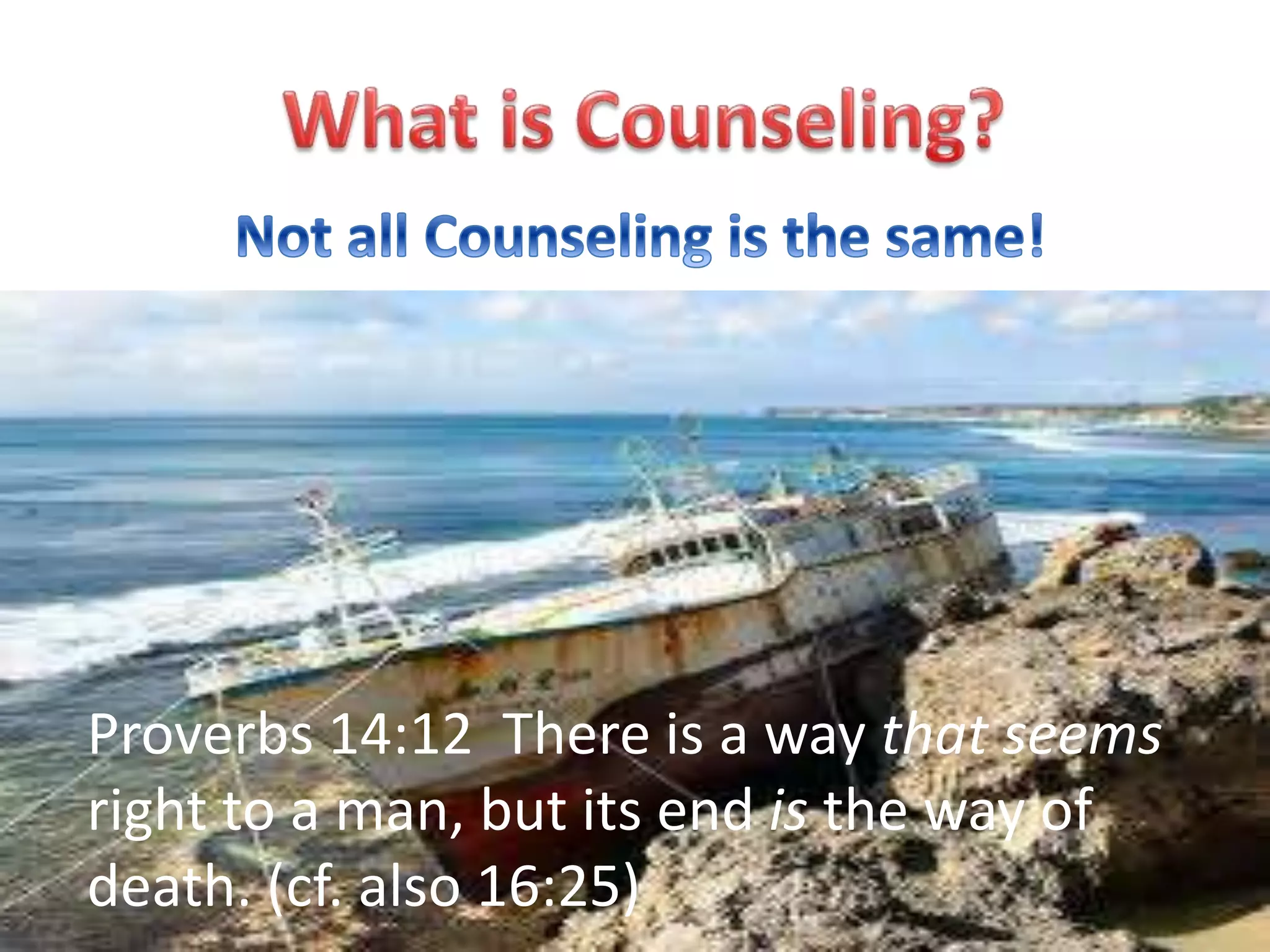
Proverbs 14:12 There is a way that seems
right to a man, but its end is the way of
death. (cf. also 16:25)
• Proverbs 11:14 Where there is no counsel, the
people fall; but in the multitude of counselors
there is safety.
• Proverbs 12:5 The thoughts of the righteous
are right, but the counsels of the wicked are
deceitful.
• Proverbs 15:22 Without counsel, plans go
awry, but in the multitude of counselors they
are established.
• Psalm 33:11 The counsel of the LORD stands
forever, the plans of His heart to all
generations.
• Proverbs 8:14 Counsel is mine, and sound
wisdom; I am understanding, I have strength.
• Isaiah 9:6 For unto us a Child is born, unto us
a Son is given; and the government will be
upon His shoulder. And His name will be called
Wonderful, Counselor, Mighty God,
Everlasting Father, Prince of Peace.
• I Corinthians 1:30 But of Him you are in Christ
Jesus, who became for us wisdom from God—
and righteousness and sanctification and
redemption.
Psalm 1:1–2 Blessed is the man who walks
not in the counsel of the ungodly, nor
stands in the path of sinners, nor sits in the
seat of the scornful; 2 but his delight is in
the law of the LORD, and in His law he
meditates day and night.
“Psychology can be defined as the scientific study of
the behavior and thinking of organisms. Psychology
might be thought of as the study of how living
creatures interact with their environment and each
other, and how they cope (successfully or
unsuccessfully) with that environment.”
Meier, P. D., M. D., Minirth, F. B., M. D., Wichern, F. B., Ph. D., & Ratcliff, D. E., Ph. D.
(1991). Introduction to psychology and counseling: Christian perspectives and
applications (Second Edition., p. 17). Grand Rapids, MI: Baker Books.
(psyche) = soul
(logos) = word, dissertation, science of
“psychologia” coined in 1524 (Vande Kemp, 1996)
‫ׁש‬ֶ‫ֶפ‬‫נ‬
(nephish)
Mind (cognition)
Emotions (affection)
Conscience (violation)
Will (volition)
(psyche) = soul + (theron) = healing
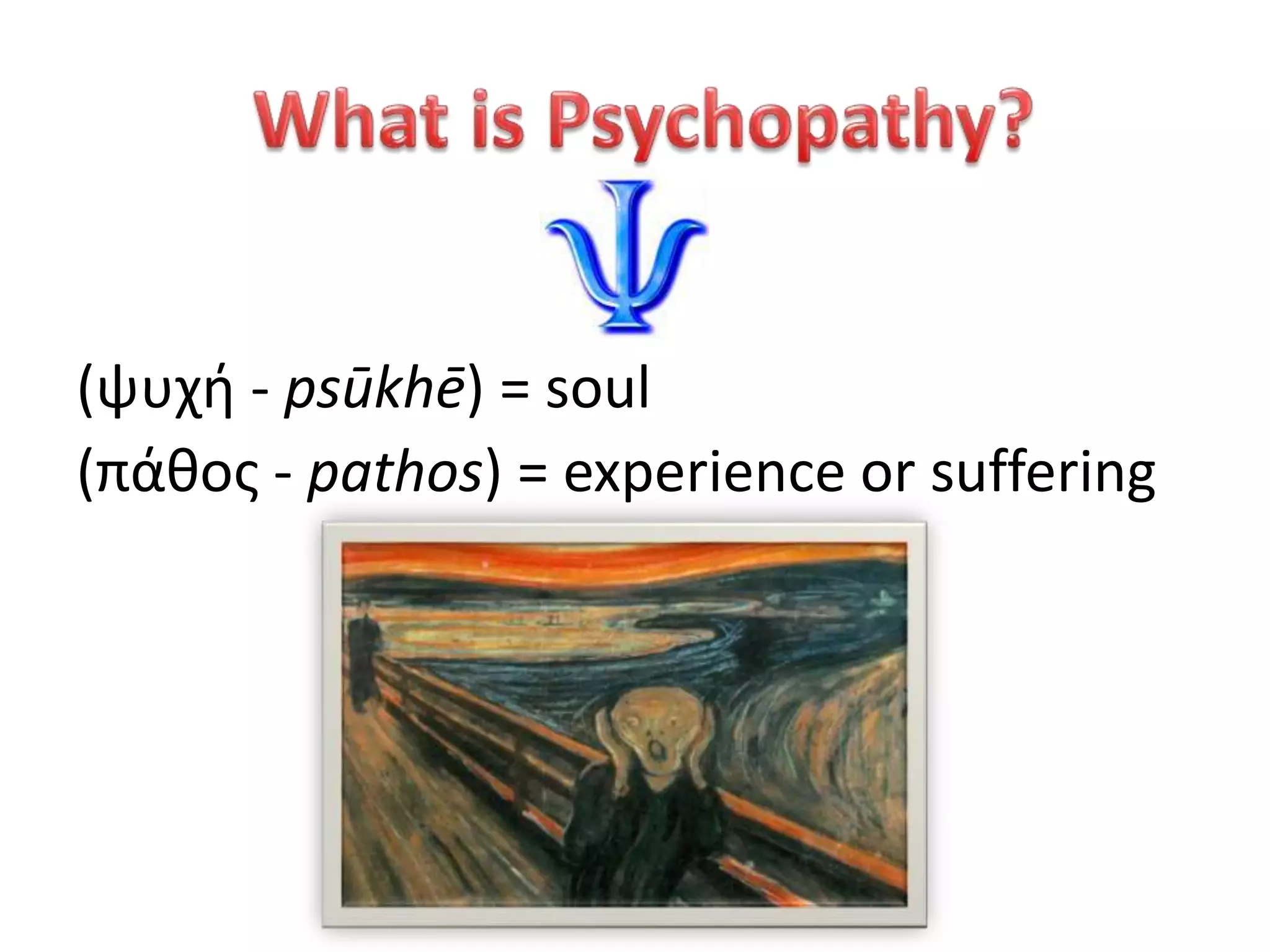
(ψυχή - psūkhē) = soul
(πάθος - pathos) = experience or suffering
(em) = toward + (pathos) = suffering
(sym) = with + (pathos) = suffering
Charles Ryrie: “Christian spirituality always involves
regeneration, the work of the Holy Spirit, and time
to learn this way of living. Spiritually is a mature
and maturing relation to the Holy Spirit.”
• In secular literature, spirituality is a rather
generic term.
• Christian spirituality is part of religious life, or
the expression of it; seeking to live life in
imitation of Christ.
• Earliest forms of psychotherapy likely came from
philosophy rather than medicine (Kurtz, 1999)
• Ancient Greeks (Zeno, Epictetus, etc.)
• Spiritual systems often contain psychological
components (e.g. The Dhammapada)
• Religion/spirituality and psychology had much
overlap until the end of the 19th century
T
Wilhelm Wundt
(1832-1920)
William James
(1842-1910)
John B. Watson
(1878-1958)
Sigmund Freud
(1856-1939)
Carl G. Jung
(1875-1961)
(Richards & Bergin, 1999)
William James
• Varieties of Religious Experience (1902)
• Emphasis on personal psychology of religion
Gordon Allport
• The Individual and His Religion (1950)
• Offers a developmental perspective of religion
• 6 characteristics of religious maturity
Paul Pruyser
• Extends on work of James and Allport
• Describes forms of neurotic religion
(Richards & Bergin, 1999)
Erich Fromm
• Religious need for a frame of orientation
Abraham Maslow
• Self actualization
Viktor Frankl
• Man’s Search for Meaning
• Transpersonal Psychology
• Application of scientific methods to spiritual
experience
Hobart Mowrer
(1907-1982)
“For several decades we psychologists looked upon the
whole matter of sin and moral accountability as a great
incubus and acclaimed our liberation from it as epoch
making. But at length we have discovered that to be free
in this sense, that is, to have the excuse of being sick
rather than sinful, is to court the danger of also becoming
lost… In becoming amoral, ethically neutral and free, we
have cut the very roots of our being, lost our deepest
sense of selfhood and identity, and with neurotics,
themselves, we find ourselves asking: Who am I, what is
my deepest destiny, what does living mean?”
“Sin, the Lesser of Two Evils,” American Psychologist, 15 (1960): 301-30
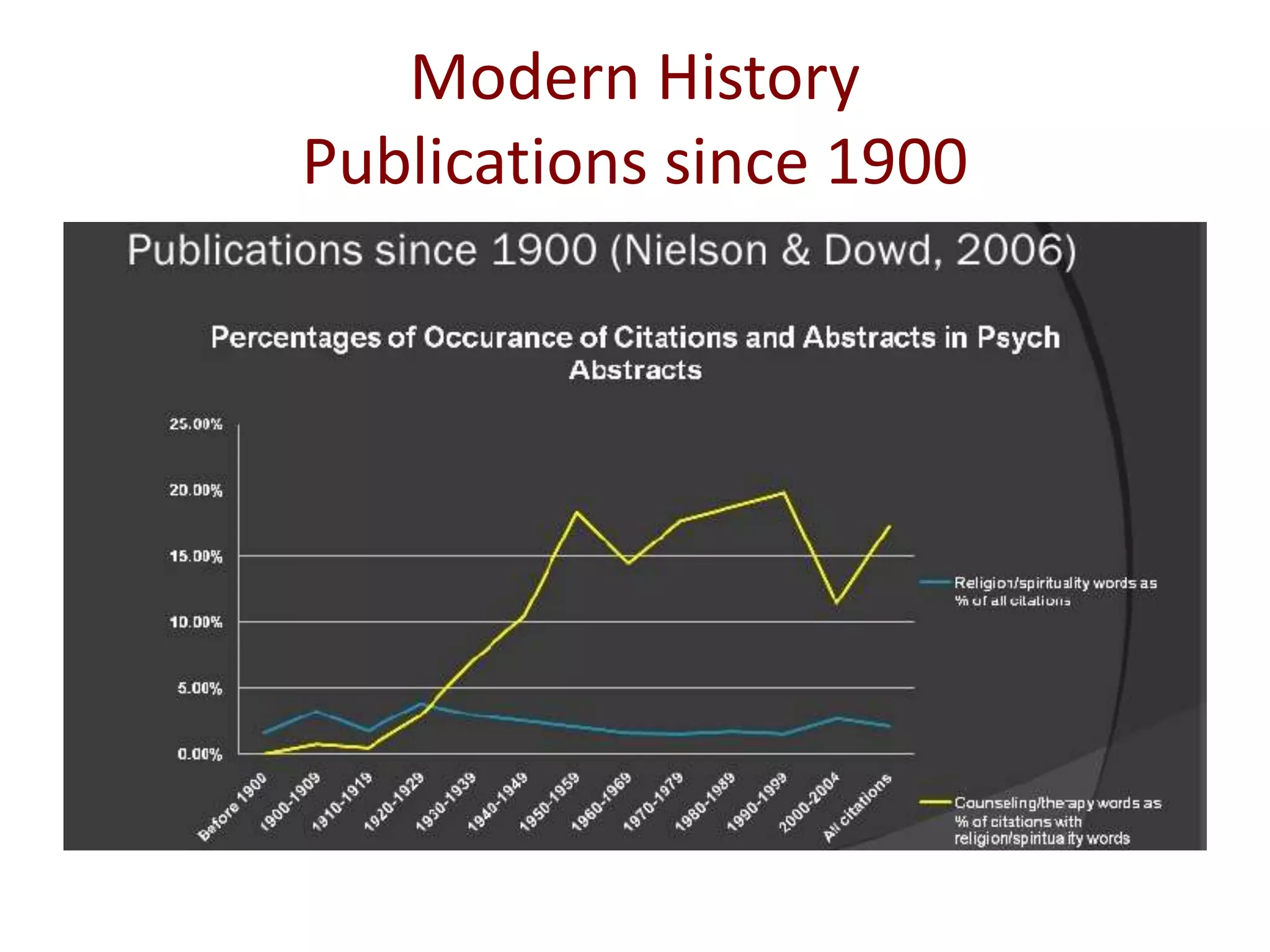
Modern History
Publications since 1900
Modern History
Publications since 1900
Modern History
Publications since 1900
• A Different Plan
• A Different Purpose
• A Different Power
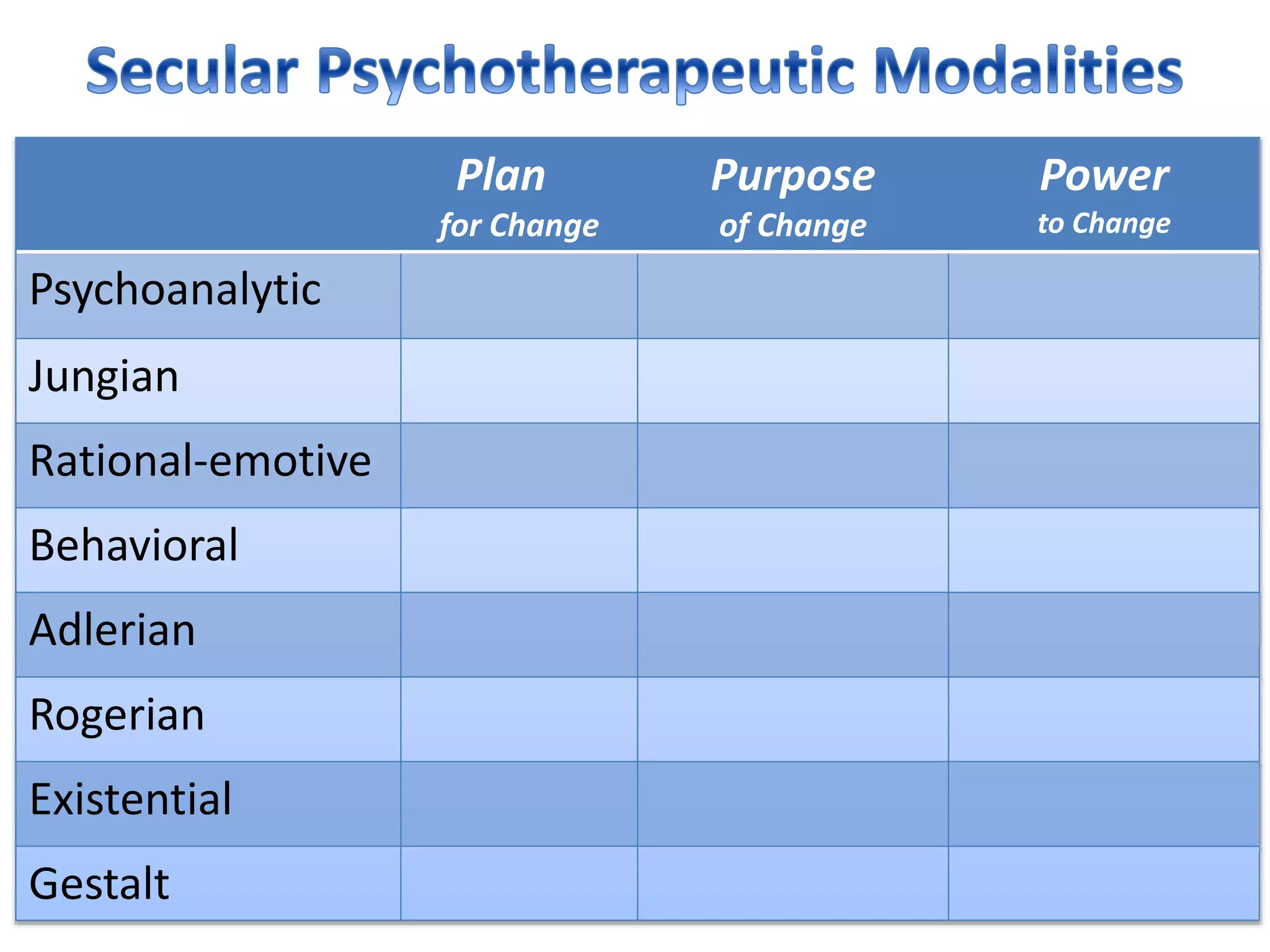
Plan
for Change
Purpose
of Change
Power
to Change
Psychoanalytic
Jungian
Rational-emotive
Behavioral
Adlerian
Rogerian
Existential
Gestalt
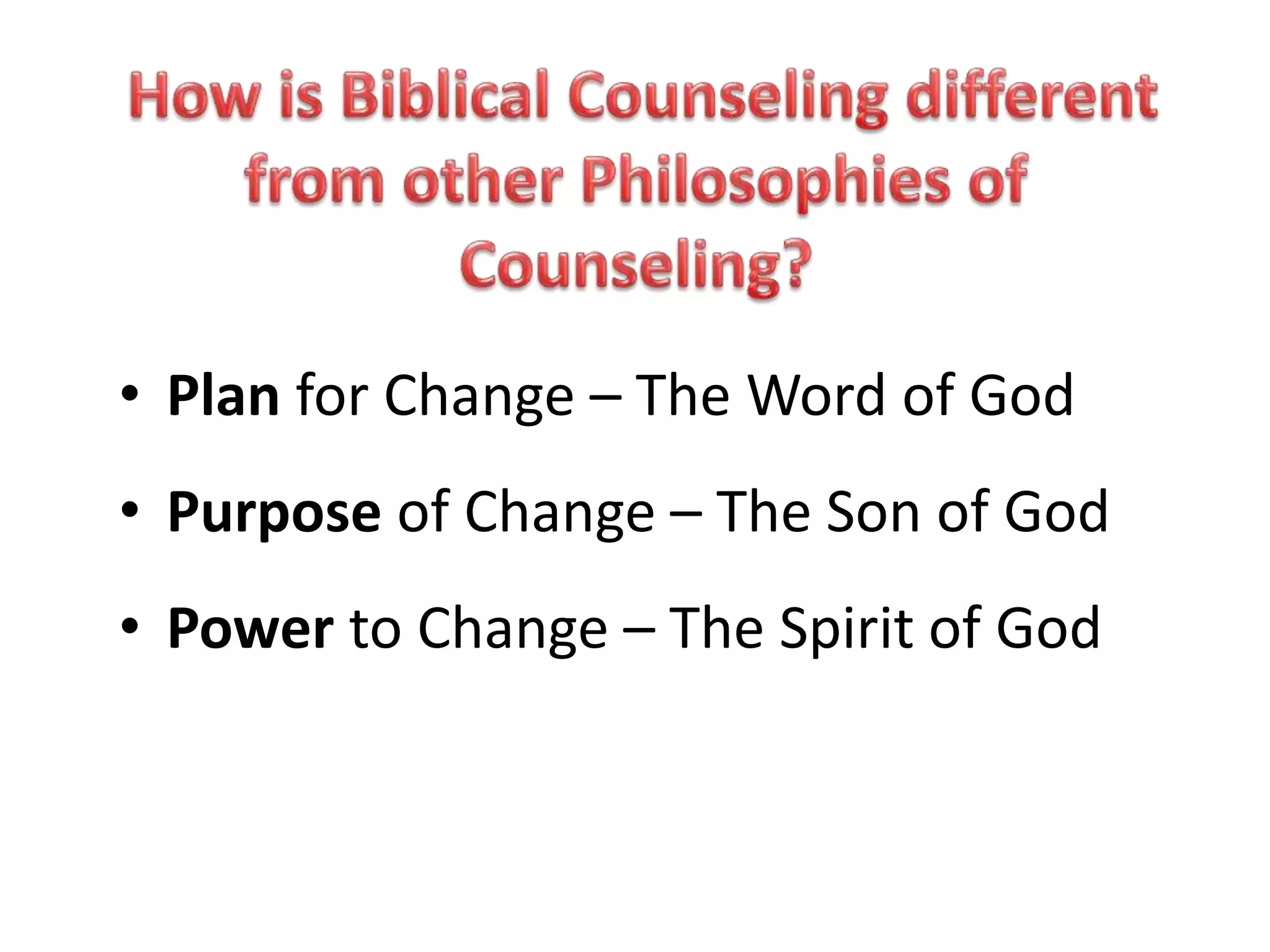
• Plan for Change – The Word of God
• Purpose of Change – The Son of God
• Power to Change – The Spirit of God
It is not the experience of life, but the experi-
ence of the cross that makes one a worthy
hearer of confessions. The most experienced
psychologist or observer of human nature
knows infinitely less of the human heart the
simplest Christian who lives beneath the cross
of Jesus. The greatest psychological insight,
Bonhoeffer
ability, and experience cannot grasp this one thing: what
sin is. Worldly wisdom knows what distress and weakness
and failure are, but it does not know the godlessness of
men. And so it also does not know that man is destroyed
only by his sin and can be healed only by forgiveness. Only
the Christian knows this. In the presence of a psychiatrist, I
can only be a sick man; in the presence of the Christian
brother, I can dare to be a sinner.
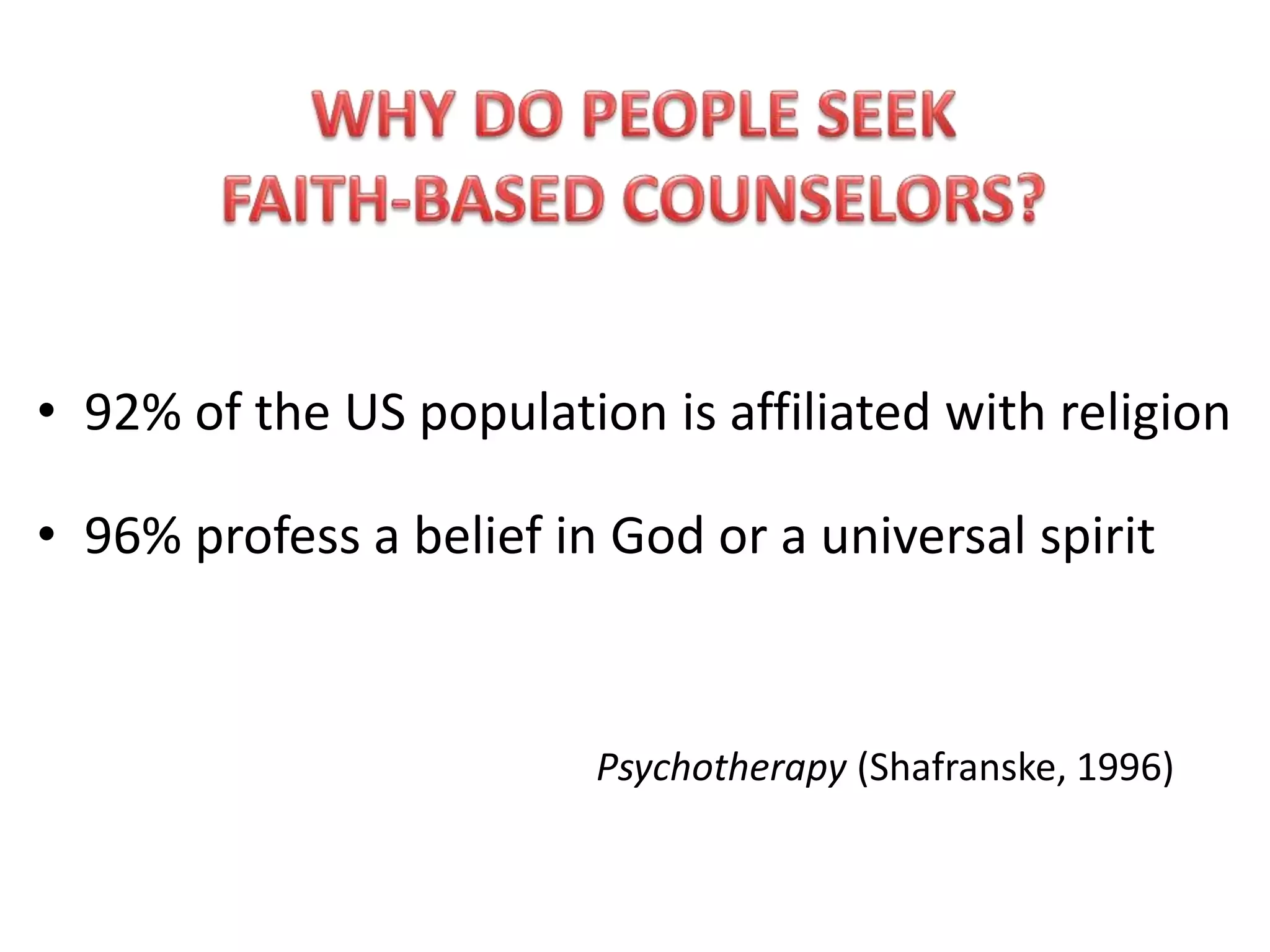
• 92% of the US population is affiliated with religion
• 96% profess a belief in God or a universal spirit
Psychotherapy (Shafranske, 1996)
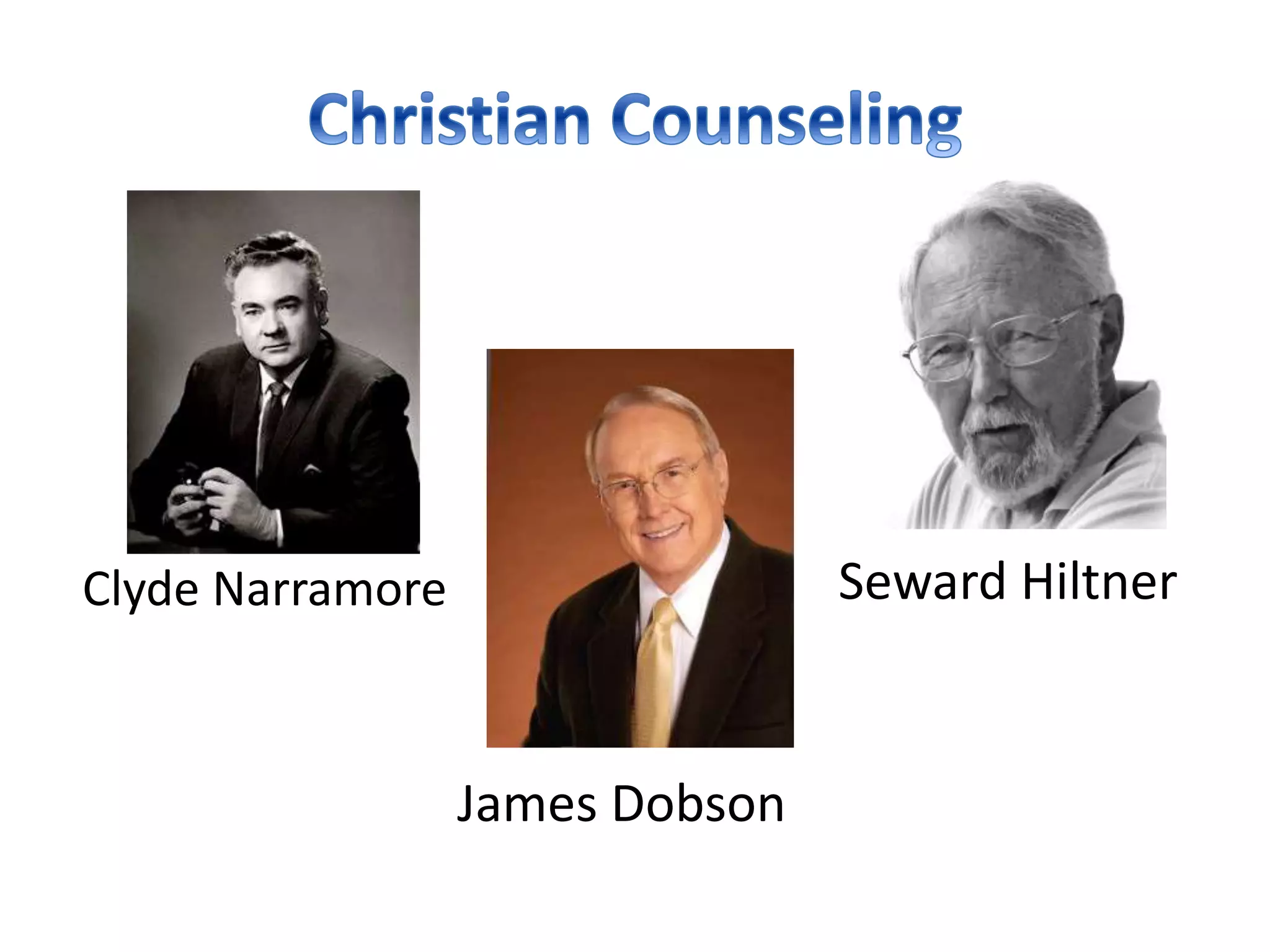
Seward HiltnerClyde Narramore
James Dobson
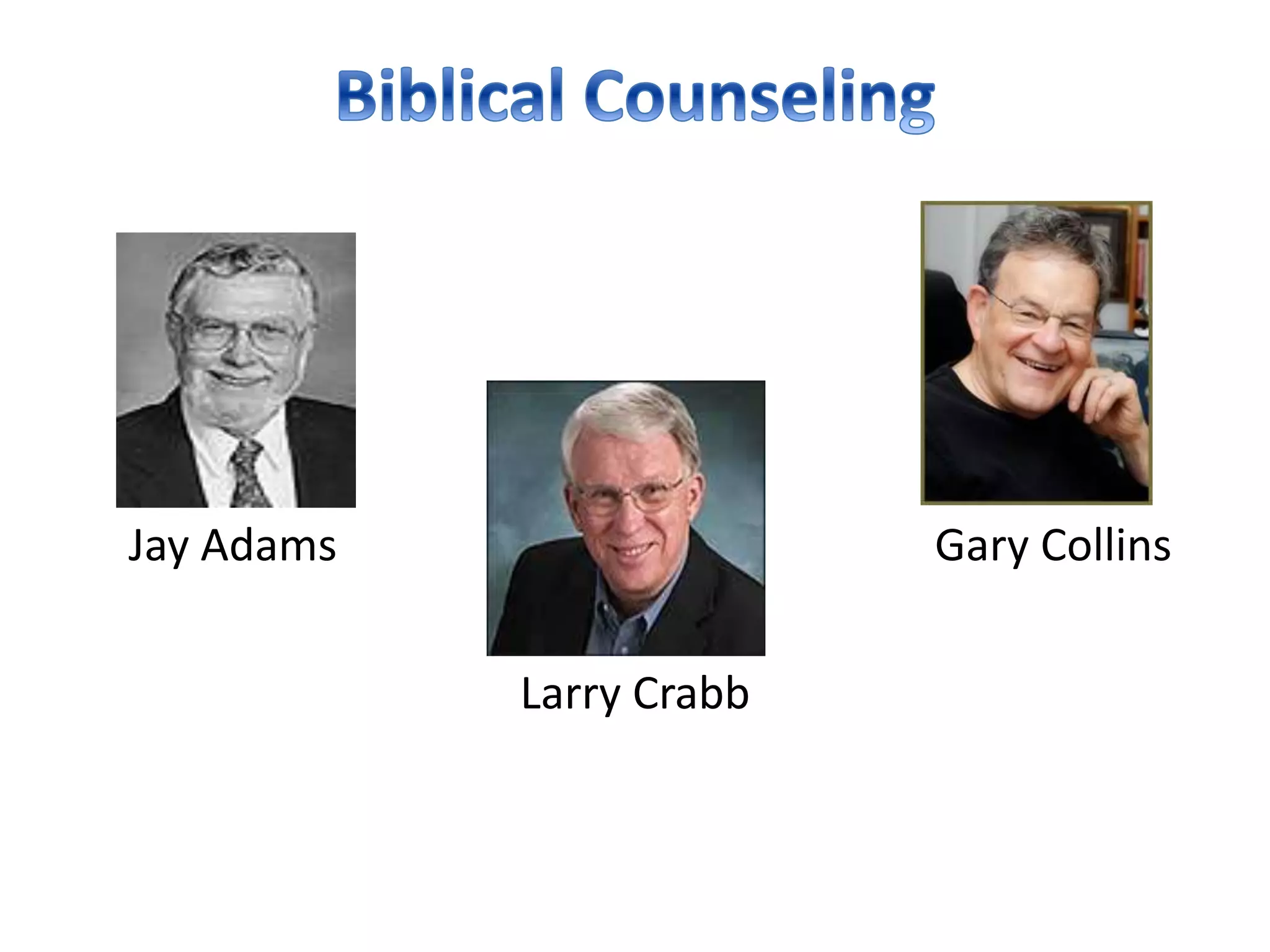
Jay Adams
Larry Crabb
Gary Collins
History of Pastoral Care in America (1983),
E. Brooks Holifield dates its development to
the first decade of the twentieth century
when a group of New England pastors first
began to consider how the newly
developed procedures of counseling and
psychotherapy could be put into spiritual
use by the church.
“care of souls” (Latin cura animarum) = care
and cure.
“The Christian church has historically
embraced both meanings of cura and has
understood soul care to involve nurture and
support as well as healing and restoration.”
Benner, D. G. (2003). Strategic pastoral counseling : a
short-term structured model (2nd ed., p. 14). Grand
Rapids, Mich.: Baker Academic.
The International Coach Federation (ICF) defines
coaching as “partnering with clients in a thought-
provoking and creative process that inspires them
to maximize their personal and professional
potential. Professional coaches provide an ongoing
partnership designed to help clients produce
fulfilling results in their personal and professional
lives. Coaches help people improve their perform-
ances and enhance the quality of their lives.
“Coaches are trained to listen, to observe and to
customize their approach to individual client
needs. They seek to elicit solutions and strategies
from the client; they believe the client is naturally
creative and resourceful. The coach’s job is to
provide support to enhance the skills, resources
and creativity that the client already has.”
Encourage
Model
Identifies:
Etiology
Faulty Thinking
False Beliefs
Coach
Counsel
Exhort
Theology
Anthropology
= (theos + logos) the study of God
= (anthropos + logos) the
study of man
Anselm: “faith seeking understanding.”
“The deeper one’s thought
penetrate in the field of
psychotherapy, the closer
one comes to the realm of
theology… The fundamental
questions with which
psychotherapy ends can
only be answered with
theology.”
(Rollo May, Love and Will, 1967,
page 218)
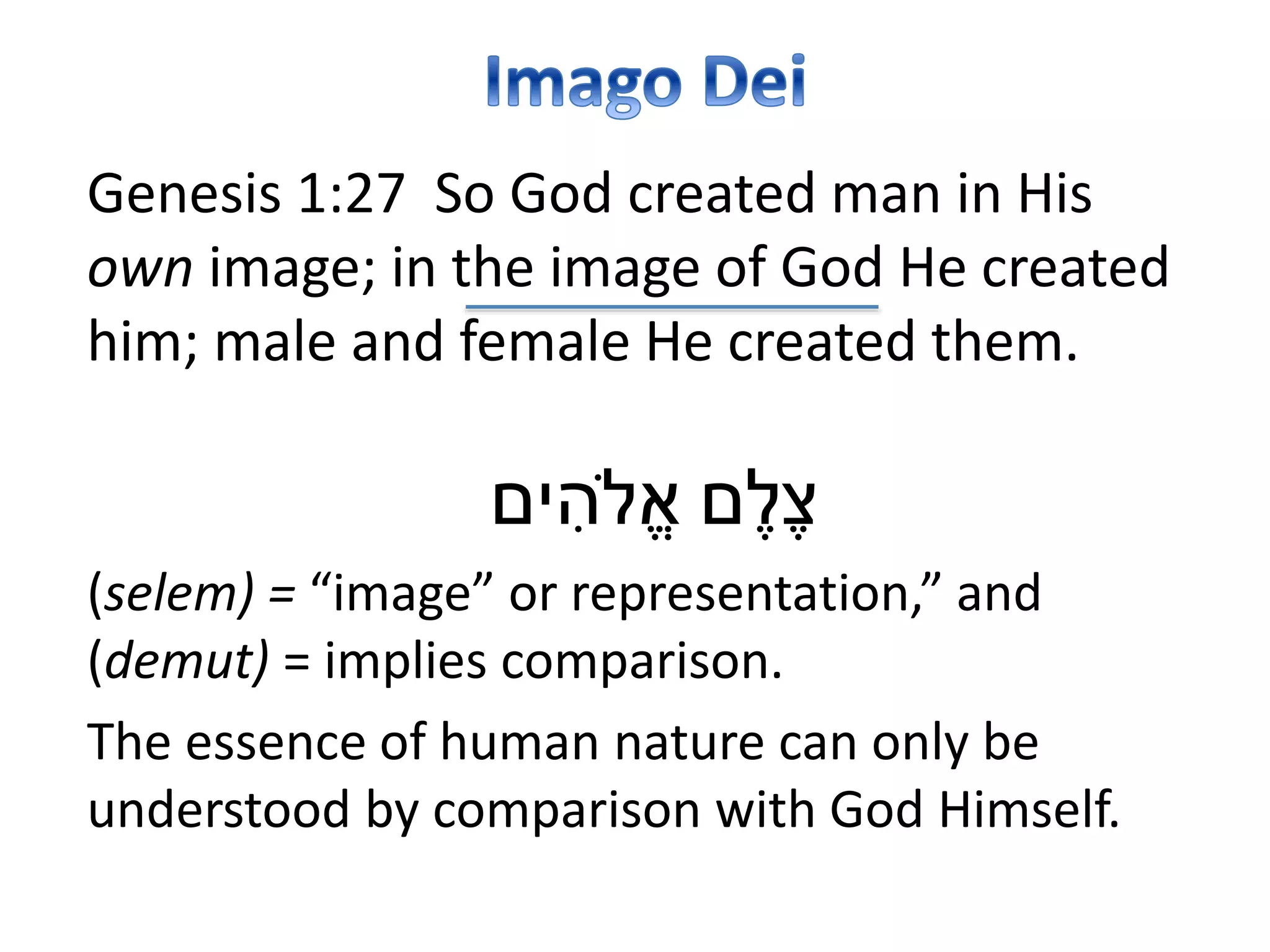
Genesis 1:27 So God created man in His
own image; in the image of God He created
him; male and female He created them.
‫ם‬ֶ‫ל‬ֶ‫צ‬‫ים‬ ִ‫ֹלה‬ֱ‫א‬
(selem) = “image” or representation,” and
(demut) = implies comparison.
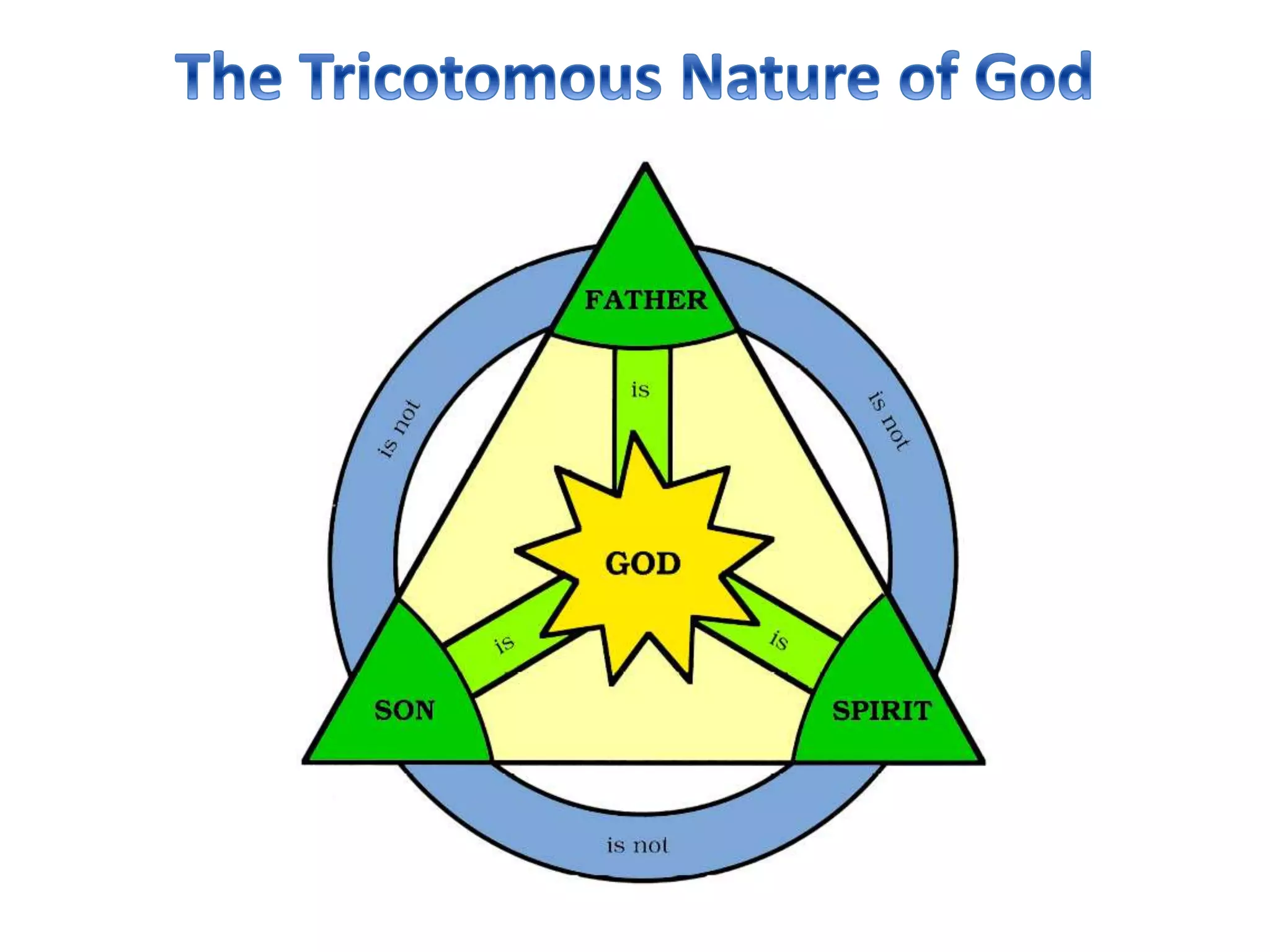
The essence of human nature can only be
understood by comparison with God Himself.
a body a soul
a spirit
Cp.
God the Son,
Jesus
Cp.
God the Father
Cp.
God the Holy Spirit
• Interprets physical, psychological and spiritual
symptoms in a proper diagnosis of pathologies
• Integrates the body, soul and spirit in the
healing process in any one or all of the parts
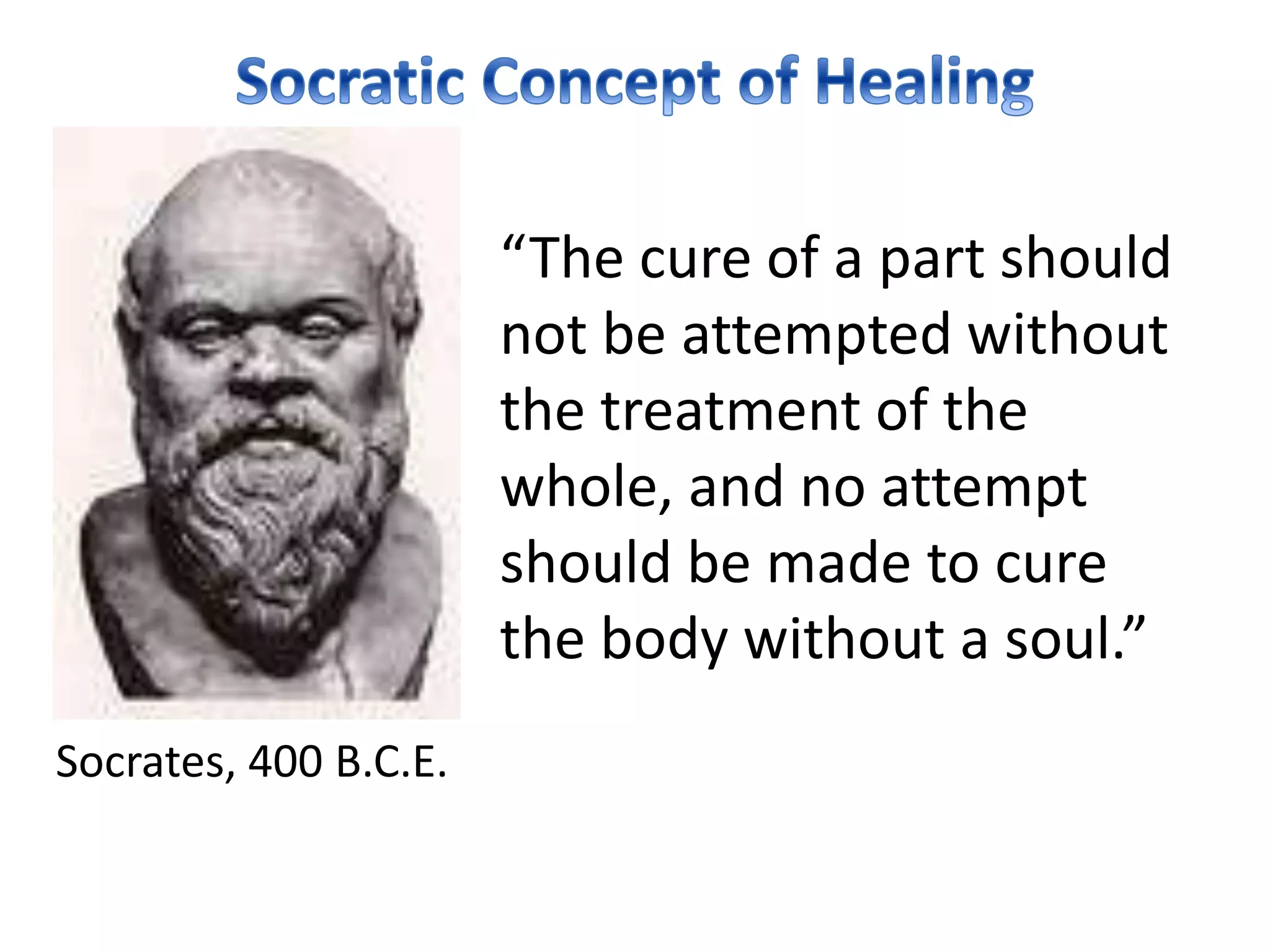
“The cure of a part should
not be attempted without
the treatment of the
whole, and no attempt
should be made to cure
the body without a soul.”
Socrates, 400 B.C.E.
“Men ought to know that from nothing else but the
brain come joys, delights, laughter and sports, and
sorrows, griefs, despondency, and lamentations.
And by this, in an especial manner, we acquire
wisdom and knowledge, and see and hear and
know what are foul and what are fair, what are bad
and what are good, what are sweet and what are
unsavory . . . And by the same organ we become
mad and delirious, and fears and terrors assail us . .
. All these things we endure from the brain when it
is not healthy . . . In these way I am of
of the opinion that the brain exercises the
greatest power in the man.”
- Hippocrates, On the Sacred Disease (4th Century, B.C.)
• Body
• Soul
• Spirit
Present
Past
Future
Justification
Sanctification
Glorification
• Augustine described the process of
appropriating gold and silver from the
Egyptians as the Israelites left the country. In
the same way, he compared taking knowledge
from “heathen” institutions and applying
them properly to Christian purposes.
• How can we understand and apply knowledge
from secular psychology, psychiatry and
neurology in Christian counseling?
• Body
• Spirit
neurology psychiatry
• Soul
observations, testing
& assessments
biochemistry brain surgery
therapy
insight
diagnosis
intervention
Isaiah 6
Seraphim’ declare “Holy, Holy, Holy”
ἅγιος [hagios] = separated
‫ש‬ ֶ‫ד‬ֹ‫ק‬ׁ [ko·desh] = separated, holy,
sacred, complete
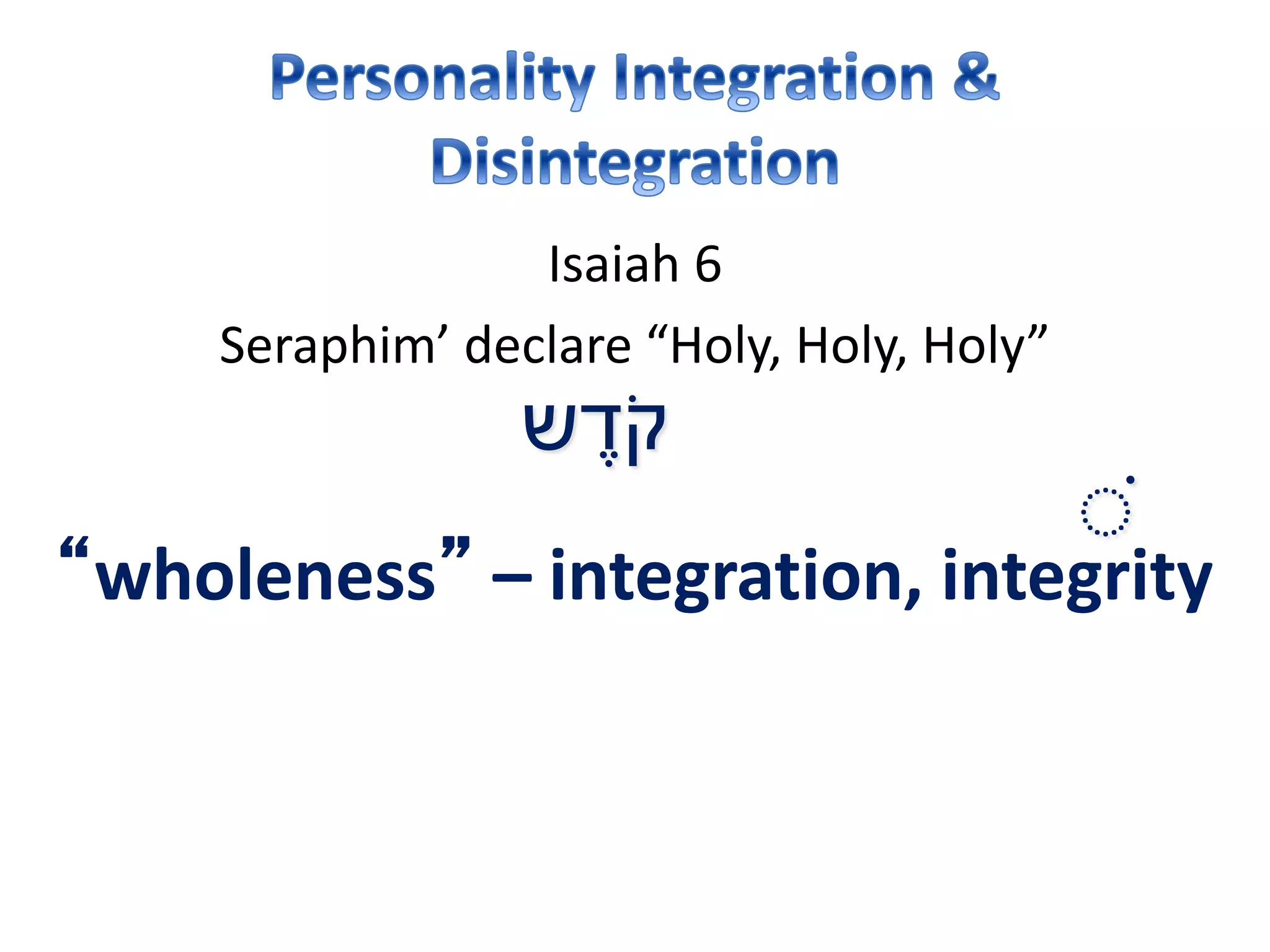
Isaiah 6
Seraphim’ declare “Holy, Holy, Holy”
“wholeness” – integration, integrity
‫ש‬ ֶ‫ד‬ֹ‫ק‬
ׁ
Isaiah 6
Isaiah’s confession “Woe is me, I am undone”
[’owy /o·ee] = “woe is me!”‫וי‬ֹ‫א‬
‫א‬ ֵ‫מ‬ ָ‫ט‬ [taw·may/] = become unclean,
defiled, undone, fragmented
I beseech you therefore, brethren, by the
mercies of God, that you present your bodies a
living sacrifice, holy, acceptable to God, which is
your reasonable service. 2And do not be
conformed to this world, but be transformed by
the renewing of your mind, that you may prove
what is that good and acceptable and perfect
will of God.
A Biblical Philosophy of Change
Is Holistic
A Biblical Philosophy of Change
You can contact Harry at:
Biblical Counseling Center
825 4th Street West
Palmetto, FL 34221
941-729-6600
Sanctitas@aol.com
www.TRUTHtransforms.com

Biblical Counseling (part 1)

  • 1.
    Network Institute ofChristian Counseling 9 September 2013 Sponsored by
  • 3.
    • To reviewthe philosophical basis for a biblical & holistic approach to psychotherapy • To identify requirements for a biblical counselor • To provide a number of examples of biblically- based interventions in counseling based on today’s presentation
  • 4.
    • σύμβουλος (sumboulos)= (σύμ) with + (βουλή) advice, direction
  • 5.
    (kho-bal) derived fromthe nouns ‫ל‬ ֶ‫ב‬ ֶ‫ח‬ a rope or ‫ל‬ ֵ‫ב‬ֹ‫ח‬ a rope puller, a sailor, a pilot (plur. fem. rule, government) ‫ה‬ָ‫ל‬ֻּ‫ב‬ ְ‫ח‬ ַּ‫ת‬
  • 6.
    Proverbs 1:5 A wiseman will hear and increase learning, and a man of understanding will attain wise counsel
  • 7.
    “Counseling Psychology isa specialty within professional psychology that maintains a focus on facilitating personal and interpersonal functioning across the life span. The specialty pays particular attention to emotional, social, vocational, educational, health-related, developmental, and organizational concerns.”
  • 8.
    “Counseling is acollaborative effort between the counselor and client. Professional counselors help clients identify goals and potential solutions to problems which cause emotional turmoil; seek to improve communication and coping skills; strengthen self-esteem; and promote behavior change and optimal mental health.”
  • 9.
    “. . .theprovision of assistance and guidance in resolving personal, social, or psychological problems and difficulties, especially by a professional.”
  • 10.
    Proverbs 14:12 Thereis a way that seems right to a man, but its end is the way of death. (cf. also 16:25)
  • 11.
    • Proverbs 11:14Where there is no counsel, the people fall; but in the multitude of counselors there is safety. • Proverbs 12:5 The thoughts of the righteous are right, but the counsels of the wicked are deceitful. • Proverbs 15:22 Without counsel, plans go awry, but in the multitude of counselors they are established.
  • 12.
    • Psalm 33:11The counsel of the LORD stands forever, the plans of His heart to all generations. • Proverbs 8:14 Counsel is mine, and sound wisdom; I am understanding, I have strength.
  • 13.
    • Isaiah 9:6For unto us a Child is born, unto us a Son is given; and the government will be upon His shoulder. And His name will be called Wonderful, Counselor, Mighty God, Everlasting Father, Prince of Peace. • I Corinthians 1:30 But of Him you are in Christ Jesus, who became for us wisdom from God— and righteousness and sanctification and redemption.
  • 14.
    Psalm 1:1–2 Blessedis the man who walks not in the counsel of the ungodly, nor stands in the path of sinners, nor sits in the seat of the scornful; 2 but his delight is in the law of the LORD, and in His law he meditates day and night.
  • 15.
    “Psychology can bedefined as the scientific study of the behavior and thinking of organisms. Psychology might be thought of as the study of how living creatures interact with their environment and each other, and how they cope (successfully or unsuccessfully) with that environment.” Meier, P. D., M. D., Minirth, F. B., M. D., Wichern, F. B., Ph. D., & Ratcliff, D. E., Ph. D. (1991). Introduction to psychology and counseling: Christian perspectives and applications (Second Edition., p. 17). Grand Rapids, MI: Baker Books.
  • 16.
    (psyche) = soul (logos)= word, dissertation, science of “psychologia” coined in 1524 (Vande Kemp, 1996)
  • 17.
  • 18.
  • 19.
    (psyche) = soul+ (theron) = healing
  • 20.
    (ψυχή - psūkhē)= soul (πάθος - pathos) = experience or suffering
  • 21.
    (em) = toward+ (pathos) = suffering (sym) = with + (pathos) = suffering
  • 22.
    Charles Ryrie: “Christianspirituality always involves regeneration, the work of the Holy Spirit, and time to learn this way of living. Spiritually is a mature and maturing relation to the Holy Spirit.” • In secular literature, spirituality is a rather generic term. • Christian spirituality is part of religious life, or the expression of it; seeking to live life in imitation of Christ.
  • 23.
    • Earliest formsof psychotherapy likely came from philosophy rather than medicine (Kurtz, 1999) • Ancient Greeks (Zeno, Epictetus, etc.) • Spiritual systems often contain psychological components (e.g. The Dhammapada) • Religion/spirituality and psychology had much overlap until the end of the 19th century T
  • 24.
  • 25.
  • 26.
    (Richards & Bergin,1999) William James • Varieties of Religious Experience (1902) • Emphasis on personal psychology of religion Gordon Allport • The Individual and His Religion (1950) • Offers a developmental perspective of religion • 6 characteristics of religious maturity Paul Pruyser • Extends on work of James and Allport • Describes forms of neurotic religion
  • 27.
    (Richards & Bergin,1999) Erich Fromm • Religious need for a frame of orientation Abraham Maslow • Self actualization Viktor Frankl • Man’s Search for Meaning • Transpersonal Psychology • Application of scientific methods to spiritual experience
  • 28.
    Hobart Mowrer (1907-1982) “For severaldecades we psychologists looked upon the whole matter of sin and moral accountability as a great incubus and acclaimed our liberation from it as epoch making. But at length we have discovered that to be free in this sense, that is, to have the excuse of being sick rather than sinful, is to court the danger of also becoming lost… In becoming amoral, ethically neutral and free, we have cut the very roots of our being, lost our deepest sense of selfhood and identity, and with neurotics, themselves, we find ourselves asking: Who am I, what is my deepest destiny, what does living mean?” “Sin, the Lesser of Two Evils,” American Psychologist, 15 (1960): 301-30
  • 29.
  • 30.
  • 31.
  • 32.
    • A DifferentPlan • A Different Purpose • A Different Power
  • 33.
    Plan for Change Purpose of Change Power toChange Psychoanalytic Jungian Rational-emotive Behavioral Adlerian Rogerian Existential Gestalt
  • 34.
    • Plan forChange – The Word of God • Purpose of Change – The Son of God • Power to Change – The Spirit of God
  • 35.
    It is notthe experience of life, but the experi- ence of the cross that makes one a worthy hearer of confessions. The most experienced psychologist or observer of human nature knows infinitely less of the human heart the simplest Christian who lives beneath the cross of Jesus. The greatest psychological insight, Bonhoeffer ability, and experience cannot grasp this one thing: what sin is. Worldly wisdom knows what distress and weakness and failure are, but it does not know the godlessness of men. And so it also does not know that man is destroyed only by his sin and can be healed only by forgiveness. Only the Christian knows this. In the presence of a psychiatrist, I can only be a sick man; in the presence of the Christian brother, I can dare to be a sinner.
  • 36.
    • 92% ofthe US population is affiliated with religion • 96% profess a belief in God or a universal spirit Psychotherapy (Shafranske, 1996)
  • 37.
  • 38.
  • 39.
    History of PastoralCare in America (1983), E. Brooks Holifield dates its development to the first decade of the twentieth century when a group of New England pastors first began to consider how the newly developed procedures of counseling and psychotherapy could be put into spiritual use by the church.
  • 40.
    “care of souls”(Latin cura animarum) = care and cure. “The Christian church has historically embraced both meanings of cura and has understood soul care to involve nurture and support as well as healing and restoration.” Benner, D. G. (2003). Strategic pastoral counseling : a short-term structured model (2nd ed., p. 14). Grand Rapids, Mich.: Baker Academic.
  • 41.
    The International CoachFederation (ICF) defines coaching as “partnering with clients in a thought- provoking and creative process that inspires them to maximize their personal and professional potential. Professional coaches provide an ongoing partnership designed to help clients produce fulfilling results in their personal and professional lives. Coaches help people improve their perform- ances and enhance the quality of their lives.
  • 42.
    “Coaches are trainedto listen, to observe and to customize their approach to individual client needs. They seek to elicit solutions and strategies from the client; they believe the client is naturally creative and resourceful. The coach’s job is to provide support to enhance the skills, resources and creativity that the client already has.”
  • 43.
  • 44.
    Theology Anthropology = (theos +logos) the study of God = (anthropos + logos) the study of man Anselm: “faith seeking understanding.”
  • 45.
    “The deeper one’sthought penetrate in the field of psychotherapy, the closer one comes to the realm of theology… The fundamental questions with which psychotherapy ends can only be answered with theology.” (Rollo May, Love and Will, 1967, page 218)
  • 46.
    Genesis 1:27 SoGod created man in His own image; in the image of God He created him; male and female He created them. ‫ם‬ֶ‫ל‬ֶ‫צ‬‫ים‬ ִ‫ֹלה‬ֱ‫א‬ (selem) = “image” or representation,” and (demut) = implies comparison. The essence of human nature can only be understood by comparison with God Himself.
  • 48.
    a body asoul a spirit Cp. God the Son, Jesus Cp. God the Father Cp. God the Holy Spirit
  • 49.
    • Interprets physical,psychological and spiritual symptoms in a proper diagnosis of pathologies • Integrates the body, soul and spirit in the healing process in any one or all of the parts
  • 50.
    “The cure ofa part should not be attempted without the treatment of the whole, and no attempt should be made to cure the body without a soul.” Socrates, 400 B.C.E.
  • 51.
    “Men ought toknow that from nothing else but the brain come joys, delights, laughter and sports, and sorrows, griefs, despondency, and lamentations. And by this, in an especial manner, we acquire wisdom and knowledge, and see and hear and know what are foul and what are fair, what are bad and what are good, what are sweet and what are unsavory . . . And by the same organ we become mad and delirious, and fears and terrors assail us . . . All these things we endure from the brain when it is not healthy . . . In these way I am of of the opinion that the brain exercises the greatest power in the man.” - Hippocrates, On the Sacred Disease (4th Century, B.C.)
  • 52.
    • Body • Soul •Spirit Present Past Future Justification Sanctification Glorification
  • 53.
    • Augustine describedthe process of appropriating gold and silver from the Egyptians as the Israelites left the country. In the same way, he compared taking knowledge from “heathen” institutions and applying them properly to Christian purposes. • How can we understand and apply knowledge from secular psychology, psychiatry and neurology in Christian counseling?
  • 54.
    • Body • Spirit neurologypsychiatry • Soul observations, testing & assessments biochemistry brain surgery therapy insight diagnosis intervention
  • 59.
    Isaiah 6 Seraphim’ declare“Holy, Holy, Holy” ἅγιος [hagios] = separated ‫ש‬ ֶ‫ד‬ֹ‫ק‬ׁ [ko·desh] = separated, holy, sacred, complete
  • 60.
    Isaiah 6 Seraphim’ declare“Holy, Holy, Holy” “wholeness” – integration, integrity ‫ש‬ ֶ‫ד‬ֹ‫ק‬ ׁ
  • 61.
    Isaiah 6 Isaiah’s confession“Woe is me, I am undone” [’owy /o·ee] = “woe is me!”‫וי‬ֹ‫א‬ ‫א‬ ֵ‫מ‬ ָ‫ט‬ [taw·may/] = become unclean, defiled, undone, fragmented
  • 62.
    I beseech youtherefore, brethren, by the mercies of God, that you present your bodies a living sacrifice, holy, acceptable to God, which is your reasonable service. 2And do not be conformed to this world, but be transformed by the renewing of your mind, that you may prove what is that good and acceptable and perfect will of God. A Biblical Philosophy of Change
  • 63.
    Is Holistic A BiblicalPhilosophy of Change
  • 64.
    You can contactHarry at: Biblical Counseling Center 825 4th Street West Palmetto, FL 34221 941-729-6600 Sanctitas@aol.com www.TRUTHtransforms.com

Editor's Notes

  • #5  Gesenius, W., & Tregelles, S. P. (2003). Gesenius Hebrew and Chaldee lexicon to the Old Testament Scriptures. Bellingham, WA: Logos Bible Software.
  • #6  Gesenius, W., & Tregelles, S. P. (2003). Gesenius Hebrew and Chaldee lexicon to the Old Testament Scriptures. Bellingham, WA: Logos Bible Software.
  • #7  Gesenius, W., & Tregelles, S. P. (2003). Gesenius Hebrew and Chaldee lexicon to the Old Testament Scriptures. Bellingham, WA: Logos Bible Software.
  • #9 http://www.counseling.org/learn-about-counseling/what-is-counseling
  • #25 Wilhelm Wundt (1832-1920) first established psychology as an independent and self-sufficient academic discipline in 1879. He founded a psychological laboratory at the University of Leipzig in Germany, where many early students of psychology took their training. Around the turn of the century the effect of the science of psychology began to be felt across much of Europe and America. Eleven years after the founding of the first psychological laboratory, William James, an American psychologist and philosopher, wrote the first general psychology textbook, entitled The Principles of Psychology (1890). This work, which is recognized as a landmark in psychology, emphasized the function of consciousness, not the components of consciousness as Wundt’s work had done. This perspective came to be known as functionalism; it emphasized the practical application of research to everyday situations. During the second decade of this century a third perspective, behaviorism, was developed by American psychologist John B. Watson. While accepting the methods of experimentation, Watson rejected the study of consciousness because he believed that it could only be examined indirectly. Since behavior could be directly studied and precisely measured, he maintained that it was the only scientific object psychologists could justifiably consider. Watson argued that human behavior was due to certain laws, all derived from the fundamental principle that stimuli (events before a behavior occurs) produce a response (the behavior itself). His approach, as a result, is often designated s-r theory. Watson’s theory became very popular in the 1920s, remained dominant in American psychology for several decades (especially after B. F. Skinner broadened the perspective considerably), and continues to have ardent supporters even today.
  • #26 While the United States became enamored of behaviorism, Freud’s radically different views began to emerge in Europe. Freud saw unconsciousness as the basic cause of behavior, and held that people generally have no idea of the real causes of their actions because these causes are hidden from consciousness. His theory, called psychoanalytic psychology, was derived from case histories of people he counseled rather than experimentation, which is probably why it did not become popular in the more experimentally oriented United States. While Freud’s views have never dominated American psychology, his emphasis on early childhood experiences has powerfully influenced many psychologists (although few completely accept his ideas about how those experiences affect people). Carl Jung: His concepts of introversion andextraversion have contributed to personality psychology and also influenced psychotherapy. His advice to a patient suffering from alcoholism led to the formation of Alcoholics Anonymous, which has helped millions of people suffering from alcohol dependence. Freud: all religious experience is infantile Jung: all religious experience is mystical and highly developed Pathology Can be result of failed integration of lower into higher levels
  • #39 Wilhelm Wundt (1832-1920) first established psychology as an independent and self-sufficient academic discipline in 1879. He founded a psychological laboratory at the University of Leipzig in Germany, where many early students of psychology took their training. Around the turn of the century the effect of the science of psychology began to be felt across much of Europe and America. Eleven years after the founding of the first psychological laboratory, William James, an American psychologist and philosopher, wrote the first general psychology textbook, entitled The Principles of Psychology (1890). This work, which is recognized as a landmark in psychology, emphasized the function of consciousness, not the components of consciousness as Wundt’s work had done. This perspective came to be known as functionalism; it emphasized the practical application of research to everyday situations. During the second decade of this century a third perspective, behaviorism, was developed by American psychologist John B. Watson. While accepting the methods of experimentation, Watson rejected the study of consciousness because he believed that it could only be examined indirectly. Since behavior could be directly studied and precisely measured, he maintained that it was the only scientific object psychologists could justifiably consider. Watson argued that human behavior was due to certain laws, all derived from the fundamental principle that stimuli (events before a behavior occurs) produce a response (the behavior itself). His approach, as a result, is often designated s-r theory. Watson’s theory became very popular in the 1920s, remained dominant in American psychology for several decades (especially after B. F. Skinner broadened the perspective considerably), and continues to have ardent supporters even today.
  • #42 International Coach Federation (ICF) claims to be the largest coaching credentialing and support organization in the world,
  • #43 International Coach Federation (ICF) claims to be the largest coaching credentialing and support organization in the world,