Topics covered
• WELDING PROCESSES.
• WELDING CONSUMABLES
• WELDING EQUIPMENTS
• WELDING PROCEDURE
• WELDING DEFECTS ITS CAUSES
AND REMIDIES
• SAFETY
WELDING PROCESS
WELDING PROCESS
Types Of Welding
Welding
Gas Welding Arc Welding
Normal practiced process
Manual Metal Arc Welding MMAW
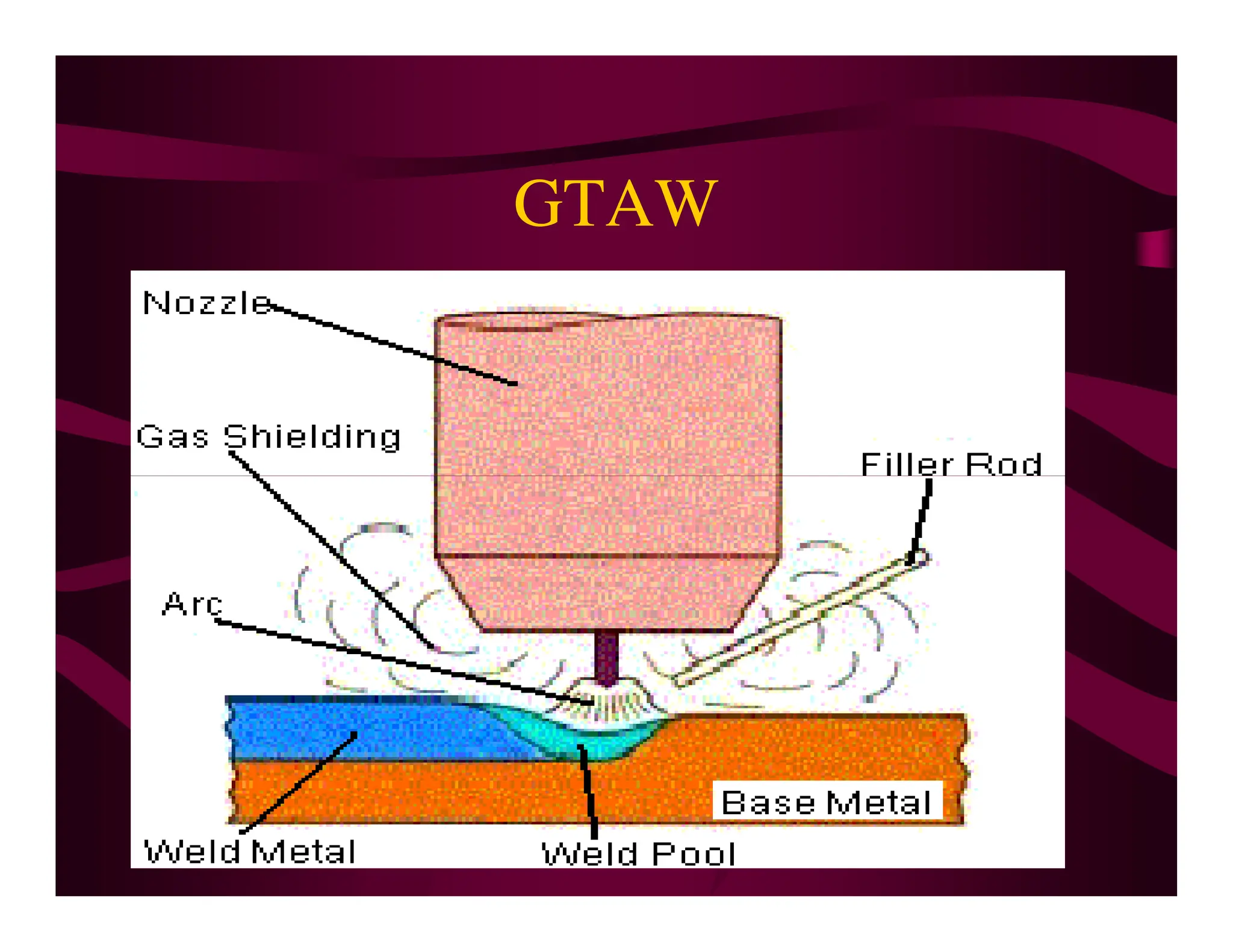
Gas Tungsten Arc Welding GTAW
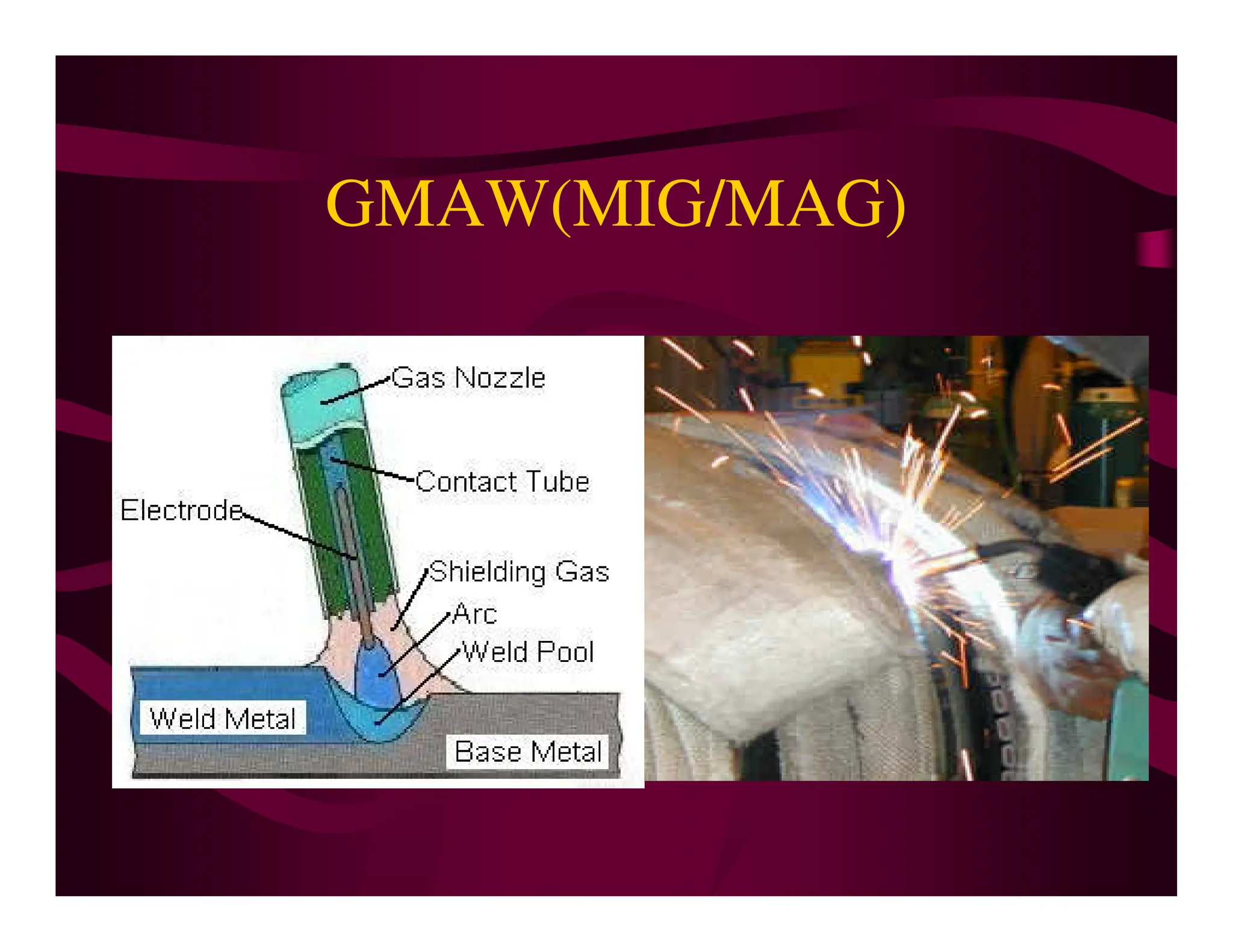
Gas Metal Arc Welding GMAW
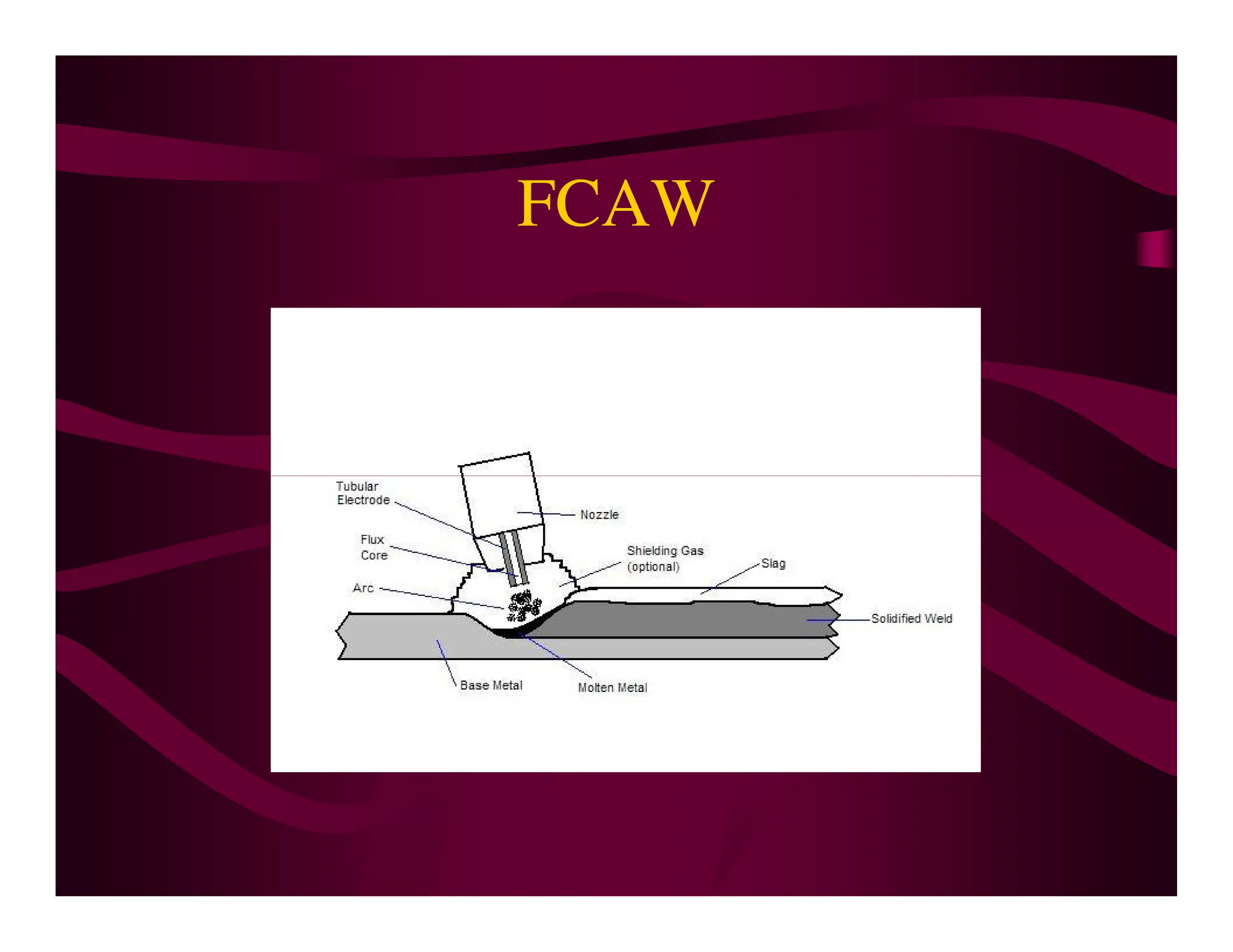
Flux Cored Arc Welding FCAW
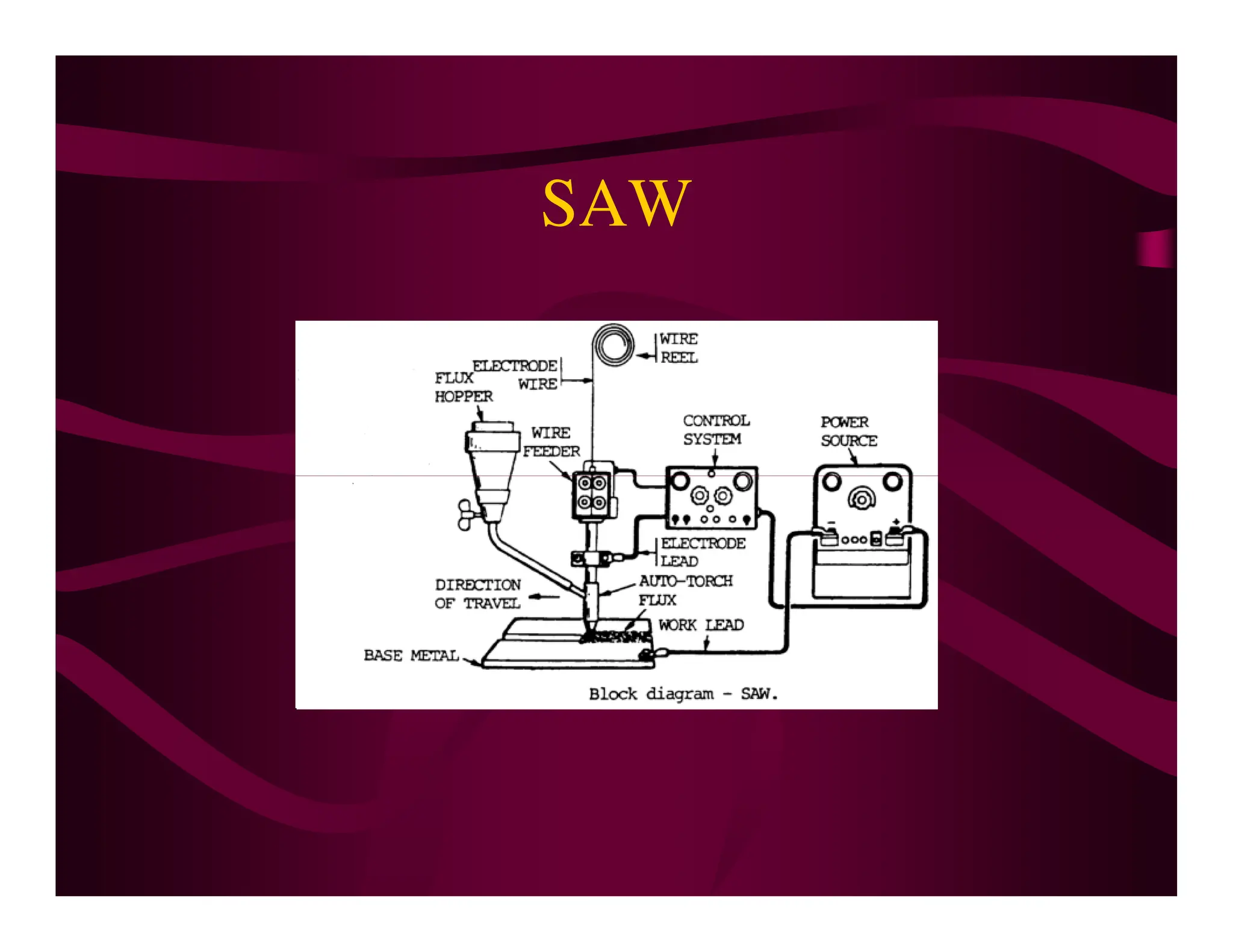
Sub Merged Arc Welding SAW
WELDING PROCESS
• The present process of welding used to
manufacture various components generally are as
follows
• MMAW- Manual Metal Arc Welding Process
• GMAW- Gas Metal Arc Welding process
• GTAW - Gas Tungsten Arc Welding
• FCAW- Flux Cored Arc Welding
• SAW- Submerged Arc Welding
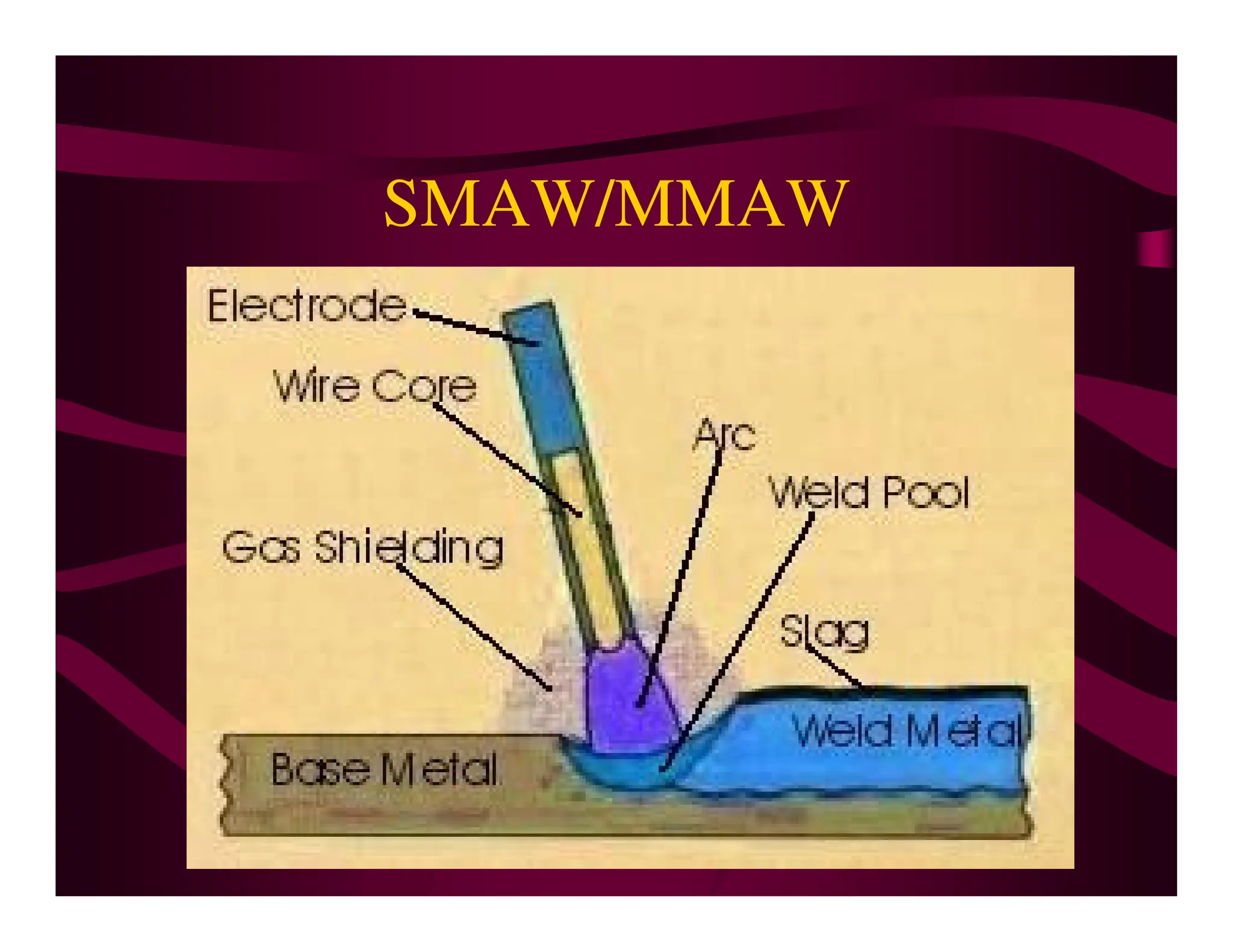
SMAW/MMAW
GTAW
GMAW(MIG/MAG)
FCAW
SAW
Advanced process
• Narrow Gap Welding
• Laser Beam Welding
• Electron Beam Welding
• Friction Stir Welding
• Plasma Welding
• Plasma Transfer Arc Technique (PTA)
• Robotic Welding
• Orbital Welding
Selection of Welding process
• Type of Base Material
• The Joint Design
• The place of welding
• Welding Position
• Type of consumables availability
• The skill availability of personnel
• The types of equipment availability
WELDING CONSUMABLES
WELDING CONSUMABLES
&
WELDING EQUIPMENTS.
RECOMMEDATIONS
The selection of the correct welding consumables
depends on the following parameters
• Base materials composition
• The weld ability of the steel
• Selection of the welding consumables as per
ASME section-II- C
• Acceptance of AWS or any other standards
depends on the clients requirements.
WELDING CONSUMABLES
• The Welding consumables like the welding electrodes and
filler wires that are required and are recommended are as
follows
• E-6013 Welding Electrodes for Welding in MMAW
process for Carbon steel, Mild steel, For the general
purpose welding applications up to thickness 18 mm or
3/4th inch.
• For thickness over the above mentioned must be welded
with Low Hydrogen electrodes as per AWS E 7018 or
E7018-1 Type of welding consumables.
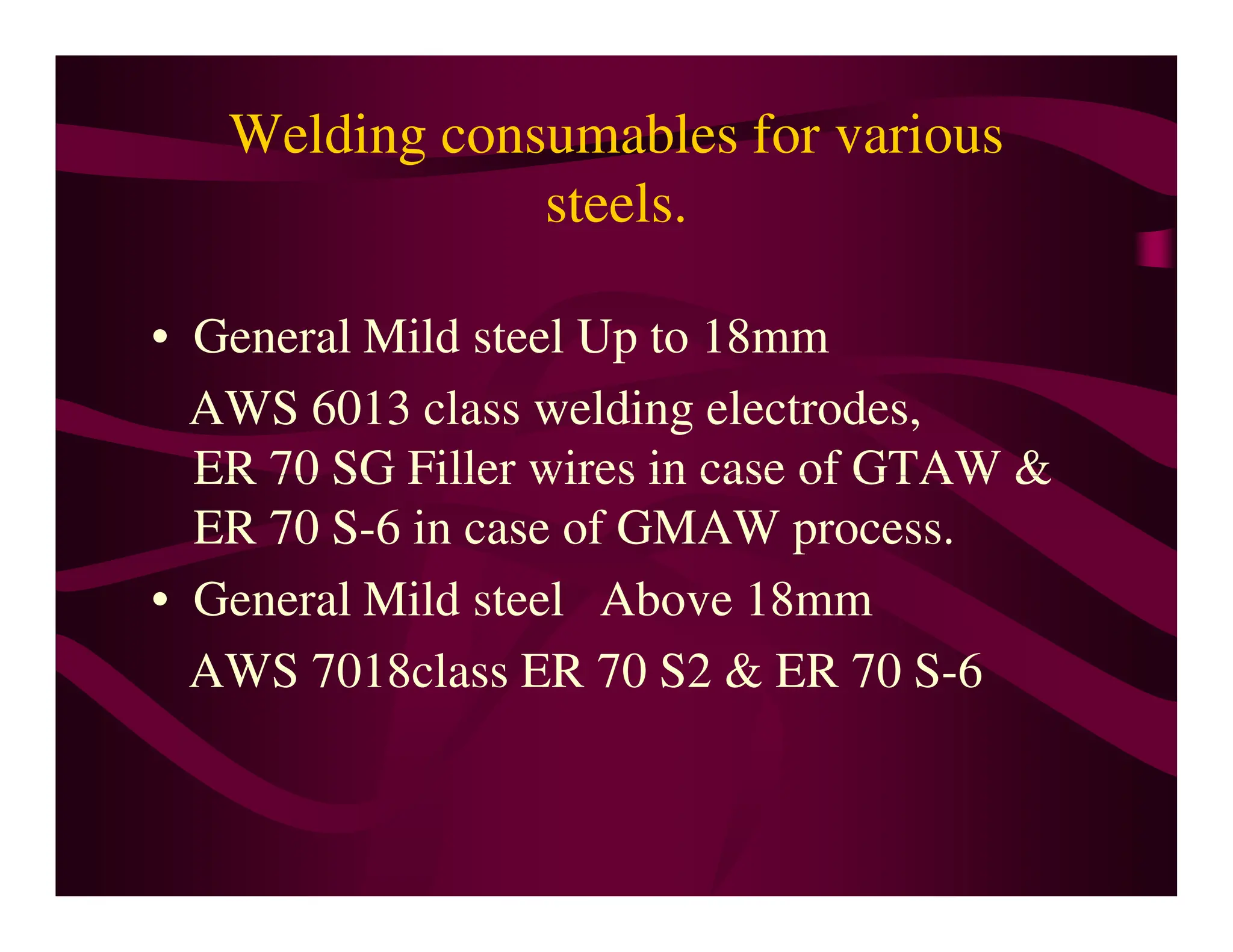
Welding consumables for various
steels.
• General Mild steel Up to 18mm
AWS 6013 class welding electrodes,
ER 70 SG Filler wires in case of GTAW &
ER 70 S-6 in case of GMAW process.
• General Mild steel Above 18mm
AWS 7018class ER 70 S2 & ER 70 S-6
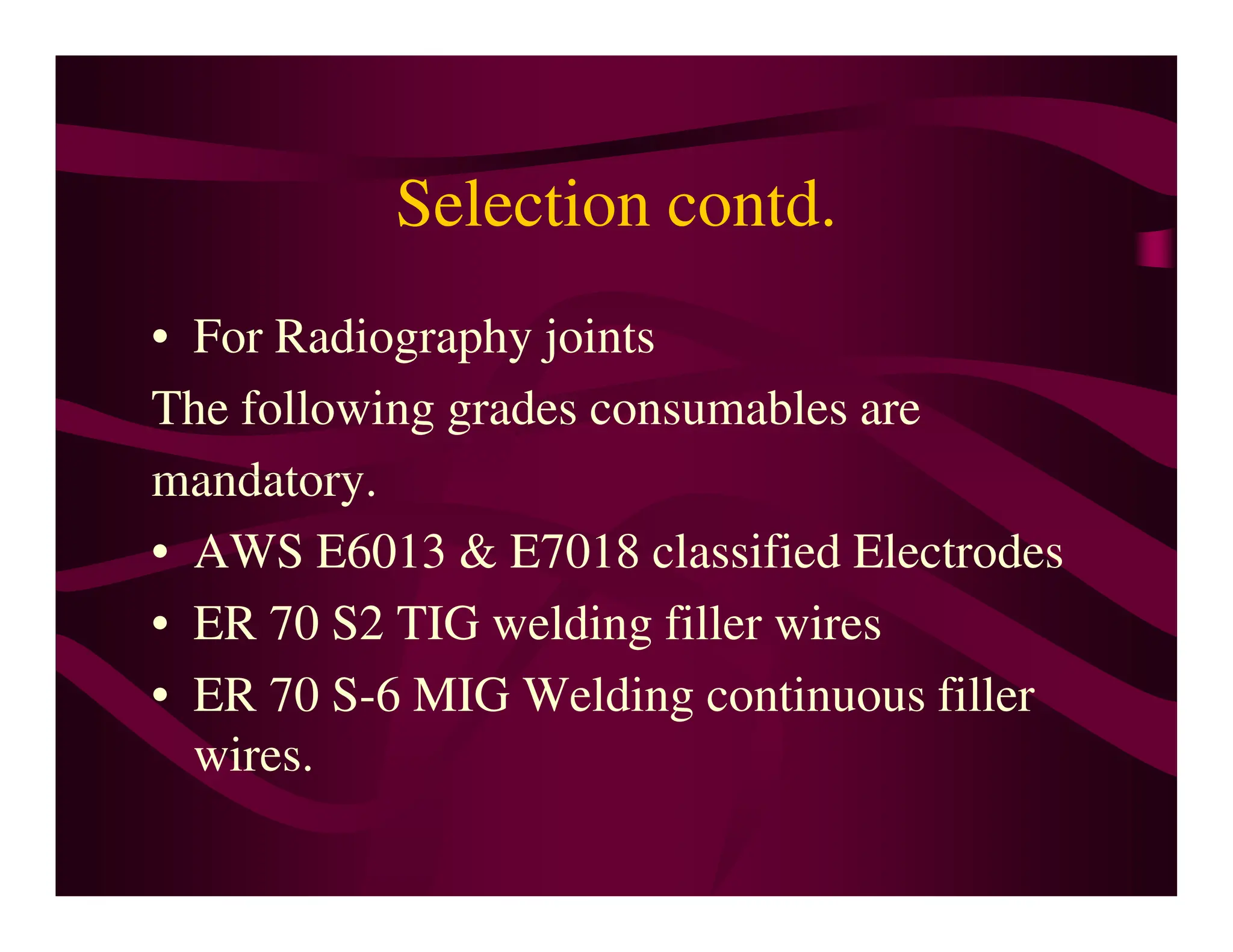
Selection contd.
• For Radiography joints
The following grades consumables are
mandatory.
mandatory.
• AWS E6013 & E7018 classified Electrodes
• ER 70 S2 TIG welding filler wires
• ER 70 S-6 MIG Welding continuous filler
wires.
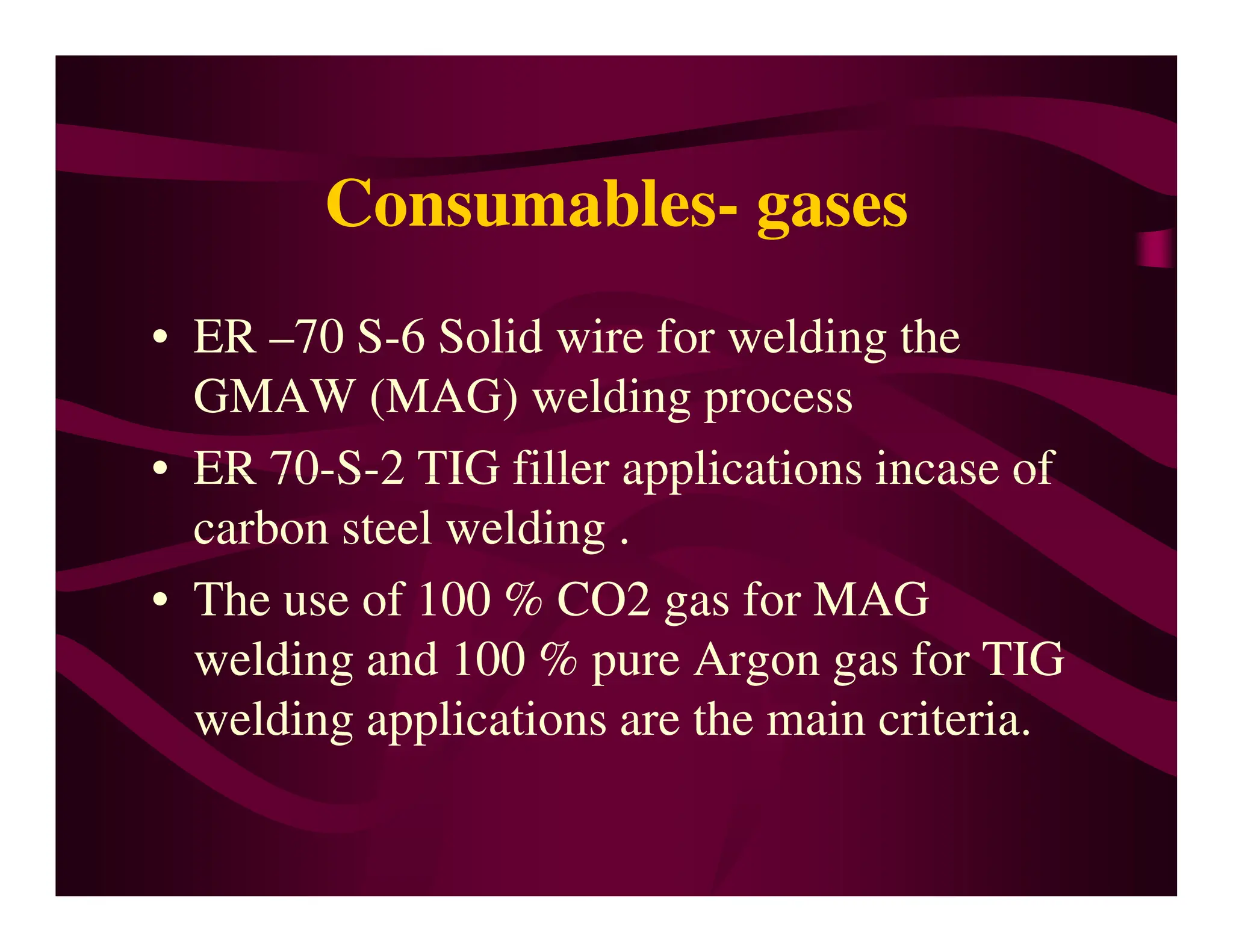
Consumables- gases
• ER –70 S-6 Solid wire for welding the
GMAW (MAG) welding process
• ER 70-S-2 TIG filler applications incase of
carbon steel welding .
• The use of 100 % CO2 gas for MAG
welding and 100 % pure Argon gas for TIG
welding applications are the main criteria.
Alloy steels
AWS class of low alloy electrodes & wires
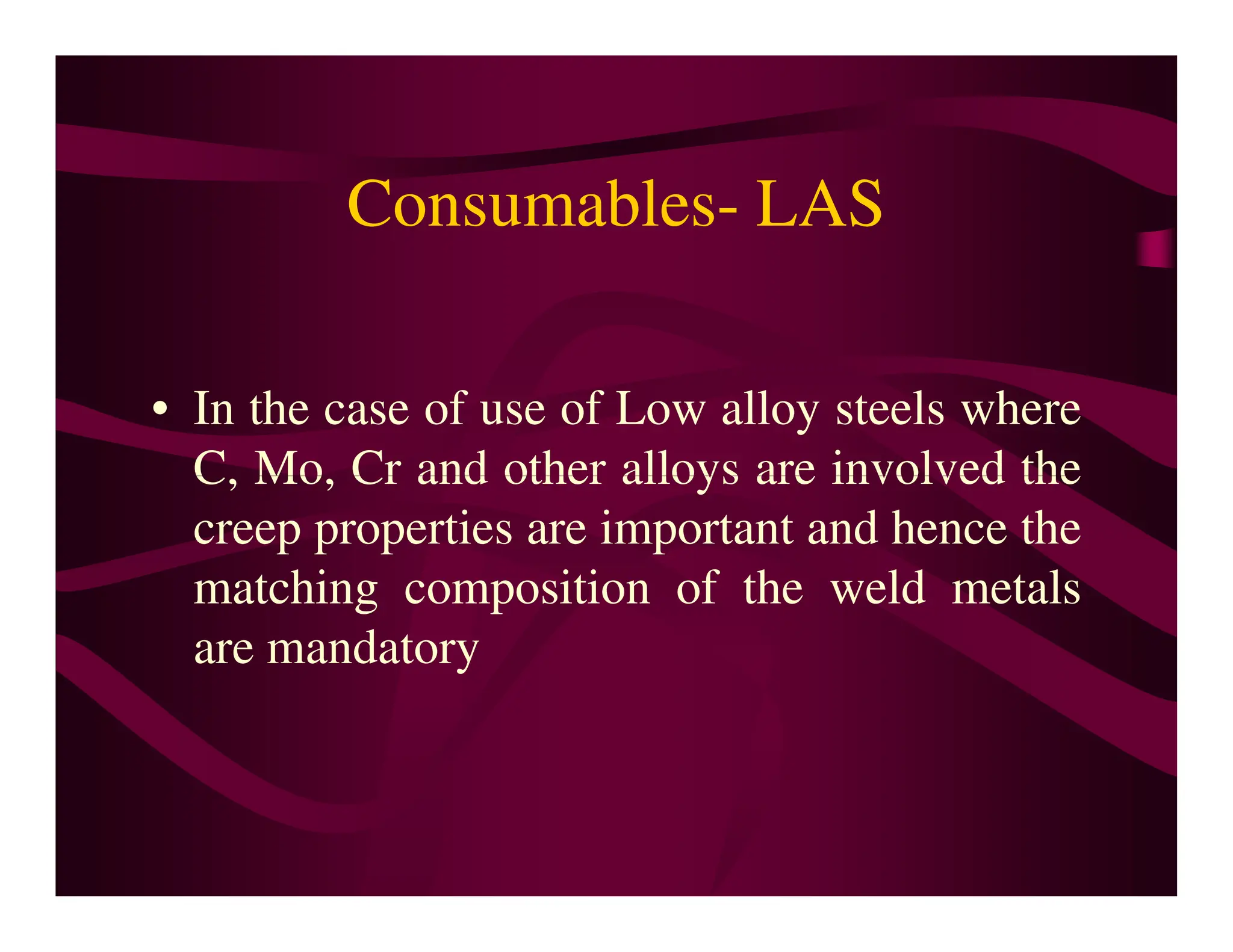
Consumables- LAS
• In the case of use of Low alloy steels where
C, Mo, Cr and other alloys are involved the
creep properties are important and hence the
matching composition of the weld metals
are mandatory
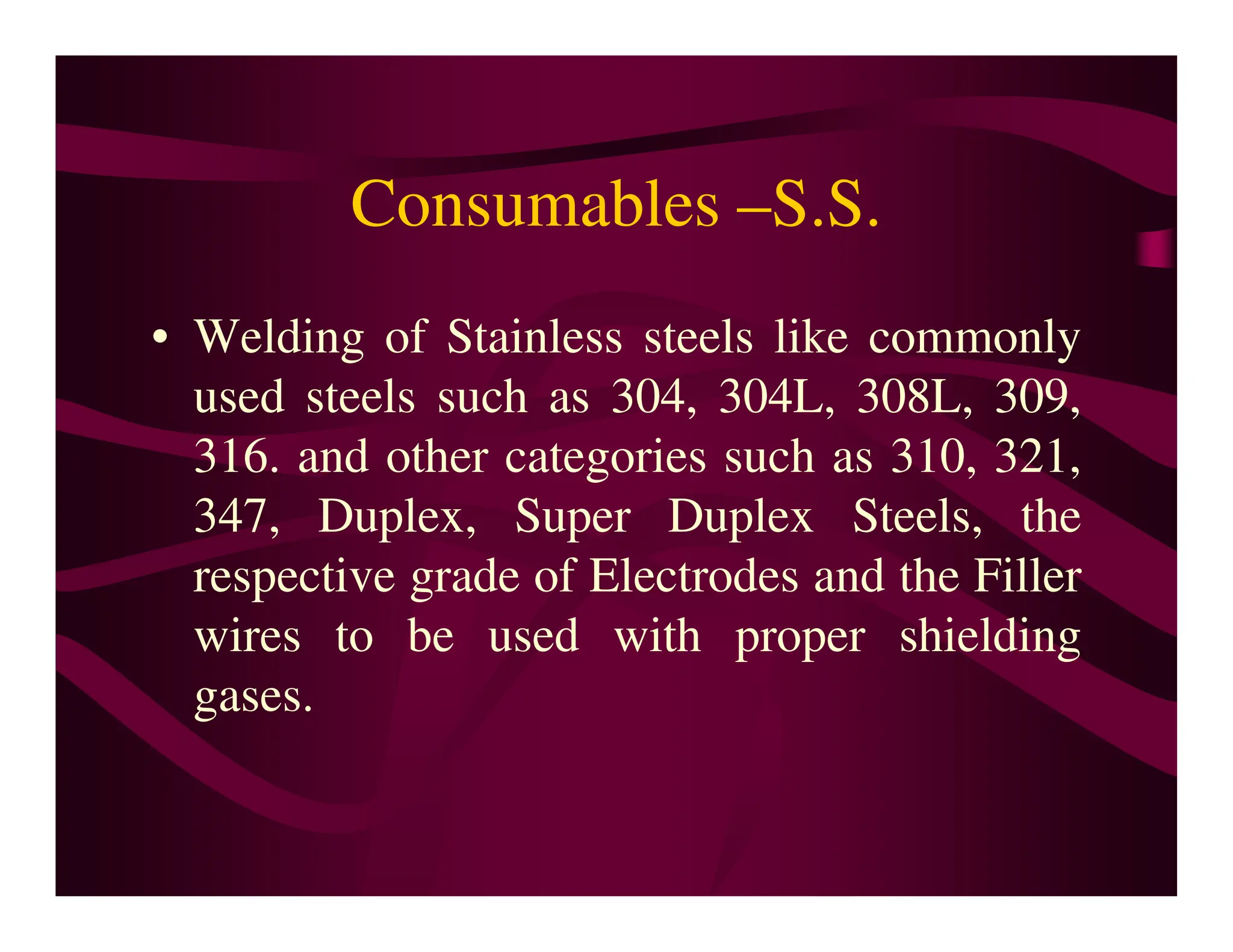
Consumables –S.S.
• Welding of Stainless steels like commonly
used steels such as 304, 304L, 308L, 309,
316. and other categories such as 310, 321,
347, Duplex, Super Duplex Steels, the
respective grade of Electrodes and the Filler
wires to be used with proper shielding
gases.
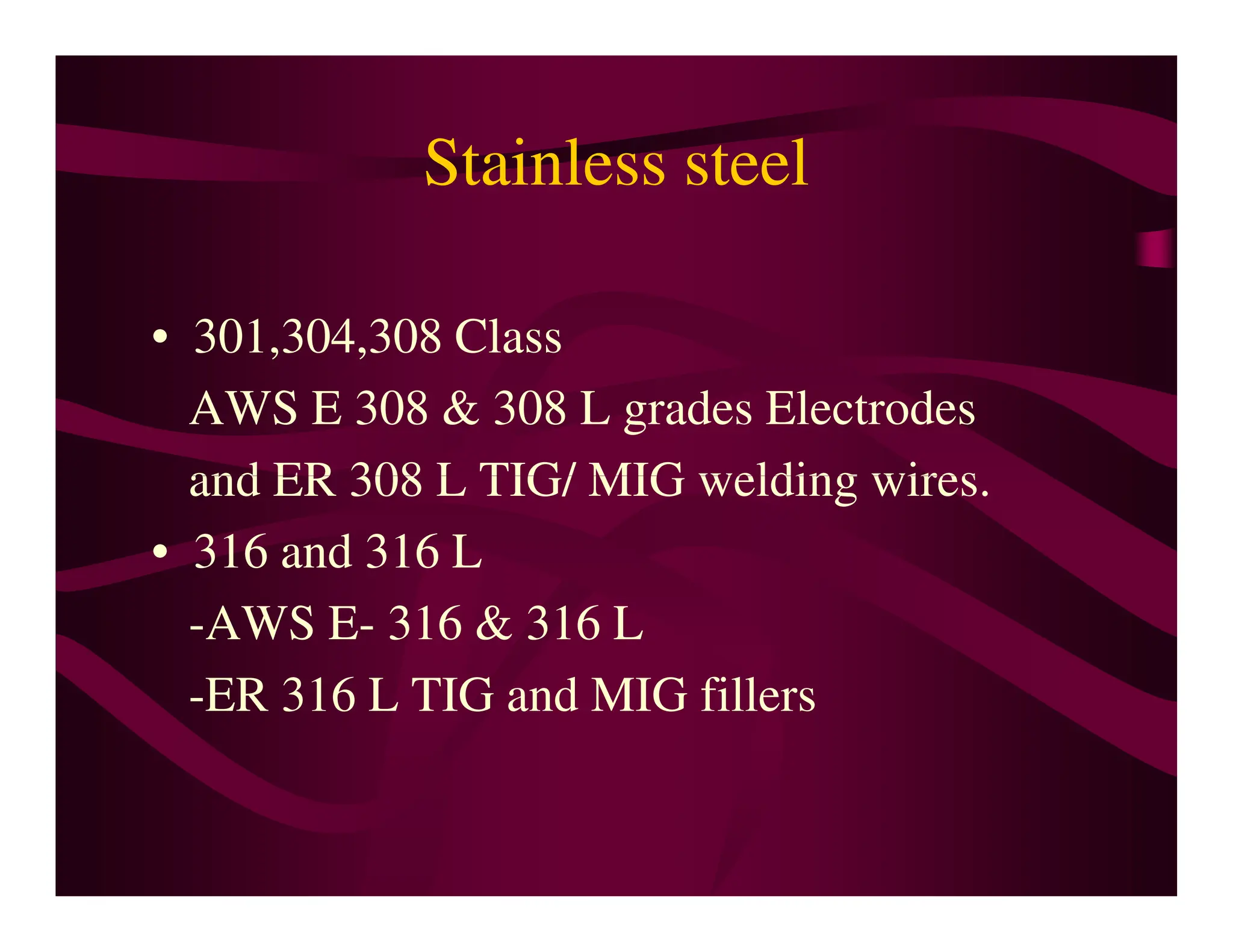
Stainless steel
• 301,304,308 Class
AWS E 308 & 308 L grades Electrodes
and ER 308 L TIG/ MIG welding wires.
• 316 and 316 L
-AWS E- 316 & 316 L
-ER 316 L TIG and MIG fillers
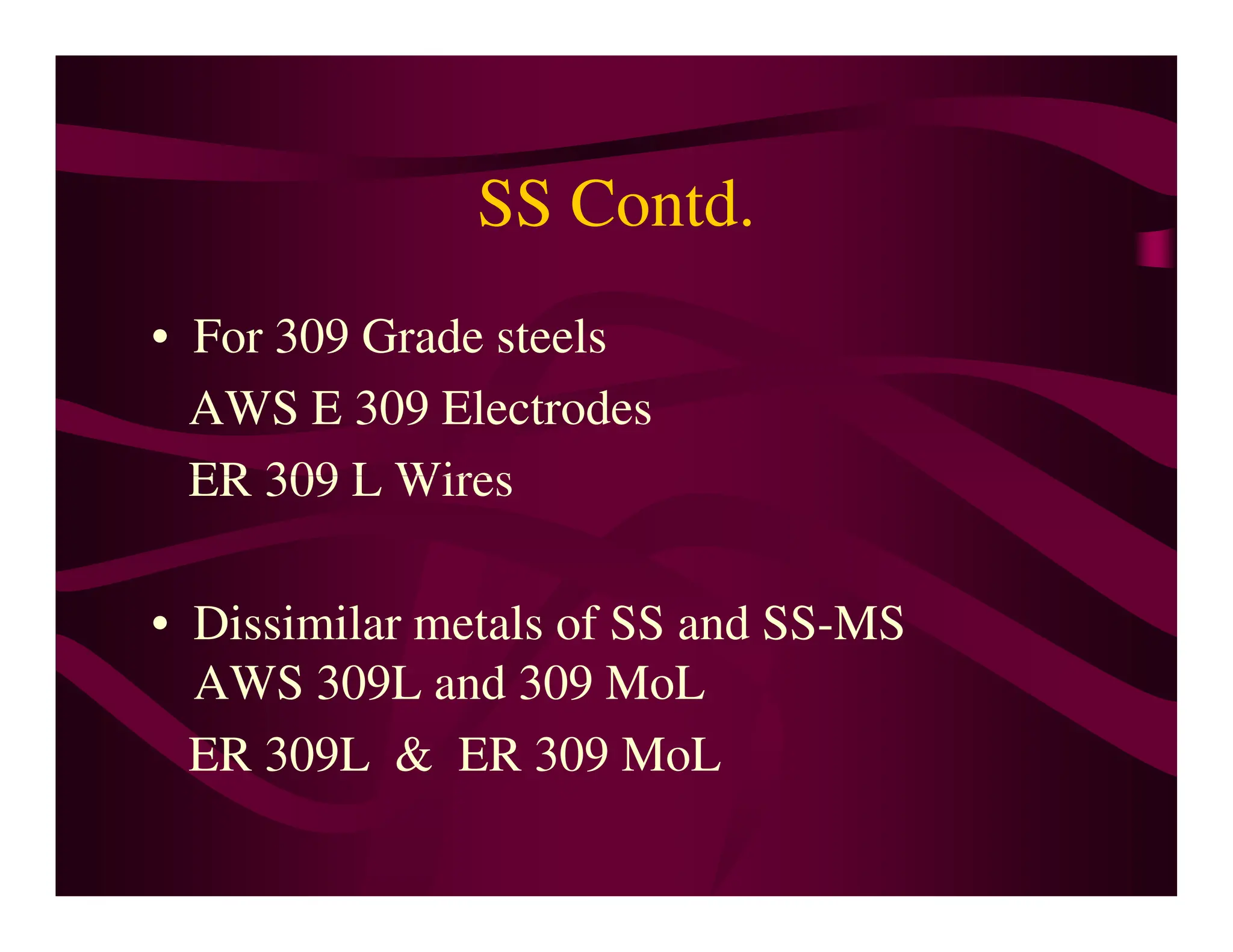
SS Contd.
• For 309 Grade steels
AWS E 309 Electrodes
ER 309 L Wires
ER 309 L Wires
• Dissimilar metals of SS and SS-MS
AWS 309L and 309 MoL
ER 309L & ER 309 MoL
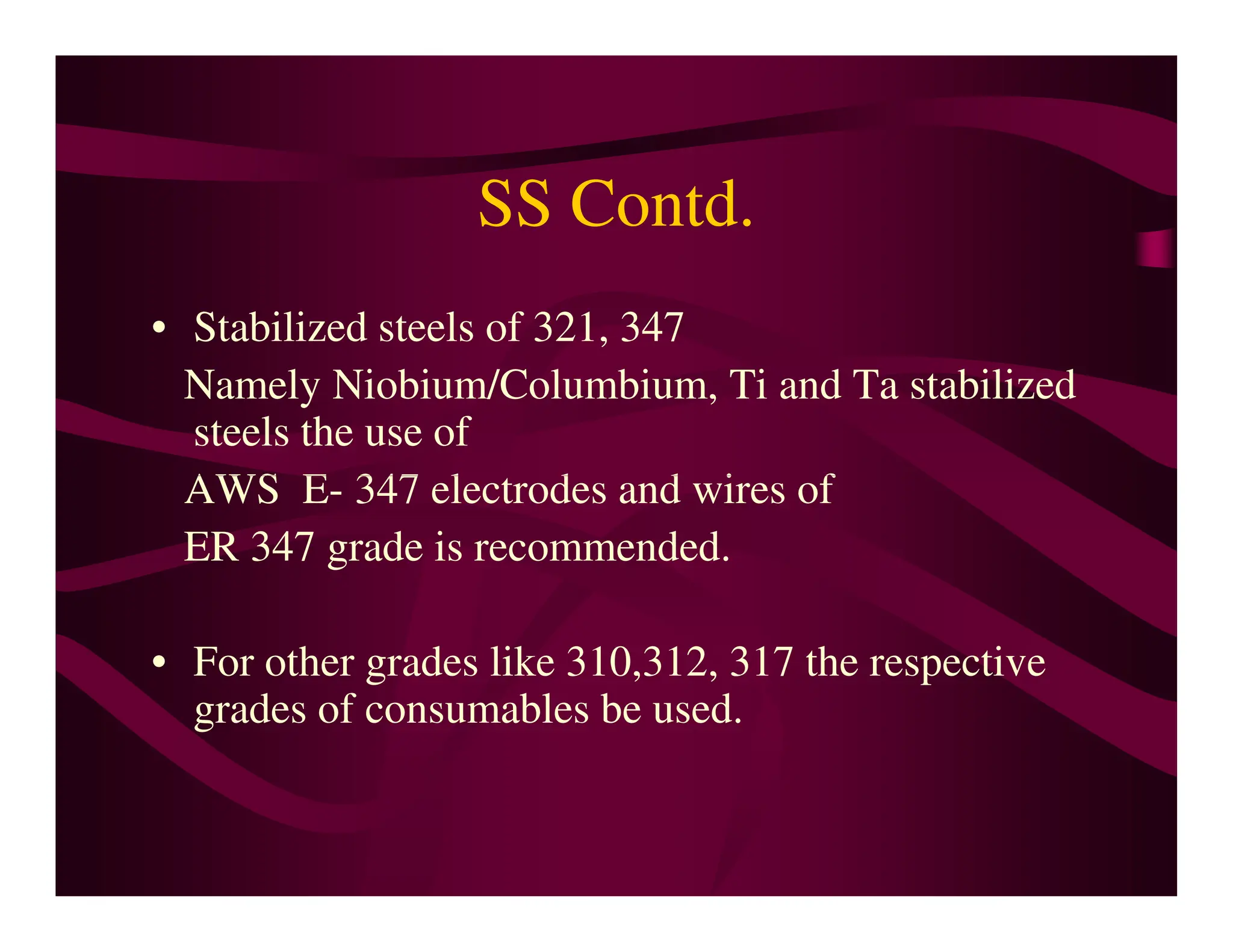
SS Contd.
• Stabilized steels of 321, 347
Namely Niobium/Columbium, Ti and Ta stabilized
steels the use of
AWS E- 347 electrodes and wires of
ER 347 grade is recommended.
• For other grades like 310,312, 317 the respective
grades of consumables be used.
Other metals
• Cast Iron
• Non-Ferrous Alloy:
Aluminium, Copper, Nickel, Magnesium
etc.
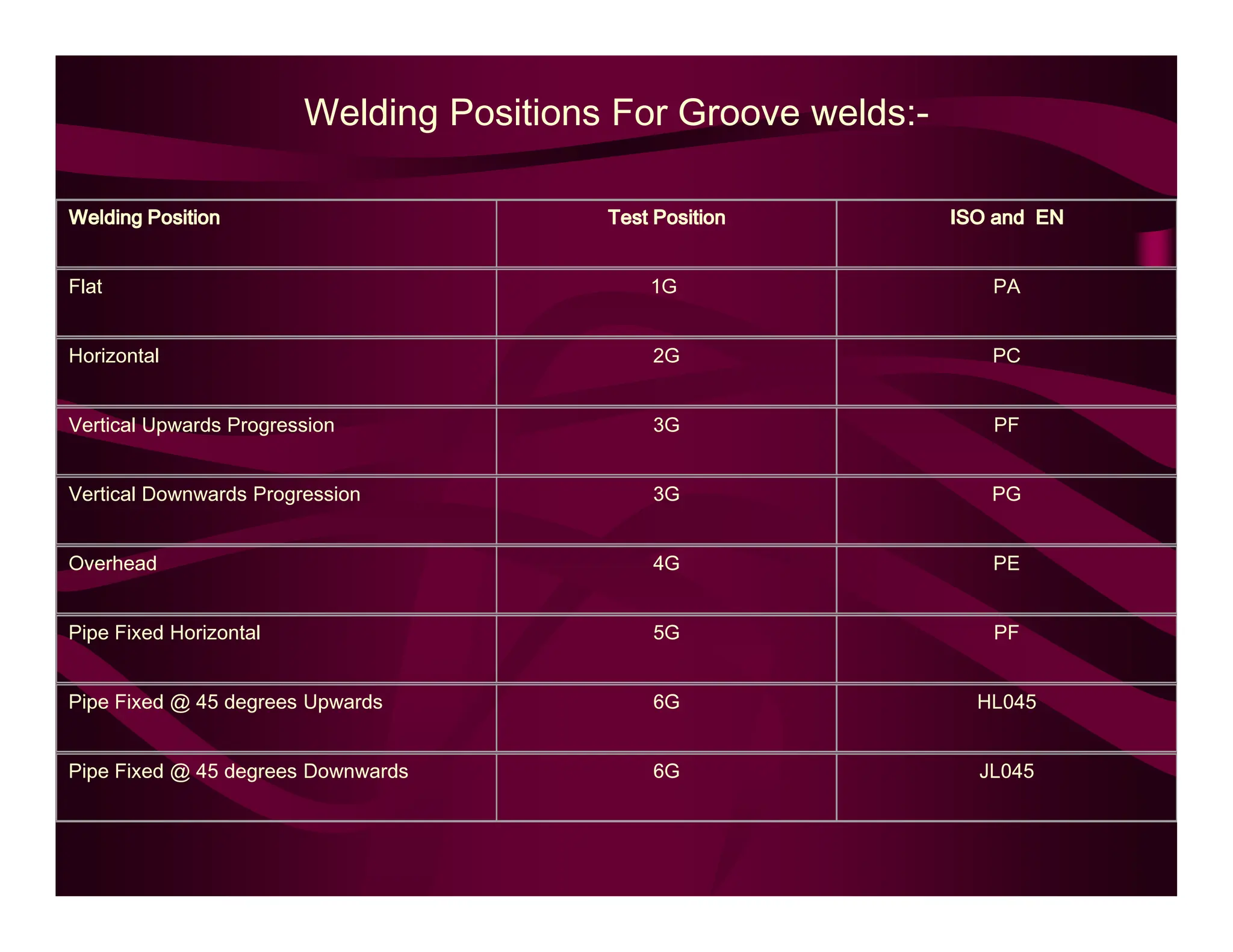
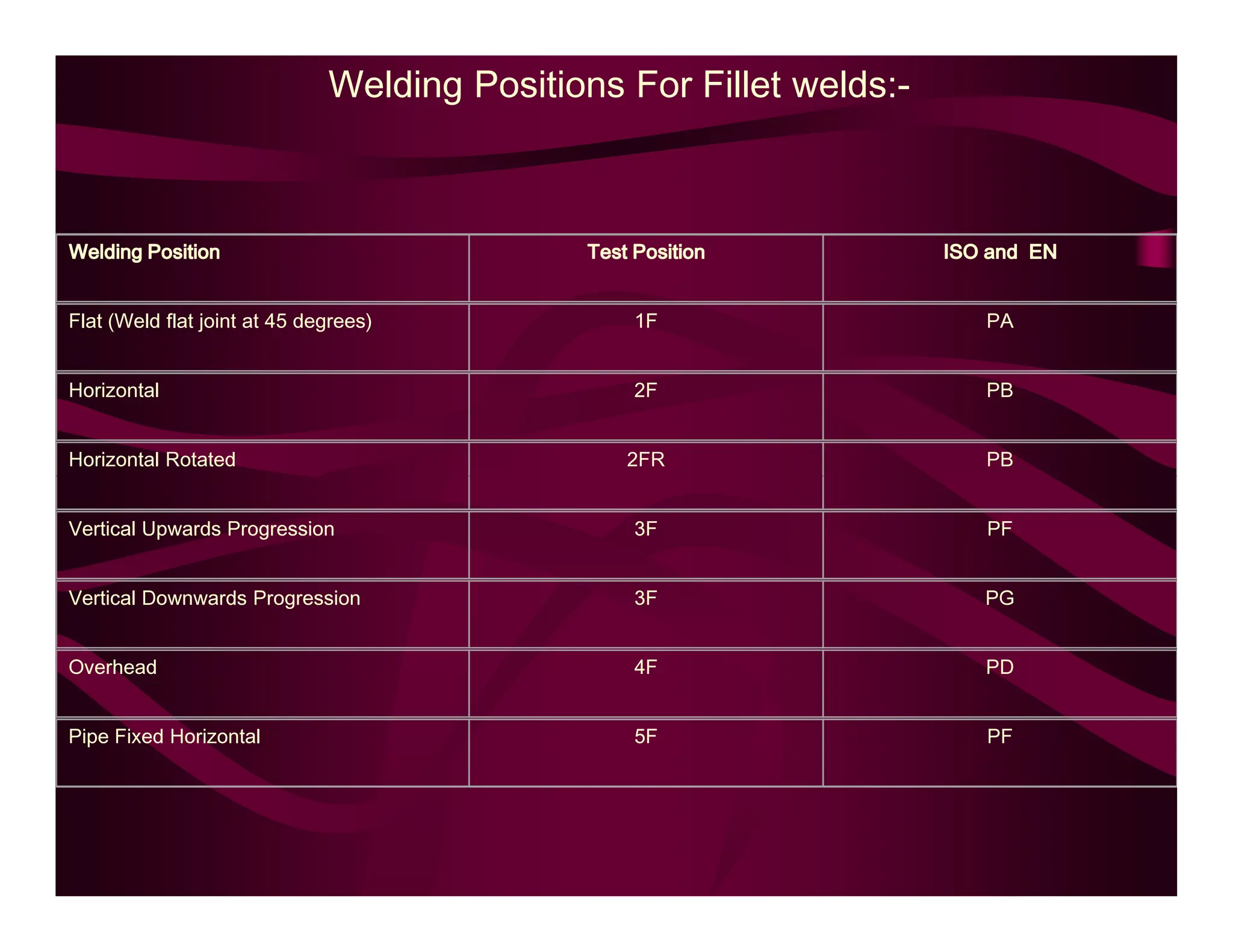
Welding Position
!
           #   
         $  #               %   ' #
         $  #                %  (  ' #
) *    +  ,    #        -    
     .
  /    /  .


           #
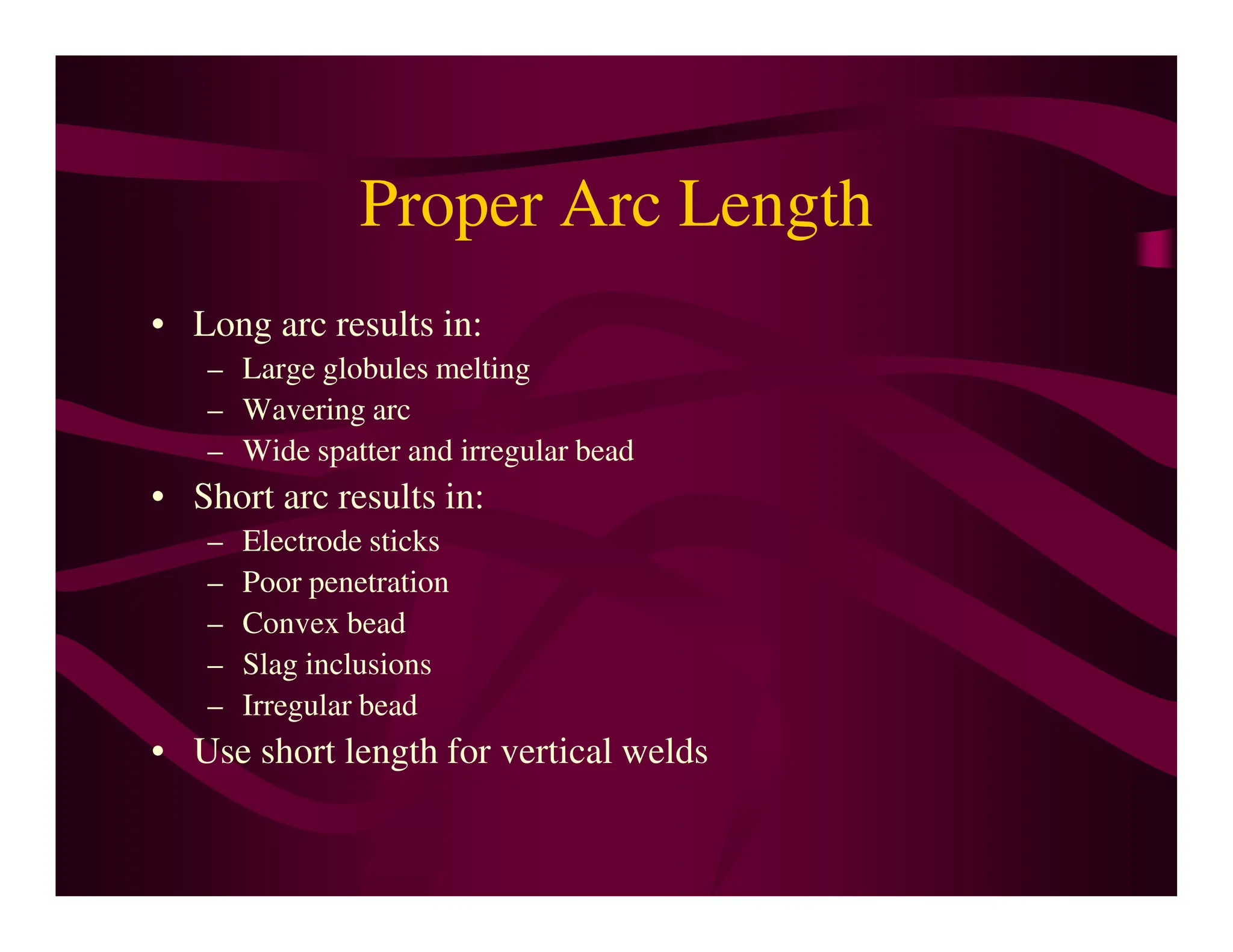
Proper Arc Length
• Long arc results in:
– Large globules melting
– Wavering arc
– Wide spatter and irregular bead
• Short arc results in:
– Electrode sticks
– Poor penetration
– Convex bead
– Slag inclusions
– Irregular bead
• Use short length for vertical welds
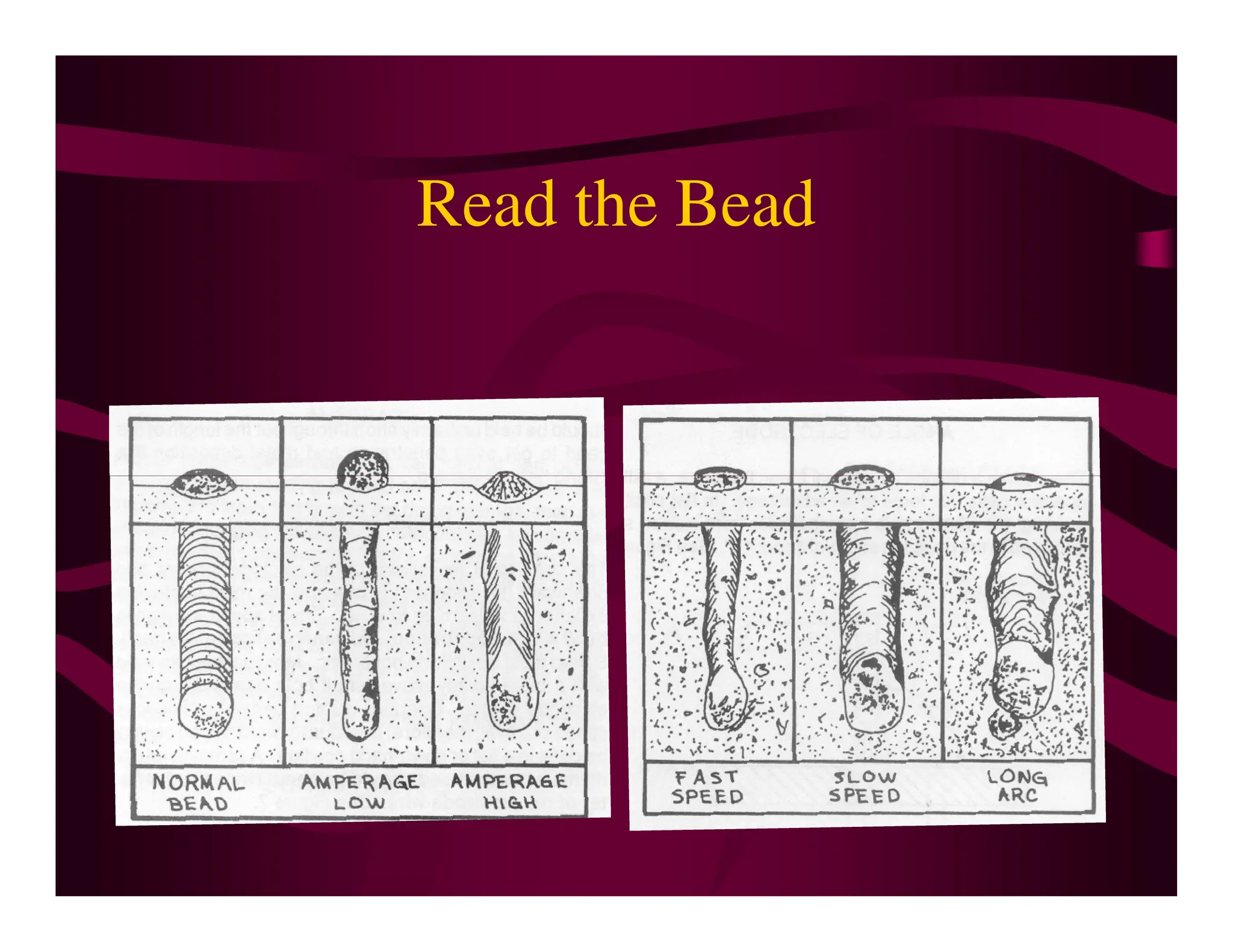
Speed of Travel
• Travel speed influences:
– Bead width
– Penetration
– General shape of the bead
• Use a uniform speed
• Both hands on the electrode holder
– Operator comfort
• Bead should be about twice the diameter of the
electrode wire
Read the Bead
WELDING EQUIPMENT
WELDING EQUIPMENT
TYPES OF EQUIPMENTS
Standard Type of welding Equipments
• Arc Welding Transformers
• D.C. Rectifiers
• D.C. Rectifiers
• Thyristor controlled Welding Rectifiers
• Welding Invertors
• TIG Welding Equipments
• MIG/MAG Welding machines
• Sub Merged Arc Welding machines
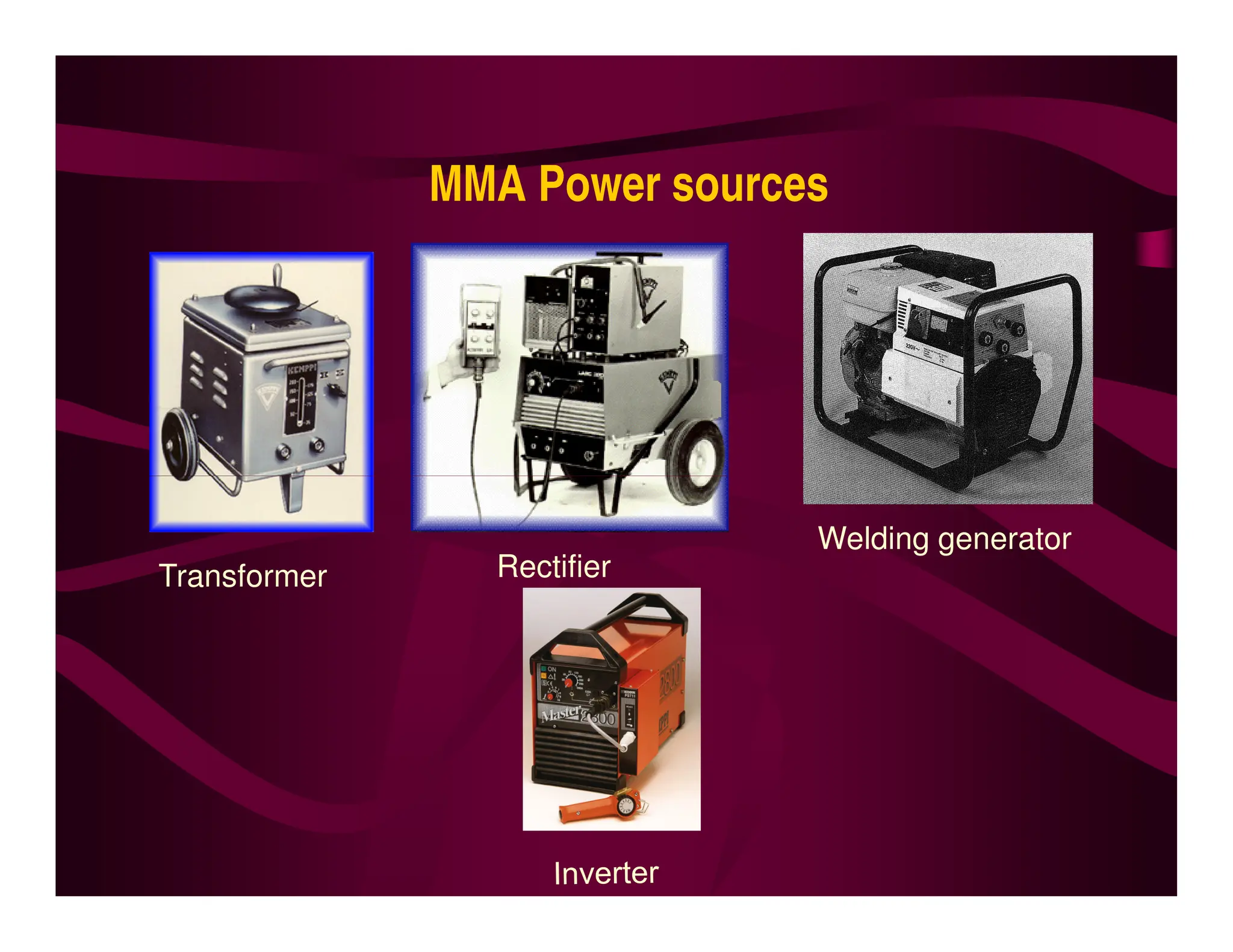
MMA Power sources
Transformer Rectifier
Welding generator
category of MIG Welding
• Pulsed MIG Welding Machines,
• Inverter based MIG Welding Machines
• Synergic Pulsed MIG Welding Machines
• Surface Tension Transfer Machines (STT)
Cont…
Under TIG Welding category we can have
• DC Pulsed welding machines
• AC/ DC TIG welding machines
• AC Square wave pulsing machines
Advanced Welding Machines:
Electron Beam Welding machines
Narrow Gap welding machines
Laser cutting and welding
Plasma Welding
Selection of the correct equipment
• Selection of the right type of equipment is
important to get the desired welding properties.
• The selection decides the feasibility of the use of
the process.
the process.
• The selection should be based on the availability
of the equipment,
• The acceptance of the process
• The convenience of the operation.
Welding Defects
TYPE OF DEFECTS
• Lack of fusion
• Lack of Penetration
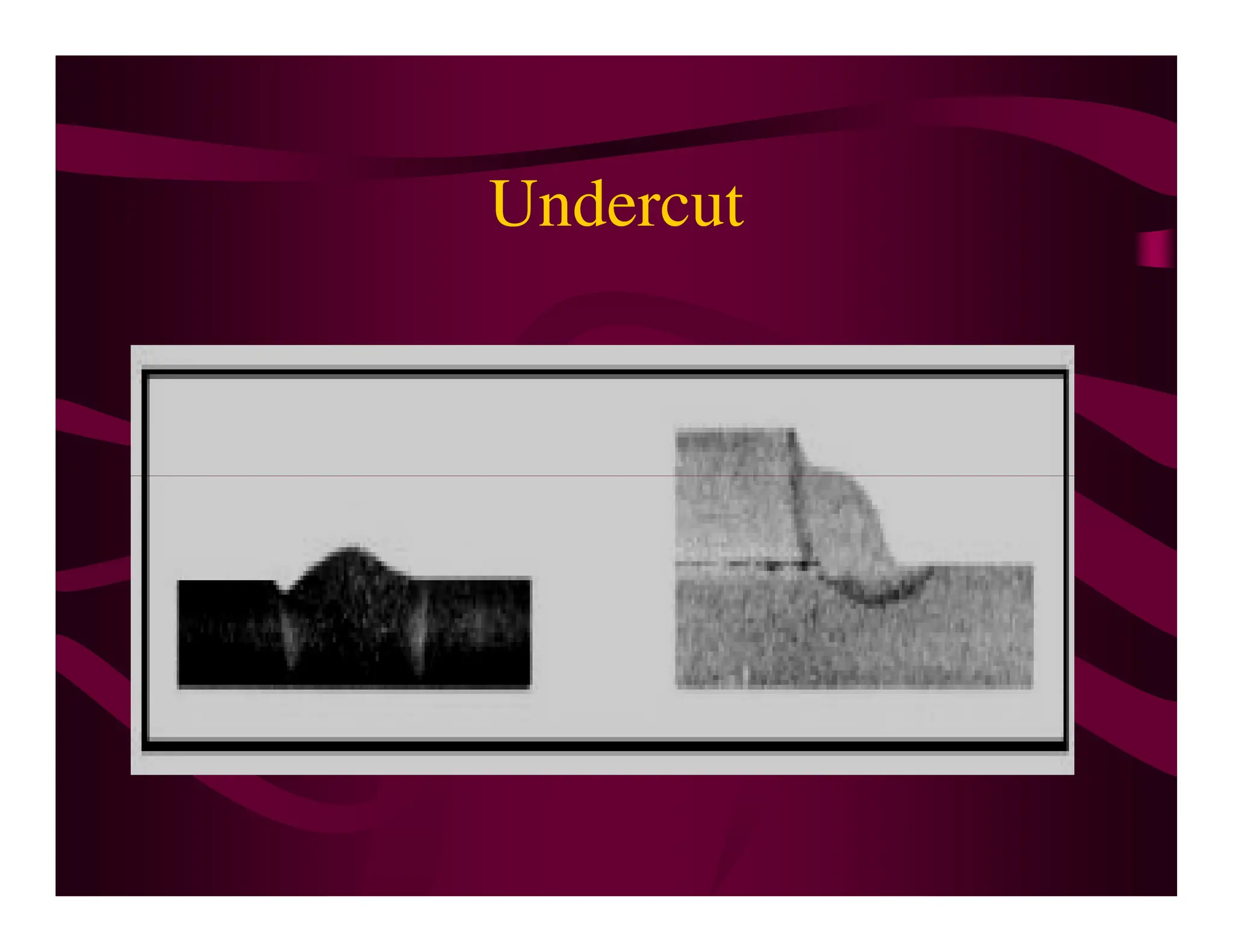
• Undercut
• Undercut
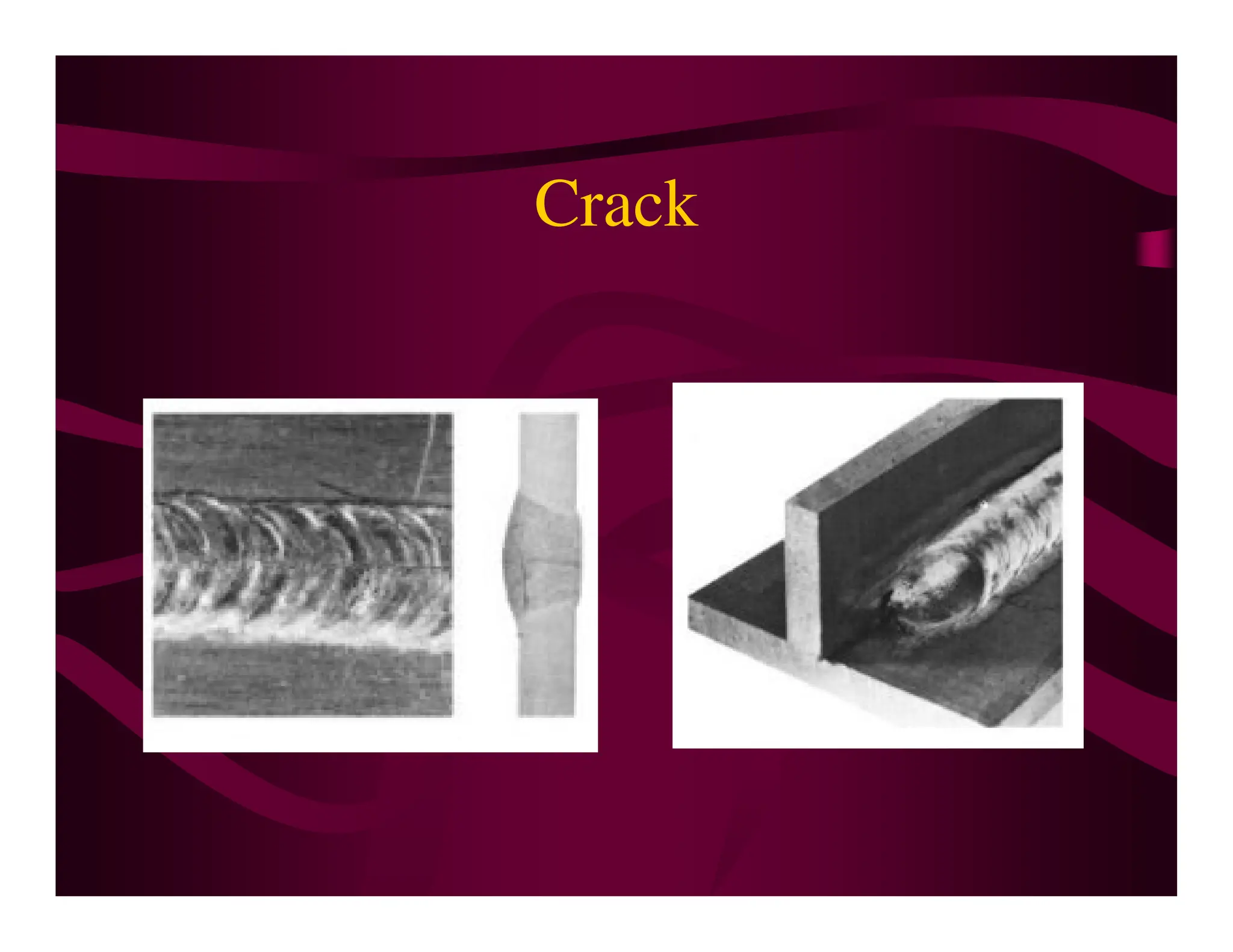
• Crack
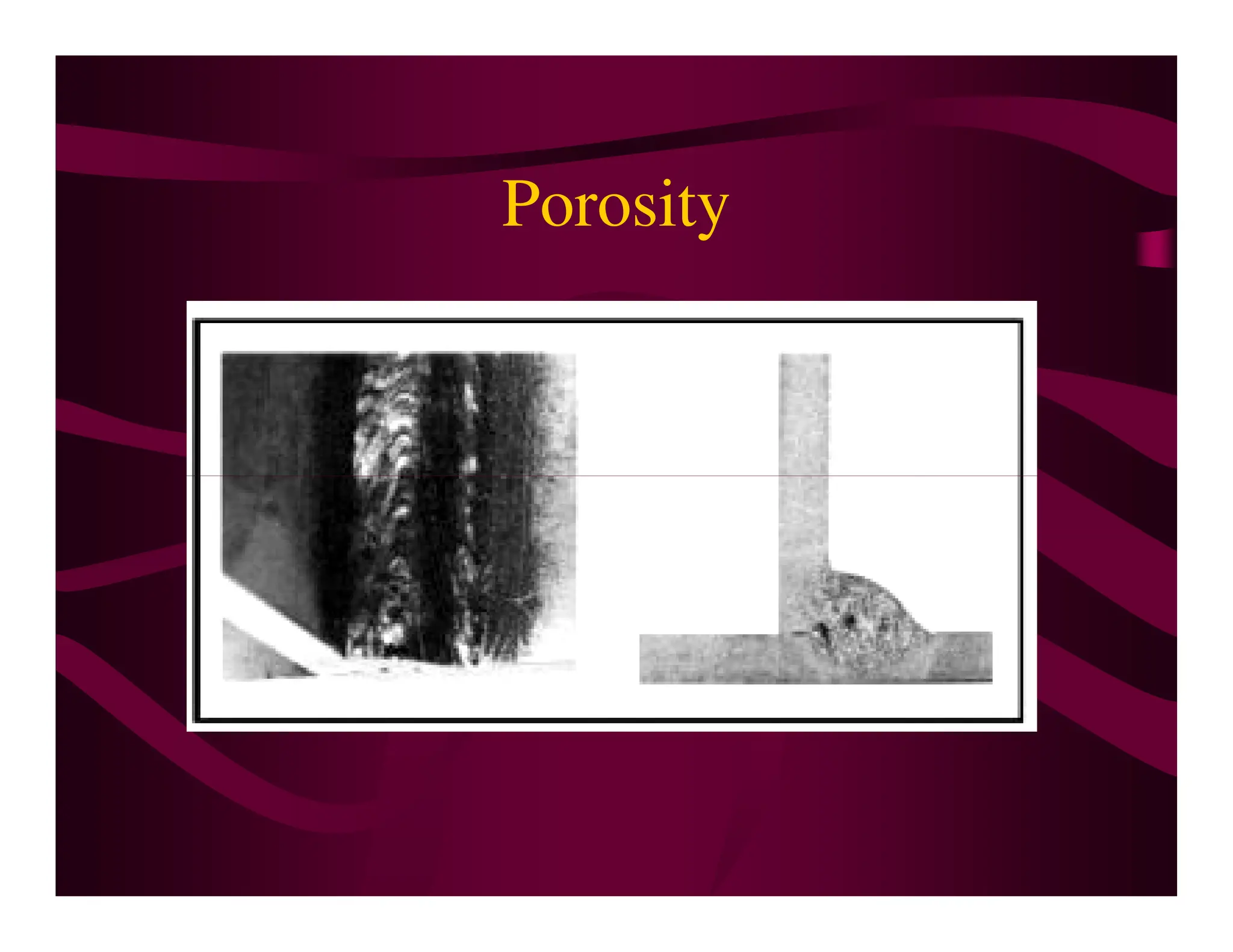
• Porosity
• Slag inclusion
Lack of Penetration
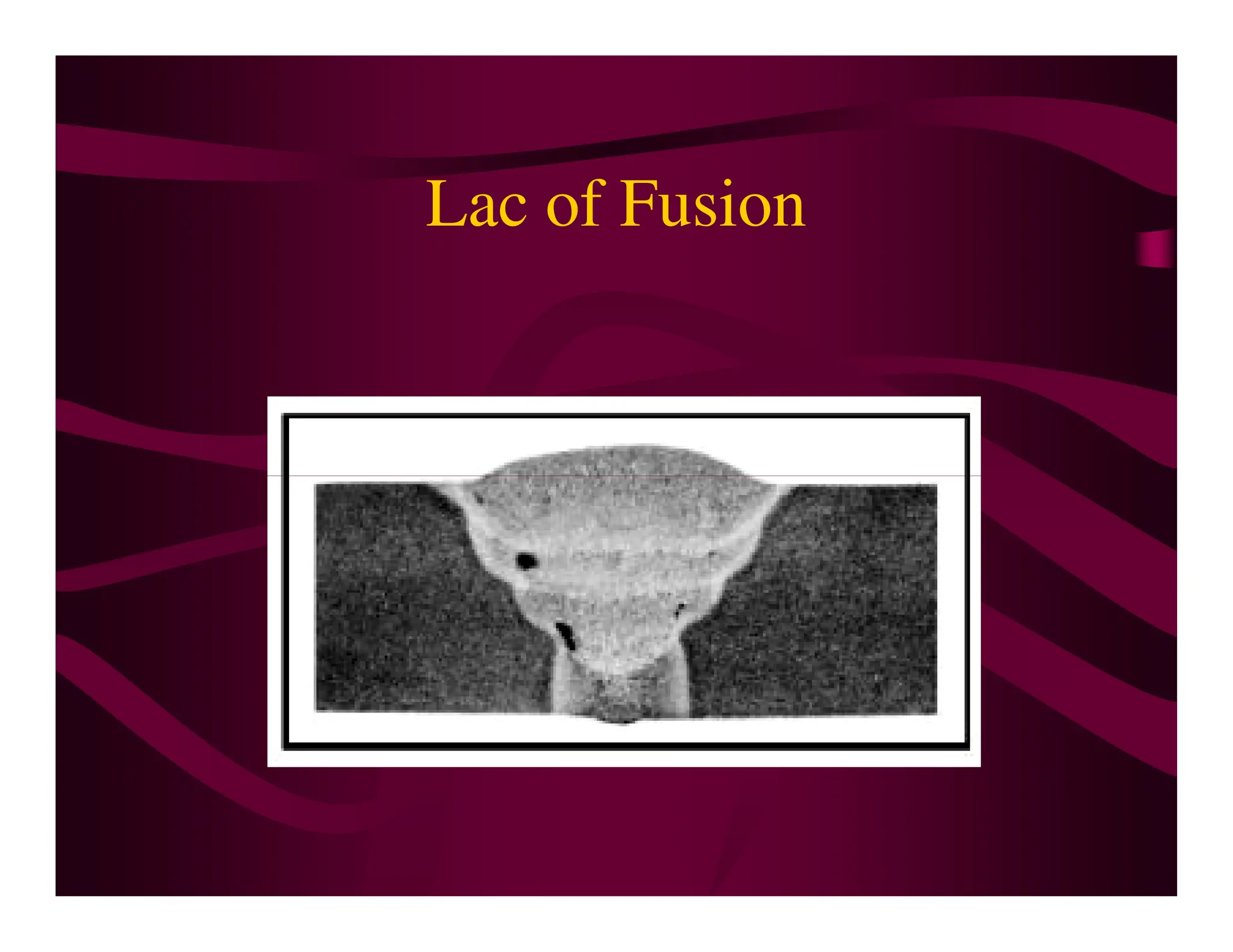
Lac of Fusion
Undercut
Porosity
Crack
ITS CAUSES AND REMIDIES
• Re-drying of Consumables/ Proper Storage
• Base metal Cleaning.
• Flow rate of Shielding GAS
• Welding Parameter.
• Use of correct welding consumables.

!
THANK YOU
THANK YOU

Learning of basic welding for beginner and expert

  • 2.
    Topics covered • WELDINGPROCESSES. • WELDING CONSUMABLES • WELDING EQUIPMENTS • WELDING EQUIPMENTS • WELDING PROCEDURE • WELDING DEFECTS ITS CAUSES AND REMIDIES • SAFETY
  • 3.
  • 4.
    Types Of Welding Welding GasWelding Arc Welding
  • 5.
    Normal practiced process ManualMetal Arc Welding MMAW Gas Tungsten Arc Welding GTAW Gas Metal Arc Welding GMAW Gas Metal Arc Welding GMAW Flux Cored Arc Welding FCAW Sub Merged Arc Welding SAW
  • 6.
    WELDING PROCESS • Thepresent process of welding used to manufacture various components generally are as follows • MMAW- Manual Metal Arc Welding Process • MMAW- Manual Metal Arc Welding Process • GMAW- Gas Metal Arc Welding process • GTAW - Gas Tungsten Arc Welding • FCAW- Flux Cored Arc Welding • SAW- Submerged Arc Welding
  • 7.
  • 8.
  • 9.
  • 10.
  • 11.
  • 12.
    Advanced process • NarrowGap Welding • Laser Beam Welding • Electron Beam Welding • Friction Stir Welding • Friction Stir Welding • Plasma Welding • Plasma Transfer Arc Technique (PTA) • Robotic Welding • Orbital Welding
  • 13.
    Selection of Weldingprocess • Type of Base Material • The Joint Design • The place of welding • The place of welding • Welding Position • Type of consumables availability • The skill availability of personnel • The types of equipment availability
  • 14.
  • 15.
    RECOMMEDATIONS The selection ofthe correct welding consumables depends on the following parameters • Base materials composition • The weld ability of the steel • The weld ability of the steel • Selection of the welding consumables as per ASME section-II- C • Acceptance of AWS or any other standards depends on the clients requirements.
  • 16.
    WELDING CONSUMABLES • TheWelding consumables like the welding electrodes and filler wires that are required and are recommended are as follows • E-6013 Welding Electrodes for Welding in MMAW process for Carbon steel, Mild steel, For the general purpose welding applications up to thickness 18 mm or 3/4th inch. • For thickness over the above mentioned must be welded with Low Hydrogen electrodes as per AWS E 7018 or E7018-1 Type of welding consumables.
  • 17.
    Welding consumables forvarious steels. • General Mild steel Up to 18mm AWS 6013 class welding electrodes, ER 70 SG Filler wires in case of GTAW & ER 70 SG Filler wires in case of GTAW & ER 70 S-6 in case of GMAW process. • General Mild steel Above 18mm AWS 7018class ER 70 S2 & ER 70 S-6
  • 18.
    Selection contd. • ForRadiography joints The following grades consumables are mandatory. mandatory. • AWS E6013 & E7018 classified Electrodes • ER 70 S2 TIG welding filler wires • ER 70 S-6 MIG Welding continuous filler wires.
  • 19.
    Consumables- gases • ER–70 S-6 Solid wire for welding the GMAW (MAG) welding process • ER 70-S-2 TIG filler applications incase of • ER 70-S-2 TIG filler applications incase of carbon steel welding . • The use of 100 % CO2 gas for MAG welding and 100 % pure Argon gas for TIG welding applications are the main criteria.
  • 20.
    Alloy steels AWS classof low alloy electrodes & wires
  • 21.
    Consumables- LAS • Inthe case of use of Low alloy steels where C, Mo, Cr and other alloys are involved the C, Mo, Cr and other alloys are involved the creep properties are important and hence the matching composition of the weld metals are mandatory
  • 22.
    Consumables –S.S. • Weldingof Stainless steels like commonly used steels such as 304, 304L, 308L, 309, 316. and other categories such as 310, 321, 316. and other categories such as 310, 321, 347, Duplex, Super Duplex Steels, the respective grade of Electrodes and the Filler wires to be used with proper shielding gases.
  • 23.
    Stainless steel • 301,304,308Class AWS E 308 & 308 L grades Electrodes and ER 308 L TIG/ MIG welding wires. and ER 308 L TIG/ MIG welding wires. • 316 and 316 L -AWS E- 316 & 316 L -ER 316 L TIG and MIG fillers
  • 24.
    SS Contd. • For309 Grade steels AWS E 309 Electrodes ER 309 L Wires ER 309 L Wires • Dissimilar metals of SS and SS-MS AWS 309L and 309 MoL ER 309L & ER 309 MoL
  • 25.
    SS Contd. • Stabilizedsteels of 321, 347 Namely Niobium/Columbium, Ti and Ta stabilized steels the use of AWS E- 347 electrodes and wires of AWS E- 347 electrodes and wires of ER 347 grade is recommended. • For other grades like 310,312, 317 the respective grades of consumables be used.
  • 26.
    Other metals • CastIron • Non-Ferrous Alloy: • Non-Ferrous Alloy: Aluminium, Copper, Nickel, Magnesium etc.
  • 27.
  • 28.
    ! # $ # % ' # $ # % ( ' #
  • 29.
    ) * + , # - . / / . #
  • 30.
    Proper Arc Length •Long arc results in: – Large globules melting – Wavering arc – Wide spatter and irregular bead • Short arc results in: • Short arc results in: – Electrode sticks – Poor penetration – Convex bead – Slag inclusions – Irregular bead • Use short length for vertical welds
  • 31.
    Speed of Travel •Travel speed influences: – Bead width – Penetration – General shape of the bead – General shape of the bead • Use a uniform speed • Both hands on the electrode holder – Operator comfort • Bead should be about twice the diameter of the electrode wire
  • 32.
  • 33.
  • 34.
    TYPES OF EQUIPMENTS StandardType of welding Equipments • Arc Welding Transformers • D.C. Rectifiers • D.C. Rectifiers • Thyristor controlled Welding Rectifiers • Welding Invertors • TIG Welding Equipments • MIG/MAG Welding machines • Sub Merged Arc Welding machines
  • 35.
    MMA Power sources TransformerRectifier Welding generator
  • 36.
    category of MIGWelding • Pulsed MIG Welding Machines, • Inverter based MIG Welding Machines • Synergic Pulsed MIG Welding Machines • Synergic Pulsed MIG Welding Machines • Surface Tension Transfer Machines (STT)
  • 37.
    Cont… Under TIG Weldingcategory we can have • DC Pulsed welding machines • AC/ DC TIG welding machines • AC/ DC TIG welding machines • AC Square wave pulsing machines
  • 38.
    Advanced Welding Machines: ElectronBeam Welding machines Narrow Gap welding machines Narrow Gap welding machines Laser cutting and welding Plasma Welding
  • 39.
    Selection of thecorrect equipment • Selection of the right type of equipment is important to get the desired welding properties. • The selection decides the feasibility of the use of the process. the process. • The selection should be based on the availability of the equipment, • The acceptance of the process • The convenience of the operation.
  • 40.
  • 41.
    TYPE OF DEFECTS •Lack of fusion • Lack of Penetration • Undercut • Undercut • Crack • Porosity • Slag inclusion
  • 42.
  • 43.
  • 44.
  • 45.
  • 46.
  • 47.
    ITS CAUSES ANDREMIDIES • Re-drying of Consumables/ Proper Storage • Base metal Cleaning. • Flow rate of Shielding GAS • Flow rate of Shielding GAS • Welding Parameter. • Use of correct welding consumables.
  • 48.
  • 49.