Selection Process of
Welding Electrodes
By: Prof. Mohit Teacher
Assistant Professor
Islamic University of Science and Technology,
Awantipora, J&K-192122.
Selection Process of Welding Electrodes
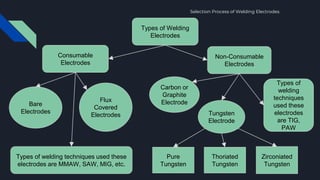
Types of Welding
Electrodes
Consumable
Electrodes
Non-Consumable
Electrodes
Types of welding techniques used these
electrodes are MMAW, SAW, MIG, etc.
Types of
welding
techniques
used these
electrodes
are TIG,
PAW
Bare
Electrodes
Flux
Covered
Electrodes
Carbon or
Graphite
Electrode
Tungsten
Electrode
Pure
Tungsten
Zirconiated
Tungsten
Thoriated
Tungsten
Selection Process of Welding Electrodes
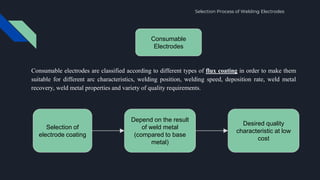
Consumable electrodes are classified according to different types of flux coating in order to make them
suitable for different arc characteristics, welding position, welding speed, deposition rate, weld metal
recovery, weld metal properties and variety of quality requirements.
Consumable
Electrodes
Selection of
electrode coating
Depend on the result
of weld metal
(compared to base
metal)
Desired quality
characteristic at low
cost
Selection Process of Welding
Electrodes
Flux Coating (Electrodes used in MMAW):
➔ Coating on electrode core wire is provided with various hydrocarbons, low ionization potential
elements, binders ( like Na and K silicates are invariably used ) etc to perform specific roles.
➔ To provide protective shielding gas environment to the arc zone and weld pool with the help of
inactive gases (like carbon dioxide) generated by thermal decomposition of constituents present in
coatings such as hydrocarbon, cellulose, charcoal, cotton, starch, wood flour.
➔ To remove impurities from the weld pool by forming slag as constituents present in coatings such as
titania, fluorspar, china-clay react with impurities and oxides in present weld pool.
➔ To deoxidize weld metal and clean the weld metal: Elements oxidized in the weld pool may act as
inclusions and deteriorate the performance of the weld joint. Therefore, metal oxides and other
impurities present in weld metal are removed by deoxidation and slag formation. For this purpose,
deoxidizers like Ferro-Mn, silicates of Mg and Al are frequently incorporated in the coating material.
➔ To increase viscosity of the molten metal and slag so as to reduce tendency of falling down of
molten weld metal in horizontal, overhead and vertical welding. This is done by adding constituents
like TiO2 and CaF2 in the coating material. These constituents increase the viscosity of the slag.
Selection Process of Welding Electrodes
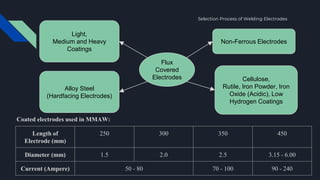
Flux
Covered
Electrodes
Light,
Medium and Heavy
Coatings
Cellulose,
Rutile, Iron Powder, Iron
Oxide (Acidic), Low
Hydrogen Coatings
Alloy Steel
(Hardfacing Electrodes)
Non-Ferrous Electrodes
Length of
Electrode (mm)
250 300 350 450
Diameter (mm) 1.5 2.0 2.5 3.15 - 6.00
Current (Ampere) 50 - 80 70 - 100 90 - 240
Coated electrodes used in MMAW:
Electrodes classification on the basis of coating constituents:
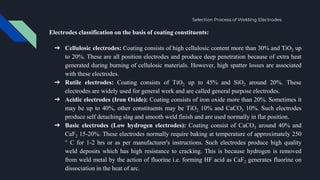
➔ Cellulosic electrodes: Coating consists of high cellulosic content more than 30% and TiO2 up
to 20%. These are all position electrodes and produce deep penetration because of extra heat
generated during burning of cellulosic materials. However, high spatter losses are associated
with these electrodes.
➔ Rutile electrodes: Coating consists of TiO2 up to 45% and SiO2 around 20%. These
electrodes are widely used for general work and are called general purpose electrodes.
➔ Acidic electrodes (Iron Oxide): Coating consists of iron oxide more than 20%. Sometimes it
may be up to 40%, other constituents may be TiO2 10% and CaCO3 10%. Such electrodes
produce self detaching slag and smooth weld finish and are used normally in flat position.
➔ Basic electrodes (Low hydrogen electrodes): Coating consist of CaCO3 around 40% and
CaF2 15-20%. These electrodes normally require baking at temperature of approximately 250
° C for 1-2 hrs or as per manufacturer's instructions. Such electrodes produce high quality
weld deposits which has high resistance to cracking. This is because hydrogen is removed
from weld metal by the action of fluorine i.e. forming HF acid as CaF2 generates fluorine on
dissociation in the heat of arc.
Selection Process of Welding Electrodes
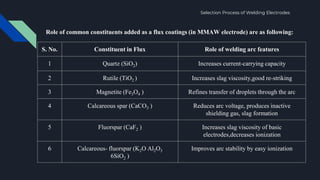
Role of common constituents added as a flux coatings (in MMAW electrode) are as following:
S. No. Constituent in Flux Role of welding arc features
1 Quartz (SiO2) Increases current-carrying capacity
2 Rutile (TiO2 ) Increases slag viscosity,good re-striking
3 Magnetite (Fe3O4 ) Refines transfer of droplets through the arc
4 Calcareous spar (CaCO3 ) Reduces arc voltage, produces inactive
shielding gas, slag formation
5 Fluorspar (CaF2 ) Increases slag viscosity of basic
electrodes,decreases ionization
6 Calcareous- fluorspar (K2O Al2O3
6SiO2 )
Improves arc stability by easy ionization
Selection Process of Welding Electrodes
Continue..
.
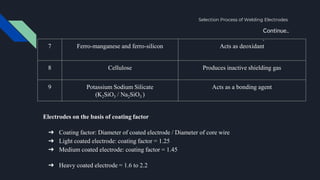
7 Ferro-manganese and ferro-silicon Acts as deoxidant
8 Cellulose Produces inactive shielding gas
9 Potassium Sodium Silicate
(K2SiO3 / Na2SiO3 )
Acts as a bonding agent
Electrodes on the basis of coating factor
➔ Coating factor: Diameter of coated electrode / Diameter of core wire
➔ Light coated electrode: coating factor = 1.25
➔ Medium coated electrode: coating factor = 1.45
➔ Heavy coated electrode = 1.6 to 2.2
Selection Process of Welding Electrodes
Designation of Coated Electrodes:
First two digits of four digit numbers and the first three digits of five digit numbers indicate
minimum tensile strength:
➔ E60XX, 60,000 psi minimum tensile strength
➔ E70XX, 70,000 psi minimum tensile strength
➔ E110XX, 110,000 psi minimum tensile strength
Third digit indicates position:
➔ EXX1X, All position
➔ EXX2X, Flat positions and horizontal fillets
Last two digit (including third) indicates type of coating and current
Fig. 1. Designations [3]
Selection Process of Welding Electrodes
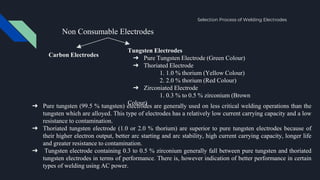
Non Consumable Electrodes
Carbon Electrodes
Tungsten Electrodes
➔ Pure Tungsten Electrode (Green Colour)
➔ Thoriated Electrode
1. 1.0 % thorium (Yellow Colour)
2. 2.0 % thorium (Red Colour)
➔ Zirconiated Electrode
1. 0.3 % to 0.5 % zirconium (Brown
Colour)
➔ Pure tungsten (99.5 % tungsten) electrodes are generally used on less critical welding operations than the
tungsten which are alloyed. This type of electrodes has a relatively low current carrying capacity and a low
resistance to contamination.
➔ Thoriated tungsten electrode (1.0 or 2.0 % thorium) are superior to pure tungsten electrodes because of
their higher electron output, better arc starting and arc stability, high current carrying capacity, longer life
and greater resistance to contamination.
➔ Tungsten electrode containing 0.3 to 0.5 % zirconium generally fall between pure tungsten and thoriated
tungsten electrodes in terms of performance. There is, however indication of better performance in certain
types of welding using AC power.
Selection Process of Welding Electrodes
THANKS FOR YOUR ATTENTION!

Selection process of welding electrodes

  • 1.
    Selection Process of WeldingElectrodes By: Prof. Mohit Teacher Assistant Professor Islamic University of Science and Technology, Awantipora, J&K-192122.
  • 2.
    Selection Process ofWelding Electrodes Types of Welding Electrodes Consumable Electrodes Non-Consumable Electrodes Types of welding techniques used these electrodes are MMAW, SAW, MIG, etc. Types of welding techniques used these electrodes are TIG, PAW Bare Electrodes Flux Covered Electrodes Carbon or Graphite Electrode Tungsten Electrode Pure Tungsten Zirconiated Tungsten Thoriated Tungsten
  • 3.
    Selection Process ofWelding Electrodes Consumable electrodes are classified according to different types of flux coating in order to make them suitable for different arc characteristics, welding position, welding speed, deposition rate, weld metal recovery, weld metal properties and variety of quality requirements. Consumable Electrodes Selection of electrode coating Depend on the result of weld metal (compared to base metal) Desired quality characteristic at low cost
  • 4.
    Selection Process ofWelding Electrodes Flux Coating (Electrodes used in MMAW): ➔ Coating on electrode core wire is provided with various hydrocarbons, low ionization potential elements, binders ( like Na and K silicates are invariably used ) etc to perform specific roles. ➔ To provide protective shielding gas environment to the arc zone and weld pool with the help of inactive gases (like carbon dioxide) generated by thermal decomposition of constituents present in coatings such as hydrocarbon, cellulose, charcoal, cotton, starch, wood flour. ➔ To remove impurities from the weld pool by forming slag as constituents present in coatings such as titania, fluorspar, china-clay react with impurities and oxides in present weld pool. ➔ To deoxidize weld metal and clean the weld metal: Elements oxidized in the weld pool may act as inclusions and deteriorate the performance of the weld joint. Therefore, metal oxides and other impurities present in weld metal are removed by deoxidation and slag formation. For this purpose, deoxidizers like Ferro-Mn, silicates of Mg and Al are frequently incorporated in the coating material. ➔ To increase viscosity of the molten metal and slag so as to reduce tendency of falling down of molten weld metal in horizontal, overhead and vertical welding. This is done by adding constituents like TiO2 and CaF2 in the coating material. These constituents increase the viscosity of the slag.
  • 5.
    Selection Process ofWelding Electrodes Flux Covered Electrodes Light, Medium and Heavy Coatings Cellulose, Rutile, Iron Powder, Iron Oxide (Acidic), Low Hydrogen Coatings Alloy Steel (Hardfacing Electrodes) Non-Ferrous Electrodes Length of Electrode (mm) 250 300 350 450 Diameter (mm) 1.5 2.0 2.5 3.15 - 6.00 Current (Ampere) 50 - 80 70 - 100 90 - 240 Coated electrodes used in MMAW:
  • 6.
    Electrodes classification onthe basis of coating constituents: ➔ Cellulosic electrodes: Coating consists of high cellulosic content more than 30% and TiO2 up to 20%. These are all position electrodes and produce deep penetration because of extra heat generated during burning of cellulosic materials. However, high spatter losses are associated with these electrodes. ➔ Rutile electrodes: Coating consists of TiO2 up to 45% and SiO2 around 20%. These electrodes are widely used for general work and are called general purpose electrodes. ➔ Acidic electrodes (Iron Oxide): Coating consists of iron oxide more than 20%. Sometimes it may be up to 40%, other constituents may be TiO2 10% and CaCO3 10%. Such electrodes produce self detaching slag and smooth weld finish and are used normally in flat position. ➔ Basic electrodes (Low hydrogen electrodes): Coating consist of CaCO3 around 40% and CaF2 15-20%. These electrodes normally require baking at temperature of approximately 250 ° C for 1-2 hrs or as per manufacturer's instructions. Such electrodes produce high quality weld deposits which has high resistance to cracking. This is because hydrogen is removed from weld metal by the action of fluorine i.e. forming HF acid as CaF2 generates fluorine on dissociation in the heat of arc. Selection Process of Welding Electrodes
  • 7.
    Selection Process ofWelding Electrodes Role of common constituents added as a flux coatings (in MMAW electrode) are as following: S. No. Constituent in Flux Role of welding arc features 1 Quartz (SiO2) Increases current-carrying capacity 2 Rutile (TiO2 ) Increases slag viscosity,good re-striking 3 Magnetite (Fe3O4 ) Refines transfer of droplets through the arc 4 Calcareous spar (CaCO3 ) Reduces arc voltage, produces inactive shielding gas, slag formation 5 Fluorspar (CaF2 ) Increases slag viscosity of basic electrodes,decreases ionization 6 Calcareous- fluorspar (K2O Al2O3 6SiO2 ) Improves arc stability by easy ionization
  • 8.
    Selection Process ofWelding Electrodes Continue.. . 7 Ferro-manganese and ferro-silicon Acts as deoxidant 8 Cellulose Produces inactive shielding gas 9 Potassium Sodium Silicate (K2SiO3 / Na2SiO3 ) Acts as a bonding agent Electrodes on the basis of coating factor ➔ Coating factor: Diameter of coated electrode / Diameter of core wire ➔ Light coated electrode: coating factor = 1.25 ➔ Medium coated electrode: coating factor = 1.45 ➔ Heavy coated electrode = 1.6 to 2.2
  • 9.
    Selection Process ofWelding Electrodes Designation of Coated Electrodes: First two digits of four digit numbers and the first three digits of five digit numbers indicate minimum tensile strength: ➔ E60XX, 60,000 psi minimum tensile strength ➔ E70XX, 70,000 psi minimum tensile strength ➔ E110XX, 110,000 psi minimum tensile strength Third digit indicates position: ➔ EXX1X, All position ➔ EXX2X, Flat positions and horizontal fillets Last two digit (including third) indicates type of coating and current Fig. 1. Designations [3]
  • 10.
    Selection Process ofWelding Electrodes Non Consumable Electrodes Carbon Electrodes Tungsten Electrodes ➔ Pure Tungsten Electrode (Green Colour) ➔ Thoriated Electrode 1. 1.0 % thorium (Yellow Colour) 2. 2.0 % thorium (Red Colour) ➔ Zirconiated Electrode 1. 0.3 % to 0.5 % zirconium (Brown Colour) ➔ Pure tungsten (99.5 % tungsten) electrodes are generally used on less critical welding operations than the tungsten which are alloyed. This type of electrodes has a relatively low current carrying capacity and a low resistance to contamination. ➔ Thoriated tungsten electrode (1.0 or 2.0 % thorium) are superior to pure tungsten electrodes because of their higher electron output, better arc starting and arc stability, high current carrying capacity, longer life and greater resistance to contamination. ➔ Tungsten electrode containing 0.3 to 0.5 % zirconium generally fall between pure tungsten and thoriated tungsten electrodes in terms of performance. There is, however indication of better performance in certain types of welding using AC power.
  • 11.
    Selection Process ofWelding Electrodes THANKS FOR YOUR ATTENTION!