Faisal YusofCopyright © 2003 TWI Ltd
TE
Welding Inspection
Welding Processes
Course Reference WIS5
Faisal YusofCopyright © 2003 TWI Ltd
TE WeldingWelding
BS 499 part 1 Welding terms
A union between pieces of metal at faces
rendered plastic or liquid by heat,pressure or
both.
 Ultrasonic
 Electron beam
 Friction
 Electric resistance
 Electric arc
Possible energy sources
Faisal YusofCopyright © 2003 TWI Ltd
TE Welding Processes chartWelding Processes chart
Fusion
Welding
Solid state
Welding
Resistance
Welding
Pressure
Welding
Arc
Welding
Power Beam
Welding
Oxy fuel
Welding
Electroslag
Welding
Thermit
Welding
MIG,MAG,
FCAW
MMA TIG PAWSAW EBW LBW
Faisal YusofCopyright © 2003 TWI Ltd
TE Fusion Welding FactorsFusion Welding Factors
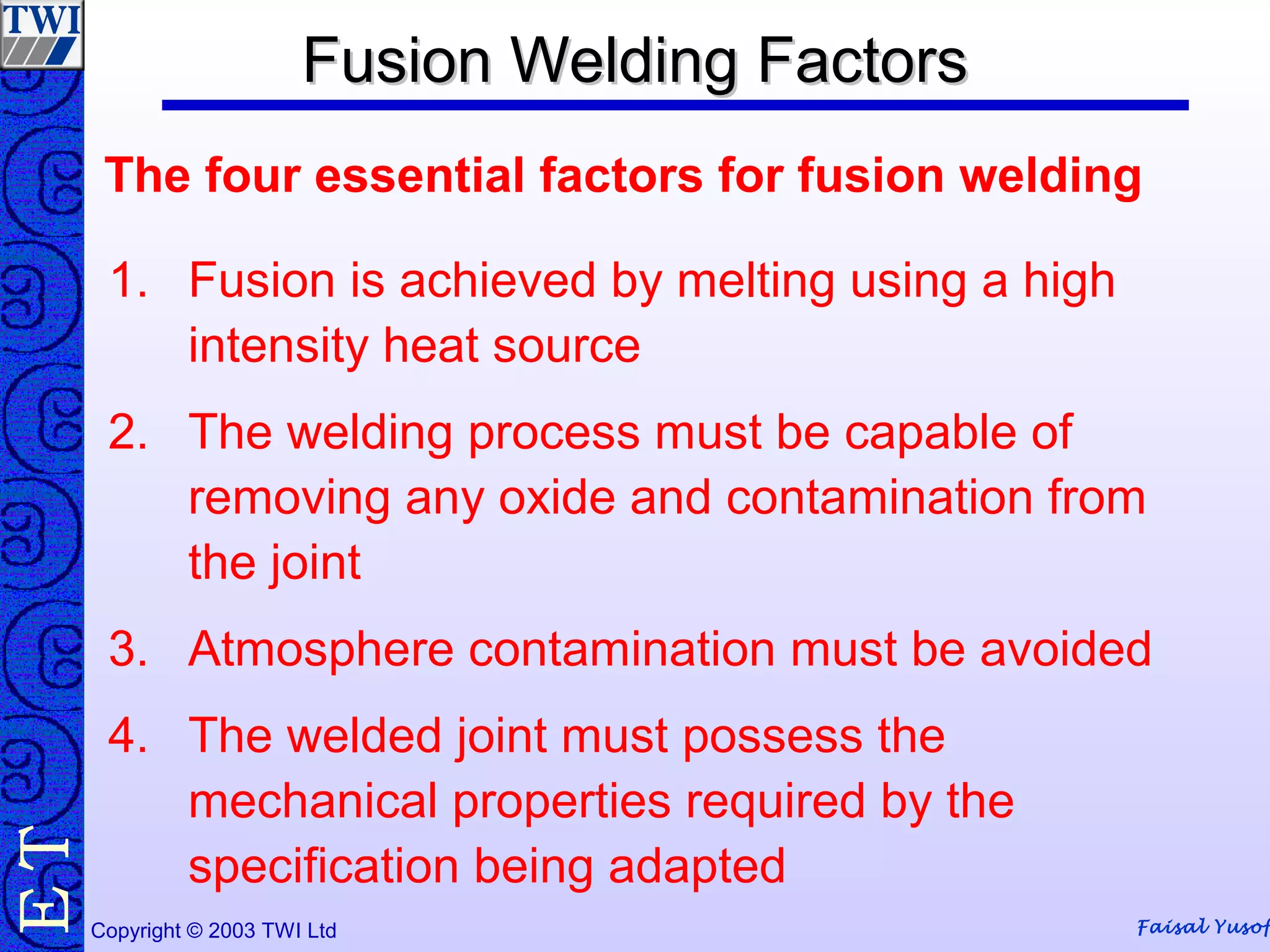
The four essential factors for fusion welding
1. Fusion is achieved by melting using a high
intensity heat source
2. The welding process must be capable of
removing any oxide and contamination from
the joint
3. Atmosphere contamination must be avoided
4. The welded joint must possess the
mechanical properties required by the
specification being adapted
Faisal YusofCopyright © 2003 TWI Ltd
TE
Before continuing with the welding processes section,
there are 2 safety related terms that should first be
understood
“Duty Cycle” relates to the current carrying capacity of
all conductors, based on a 10 minute cycle i.e. 60% duty
cycle means it can carry the specified current for 6
minutes in 10 then must rest for 4. A 100% duty cycle
has no rest period requirement. (Explained fully in the
WIS 5 course notes)
Arc Welding SafetyArc Welding Safety
Faisal YusofCopyright © 2003 TWI Ltd
TE
Welding ProcessesWelding Processes
Faisal YusofCopyright © 2003 TWI Ltd
TE Manual Metal Arc Process (MMA)Manual Metal Arc Process (MMA)
USA: SMAWUSA: SMAW
Faisal YusofCopyright © 2003 TWI Ltd
TE Manual Metal Arc Process (MMA)Manual Metal Arc Process (MMA)
Faisal YusofCopyright © 2003 TWI Ltd
TE Manual Metal Arc Process (MMA)Manual Metal Arc Process (MMA)
Welding position has a big affect on weld quality.
More welder skill is required to weld in the overhead position
(4G), when compared to down hand position (1G)
Faisal YusofCopyright © 2003 TWI Ltd
TE
In the down hand position (1G) the welder can drag the tip of
the electrode along the joint. In the case of vertical (3G) and
overhead welding (4G) the welder always gauges the arcs
length
Manual Metal Arc Process (MMA)Manual Metal Arc Process (MMA)
Faisal YusofCopyright © 2003 TWI Ltd
TE
Current (amps) primarily controls depth of penetration, the
higher the current the deeper the penetration. If the current is
too high this may lead to high spatter, undercut and the
possibility of burn through
Manual Metal Arc Process (MMA)Manual Metal Arc Process (MMA)
Faisal YusofCopyright © 2003 TWI Ltd
TE Manual Metal Arc Process (MMA)Manual Metal Arc Process (MMA)
Faisal YusofCopyright © 2003 TWI Ltd
TE
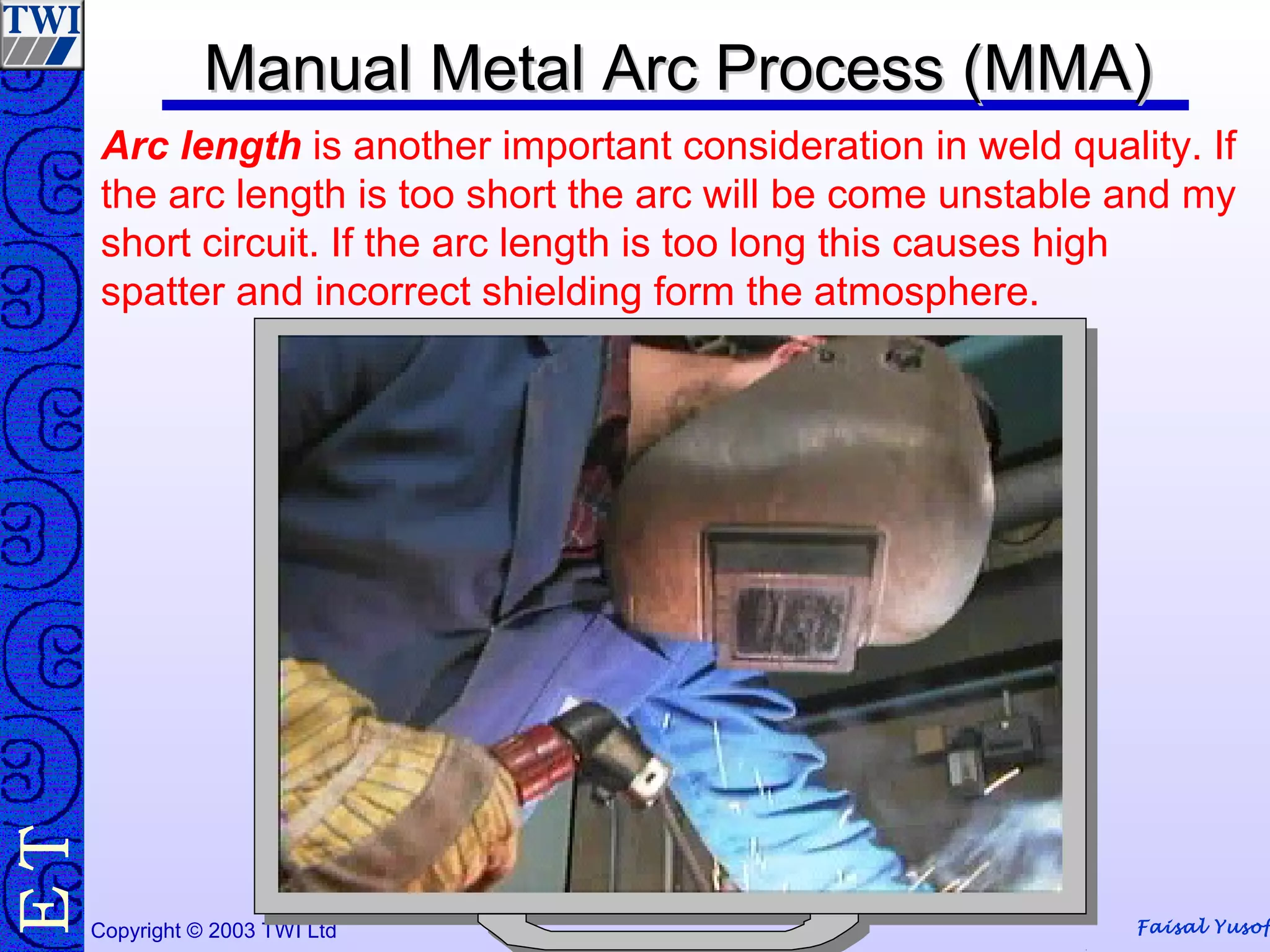
Arc length is another important consideration in weld quality. If
the arc length is too short the arc will be come unstable and my
short circuit. If the arc length is too long this causes high
spatter and incorrect shielding form the atmosphere.
Manual Metal Arc Process (MMA)Manual Metal Arc Process (MMA)
Faisal YusofCopyright © 2003 TWI Ltd
TE
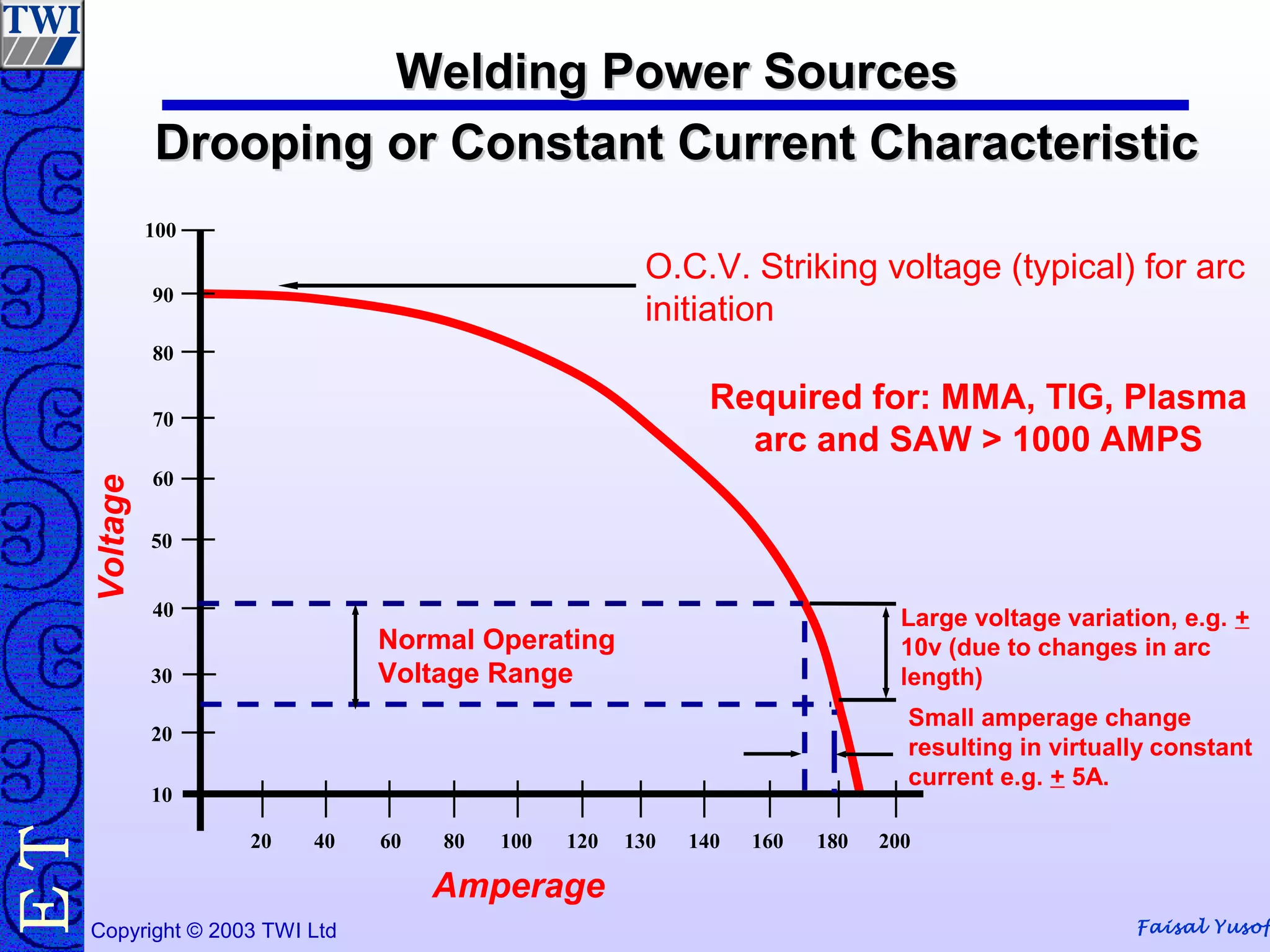
20 8040 60 130 140120100 180160 200
10
60
50
40
30
20
80
70
90
100
Normal Operating
Voltage Range
Large voltage variation, e.g. +
10v (due to changes in arc
length)
Small amperage change
resulting in virtually constant
current e.g. + 5A.
Voltage
Amperage
Required for: MMA, TIG, Plasma
arc and SAW > 1000 AMPS
O.C.V. Striking voltage (typical) for arc
initiation
Welding Power SourcesWelding Power Sources
Drooping or Constant Current CharacteristicDrooping or Constant Current Characteristic
Faisal YusofCopyright © 2003 TWI Ltd
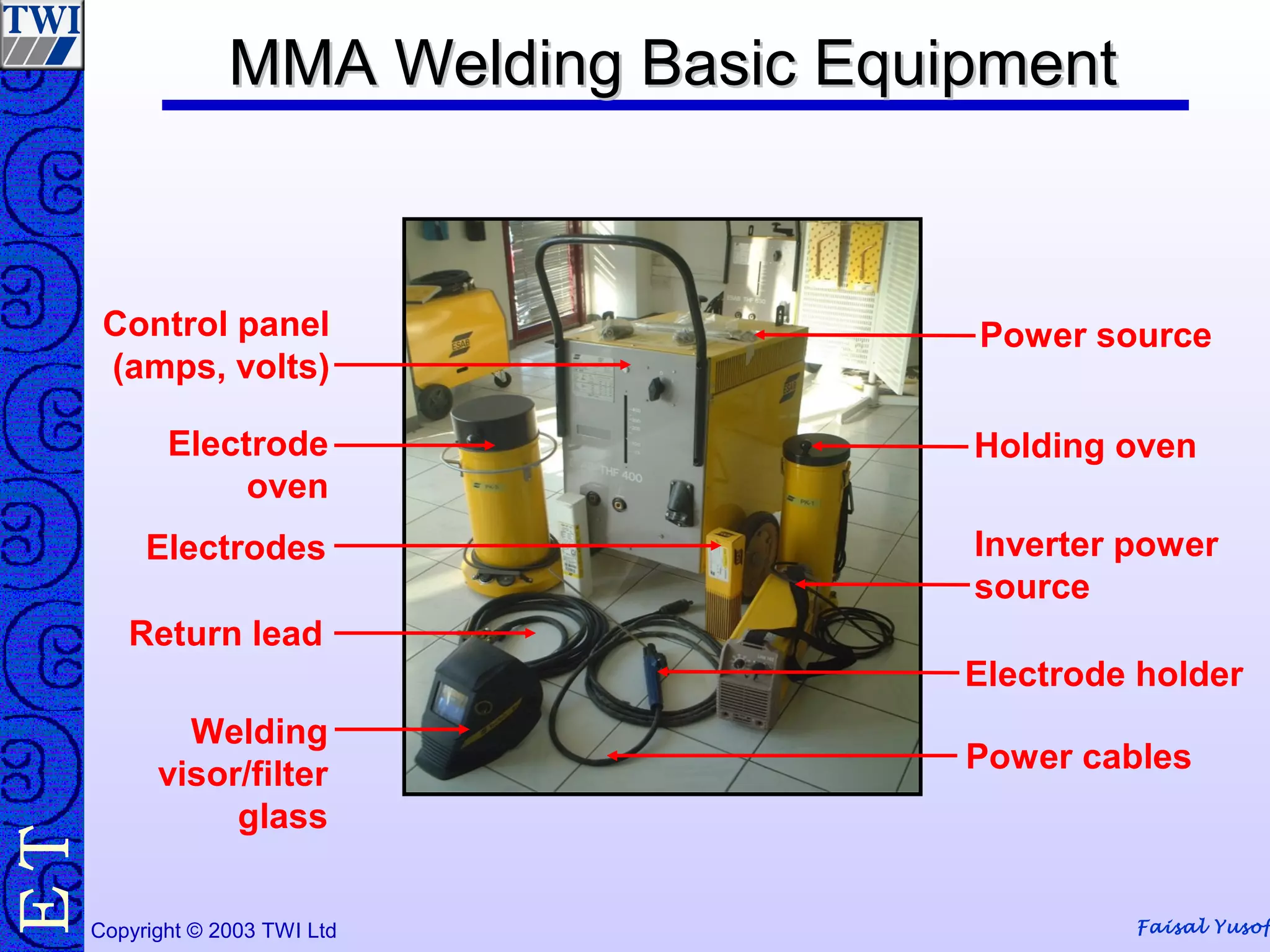
TE MMA Welding Basic EquipmentMMA Welding Basic Equipment
Power source
Holding oven
Inverter power
source
Electrode holder
Power cables
Welding
visor/filter
glass
Return lead
Electrodes
Electrode
oven
Control panel
(amps, volts)
Faisal YusofCopyright © 2003 TWI Ltd
TE
Welder controls
 Arc length
 Angle of electrode
 Speed of travel
Manual Metal Arc Process (MMA)Manual Metal Arc Process (MMA)
Faisal YusofCopyright © 2003 TWI Ltd
TE Welding PlantWelding Plant
 Transformer:Transformer:
Changes mains supply voltage to a voltage suitable for
welding. Has no moving parts and is often termed static plant.
 Rectifier:Rectifier:
Changes. AC to DC, can be mechanically or statically
achieved.
 Generator:Generator:
Produces welding current. The generator consists of an
armature rotating in a magnetic field, the armature must be
rotated at a constant speed either by a motor unit or, in the
absence of electrical power, by an internal combustion (sự
cháy) engine.
 Inverter:Inverter:
An inverter changes d.c. to a.c. at a higher frequency.
Faisal YusofCopyright © 2003 TWI Ltd
TE Variable ParametersVariable Parameters
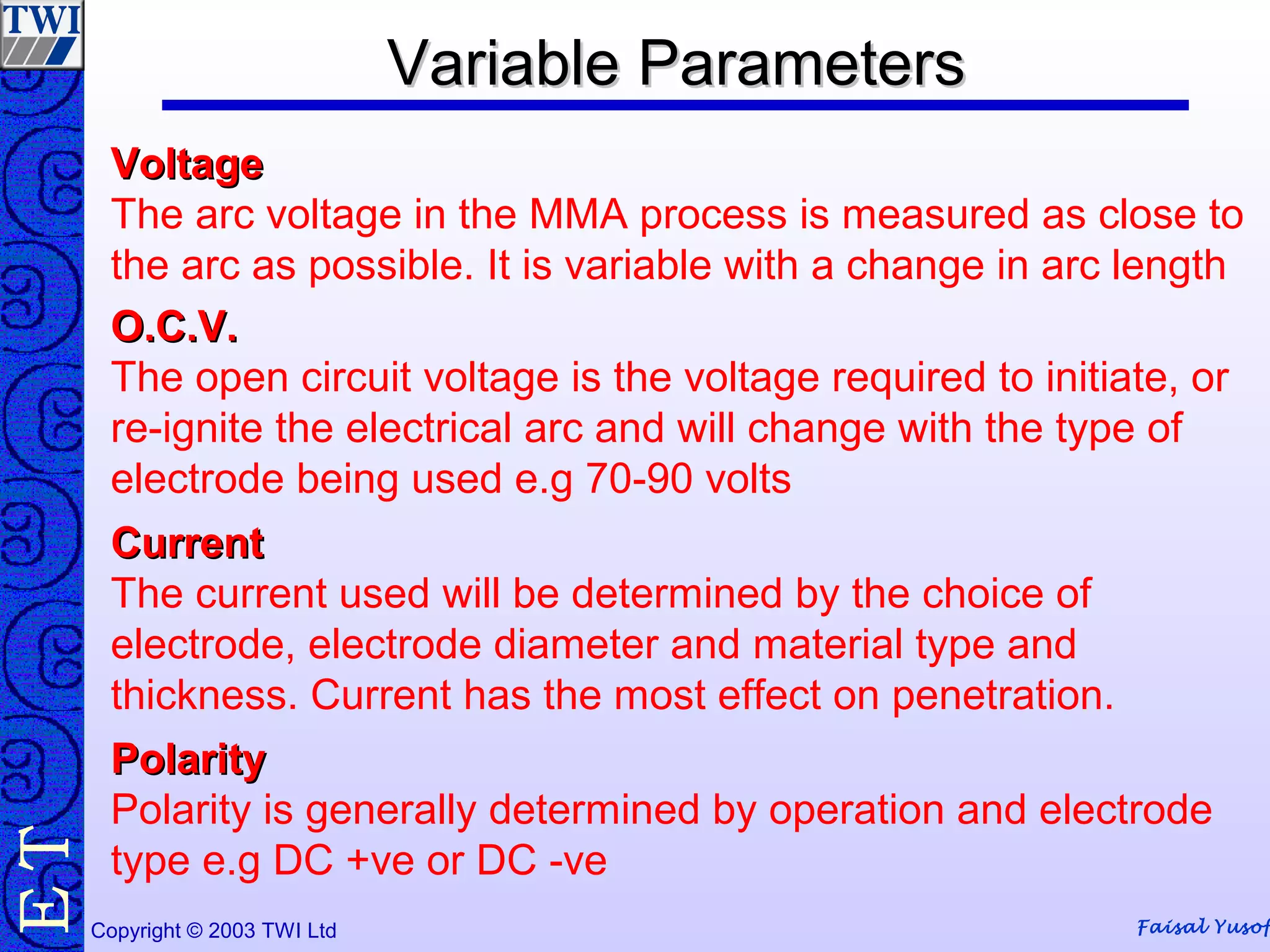
VoltageVoltage
The arc voltage in the MMA process is measured as close to
the arc as possible. It is variable with a change in arc length
O.C.V.O.C.V.
The open circuit voltage is the voltage required to initiate, or
re-ignite the electrical arc and will change with the type of
electrode being used e.g 70-90 volts
CurrentCurrent
The current used will be determined by the choice of
electrode, electrode diameter and material type and
thickness. Current has the most effect on penetration.
PolarityPolarity
Polarity is generally determined by operation and electrode
type e.g DC +ve or DC -ve
Faisal YusofCopyright © 2003 TWI Ltd
TE Manual Metal Arc (MMA)Manual Metal Arc (MMA)
The three main electrode covering types
used in MMA welding
 Rutile - general purpose
 Basic - low hydrogen
 Cellulose - deep penetration/fusion
Faisal YusofCopyright © 2003 TWI Ltd
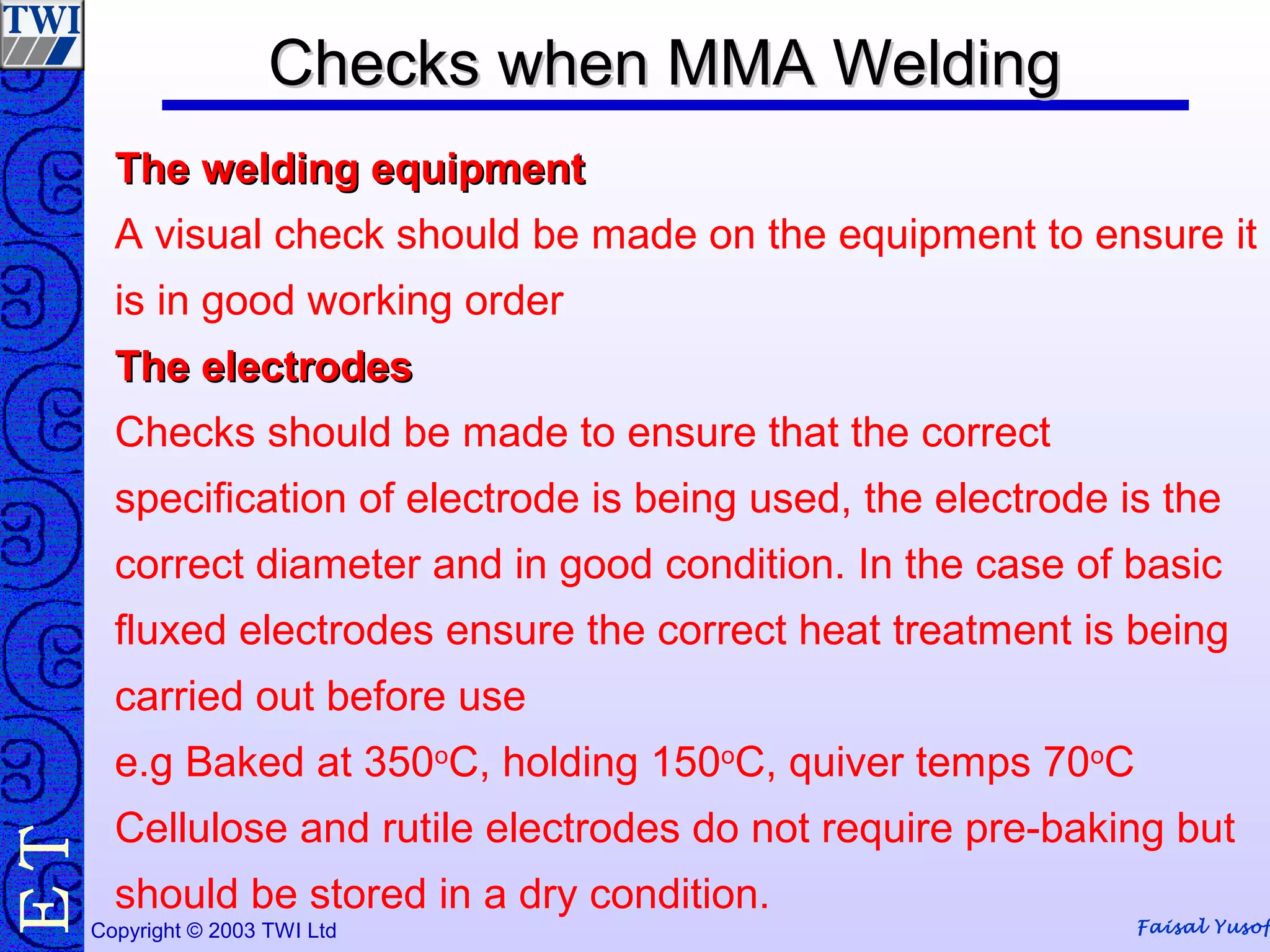
TE Checks when MMA WeldingChecks when MMA Welding
The welding equipmentThe welding equipment
A visual check should be made on the equipment to ensure it
is in good working order
The electrodesThe electrodes
Checks should be made to ensure that the correct
specification of electrode is being used, the electrode is the
correct diameter and in good condition. In the case of basic
fluxed electrodes ensure the correct heat treatment is being
carried out before use
e.g Baked at 350o
C, holding 150o
C, quiver temps 70o
C
Cellulose and rutile electrodes do not require pre-baking but
should be stored in a dry condition.
Faisal YusofCopyright © 2003 TWI Ltd
TE
OCV open circuit voltsOCV open circuit volts
A check should be made to ensure that the equipment can
produce the OCV required by the consumable and that any
voltage selector has been moved to the correct position
Current & polarityCurrent & polarity
A check should be made to ensure the current type and
range is as detailed on the WPS
Other variablesOther variables
Checks should be made for correct electrode angle, arc gap
and travel speed
SafetySafety
Checks when MMA WeldingChecks when MMA Welding
Faisal YusofCopyright © 2003 TWI Ltd
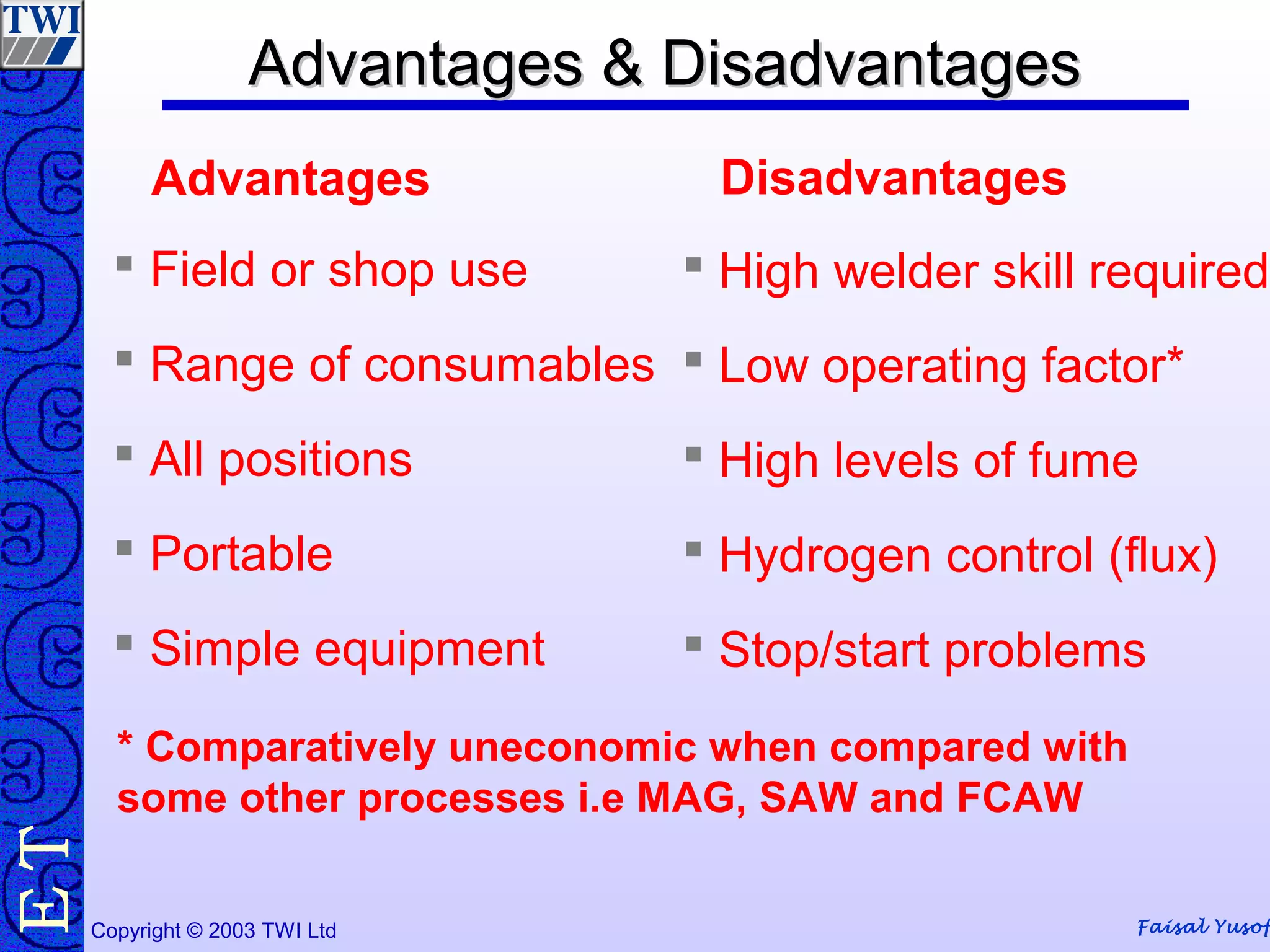
TE Advantages & DisadvantagesAdvantages & Disadvantages
Advantages Disadvantages
 Field or shop use
 Range of consumables
 All positions
 Portable
 Simple equipment
 High welder skill required
 Low operating factor*
 High levels of fume
 Hydrogen control (flux)
 Stop/start problems
* Comparatively uneconomic when compared with
some other processes i.e MAG, SAW and FCAW
Faisal YusofCopyright © 2003 TWI Ltd
TE Arc Blow / WanderArc Blow / Wander
Electrode
Welding
arc
Faisal YusofCopyright © 2003 TWI Ltd
TE Arc Blow / WanderArc Blow / Wander
 Arc blow is the deviation of
the arc due to magnetic
influences.
 Arc blow occurs using DC
current only
 The occurrence of arc blow
may cause the following
problems
 Poor penetration/fusion
 Poor cap profiles
 High spatter
 General manipulation
problems
Electrode
Magnetic
flux
Welding
arc
Faisal YusofCopyright © 2003 TWI Ltd
TE Precautions Against Arc BlowPrecautions Against Arc Blow
 If the procedure allows
change welding current
from DC to AC
 Hold as short an arc as
possible.
 Reduce welding current
(within the procedures
range)
 Change the electrodes
angle, opposite to the arc
blows direction.
 If possible weld towards
heavy tack welds or
previously deposited
welds.
 Wrap ground cables
(return leads) around the
work piece .
 De-magnetise component
being welded
Faisal YusofCopyright © 2003 TWI Ltd
TE
QU 1. State the main welding parameters of the MMA welding
process
QuestionsQuestions
QU 2. What type of power source characteristic is considered
essential for a MMA welding plant?
QU 3. Give the main advantages of the MMA welding process
when compared to the MAG welding process
QU 4. State the four criteria that will govern the number of weld
passes in a MMA welded joint
QU 5. State two types of electrical supply and give the advantages
of each
Faisal YusofCopyright © 2003 TWI Ltd
TE Tungsten Inert Gas (TIG)Tungsten Inert Gas (TIG)
USA: GTAWUSA: GTAW
Faisal YusofCopyright © 2003 TWI Ltd
TE Tungsten Inert Gas (TIG)Tungsten Inert Gas (TIG)
USA: GTAWUSA: GTAW
Faisal YusofCopyright © 2003 TWI Ltd
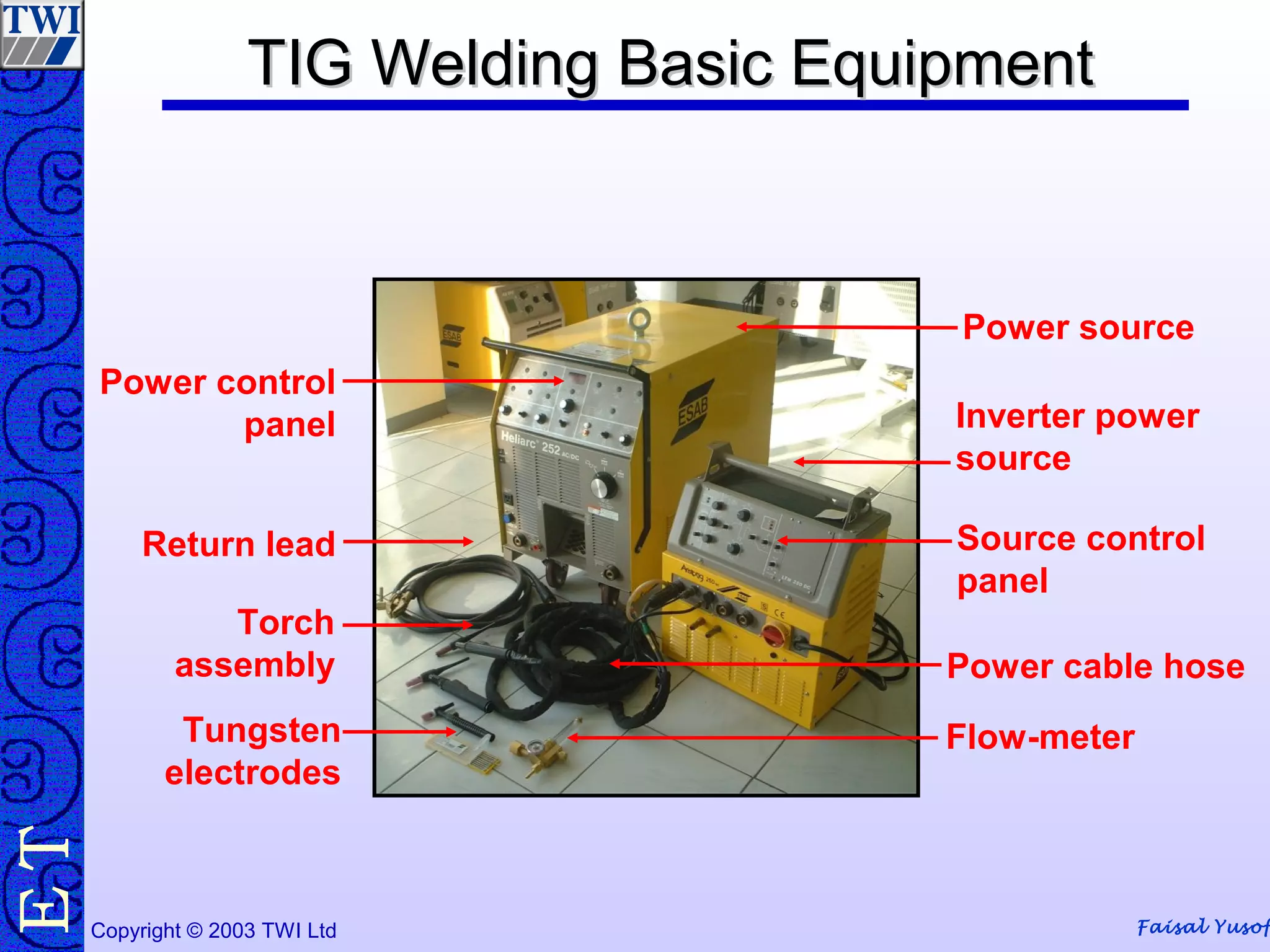
TE TIG Welding Basic EquipmentTIG Welding Basic Equipment
Power source
Inverter power
source
Source control
panel
Power cable hose
Flow-meterTungsten
electrodes
Torch
assembly
Return lead
Power control
panel
Faisal YusofCopyright © 2003 TWI Ltd
TE
Ceramic
shield cup
Gas lens
Torch body
Tungsten
electrode
Spare ceramic
shielding cup
Gas diffuser
Split collet
On/Off switch
Fitted ceramic
shielding cup
Tungsten
housing
TIG Torch AssemblyTIG Torch Assembly
Faisal YusofCopyright © 2003 TWI Ltd
TE Variable ParametersVariable ParametersVariable ParametersVariable Parameters
VoltageVoltage
The voltage of the TIG welding process is variable only by
the type of gas being used, and changes in the arc length
CurrentCurrent
The current is adjusted proportionally to the tungsten
electrodes diameter being used. The higher the current the
deeper the penetration and fusion
PolarityPolarity
The polarity used for steels is always DC –ve as most of the
heat is concentrated at the +ve pole, this is required to keep
the tungsten electrode at the cool end of the arc. When
welding aluminium and its alloys AC current is used
Faisal YusofCopyright © 2003 TWI Ltd
TE Variable ParametersVariable Parameters
Tungsten electrodesTungsten electrodes
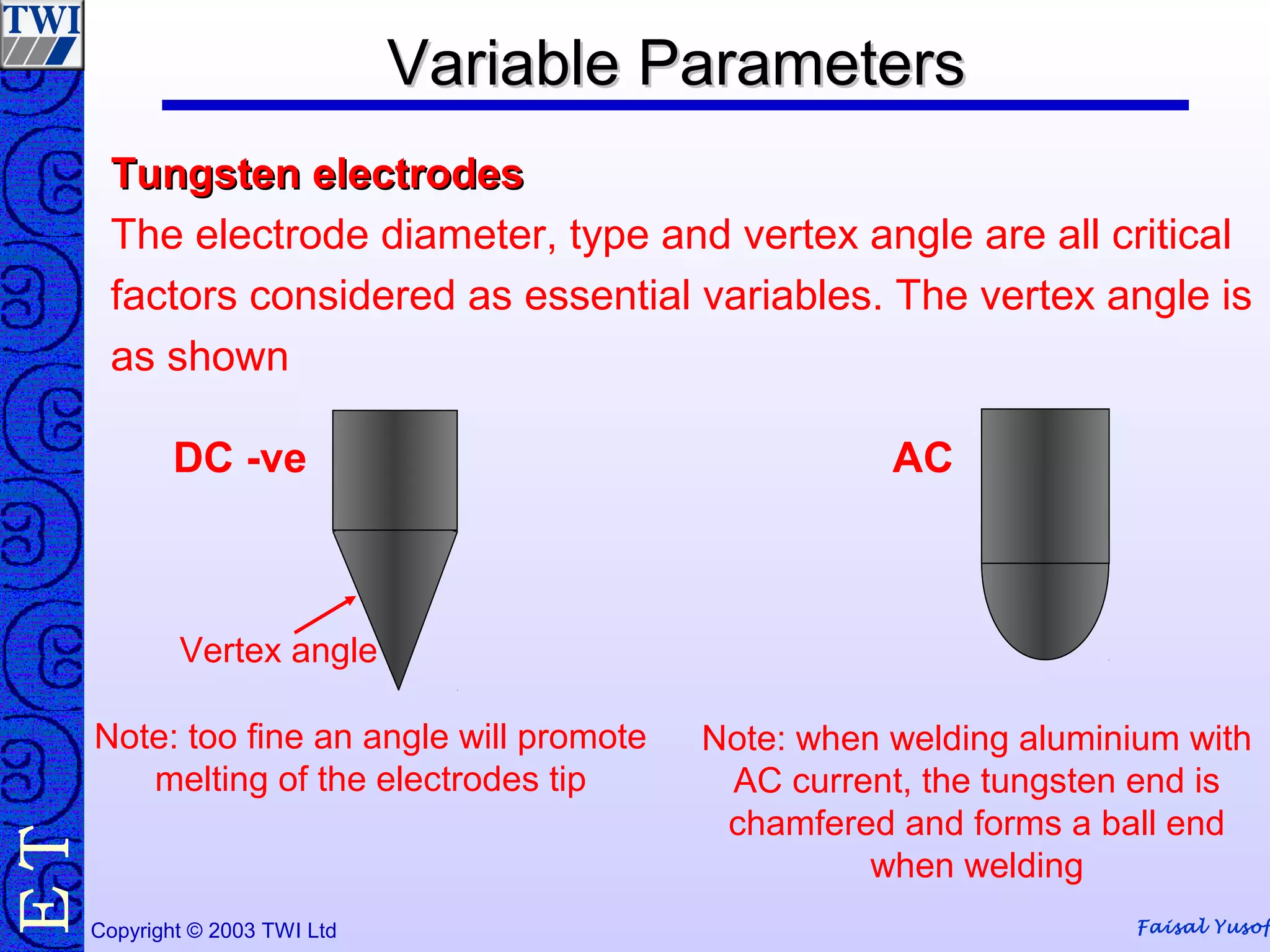
The electrode diameter, type and vertex angle are all critical
factors considered as essential variables. The vertex angle is
as shown
Vertex angle
Note: when welding aluminium with
AC current, the tungsten end is
chamfered and forms a ball end
when welding
DC -ve
Note: too fine an angle will promote
melting of the electrodes tip
AC
Faisal YusofCopyright © 2003 TWI Ltd
TE Tungsten ElectrodesTungsten Electrodes
Old types
Thoriated: DC -ve electrode - steels and most
metals
Zirconiated: AC - aluminum alloys and magnesium
New types
Cerium: DC -ve elctrode - steels and most metals
Lanthanum: DC -ve electrode - steels and most metals
Faisal YusofCopyright © 2003 TWI Ltd
TE Variable ParametersVariable Parameters
Gas type and flow rateGas type and flow rate
Generally two types of gases are used in TIG welding, argon and helium,
though nitrogen may be considered for welding copper and hydrogen
may be added for the welding of austenitic stainless steels. The gas flow
rate is also an important
Argon (Ar) Inert
 Suitable for welding carbon
steel,stainless steel, aluminium
and magnesium
 Lower cost, lower flow rates
 More suitable for thinner
materials and positional
welding
Helium Argon mixes
 Suitable for welding carbon
steel, stainless steel, copper,
aluminium and magnesium
 High cost, high flow rates
 More suitable for thicker
materials and materials of
high thermal conductivity.
Faisal YusofCopyright © 2003 TWI Ltd
TE Tungsten Inert Gas WeldingTungsten Inert Gas Welding
1. 2. 3. 4. 5.
1. Pre-flow timer control
Adjusts the time the gas and
water valves are open
2. Up-Slope control (Slope-In)
Prevents burn throughs and the
possibility of tungsten inclusions
3. Output control
Welding current control
4. Down-Slope control (Slope-
out)
Crater fill and controls crater
pipe and the possibility of crater
cracks
5. Post-flow timer control
Adjusts the time the gas flows
after welding
i
t
Faisal YusofCopyright © 2003 TWI Ltd
TE Checks when TIG WeldingChecks when TIG Welding
The welding equipmentThe welding equipment
A visual check should be made to ensure the welding
equipment is in good condition
The torch head assemblyThe torch head assembly
Check the diameter and specification of the tungsten
electrode, the required vertex angle and that a gas lens is
fitted correctly. Check the electrode stick-out length and that
the ceramic is the correct type and in good condition
Gas type and flow rateGas type and flow rate
Check the shielding gas is the correct type, or gas mixture
and the flow rate is correct for the given joint design, welding
position as stated in the WPS
Faisal YusofCopyright © 2003 TWI Ltd
TE Checks when TIG WeldingChecks when TIG Welding
Current and polarityCurrent and polarity
Checks should be made to ensure that the type of current
and polarity are correctly set, and the range is within that
given on the procedure.
Other welding parametersOther welding parameters
Checks should be made to other parameters such as torch
angle, arc gap distance and travel speed.
SafetySafety
Check should be made on the current carrying capacity, or
duty cycle of the equipment and all electrical insulation is
sound and in place. Correct extraction systems should be in
use to avoid exposure to toxic fume.
Faisal YusofCopyright © 2003 TWI Ltd
TE Advantages & DisadvantagesAdvantages & Disadvantages
Advantages Disadvantages
 High quality
 Good control
 All positions
 Low hydrogen
 Minimal cleaning
 High skill factor required
 Small consumable range
 High protection required
 Low productivity
 High ozone levels
Faisal YusofCopyright © 2003 TWI Ltd
TE
QU 1. Give three reasons for the occurrence of tungsten
inclusions
QuestionsQuestions
QU 2. State the main welding parameters with the TIG welding
process
QU 3. Which electrode polarity is considered essential for the
welding of carbon steel? And give a brief description why
QU 4. Which electrode polarity is considered essential for the
welding of aluminium? And give a brief description why
QU 5. State the tungsten electrode activators required to weld
carbon steel and the light alloys
QU 5. State the main advantages and disadvantage of the TIG
welding process
Faisal YusofCopyright © 2003 TWI Ltd
TE Metal Active/Inert Gas (MAG/MIG)Metal Active/Inert Gas (MAG/MIG)
Faisal YusofCopyright © 2003 TWI Ltd
TE Metal Active/Inert Gas (MAG/MIG)Metal Active/Inert Gas (MAG/MIG)
USA: GMAWUSA: GMAW
Faisal YusofCopyright © 2003 TWI Ltd
TE
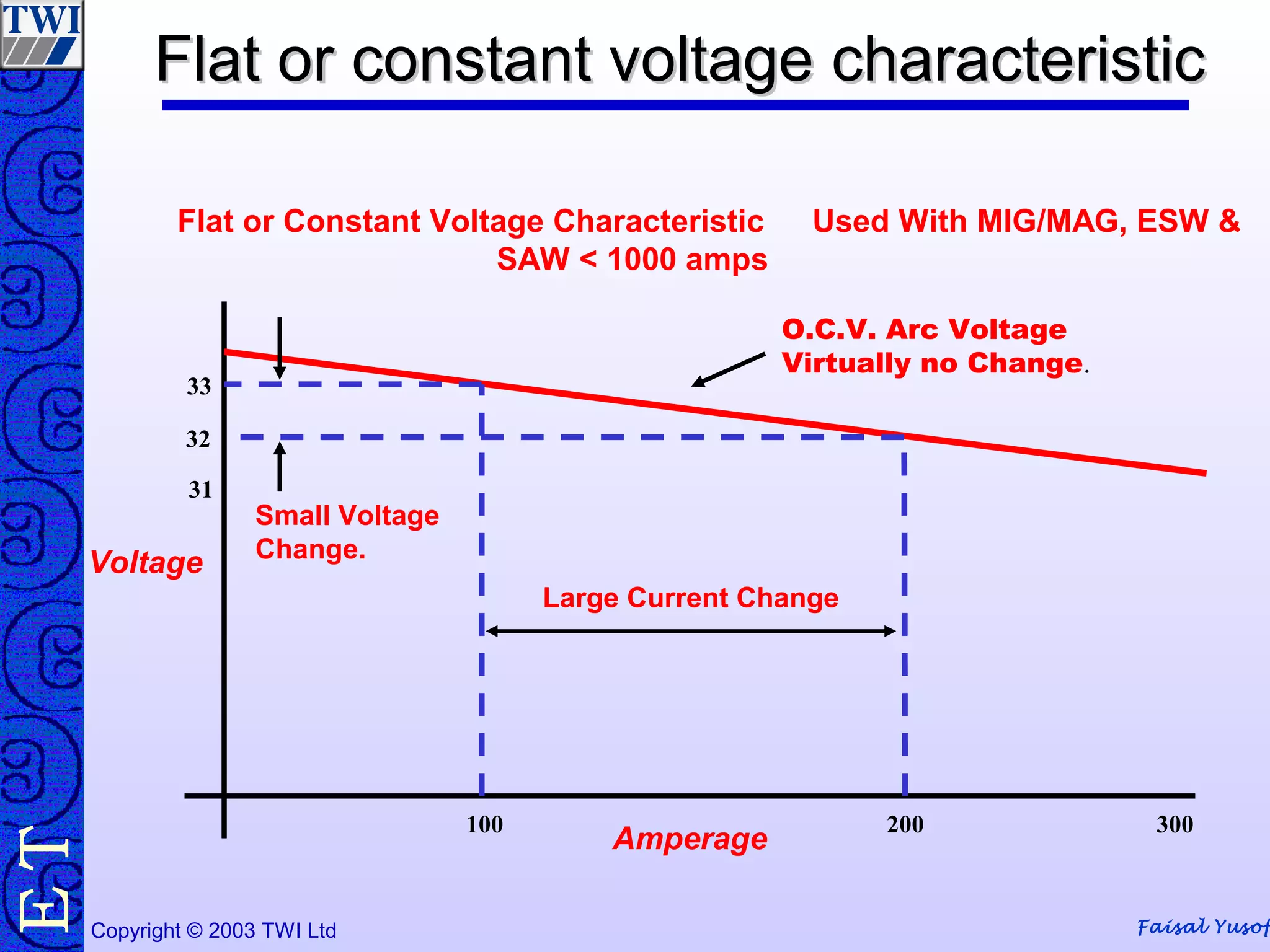
O.C.V. Arc Voltage
Virtually no Change.
Voltage
Flat or Constant Voltage Characteristic Used With MIG/MAG, ESW &
SAW < 1000 amps
100 200 300
33
32
31
Large Current Change
Small Voltage
Change.
Amperage
Flat or constant voltage characteristicFlat or constant voltage characteristic
Faisal YusofCopyright © 2003 TWI Ltd
TE MAG Welding Basic EquipmentMAG Welding Basic Equipment
Power return
cable
External wire
feed unit
control panel
Power
control panel
15kg wire spool
Welding gun
assembly
Transformer/
Rectifier
Power cable &
hose assembly
Liner for wire
External wire
feed motor
Spare contact
tips
Faisal YusofCopyright © 2003 TWI Ltd
TE
Torch body
Contact tips
Spot welding
spacer
Gas diffuser
Nozzles or
shrouds
Torch head assembly
(Less nozzle)
On/Off switch
Hose port
MAG/MIG Torch Head AssemblyMAG/MIG Torch Head Assembly
Faisal YusofCopyright © 2003 TWI Ltd
TE
Plain top roller
Half grooved
bottom roller
Wire guide
MAG/MIG Internal Wire DriveMAG/MIG Internal Wire Drive
Faisal YusofCopyright © 2003 TWI Ltd
TE Metal Transfer Modes for MAG/MIGMetal Transfer Modes for MAG/MIG
 Dip Transfer: Voltage < 22 Amperage < 200
Thin materials positional welding
Faisal YusofCopyright © 2003 TWI Ltd
TE Metal Transfer Modes for MAG/MIGMetal Transfer Modes for MAG/MIG
 Spray Transfer: Voltage > 27 Amperage > 220
Thicker materials, limited to flat welding positions, high
deposition.
Faisal YusofCopyright © 2003 TWI Ltd
TE
 Globular Transfer: Between Dip & Spray Transfer
Limited commercial, used only in some mechanised
MAG process using CO2 shielding gas
Metal Transfer Modes for MAG/MIGMetal Transfer Modes for MAG/MIG
Faisal YusofCopyright © 2003 TWI Ltd
TE
 Pulsed Transfer: utilised spray transfer during peak
current and superimposed background current
Metal Transfer Modes for MAG/MIGMetal Transfer Modes for MAG/MIG
Faisal YusofCopyright © 2003 TWI Ltd
TE
 Dip Transfer:Dip Transfer: Voltage < 22 Amperage < 200
Thin materials positional welding
 Globular Transfer:Globular Transfer: Between Dip & Spray Transfer
Limited commercial, Used only in some mechanised MAG
process using CO2 shielding gas
 Spray Transfer:Spray Transfer: Voltage > 27 Amperage > 220
Thicker materials, limited to flat welding positions, high
deposition
 Pulse Transfer:Pulse Transfer: Both spray and dip transfer in
one mode of operation, frequency range 50-300
pulses/second
Positional welding and root runs
Metal Transfer Modes for MAG/MIGMetal Transfer Modes for MAG/MIG
Faisal YusofCopyright © 2003 TWI Ltd
TE
Wire feed speedWire feed speed
Increasing the wire feed speed automatically increases the
current in the wire
VoltageVoltage
The voltage is the most important setting in the spray
transfer mode, as it controls the arc length. In dip transfer it
controls the rise in current
CurrentCurrent
The current is automatically increased as the wire feed is
increased. Current mainly affects penetration
Variable ParametersVariable ParametersVariable ParametersVariable Parameters
Faisal YusofCopyright © 2003 TWI Ltd
TE
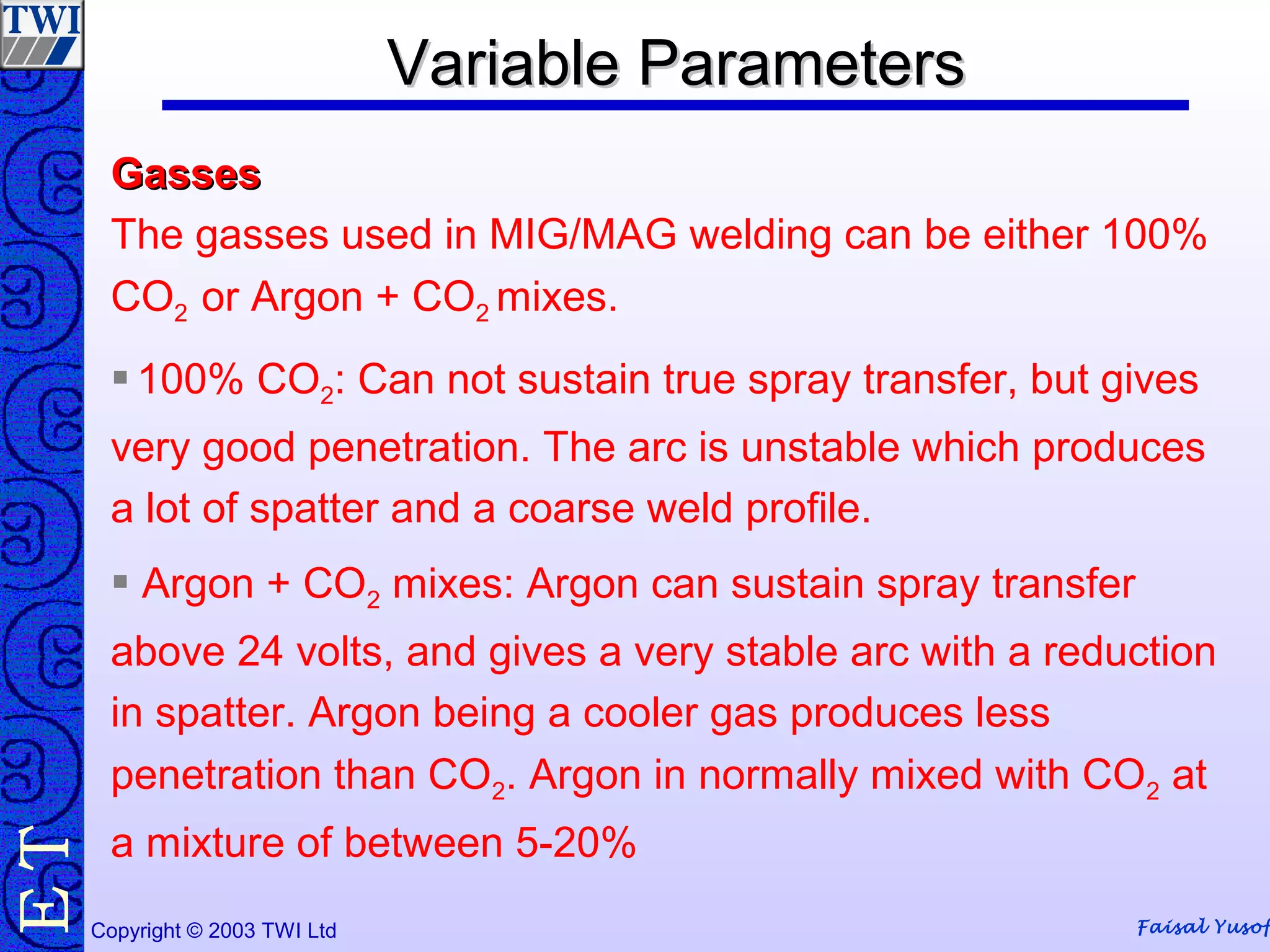
GassesGasses
Variable ParametersVariable ParametersVariable ParametersVariable Parameters
Faisal YusofCopyright © 2003 TWI Ltd
TE
GassesGasses
The gasses used in MIG/MAG welding can be either 100%
CO2 or Argon + CO2 mixes.
 100% CO2: Can not sustain true spray transfer, but gives
very good penetration. The arc is unstable which produces
a lot of spatter and a coarse weld profile.
 Argon + CO2 mixes: Argon can sustain spray transfer
above 24 volts, and gives a very stable arc with a reduction
in spatter. Argon being a cooler gas produces less
penetration than CO2. Argon in normally mixed with CO2 at
a mixture of between 5-20%
Variable ParametersVariable ParametersVariable ParametersVariable Parameters
Faisal YusofCopyright © 2003 TWI Ltd
TE Checks when MIG/MAG WeldingChecks when MIG/MAG Welding
Wire linerWire liner
Check that the liner is the correct type and size for the wire
being used. Steel liners for steel and Teflon liners for
aluminium.
Contact tipsContact tips
Check the tip is the correct size for the wire being used and
check the amount of wear. Excessive wear will affect wire
speed and electrical current pick-up
Gas and gas flow-ratesGas and gas flow-rates
Type of gas and the flow rate need to be checked to ensure
they comply with the WPS
Other welding variablesOther welding variables
Check WFS, amps, volts and travel speed
Faisal YusofCopyright © 2003 TWI Ltd
TE
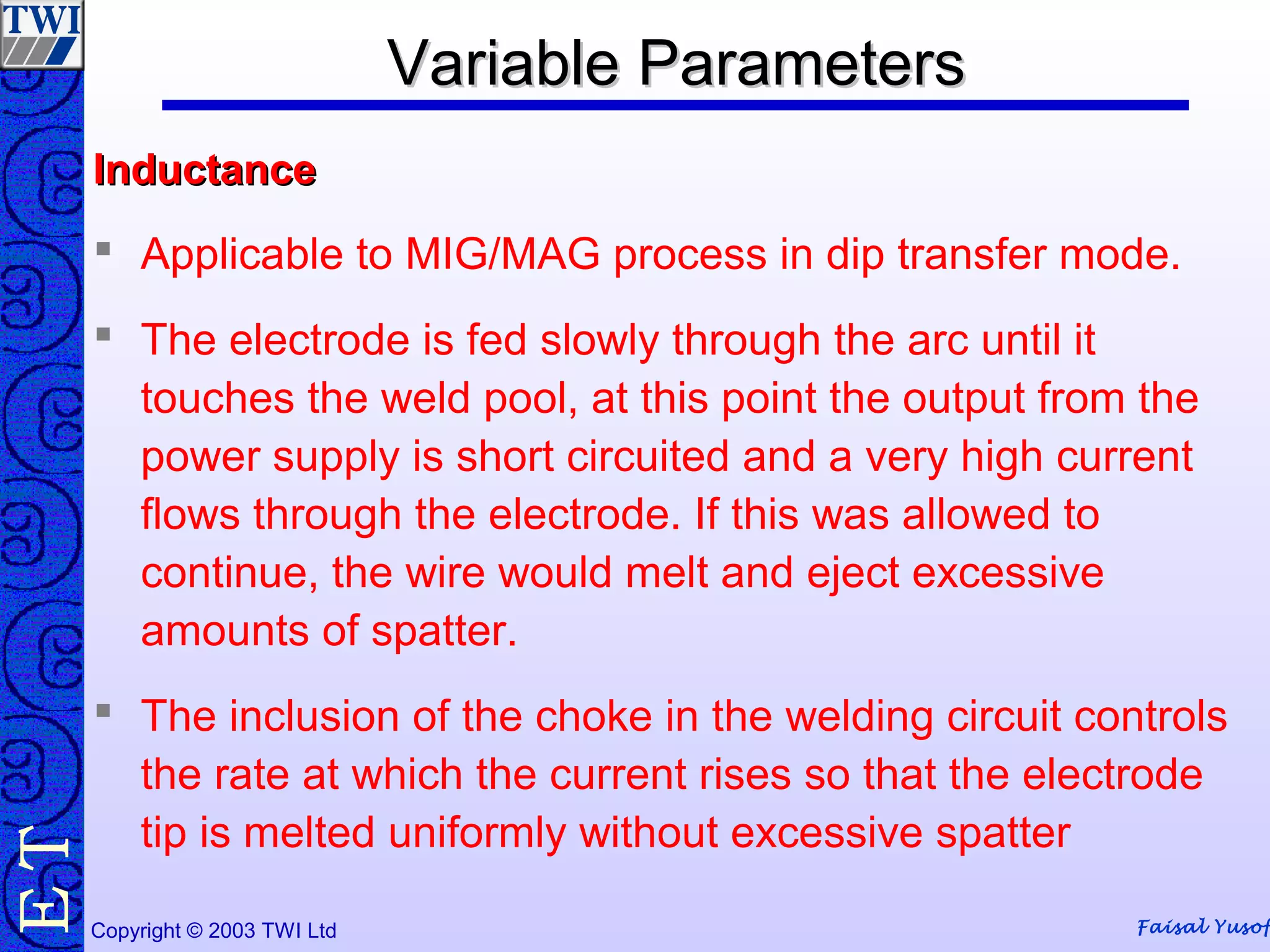
InductanceInductance
 Applicable to MIG/MAG process in dip transfer mode.
 The electrode is fed slowly through the arc until it
touches the weld pool, at this point the output from the
power supply is short circuited and a very high current
flows through the electrode. If this was allowed to
continue, the wire would melt and eject excessive
amounts of spatter.
 The inclusion of the choke in the welding circuit controls
the rate at which the current rises so that the electrode
tip is melted uniformly without excessive spatter
Variable ParametersVariable Parameters
Faisal YusofCopyright © 2003 TWI Ltd
TE Checks when MIG/MAG WeldingChecks when MIG/MAG Welding
The welding equipmentThe welding equipment
A visual check should be made on the equipment to ensure it
is in good working order
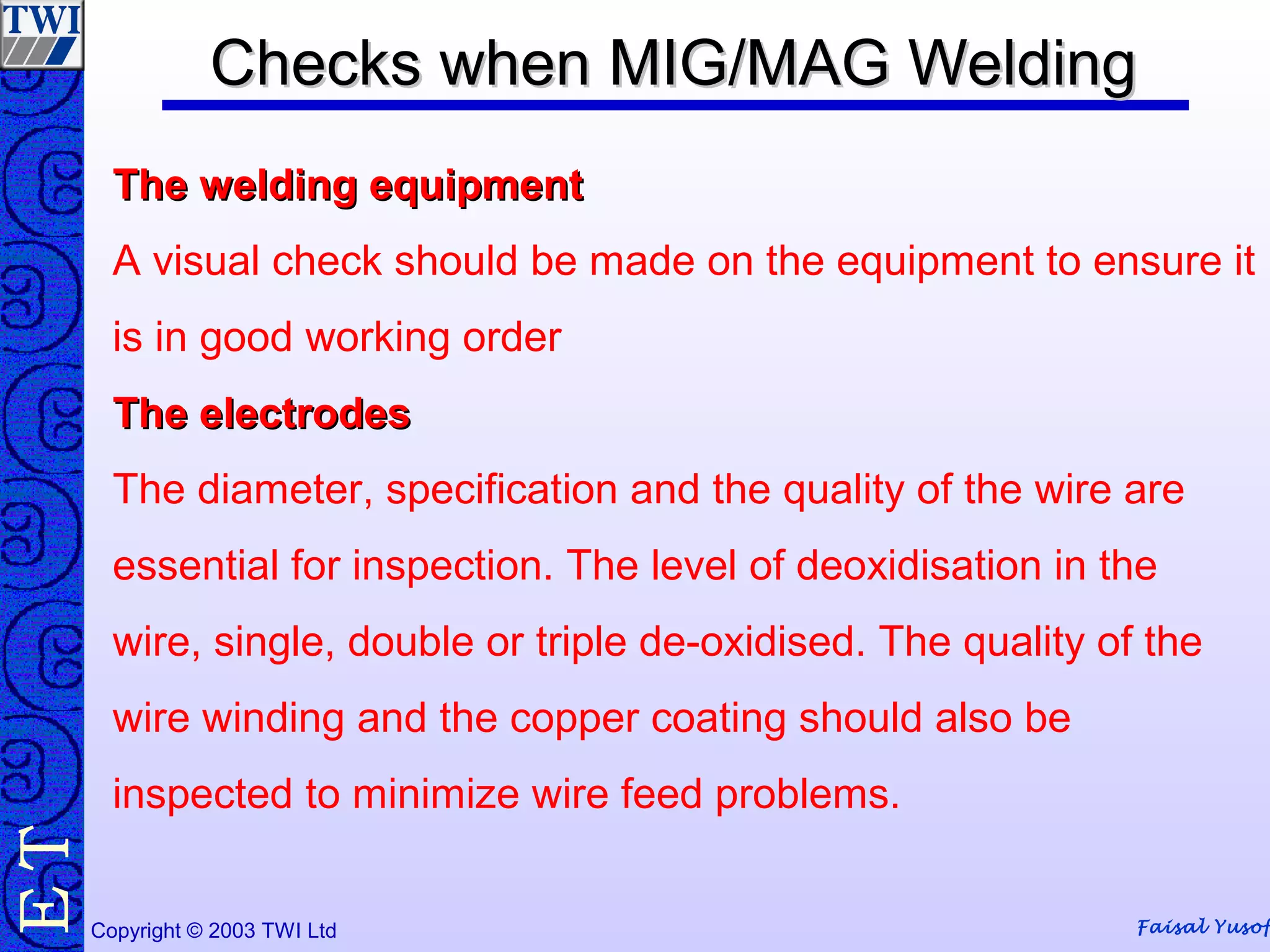
The electrodesThe electrodes
The diameter, specification and the quality of the wire are
essential for inspection. The level of deoxidisation in the
wire, single, double or triple de-oxidised. The quality of the
wire winding and the copper coating should also be
inspected to minimize wire feed problems.
Faisal YusofCopyright © 2003 TWI Ltd
TE Advantages & DisadvantagesAdvantages & Disadvantages
Advantages Disadvantages
 High productivity
 Easily automated
 All positional (dip &
pulse)
 Material thickness
range
 Continuous electrode
 Lack of fusion (dip)
 Small range of
consumables
 Protection on site
 Complex equipment
 Not so portable
Faisal YusofCopyright © 2003 TWI Ltd
TE Flux Cored Arc WeldingFlux Cored Arc Welding
Insulated extension nozzle
Current carrying guild tube
Flux cored hollow wire
Flux powder
Arc shield composed of
vaporized and slag forming
compounds
Metal droplets covered
with thin slag coating
Molten
weld
poolSolidified weld
metal and slag
Flux core
Wire joint
Flux core
wires
Faisal YusofCopyright © 2003 TWI Ltd
TE Flux cored weldingFlux cored welding
Faisal YusofCopyright © 2003 TWI Ltd
TE
QU 1. State the possible problems when using the dip transfer
mode in the MAG welding process
QuestionsQuestions
QU 2. State the application areas for the spray transfer mode
when using the MAG welding process.
QU 3. What power source characteristic is required and electrode
polarity/current type for the MAG welding process
QU 4. State the main variables for the MAG welding process
QU 5. State the advantages and disadvantages of the MAG
welding process when compared to MMA
Faisal YusofCopyright © 2003 TWI Ltd
TE Submerged-arc (SAW)Submerged-arc (SAW)
Faisal YusofCopyright © 2003 TWI Ltd
TE Submerged-arc (SAW)Submerged-arc (SAW)
Schematic diagram of SAW
Faisal YusofCopyright © 2003 TWI Ltd
TE Submerged-arc (SAW)Submerged-arc (SAW)
- +
Power supply
Filler wire spool
Flux hopper
Wire electrode
Flux
Slide rail
Faisal YusofCopyright © 2003 TWI Ltd
TE Submerged-arc basic equipmentSubmerged-arc basic equipment
Transformer/
Rectifier
Power return
cable
Power control
panel
Welding carriage
control unit
Granulated
flux
Granulated
flux
Welding carriage
Electrode wire
reel
Faisal YusofCopyright © 2003 TWI Ltd
TE
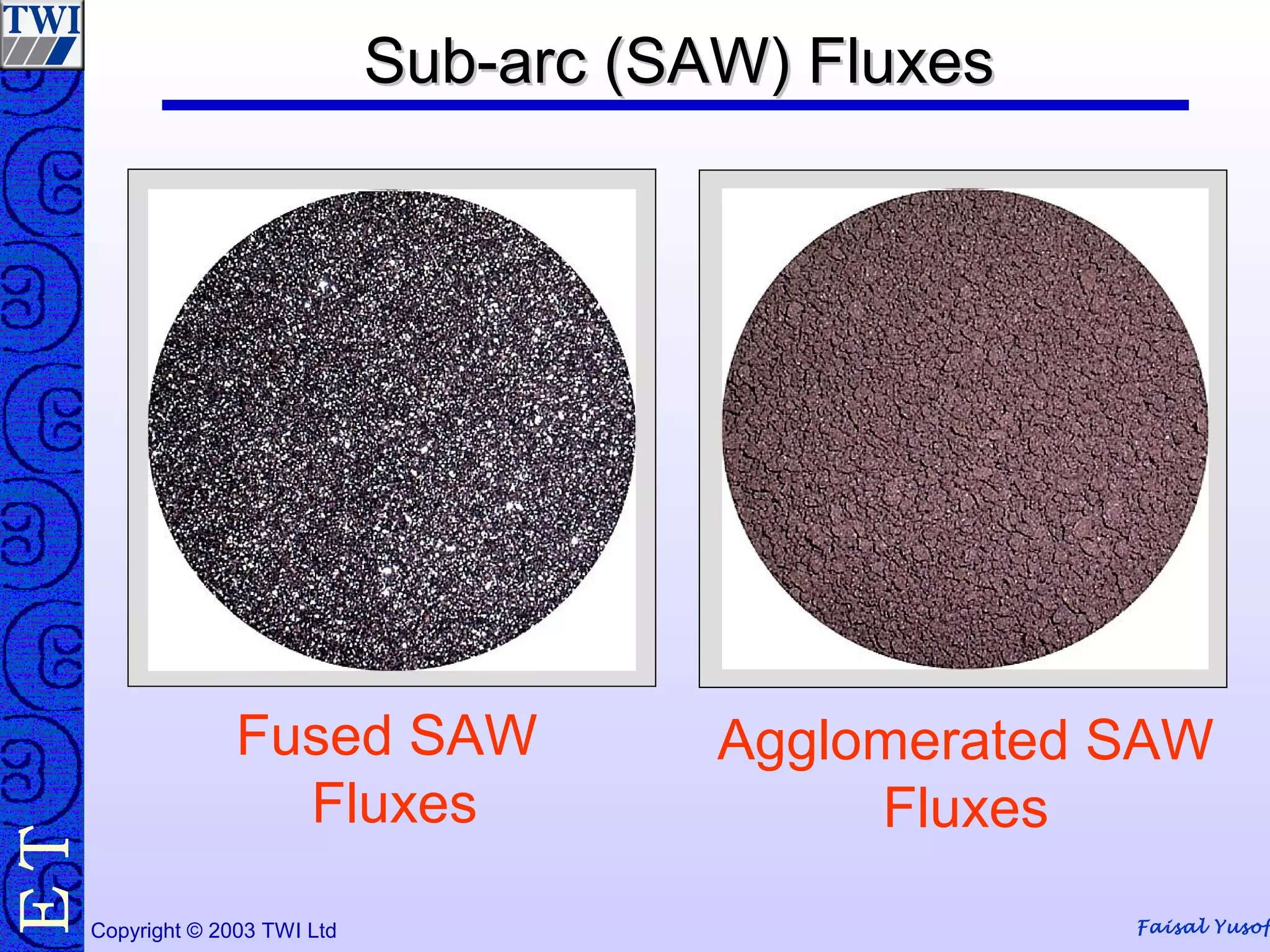
Fused SAW
Fluxes
Agglomerated SAW
Fluxes
Sub-arc (SAW) FluxesSub-arc (SAW) Fluxes
Faisal YusofCopyright © 2003 TWI Ltd
TE Sub-arc Fluxes
Fused Flux
 Flaky appearance
 Lower weld quality
 Low moisture intake
 Low dust tendency
 Good re-cycling
 Very smooth weld
profile
Agglomerated Flux
 Granulated appearance
 High weld quality
 Addition of alloys
 Lower consumption
 Easy slag removal
 Smooth weld profile
Faisal YusofCopyright © 2003 TWI Ltd
TE Submerged-arc (SAW) welding head arrangementSubmerged-arc (SAW) welding head arrangement
Faisal YusofCopyright © 2003 TWI Ltd
TE Submerged-arc (SAW) process variablesSubmerged-arc (SAW) process variables
Welding current
Faisal YusofCopyright © 2003 TWI Ltd
TE Submerged-arc (SAW) process variablesSubmerged-arc (SAW) process variables
Welding current
Faisal YusofCopyright © 2003 TWI Ltd
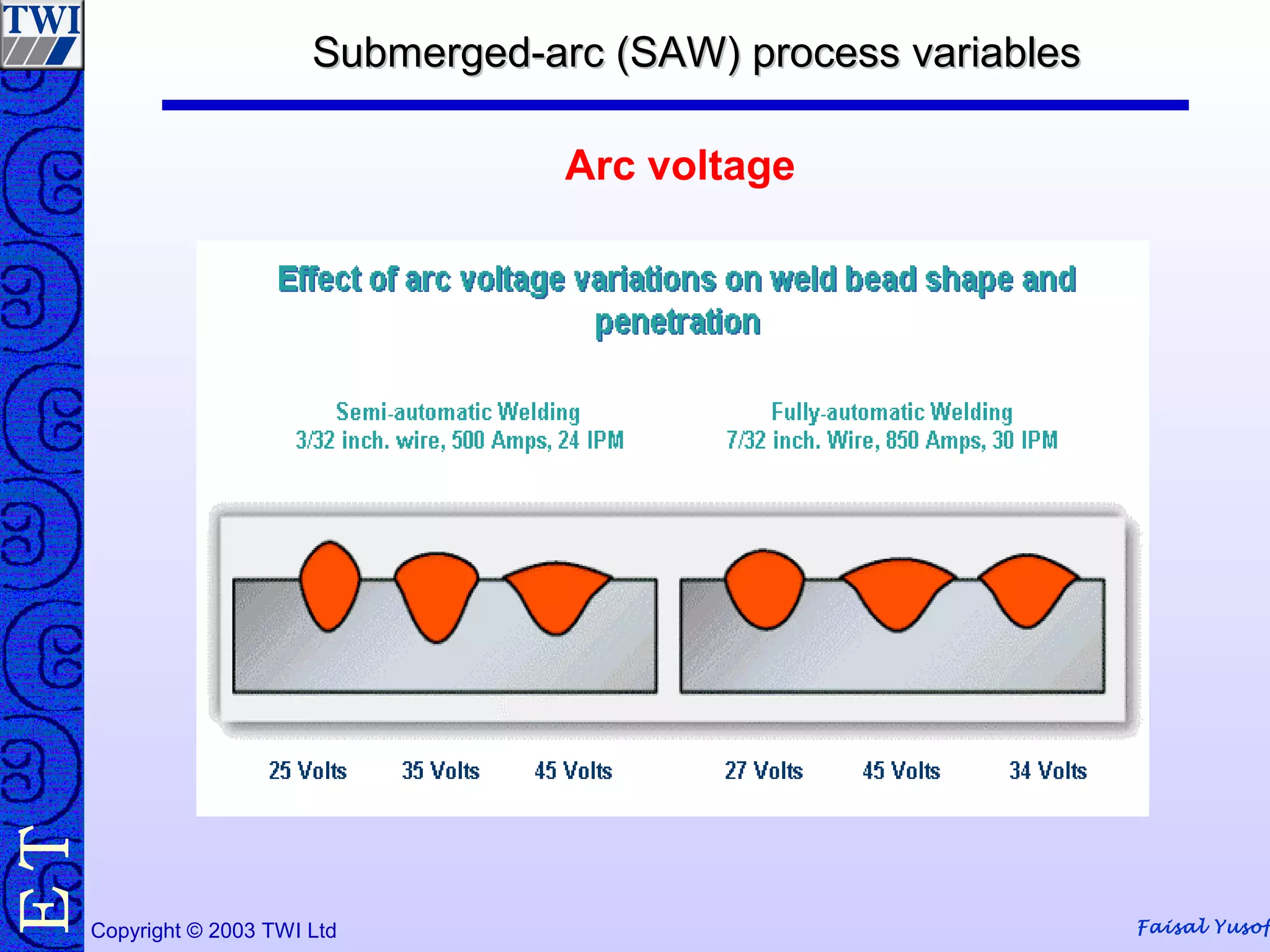
TE Submerged-arc (SAW) process variablesSubmerged-arc (SAW) process variables
Arc voltage
Faisal YusofCopyright © 2003 TWI Ltd
TE Submerged-arc (SAW) process variablesSubmerged-arc (SAW) process variables
Arc voltage
Faisal YusofCopyright © 2003 TWI Ltd
TE Submerged-arc (SAW) process variablesSubmerged-arc (SAW) process variables
Travel speed
Faisal YusofCopyright © 2003 TWI Ltd
TE Submerged-arc (SAW) process variablesSubmerged-arc (SAW) process variables
Travel speed
Faisal YusofCopyright © 2003 TWI Ltd
TE Submerged-arc (SAW) process variablesSubmerged-arc (SAW) process variables
Wire size
Faisal YusofCopyright © 2003 TWI Ltd
TE Submerged-arc (SAW) process variablesSubmerged-arc (SAW) process variables
Wire size
Faisal YusofCopyright © 2003 TWI Ltd
TE Submerged-arc (SAW) process variablesSubmerged-arc (SAW) process variables
Electrode extension
Faisal YusofCopyright © 2003 TWI Ltd
TE Submerged-arc (SAW) process variablesSubmerged-arc (SAW) process variables
Flux depth
Faisal YusofCopyright © 2003 TWI Ltd
TE Advantages & DisadvantagesAdvantages & Disadvantages
Advantages Disadvantages
 Low weld-metal cost
 Easily automated
 Low levels of ozone
 High productivity
 No visible arc light
 Restricted welding
positions
 Arc blow on DC current
 Shrinkage defects
 Difficult penetration
control
 Limited joints
Faisal YusofCopyright © 2003 TWI Ltd
TE
QU 1. State the possible problems when using damp and
contaminated fluxes when using the sub-arc process
Questions
QU 2. State the two flux types used in the sub-arc welding
process.
QU 3. What power source characteristic is required for a 500
amp out-put sub-arc welding plant
QU 4. State three main items of sub-arc fluxes, which require
inspection
QU 5. State the advantages and disadvantages of the sub-arc
welding process
Faisal YusofCopyright © 2003 TWI Ltd
TE Electro-slag (ESW)Electro-slag (ESW)
More suitable for longer weld lengths
and mechanically more complicated.
Non Consumable-GuideConsumable-Guide
Electrode
Feed Rolls
Electrode Wire
Molten Slag
Bath
Copper
Shoe
Solid Weld
Metal
More suitable for short weld lengths and
mechanically simpler. Can also be used
in portable models.
Electrode
Feed Rolls
Electrode Wire
Drive Unit
Electrode
Guide
Copper Shoe
Solid Weld
Metal
Guide Tube
Faisal YusofCopyright © 2003 TWI Ltd
TE Electro-slagElectro-slag
 Electro-slag welds are relatively defect free
 More suited to the joining of thick materials
 No costly joint edge preparations required, square
butt
 Minimal distortion
 Minimal pre-heat required
 Low flux consumption
 High deposition
 Vertical up welding position only
 Low toughness values, may require PWHT.
 Timely Set-ups
Faisal YusofCopyright © 2003 TWI Ltd
TE Process ComparisonsProcess Comparisons
Process Electrical characteristic Electrode current type
MMA Drooping / constant current DC+ve, DC-ve, AC
TIG Drooping / constant current DC-ve, AC
MIG/MAG Flat / constant voltage DC+ve,
MAG FCAW Flat / constant voltage DC+ve, DC-ve,
Sub-arc DC+ve, DC-ve, AC
Electro-slag Flat / constant voltage DC+ve,
Drooping / constant current >500amp
Flat / constant voltage <500amp
Faisal YusofCopyright © 2003 TWI Ltd
TE
Any Questions?Any Questions?

Wis5 process 04 (new )

  • 1.
    Faisal YusofCopyright ©2003 TWI Ltd TE Welding Inspection Welding Processes Course Reference WIS5
  • 2.
    Faisal YusofCopyright ©2003 TWI Ltd TE WeldingWelding BS 499 part 1 Welding terms A union between pieces of metal at faces rendered plastic or liquid by heat,pressure or both.  Ultrasonic  Electron beam  Friction  Electric resistance  Electric arc Possible energy sources
  • 3.
    Faisal YusofCopyright ©2003 TWI Ltd TE Welding Processes chartWelding Processes chart Fusion Welding Solid state Welding Resistance Welding Pressure Welding Arc Welding Power Beam Welding Oxy fuel Welding Electroslag Welding Thermit Welding MIG,MAG, FCAW MMA TIG PAWSAW EBW LBW
  • 4.
    Faisal YusofCopyright ©2003 TWI Ltd TE Fusion Welding FactorsFusion Welding Factors The four essential factors for fusion welding 1. Fusion is achieved by melting using a high intensity heat source 2. The welding process must be capable of removing any oxide and contamination from the joint 3. Atmosphere contamination must be avoided 4. The welded joint must possess the mechanical properties required by the specification being adapted
  • 5.
    Faisal YusofCopyright ©2003 TWI Ltd TE Before continuing with the welding processes section, there are 2 safety related terms that should first be understood “Duty Cycle” relates to the current carrying capacity of all conductors, based on a 10 minute cycle i.e. 60% duty cycle means it can carry the specified current for 6 minutes in 10 then must rest for 4. A 100% duty cycle has no rest period requirement. (Explained fully in the WIS 5 course notes) Arc Welding SafetyArc Welding Safety
  • 6.
    Faisal YusofCopyright ©2003 TWI Ltd TE Welding ProcessesWelding Processes
  • 7.
    Faisal YusofCopyright ©2003 TWI Ltd TE Manual Metal Arc Process (MMA)Manual Metal Arc Process (MMA) USA: SMAWUSA: SMAW
  • 8.
    Faisal YusofCopyright ©2003 TWI Ltd TE Manual Metal Arc Process (MMA)Manual Metal Arc Process (MMA)
  • 9.
    Faisal YusofCopyright ©2003 TWI Ltd TE Manual Metal Arc Process (MMA)Manual Metal Arc Process (MMA) Welding position has a big affect on weld quality. More welder skill is required to weld in the overhead position (4G), when compared to down hand position (1G)
  • 10.
    Faisal YusofCopyright ©2003 TWI Ltd TE In the down hand position (1G) the welder can drag the tip of the electrode along the joint. In the case of vertical (3G) and overhead welding (4G) the welder always gauges the arcs length Manual Metal Arc Process (MMA)Manual Metal Arc Process (MMA)
  • 11.
    Faisal YusofCopyright ©2003 TWI Ltd TE Current (amps) primarily controls depth of penetration, the higher the current the deeper the penetration. If the current is too high this may lead to high spatter, undercut and the possibility of burn through Manual Metal Arc Process (MMA)Manual Metal Arc Process (MMA)
  • 12.
    Faisal YusofCopyright ©2003 TWI Ltd TE Manual Metal Arc Process (MMA)Manual Metal Arc Process (MMA)
  • 13.
    Faisal YusofCopyright ©2003 TWI Ltd TE Arc length is another important consideration in weld quality. If the arc length is too short the arc will be come unstable and my short circuit. If the arc length is too long this causes high spatter and incorrect shielding form the atmosphere. Manual Metal Arc Process (MMA)Manual Metal Arc Process (MMA)
  • 14.
    Faisal YusofCopyright ©2003 TWI Ltd TE 20 8040 60 130 140120100 180160 200 10 60 50 40 30 20 80 70 90 100 Normal Operating Voltage Range Large voltage variation, e.g. + 10v (due to changes in arc length) Small amperage change resulting in virtually constant current e.g. + 5A. Voltage Amperage Required for: MMA, TIG, Plasma arc and SAW > 1000 AMPS O.C.V. Striking voltage (typical) for arc initiation Welding Power SourcesWelding Power Sources Drooping or Constant Current CharacteristicDrooping or Constant Current Characteristic
  • 15.
    Faisal YusofCopyright ©2003 TWI Ltd TE MMA Welding Basic EquipmentMMA Welding Basic Equipment Power source Holding oven Inverter power source Electrode holder Power cables Welding visor/filter glass Return lead Electrodes Electrode oven Control panel (amps, volts)
  • 16.
    Faisal YusofCopyright ©2003 TWI Ltd TE Welder controls  Arc length  Angle of electrode  Speed of travel Manual Metal Arc Process (MMA)Manual Metal Arc Process (MMA)
  • 17.
    Faisal YusofCopyright ©2003 TWI Ltd TE Welding PlantWelding Plant  Transformer:Transformer: Changes mains supply voltage to a voltage suitable for welding. Has no moving parts and is often termed static plant.  Rectifier:Rectifier: Changes. AC to DC, can be mechanically or statically achieved.  Generator:Generator: Produces welding current. The generator consists of an armature rotating in a magnetic field, the armature must be rotated at a constant speed either by a motor unit or, in the absence of electrical power, by an internal combustion (sự cháy) engine.  Inverter:Inverter: An inverter changes d.c. to a.c. at a higher frequency.
  • 18.
    Faisal YusofCopyright ©2003 TWI Ltd TE Variable ParametersVariable Parameters VoltageVoltage The arc voltage in the MMA process is measured as close to the arc as possible. It is variable with a change in arc length O.C.V.O.C.V. The open circuit voltage is the voltage required to initiate, or re-ignite the electrical arc and will change with the type of electrode being used e.g 70-90 volts CurrentCurrent The current used will be determined by the choice of electrode, electrode diameter and material type and thickness. Current has the most effect on penetration. PolarityPolarity Polarity is generally determined by operation and electrode type e.g DC +ve or DC -ve
  • 19.
    Faisal YusofCopyright ©2003 TWI Ltd TE Manual Metal Arc (MMA)Manual Metal Arc (MMA) The three main electrode covering types used in MMA welding  Rutile - general purpose  Basic - low hydrogen  Cellulose - deep penetration/fusion
  • 20.
    Faisal YusofCopyright ©2003 TWI Ltd TE Checks when MMA WeldingChecks when MMA Welding The welding equipmentThe welding equipment A visual check should be made on the equipment to ensure it is in good working order The electrodesThe electrodes Checks should be made to ensure that the correct specification of electrode is being used, the electrode is the correct diameter and in good condition. In the case of basic fluxed electrodes ensure the correct heat treatment is being carried out before use e.g Baked at 350o C, holding 150o C, quiver temps 70o C Cellulose and rutile electrodes do not require pre-baking but should be stored in a dry condition.
  • 21.
    Faisal YusofCopyright ©2003 TWI Ltd TE OCV open circuit voltsOCV open circuit volts A check should be made to ensure that the equipment can produce the OCV required by the consumable and that any voltage selector has been moved to the correct position Current & polarityCurrent & polarity A check should be made to ensure the current type and range is as detailed on the WPS Other variablesOther variables Checks should be made for correct electrode angle, arc gap and travel speed SafetySafety Checks when MMA WeldingChecks when MMA Welding
  • 22.
    Faisal YusofCopyright ©2003 TWI Ltd TE Advantages & DisadvantagesAdvantages & Disadvantages Advantages Disadvantages  Field or shop use  Range of consumables  All positions  Portable  Simple equipment  High welder skill required  Low operating factor*  High levels of fume  Hydrogen control (flux)  Stop/start problems * Comparatively uneconomic when compared with some other processes i.e MAG, SAW and FCAW
  • 23.
    Faisal YusofCopyright ©2003 TWI Ltd TE Arc Blow / WanderArc Blow / Wander Electrode Welding arc
  • 24.
    Faisal YusofCopyright ©2003 TWI Ltd TE Arc Blow / WanderArc Blow / Wander  Arc blow is the deviation of the arc due to magnetic influences.  Arc blow occurs using DC current only  The occurrence of arc blow may cause the following problems  Poor penetration/fusion  Poor cap profiles  High spatter  General manipulation problems Electrode Magnetic flux Welding arc
  • 25.
    Faisal YusofCopyright ©2003 TWI Ltd TE Precautions Against Arc BlowPrecautions Against Arc Blow  If the procedure allows change welding current from DC to AC  Hold as short an arc as possible.  Reduce welding current (within the procedures range)  Change the electrodes angle, opposite to the arc blows direction.  If possible weld towards heavy tack welds or previously deposited welds.  Wrap ground cables (return leads) around the work piece .  De-magnetise component being welded
  • 26.
    Faisal YusofCopyright ©2003 TWI Ltd TE QU 1. State the main welding parameters of the MMA welding process QuestionsQuestions QU 2. What type of power source characteristic is considered essential for a MMA welding plant? QU 3. Give the main advantages of the MMA welding process when compared to the MAG welding process QU 4. State the four criteria that will govern the number of weld passes in a MMA welded joint QU 5. State two types of electrical supply and give the advantages of each
  • 27.
    Faisal YusofCopyright ©2003 TWI Ltd TE Tungsten Inert Gas (TIG)Tungsten Inert Gas (TIG) USA: GTAWUSA: GTAW
  • 28.
    Faisal YusofCopyright ©2003 TWI Ltd TE Tungsten Inert Gas (TIG)Tungsten Inert Gas (TIG) USA: GTAWUSA: GTAW
  • 29.
    Faisal YusofCopyright ©2003 TWI Ltd TE TIG Welding Basic EquipmentTIG Welding Basic Equipment Power source Inverter power source Source control panel Power cable hose Flow-meterTungsten electrodes Torch assembly Return lead Power control panel
  • 30.
    Faisal YusofCopyright ©2003 TWI Ltd TE Ceramic shield cup Gas lens Torch body Tungsten electrode Spare ceramic shielding cup Gas diffuser Split collet On/Off switch Fitted ceramic shielding cup Tungsten housing TIG Torch AssemblyTIG Torch Assembly
  • 31.
    Faisal YusofCopyright ©2003 TWI Ltd TE Variable ParametersVariable ParametersVariable ParametersVariable Parameters VoltageVoltage The voltage of the TIG welding process is variable only by the type of gas being used, and changes in the arc length CurrentCurrent The current is adjusted proportionally to the tungsten electrodes diameter being used. The higher the current the deeper the penetration and fusion PolarityPolarity The polarity used for steels is always DC –ve as most of the heat is concentrated at the +ve pole, this is required to keep the tungsten electrode at the cool end of the arc. When welding aluminium and its alloys AC current is used
  • 32.
    Faisal YusofCopyright ©2003 TWI Ltd TE Variable ParametersVariable Parameters Tungsten electrodesTungsten electrodes The electrode diameter, type and vertex angle are all critical factors considered as essential variables. The vertex angle is as shown Vertex angle Note: when welding aluminium with AC current, the tungsten end is chamfered and forms a ball end when welding DC -ve Note: too fine an angle will promote melting of the electrodes tip AC
  • 33.
    Faisal YusofCopyright ©2003 TWI Ltd TE Tungsten ElectrodesTungsten Electrodes Old types Thoriated: DC -ve electrode - steels and most metals Zirconiated: AC - aluminum alloys and magnesium New types Cerium: DC -ve elctrode - steels and most metals Lanthanum: DC -ve electrode - steels and most metals
  • 34.
    Faisal YusofCopyright ©2003 TWI Ltd TE Variable ParametersVariable Parameters Gas type and flow rateGas type and flow rate Generally two types of gases are used in TIG welding, argon and helium, though nitrogen may be considered for welding copper and hydrogen may be added for the welding of austenitic stainless steels. The gas flow rate is also an important Argon (Ar) Inert  Suitable for welding carbon steel,stainless steel, aluminium and magnesium  Lower cost, lower flow rates  More suitable for thinner materials and positional welding Helium Argon mixes  Suitable for welding carbon steel, stainless steel, copper, aluminium and magnesium  High cost, high flow rates  More suitable for thicker materials and materials of high thermal conductivity.
  • 35.
    Faisal YusofCopyright ©2003 TWI Ltd TE Tungsten Inert Gas WeldingTungsten Inert Gas Welding 1. 2. 3. 4. 5. 1. Pre-flow timer control Adjusts the time the gas and water valves are open 2. Up-Slope control (Slope-In) Prevents burn throughs and the possibility of tungsten inclusions 3. Output control Welding current control 4. Down-Slope control (Slope- out) Crater fill and controls crater pipe and the possibility of crater cracks 5. Post-flow timer control Adjusts the time the gas flows after welding i t
  • 36.
    Faisal YusofCopyright ©2003 TWI Ltd TE Checks when TIG WeldingChecks when TIG Welding The welding equipmentThe welding equipment A visual check should be made to ensure the welding equipment is in good condition The torch head assemblyThe torch head assembly Check the diameter and specification of the tungsten electrode, the required vertex angle and that a gas lens is fitted correctly. Check the electrode stick-out length and that the ceramic is the correct type and in good condition Gas type and flow rateGas type and flow rate Check the shielding gas is the correct type, or gas mixture and the flow rate is correct for the given joint design, welding position as stated in the WPS
  • 37.
    Faisal YusofCopyright ©2003 TWI Ltd TE Checks when TIG WeldingChecks when TIG Welding Current and polarityCurrent and polarity Checks should be made to ensure that the type of current and polarity are correctly set, and the range is within that given on the procedure. Other welding parametersOther welding parameters Checks should be made to other parameters such as torch angle, arc gap distance and travel speed. SafetySafety Check should be made on the current carrying capacity, or duty cycle of the equipment and all electrical insulation is sound and in place. Correct extraction systems should be in use to avoid exposure to toxic fume.
  • 38.
    Faisal YusofCopyright ©2003 TWI Ltd TE Advantages & DisadvantagesAdvantages & Disadvantages Advantages Disadvantages  High quality  Good control  All positions  Low hydrogen  Minimal cleaning  High skill factor required  Small consumable range  High protection required  Low productivity  High ozone levels
  • 39.
    Faisal YusofCopyright ©2003 TWI Ltd TE QU 1. Give three reasons for the occurrence of tungsten inclusions QuestionsQuestions QU 2. State the main welding parameters with the TIG welding process QU 3. Which electrode polarity is considered essential for the welding of carbon steel? And give a brief description why QU 4. Which electrode polarity is considered essential for the welding of aluminium? And give a brief description why QU 5. State the tungsten electrode activators required to weld carbon steel and the light alloys QU 5. State the main advantages and disadvantage of the TIG welding process
  • 40.
    Faisal YusofCopyright ©2003 TWI Ltd TE Metal Active/Inert Gas (MAG/MIG)Metal Active/Inert Gas (MAG/MIG)
  • 41.
    Faisal YusofCopyright ©2003 TWI Ltd TE Metal Active/Inert Gas (MAG/MIG)Metal Active/Inert Gas (MAG/MIG) USA: GMAWUSA: GMAW
  • 42.
    Faisal YusofCopyright ©2003 TWI Ltd TE O.C.V. Arc Voltage Virtually no Change. Voltage Flat or Constant Voltage Characteristic Used With MIG/MAG, ESW & SAW < 1000 amps 100 200 300 33 32 31 Large Current Change Small Voltage Change. Amperage Flat or constant voltage characteristicFlat or constant voltage characteristic
  • 43.
    Faisal YusofCopyright ©2003 TWI Ltd TE MAG Welding Basic EquipmentMAG Welding Basic Equipment Power return cable External wire feed unit control panel Power control panel 15kg wire spool Welding gun assembly Transformer/ Rectifier Power cable & hose assembly Liner for wire External wire feed motor Spare contact tips
  • 44.
    Faisal YusofCopyright ©2003 TWI Ltd TE Torch body Contact tips Spot welding spacer Gas diffuser Nozzles or shrouds Torch head assembly (Less nozzle) On/Off switch Hose port MAG/MIG Torch Head AssemblyMAG/MIG Torch Head Assembly
  • 45.
    Faisal YusofCopyright ©2003 TWI Ltd TE Plain top roller Half grooved bottom roller Wire guide MAG/MIG Internal Wire DriveMAG/MIG Internal Wire Drive
  • 46.
    Faisal YusofCopyright ©2003 TWI Ltd TE Metal Transfer Modes for MAG/MIGMetal Transfer Modes for MAG/MIG  Dip Transfer: Voltage < 22 Amperage < 200 Thin materials positional welding
  • 47.
    Faisal YusofCopyright ©2003 TWI Ltd TE Metal Transfer Modes for MAG/MIGMetal Transfer Modes for MAG/MIG  Spray Transfer: Voltage > 27 Amperage > 220 Thicker materials, limited to flat welding positions, high deposition.
  • 48.
    Faisal YusofCopyright ©2003 TWI Ltd TE  Globular Transfer: Between Dip & Spray Transfer Limited commercial, used only in some mechanised MAG process using CO2 shielding gas Metal Transfer Modes for MAG/MIGMetal Transfer Modes for MAG/MIG
  • 49.
    Faisal YusofCopyright ©2003 TWI Ltd TE  Pulsed Transfer: utilised spray transfer during peak current and superimposed background current Metal Transfer Modes for MAG/MIGMetal Transfer Modes for MAG/MIG
  • 50.
    Faisal YusofCopyright ©2003 TWI Ltd TE  Dip Transfer:Dip Transfer: Voltage < 22 Amperage < 200 Thin materials positional welding  Globular Transfer:Globular Transfer: Between Dip & Spray Transfer Limited commercial, Used only in some mechanised MAG process using CO2 shielding gas  Spray Transfer:Spray Transfer: Voltage > 27 Amperage > 220 Thicker materials, limited to flat welding positions, high deposition  Pulse Transfer:Pulse Transfer: Both spray and dip transfer in one mode of operation, frequency range 50-300 pulses/second Positional welding and root runs Metal Transfer Modes for MAG/MIGMetal Transfer Modes for MAG/MIG
  • 51.
    Faisal YusofCopyright ©2003 TWI Ltd TE Wire feed speedWire feed speed Increasing the wire feed speed automatically increases the current in the wire VoltageVoltage The voltage is the most important setting in the spray transfer mode, as it controls the arc length. In dip transfer it controls the rise in current CurrentCurrent The current is automatically increased as the wire feed is increased. Current mainly affects penetration Variable ParametersVariable ParametersVariable ParametersVariable Parameters
  • 52.
    Faisal YusofCopyright ©2003 TWI Ltd TE GassesGasses Variable ParametersVariable ParametersVariable ParametersVariable Parameters
  • 53.
    Faisal YusofCopyright ©2003 TWI Ltd TE GassesGasses The gasses used in MIG/MAG welding can be either 100% CO2 or Argon + CO2 mixes.  100% CO2: Can not sustain true spray transfer, but gives very good penetration. The arc is unstable which produces a lot of spatter and a coarse weld profile.  Argon + CO2 mixes: Argon can sustain spray transfer above 24 volts, and gives a very stable arc with a reduction in spatter. Argon being a cooler gas produces less penetration than CO2. Argon in normally mixed with CO2 at a mixture of between 5-20% Variable ParametersVariable ParametersVariable ParametersVariable Parameters
  • 54.
    Faisal YusofCopyright ©2003 TWI Ltd TE Checks when MIG/MAG WeldingChecks when MIG/MAG Welding Wire linerWire liner Check that the liner is the correct type and size for the wire being used. Steel liners for steel and Teflon liners for aluminium. Contact tipsContact tips Check the tip is the correct size for the wire being used and check the amount of wear. Excessive wear will affect wire speed and electrical current pick-up Gas and gas flow-ratesGas and gas flow-rates Type of gas and the flow rate need to be checked to ensure they comply with the WPS Other welding variablesOther welding variables Check WFS, amps, volts and travel speed
  • 55.
    Faisal YusofCopyright ©2003 TWI Ltd TE InductanceInductance  Applicable to MIG/MAG process in dip transfer mode.  The electrode is fed slowly through the arc until it touches the weld pool, at this point the output from the power supply is short circuited and a very high current flows through the electrode. If this was allowed to continue, the wire would melt and eject excessive amounts of spatter.  The inclusion of the choke in the welding circuit controls the rate at which the current rises so that the electrode tip is melted uniformly without excessive spatter Variable ParametersVariable Parameters
  • 56.
    Faisal YusofCopyright ©2003 TWI Ltd TE Checks when MIG/MAG WeldingChecks when MIG/MAG Welding The welding equipmentThe welding equipment A visual check should be made on the equipment to ensure it is in good working order The electrodesThe electrodes The diameter, specification and the quality of the wire are essential for inspection. The level of deoxidisation in the wire, single, double or triple de-oxidised. The quality of the wire winding and the copper coating should also be inspected to minimize wire feed problems.
  • 57.
    Faisal YusofCopyright ©2003 TWI Ltd TE Advantages & DisadvantagesAdvantages & Disadvantages Advantages Disadvantages  High productivity  Easily automated  All positional (dip & pulse)  Material thickness range  Continuous electrode  Lack of fusion (dip)  Small range of consumables  Protection on site  Complex equipment  Not so portable
  • 58.
    Faisal YusofCopyright ©2003 TWI Ltd TE Flux Cored Arc WeldingFlux Cored Arc Welding Insulated extension nozzle Current carrying guild tube Flux cored hollow wire Flux powder Arc shield composed of vaporized and slag forming compounds Metal droplets covered with thin slag coating Molten weld poolSolidified weld metal and slag Flux core Wire joint Flux core wires
  • 59.
    Faisal YusofCopyright ©2003 TWI Ltd TE Flux cored weldingFlux cored welding
  • 60.
    Faisal YusofCopyright ©2003 TWI Ltd TE QU 1. State the possible problems when using the dip transfer mode in the MAG welding process QuestionsQuestions QU 2. State the application areas for the spray transfer mode when using the MAG welding process. QU 3. What power source characteristic is required and electrode polarity/current type for the MAG welding process QU 4. State the main variables for the MAG welding process QU 5. State the advantages and disadvantages of the MAG welding process when compared to MMA
  • 61.
    Faisal YusofCopyright ©2003 TWI Ltd TE Submerged-arc (SAW)Submerged-arc (SAW)
  • 62.
    Faisal YusofCopyright ©2003 TWI Ltd TE Submerged-arc (SAW)Submerged-arc (SAW) Schematic diagram of SAW
  • 63.
    Faisal YusofCopyright ©2003 TWI Ltd TE Submerged-arc (SAW)Submerged-arc (SAW) - + Power supply Filler wire spool Flux hopper Wire electrode Flux Slide rail
  • 64.
    Faisal YusofCopyright ©2003 TWI Ltd TE Submerged-arc basic equipmentSubmerged-arc basic equipment Transformer/ Rectifier Power return cable Power control panel Welding carriage control unit Granulated flux Granulated flux Welding carriage Electrode wire reel
  • 65.
    Faisal YusofCopyright ©2003 TWI Ltd TE Fused SAW Fluxes Agglomerated SAW Fluxes Sub-arc (SAW) FluxesSub-arc (SAW) Fluxes
  • 66.
    Faisal YusofCopyright ©2003 TWI Ltd TE Sub-arc Fluxes Fused Flux  Flaky appearance  Lower weld quality  Low moisture intake  Low dust tendency  Good re-cycling  Very smooth weld profile Agglomerated Flux  Granulated appearance  High weld quality  Addition of alloys  Lower consumption  Easy slag removal  Smooth weld profile
  • 67.
    Faisal YusofCopyright ©2003 TWI Ltd TE Submerged-arc (SAW) welding head arrangementSubmerged-arc (SAW) welding head arrangement
  • 68.
    Faisal YusofCopyright ©2003 TWI Ltd TE Submerged-arc (SAW) process variablesSubmerged-arc (SAW) process variables Welding current
  • 69.
    Faisal YusofCopyright ©2003 TWI Ltd TE Submerged-arc (SAW) process variablesSubmerged-arc (SAW) process variables Welding current
  • 70.
    Faisal YusofCopyright ©2003 TWI Ltd TE Submerged-arc (SAW) process variablesSubmerged-arc (SAW) process variables Arc voltage
  • 71.
    Faisal YusofCopyright ©2003 TWI Ltd TE Submerged-arc (SAW) process variablesSubmerged-arc (SAW) process variables Arc voltage
  • 72.
    Faisal YusofCopyright ©2003 TWI Ltd TE Submerged-arc (SAW) process variablesSubmerged-arc (SAW) process variables Travel speed
  • 73.
    Faisal YusofCopyright ©2003 TWI Ltd TE Submerged-arc (SAW) process variablesSubmerged-arc (SAW) process variables Travel speed
  • 74.
    Faisal YusofCopyright ©2003 TWI Ltd TE Submerged-arc (SAW) process variablesSubmerged-arc (SAW) process variables Wire size
  • 75.
    Faisal YusofCopyright ©2003 TWI Ltd TE Submerged-arc (SAW) process variablesSubmerged-arc (SAW) process variables Wire size
  • 76.
    Faisal YusofCopyright ©2003 TWI Ltd TE Submerged-arc (SAW) process variablesSubmerged-arc (SAW) process variables Electrode extension
  • 77.
    Faisal YusofCopyright ©2003 TWI Ltd TE Submerged-arc (SAW) process variablesSubmerged-arc (SAW) process variables Flux depth
  • 78.
    Faisal YusofCopyright ©2003 TWI Ltd TE Advantages & DisadvantagesAdvantages & Disadvantages Advantages Disadvantages  Low weld-metal cost  Easily automated  Low levels of ozone  High productivity  No visible arc light  Restricted welding positions  Arc blow on DC current  Shrinkage defects  Difficult penetration control  Limited joints
  • 79.
    Faisal YusofCopyright ©2003 TWI Ltd TE QU 1. State the possible problems when using damp and contaminated fluxes when using the sub-arc process Questions QU 2. State the two flux types used in the sub-arc welding process. QU 3. What power source characteristic is required for a 500 amp out-put sub-arc welding plant QU 4. State three main items of sub-arc fluxes, which require inspection QU 5. State the advantages and disadvantages of the sub-arc welding process
  • 80.
    Faisal YusofCopyright ©2003 TWI Ltd TE Electro-slag (ESW)Electro-slag (ESW) More suitable for longer weld lengths and mechanically more complicated. Non Consumable-GuideConsumable-Guide Electrode Feed Rolls Electrode Wire Molten Slag Bath Copper Shoe Solid Weld Metal More suitable for short weld lengths and mechanically simpler. Can also be used in portable models. Electrode Feed Rolls Electrode Wire Drive Unit Electrode Guide Copper Shoe Solid Weld Metal Guide Tube
  • 81.
    Faisal YusofCopyright ©2003 TWI Ltd TE Electro-slagElectro-slag  Electro-slag welds are relatively defect free  More suited to the joining of thick materials  No costly joint edge preparations required, square butt  Minimal distortion  Minimal pre-heat required  Low flux consumption  High deposition  Vertical up welding position only  Low toughness values, may require PWHT.  Timely Set-ups
  • 82.
    Faisal YusofCopyright ©2003 TWI Ltd TE Process ComparisonsProcess Comparisons Process Electrical characteristic Electrode current type MMA Drooping / constant current DC+ve, DC-ve, AC TIG Drooping / constant current DC-ve, AC MIG/MAG Flat / constant voltage DC+ve, MAG FCAW Flat / constant voltage DC+ve, DC-ve, Sub-arc DC+ve, DC-ve, AC Electro-slag Flat / constant voltage DC+ve, Drooping / constant current >500amp Flat / constant voltage <500amp
  • 83.
    Faisal YusofCopyright ©2003 TWI Ltd TE Any Questions?Any Questions?