Network Transmission
      Media
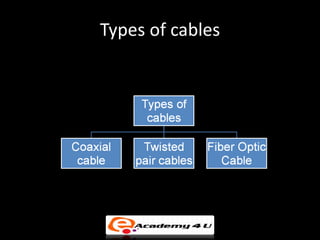
Types of cables
Coaxial cable
• Consist of a solid copper core surrounded by an
  insulator mainly made up of Poly Vinyl Chloride
  (PVC) or Teflon
• Coaxial cables are less prone to interference (both
  internal and external)
Types of Coaxial cable
• Coaxial cables are mainly divided into four
  categories
                            Types of
                          Coaxial cables


          RG58         RG8             RG6      RG59
RG58
• Maximum segment length is 200 meters
• Interference protection is better than twisted pair
  cables
• Offers resistance of 50 ohms
• BNC-T connector is used to connect this cable
• Used in thinnet (10BASE2) network
• Mostly used in changing environments
• Easy to add/remove devices form the network using
  RG58 cable
• Cheapest form of coaxial cable
RG8
• Maximum segment length is 500 meters
• Interference protection is good compared to any
  copper cable
• Offers resistance of 50 ohms
• AUI and Vampire Tap connector is used to connect
  this cable
• Used in 10BASE5 network
• Expensive than RG58
• Disadvantage is rigidness due to which it is only used
  as a backbone
RG6
• Broadband quad-shielded
  cable that offers an
  impedance of 75 ohms
• Provides lower attenuation
  characteristics
• Useful in cable TV, CCTV
  and satellite dish antenna
• Covers distance up to 1500
  feet (450m approx)
RG59
• Solid conductor is surrounded by a
  foam polyethylene dielectric
• Offers impedance of 75 ohm and
  used with BNC connector
• Useful in security camera, cable TV
  and home theatre
• Covers a distance up to 1000 feet
  (300m approx)
• Has a higher attenuation as
  compared to other coaxial cables
Twisted Pair Cables
• A pair of cables twisted around each other forms a
  twisted pair cable.


                       Twisted Pair cables


               Unshielded              Shielded
               Twisted Pair           Twisted pair
UTP Cables
• Pair of unshielded wires
  wound around each other
• Cheapest form of cables
  available for networking
  purpose
• Highly used in LAN
  environments
• Easy to install
• Easily gets affected by EMI
  and RFI
UTP Cables
•   Maximum cable length – 100m
•   Bandwidth – 100 Mbps
•   Connector – RJ45
•   Bend Radius – 360 degree/feet
•   Resistance – 50 ohm
•   Signal Transmission Mode - Baseband
UTP cable types
•   CAT1 – telephone cable
•   CAT2 – 4 Mbps
•   CAT3 – 10 Mbps, 16 MHz (10 Base T)
•   CAT4 – 16 Mbps, 20 MHz (Token Ring)
•   CAT5 – 100 Mbps, 100 MHz (100 Base T)
•   CAT5e – 1000 Mbps, 100 MHz (22 Gauge)
•   CAT6 – 1000 Mbps, 250 MHz (24 Gauge)
•   CAT7 – 600 MHz
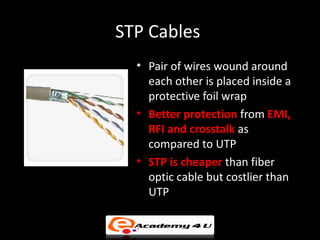
STP Cables
  • Pair of wires wound around
    each other is placed inside a
    protective foil wrap
  • Better protection from EMI,
    RFI and crosstalk as
    compared to UTP
  • STP is cheaper than fiber
    optic cable but costlier than
    UTP
Types of STP Cables
• CAT5e – Operates at 350 MHz and carries data up to
  1000 Mbps
• 150 Ohm Shielded Cable – Operates at 16 MHz
Fiber Optic Cable
• Bandwidth – Carries large amount of data ranging
  from 100 Mbps to 1 Gbps
• Segment Length – Transmits data signals over larger
  distance (2 – 100 K.M.)
• Interference – No electric signals pass through these
  types of cables thus providing security. Used in areas
  that are highly susceptible to noise, e.g. near TV
  towers, radio stations and electric transformer.
Fiber Optic Cable Types
• Fiber optic cables can carry signals in a single
  direction.
• Light signals are turned on and off in order to
  transmit data
                       Fiber Optic Cable
                             Types


               Single Mode            Multi mode
Single Mode Fiber Optic cable
• A type of cable that has only a single strand of glass
  fiber with a thin diameter.
• Fiber optic cables that use lasers are known as single
  mode cable.
• Data can be transmitted at higher speeds and over
  long distances
Multi Mode Fiber Optic cable
• A type of cable that contains a glass fiber with a
  larger diameter.
• It is a 62.5/125 micrometer fiber cable.
Multi Mode Fiber Optic cable
• Multiple modes of light signals can be propagated
  through it
• Transmits data over short distances
• Use LEDs as source of light
• Used to transmit two or more signals using a single
  fiber
• Speed is less as compared to single mode fiber optic
  cable
• Widely used now a days

Network cable

  • 1.
  • 2.
  • 3.
    Coaxial cable • Consistof a solid copper core surrounded by an insulator mainly made up of Poly Vinyl Chloride (PVC) or Teflon • Coaxial cables are less prone to interference (both internal and external)
  • 4.
    Types of Coaxialcable • Coaxial cables are mainly divided into four categories Types of Coaxial cables RG58 RG8 RG6 RG59
  • 5.
    RG58 • Maximum segmentlength is 200 meters • Interference protection is better than twisted pair cables • Offers resistance of 50 ohms • BNC-T connector is used to connect this cable • Used in thinnet (10BASE2) network • Mostly used in changing environments • Easy to add/remove devices form the network using RG58 cable • Cheapest form of coaxial cable
  • 6.
    RG8 • Maximum segmentlength is 500 meters • Interference protection is good compared to any copper cable • Offers resistance of 50 ohms • AUI and Vampire Tap connector is used to connect this cable • Used in 10BASE5 network • Expensive than RG58 • Disadvantage is rigidness due to which it is only used as a backbone
  • 7.
    RG6 • Broadband quad-shielded cable that offers an impedance of 75 ohms • Provides lower attenuation characteristics • Useful in cable TV, CCTV and satellite dish antenna • Covers distance up to 1500 feet (450m approx)
  • 8.
    RG59 • Solid conductoris surrounded by a foam polyethylene dielectric • Offers impedance of 75 ohm and used with BNC connector • Useful in security camera, cable TV and home theatre • Covers a distance up to 1000 feet (300m approx) • Has a higher attenuation as compared to other coaxial cables
  • 9.
    Twisted Pair Cables •A pair of cables twisted around each other forms a twisted pair cable. Twisted Pair cables Unshielded Shielded Twisted Pair Twisted pair
  • 10.
    UTP Cables • Pairof unshielded wires wound around each other • Cheapest form of cables available for networking purpose • Highly used in LAN environments • Easy to install • Easily gets affected by EMI and RFI
  • 11.
    UTP Cables • Maximum cable length – 100m • Bandwidth – 100 Mbps • Connector – RJ45 • Bend Radius – 360 degree/feet • Resistance – 50 ohm • Signal Transmission Mode - Baseband
  • 12.
    UTP cable types • CAT1 – telephone cable • CAT2 – 4 Mbps • CAT3 – 10 Mbps, 16 MHz (10 Base T) • CAT4 – 16 Mbps, 20 MHz (Token Ring) • CAT5 – 100 Mbps, 100 MHz (100 Base T) • CAT5e – 1000 Mbps, 100 MHz (22 Gauge) • CAT6 – 1000 Mbps, 250 MHz (24 Gauge) • CAT7 – 600 MHz
  • 13.
    STP Cables • Pair of wires wound around each other is placed inside a protective foil wrap • Better protection from EMI, RFI and crosstalk as compared to UTP • STP is cheaper than fiber optic cable but costlier than UTP
  • 14.
    Types of STPCables • CAT5e – Operates at 350 MHz and carries data up to 1000 Mbps • 150 Ohm Shielded Cable – Operates at 16 MHz
  • 15.
    Fiber Optic Cable •Bandwidth – Carries large amount of data ranging from 100 Mbps to 1 Gbps • Segment Length – Transmits data signals over larger distance (2 – 100 K.M.) • Interference – No electric signals pass through these types of cables thus providing security. Used in areas that are highly susceptible to noise, e.g. near TV towers, radio stations and electric transformer.
  • 16.
    Fiber Optic CableTypes • Fiber optic cables can carry signals in a single direction. • Light signals are turned on and off in order to transmit data Fiber Optic Cable Types Single Mode Multi mode
  • 17.
    Single Mode FiberOptic cable • A type of cable that has only a single strand of glass fiber with a thin diameter. • Fiber optic cables that use lasers are known as single mode cable. • Data can be transmitted at higher speeds and over long distances
  • 18.
    Multi Mode FiberOptic cable • A type of cable that contains a glass fiber with a larger diameter. • It is a 62.5/125 micrometer fiber cable.
  • 19.
    Multi Mode FiberOptic cable • Multiple modes of light signals can be propagated through it • Transmits data over short distances • Use LEDs as source of light • Used to transmit two or more signals using a single fiber • Speed is less as compared to single mode fiber optic cable • Widely used now a days