Contrast
THIS IS THEDIFFERENCE IN LIGHT INTENSITY BETWEEN
BLACK AND WHITE PARTS OF THE PICTURE OVER
AVERAGE BRIGHTNESS .
WITH CONTRAST CONTRAST NOT
ADJUSTED
Luminance
THIS IS THEAMOUNT OF LIGHT INTENSITY
PERCEIVED BY THE EYE REGARDLESS OF
COLOUR.
9.
Hue or Tint
THECOLOUR ITSELF IS CALLED HUE AND
DEPENDS ON DOMINANT WAVELENGTH OF
THE LIGHT.
ALL COLOURS E.G. RED ,YELLOW, GREEN ARE
HUES.
10.
Saturation
IT REPRESENTS THEPURITY OF COLOUR.
A FULLY SATURATED COLOUR WILL HAVE NO
WHITE LIGHT PRESENT IN IT. E.G. PURE RED,
GREEN, BLUE.
11.
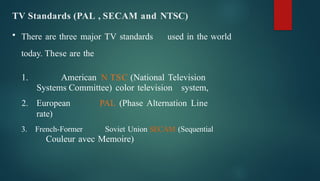
TV Standards (PAL, SECAM and NTSC)
• There are three major TV standards used in the world
today. These are the
1. American N TSC (National Television
Systems Committee) color television system,
2. European PAL (Phase Alternation Line
rate)
3. French-Former Soviet Union SECAM (Sequential
Couleur avec Memoire)
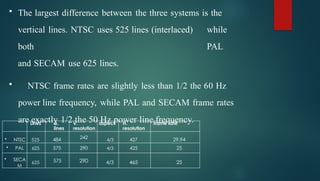
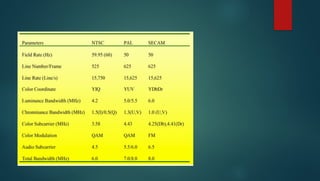
• The largestdifference between the three systems is the
vertical lines. NTSC uses 525 lines (interlaced) while
both PAL
and SECAM use 625 lines.
• NTSC frame rates are slightly less than 1/2 the 60 Hz
power line frequency, while PAL and SECAM frame rates
are exactly 1/2 the 50 Hz power line frequency.
Lines a.
lines
V.
resolution
aspect H.
resolution
frame rate
• NTSC 525 484 242 4/3 427 29.94
• PAL 625 575 290 4/3 425 25
• SECA
M
625 575 290 4/3 465 25
15.
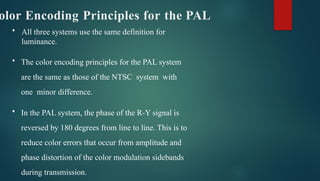
olor Encoding Principlesfor the PAL
• All three systems use the same definition for
luminance.
• The color encoding principles for the PAL system
are the same as those of the NTSC system with
one minor difference.
• In the PAL system, the phase of the R-Y signal is
reversed by 180 degrees from line to line. This is to
reduce color errors that occur from amplitude and
phase distortion of the color modulation sidebands
during transmission.
16.
Color Encoding Principlesfor the SECAM
• SECAM system differs very strongly from PAL
and NTSC
• In SECAM the R-Y and B-Y signals are
transmitted alternately every line. (The Y signal
remains on for each line). Since there is an
odd number of lines on any given scan, any
line will have R-Y information on the first frame
and B-Y on the second.
17.
• Furthermore, theR-Y and B-Y information is
transmitted on different subcarriers. The B-Y sub-
carrier runs at 4.25 MHz and the R-Y subcarrier runs
at 4.4 MHz.
• In order to synchronize the line switching, alternate
R-Y and B-Y sync signals are provided for nine lines
during he vertical blanking interval following
the equalizing pulses after the vertical sync.