Lecture 4: Digital and Analog Audio,
Audio Compression Technology
An Analog audio
An Analog Audio:
• Audio is sound. Sound itself is an analog signal. Thus an analog
audio is an electrical signal that is in the wave format and which
exactly represents the original sound signal.
• The analog audio is recorded on a magnetic tape or gramophone
disc.
• The analog audio is susceptible to noise and distortions. The
quality of analog audio is not very good.
• The quality degrades every time we make a copy
of the analog audio.
• Due to all these problems, the analog audio is
not being used in the modern days.
• Instead every where the digital audio is being
Digital Audio:
• Definition:
• Digital audio is audio or simply sound signal
that has been recorded as or converted into
digital form
• Digital audio generation:
• Digital audio is recorded by taking samples of
the original sound wave at a specific rate.
• Each sampled value is then encoded into a
group of binary bits to convert it into a
digital form.
• This digital audio is then applied to an
audio compressor which compresses it to
reduce its Bit Rate (BR) without reducing its
quality significantly
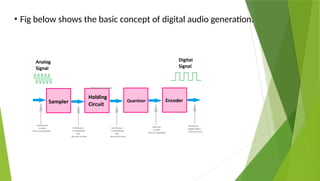
• Fig below shows the basic concept of digital audio generation.
Digital Audio…
• For recording the digital audio contents on a CD. The sampling rate is 44.1k samples/sec,
and each sample encoded to a 16 bit digital word.
• Digital audio is actually the name given to the entire technology used for recording and
reproduction using audio signals that have been
encoded into the digital form.
• In a digital audio system, sound in the
analog electric form is converted into
a digital signal using an Analog to
Digital Converter(ADC). The Pulse
Code Modulation (PCM) technique is
used for such conversion.
• The digital audio signal produced with this
technique can be recorded, edited, modified and
stored on computers or any digital storage device
such as a CD or pen drive or a hard disc.
Reproduction:
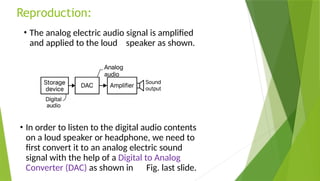
• The analog electric audio signal is amplified
and applied to the loud speaker as shown.
• In order to listen to the digital audio contents
on a loud speaker or headphone, we need to
first convert it to an analog electric sound
signal with the help of a Digital to Analog
Converter (DAC) as shown in Fig. last slide.
• Advantages of Digital Audio :
1. A digital audio can be processed easily.
2.It can be compressed by using a suitable
compression technique which reduces its
storage space and transmission bandwidth.
3.There is no loss of signal quality even if an
infinite number of copies of a digital audio are
made.
4.- Digital audio is less susceptible to errors,
distortion and noise.
5. An optional error correction technique is called
channelcoding
•Conversion Process :
• Digital audio is used in recording,
manipulation, mass- production and
distribution of sound that includes recorded
songs, podcasts, sound effects etc.
• The modern on line music distribution
is based on the digital recording and
data compression.
• With music distribution on, the
Internet, it is not necessary to distribute
music using CDs or tapes.
• Digital audio signal is obtained by sampling the
analog audio at 44.1 kHz and then encoding it
using a DAC in a digital signal at a known bit
resolution.
• A CD audio has a bit resolution of 16-bits for
each stereo channel.
• A digital audio signal maybe either stored or
transmitted
• A digital audio can be stored on a CD, hard
disc or any other digital storage devices.
• A digital audio signal may be altered using digital
signal processing for upsampling,
downsampling, filtering etc
Audio Data Compression
• Need of audio compression
• When audio is convered into a digital audio
signal,it needs a large bandwidth for
transmission and a large space for its storage on
a CD.
• Audio data compression can reduce the
bandwidth requirement as well as the storage
space.
• Therefore some kind of compression technique
is used in the digital audio transmission (on the
internet) or its storage on a CD.
Types of compression
techniques:
• Compression techniques are of two types
1. Lossless compression
2. Lossy Compression
• In the lossless compression there is absolutely
no loss of data. But in the lossy compression
there is a loss of information in a controlled
manner
• The commonly employed audio data
compressive techniques are as follows
1. MP3 (MPEG-1 Audio Layer-3)
2. Advanced audio coding
3. FLAC(Free Lossless Audio Codec)
• These techniques are used to reduce the file
size required to store the digital audio
• MP3 is a lossy type of audio compression
technique
• The perceptual coding is based on frequency
masking principal
• the audio compression is done by sampling the
waveform at 32 kHz, 44.1 kHz or 48 kHz.
• Sampling can be done on one or more channels
in anyone of the following four configurations
1. Monophonic (a single input stream)
2. Dual monophonic (for example an English and
French sound tracks)
3. Disjoint stereo (each channel compressed
separately)
4. joint stereo
A Home theatre
• A home theatre, is an integrated audio,
video system which consists of a DVD or a
Blu ray player, a multichannel amplifier, a set
of five or more surround sound speakers,
speaker wires, connection cables, a
remote control and a subwoofer cabinet.
• Some of the manufacturers of home
theatres are Philips, Sony, Panasonic,
LG, Samsung etc
• The low price Home theatre systems are
called as the "2.1" systems, whereas the
higher quality ones are called as "5.1" or
"7.1" systems.
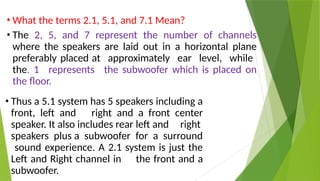
• What the terms 2.1, 5.1, and 7.1 Mean?
• The 2, 5, and 7 represent the number of channels
where the speakers are laid out in a horizontal plane
preferably placed at approximately ear level, while
the. 1 represents the subwoofer which is placed on
the floor.
• Thus a 5.1 system has 5 speakers including a
front, left and right and a front center
speaker. It also includes rear left and right
speakers plus a subwoofer for a surround
sound experience. A 2.1 system is just the
Left and Right channel in the front and a
subwoofer.
A Home theatre ….
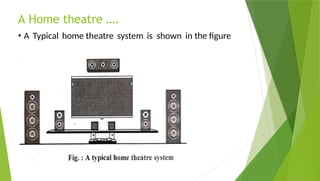
• A Typical home theatre system is shown in the figure
A Home theatre ….
•Features
• The important features of a high end home theatre system
are as follows
• Surround sound speakers
• It does not include a TV or a monitor
• Wireless speakers
• 1080i or 4K video resolution (HD quality video)
• 5 disc platter (the spinning surface that the record is placed on)
• HDMI (High-Definition Multimedia Interface) inputs
• USB (Universal Serial Bus) connectivity
• Bluetooth support
• Wi-Fi support
•Provision of hard disc for recording the TV
shows Advantages
• Home theatre is an all in one way to enjoy the surround
sound experience of home cinema The customer
doesn't have to select different units such as amplifiers,
speakers, cables etc on his own.
• Drawbacks:
• The home theatres lack the features and
tweakabillity of home theatre components which
are available separately in market
• These systems are quite expensive.
Madhav Institute
of
Technology
&
Science
Gwalior (M.P.)
(Deemed to be
University)
Thank You

Audio Compression technology for BTech.pptx

  • 1.
    Lecture 4: Digitaland Analog Audio, Audio Compression Technology
  • 2.
    An Analog audio AnAnalog Audio: • Audio is sound. Sound itself is an analog signal. Thus an analog audio is an electrical signal that is in the wave format and which exactly represents the original sound signal. • The analog audio is recorded on a magnetic tape or gramophone disc. • The analog audio is susceptible to noise and distortions. The quality of analog audio is not very good. • The quality degrades every time we make a copy of the analog audio. • Due to all these problems, the analog audio is not being used in the modern days. • Instead every where the digital audio is being
  • 3.
    Digital Audio: • Definition: •Digital audio is audio or simply sound signal that has been recorded as or converted into digital form • Digital audio generation: • Digital audio is recorded by taking samples of the original sound wave at a specific rate. • Each sampled value is then encoded into a group of binary bits to convert it into a digital form. • This digital audio is then applied to an audio compressor which compresses it to reduce its Bit Rate (BR) without reducing its quality significantly
  • 4.
    • Fig belowshows the basic concept of digital audio generation.
  • 5.
    Digital Audio… • Forrecording the digital audio contents on a CD. The sampling rate is 44.1k samples/sec, and each sample encoded to a 16 bit digital word. • Digital audio is actually the name given to the entire technology used for recording and reproduction using audio signals that have been encoded into the digital form. • In a digital audio system, sound in the analog electric form is converted into a digital signal using an Analog to Digital Converter(ADC). The Pulse Code Modulation (PCM) technique is used for such conversion.
  • 6.
    • The digitalaudio signal produced with this technique can be recorded, edited, modified and stored on computers or any digital storage device such as a CD or pen drive or a hard disc.
  • 7.
    Reproduction: • The analogelectric audio signal is amplified and applied to the loud speaker as shown. • In order to listen to the digital audio contents on a loud speaker or headphone, we need to first convert it to an analog electric sound signal with the help of a Digital to Analog Converter (DAC) as shown in Fig. last slide.
  • 8.
    • Advantages ofDigital Audio : 1. A digital audio can be processed easily. 2.It can be compressed by using a suitable compression technique which reduces its storage space and transmission bandwidth. 3.There is no loss of signal quality even if an infinite number of copies of a digital audio are made. 4.- Digital audio is less susceptible to errors, distortion and noise. 5. An optional error correction technique is called channelcoding
  • 9.
    •Conversion Process : •Digital audio is used in recording, manipulation, mass- production and distribution of sound that includes recorded songs, podcasts, sound effects etc. • The modern on line music distribution is based on the digital recording and data compression. • With music distribution on, the Internet, it is not necessary to distribute music using CDs or tapes.
  • 10.
    • Digital audiosignal is obtained by sampling the analog audio at 44.1 kHz and then encoding it using a DAC in a digital signal at a known bit resolution. • A CD audio has a bit resolution of 16-bits for each stereo channel. • A digital audio signal maybe either stored or transmitted • A digital audio can be stored on a CD, hard disc or any other digital storage devices. • A digital audio signal may be altered using digital signal processing for upsampling, downsampling, filtering etc
  • 11.
    Audio Data Compression •Need of audio compression • When audio is convered into a digital audio signal,it needs a large bandwidth for transmission and a large space for its storage on a CD. • Audio data compression can reduce the bandwidth requirement as well as the storage space. • Therefore some kind of compression technique is used in the digital audio transmission (on the internet) or its storage on a CD.
  • 12.
    Types of compression techniques: •Compression techniques are of two types 1. Lossless compression 2. Lossy Compression • In the lossless compression there is absolutely no loss of data. But in the lossy compression there is a loss of information in a controlled manner
  • 13.
    • The commonlyemployed audio data compressive techniques are as follows 1. MP3 (MPEG-1 Audio Layer-3) 2. Advanced audio coding 3. FLAC(Free Lossless Audio Codec) • These techniques are used to reduce the file size required to store the digital audio • MP3 is a lossy type of audio compression technique
  • 14.
    • The perceptualcoding is based on frequency masking principal • the audio compression is done by sampling the waveform at 32 kHz, 44.1 kHz or 48 kHz. • Sampling can be done on one or more channels in anyone of the following four configurations 1. Monophonic (a single input stream) 2. Dual monophonic (for example an English and French sound tracks) 3. Disjoint stereo (each channel compressed separately) 4. joint stereo
  • 15.
    A Home theatre •A home theatre, is an integrated audio, video system which consists of a DVD or a Blu ray player, a multichannel amplifier, a set of five or more surround sound speakers, speaker wires, connection cables, a remote control and a subwoofer cabinet. • Some of the manufacturers of home theatres are Philips, Sony, Panasonic, LG, Samsung etc • The low price Home theatre systems are called as the "2.1" systems, whereas the higher quality ones are called as "5.1" or "7.1" systems.
  • 16.
    • What theterms 2.1, 5.1, and 7.1 Mean? • The 2, 5, and 7 represent the number of channels where the speakers are laid out in a horizontal plane preferably placed at approximately ear level, while the. 1 represents the subwoofer which is placed on the floor. • Thus a 5.1 system has 5 speakers including a front, left and right and a front center speaker. It also includes rear left and right speakers plus a subwoofer for a surround sound experience. A 2.1 system is just the Left and Right channel in the front and a subwoofer.
  • 17.
    A Home theatre…. • A Typical home theatre system is shown in the figure
  • 18.
    A Home theatre…. •Features • The important features of a high end home theatre system are as follows • Surround sound speakers • It does not include a TV or a monitor • Wireless speakers • 1080i or 4K video resolution (HD quality video)
  • 19.
    • 5 discplatter (the spinning surface that the record is placed on) • HDMI (High-Definition Multimedia Interface) inputs • USB (Universal Serial Bus) connectivity • Bluetooth support • Wi-Fi support •Provision of hard disc for recording the TV shows Advantages • Home theatre is an all in one way to enjoy the surround sound experience of home cinema The customer doesn't have to select different units such as amplifiers, speakers, cables etc on his own. • Drawbacks: • The home theatres lack the features and tweakabillity of home theatre components which are available separately in market • These systems are quite expensive.
  • 20.