Lecture No.8
Drawing
By
Ass. Lect. Ali H. Almaily
enginerali1989@gmail.com
8.1Wire and Bar Drawing:
Drawing is an operation in which the cross section of a bar, rod, or wire is reduced by pulling it
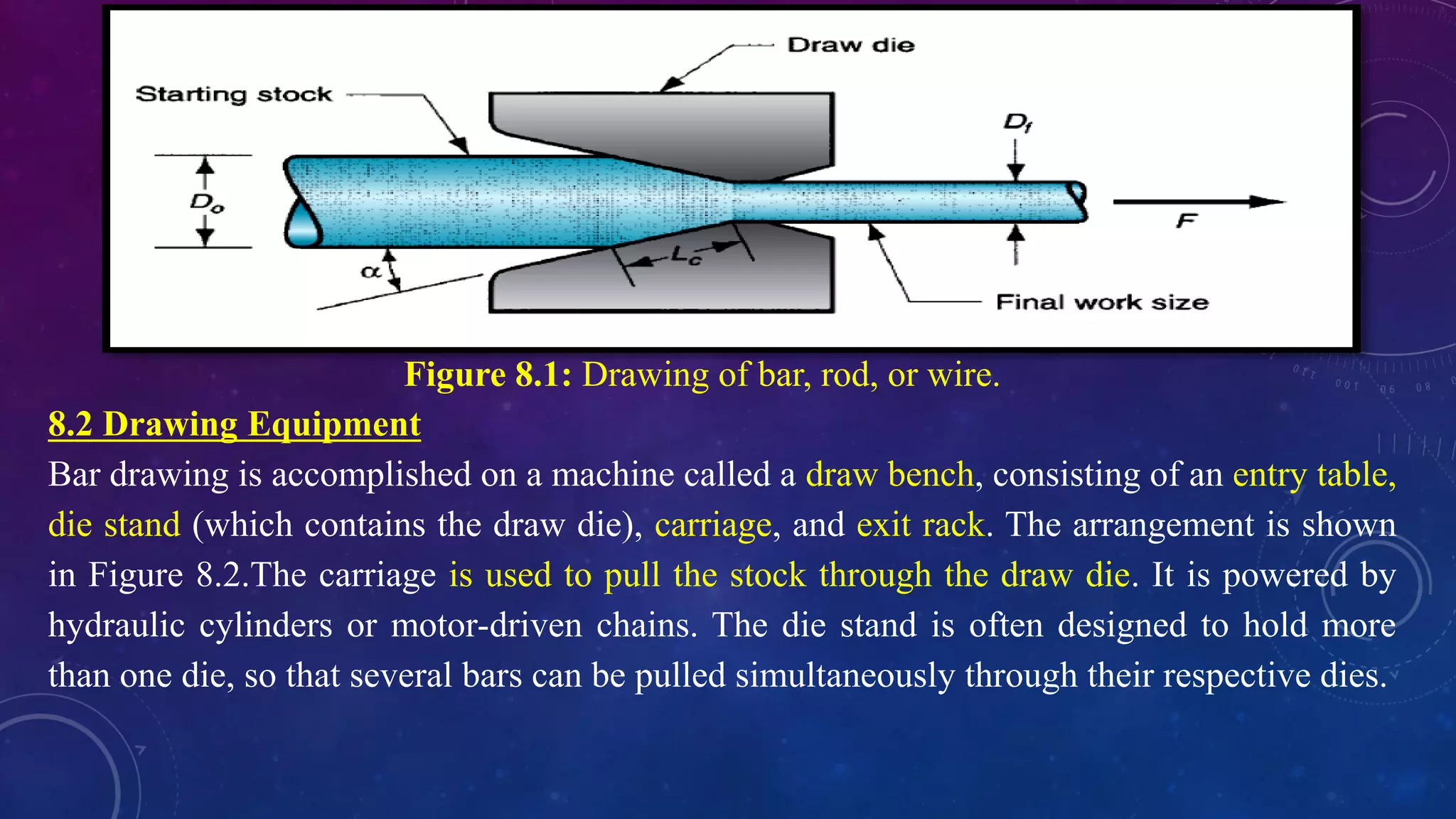
through a die opening, as in Figure (8.1). The general features of the process are similar to
those of extrusion. The difference is that:
1-The work is pulled through the die in drawing, whereas it is pushed through the die in
extrusion.
2-Although the presence of tensile stresses is obvious in drawing, compression also plays a
significant role because the metal is squeezed down as it passes through the die opening.
For this reason, the deformation that occurs in drawing is sometimes referred to as indirect
compression.
The basic difference between bar drawing and wire drawing is the stock size that is
processed. Bar drawing is the term used for large diameter bar and rod stock, while wire
drawing applies to small diameter stock. Wire sizes down to 0.03 mm are possible in wire
drawing.
stock
 The term continuous drawing is used to describe this type of operation because of the
long production runs that are achieved with the wire coils.
Drawing is usually performed as a cold working operation. It is most frequently used to
produce round cross sections, but squares and other shapes are also drawn. Wire drawing
is an important industrial process, providing commercial products such as electrical wire
and cable; and rod stock to produce nails, screws, rivets, springs, and other hardware
items. Advantages of drawing in these applications include:
(1) Close dimensional control.
(2) Good surface finish.
(3) Improved mechanical properties such as strength and hardness. And,
(4) Adaptability to economical batch or mass production.
Figure 8.1: Drawing of bar, rod, or wire.
8.2 Drawing Equipment
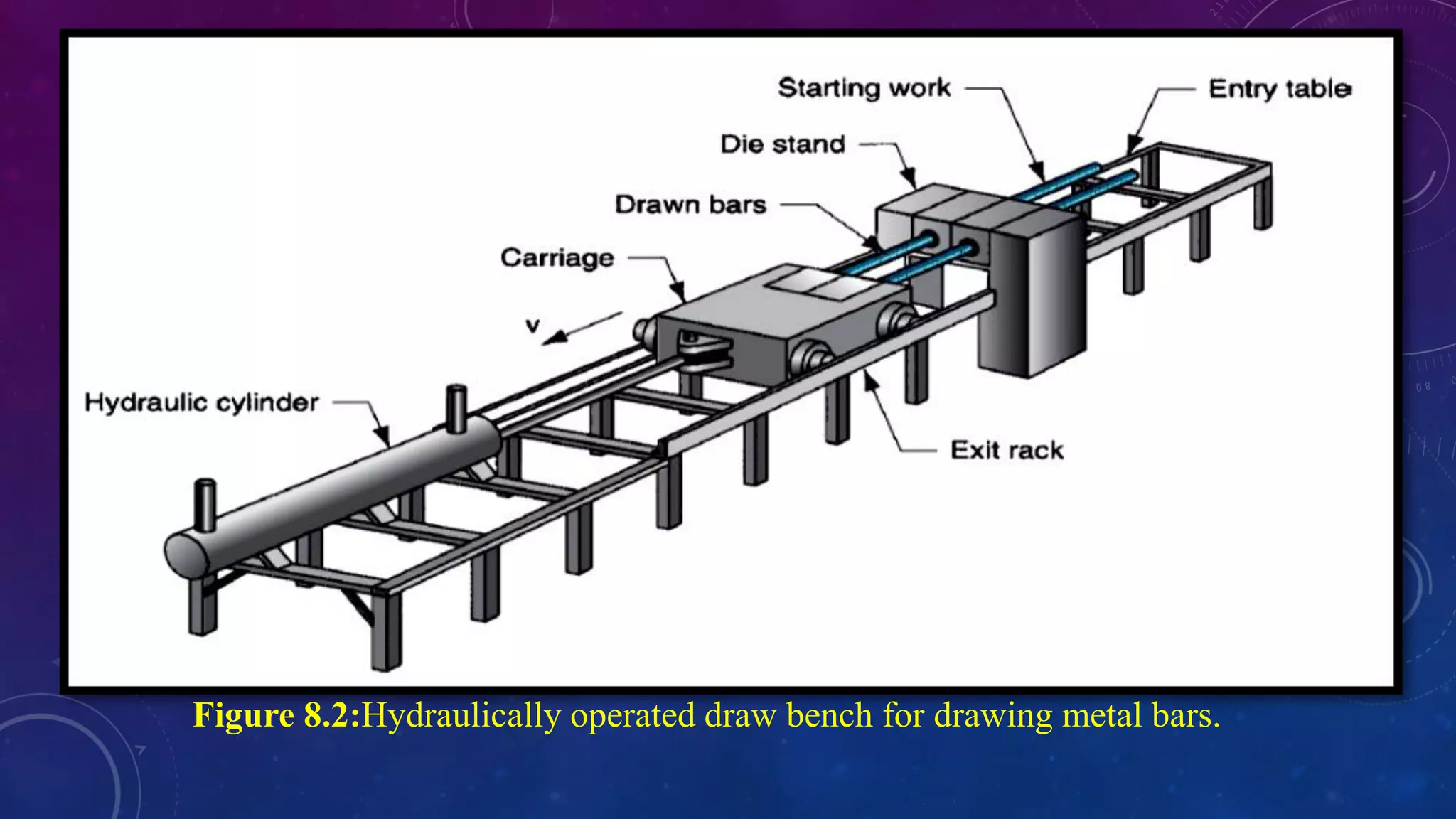
Bar drawing is accomplished on a machine called a draw bench, consisting of an entry table,
die stand (which contains the draw die), carriage, and exit rack. The arrangement is shown
in Figure 8.2.The carriage is used to pull the stock through the draw die. It is powered by
hydraulic cylinders or motor-driven chains. The die stand is often designed to hold more
than one die, so that several bars can be pulled simultaneously through their respective dies.
Figure 8.2:Hydraulically operated draw bench for drawing metal bars.
8.3Wire drawing
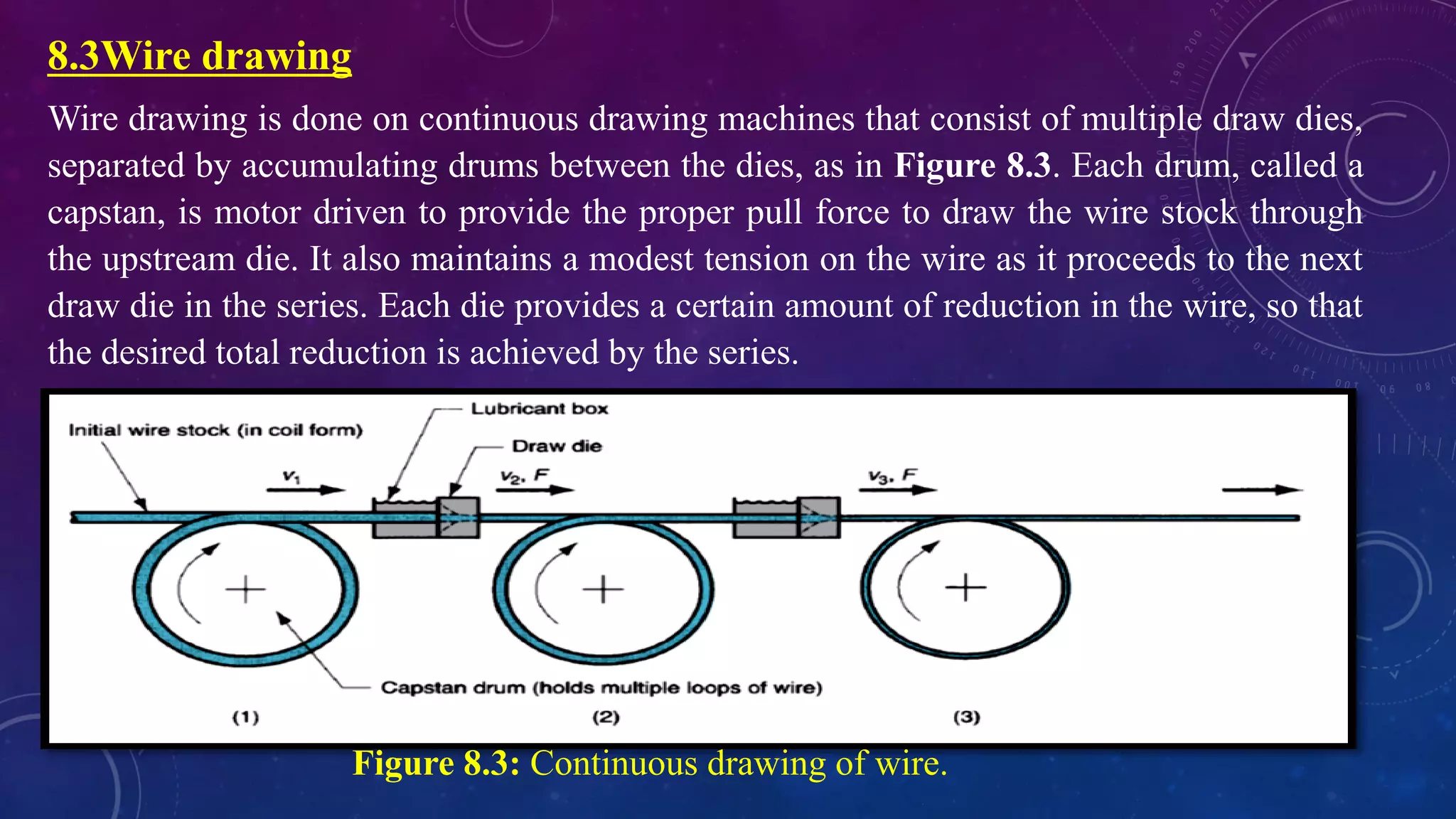
Wire drawing is done on continuous drawing machines that consist of multiple draw dies,
separated by accumulating drums between the dies, as in Figure 8.3. Each drum, called a
capstan, is motor driven to provide the proper pull force to draw the wire stock through
the upstream die. It also maintains a modest tension on the wire as it proceeds to the next
draw die in the series. Each die provides a certain amount of reduction in the wire, so that
the desired total reduction is achieved by the series.
Figure 8.3: Continuous drawing of wire.
8.4 Tube Drawing:
Drawing can be used to reduce the diameter or wall thickness of seamless tubes, after the
initial tubing has been produced by some other process such as extrusion. Tube drawing can
be carried out either with or without a mandrel. The simplest method uses no mandrel and is
used for diameter reduction, as in Figure 8.4.
Figure 8.4 Tube drawing with on mandrel (tube sinking).
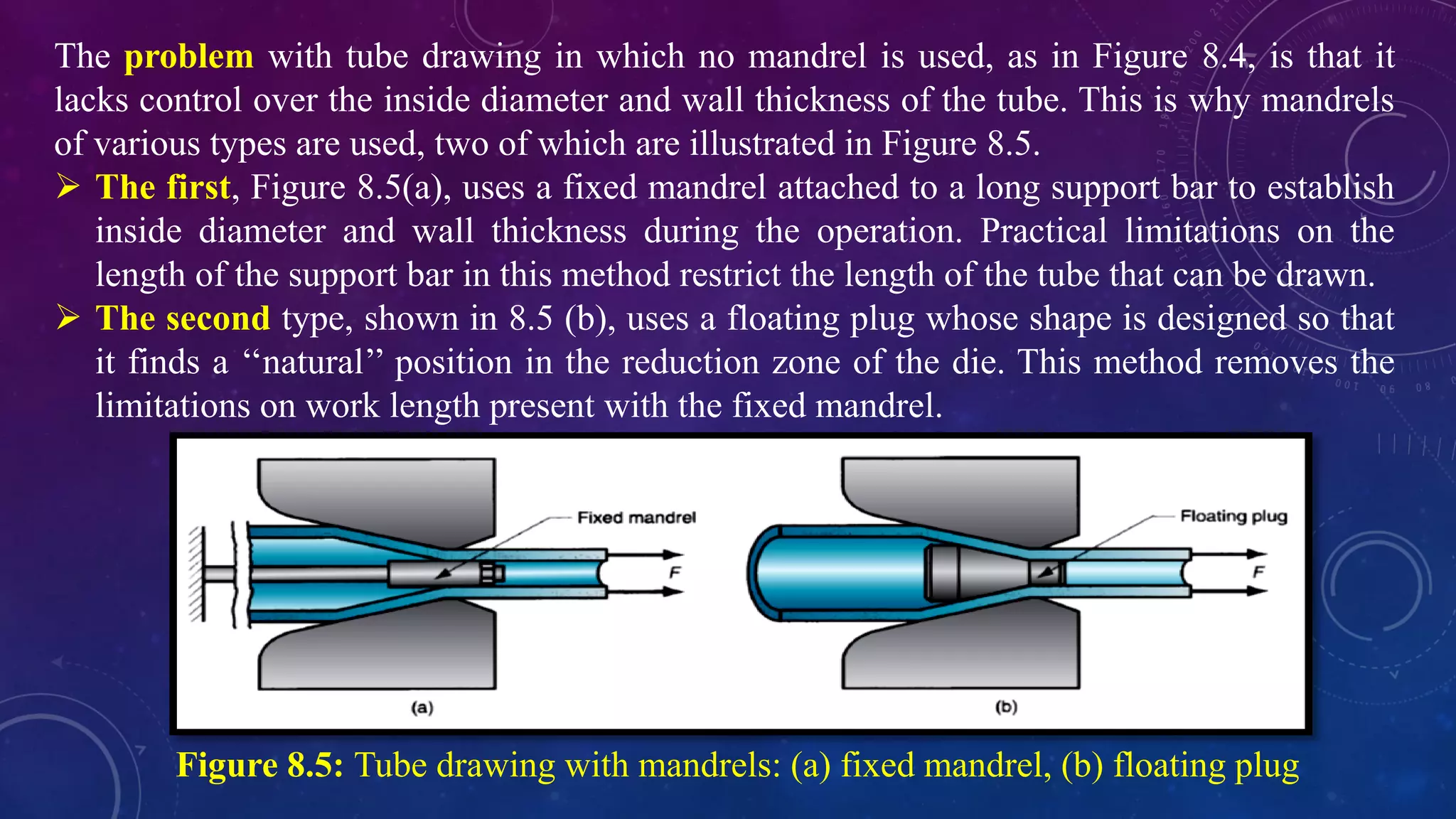
The problem with tube drawing in which no mandrel is used, as in Figure 8.4, is that it
lacks control over the inside diameter and wall thickness of the tube. This is why mandrels
of various types are used, two of which are illustrated in Figure 8.5.
 The first, Figure 8.5(a), uses a fixed mandrel attached to a long support bar to establish
inside diameter and wall thickness during the operation. Practical limitations on the
length of the support bar in this method restrict the length of the tube that can be drawn.
 The second type, shown in 8.5 (b), uses a floating plug whose shape is designed so that
it finds a ‘‘natural’’ position in the reduction zone of the die. This method removes the
limitations on work length present with the fixed mandrel.
Figure 8.5: Tube drawing with mandrels: (a) fixed mandrel, (b) floating plug
8.5 Analysis of Drawing
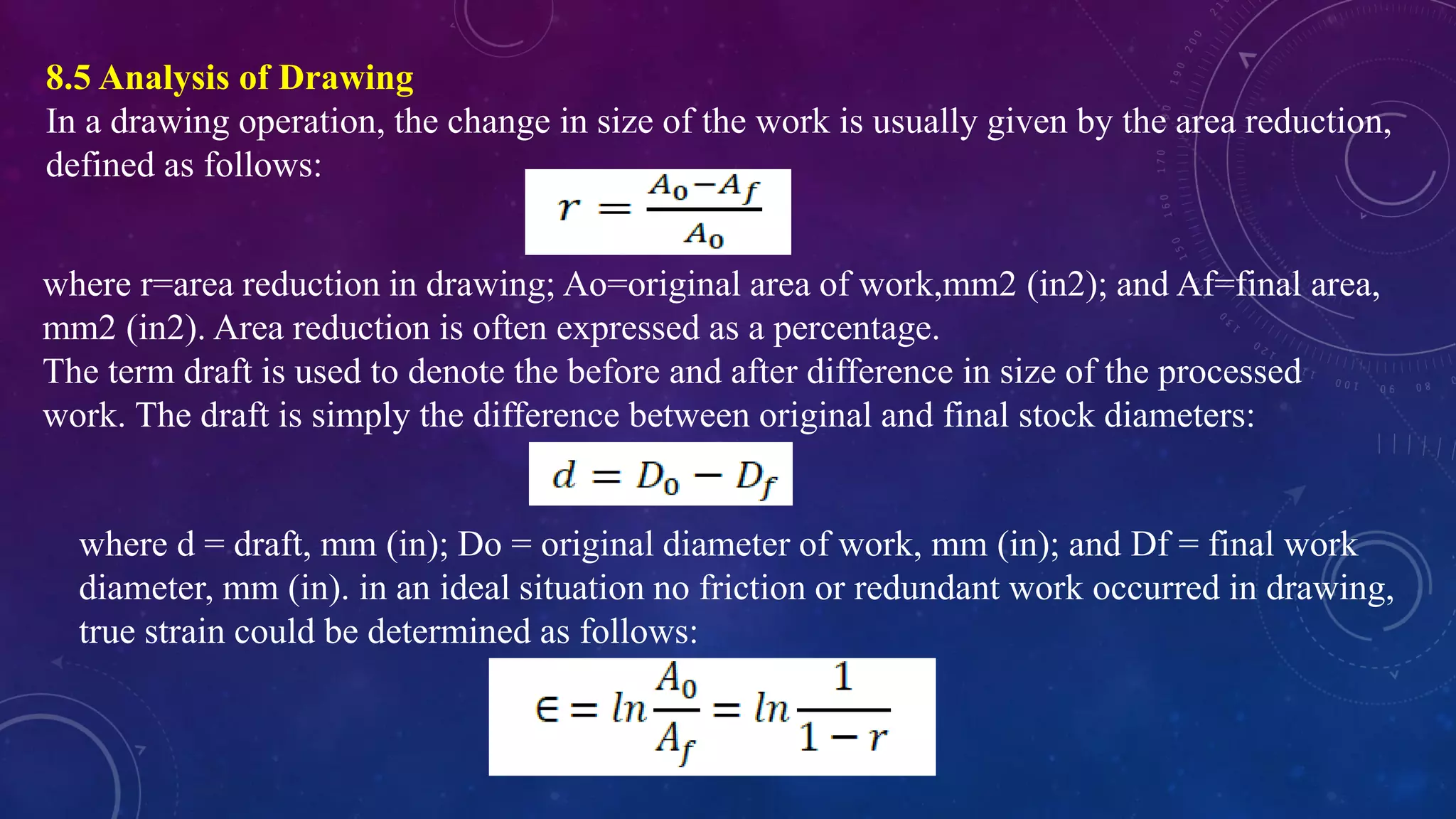
In a drawing operation, the change in size of the work is usually given by the area reduction,
defined as follows:
where r=area reduction in drawing; Ao=original area of work,mm2 (in2); and Af=final area,
mm2 (in2). Area reduction is often expressed as a percentage.
The term draft is used to denote the before and after difference in size of the processed
work. The draft is simply the difference between original and final stock diameters:
where d = draft, mm (in); Do = original diameter of work, mm (in); and Df = final work
diameter, mm (in). in an ideal situation no friction or redundant work occurred in drawing,
true strain could be determined as follows:
Where Ao and Af are the original and final cross-sectional areas of the work, as previously
defined; and r =drawing reduction . The stress that results from this ideal deformation is
given by:
Where average flow stress due to true strain. Because friction is present in drawing and
the work metal experiences inhomogeneous deformation, A number of methods have been
proposed for predicting draw stress we present the equation suggested by Schey:
Where D = average diameter of work during drawing, mm(in); and Lc = contact length of
the work with the draw die in Figure 8.1,mm(in).Values of D and Lc can be determined
from the following:
The draw force is then the area of the drawn cross section multiplied by the draw stress:
Where F = draw force, N (lb); and the other terms are defined above. The power required
in a drawing operation is the draw force multiplied by exit velocity of the work.
Example 8.1: Wire is drawn through a draw die with entrance angle =15 . Starting diameter is
2.5mm and final diameter = 2.0 mm. The coefficient of friction at the work–die interface =
0.07. The metal has a strength coefficient K = 205 MPa and a strain-hardening exponent n =
0.20. Determine the draw stress and draw force in this operation.
Solution: The values of D= 2.25 mm and Lc =0.966 mm. Thus,
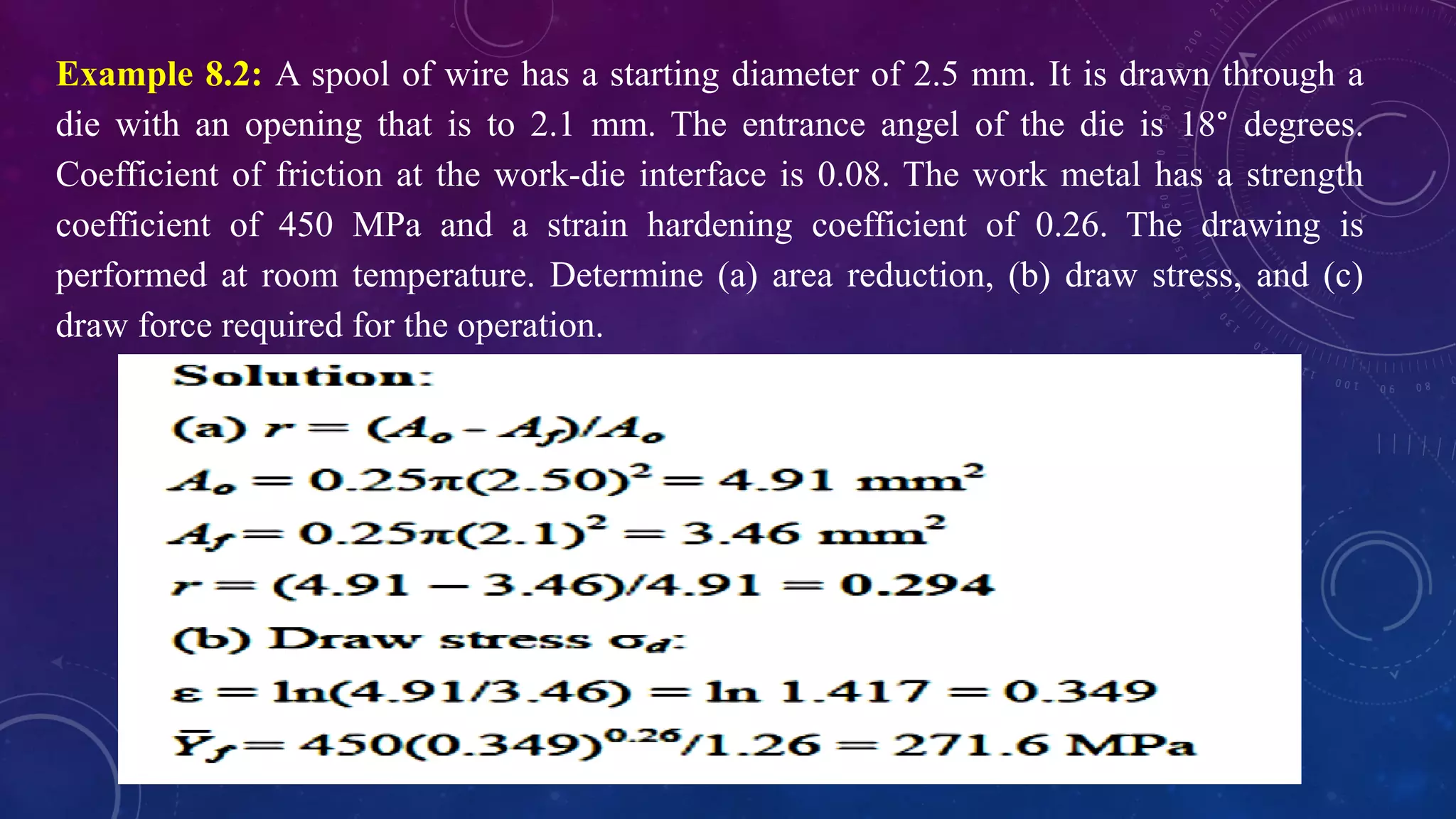
Example 8.2: A spool of wire has a starting diameter of 2.5 mm. It is drawn through a
die with an opening that is to 2.1 mm. The entrance angel of the die is 18° degrees.
Coefficient of friction at the work-die interface is 0.08. The work metal has a strength
coefficient of 450 MPa and a strain hardening coefficient of 0.26. The drawing is
performed at room temperature. Determine (a) area reduction, (b) draw stress, and (c)
draw force required for the operation.
  Wire and bar Drawing

Wire and bar Drawing

  • 1.
    Lecture No.8 Drawing By Ass. Lect.Ali H. Almaily enginerali1989@gmail.com
  • 2.
    8.1Wire and BarDrawing: Drawing is an operation in which the cross section of a bar, rod, or wire is reduced by pulling it through a die opening, as in Figure (8.1). The general features of the process are similar to those of extrusion. The difference is that: 1-The work is pulled through the die in drawing, whereas it is pushed through the die in extrusion. 2-Although the presence of tensile stresses is obvious in drawing, compression also plays a significant role because the metal is squeezed down as it passes through the die opening. For this reason, the deformation that occurs in drawing is sometimes referred to as indirect compression. The basic difference between bar drawing and wire drawing is the stock size that is processed. Bar drawing is the term used for large diameter bar and rod stock, while wire drawing applies to small diameter stock. Wire sizes down to 0.03 mm are possible in wire drawing. stock
  • 3.
     The termcontinuous drawing is used to describe this type of operation because of the long production runs that are achieved with the wire coils. Drawing is usually performed as a cold working operation. It is most frequently used to produce round cross sections, but squares and other shapes are also drawn. Wire drawing is an important industrial process, providing commercial products such as electrical wire and cable; and rod stock to produce nails, screws, rivets, springs, and other hardware items. Advantages of drawing in these applications include: (1) Close dimensional control. (2) Good surface finish. (3) Improved mechanical properties such as strength and hardness. And, (4) Adaptability to economical batch or mass production.
  • 4.
    Figure 8.1: Drawingof bar, rod, or wire. 8.2 Drawing Equipment Bar drawing is accomplished on a machine called a draw bench, consisting of an entry table, die stand (which contains the draw die), carriage, and exit rack. The arrangement is shown in Figure 8.2.The carriage is used to pull the stock through the draw die. It is powered by hydraulic cylinders or motor-driven chains. The die stand is often designed to hold more than one die, so that several bars can be pulled simultaneously through their respective dies.
  • 5.
    Figure 8.2:Hydraulically operateddraw bench for drawing metal bars.
  • 6.
    8.3Wire drawing Wire drawingis done on continuous drawing machines that consist of multiple draw dies, separated by accumulating drums between the dies, as in Figure 8.3. Each drum, called a capstan, is motor driven to provide the proper pull force to draw the wire stock through the upstream die. It also maintains a modest tension on the wire as it proceeds to the next draw die in the series. Each die provides a certain amount of reduction in the wire, so that the desired total reduction is achieved by the series. Figure 8.3: Continuous drawing of wire.
  • 7.
    8.4 Tube Drawing: Drawingcan be used to reduce the diameter or wall thickness of seamless tubes, after the initial tubing has been produced by some other process such as extrusion. Tube drawing can be carried out either with or without a mandrel. The simplest method uses no mandrel and is used for diameter reduction, as in Figure 8.4. Figure 8.4 Tube drawing with on mandrel (tube sinking).
  • 8.
    The problem withtube drawing in which no mandrel is used, as in Figure 8.4, is that it lacks control over the inside diameter and wall thickness of the tube. This is why mandrels of various types are used, two of which are illustrated in Figure 8.5.  The first, Figure 8.5(a), uses a fixed mandrel attached to a long support bar to establish inside diameter and wall thickness during the operation. Practical limitations on the length of the support bar in this method restrict the length of the tube that can be drawn.  The second type, shown in 8.5 (b), uses a floating plug whose shape is designed so that it finds a ‘‘natural’’ position in the reduction zone of the die. This method removes the limitations on work length present with the fixed mandrel. Figure 8.5: Tube drawing with mandrels: (a) fixed mandrel, (b) floating plug
  • 9.
    8.5 Analysis ofDrawing In a drawing operation, the change in size of the work is usually given by the area reduction, defined as follows: where r=area reduction in drawing; Ao=original area of work,mm2 (in2); and Af=final area, mm2 (in2). Area reduction is often expressed as a percentage. The term draft is used to denote the before and after difference in size of the processed work. The draft is simply the difference between original and final stock diameters: where d = draft, mm (in); Do = original diameter of work, mm (in); and Df = final work diameter, mm (in). in an ideal situation no friction or redundant work occurred in drawing, true strain could be determined as follows:
  • 10.
    Where Ao andAf are the original and final cross-sectional areas of the work, as previously defined; and r =drawing reduction . The stress that results from this ideal deformation is given by: Where average flow stress due to true strain. Because friction is present in drawing and the work metal experiences inhomogeneous deformation, A number of methods have been proposed for predicting draw stress we present the equation suggested by Schey:
  • 11.
    Where D =average diameter of work during drawing, mm(in); and Lc = contact length of the work with the draw die in Figure 8.1,mm(in).Values of D and Lc can be determined from the following: The draw force is then the area of the drawn cross section multiplied by the draw stress: Where F = draw force, N (lb); and the other terms are defined above. The power required in a drawing operation is the draw force multiplied by exit velocity of the work.
  • 12.
    Example 8.1: Wireis drawn through a draw die with entrance angle =15 . Starting diameter is 2.5mm and final diameter = 2.0 mm. The coefficient of friction at the work–die interface = 0.07. The metal has a strength coefficient K = 205 MPa and a strain-hardening exponent n = 0.20. Determine the draw stress and draw force in this operation. Solution: The values of D= 2.25 mm and Lc =0.966 mm. Thus,
  • 13.
    Example 8.2: Aspool of wire has a starting diameter of 2.5 mm. It is drawn through a die with an opening that is to 2.1 mm. The entrance angel of the die is 18° degrees. Coefficient of friction at the work-die interface is 0.08. The work metal has a strength coefficient of 450 MPa and a strain hardening coefficient of 0.26. The drawing is performed at room temperature. Determine (a) area reduction, (b) draw stress, and (c) draw force required for the operation.