Write that Journal Article - in 7 days!
        (or how to be a plotter and a pantser)

Dr Inger Mewburn (a.k.a @thesiswhisperer) & Dr Judy Maxwell
(A caveat…)

You can turn a messy bunch of
'academic stuff’ into an article
quickly… but you must have:

• Data, ideas or artifacts,
• Preliminary analysis or thoughts
Day: Zero
What sort of academic do you want to be?
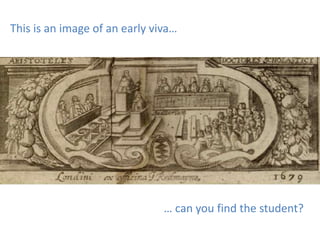
This is an image of an early viva…


                                         … can you find the student?
 RMIT University©2008   Information Technology Services           4
What sort of scholar do you want to be?
Where will I publish?
• Where do people I like to read seem to get
  published?
• Which of these journals seem to get more
  citations? (impact factors)
• Do the editorial guidelines seem sympathetic
  to the work I do?
• What are the open access policies of this
  journal?
Day: One
Choose your flavour…
What sort of paper will you write?
Rugg and Petre (2003) claim journal articles can be
understood as falling into genres:

          – Data Driven
          – Methods Papers
          – Agenda Setting / Consciousness raising papers
          – Review papers
          – Theory papers

Writing in a range of genres shows your versatility as a
scholar.
Data Driven papers should contain:
• What question is being addressed and why?
• A description of the study and how it was
  conducted
• The results (data collected, analysis, findings)
• Discussion (significance, limitations, claims to
  generalisation)
• Conclusion (implications, further work)
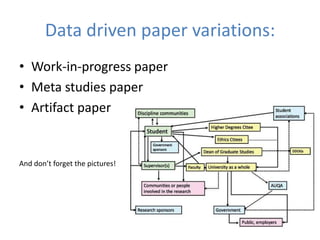
Data driven paper variations:
• Work-in-progress paper
• Meta studies paper
• Artifact paper


And don’t forget the pictures!
Method papers
should contain:
• What it is
• How it works
• What it's good for
  (both utility and how
  it's different)
• Any constraints
• Agenda setting papers
 • Consciousness raising papers


‘Look at me’ papers
Review papers


Are usually written every ten years or
so - when someone (like a thesis
writer!) "bothers to read everything in
a field" again summarises it and
provides evaluative judgment.
Theory papers should:

• Refine or extend
  existing theory and / or
• critique and debunk it
  and / or
• Set an agenda for new
  theory
Audience First!
They WON'T want:
  • Lots of information they already know
  • a long winded literature review
  • lots of process-focused information.

They WILL want:
  • A tight, useful review of the literature
  • Well supported conclusions
  • A clear and well stated contribution to the field
Day: Two
“The tiny text”
An abstract for this workshop
Many Doctoral students have to write journal articles
for their PhD. While there is a lot of written advice on
this topic, it is often hard to follow because it is not put
in context with the daily activities of a professional
writer ( Kamler and Thomson, 2006). This presentation
collects the best parts of this advice and puts them in a
'temporal' frame work, based on days of the week. This
framework helps PhD students see writing a paper as a
purposeful, step wise process, rather than a list of "do's
and don'ts which are hard to operationalise.”
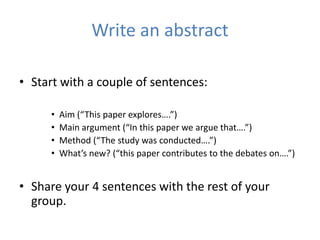
Write an abstract

• Start with a couple of sentences:

     •   Aim (“This paper explores….”)
     •   Main argument (“In this paper we argue that….”)
     •   Method (“The study was conducted….”)
     •   What’s new? (“this paper contributes to the debates on….”)


• Share your 4 sentences with the rest of your
  group.
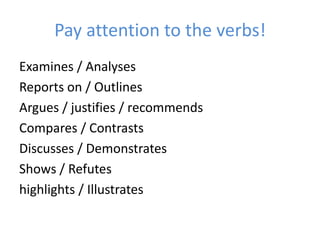
Pay attention to the verbs!
Examines / Analyses
Reports on / Outlines
Argues / justifies / recommends
Compares / Contrasts
Discusses / Demonstrates
Shows / Refutes
highlights / Illustrates
Add a title… for now
Thesis Whisperer Jnr (aged 10 and 1/4) wants to do his PhD about
“rocks” (with a side interest in gold). Dr Barry White advises there are
a range of theses Thesis Whisperer Jnr would write on this topic
depending on how he phrased the title:

• As a question: “What do school children know about rocks with
  gold in them?”
• As an exploration: “Rocks in ‘scrap heaps’ found in the Victorian
  gold districts”
• As a statement: “Why most school kids are not interested in rocks
  (even if there’s gold in them”
• As an investigation: “Rocks with gold in them: places they are most
  likely to be found”
• As a hypothesis: “If rocks have gold in them, they are more likely to
  be dug up”
• As a thesis: “rocks are cool, especially if there is gold in them”
Day: Three
“The spew draft”
What stops us ‘just writing’?

"They feared that what they wrote
would be ‘wrong’ and unspecified
people would laugh at them”
Howard Becker
Have you got useful notes?
• Good note taking helps you to avoid plagiarizing ‘by mistake’

• Ballenger (2004) claims good papers start with good note
  taking. As we write notes (with verbs!) we write parts of the
  paper, which saves time.

• Some note-keeping methods are
                • Researcher log book
                • Double entry note taking
                • Narrative note taking
Free writing
Write as much as you can about “what’s new?”
for 5 minutes.

Just write.

If you are stuck for a word use another
/different / better word and keep writing
How to write 1000 words a day
• Write new stuff just after breakfast and before lunch. Cut
  and paste free writing into / around / through notes you
  already have.

• Use pomodoro technique to focus (25 min writing sprints
  with 10 min breaks between)

• Take the afternoon off

• Come back in the evening, outline, edit and rearrange your
  text
•   http://thethesiswhisperer.wordpress.com/2011/03/24/how-to-write-1000-words-a-day-and-not-go-bat-
    shit-crazy/
Day: Four
“the scratch outline”
The ‘screen
treatment’ method
Title: "Write an article in 7 days"
• explain why you should write
    articles
• talk about the importance of doing
    research to find out the best place
    to publish
• Talk about different types of
    articles in academia
• Talk about the importance of
    audience - explain how academic
    audiences 'work'
• Introduce the idea of a 'tiny text'
    as a way of focusing for your
    audience
• Talk about the value of doing a
    'spew draft'
The Big List
Write everything you have as a list:

  – facts
  – issues
  – detail
  – Findings
Organise these in the best way to tell your story
then delete those that are not essential.
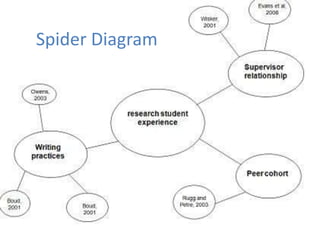
Spider Diagram
Day: Five
“Cleaning up the mess”
Time to reassess
Identify the strengths and weaknesses of your
work so far. Ask yourself:

• Do I have enough literature?
• Am I making 'knowledge claims' or just
  reporting?
• Is this an argument - or a manifesto?
• Is my data sufficient to the claims I am making?
• Am I being sufficiently speculative?
Excessive ‘tinkering’ is a
 deferment strategy. If you find
yourself endlessly 'polishing' and
 not moving on, plan what to do
the next day. Go straight to that
 section next time you open the
 document. At least you will be
  ‘polishing’ where it is needed.
Not working?
You might find yourself bouncing
around between these steps for
awhile. It usually is a sign that you
didn't have enough 'stuff' to make
the kind of paper you are aiming
for, or you lack confidence in your
ideas.
Day: Six
“Murder your darlings”
Stephen King once said: “… kill
your darlings, kill your darlings,
even when it breaks your
egocentric little scribbler’s heart,
kill your darlings.”
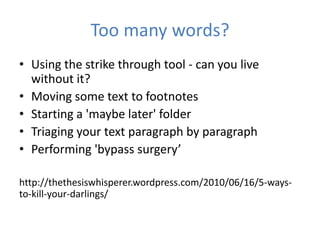
Too many words?
• Using the strike through tool - can you live
  without it?
• Moving some text to footnotes
• Starting a 'maybe later' folder
• Triaging your text paragraph by paragraph
• Performing 'bypass surgery’

http://thethesiswhisperer.wordpress.com/2010/06/16/5-ways-
to-kill-your-darlings/
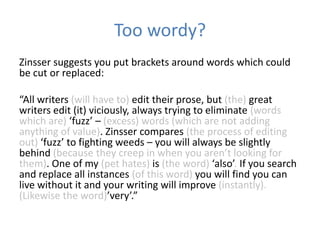
Too wordy?
Zinsser suggests you put brackets around words which could
be cut or replaced:

“All writers (will have to) edit their prose, but (the) great
writers edit (it) viciously, always trying to eliminate (words
which are) ‘fuzz’ – (excess) words (which are not adding
anything of value). Zinsser compares (the process of editing
out) ‘fuzz’ to fighting weeds – you will always be slightly
behind (because they creep in when you aren’t looking for
them). One of my (pet hates) is (the word) ‘also’. If you search
and replace all instances (of this word) you will find you can
live without it and your writing will improve (instantly).
(Likewise the word)’very’.”
Let it rest
Day: Seven
Rejection (maybe).
Kate Chanock’s 7 stages of resentment
1. Outrage, noise, unladylike rejoinders
2. Incomprehension
3. More outrage
4. One or two of the comments might make sense
5. There’s a bit of truth in that one
6. I’ll just have a go at doing what they said to do
here
7. Actually, the paper is a whole lot better for all
those revisions.
How will I ‘market’ this paper?
Your paper is one of thousands… how can you get it
to be noticed? Some ideas:

•   Send it to authors you referenced
•   Tweet / blog about it
•   Lectures to professional gatherings
•   Write opinion pieces for the paper
•   Radio / TV
•   Make a film of it!
Some useful references on writing
• Becker, Howard (2007) Writing for social scientists: how to start and finish
  your thesis, book or article, Chicago University Press, Chicago.
• Ballenger, B (2011) The Curious Researcher, Longman
• Becher, W (2009) Writing your journal article in 12 weeks, Sage.
• Boise, R (2003) Professors as writers: a self help guide for productive
  writing, New Forum Press
• Chanok, K. (2008). Surviving the reviewing process and getting published,
  Journal of Academic Language & Learning. Vol. 2, No. 1.
• Kamler, B & Thomson, P (2006) Helping doctoral students to write,
  Routledge, New York.
• Murray, R (2009), Writing for academic journals, Open University Press.
• Rugg, G & Petre, M (2010) The unwritten rules of PhD Research, Open
  University Press, Maidenhead.
• Silva, P (2007) How to write a lot, American psychology association
• White, B (2011), Mapping your thesis, ACER Press.
• Zinsser, W (2003), On Writing, Pan McMillan.
Final thoughts

Writing a paper is what designers call a ‘wicked
problem’.

There are no right or wrong papers, just better
and worse ones. The more you write, the better
your papers will be.

We hope this presentation helps you write
more and more papers.