LOGO
www.uokufa.edu.iq
How To Write a Scientific Paper –
A General Guide
ITRDC Center- University of Kufa
Nabeel Salih Ali
MSc. In Computer Science (Internetworking Technology)
Member at ITRDC Center, University of Kufa.
Lecturer at ECE, Faculty of Engineering, University of Kufa.
LOGO
www.uokufa.edu.iq
Outlines
Introduction (Overview)
Author, Reader , & Audience perspectives?
Paper Common Types & Structure
Title, Author Listing, & Keywords
1
2
3
4
Introduction, Methodology (Materials & Methods)5
LOGO
www.uokufa.edu.iq
Outlines
Results (Results & Discussion Strategy)
Discussion / Conclusions
Acknowledgments
References
6
7
8
9
Supporting Information (Appendix)10
LOGO Introduction
Task of writing a research paper could be a hectic effort.
Even with groundbreaking, innovative and original
research, the presentation and documented form of
research paper is very important.
Even with groundbreaking research, unless the paper is
correctly written: at best, the publication will be:
 Delay the publication process, & at worse, never
published.
www.uokufa.edu.iq
LOGO Introduction
 So writing of scientific paper is an art comes with:
 Experience
 Scientific learning.
 Hence, The Presentation will provide an overview of
‘How to write a well-structured research paper for
publication’.
www.uokufa.edu.iq
LOGO Why do we (have to) publish?
 Participating in scientific communication
 Creating and demonstrating new knowledge
 Providing new material for scientific discussion
 Participate in academic progress
 Documentation of scientific processes and their results
www.uokufa.edu.iq
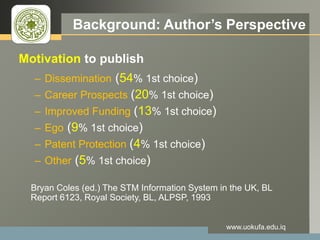
LOGO Background: Author’s Perspective
Motivation to publish
– Dissemination (54% 1st choice)
– Career Prospects (20% 1st choice)
– Improved Funding (13% 1st choice)
– Ego (9% 1st choice)
– Patent Protection (4% 1st choice)
– Other (5% 1st choice)
Bryan Coles (ed.) The STM Information System in the UK, BL
Report 6123, Royal Society, BL, ALPSP, 1993
www.uokufa.edu.iq
LOGO Background: Author’s Perspective
Motivation to publish
– Papers as indicators for success in scientific evaluation
– Papers as background information for funding in
research institutions
– Papers as criteria for project support in funding
agencies
– Cumulative PhD theses need 3-4-5 papers in peer-
reviewed journals
– Papers as media for cooperation
www.uokufa.edu.iq
LOGO How To Start?
Consider the following factors:
– Your research Community
– Papers cited in your manuscript
– Journal Scope Statements
– Cost of publication :
Submission Fees/ author fees ( open access model).
Page charges
Reprint cost
www.uokufa.edu.iq
LOGO How To Start?
Consider the following factors:
– Publication time
– Journal impact factor
www.uokufa.edu.iq
LOGO When to choose?
– As early as possible
– Before you start to write your manuscript:
 Format issues
 Style issues
 Figures and Tables Limitations
www.uokufa.edu.iq
LOGO Author Publishing Priorities
– Quality and speed
– Top items were
 Refereeing speed
 Refereeing standard
 Journal reputation
– Editor/board, physical quality and publication services
www.uokufa.edu.iq
LOGO Author Vs. Reader Behavior
www.uokufa.edu.iq
•Author behaviour
–Want to publish more
–Peer review essential
–Other journal functions
crucial
–Wider dissemination
• Reader behaviour
–Want integrated system
–Browsing is crucial
–Quality information
important
– Want to read less
LOGO The reader’s perspective
• Authoritative high quality articles
• Ease of access
• Rapid delivery
• Convenient format
• Linking of information
• Low or no cost
• Up-to-date information
• Comprehensible, easy to read
• Short and compact information
www.uokufa.edu.iq
LOGO Differences: Authors and Readers
– Authors are journal focused
– Readers are article focused
– Publish more/read less dichotomy
www.uokufa.edu.iq
LOGO Audience:
Papers are written to:
– Editors: generalists, interested in good stories with high
scientific impact fitting their journal's topics, scan
papers quickly
– Reviewers: experts, but not necessarily in your absolute
specialty; voluntary; short of time
– Readers: specialty depending on the journal, generally
not experts in your specific field
www.uokufa.edu.iq
LOGO Audience:
Always remember:
– Those people deciding on the acceptance of your paper
(Editors, Reviewers) are generally very busy and have
to read a lot of papers in little time!
– Therefore, keep things well organized and easy to
understand (KISS rule : Keep it Short and Simple)
– They will like your paper much better if they can
understand it quickly!
www.uokufa.edu.iq
LOGO Key Elements of Publishing
– Ethical Issues
– Style and language
– Structure of paper
– Components of paper
– Article submission/ journal selection
– Publisher’s process/ peer review
www.uokufa.edu.iq
LOGO Ethical Issues
– Disclosure of Conflict of Interest
– Acknowledgment of funding sources
– Image manipulation guidelines
– Online submission - supplemental information
(datasets, videos)
– For Health Sciences
• Submission of a Clinical Trials to a Central
• Registry
• Institutional Review Board approval
• See: Blackwell Science - Best Practice Guidelines on
Publishing Ethics
• http://www.blackwellpublishing.com/Publicationethics/
www.uokufa.edu.iq
LOGO Style and Language
– Refer to the journal’s author guide for notes on style
(see Publishing Skills Web- Bibliography for examples)
• Some authors write their paper with a specific journal in mind
• Others write the paper and then adapt it to fit the style of a
journal they subsequently choose
– Objective is to report your findings and conclusions
clearly and concisely as possible
www.uokufa.edu.iq
LOGO Style and Language
– If English is not your first language, find a native English
speaker (if possible) to review the content and language
of the paper before submitting it
– Regardless of primary language, find a colleague/
editor to review the content and language of the paper
See: Uniform Requirements for Manuscripts Submitted to
Biomedical Journals: Writing and Editing for Biomedical
Publication http://www.icmje.org/
www.uokufa.edu.iq
LOGO Types of papers
– Research papers
– Review papers (state-of-the-art)
– Case study papers (short note)
– Discussion papers (e.g. ideas or view points)
– Short note papers/short communication
– Book reviews
– Letters to the editor
www.uokufa.edu.iq
LOGO Getting prepared
– Identification of the focal topic
– Definition of article type
– Appointment of the authors
– Develop your publication plan
– Define the objectives (do this very clearly)
– Ask three questions which the paper should answer
– Define the working title
www.uokufa.edu.iq
LOGO Structure of a paper
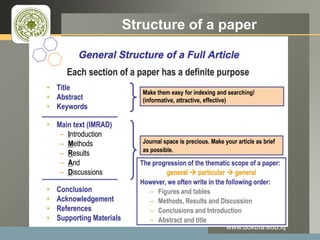
Scientific writing follows a rigid structure – a format
developed over hundreds of years consequently, a paper
can be read at several levels:
– Some people just will refer to the title
– Others may read only the title and abstract
– Others will read the paper for a deeper understanding
www.uokufa.edu.iq
LOGO Structure of a paper
www.uokufa.edu.iq
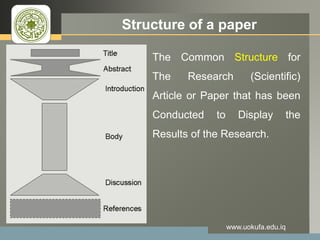
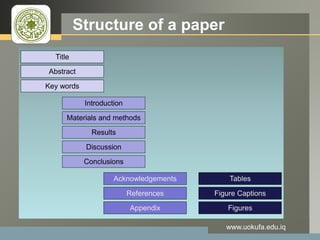
The Common Structure for
The Research (Scientific)
Article or Paper that has been
Conducted to Display the
Results of the Research.
LOGO Structure of a paper
www.uokufa.edu.iq
LOGO Structure of a paper
www.uokufa.edu.iq
LOGO Components of a Paper
www.uokufa.edu.iq
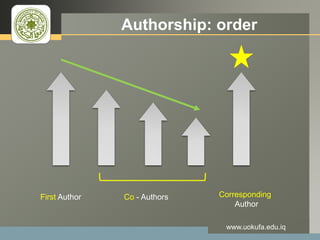
LOGO Authors Listing
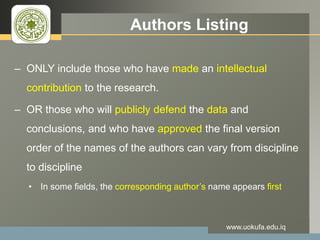
– ONLY include those who have made an intellectual
contribution to the research.
– OR those who will publicly defend the data and
conclusions, and who have approved the final version
order of the names of the authors can vary from discipline
to discipline
• In some fields, the corresponding author’s name appears first
www.uokufa.edu.iq
LOGO Authorship: order
www.uokufa.edu.iq
First Author Co - Authors Corresponding
Author
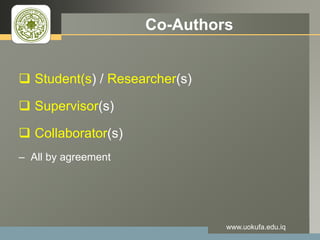
LOGO Co-Authors
 Student(s) / Researcher(s)
 Supervisor(s)
 Collaborator(s)
– All by agreement
www.uokufa.edu.iq
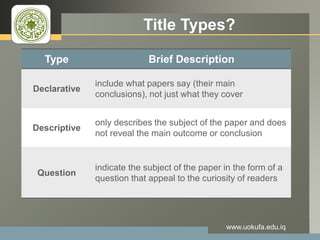
LOGO Title Types?
www.uokufa.edu.iq
Type Brief Description
Declarative
include what papers say (their main
conclusions), not just what they cover
Descriptive
only describes the subject of the paper and does
not reveal the main outcome or conclusion
Question
indicate the subject of the paper in the form of a
question that appeal to the curiosity of readers
LOGO How to prepare the title?
– Capture Attention!
– Avoid “question” (?) titles
– Select the right keywords.
– Limit the number of words(~ 13 words).
– No full stop.
– Avoid “Novel”
– Be Specific!.
www.uokufa.edu.iq
LOGO Title
– Describes the paper’s content clearly and precisely
including keywords
– Is the advertisement for the article?
– Do not use abbreviations and jargon
– Search engines/indexing databases depend on the
accuracy of the title - since they use the keywords to
identify relevant articles
www.uokufa.edu.iq
LOGO Title
Title should be…..
– Short
– Informative
– Explaining the subject of the study
– May contain paper type (e.g. review)
– Should be understandable in isolation
– Should be specific (not too general)
– Should not include abbreviations
www.uokufa.edu.iq
LOGO Title
Avoid Abbreviations…
Abbreviations confused reader if they are not expert s in
the subject of your manuscript.
Examples:
 DOE : Department of Environment
 DOE : Department of Energy
 DOE :----- Design of Experiment
www.uokufa.edu.iq
LOGO Title
Avoid unnecessary waste” words…..
– "A study of ...“
– "Investigations of ...“
– "Observations on ...“
– “Novel…..”
– “New….”
– “Research on….”
– “ A comprehensive experimental investigations on”…
– “A studies on……”
www.uokufa.edu.iq
LOGO Title
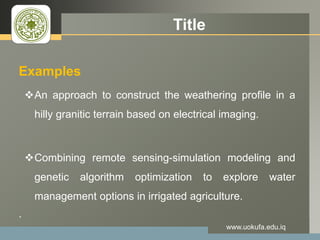
Examples
An approach to construct the weathering profile in a
hilly granitic terrain based on electrical imaging.
Combining remote sensing-simulation modeling and
genetic algorithm optimization to explore water
management options in irrigated agriculture.
.
www.uokufa.edu.iq
LOGO Title
www.uokufa.edu.iq
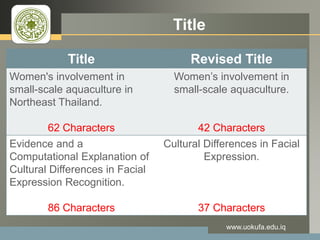
Title Revised Title
Women's involvement in
small-scale aquaculture in
Northeast Thailand.
62 Characters
Women’s involvement in
small-scale aquaculture.
42 Characters
Evidence and a
Computational Explanation of
Cultural Differences in Facial
Expression Recognition.
86 Characters
Cultural Differences in Facial
Expression.
37 Characters
LOGO Abstract Kinds
www.uokufa.edu.iq
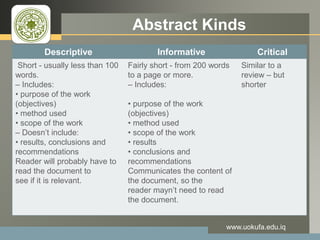
Descriptive Informative Critical
Short - usually less than 100
words.
– Includes:
• purpose of the work
(objectives)
• method used
• scope of the work
– Doesn’t include:
• results, conclusions and
recommendations
Reader will probably have to
read the document to
see if it is relevant.
Fairly short - from 200 words
to a page or more.
– Includes:
• purpose of the work
(objectives)
• method used
• scope of the work
• results
• conclusions and
recommendations
Communicates the content of
the document, so the
reader mayn’t need to read
the document.
Similar to a
review – but
shorter
LOGO Abstract
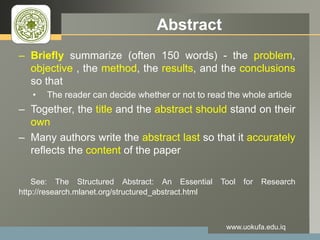
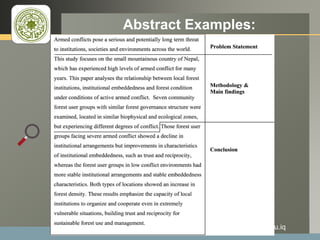
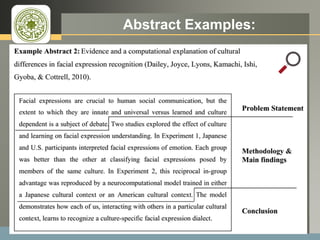
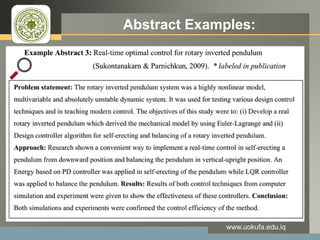
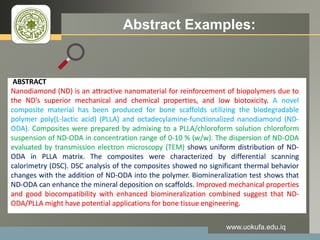
– Briefly summarize (often 150 words) - the problem,
objective , the method, the results, and the conclusions
so that
• The reader can decide whether or not to read the whole article
– Together, the title and the abstract should stand on their
own
– Many authors write the abstract last so that it accurately
reflects the content of the paper
See: The Structured Abstract: An Essential Tool for Research
http://research.mlanet.org/structured_abstract.html
www.uokufa.edu.iq
LOGO Abstract
What the abstract Should Say?
 Stands on its own without need to read MS
 Follow the order of the main text (IMRAD)
 Contains the same keywords & terms as the title, the
introduction.
 Follow the correct style and format.
 Stays within the allowed word count (150 word).
www.uokufa.edu.iq
LOGO Four-part Abstract Model:
– PROBLEM STATEMENT: Give the primary research
question, objective, and/or motivation.
– Methodology: Provide a basic indication of how the
data were gathered.
– MAIN FINDINGS: Show only those results which
relate directly to the research objectives and
conclusions.
– CONCLUSION: Choose the most important
implication, application, or suggestion related to the
problem statement and main findings.
www.uokufa.edu.iq
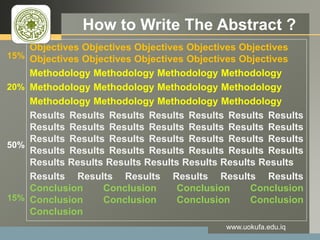
LOGO How to Write The Abstract ?
Objectives Objectives Objectives Objectives Objectives
Methodology Methodology Methodology Methodology
Results Results Results Results Results Results Results
Results Results Results Results Results Results
Conclusion Conclusion Conclusion Conclusion
Conclusion
www.uokufa.edu.iq
15%
20%
50%
15%
LOGO Abstract
What the abstract Features?
– Does not contain information absent in MS.
– Limit the use of abbreviations.
– Des not include references.
– Should be a single paragraph.
– Be concise, precise to the point”, and efficient in using
the words!.
– Write it after completing the main text.
www.uokufa.edu.iq
LOGO Qualities of a good informative abstract
• Concise
– Usually less than 250 words
• Structured
– The abstract has an introduction-body-conclusion structure.
• In engineering, this is sometimes seen as a situation-
problem-solution-evaluation paradigm.
• Reports the paper’s structure
– Reports the purpose/objectives, method, findings,
conclusions of the paper.
• Connected
– – Provides logical connections between the parts of the
abstract.
www.uokufa.edu.iq
LOGO Qualities of a good informative abstract
• Adds nothing new
– Summarizes the paper - doesn’t add any new material or
analysis.
www.uokufa.edu.iq
LOGO Don’t
• There are a number of very common errors
made in writing descriptive and informative
abstracts:
• Repeat the title
– Don’t repeat the title of the paper as it is already in the title
(and the more you repeat the title, the more boring it gets and
the more space it wastes).
www.uokufa.edu.iq
LOGO Don’t
Don’t …
• refer to things outside the abstract
– The title and abstract should function as a self- contained
unit - eg they might be used in an indexing and
abstracting service like Compendex or Science Citation
Index.
www.uokufa.edu.iq
LOGO Don’t
Don’t …
• Use obscure abbreviations and acronyms
– You may define abbreviations and acronyms in your text
but the reader will have to read your paper to find out
what your abstract is about.
www.uokufa.edu.iq
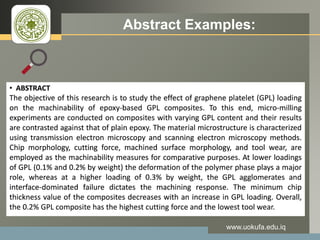
LOGO Abstract Examples:
www.uokufa.edu.iq
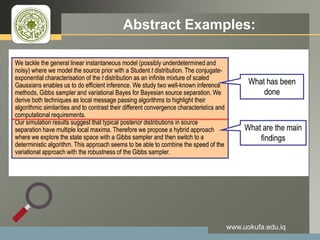
LOGO Abstract Examples:
www.uokufa.edu.iq
LOGO Abstract Examples:
www.uokufa.edu.iq
LOGO Abstract Examples:
www.uokufa.edu.iq
LOGO Abstract Examples:
www.uokufa.edu.iq
LOGO Abstract Examples:
www.uokufa.edu.iq
LOGO Abstract Examples:
www.uokufa.edu.iq
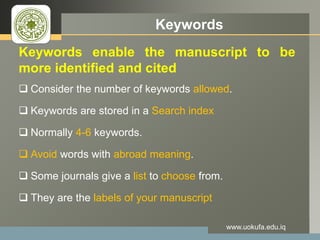
LOGO Keywords
Keywords enable the manuscript to be
more identified and cited
 Consider the number of keywords allowed.
 Keywords are stored in a Search index
 Normally 4-6 keywords.
 Avoid words with abroad meaning.
 Some journals give a list to choose from.
 They are the labels of your manuscript
www.uokufa.edu.iq
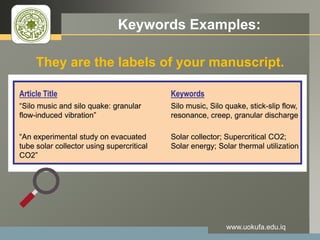
LOGO Keywords Examples:
www.uokufa.edu.iq
They are the labels of your manuscript.
LOGO Introduction
 Clearly state the:
 Problem being investigated
 Background that explains the problem
 Reasons for conducting the research
 Summarize relevant research to provide context
 State how your work differs from published work
 Identify the questions you are answering
 Explain what other findings, if any, you are challenging
or extending
 Briefly describe the experiment, hypothesis(es),
research question(s); general experimental design or
method.
www.uokufa.edu.iq
LOGO Introduction
www.uokufa.edu.iq
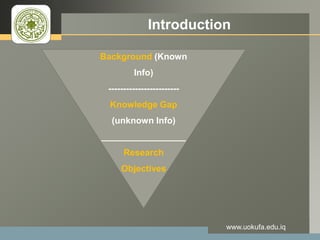
Background (Known
Info)
------------------------
Knowledge Gap
(unknown Info)
_________________
Research
Objectives
LOGO Introduction
Things to avoid:
 Lengthy introduction
 Make any promises
 Mixing the introduction with results, discussion, and
conclusion section.
 “novel”, “first time”, “ first ever”, “ never reported”,….
 Cited outdate references.
 Citing many references for one author.
www.uokufa.edu.iq
LOGO Introduction Structure
1. Introductory Paragraph
• Start with an attention-getting broad statement that
establishes a general topic for the article.
• Narrow the topic in successive sentences that outline
the state of the art and introduce a gap in knowledge.
• End the introductory paragraph with a general
statement of the problem and optional supporting
/specifying statements.
www.uokufa.edu.iq
LOGO Introduction Structure
2. Middle paragraphs
• Usually the literature review,
• The literature review identifies the seminal historical
contributions, outlines the state of knowledge, and
justifies the novelty of the article’s contribution.
• Start with a broad background/contextual view then
narrow it down to your field of study.
www.uokufa.edu.iq
LOGO Introduction Structure
3. Last Paragraph
• End the introduction by outlining for the reader the
specific contribution of the article and
• Tell the reader the overall organization of the article
and what he will find in the following sections.
www.uokufa.edu.iq
LOGO Introduction Structure
 Introduction – concisely convince readers you
know why your work is useful.
 Answer these questions:
 What is the problem?
 Are there any existing solutions?
 What are the best solutions?
 What are the main limitations?
 What do you hope to achieve?
www.uokufa.edu.iq
LOGO Introduction Structure
 Introduction should include information
about:.
 The background
 The motivation
 The state-of-the-art
 The respective gaps in knowledge
 Definitions (if necessary)
 Objectives and questions
 Structure of the paper
www.uokufa.edu.iq
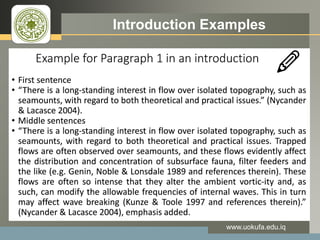
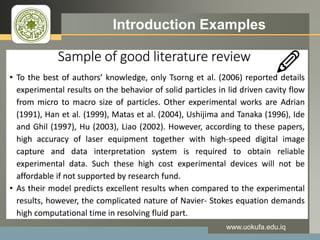
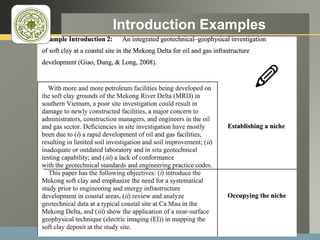
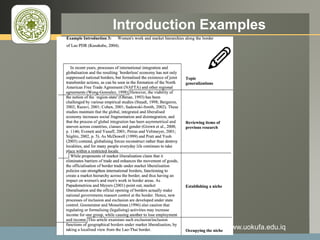
LOGO Introduction Examples
www.uokufa.edu.iq
LOGO Introduction Examples
www.uokufa.edu.iq
LOGO Introduction Examples
www.uokufa.edu.iq
LOGO Introduction Examples
www.uokufa.edu.iq
LOGO Introduction Examples
www.uokufa.edu.iq
LOGO Introduction Examples
www.uokufa.edu.iq
LOGO Methods
 Provide the reader enough details so they can
understand and replicate your research
 Explain how you studied the problem, identify the
procedures you followed, and order these
chronologically where possible
 Explain new methodology in detail; otherwise name
the method and cite the previously published work
 Include the frequency of observations, what types of
data were recorded, etc.
 Be precise in describing measurements and include
errors of measurement or research design limits
www.uokufa.edu.iq
LOGO Methods & Methods
 Include the exact technical specification & quantities &
source or method of preparation.
 Possible to list the physical properties of the reagent
used
 Procedure: new , novel adapted [ ref]
 Sampling method
 Survey
 Software
 Modeling/ Calculation
 Repeatability of experiments
www.uokufa.edu.iq
LOGO Methods & Methods
 Divide this section into Materials & Methods,
Characterization, Measurements and Data analysis.
 Writing the methodology lies at the core of the paper,
and fulfills one of the basic principles underlying the
scientific method.
 Needs an accurate description of the equipment and
techniques used to gather data.
 Allows readers to evaluate the results and judge the
validity of your conclusions.
www.uokufa.edu.iq
LOGO Methods & Methods
•There are variations according to the type of
research, the methodology can be divided into a few
sections:
• Materials and equipment description.
• Experiment setup.
• Input variables.
• Sampling, measurements and data collections.
• Calculations that were performed on the data.
• Statistical or analytical or modeling techniques used.
www.uokufa.edu.iq
LOGO Methods & Methods
COMMON METHODOLOGY TECHNIQUES:
• Experimental.
• Analytical.
• Modelling.
• Common Analytical Approaches.
• Theory; machining theory.
• Statistical Modelling.
www.uokufa.edu.iq
LOGO Methods & Methods
COMMON METHODOLOGY TECHNIQUES:
• Design of Experiment.
– Response surface methodology.
– Taguchi techniques for DoE.
• Artificial intelligence approach.
– Artificial neural networks (ANN).
– Neuro-fuzzy systems.
• Modelling and analysis.
– Finite Element Methods.
– Finite Difference.
www.uokufa.edu.iq
LOGO Methods & Methods
• Use flowcharts if possible.
• Do not describe previously published procedures but use
references and supplementary materials to indicate
these.
• Do not include results in methods.
• This section is the most thoroughly inspection section by
reviewers.
www.uokufa.edu.iq
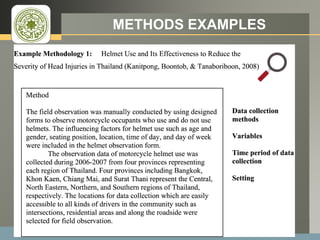
LOGO METHODS EXAMPLES
www.uokufa.edu.iq
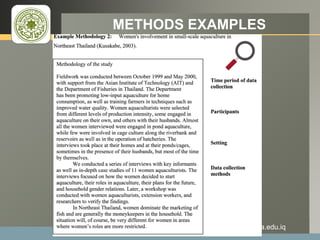
LOGO METHODS EXAMPLES
www.uokufa.edu.iq
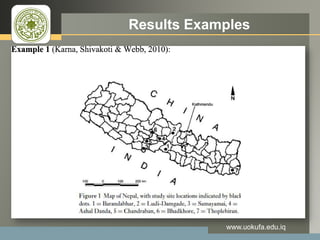
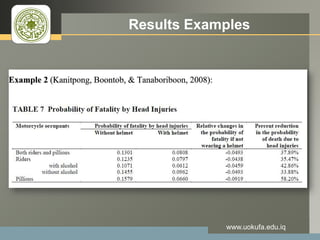
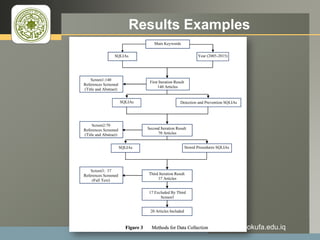
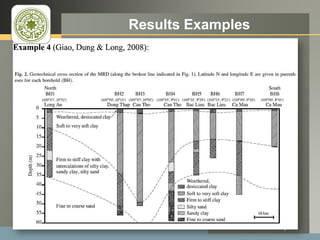
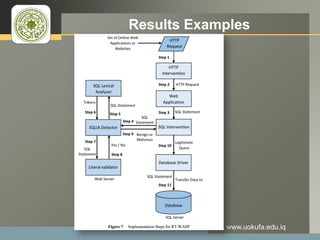
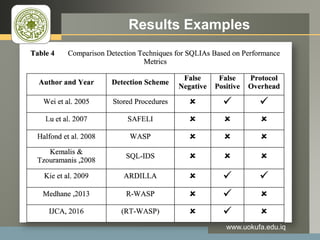
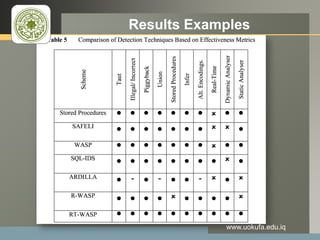
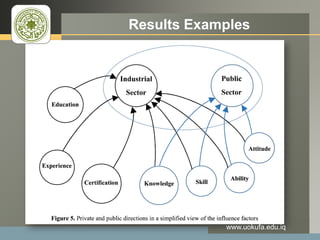
LOGO Results
Objectively present your findings, and explain what was found
Show that your new results are contributing to the body of
scientific knowledge
Follow a logical sequence based on the tables and figures
presenting the findings to answer the question or hypothesis
Figures should have a brief description (a legend), providing
the reader sufficient information to know how the data were
produced.
www.uokufa.edu.iq
LOGO Results
Don’t repeat; e.g., use tables or graphs, not both. If data is in
a table, don’t repeat it in the text.
Use the text to direct the reader to these, and to link to the
discussion section, e.g., highlighting correlations and key
findings.
Negative results, and how you handle them, often lead to an
interesting discussion section.
Use an appendix for larger amounts of raw data and/or
calculations.
www.uokufa.edu.iq
LOGO Results
Make sure that all figures and tables, enumerated, have title
and referred to on the text.
Principle: Results should be clear, convincing, and general and
should be free from interpretations or opinions.
Tables are preferred when it is useful for understanding of the
results to provide a large dataset. Other figures, such as charts
or photographs, can also be included if they are necessary or
helpful for clarity of the discussion.
www.uokufa.edu.iq
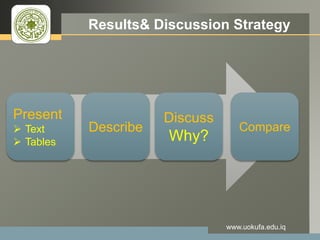
LOGO Results& Discussion Strategy
www.uokufa.edu.iq
Present
 Text
 Tables
Describe
Discuss
Why?
Compare
LOGO Results& Discussion Strategy
www.uokufa.edu.iq
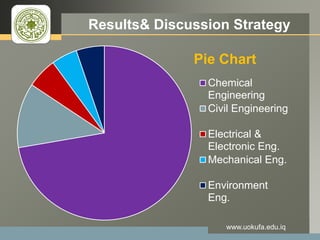
Chemical
Engineering
Civil Engineering
Electrical &
Electronic Eng.
Mechanical Eng.
Environment
Eng.
Pie Chart
LOGO Anatomy of a Figure
www.uokufa.edu.iq
Title
11
16
20
25
29
41
45
53
65 67
33 35 32
28
33 35
31
27
32 34
93
80
98 95 96
86 85 84
78
86
0
20
40
60
80
100
120
1 2 3 4 5 6 7 8 9 10
HeartPluse
No. of Patients
Heart Pulse and Temp
Age Temp Actual HP Y-Axis
X-Axis
Axis
Labels
Legend
Symbol
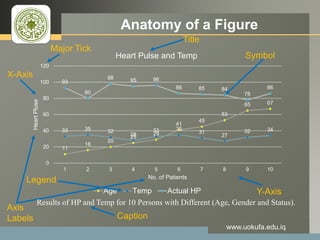
Results of HP and Temp for 10 Persons with Different (Age, Gender and Status).
Caption
Major Tick
LOGO Bar Graph
www.uokufa.edu.iq
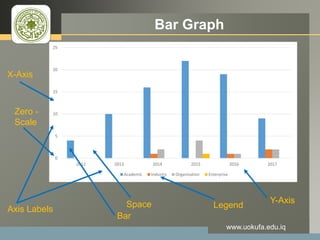
Y-Axis
X-Axis
Axis Labels Legend
Bar
Space
Zero -
Scale
LOGO Component of a Table
www.uokufa.edu.iq
Horizontal
Rules
Horizontal
Rules
Footnote
Table No.
Title
Body of
Table
Column
Headings
Standard
HP
Measured
HP
TempGenderAge*No
60-1009337Male11 years1
60-1008037Female16 years2
100-1509836Male20 years3
95-1629537Female25 years4
95-1629637Male29 years5
90-1538637Female41years6
90-1538537Female45years7
83-1408437Male53years8
78-1327837Female65 years9
78-1328737Female67years10
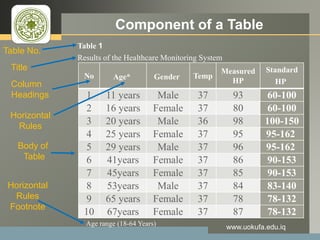
Table 1
Results of the Healthcare Monitoring System
Age range (18-64 Years)
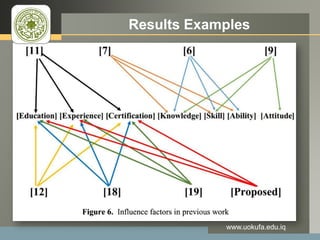
LOGO Results Examples
www.uokufa.edu.iq
LOGO Results Examples
www.uokufa.edu.iq
LOGO Results Examples
www.uokufa.edu.iq
LOGO Results Examples
www.uokufa.edu.iq
LOGO Results Examples
www.uokufa.edu.iq
LOGO Results Examples
www.uokufa.edu.iq
LOGO Results Examples
www.uokufa.edu.iq
LOGO Results Examples
www.uokufa.edu.iq
LOGO Results Examples
www.uokufa.edu.iq
LOGO Discussion / Conclusion
 Describe what your results mean in context of what was
already known about the subject.
 Indicate how the results relate to expectations and to the
literature previously cited.
 Explain how the research has moved the body of scientific
knowledge forward.
 Do not extend your conclusions beyond what is directly
supported by your results - avoid undue speculation
 Outline the next steps for further study
www.uokufa.edu.iq
LOGO Discussion / Conclusion
 Principles, relationships and generalizations that can be
interpreted by the results
 Report about unexpected results or problems occurring due
to the state-of-the-art
 Critical assessment of the study design and methods,
limitations in analysis or validity
 Relationship with other results from the literature
 Theoretical implications of the results
www.uokufa.edu.iq
LOGO Discussion / Conclusion
 Build on the links you left in the results section.
 Position your findings into the context of previous research;
do they concur or contradict or add something new.
 Reflect on the research design in the light of the outcomes:
What might you have done differently.
What modifications and improvements would you suggest to another
researcher.
www.uokufa.edu.iq
LOGO Discussion / Conclusion
Discussion – What the Results Mean
DO..
• Explain how the results relate to the study’s aims and
hypotheses.
 Mention how the findings relate to those of other studies.
 Give all possible interpretations of your findings.
 Acknowledge limitations of the study.
www.uokufa.edu.iq
LOGO Discussion / Conclusion
Discussion – What the Results Mean
DO NOT…
 Make “grand statements” that are not supported by the data.
 Introduce new results or terms.
 Ignore work that disagrees with yours – confront it and
convince the reader you are correct – this is KEY.
www.uokufa.edu.iq
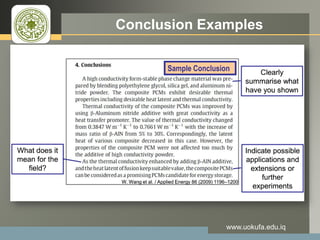
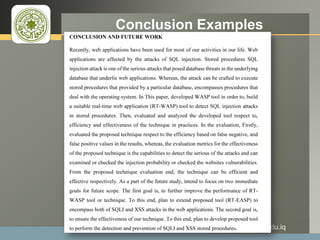
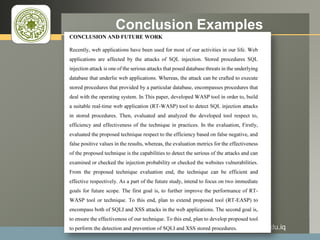
LOGO Conclusion & Future Works
 IMPORTANT: how the work advances the field? Do not
rewrite the abstract.
 Principle: The summary and conclusions section tells the
reader what has already been read and draws the important
conclusions, keep it short and make it as specific as possible.
 Answer the research question here.
 Provide a short synopsis of the results and discussion,
summing up the paper.
www.uokufa.edu.iq
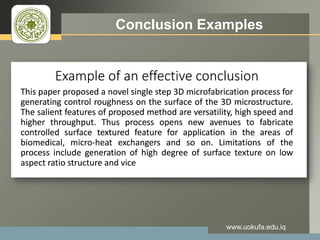
LOGO Conclusion Examples
www.uokufa.edu.iq
LOGO Conclusion Examples
www.uokufa.edu.iq
LOGO Conclusion Examples
www.uokufa.edu.iq
LOGO Conclusion Examples
www.uokufa.edu.iq
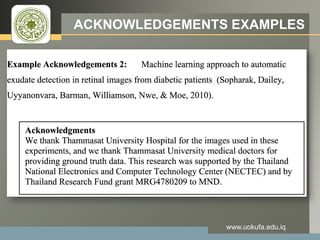
LOGO Acknowledgements
 Optional section
 Keep it short
 Acknowledge significant support (technical and financial
support, data, information, reviewers,..)
 If you acknowledge persons, write what for
 Do not use titles
 Often: standard text necessary to acknowledge funding
agencies
www.uokufa.edu.iq
LOGO ACKNOWLEDGEMENTS EXAMPLES
www.uokufa.edu.iq
LOGO ACKNOWLEDGEMENTS EXAMPLES
www.uokufa.edu.iq
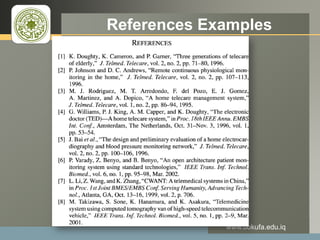
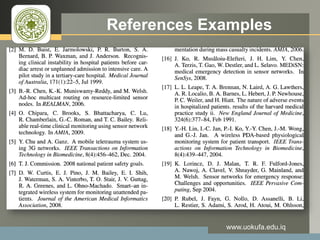
LOGO References
 Whenever you draw upon previously published work, you
must acknowledge the source
 Any information not from your experiment and not ‘common
knowledge’ should be recognized by a citation
 How references are presented varies considerably - refer to
notes for authors for the specific journal
 Avoid references that are difficult to find
 Avoid listing related references that were not important to the
study
www.uokufa.edu.iq
LOGO References
 Reviewers and experienced researchers often look at the
references first to see if the right ones are there.
 Follow the style of the journal to which you are submitting
and be consistent.
 Ensure every reference is cited in the text.
 Ensure every citation in the text is referenced.
 Guide to Citation Style Guides
http://bailiwick.lib.uiowa.edu/journalism/cite.html.
www.uokufa.edu.iq
LOGO References
 Avoid excessive self-citations.
 Avoid excessive citations of publications from the same
region.
 The styles vary for different journals. (Use ENDNOTE,
RefWorks, Mendeley).
www.uokufa.edu.iq
LOGO References
 Good reference lists support credibility, validity,
communication
 All references should have been read by you!
 Only list references which are used in the paper! Check this
in the end!
 Avoid grey literature (no quality control)
www.uokufa.edu.iq
LOGO References Examples
www.uokufa.edu.iq
LOGO References Examples
www.uokufa.edu.iq
LOGO SUPPORTING INFORMATION
www.uokufa.edu.iq
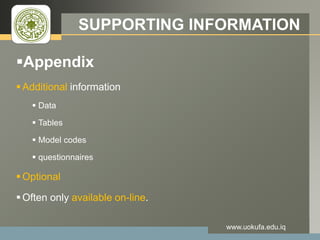
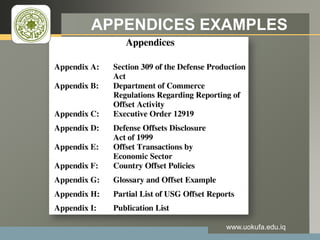
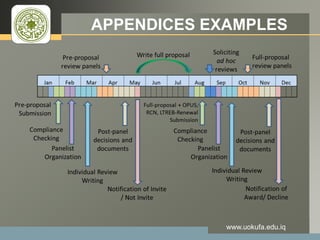
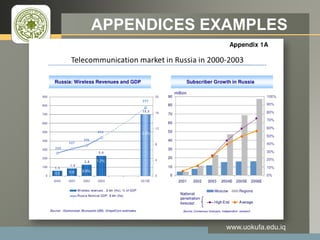
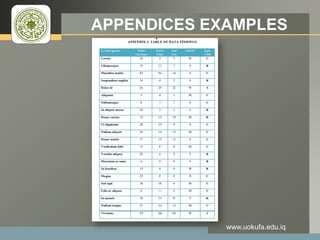
Appendix
 Additional information
 Data
 Tables
 Model codes
 questionnaires
 Optional
 Often only available on-line.
LOGO APPENDICES EXAMPLES
www.uokufa.edu.iq
LOGO APPENDICES EXAMPLES
www.uokufa.edu.iq
LOGO APPENDICES EXAMPLES
www.uokufa.edu.iq
LOGO APPENDICES EXAMPLES
www.uokufa.edu.iq
LOGO
www.uokufa.edu.iq
ITRDC Center- University of Kufa

How to Write Scientific Research Article? A General Guide

  • 1.
    LOGO www.uokufa.edu.iq How To Writea Scientific Paper – A General Guide ITRDC Center- University of Kufa Nabeel Salih Ali MSc. In Computer Science (Internetworking Technology) Member at ITRDC Center, University of Kufa. Lecturer at ECE, Faculty of Engineering, University of Kufa.
  • 2.
    LOGO www.uokufa.edu.iq Outlines Introduction (Overview) Author, Reader, & Audience perspectives? Paper Common Types & Structure Title, Author Listing, & Keywords 1 2 3 4 Introduction, Methodology (Materials & Methods)5
  • 3.
    LOGO www.uokufa.edu.iq Outlines Results (Results &Discussion Strategy) Discussion / Conclusions Acknowledgments References 6 7 8 9 Supporting Information (Appendix)10
  • 4.
    LOGO Introduction Task ofwriting a research paper could be a hectic effort. Even with groundbreaking, innovative and original research, the presentation and documented form of research paper is very important. Even with groundbreaking research, unless the paper is correctly written: at best, the publication will be:  Delay the publication process, & at worse, never published. www.uokufa.edu.iq
  • 5.
    LOGO Introduction  Sowriting of scientific paper is an art comes with:  Experience  Scientific learning.  Hence, The Presentation will provide an overview of ‘How to write a well-structured research paper for publication’. www.uokufa.edu.iq
  • 6.
    LOGO Why dowe (have to) publish?  Participating in scientific communication  Creating and demonstrating new knowledge  Providing new material for scientific discussion  Participate in academic progress  Documentation of scientific processes and their results www.uokufa.edu.iq
  • 7.
    LOGO Background: Author’sPerspective Motivation to publish – Dissemination (54% 1st choice) – Career Prospects (20% 1st choice) – Improved Funding (13% 1st choice) – Ego (9% 1st choice) – Patent Protection (4% 1st choice) – Other (5% 1st choice) Bryan Coles (ed.) The STM Information System in the UK, BL Report 6123, Royal Society, BL, ALPSP, 1993 www.uokufa.edu.iq
  • 8.
    LOGO Background: Author’sPerspective Motivation to publish – Papers as indicators for success in scientific evaluation – Papers as background information for funding in research institutions – Papers as criteria for project support in funding agencies – Cumulative PhD theses need 3-4-5 papers in peer- reviewed journals – Papers as media for cooperation www.uokufa.edu.iq
  • 9.
    LOGO How ToStart? Consider the following factors: – Your research Community – Papers cited in your manuscript – Journal Scope Statements – Cost of publication : Submission Fees/ author fees ( open access model). Page charges Reprint cost www.uokufa.edu.iq
  • 10.
    LOGO How ToStart? Consider the following factors: – Publication time – Journal impact factor www.uokufa.edu.iq
  • 11.
    LOGO When tochoose? – As early as possible – Before you start to write your manuscript:  Format issues  Style issues  Figures and Tables Limitations www.uokufa.edu.iq
  • 12.
    LOGO Author PublishingPriorities – Quality and speed – Top items were  Refereeing speed  Refereeing standard  Journal reputation – Editor/board, physical quality and publication services www.uokufa.edu.iq
  • 13.
    LOGO Author Vs.Reader Behavior www.uokufa.edu.iq •Author behaviour –Want to publish more –Peer review essential –Other journal functions crucial –Wider dissemination • Reader behaviour –Want integrated system –Browsing is crucial –Quality information important – Want to read less
  • 14.
    LOGO The reader’sperspective • Authoritative high quality articles • Ease of access • Rapid delivery • Convenient format • Linking of information • Low or no cost • Up-to-date information • Comprehensible, easy to read • Short and compact information www.uokufa.edu.iq
  • 15.
    LOGO Differences: Authorsand Readers – Authors are journal focused – Readers are article focused – Publish more/read less dichotomy www.uokufa.edu.iq
  • 16.
    LOGO Audience: Papers arewritten to: – Editors: generalists, interested in good stories with high scientific impact fitting their journal's topics, scan papers quickly – Reviewers: experts, but not necessarily in your absolute specialty; voluntary; short of time – Readers: specialty depending on the journal, generally not experts in your specific field www.uokufa.edu.iq
  • 17.
    LOGO Audience: Always remember: –Those people deciding on the acceptance of your paper (Editors, Reviewers) are generally very busy and have to read a lot of papers in little time! – Therefore, keep things well organized and easy to understand (KISS rule : Keep it Short and Simple) – They will like your paper much better if they can understand it quickly! www.uokufa.edu.iq
  • 18.
    LOGO Key Elementsof Publishing – Ethical Issues – Style and language – Structure of paper – Components of paper – Article submission/ journal selection – Publisher’s process/ peer review www.uokufa.edu.iq
  • 19.
    LOGO Ethical Issues –Disclosure of Conflict of Interest – Acknowledgment of funding sources – Image manipulation guidelines – Online submission - supplemental information (datasets, videos) – For Health Sciences • Submission of a Clinical Trials to a Central • Registry • Institutional Review Board approval • See: Blackwell Science - Best Practice Guidelines on Publishing Ethics • http://www.blackwellpublishing.com/Publicationethics/ www.uokufa.edu.iq
  • 20.
    LOGO Style andLanguage – Refer to the journal’s author guide for notes on style (see Publishing Skills Web- Bibliography for examples) • Some authors write their paper with a specific journal in mind • Others write the paper and then adapt it to fit the style of a journal they subsequently choose – Objective is to report your findings and conclusions clearly and concisely as possible www.uokufa.edu.iq
  • 21.
    LOGO Style andLanguage – If English is not your first language, find a native English speaker (if possible) to review the content and language of the paper before submitting it – Regardless of primary language, find a colleague/ editor to review the content and language of the paper See: Uniform Requirements for Manuscripts Submitted to Biomedical Journals: Writing and Editing for Biomedical Publication http://www.icmje.org/ www.uokufa.edu.iq
  • 22.
    LOGO Types ofpapers – Research papers – Review papers (state-of-the-art) – Case study papers (short note) – Discussion papers (e.g. ideas or view points) – Short note papers/short communication – Book reviews – Letters to the editor www.uokufa.edu.iq
  • 23.
    LOGO Getting prepared –Identification of the focal topic – Definition of article type – Appointment of the authors – Develop your publication plan – Define the objectives (do this very clearly) – Ask three questions which the paper should answer – Define the working title www.uokufa.edu.iq
  • 24.
    LOGO Structure ofa paper Scientific writing follows a rigid structure – a format developed over hundreds of years consequently, a paper can be read at several levels: – Some people just will refer to the title – Others may read only the title and abstract – Others will read the paper for a deeper understanding www.uokufa.edu.iq
  • 25.
    LOGO Structure ofa paper www.uokufa.edu.iq The Common Structure for The Research (Scientific) Article or Paper that has been Conducted to Display the Results of the Research.
  • 26.
    LOGO Structure ofa paper www.uokufa.edu.iq
  • 27.
    LOGO Structure ofa paper www.uokufa.edu.iq
  • 28.
    LOGO Components ofa Paper www.uokufa.edu.iq
  • 29.
    LOGO Authors Listing –ONLY include those who have made an intellectual contribution to the research. – OR those who will publicly defend the data and conclusions, and who have approved the final version order of the names of the authors can vary from discipline to discipline • In some fields, the corresponding author’s name appears first www.uokufa.edu.iq
  • 30.
    LOGO Authorship: order www.uokufa.edu.iq FirstAuthor Co - Authors Corresponding Author
  • 31.
    LOGO Co-Authors  Student(s)/ Researcher(s)  Supervisor(s)  Collaborator(s) – All by agreement www.uokufa.edu.iq
  • 32.
    LOGO Title Types? www.uokufa.edu.iq TypeBrief Description Declarative include what papers say (their main conclusions), not just what they cover Descriptive only describes the subject of the paper and does not reveal the main outcome or conclusion Question indicate the subject of the paper in the form of a question that appeal to the curiosity of readers
  • 33.
    LOGO How toprepare the title? – Capture Attention! – Avoid “question” (?) titles – Select the right keywords. – Limit the number of words(~ 13 words). – No full stop. – Avoid “Novel” – Be Specific!. www.uokufa.edu.iq
  • 34.
    LOGO Title – Describesthe paper’s content clearly and precisely including keywords – Is the advertisement for the article? – Do not use abbreviations and jargon – Search engines/indexing databases depend on the accuracy of the title - since they use the keywords to identify relevant articles www.uokufa.edu.iq
  • 35.
    LOGO Title Title shouldbe….. – Short – Informative – Explaining the subject of the study – May contain paper type (e.g. review) – Should be understandable in isolation – Should be specific (not too general) – Should not include abbreviations www.uokufa.edu.iq
  • 36.
    LOGO Title Avoid Abbreviations… Abbreviationsconfused reader if they are not expert s in the subject of your manuscript. Examples:  DOE : Department of Environment  DOE : Department of Energy  DOE :----- Design of Experiment www.uokufa.edu.iq
  • 37.
    LOGO Title Avoid unnecessarywaste” words….. – "A study of ...“ – "Investigations of ...“ – "Observations on ...“ – “Novel…..” – “New….” – “Research on….” – “ A comprehensive experimental investigations on”… – “A studies on……” www.uokufa.edu.iq
  • 38.
    LOGO Title Examples An approachto construct the weathering profile in a hilly granitic terrain based on electrical imaging. Combining remote sensing-simulation modeling and genetic algorithm optimization to explore water management options in irrigated agriculture. . www.uokufa.edu.iq
  • 39.
    LOGO Title www.uokufa.edu.iq Title RevisedTitle Women's involvement in small-scale aquaculture in Northeast Thailand. 62 Characters Women’s involvement in small-scale aquaculture. 42 Characters Evidence and a Computational Explanation of Cultural Differences in Facial Expression Recognition. 86 Characters Cultural Differences in Facial Expression. 37 Characters
  • 40.
    LOGO Abstract Kinds www.uokufa.edu.iq DescriptiveInformative Critical Short - usually less than 100 words. – Includes: • purpose of the work (objectives) • method used • scope of the work – Doesn’t include: • results, conclusions and recommendations Reader will probably have to read the document to see if it is relevant. Fairly short - from 200 words to a page or more. – Includes: • purpose of the work (objectives) • method used • scope of the work • results • conclusions and recommendations Communicates the content of the document, so the reader mayn’t need to read the document. Similar to a review – but shorter
  • 41.
    LOGO Abstract – Brieflysummarize (often 150 words) - the problem, objective , the method, the results, and the conclusions so that • The reader can decide whether or not to read the whole article – Together, the title and the abstract should stand on their own – Many authors write the abstract last so that it accurately reflects the content of the paper See: The Structured Abstract: An Essential Tool for Research http://research.mlanet.org/structured_abstract.html www.uokufa.edu.iq
  • 42.
    LOGO Abstract What theabstract Should Say?  Stands on its own without need to read MS  Follow the order of the main text (IMRAD)  Contains the same keywords & terms as the title, the introduction.  Follow the correct style and format.  Stays within the allowed word count (150 word). www.uokufa.edu.iq
  • 43.
    LOGO Four-part AbstractModel: – PROBLEM STATEMENT: Give the primary research question, objective, and/or motivation. – Methodology: Provide a basic indication of how the data were gathered. – MAIN FINDINGS: Show only those results which relate directly to the research objectives and conclusions. – CONCLUSION: Choose the most important implication, application, or suggestion related to the problem statement and main findings. www.uokufa.edu.iq
  • 44.
    LOGO How toWrite The Abstract ? Objectives Objectives Objectives Objectives Objectives Objectives Objectives Objectives Objectives Objectives Methodology Methodology Methodology Methodology Methodology Methodology Methodology Methodology Methodology Methodology Methodology Methodology Results Results Results Results Results Results Results Results Results Results Results Results Results Results Results Results Results Results Results Results Results Results Results Results Results Results Results Results Results Results Results Results Results Results Results Results Results Results Results Results Results Conclusion Conclusion Conclusion Conclusion Conclusion Conclusion Conclusion Conclusion Conclusion www.uokufa.edu.iq 15% 20% 50% 15%
  • 45.
    LOGO Abstract What theabstract Features? – Does not contain information absent in MS. – Limit the use of abbreviations. – Des not include references. – Should be a single paragraph. – Be concise, precise to the point”, and efficient in using the words!. – Write it after completing the main text. www.uokufa.edu.iq
  • 46.
    LOGO Qualities ofa good informative abstract • Concise – Usually less than 250 words • Structured – The abstract has an introduction-body-conclusion structure. • In engineering, this is sometimes seen as a situation- problem-solution-evaluation paradigm. • Reports the paper’s structure – Reports the purpose/objectives, method, findings, conclusions of the paper. • Connected – – Provides logical connections between the parts of the abstract. www.uokufa.edu.iq
  • 47.
    LOGO Qualities ofa good informative abstract • Adds nothing new – Summarizes the paper - doesn’t add any new material or analysis. www.uokufa.edu.iq
  • 48.
    LOGO Don’t • Thereare a number of very common errors made in writing descriptive and informative abstracts: • Repeat the title – Don’t repeat the title of the paper as it is already in the title (and the more you repeat the title, the more boring it gets and the more space it wastes). www.uokufa.edu.iq
  • 49.
    LOGO Don’t Don’t … •refer to things outside the abstract – The title and abstract should function as a self- contained unit - eg they might be used in an indexing and abstracting service like Compendex or Science Citation Index. www.uokufa.edu.iq
  • 50.
    LOGO Don’t Don’t … •Use obscure abbreviations and acronyms – You may define abbreviations and acronyms in your text but the reader will have to read your paper to find out what your abstract is about. www.uokufa.edu.iq
  • 51.
  • 52.
  • 53.
  • 54.
  • 55.
  • 56.
  • 57.
  • 58.
    LOGO Keywords Keywords enablethe manuscript to be more identified and cited  Consider the number of keywords allowed.  Keywords are stored in a Search index  Normally 4-6 keywords.  Avoid words with abroad meaning.  Some journals give a list to choose from.  They are the labels of your manuscript www.uokufa.edu.iq
  • 59.
    LOGO Keywords Examples: www.uokufa.edu.iq Theyare the labels of your manuscript.
  • 60.
    LOGO Introduction  Clearlystate the:  Problem being investigated  Background that explains the problem  Reasons for conducting the research  Summarize relevant research to provide context  State how your work differs from published work  Identify the questions you are answering  Explain what other findings, if any, you are challenging or extending  Briefly describe the experiment, hypothesis(es), research question(s); general experimental design or method. www.uokufa.edu.iq
  • 61.
  • 62.
    LOGO Introduction Things toavoid:  Lengthy introduction  Make any promises  Mixing the introduction with results, discussion, and conclusion section.  “novel”, “first time”, “ first ever”, “ never reported”,….  Cited outdate references.  Citing many references for one author. www.uokufa.edu.iq
  • 63.
    LOGO Introduction Structure 1.Introductory Paragraph • Start with an attention-getting broad statement that establishes a general topic for the article. • Narrow the topic in successive sentences that outline the state of the art and introduce a gap in knowledge. • End the introductory paragraph with a general statement of the problem and optional supporting /specifying statements. www.uokufa.edu.iq
  • 64.
    LOGO Introduction Structure 2.Middle paragraphs • Usually the literature review, • The literature review identifies the seminal historical contributions, outlines the state of knowledge, and justifies the novelty of the article’s contribution. • Start with a broad background/contextual view then narrow it down to your field of study. www.uokufa.edu.iq
  • 65.
    LOGO Introduction Structure 3.Last Paragraph • End the introduction by outlining for the reader the specific contribution of the article and • Tell the reader the overall organization of the article and what he will find in the following sections. www.uokufa.edu.iq
  • 66.
    LOGO Introduction Structure Introduction – concisely convince readers you know why your work is useful.  Answer these questions:  What is the problem?  Are there any existing solutions?  What are the best solutions?  What are the main limitations?  What do you hope to achieve? www.uokufa.edu.iq
  • 67.
    LOGO Introduction Structure Introduction should include information about:.  The background  The motivation  The state-of-the-art  The respective gaps in knowledge  Definitions (if necessary)  Objectives and questions  Structure of the paper www.uokufa.edu.iq
  • 68.
  • 69.
  • 70.
  • 71.
  • 72.
  • 73.
  • 74.
    LOGO Methods  Providethe reader enough details so they can understand and replicate your research  Explain how you studied the problem, identify the procedures you followed, and order these chronologically where possible  Explain new methodology in detail; otherwise name the method and cite the previously published work  Include the frequency of observations, what types of data were recorded, etc.  Be precise in describing measurements and include errors of measurement or research design limits www.uokufa.edu.iq
  • 75.
    LOGO Methods &Methods  Include the exact technical specification & quantities & source or method of preparation.  Possible to list the physical properties of the reagent used  Procedure: new , novel adapted [ ref]  Sampling method  Survey  Software  Modeling/ Calculation  Repeatability of experiments www.uokufa.edu.iq
  • 76.
    LOGO Methods &Methods  Divide this section into Materials & Methods, Characterization, Measurements and Data analysis.  Writing the methodology lies at the core of the paper, and fulfills one of the basic principles underlying the scientific method.  Needs an accurate description of the equipment and techniques used to gather data.  Allows readers to evaluate the results and judge the validity of your conclusions. www.uokufa.edu.iq
  • 77.
    LOGO Methods &Methods •There are variations according to the type of research, the methodology can be divided into a few sections: • Materials and equipment description. • Experiment setup. • Input variables. • Sampling, measurements and data collections. • Calculations that were performed on the data. • Statistical or analytical or modeling techniques used. www.uokufa.edu.iq
  • 78.
    LOGO Methods &Methods COMMON METHODOLOGY TECHNIQUES: • Experimental. • Analytical. • Modelling. • Common Analytical Approaches. • Theory; machining theory. • Statistical Modelling. www.uokufa.edu.iq
  • 79.
    LOGO Methods &Methods COMMON METHODOLOGY TECHNIQUES: • Design of Experiment. – Response surface methodology. – Taguchi techniques for DoE. • Artificial intelligence approach. – Artificial neural networks (ANN). – Neuro-fuzzy systems. • Modelling and analysis. – Finite Element Methods. – Finite Difference. www.uokufa.edu.iq
  • 80.
    LOGO Methods &Methods • Use flowcharts if possible. • Do not describe previously published procedures but use references and supplementary materials to indicate these. • Do not include results in methods. • This section is the most thoroughly inspection section by reviewers. www.uokufa.edu.iq
  • 81.
  • 82.
  • 83.
    LOGO Results Objectively presentyour findings, and explain what was found Show that your new results are contributing to the body of scientific knowledge Follow a logical sequence based on the tables and figures presenting the findings to answer the question or hypothesis Figures should have a brief description (a legend), providing the reader sufficient information to know how the data were produced. www.uokufa.edu.iq
  • 84.
    LOGO Results Don’t repeat;e.g., use tables or graphs, not both. If data is in a table, don’t repeat it in the text. Use the text to direct the reader to these, and to link to the discussion section, e.g., highlighting correlations and key findings. Negative results, and how you handle them, often lead to an interesting discussion section. Use an appendix for larger amounts of raw data and/or calculations. www.uokufa.edu.iq
  • 85.
    LOGO Results Make surethat all figures and tables, enumerated, have title and referred to on the text. Principle: Results should be clear, convincing, and general and should be free from interpretations or opinions. Tables are preferred when it is useful for understanding of the results to provide a large dataset. Other figures, such as charts or photographs, can also be included if they are necessary or helpful for clarity of the discussion. www.uokufa.edu.iq
  • 86.
    LOGO Results& DiscussionStrategy www.uokufa.edu.iq Present  Text  Tables Describe Discuss Why? Compare
  • 87.
    LOGO Results& DiscussionStrategy www.uokufa.edu.iq Chemical Engineering Civil Engineering Electrical & Electronic Eng. Mechanical Eng. Environment Eng. Pie Chart
  • 88.
    LOGO Anatomy ofa Figure www.uokufa.edu.iq Title 11 16 20 25 29 41 45 53 65 67 33 35 32 28 33 35 31 27 32 34 93 80 98 95 96 86 85 84 78 86 0 20 40 60 80 100 120 1 2 3 4 5 6 7 8 9 10 HeartPluse No. of Patients Heart Pulse and Temp Age Temp Actual HP Y-Axis X-Axis Axis Labels Legend Symbol Results of HP and Temp for 10 Persons with Different (Age, Gender and Status). Caption Major Tick
  • 89.
    LOGO Bar Graph www.uokufa.edu.iq Y-Axis X-Axis AxisLabels Legend Bar Space Zero - Scale
  • 90.
    LOGO Component ofa Table www.uokufa.edu.iq Horizontal Rules Horizontal Rules Footnote Table No. Title Body of Table Column Headings Standard HP Measured HP TempGenderAge*No 60-1009337Male11 years1 60-1008037Female16 years2 100-1509836Male20 years3 95-1629537Female25 years4 95-1629637Male29 years5 90-1538637Female41years6 90-1538537Female45years7 83-1408437Male53years8 78-1327837Female65 years9 78-1328737Female67years10 Table 1 Results of the Healthcare Monitoring System Age range (18-64 Years)
  • 91.
  • 92.
  • 93.
  • 94.
  • 95.
  • 96.
  • 97.
  • 98.
  • 99.
  • 100.
    LOGO Discussion /Conclusion  Describe what your results mean in context of what was already known about the subject.  Indicate how the results relate to expectations and to the literature previously cited.  Explain how the research has moved the body of scientific knowledge forward.  Do not extend your conclusions beyond what is directly supported by your results - avoid undue speculation  Outline the next steps for further study www.uokufa.edu.iq
  • 101.
    LOGO Discussion /Conclusion  Principles, relationships and generalizations that can be interpreted by the results  Report about unexpected results or problems occurring due to the state-of-the-art  Critical assessment of the study design and methods, limitations in analysis or validity  Relationship with other results from the literature  Theoretical implications of the results www.uokufa.edu.iq
  • 102.
    LOGO Discussion /Conclusion  Build on the links you left in the results section.  Position your findings into the context of previous research; do they concur or contradict or add something new.  Reflect on the research design in the light of the outcomes: What might you have done differently. What modifications and improvements would you suggest to another researcher. www.uokufa.edu.iq
  • 103.
    LOGO Discussion /Conclusion Discussion – What the Results Mean DO.. • Explain how the results relate to the study’s aims and hypotheses.  Mention how the findings relate to those of other studies.  Give all possible interpretations of your findings.  Acknowledge limitations of the study. www.uokufa.edu.iq
  • 104.
    LOGO Discussion /Conclusion Discussion – What the Results Mean DO NOT…  Make “grand statements” that are not supported by the data.  Introduce new results or terms.  Ignore work that disagrees with yours – confront it and convince the reader you are correct – this is KEY. www.uokufa.edu.iq
  • 105.
    LOGO Conclusion &Future Works  IMPORTANT: how the work advances the field? Do not rewrite the abstract.  Principle: The summary and conclusions section tells the reader what has already been read and draws the important conclusions, keep it short and make it as specific as possible.  Answer the research question here.  Provide a short synopsis of the results and discussion, summing up the paper. www.uokufa.edu.iq
  • 106.
  • 107.
  • 108.
  • 109.
  • 110.
    LOGO Acknowledgements  Optionalsection  Keep it short  Acknowledge significant support (technical and financial support, data, information, reviewers,..)  If you acknowledge persons, write what for  Do not use titles  Often: standard text necessary to acknowledge funding agencies www.uokufa.edu.iq
  • 111.
  • 112.
  • 113.
    LOGO References  Wheneveryou draw upon previously published work, you must acknowledge the source  Any information not from your experiment and not ‘common knowledge’ should be recognized by a citation  How references are presented varies considerably - refer to notes for authors for the specific journal  Avoid references that are difficult to find  Avoid listing related references that were not important to the study www.uokufa.edu.iq
  • 114.
    LOGO References  Reviewersand experienced researchers often look at the references first to see if the right ones are there.  Follow the style of the journal to which you are submitting and be consistent.  Ensure every reference is cited in the text.  Ensure every citation in the text is referenced.  Guide to Citation Style Guides http://bailiwick.lib.uiowa.edu/journalism/cite.html. www.uokufa.edu.iq
  • 115.
    LOGO References  Avoidexcessive self-citations.  Avoid excessive citations of publications from the same region.  The styles vary for different journals. (Use ENDNOTE, RefWorks, Mendeley). www.uokufa.edu.iq
  • 116.
    LOGO References  Goodreference lists support credibility, validity, communication  All references should have been read by you!  Only list references which are used in the paper! Check this in the end!  Avoid grey literature (no quality control) www.uokufa.edu.iq
  • 117.
  • 118.
  • 119.
    LOGO SUPPORTING INFORMATION www.uokufa.edu.iq Appendix Additional information  Data  Tables  Model codes  questionnaires  Optional  Often only available on-line.
  • 120.
  • 121.
  • 122.
  • 123.
  • 124.