Publication Strategy: Helping Academics to Increase the Impact of their Research 
Dr. Fintan Bracken 
Supporting the activities of your research community – issues and initiatives 
Royal Irish Academy 
3rd December 2014 
Research Support Task & Finish Group
Presentation Outline 
•Book Publishing 
•Journal Publishing 
•Maximising the Impact of Research
Book Publishing 
•How reputable and suitable is the publisher? 
•Editorial Board / Peer-Review System / Distribution / Promotion 
•Publisher website 
•Avoid vanity presses & print-on-demand publishers http://scholarlyoa.com/2014/04/08/a-list-of-print-on-demand-publishers- self-publishingvanity-presses-and-other-non-traditional-publishers-for-librarians-and-authors/
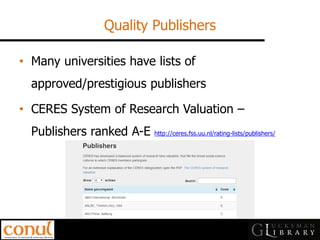
Quality Publishers 
•Many universities have lists of approved/prestigious publishers 
•CERES System of Research Valuation – Publishers ranked A-E http://ceres.fss.uu.nl/rating-lists/publishers/
Journal Publishing 
•Journal scope 
•Editorial Board / Peer-Review System / Waiting time 
•Terms and Conditions 
•Publisher website 
•Impact factor metrics – JIF, SJR, SNIP
Maximising the Impact of Research 
1.Publish in high impact journals 
2.Collaborate with other researchers 
3.Ensure research is easily identifiable 
4.Increase the visibility of research outputs 
5.Communicate & promote research outputs
1. Publish in High Impact Journals 
•Impact factor metrics (JCR, SJR & SNIP) should be used as a guide to selecting high impact journals 
•Researchers should consult with their peers & check that the scope of the journal matches their article topic before submitting to a journal 
•Publishing in high impact journals does not guarantee that an article will receive high citations
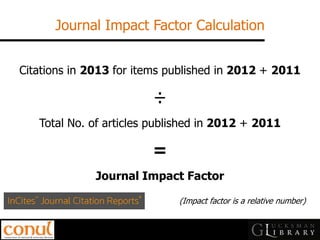
Journal Impact Factor Calculation 
Citations in 2013 for items published in 2012 + 2011 ÷ Total No. of articles published in 2012 + 2011 = Journal Impact Factor (Impact factor is a relative number)
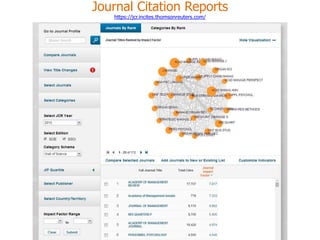
Journal Citation Reports https://jcr.incites.thomsonreuters.com/
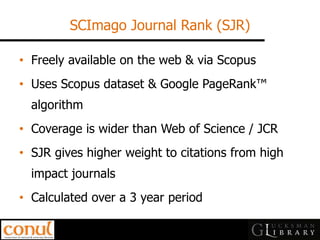
SCImago Journal Rank (SJR) 
•Freely available on the web & via Scopus 
•Uses Scopus dataset & Google PageRank™ algorithm 
•Coverage is wider than Web of Science / JCR 
•SJR gives higher weight to citations from high impact journals 
•Calculated over a 3 year period
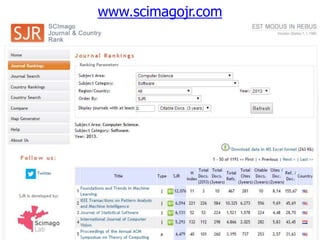
www.scimagojr.com
SNIP 
•SNIP = source normalized impact per paper 
•Based on Elsevier’s Scopus data 
•Freely available on the web www.journalindicators.com & via Scopus 
•SNIP numbers can be compared for any two journals, regardless of the field 
•SNIP is defined as the ratio of the Raw Impact per Paper divided by the Database Citation Potential
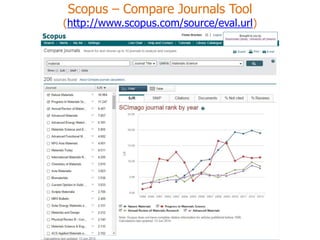
Scopus – Compare Journals Tool (http://www.scopus.com/source/eval.url)
Discipline Specific Rankings 
•Association of Business Schools (ABS) (http://www.bizschooljournals.com/) 
•Washington and Lee Law Journal Ranking (http://lawlib.wlu.edu/LJ/) 
•Harzing’s Journal Quality List (http://www.harzing.com/jql.htm)
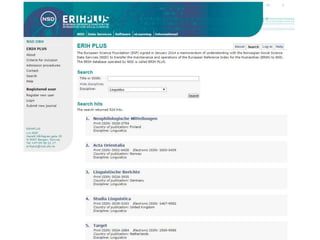
European Reference Index for the Humanities & the Social Sciences (ERIH PLUS) 
•ERIH PLUS includes scientific journals in humanities & social sciences published in Europe that meet benchmark standards 
•Journals are not allocated to particular categories 
•https://dbh.nsd.uib.no/publiseringskanaler/erihplus/
2. Collaborate with Other Researchers 
•Collaborate with researchers in other institutions 
•Co-authored papers, especially with international authors, are cited more frequently 
•Collaboration can lead to better quality research due to the complementary skills of the team
3. Ensure Research is Easily Identifiable 
•Researchers should always use the same name version consistently throughout their career 
•Create online researcher profile(s): 
ORCID 
ResearcherID 
Google Scholar Profile
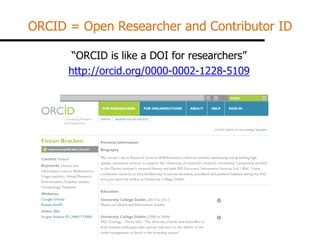
ORCID = Open Researcher and Contributor ID 
“ORCID is like a DOI for researchers” 
http://orcid.org/0000-0002-1228-5109
ORCID Helps Researchers to: 
•Ensure their work is discoverable & connected to them throughout their career 
•Eliminate name ambiguity, distinguishing them from other researchers & ensuring their work is easily identifiable as theirs (i.e. proper attribution) 
•Save time by associating their existing IDs (e.g. ResearcherID, Scopus Author Profile) with ORCID & exchanging profile and/or publication data between them
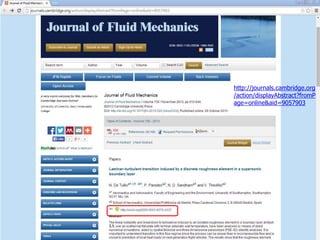
http://journals.cambridge.org/action/displayAbstract?fromPage=online&aid=9057903
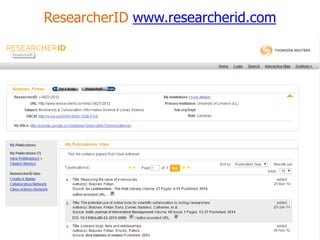
ResearcherID www.researcherid.com
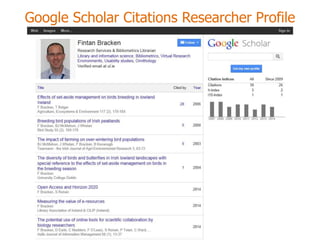
Google Scholar Citations Researcher Profile
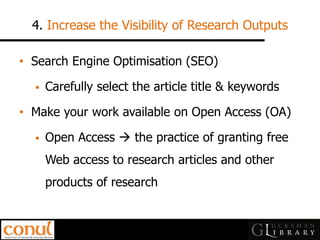
4. Increase the Visibility of Research Outputs 
•Search Engine Optimisation (SEO) 
Carefully select the article title & keywords 
•Make your work available on Open Access (OA) 
Open Access  the practice of granting free Web access to research articles and other products of research
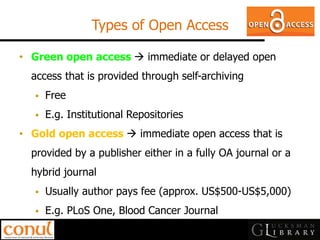
Types of Open Access 
•Green open access  immediate or delayed open access that is provided through self-archiving 
Free 
E.g. Institutional Repositories 
•Gold open access  immediate open access that is provided by a publisher either in a fully OA journal or a hybrid journal 
Usually author pays fee (approx. US$500-US$5,000) 
E.g. PLoS One, Blood Cancer Journal
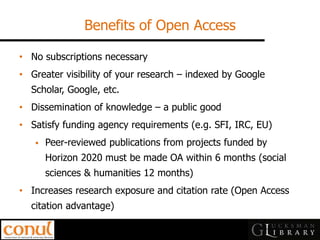
Benefits of Open Access 
•No subscriptions necessary 
•Greater visibility of your research – indexed by Google Scholar, Google, etc. 
•Dissemination of knowledge – a public good 
•Satisfy funding agency requirements (e.g. SFI, IRC, EU) 
Peer-reviewed publications from projects funded by Horizon 2020 must be made OA within 6 months (social sciences & humanities 12 months) 
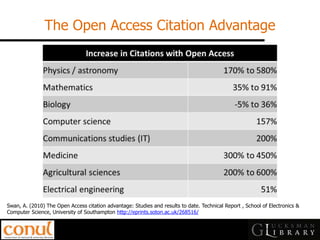
•Increases research exposure and citation rate (Open Access citation advantage)
The Open Access Citation Advantage 
Swan, A. (2010) The Open Access citation advantage: Studies and results to date. Technical Report , School of Electronics & Computer Science, University of Southampton http://eprints.soton.ac.uk/268516/
Green OA & Copyright 
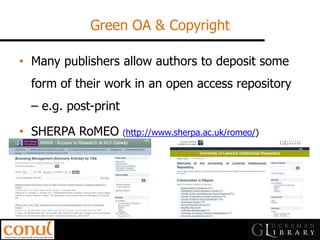
•Many publishers allow authors to deposit some form of their work in an open access repository – e.g. post-print 
•SHERPA RoMEO (http://www.sherpa.ac.uk/romeo/)
5. Communicate & Promote Research Outputs 
•Attend & present at conferences & seminars 
To communicate the results of research & meet potential collaborators 
•Profiles on academic social networking sites e.g.: 
Academia.edu 
ResearchGate 
Mendeley
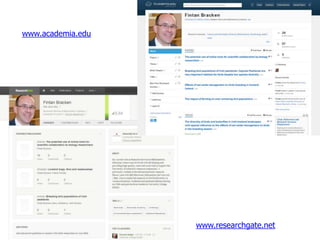
www.researchgate.net 
www.academia.edu
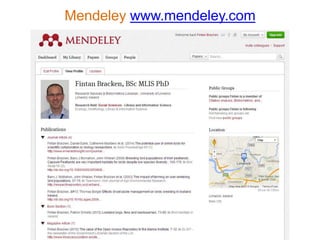
Mendeley www.mendeley.com
Researchers can use Social Media to: 
•Publicise their research & engage with their audience: 
Twitter 
Blogs 
Slideshare 
YouTube 
Personal Website
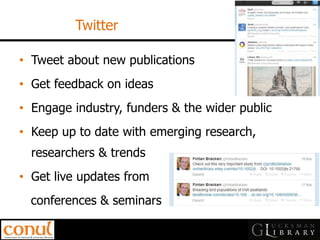
•Tweet about new publications 
•Get feedback on ideas 
•Engage industry, funders & the wider public 
•Keep up to date with emerging research, researchers & trends 
•Get live updates from 
conferences & seminars 
Twitter
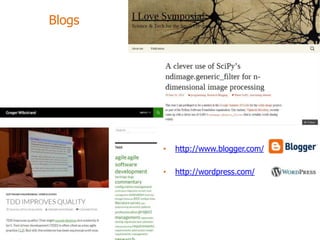
Blogs 
•http://www.blogger.com/ 
•http://wordpress.com/
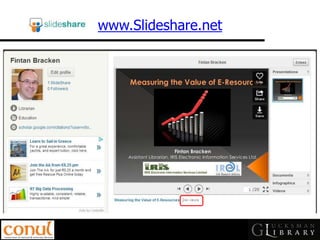
www.Slideshare.net
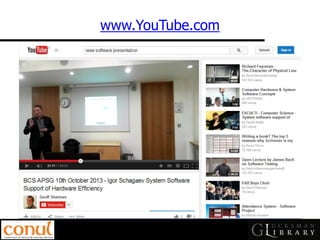
www.YouTube.com
Altmetrics / Alternative Metrics 
•Measures of scholarly activity & impact which differ from the traditional measures such as citations 
•Aim is to provide a more comprehensive picture of scholarly activity & of the use & impact of a researcher's work 
•Altmetrics are largely based on social media activity: 
downloads, shares, tweets, likes, views, bookmarks, comments, reviews, wikipedia articles, blog posts, news stories, saves, +1s, google scholar citations, favourites, clicks, stars, mentions …
Potential of Altmetrics in: 
•Providing real-time indicators of impact 
•Capturing ‘practitioner’ impact of those who may never publish 
•Showing evidence of industry & public engagement 
•Being an indicator for future citations?
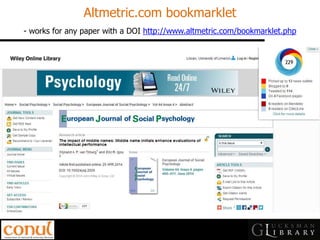
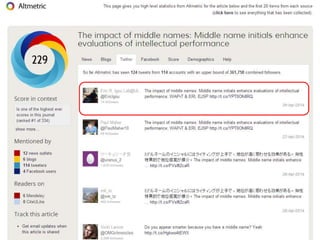
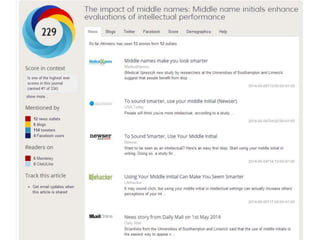
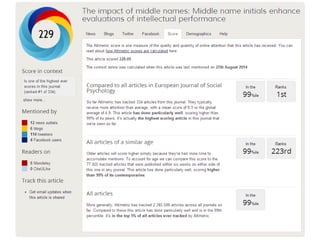
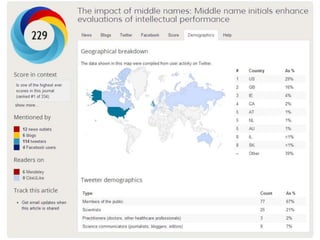
Altmetric.com bookmarklet - works for any paper with a DOI http://www.altmetric.com/bookmarklet.php
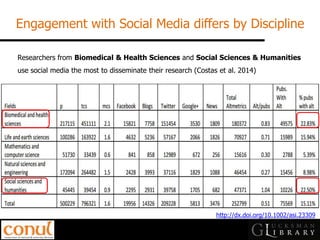
Engagement with Social Media differs by Discipline 
Researchers from Biomedical & Health Sciences and Social Sciences & Humanities use social media the most to disseminate their research (Costas et al. 2014) 
http://dx.doi.org/10.1002/asi.23309
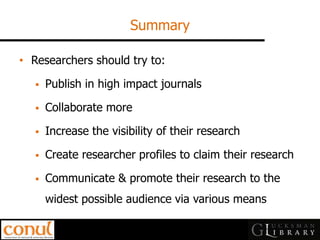
Summary 
•Researchers should try to: 
Publish in high impact journals 
Collaborate more 
Increase the visibility of their research 
Create researcher profiles to claim their research 
Communicate & promote their research to the widest possible audience via various means
Thank you for Listening 
Questions? 
Dr. Fintan Bracken 
Research Services & Bibliometrics Librarian, University of Limerick 
Email: fintan.bracken@ul.ie 
Further information at: http://libguides.ul.ie/research

Publication Strategy: Helping Academics to Increase the Impact of their Research

  • 1.
    Publication Strategy: HelpingAcademics to Increase the Impact of their Research Dr. Fintan Bracken Supporting the activities of your research community – issues and initiatives Royal Irish Academy 3rd December 2014 Research Support Task & Finish Group
  • 2.
    Presentation Outline •BookPublishing •Journal Publishing •Maximising the Impact of Research
  • 3.
    Book Publishing •Howreputable and suitable is the publisher? •Editorial Board / Peer-Review System / Distribution / Promotion •Publisher website •Avoid vanity presses & print-on-demand publishers http://scholarlyoa.com/2014/04/08/a-list-of-print-on-demand-publishers- self-publishingvanity-presses-and-other-non-traditional-publishers-for-librarians-and-authors/
  • 4.
    Quality Publishers •Manyuniversities have lists of approved/prestigious publishers •CERES System of Research Valuation – Publishers ranked A-E http://ceres.fss.uu.nl/rating-lists/publishers/
  • 5.
    Journal Publishing •Journalscope •Editorial Board / Peer-Review System / Waiting time •Terms and Conditions •Publisher website •Impact factor metrics – JIF, SJR, SNIP
  • 6.
    Maximising the Impactof Research 1.Publish in high impact journals 2.Collaborate with other researchers 3.Ensure research is easily identifiable 4.Increase the visibility of research outputs 5.Communicate & promote research outputs
  • 7.
    1. Publish inHigh Impact Journals •Impact factor metrics (JCR, SJR & SNIP) should be used as a guide to selecting high impact journals •Researchers should consult with their peers & check that the scope of the journal matches their article topic before submitting to a journal •Publishing in high impact journals does not guarantee that an article will receive high citations
  • 8.
    Journal Impact FactorCalculation Citations in 2013 for items published in 2012 + 2011 ÷ Total No. of articles published in 2012 + 2011 = Journal Impact Factor (Impact factor is a relative number)
  • 9.
    Journal Citation Reportshttps://jcr.incites.thomsonreuters.com/
  • 10.
    SCImago Journal Rank(SJR) •Freely available on the web & via Scopus •Uses Scopus dataset & Google PageRank™ algorithm •Coverage is wider than Web of Science / JCR •SJR gives higher weight to citations from high impact journals •Calculated over a 3 year period
  • 11.
  • 12.
    SNIP •SNIP =source normalized impact per paper •Based on Elsevier’s Scopus data •Freely available on the web www.journalindicators.com & via Scopus •SNIP numbers can be compared for any two journals, regardless of the field •SNIP is defined as the ratio of the Raw Impact per Paper divided by the Database Citation Potential
  • 13.
    Scopus – CompareJournals Tool (http://www.scopus.com/source/eval.url)
  • 14.
    Discipline Specific Rankings •Association of Business Schools (ABS) (http://www.bizschooljournals.com/) •Washington and Lee Law Journal Ranking (http://lawlib.wlu.edu/LJ/) •Harzing’s Journal Quality List (http://www.harzing.com/jql.htm)
  • 15.
    European Reference Indexfor the Humanities & the Social Sciences (ERIH PLUS) •ERIH PLUS includes scientific journals in humanities & social sciences published in Europe that meet benchmark standards •Journals are not allocated to particular categories •https://dbh.nsd.uib.no/publiseringskanaler/erihplus/
  • 17.
    2. Collaborate withOther Researchers •Collaborate with researchers in other institutions •Co-authored papers, especially with international authors, are cited more frequently •Collaboration can lead to better quality research due to the complementary skills of the team
  • 18.
    3. Ensure Researchis Easily Identifiable •Researchers should always use the same name version consistently throughout their career •Create online researcher profile(s): ORCID ResearcherID Google Scholar Profile
  • 19.
    ORCID = OpenResearcher and Contributor ID “ORCID is like a DOI for researchers” http://orcid.org/0000-0002-1228-5109
  • 20.
    ORCID Helps Researchersto: •Ensure their work is discoverable & connected to them throughout their career •Eliminate name ambiguity, distinguishing them from other researchers & ensuring their work is easily identifiable as theirs (i.e. proper attribution) •Save time by associating their existing IDs (e.g. ResearcherID, Scopus Author Profile) with ORCID & exchanging profile and/or publication data between them
  • 21.
  • 22.
  • 23.
    Google Scholar CitationsResearcher Profile
  • 24.
    4. Increase theVisibility of Research Outputs •Search Engine Optimisation (SEO) Carefully select the article title & keywords •Make your work available on Open Access (OA) Open Access  the practice of granting free Web access to research articles and other products of research
  • 25.
    Types of OpenAccess •Green open access  immediate or delayed open access that is provided through self-archiving Free E.g. Institutional Repositories •Gold open access  immediate open access that is provided by a publisher either in a fully OA journal or a hybrid journal Usually author pays fee (approx. US$500-US$5,000) E.g. PLoS One, Blood Cancer Journal
  • 26.
    Benefits of OpenAccess •No subscriptions necessary •Greater visibility of your research – indexed by Google Scholar, Google, etc. •Dissemination of knowledge – a public good •Satisfy funding agency requirements (e.g. SFI, IRC, EU) Peer-reviewed publications from projects funded by Horizon 2020 must be made OA within 6 months (social sciences & humanities 12 months) •Increases research exposure and citation rate (Open Access citation advantage)
  • 27.
    The Open AccessCitation Advantage Swan, A. (2010) The Open Access citation advantage: Studies and results to date. Technical Report , School of Electronics & Computer Science, University of Southampton http://eprints.soton.ac.uk/268516/
  • 28.
    Green OA &Copyright •Many publishers allow authors to deposit some form of their work in an open access repository – e.g. post-print •SHERPA RoMEO (http://www.sherpa.ac.uk/romeo/)
  • 29.
    5. Communicate &Promote Research Outputs •Attend & present at conferences & seminars To communicate the results of research & meet potential collaborators •Profiles on academic social networking sites e.g.: Academia.edu ResearchGate Mendeley
  • 30.
  • 31.
  • 32.
    Researchers can useSocial Media to: •Publicise their research & engage with their audience: Twitter Blogs Slideshare YouTube Personal Website
  • 33.
    •Tweet about newpublications •Get feedback on ideas •Engage industry, funders & the wider public •Keep up to date with emerging research, researchers & trends •Get live updates from conferences & seminars Twitter
  • 34.
  • 35.
  • 36.
  • 37.
    Altmetrics / AlternativeMetrics •Measures of scholarly activity & impact which differ from the traditional measures such as citations •Aim is to provide a more comprehensive picture of scholarly activity & of the use & impact of a researcher's work •Altmetrics are largely based on social media activity: downloads, shares, tweets, likes, views, bookmarks, comments, reviews, wikipedia articles, blog posts, news stories, saves, +1s, google scholar citations, favourites, clicks, stars, mentions …
  • 38.
    Potential of Altmetricsin: •Providing real-time indicators of impact •Capturing ‘practitioner’ impact of those who may never publish •Showing evidence of industry & public engagement •Being an indicator for future citations?
  • 39.
    Altmetric.com bookmarklet -works for any paper with a DOI http://www.altmetric.com/bookmarklet.php
  • 44.
    Engagement with SocialMedia differs by Discipline Researchers from Biomedical & Health Sciences and Social Sciences & Humanities use social media the most to disseminate their research (Costas et al. 2014) http://dx.doi.org/10.1002/asi.23309
  • 45.
    Summary •Researchers shouldtry to: Publish in high impact journals Collaborate more Increase the visibility of their research Create researcher profiles to claim their research Communicate & promote their research to the widest possible audience via various means
  • 46.
    Thank you forListening Questions? Dr. Fintan Bracken Research Services & Bibliometrics Librarian, University of Limerick Email: fintan.bracken@ul.ie Further information at: http://libguides.ul.ie/research