
Open Access and PLOS: The Future of Scholarly
Publishing
Ginny Barbour
Medicine Editorial Director, PLOS
vbarbour@plos.org
@ginnybarbour
0000-0002-2358-2440
1
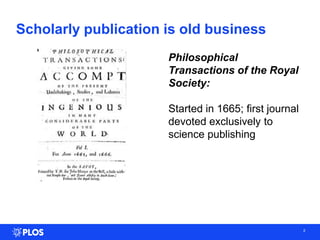
Scholarly publication is old business
2
Philosophical
Transactions of the Royal
Society:
Started in 1665; first journal
devoted exclusively to
science publishing
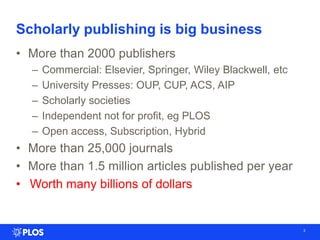
Scholarly publishing is big business
• More than 2000 publishers
– Commercial: Elsevier, Springer, Wiley Blackwell, etc
– University Presses: OUP, CUP, ACS, AIP
– Scholarly societies
– Independent not for profit, eg PLOS
– Open access, Subscription, Hybrid
• More than 25,000 journals
• More than 1.5 million articles published per year
• Worth many billions of dollars
3
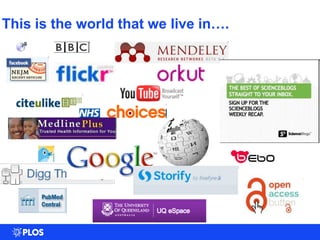
This is the world that we live in….
The internet changed everything
5
There are three things that we need to understand
about the web. First, it is more amazing than we
think. Second, the conjunction of technologies that
made the web successful was extremely unlikely.
Third, we probably would not create it, or any
technology like it, today. In fact, we would be more
likely to cripple it, or declare it illegal.
James Boyle, Web’s never-to-be-repeated revolution, Financial Times, November 2, 2005
Open Access: the revolutionary idea
6
7
Kiwi Open Access Logo by the University of Auckland, Libraries and Learning
Services is licensed under a Creative Commons Attribution 3.0 Unported
License.
Open > Free
8
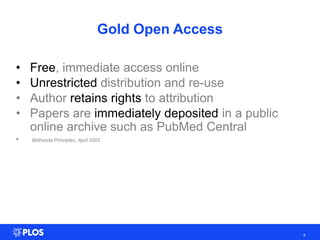
• Free, immediate access online
• Unrestricted distribution and re-use
• Author retains rights to attribution
• Papers are immediately deposited in a public
online archive such as PubMed Central
• Bethesda Principles, April 2003
9
Gold Open Access
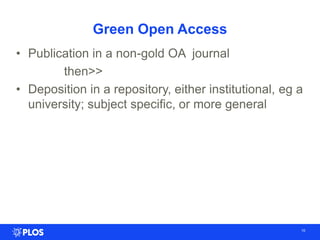
Green Open Access
• Publication in a non-gold OA journal
then>>
• Deposition in a repository, either institutional, eg a
university; subject specific, or more general
10
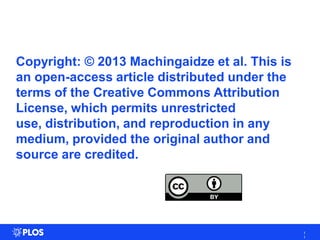
Copyright: © 2013 Machingaidze et al. This is
an open-access article distributed under the
terms of the Creative Commons Attribution
License, which permits unrestricted
use, distribution, and reproduction in any
medium, provided the original author and
source are credited.
1
1
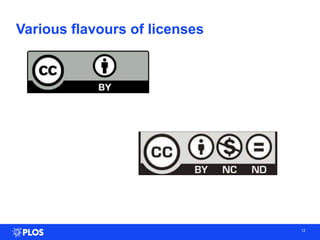
Various flavours of licenses
12
www.plos.org
All PLOS journals are gold open access
• Free, immediate access online
• Unrestricted distribution and re-use
• Author retains rights to attribution and copyright
• Papers are deposited in a public online archive
such as PubMed Central
Bethesda Principles, April 2003
1
4
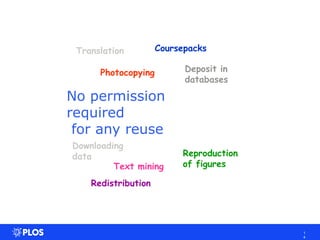
No permission
required
for any reuse
Translation
Redistribution
Photocopying
Coursepacks
Reproduction
of figures
Deposit in
databases
Downloading
data
Text mining
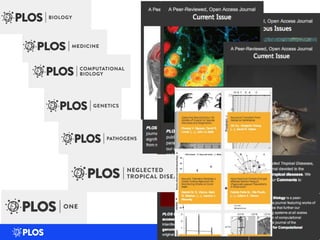
PLOS
• Founded in October, 2000
• December, 2002, $9M grant from Moore Foundation
• October 2003, 1st journal, PLOS Biology, launched
• Now has seven journals
• Now has diverse sources of revenue
– Publication charges
• $2900 for PLOS Medicine and Biology
• $2250 Community journals
• $1350 PLOS ONE
– Publication Fee assistance programme
– Institutional and individual memberships
– Advertising
• 2011 posted first surplus
16
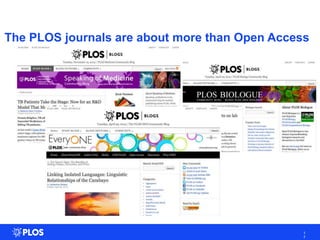
The PLOS journals are about more than Open Access
1
7
19
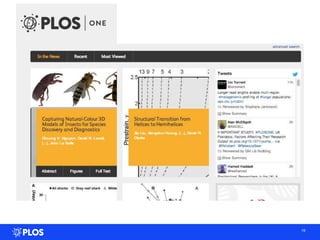
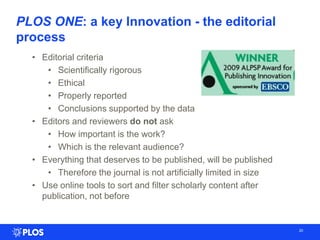
PLOS ONE: a key Innovation - the editorial
process
20
• Editorial criteria
• Scientifically rigorous
• Ethical
• Properly reported
• Conclusions supported by the data
• Editors and reviewers do not ask
• How important is the work?
• Which is the relevant audience?
• Everything that deserves to be published, will be published
• Therefore the journal is not artificially limited in size
• Use online tools to sort and filter scholarly content after
publication, not before
The megajournals…
OK, why do I need to care
about OA?
22
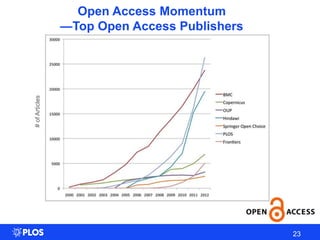
Open Access Momentum
—Top Open Access Publishers
23
23
#ofArticles
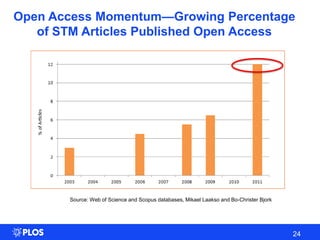
Open Access Momentum—Growing Percentage
of STM Articles Published Open Access
24
24
Source: Web of Science and Scopus databases, Mikael Laakso and Bo-Christer Bjork
Your funders care:
ARC/NHMRC policies
• ―… requires that any publications arising from an [ARC/NHMRC]
supported research project must be deposited into an open access
institutional repository within a twelve (12) month period from the date
of publication‖.
• Say all metadata must be deposited in IR with a link to OA version as
soon as possible after acceptance
• Prefer the deposit of Accepted or Published version into an IR
• Permit the deposit into a subject repository (linking to the IR)
• Permit publication in an OA journal (linking to the IR)
• Both the ARC and the NHMRC do allow some of their grant allocation
to be directed to publication costs:
• NHMRC relates to any publication after 1 July 2012, regardless of the
grant that supported the research;
• ARC policy only affects publications arising from Funding Grants and
Rules 2013
25
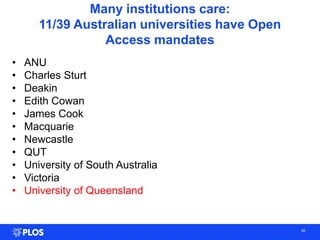
Many institutions care:
11/39 Australian universities have Open
Access mandates
• ANU
• Charles Sturt
• Deakin
• Edith Cowan
• James Cook
• Macquarie
• Newcastle
• QUT
• University of South Australia
• Victoria
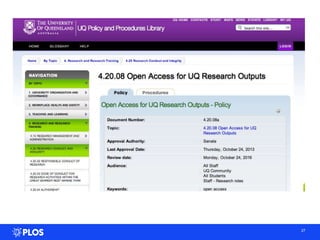
• University of Queensland
26
27
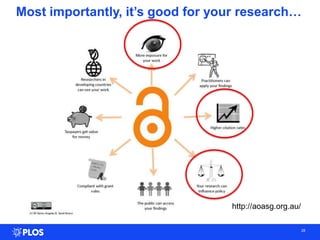
Most importantly, it’s good for your research…
28
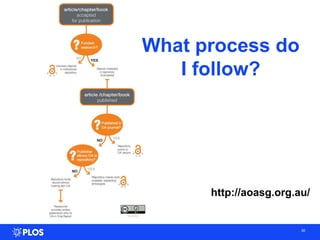
http://aoasg.org.au/
Make it easy, please…
29
30
http://aoasg.org.au/
What process do
I follow?
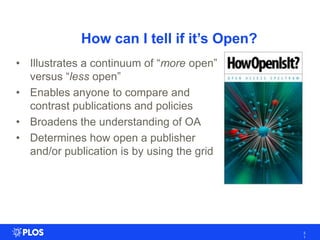
How can I tell if it’s Open?
• Illustrates a continuum of ―more open‖
versus ―less open‖
• Enables anyone to compare and
contrast publications and policies
• Broadens the understanding of OA
• Determines how open a publisher
and/or publication is by using the grid
3
1
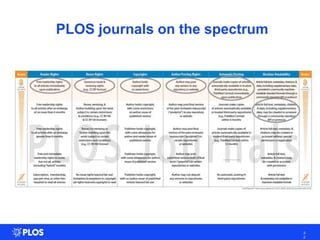
PLOS journals on the spectrum
3
2
3
3
International Journal and
Research Academy
Invitation for Paper Submission
Publish your Paper through International Journal & Research Academy (IJARA)
IJARA�stands for International Journal & Research Academy. We are searching for scholars
from all over the world and from all fields of studies in order to bring them into a common
platform.�IJARA�is an international organization for promoting research and for providing a
common platform for research scholars from all disciplines.IJARA�is formed by group of
researchers, academicians and scholars based in many different countries (such as USA, UK,
Canada, Australia, Sweden, Italy, France, Poland, China, Nigeria, South Africa, Pakistan, India,
Bangladesh, Vietnam, Thailand, Malaysia, Hong Kong) working with various esteemed
educational institutions, government and research organizations across the world.
We strive to promote �E-Publishing� by publishing our journals in Electronic
form,�IJARA�invites scholars, researchers, professionals and academicians to publish their
research papers in our journals.�IJARA�is keen to publish papers from researchers all over the
world.
Paper Submission Deadline:�May 20, 2013
Review Results (Acceptance/Rejection) Notification: Within 10 working days (maximum) of
paper submission.
Publication Date:�June 01, 2013
Send manuscripts to the assigned email address for each journal.
Submit articles for 2nd Issue, Volume 01 of following Journals
The author(s) can submit their manuscripts for the following journal categories:
International Journal ofBusiness & ManagementResearch [ISSN 2306-9165]
Research Journal ofFinance and Accounting [ISSN 1888-7373]
International Journal for Research and Developmentin Engineering [ISSN 2113-5468]
Research Journal on Distance Learning [ISSN 2113-7968]
Special Issue "Advances in Clinical Trials"
Dear Dr. Editors,
Please pay attention to our upcoming Special
Issue on "Advances in Clinical Trials"
( www.scirp.org/journal/ijcm), which will be
published in the "International Journal of
Clinical Medicine"(IJCM, ISSN: 2158-2882), a
peer-reviewed open access journal. We cordially
invite you to submit your manuscript to this
special issue through our Online Submission
System.
About Our Journal
■ Full peer review: All manuscripts submitted to
our journals undergo peer review.
■ Fast publication: Fast peer review process of
papers within approximately one month of
submission.
■ Low price: Publication Fee Assistance to
Authors from Low Income Countries.
To authors who cannot afford a full payment of
the fee, we may offer partial or total fee waivers
on the sole condition that the papers they submit
be of high quality. Article ProcessingCharges
for Low and Lower Middle Income Countries
are calculated according to the SCIRP Global
Participation Initiative.
Journal Introduction
■ IJCM has 315 papers in 19
issues so far
■ The downloads of articles in
IJCM exceed 171,000
■ The visits of the journal
exceed 340,000
■ The journal has been indexed
by 64 databases
Other Special Issues
on IJCM
■ Pediatric Surgery
Submission Deadline:
May 15th, 2013
■ Shoulder Surgery
Submission Deadline:
May 22th, 2013
>>More
Connect with Us
■ E-mail: ijcm@scirp.org
―Open Access‖ does NOT tell you about
• The scope of the journal
• The quality of the journal
• The language of the journal
• The review process of the journal
3
4
3
5
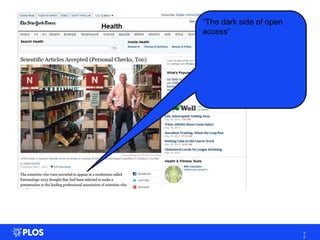
―The dark side of open
access‖
3
6
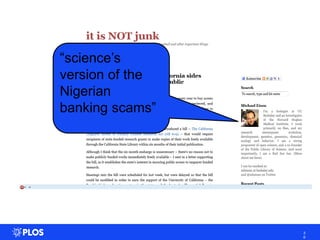
―science‘s
version of the
Nigerian
banking scams‖
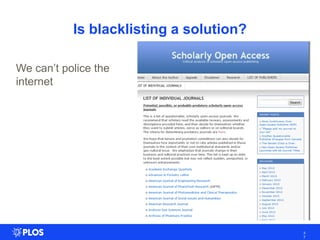
Is blacklisting a solution?
We can‘t police the
internet
3
7
38
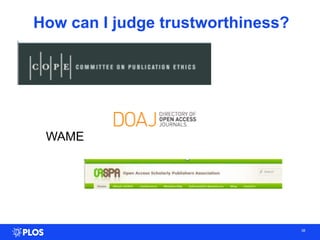
WAME
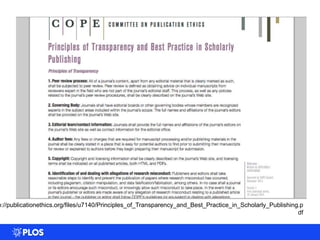
How can I judge trustworthiness?
p://publicationethics.org/files/u7140/Principles_of_Transparency_and_Best_Practice_in_Scholarly_Publishing.p
df
What’s next?
40
Technology is enabling major changes
in publishing
• Open Access to publications ✔
• Open Access to data
• Bringing authorship out of the shadows
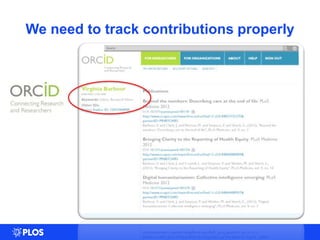
• ORCID
• Contributorship
• Enabling correction of the literature
• Post publication peer review
• New ways of measuring impact
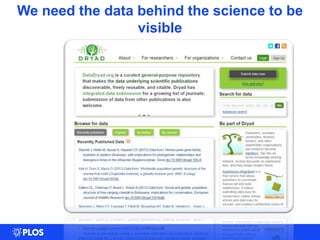
We need the data behind the science to be
visible
New PLOS Data Policy
• Ensuring access to the underlying data should be
an intrinsic part of the scientific publishing
process
• To ensure that all steps, from authoring to
publication, capture data and its associated
metadata well and then present them in optimal
human and machine-readable formats to all
readers and users of PLOS-published research
43
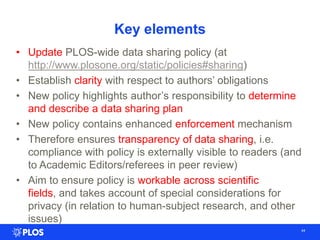
Key elements
44
• Update PLOS-wide data sharing policy (at
http://www.plosone.org/static/policies#sharing)
• Establish clarity with respect to authors‘ obligations
• New policy highlights author‘s responsibility to determine
and describe a data sharing plan
• New policy contains enhanced enforcement mechanism
• Therefore ensures transparency of data sharing, i.e.
compliance with policy is externally visible to readers (and
to Academic Editors/referees in peer review)
• Aim to ensure policy is workable across scientific
fields, and takes account of special considerations for
privacy (in relation to human-subject research, and other
issues)
We need to track contributions properly
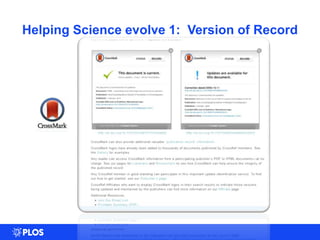
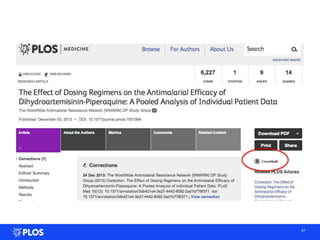
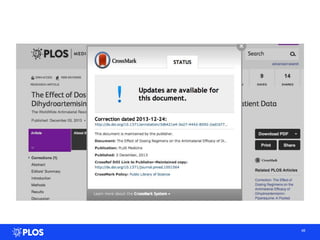
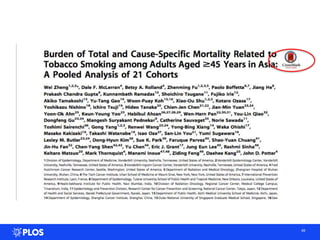
Helping Science evolve 1: Version of Record
47
48
49
Helping science evolve 2: Post publication
review and commenting
50
51
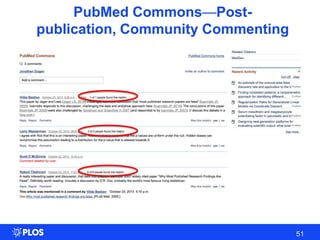
PubMed Commons—Post-
publication, Community Commenting
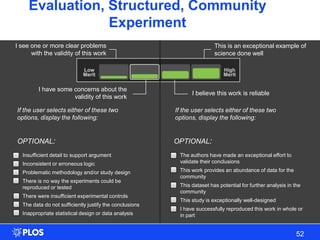
Evaluation, Structured, Community
Experiment
I have some concerns about the
validity of this work
This is an exceptional example of
science done well
I see one or more clear problems
with the validity of this work
I believe this work is reliable
If the user selects either of these two
options, display the following:
If the user selects either of these two
options, display the following:
The authors have made an exceptional effort to
validate their conclusions
This work provides an abundance of data for the
community
This dataset has potential for further analysis in the
community
This study is exceptionally well-designed
I have successfully reproduced this work in whole or
in part
Insufficient detail to support argument
Inconsistent or erroneous logic
Problematic methodology and/or study design
There is no way the experiments could be
reproduced or tested
There were insufficient experimental controls
The data do not sufficiently justify the conclusions
Inappropriate statistical design or data analysis
OPTIONAL: OPTIONAL:
52
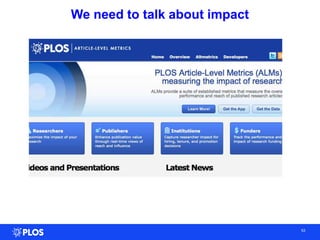
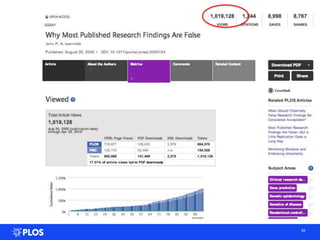
We need to talk about impact
53
5
4
54
0.3%
100%
22.2%
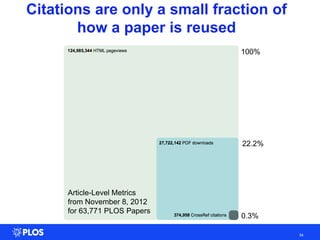
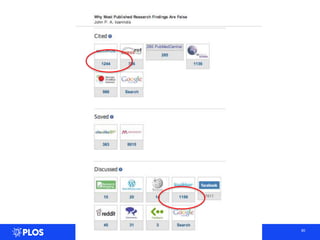
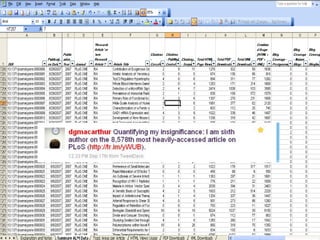
Citations are only a small fraction of
how a paper is reused
Article-Level Metrics
from November 8, 2012
for 63,771 PLOS Papers
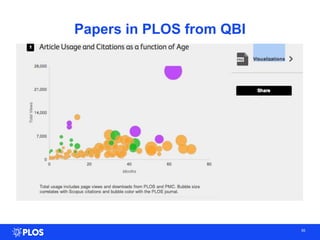
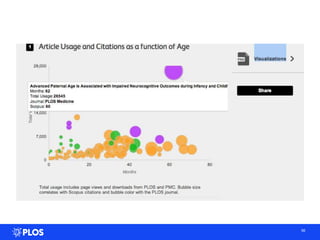
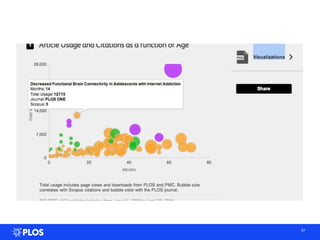
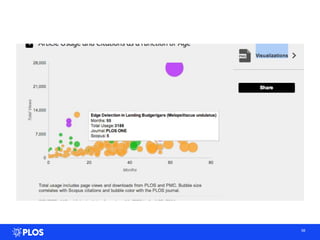
Papers in PLOS from QBI
55
56
57
58
59
60
6
2
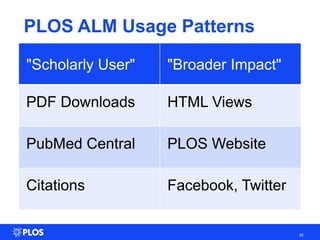
PLOS ALM Usage Patterns
62
"Scholarly User" "Broader Impact"
PDF Downloads HTML Views
PubMed Central PLOS Website
Citations Facebook, Twitter
63
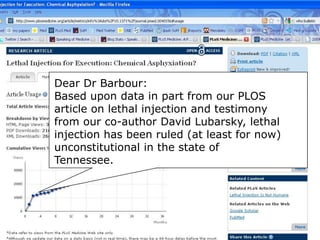
Dear Dr Barbour:
Based upon data in part from our PLOS
article on lethal injection and testimony
from our co-author David Lubarsky, lethal
injection has been ruled (at least for now)
unconstitutional in the state of
Tennessee.
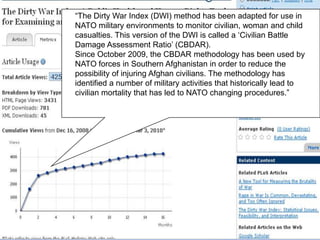
―The Dirty War Index (DWI) method has been adapted for use in
NATO military environments to monitor civilian, woman and child
casualties. This version of the DWI is called a ‗Civilian Battle
Damage Assessment Ratio‘ (CBDAR).
Since October 2009, the CBDAR methodology has been used by
NATO forces in Southern Afghanistan in order to reduce the
possibility of injuring Afghan civilians. The methodology has
identified a number of military activities that historically lead to
civilian mortality that has led to NATO changing procedures.‖
In short…
The internet has changed academic publishing for good
Publishing is, more than ever, a service industry
Open (not just free) Access is a means to an end – the
next (interesting) bit is in your hands
Other things I’d happily talk about…
67
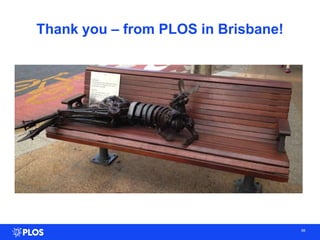
Thank you – from PLOS in Brisbane!
68

Open Access and PLOS: The Future of Scholarly Publishing - Dr. Virginia Barbour

  • 1.
    Open Access andPLOS: The Future of Scholarly Publishing Ginny Barbour Medicine Editorial Director, PLOS vbarbour@plos.org @ginnybarbour 0000-0002-2358-2440 1
  • 2.
    Scholarly publication isold business 2 Philosophical Transactions of the Royal Society: Started in 1665; first journal devoted exclusively to science publishing
  • 3.
    Scholarly publishing isbig business • More than 2000 publishers – Commercial: Elsevier, Springer, Wiley Blackwell, etc – University Presses: OUP, CUP, ACS, AIP – Scholarly societies – Independent not for profit, eg PLOS – Open access, Subscription, Hybrid • More than 25,000 journals • More than 1.5 million articles published per year • Worth many billions of dollars 3
  • 4.
    This is theworld that we live in….
  • 5.
    The internet changedeverything 5 There are three things that we need to understand about the web. First, it is more amazing than we think. Second, the conjunction of technologies that made the web successful was extremely unlikely. Third, we probably would not create it, or any technology like it, today. In fact, we would be more likely to cripple it, or declare it illegal. James Boyle, Web’s never-to-be-repeated revolution, Financial Times, November 2, 2005
  • 6.
    Open Access: therevolutionary idea 6
  • 7.
    7 Kiwi Open AccessLogo by the University of Auckland, Libraries and Learning Services is licensed under a Creative Commons Attribution 3.0 Unported License.
  • 8.
  • 9.
    • Free, immediateaccess online • Unrestricted distribution and re-use • Author retains rights to attribution • Papers are immediately deposited in a public online archive such as PubMed Central • Bethesda Principles, April 2003 9 Gold Open Access
  • 10.
    Green Open Access •Publication in a non-gold OA journal then>> • Deposition in a repository, either institutional, eg a university; subject specific, or more general 10
  • 11.
    Copyright: © 2013Machingaidze et al. This is an open-access article distributed under the terms of the Creative Commons Attribution License, which permits unrestricted use, distribution, and reproduction in any medium, provided the original author and source are credited. 1 1
  • 12.
  • 13.
    www.plos.org All PLOS journalsare gold open access • Free, immediate access online • Unrestricted distribution and re-use • Author retains rights to attribution and copyright • Papers are deposited in a public online archive such as PubMed Central Bethesda Principles, April 2003
  • 14.
    1 4 No permission required for anyreuse Translation Redistribution Photocopying Coursepacks Reproduction of figures Deposit in databases Downloading data Text mining
  • 15.
    PLOS • Founded inOctober, 2000 • December, 2002, $9M grant from Moore Foundation • October 2003, 1st journal, PLOS Biology, launched • Now has seven journals • Now has diverse sources of revenue – Publication charges • $2900 for PLOS Medicine and Biology • $2250 Community journals • $1350 PLOS ONE – Publication Fee assistance programme – Institutional and individual memberships – Advertising • 2011 posted first surplus
  • 16.
  • 17.
    The PLOS journalsare about more than Open Access 1 7
  • 19.
  • 20.
    PLOS ONE: akey Innovation - the editorial process 20 • Editorial criteria • Scientifically rigorous • Ethical • Properly reported • Conclusions supported by the data • Editors and reviewers do not ask • How important is the work? • Which is the relevant audience? • Everything that deserves to be published, will be published • Therefore the journal is not artificially limited in size • Use online tools to sort and filter scholarly content after publication, not before
  • 21.
  • 22.
    OK, why doI need to care about OA? 22
  • 23.
    Open Access Momentum —TopOpen Access Publishers 23 23 #ofArticles
  • 24.
    Open Access Momentum—GrowingPercentage of STM Articles Published Open Access 24 24 Source: Web of Science and Scopus databases, Mikael Laakso and Bo-Christer Bjork
  • 25.
    Your funders care: ARC/NHMRCpolicies • ―… requires that any publications arising from an [ARC/NHMRC] supported research project must be deposited into an open access institutional repository within a twelve (12) month period from the date of publication‖. • Say all metadata must be deposited in IR with a link to OA version as soon as possible after acceptance • Prefer the deposit of Accepted or Published version into an IR • Permit the deposit into a subject repository (linking to the IR) • Permit publication in an OA journal (linking to the IR) • Both the ARC and the NHMRC do allow some of their grant allocation to be directed to publication costs: • NHMRC relates to any publication after 1 July 2012, regardless of the grant that supported the research; • ARC policy only affects publications arising from Funding Grants and Rules 2013 25
  • 26.
    Many institutions care: 11/39Australian universities have Open Access mandates • ANU • Charles Sturt • Deakin • Edith Cowan • James Cook • Macquarie • Newcastle • QUT • University of South Australia • Victoria • University of Queensland 26
  • 27.
  • 28.
    Most importantly, it’sgood for your research… 28 http://aoasg.org.au/
  • 29.
    Make it easy,please… 29
  • 30.
  • 31.
    How can Itell if it’s Open? • Illustrates a continuum of ―more open‖ versus ―less open‖ • Enables anyone to compare and contrast publications and policies • Broadens the understanding of OA • Determines how open a publisher and/or publication is by using the grid 3 1
  • 32.
    PLOS journals onthe spectrum 3 2
  • 33.
    3 3 International Journal and ResearchAcademy Invitation for Paper Submission Publish your Paper through International Journal & Research Academy (IJARA) IJARA�stands for International Journal & Research Academy. We are searching for scholars from all over the world and from all fields of studies in order to bring them into a common platform.�IJARA�is an international organization for promoting research and for providing a common platform for research scholars from all disciplines.IJARA�is formed by group of researchers, academicians and scholars based in many different countries (such as USA, UK, Canada, Australia, Sweden, Italy, France, Poland, China, Nigeria, South Africa, Pakistan, India, Bangladesh, Vietnam, Thailand, Malaysia, Hong Kong) working with various esteemed educational institutions, government and research organizations across the world. We strive to promote �E-Publishing� by publishing our journals in Electronic form,�IJARA�invites scholars, researchers, professionals and academicians to publish their research papers in our journals.�IJARA�is keen to publish papers from researchers all over the world. Paper Submission Deadline:�May 20, 2013 Review Results (Acceptance/Rejection) Notification: Within 10 working days (maximum) of paper submission. Publication Date:�June 01, 2013 Send manuscripts to the assigned email address for each journal. Submit articles for 2nd Issue, Volume 01 of following Journals The author(s) can submit their manuscripts for the following journal categories: International Journal ofBusiness & ManagementResearch [ISSN 2306-9165] Research Journal ofFinance and Accounting [ISSN 1888-7373] International Journal for Research and Developmentin Engineering [ISSN 2113-5468] Research Journal on Distance Learning [ISSN 2113-7968] Special Issue "Advances in Clinical Trials" Dear Dr. Editors, Please pay attention to our upcoming Special Issue on "Advances in Clinical Trials" ( www.scirp.org/journal/ijcm), which will be published in the "International Journal of Clinical Medicine"(IJCM, ISSN: 2158-2882), a peer-reviewed open access journal. We cordially invite you to submit your manuscript to this special issue through our Online Submission System. About Our Journal ■ Full peer review: All manuscripts submitted to our journals undergo peer review. ■ Fast publication: Fast peer review process of papers within approximately one month of submission. ■ Low price: Publication Fee Assistance to Authors from Low Income Countries. To authors who cannot afford a full payment of the fee, we may offer partial or total fee waivers on the sole condition that the papers they submit be of high quality. Article ProcessingCharges for Low and Lower Middle Income Countries are calculated according to the SCIRP Global Participation Initiative. Journal Introduction ■ IJCM has 315 papers in 19 issues so far ■ The downloads of articles in IJCM exceed 171,000 ■ The visits of the journal exceed 340,000 ■ The journal has been indexed by 64 databases Other Special Issues on IJCM ■ Pediatric Surgery Submission Deadline: May 15th, 2013 ■ Shoulder Surgery Submission Deadline: May 22th, 2013 >>More Connect with Us ■ E-mail: ijcm@scirp.org
  • 34.
    ―Open Access‖ doesNOT tell you about • The scope of the journal • The quality of the journal • The language of the journal • The review process of the journal 3 4
  • 35.
    3 5 ―The dark sideof open access‖
  • 36.
  • 37.
    Is blacklisting asolution? We can‘t police the internet 3 7
  • 38.
    38 WAME How can Ijudge trustworthiness?
  • 39.
  • 40.
  • 41.
    Technology is enablingmajor changes in publishing • Open Access to publications ✔ • Open Access to data • Bringing authorship out of the shadows • ORCID • Contributorship • Enabling correction of the literature • Post publication peer review • New ways of measuring impact
  • 42.
    We need thedata behind the science to be visible
  • 43.
    New PLOS DataPolicy • Ensuring access to the underlying data should be an intrinsic part of the scientific publishing process • To ensure that all steps, from authoring to publication, capture data and its associated metadata well and then present them in optimal human and machine-readable formats to all readers and users of PLOS-published research 43
  • 44.
    Key elements 44 • UpdatePLOS-wide data sharing policy (at http://www.plosone.org/static/policies#sharing) • Establish clarity with respect to authors‘ obligations • New policy highlights author‘s responsibility to determine and describe a data sharing plan • New policy contains enhanced enforcement mechanism • Therefore ensures transparency of data sharing, i.e. compliance with policy is externally visible to readers (and to Academic Editors/referees in peer review) • Aim to ensure policy is workable across scientific fields, and takes account of special considerations for privacy (in relation to human-subject research, and other issues)
  • 45.
    We need totrack contributions properly
  • 46.
    Helping Science evolve1: Version of Record
  • 47.
  • 48.
  • 49.
  • 50.
    Helping science evolve2: Post publication review and commenting 50
  • 51.
  • 52.
    Evaluation, Structured, Community Experiment Ihave some concerns about the validity of this work This is an exceptional example of science done well I see one or more clear problems with the validity of this work I believe this work is reliable If the user selects either of these two options, display the following: If the user selects either of these two options, display the following: The authors have made an exceptional effort to validate their conclusions This work provides an abundance of data for the community This dataset has potential for further analysis in the community This study is exceptionally well-designed I have successfully reproduced this work in whole or in part Insufficient detail to support argument Inconsistent or erroneous logic Problematic methodology and/or study design There is no way the experiments could be reproduced or tested There were insufficient experimental controls The data do not sufficiently justify the conclusions Inappropriate statistical design or data analysis OPTIONAL: OPTIONAL: 52
  • 53.
    We need totalk about impact 53
  • 54.
    5 4 54 0.3% 100% 22.2% Citations are onlya small fraction of how a paper is reused Article-Level Metrics from November 8, 2012 for 63,771 PLOS Papers
  • 55.
    Papers in PLOSfrom QBI 55
  • 56.
  • 57.
  • 58.
  • 59.
  • 60.
  • 62.
    6 2 PLOS ALM UsagePatterns 62 "Scholarly User" "Broader Impact" PDF Downloads HTML Views PubMed Central PLOS Website Citations Facebook, Twitter
  • 63.
  • 64.
    Dear Dr Barbour: Basedupon data in part from our PLOS article on lethal injection and testimony from our co-author David Lubarsky, lethal injection has been ruled (at least for now) unconstitutional in the state of Tennessee.
  • 65.
    ―The Dirty WarIndex (DWI) method has been adapted for use in NATO military environments to monitor civilian, woman and child casualties. This version of the DWI is called a ‗Civilian Battle Damage Assessment Ratio‘ (CBDAR). Since October 2009, the CBDAR methodology has been used by NATO forces in Southern Afghanistan in order to reduce the possibility of injuring Afghan civilians. The methodology has identified a number of military activities that historically lead to civilian mortality that has led to NATO changing procedures.‖
  • 66.
    In short… The internethas changed academic publishing for good Publishing is, more than ever, a service industry Open (not just free) Access is a means to an end – the next (interesting) bit is in your hands
  • 67.
    Other things I’dhappily talk about… 67
  • 68.
    Thank you –from PLOS in Brisbane! 68

Editor's Notes

  • #5 There are so many different ways of accessing information
  • #6 What made this all possible?
  • #9 What is open access
  • #10 What does it mean for my research?
  • #44 Address at the beginning of the submission process, just like submission of the protocol, ethical approval, etc“optimal human and machine-readable formats” – an aspirational goal
  • #65 Email directly from author