Predatory publishing: pitfalls for the unwary!
Simon Huggard
Digital Infrastructure Manager

Sharon Karasmanis
Faculty Librarian and Team Leader (Health Sciences)
Library Research Forum, 25 October 2013
latrobe.edu.au

CRICOS Provider 00115M
Predatory Publishers:
• Gold Open Access Model has created opportunities
for corrupt publishers to flourish
• Open Access mandates have spawned more of these
recently, with a huge increase in reports of
questionable email requests
• Only exist to extract author processing fees (often only
charging when the manuscript accepted)
• Take advantage of authors who want to publish in
Open Access journals, note: new PhD graduates
targeted!
La Trobe University

2
2
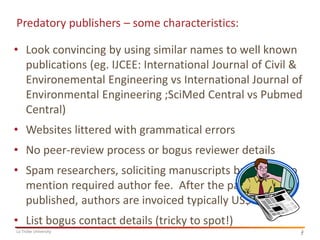
Predatory publishers – some characteristics:

• Look convincing by using similar names to well known
publications (eg. IJCEE: International Journal of Civil &
Environemental Engineering vs International Journal of
Environmental Engineering ;SciMed Central vs Pubmed
Central)
• Websites littered with grammatical errors
• No peer-review process or bogus reviewer details
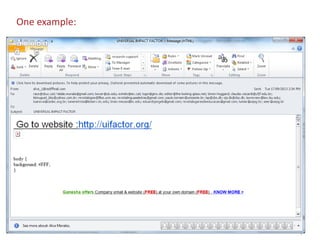
• Spam researchers, soliciting manuscripts but failing to
mention required author fee. After the paper is
published, authors are invoiced typically US$1,800
• List bogus contact details (tricky to spot!)
La Trobe University

3
3
How can you check?
• Look for publishers verifiable contact details,
be cautious if only a web form is provided!

• Does the editorial board list recognised experts with
affiliations
• Check that author fees are prominently displayed
• Be wary of email invitations
• Read previous papers and assess the quality
• Check peer-review process is clearly described, try to
confirm if the displayed impact factor is correct!
La Trobe University

4
4
More on checking:

• Check Beall’s list of Predatory Publishers
•

scholarlyoa.com/2012/12/06/bealls-list-of-predatory-publishers-2013/

•

Further reading:
•

LibGuide on Predatory Publishing in:
latrobe.libguides.com/journalimpact

•

Butler, D. (2013). Investigating journals: the dark side of publishing,
Nature, 495(7442), 433-435. (Describes the emergence of predatory publishing
and provides an alternate view of the Beall’s list)

•

Bohannon, J. (2013). Who’s afraid of peer-review? Science, 342.
(Spoof paper concocted by Science reveals little scrutiny by some predatory journals)

La Trobe University

5
5
Consider Green Open Access!
• Upload a submitted manuscript or postprint of your
article to Research Online (LTU research repository)

• Article will be available freely online
• No article processing fees

• Contact repository@latrobe.edu.au

La Trobe University

6
6
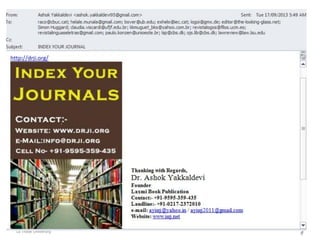
One example:

La Trobe University

7
7
La Trobe University

8
8
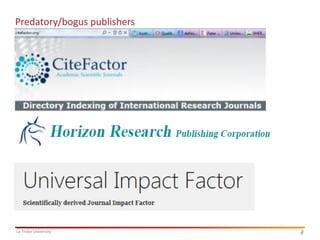
Predatory/bogus publishers

La Trobe University

9
9
Where to Publish: Evaluating journals

• What are the main issues?
• Publishing in high impact scholarly journals
• Selecting journals relevant to your discipline
• Where are other experts in your discipline
publishing?

• Identifying a journal in consideration of ERA, FoR
codes and impact factors
• Ensuring your research is reaching relevant
audiences
La Trobe University

10
10
What quality factors should I look for?

• Use a range of criteria and compare with other journals
in the same category
• Quantitative and qualitative assessments such as:

• Journal impact factors
• Indexing and abstracting services

• Relevance to your discipline
• Ranking within your discipline

• Peer review process
La Trobe University

11
11
A range of Library resources are available:
(under Databases Tab)
• Journal Citation Reports (JCR)
• Eigenfactor calculation
• Scopus Journal Analyzer (SJR)
• SCImago (uses SJR data)
• InCites
• Further guidance available:

• latrobe.libguides.com/journalimpact
La Trobe University

12
12
• Contact your Faculty Librarian
• latrobe.edu.au/library/contact-us

• Research Education and Development (RED)
• latrobe.edu.au/research/red
• Research Services

• latrobe.edu.au/research-services

La Trobe University

13
13

Predatory publishing: pitfalls for the unwary. 25 Oct 2013

  • 1.
    Predatory publishing: pitfallsfor the unwary! Simon Huggard Digital Infrastructure Manager Sharon Karasmanis Faculty Librarian and Team Leader (Health Sciences) Library Research Forum, 25 October 2013 latrobe.edu.au CRICOS Provider 00115M
  • 2.
    Predatory Publishers: • GoldOpen Access Model has created opportunities for corrupt publishers to flourish • Open Access mandates have spawned more of these recently, with a huge increase in reports of questionable email requests • Only exist to extract author processing fees (often only charging when the manuscript accepted) • Take advantage of authors who want to publish in Open Access journals, note: new PhD graduates targeted! La Trobe University 2 2
  • 3.
    Predatory publishers –some characteristics: • Look convincing by using similar names to well known publications (eg. IJCEE: International Journal of Civil & Environemental Engineering vs International Journal of Environmental Engineering ;SciMed Central vs Pubmed Central) • Websites littered with grammatical errors • No peer-review process or bogus reviewer details • Spam researchers, soliciting manuscripts but failing to mention required author fee. After the paper is published, authors are invoiced typically US$1,800 • List bogus contact details (tricky to spot!) La Trobe University 3 3
  • 4.
    How can youcheck? • Look for publishers verifiable contact details, be cautious if only a web form is provided! • Does the editorial board list recognised experts with affiliations • Check that author fees are prominently displayed • Be wary of email invitations • Read previous papers and assess the quality • Check peer-review process is clearly described, try to confirm if the displayed impact factor is correct! La Trobe University 4 4
  • 5.
    More on checking: •Check Beall’s list of Predatory Publishers • scholarlyoa.com/2012/12/06/bealls-list-of-predatory-publishers-2013/ • Further reading: • LibGuide on Predatory Publishing in: latrobe.libguides.com/journalimpact • Butler, D. (2013). Investigating journals: the dark side of publishing, Nature, 495(7442), 433-435. (Describes the emergence of predatory publishing and provides an alternate view of the Beall’s list) • Bohannon, J. (2013). Who’s afraid of peer-review? Science, 342. (Spoof paper concocted by Science reveals little scrutiny by some predatory journals) La Trobe University 5 5
  • 6.
    Consider Green OpenAccess! • Upload a submitted manuscript or postprint of your article to Research Online (LTU research repository) • Article will be available freely online • No article processing fees • Contact repository@latrobe.edu.au La Trobe University 6 6
  • 7.
    One example: La TrobeUniversity 7 7
  • 8.
  • 9.
  • 10.
    Where to Publish:Evaluating journals • What are the main issues? • Publishing in high impact scholarly journals • Selecting journals relevant to your discipline • Where are other experts in your discipline publishing? • Identifying a journal in consideration of ERA, FoR codes and impact factors • Ensuring your research is reaching relevant audiences La Trobe University 10 10
  • 11.
    What quality factorsshould I look for? • Use a range of criteria and compare with other journals in the same category • Quantitative and qualitative assessments such as: • Journal impact factors • Indexing and abstracting services • Relevance to your discipline • Ranking within your discipline • Peer review process La Trobe University 11 11
  • 12.
    A range ofLibrary resources are available: (under Databases Tab) • Journal Citation Reports (JCR) • Eigenfactor calculation • Scopus Journal Analyzer (SJR) • SCImago (uses SJR data) • InCites • Further guidance available: • latrobe.libguides.com/journalimpact La Trobe University 12 12
  • 13.
    • Contact yourFaculty Librarian • latrobe.edu.au/library/contact-us • Research Education and Development (RED) • latrobe.edu.au/research/red • Research Services • latrobe.edu.au/research-services La Trobe University 13 13