Publishing in Academic Journals:
a beginner’s guide
Rebecca Launchbury
Senior Commissioning Editor, Educational Research Journals
Why publish?
—Registration: to establish priority
—Certification: acknowledgement of
the quality of the research
—Dissemination: sharing research
findings
—Archiving: permanent version of
record
—Improvement: secure future funding
and career enhancement
Choosing the right journal
— Subject coverage
— Specialist vs generalist

— Prestige
— Impact Factor and subject rankings
— Refereeing standards

— Turnaround times and acceptance rates
— Ease of access and (perceived) quality

— Audience
— Circulation and reach
— Society journals (membership)

— Types and length of articles
— Research articles, review
essays, communications, debates etc

— Open Access Options
Writing the article; or: What
editors want
— Good match to journal scope
— Standalone, original piece of work
— Substantive and new intervention or
argument
— Approach, method and data sources
need to be clear
— Existing literature needs to be taken
into account and referenced
Writing the article - don’t
forget..
Author guidelines
• Journal style and article types
• Word limits
• Details on how to submit figures (remember:
permissions)
• Copyright and licensing information

Abstract
•
•
•
•

Most widely read part of your article!
What is the article about?
Approach, key findings, implications
Keywords: key topics and trends; use well
established terms
Ethics: some golden rules
— Articles should always be submitted
to one journal at a time
—The same article should not be
published in more than one place
— Several articles based on the same
research must each make a unique
contribution
—Acknowledge all those that have
contributed to the work
—Cite thoroughly and accurately
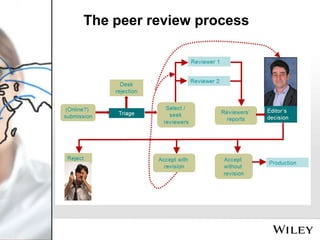
The peer review process
Types of peer review

—Single blinded
— Double blinded
— Open peer-review
— Post-publication peer-review
What to expect from peer
reviewers
—
—
—
—
—

Are recognised experts in the field
Read, assess and feedback on your work
Will not rewrite your article for you
Are a precious resource
Are not the enemy!
(Picture credit: GenomicEnterprise.com Science Blog)
Types of Decision
— Vary by journal
— Accept (rare!)
— Accept with minor revisions
— Accept with major revisions
— Reject and resubmit
— Reject
Survival tips!
— Seek help with language and statistics
if you need to (before submission!)
— Understand that Editors and reviewers
are trying to improve your paper
— Accept feedback as a learning
experience
— Persistence pays – answer questions
and address requests for revisions in a
clear and timely fashion
— Seek out Editors at conferences, ‘Meet
the Editor’ sessions etc.
—Read and heed author guidelines!
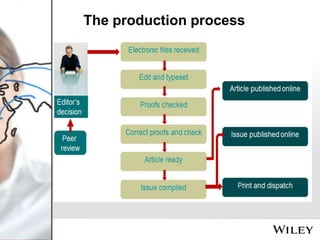
The production process
Search Engine Optimisation
Essential to success in an online publishing
environment
— Title and abstract
— Must contain key words and phrases that tell the
search engine what the article is about
— Descriptive titles always work
— Consider how readers search: phrases rather than
words (‘women’s fiction’ vs ‘fiction’)
— Encourage links to publisher’s site

— Don’t sacrifice readability – write for humans not
robots
Open Access –
a new(ish) choice
Digital/online content which can be
accessed without payment by readers
globally
—Now an accepted and growing
aspect of publishing
—Often mandated by institutions and
funders
—Hybrid journals vs ‘born OA’
Open Access
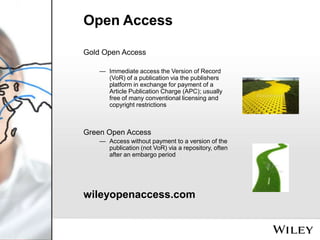
Gold Open Access
— Immediate access the Version of Record
(VoR) of a publication via the publishers
platform in exchange for payment of a
Article Publication Charge (APC); usually
free of many conventional licensing and
copyright restrictions

Green Open Access
— Access without payment to a version of the
publication (not VoR) via a repository, often
after an embargo period

wileyopenaccess.com
Keep in touch!

Free download Wiley Education Spotlight App
Follow us on Twitter @wileyeducation

Like Wiley Social Sciences and Humanities on facebook
how to get published

how to get published

  • 1.
    Publishing in AcademicJournals: a beginner’s guide Rebecca Launchbury Senior Commissioning Editor, Educational Research Journals
  • 2.
    Why publish? —Registration: toestablish priority —Certification: acknowledgement of the quality of the research —Dissemination: sharing research findings —Archiving: permanent version of record —Improvement: secure future funding and career enhancement
  • 3.
    Choosing the rightjournal — Subject coverage — Specialist vs generalist — Prestige — Impact Factor and subject rankings — Refereeing standards — Turnaround times and acceptance rates — Ease of access and (perceived) quality — Audience — Circulation and reach — Society journals (membership) — Types and length of articles — Research articles, review essays, communications, debates etc — Open Access Options
  • 4.
    Writing the article;or: What editors want — Good match to journal scope — Standalone, original piece of work — Substantive and new intervention or argument — Approach, method and data sources need to be clear — Existing literature needs to be taken into account and referenced
  • 5.
    Writing the article- don’t forget.. Author guidelines • Journal style and article types • Word limits • Details on how to submit figures (remember: permissions) • Copyright and licensing information Abstract • • • • Most widely read part of your article! What is the article about? Approach, key findings, implications Keywords: key topics and trends; use well established terms
  • 6.
    Ethics: some goldenrules — Articles should always be submitted to one journal at a time —The same article should not be published in more than one place — Several articles based on the same research must each make a unique contribution —Acknowledge all those that have contributed to the work —Cite thoroughly and accurately
  • 7.
  • 8.
    Types of peerreview —Single blinded — Double blinded — Open peer-review — Post-publication peer-review
  • 9.
    What to expectfrom peer reviewers — — — — — Are recognised experts in the field Read, assess and feedback on your work Will not rewrite your article for you Are a precious resource Are not the enemy! (Picture credit: GenomicEnterprise.com Science Blog)
  • 10.
    Types of Decision —Vary by journal — Accept (rare!) — Accept with minor revisions — Accept with major revisions — Reject and resubmit — Reject
  • 11.
    Survival tips! — Seekhelp with language and statistics if you need to (before submission!) — Understand that Editors and reviewers are trying to improve your paper — Accept feedback as a learning experience — Persistence pays – answer questions and address requests for revisions in a clear and timely fashion — Seek out Editors at conferences, ‘Meet the Editor’ sessions etc. —Read and heed author guidelines!
  • 12.
  • 13.
    Search Engine Optimisation Essentialto success in an online publishing environment — Title and abstract — Must contain key words and phrases that tell the search engine what the article is about — Descriptive titles always work — Consider how readers search: phrases rather than words (‘women’s fiction’ vs ‘fiction’) — Encourage links to publisher’s site — Don’t sacrifice readability – write for humans not robots
  • 14.
    Open Access – anew(ish) choice Digital/online content which can be accessed without payment by readers globally —Now an accepted and growing aspect of publishing —Often mandated by institutions and funders —Hybrid journals vs ‘born OA’
  • 15.
    Open Access Gold OpenAccess — Immediate access the Version of Record (VoR) of a publication via the publishers platform in exchange for payment of a Article Publication Charge (APC); usually free of many conventional licensing and copyright restrictions Green Open Access — Access without payment to a version of the publication (not VoR) via a repository, often after an embargo period wileyopenaccess.com
  • 16.
    Keep in touch! Freedownload Wiley Education Spotlight App Follow us on Twitter @wileyeducation Like Wiley Social Sciences and Humanities on facebook