MYER-BRIGGS
Condensed Version for Student Organizations
Agenda
1) Explain what the Myer-Briggs Test is
2) Take the condensed version of the Myer-Briggs Test
3) Learn about why student organizations should know their Myer-
Briggs personality type
Myer-Briggs
◦ Every individual who takes the Myer-Briggs test obtains four letters.
These letters stand for four type preferences, which start early in
life.
◦ Myer Briggs tests preferences and not aptitude. This is an indicator
based on psychology.
What is the Myer-Briggs Test?
◦ Myers-Briggs can help students find their career path. Today we
are utilizing it to show you your personality type.
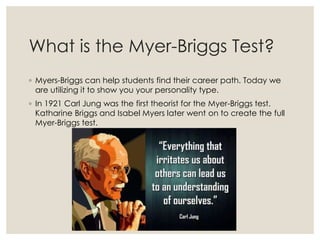
◦ In 1921 Carl Jung was the first theorist for the Myer-Briggs test.
Katharine Briggs and Isabel Myers later went on to create the full
Myer-Briggs test.
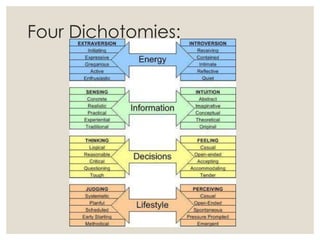
Four Dichotomies:
EXTRAVERSION-INTROVERSION
Extraversion
Energized by working with others
Like to talk
Easy to get to know
Broad interests, Seek “breadth”
of Knowledge
Variety and action oriented
“There are no strangers, only
friends you haven’t met yet.”
~ Anonymous
Introversion
Energized by thoughts, ideas,
and feelings
Like to listen
More private
Focused interest, Seek “depth”
of knowledge
Thought oriented and enjoy
quiet time
“Well-timed silence has more
eloquence than speech” ~
Martin Fraquhar Tupper
SENSING- INTUITION
Sensing Intuition
Past and Present Future
Facts and practicality Ideas and imagination
Trust experience Trust inspiration
Specifics Patterns- the “big picture”
Work carefully toward
conclusion
Follow hunches
“What part of no don’t you
understand, the ‘n’ or the ‘o’?”
~ Jacqueline S. Levy
“Some things have to be
believed to be seen” ~Ralph
Hodgson
THINKING- FEELING
Thinking Feeling
Focus on logical
consequences
Focus on values
Logical Personal
Fair Harmonious
Analytical Empathetic
Tend to be firm Tend to be sympathetic
“ABC, Simple as Do, Re,
Me” ~ Jackson 5
“What wisdom can your find that
is greater than kindness?” ~Jean-
Jacques Rousseau
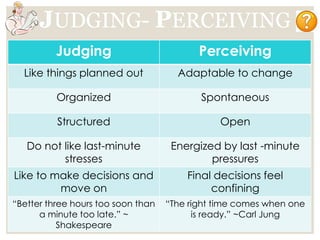
JUDGING- PERCEIVING
Judging Perceiving
Like things planned out Adaptable to change
Organized Spontaneous
Structured Open
Do not like last-minute
stresses
Energized by last -minute
pressures
Like to make decisions and
move on
Final decisions feel
confining
“Better three hours too soon than
a minute too late.” ~
Shakespeare
“The right time comes when one
is ready.” ~Carl Jung
Time to take the Test!
◦ Now it is your turn to figure
out what type you are!
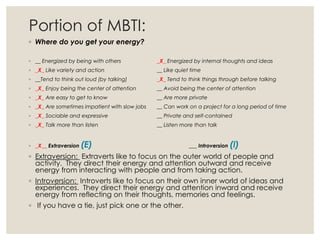
Portion of MBTI:
◦ Where do you get your energy?
◦ __ Energized by being with others _X_ Energized by internal thoughts and ideas
◦ _X_ Like variety and action __ Like quiet time
◦ __Tend to think out loud (by talking) _X_ Tend to think things through before talking
◦ _X_ Enjoy being the center of attention __ Avoid being the center of attention
◦ _X_ Are easy to get to know __ Are more private
◦ _X_ Are sometimes impatient with slow jobs __ Can work on a project for a long period of time
◦ _X_ Sociable and expressive __ Private and self-contained
◦ _X_ Talk more than listen __ Listen more than talk
◦ _X__ Extraversion (E) ___ Introversion (I)
◦ Extraversion: Extraverts like to focus on the outer world of people and
activity. They direct their energy and attention outward and receive
energy from interacting with people and from taking action.
◦ Introversion: Introverts like to focus on their own inner world of ideas and
experiences. They direct their energy and attention inward and receive
energy from reflecting on their thoughts, memories and feelings.
◦ If you have a tie, just pick one or the other.
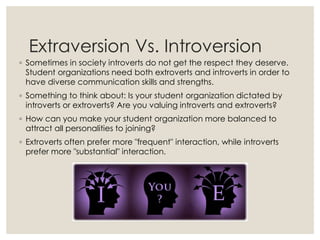
Extraversion Vs. Introversion
◦ Sometimes in society introverts do not get the respect they deserve.
Student organizations need both extroverts and introverts in order to
have diverse communication skills and strengths.
◦ Something to think about: Is your student organization dictated by
introverts or extroverts? Are you valuing introverts and extroverts?
◦ How can you make your student organization more balanced to
attract all personalities to joining?
◦ Extroverts often prefer more "frequent" interaction, while introverts
prefer more "substantial" interaction.
Ambivert; the middle ground
between extraverts and introverts
If you have found that you have many qualities making up an introvert
and an extrovert, you may be an ambivert!
Here are 5 signs:
◦ Some people describe you as quiet, while others would say you’re super
sociable.
◦ You’re fine doing a task with others or all by yourself, it doesn’t bother
you one way or the other.
◦ You’re not afraid to small talk, but at times it seems disingenuous.
◦ Spending lots of times with others can be draining, while spending too
much time alone can leave you feeling blue and unproductive.
◦ Sometimes you immerse yourself in the moment, while other times you
find yourself simply observing people and your surroundings.
Heart of Type and Skills:
(Middle Letters)
ST SF
NT NF
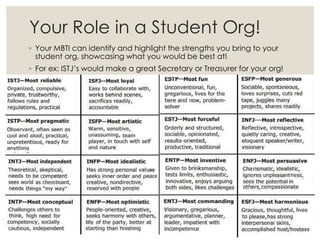
Your Role in a Student Org!
◦ Your MBTI can identify and highlight the strengths you bring to your
student org, showcasing what you would be best at!
◦ For ex: ISTJ’s would make a great Secretary or Treasurer for your org!
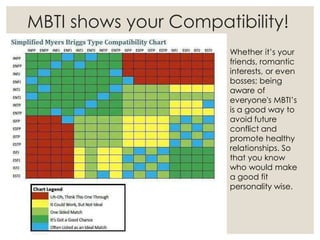
MBTI shows your Compatibility!
Whether it’s your
friends, romantic
interests, or even
bosses; being
aware of
everyone's MBTI’s
is a good way to
avoid future
conflict and
promote healthy
relationships. So
that you know
who would make
a good fit
personality wise.
Suggested Careers
Suggested Careers
Why is this important to your
sorority?
1) Assign work based off each person’s strengths!
◦ Extroverts= Recruitment
◦ Introverts= Event Planning
◦ NF’s are Empowerers+ Creative + Growth-oriented = Super Motivators
◦ NT’s are Managers+ Effective + Competition-oriented = Good Designers
◦ SF’s are Helpful+ Social + Service-oriented = Group Harmony
◦ ST’s are Efficient + Analytical + Problem Solvers = Great Budgeters
Why is this important for your Fraternity?
Knowing one another’s personality types will teach you what they like
and what bugs them. Know their personality type helps in decreasing
the chances of conflict because you can bypass hurting their feelings.
“I thought one of
my fraternity
brothers hated
me because he
barely talked to
me. The truth is
he is an extreme
introvert, and I
am an extreme
extrovert. My
personality took
a lot of energy
out of him to
handle.”
Thank you!
Winter 2015 Myers-Briggs presentation

Winter 2015 Myers-Briggs presentation

  • 1.
    MYER-BRIGGS Condensed Version forStudent Organizations
  • 2.
    Agenda 1) Explain whatthe Myer-Briggs Test is 2) Take the condensed version of the Myer-Briggs Test 3) Learn about why student organizations should know their Myer- Briggs personality type
  • 3.
    Myer-Briggs ◦ Every individualwho takes the Myer-Briggs test obtains four letters. These letters stand for four type preferences, which start early in life. ◦ Myer Briggs tests preferences and not aptitude. This is an indicator based on psychology.
  • 4.
    What is theMyer-Briggs Test? ◦ Myers-Briggs can help students find their career path. Today we are utilizing it to show you your personality type. ◦ In 1921 Carl Jung was the first theorist for the Myer-Briggs test. Katharine Briggs and Isabel Myers later went on to create the full Myer-Briggs test.
  • 5.
  • 6.
    EXTRAVERSION-INTROVERSION Extraversion Energized by workingwith others Like to talk Easy to get to know Broad interests, Seek “breadth” of Knowledge Variety and action oriented “There are no strangers, only friends you haven’t met yet.” ~ Anonymous Introversion Energized by thoughts, ideas, and feelings Like to listen More private Focused interest, Seek “depth” of knowledge Thought oriented and enjoy quiet time “Well-timed silence has more eloquence than speech” ~ Martin Fraquhar Tupper
  • 7.
    SENSING- INTUITION Sensing Intuition Pastand Present Future Facts and practicality Ideas and imagination Trust experience Trust inspiration Specifics Patterns- the “big picture” Work carefully toward conclusion Follow hunches “What part of no don’t you understand, the ‘n’ or the ‘o’?” ~ Jacqueline S. Levy “Some things have to be believed to be seen” ~Ralph Hodgson
  • 8.
    THINKING- FEELING Thinking Feeling Focuson logical consequences Focus on values Logical Personal Fair Harmonious Analytical Empathetic Tend to be firm Tend to be sympathetic “ABC, Simple as Do, Re, Me” ~ Jackson 5 “What wisdom can your find that is greater than kindness?” ~Jean- Jacques Rousseau
  • 9.
    JUDGING- PERCEIVING Judging Perceiving Likethings planned out Adaptable to change Organized Spontaneous Structured Open Do not like last-minute stresses Energized by last -minute pressures Like to make decisions and move on Final decisions feel confining “Better three hours too soon than a minute too late.” ~ Shakespeare “The right time comes when one is ready.” ~Carl Jung
  • 10.
    Time to takethe Test! ◦ Now it is your turn to figure out what type you are!
  • 11.
    Portion of MBTI: ◦Where do you get your energy? ◦ __ Energized by being with others _X_ Energized by internal thoughts and ideas ◦ _X_ Like variety and action __ Like quiet time ◦ __Tend to think out loud (by talking) _X_ Tend to think things through before talking ◦ _X_ Enjoy being the center of attention __ Avoid being the center of attention ◦ _X_ Are easy to get to know __ Are more private ◦ _X_ Are sometimes impatient with slow jobs __ Can work on a project for a long period of time ◦ _X_ Sociable and expressive __ Private and self-contained ◦ _X_ Talk more than listen __ Listen more than talk ◦ _X__ Extraversion (E) ___ Introversion (I) ◦ Extraversion: Extraverts like to focus on the outer world of people and activity. They direct their energy and attention outward and receive energy from interacting with people and from taking action. ◦ Introversion: Introverts like to focus on their own inner world of ideas and experiences. They direct their energy and attention inward and receive energy from reflecting on their thoughts, memories and feelings. ◦ If you have a tie, just pick one or the other.
  • 12.
    Extraversion Vs. Introversion ◦Sometimes in society introverts do not get the respect they deserve. Student organizations need both extroverts and introverts in order to have diverse communication skills and strengths. ◦ Something to think about: Is your student organization dictated by introverts or extroverts? Are you valuing introverts and extroverts? ◦ How can you make your student organization more balanced to attract all personalities to joining? ◦ Extroverts often prefer more "frequent" interaction, while introverts prefer more "substantial" interaction.
  • 13.
    Ambivert; the middleground between extraverts and introverts If you have found that you have many qualities making up an introvert and an extrovert, you may be an ambivert! Here are 5 signs: ◦ Some people describe you as quiet, while others would say you’re super sociable. ◦ You’re fine doing a task with others or all by yourself, it doesn’t bother you one way or the other. ◦ You’re not afraid to small talk, but at times it seems disingenuous. ◦ Spending lots of times with others can be draining, while spending too much time alone can leave you feeling blue and unproductive. ◦ Sometimes you immerse yourself in the moment, while other times you find yourself simply observing people and your surroundings.
  • 17.
    Heart of Typeand Skills: (Middle Letters) ST SF NT NF
  • 18.
    Your Role ina Student Org! ◦ Your MBTI can identify and highlight the strengths you bring to your student org, showcasing what you would be best at! ◦ For ex: ISTJ’s would make a great Secretary or Treasurer for your org!
  • 19.
    MBTI shows yourCompatibility! Whether it’s your friends, romantic interests, or even bosses; being aware of everyone's MBTI’s is a good way to avoid future conflict and promote healthy relationships. So that you know who would make a good fit personality wise.
  • 20.
  • 21.
  • 22.
    Why is thisimportant to your sorority? 1) Assign work based off each person’s strengths! ◦ Extroverts= Recruitment ◦ Introverts= Event Planning ◦ NF’s are Empowerers+ Creative + Growth-oriented = Super Motivators ◦ NT’s are Managers+ Effective + Competition-oriented = Good Designers ◦ SF’s are Helpful+ Social + Service-oriented = Group Harmony ◦ ST’s are Efficient + Analytical + Problem Solvers = Great Budgeters
  • 23.
    Why is thisimportant for your Fraternity? Knowing one another’s personality types will teach you what they like and what bugs them. Know their personality type helps in decreasing the chances of conflict because you can bypass hurting their feelings. “I thought one of my fraternity brothers hated me because he barely talked to me. The truth is he is an extreme introvert, and I am an extreme extrovert. My personality took a lot of energy out of him to handle.”
  • 24.

Editor's Notes

  • #2 Prep Notes for LC: How many students are you presenting to? Do they have a projector? Check one out from CSA, if needed. Do you have a laptop? Check one out from CSA, if needed. Check out the wireless clicker from Emily Do you have enough copies for your entire group? Do you have pens for students? Have you practiced? At the end, plug yourself for more Trainings. Hand out sheets in the beginning (Need Myer-Briggs Sheet)
  • #4 When talking about preferences, do the left hand or right hand activity
  • #5 Jung realized that human behavior is not random but was in fact predictable and therefore, classifiable.
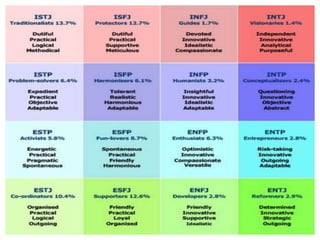
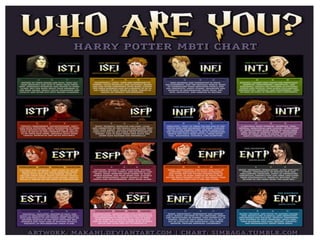
  • #6 The chart above shows the four different dichotomies. There are 16 possible psychological types. The chart shows where you pull your energy from (extrovert or introvert), how you gather information (sensing or intuition), How you make decisions (thinking or feeling). The last section focuses on how you like to live. Do you like a structured and decided lifestyle? This is labeling a “judging” style or do you like a more flexible and adaptable lifestyle? (Perceiving) Remembering “judging” should not be confused with the word “judgmental”; it does not have that negative connotation.
  • #7 Jackie
  • #8 How you take in information and give information
  • #9 How you make decisions
  • #10 Organize your world
  • #11 Have the group share their results and read their Myer-Briggs Summary.
  • #12 The letter in parenthesis is your MBTI letter! (It is blue in the example above)
  • #13 Plug a story about how knowing if you are an introvert or extrovert has helped you get along with colleagues or student org. members. Ted Talk about introverts that you can show: http://www.ted.com/talks/susan_cain_the_power_of_introverts?language=en
  • #16 http://www.buzzfeed.com/jessicamisener/frustrating-things-about-being-an-extrovert
  • #18 Knowing this will help you see your “sisters” strengths. These are the middle letters. Group one ST&NT Group two SF&NF