Maximizing Social Media:
Higher Education
Annukka Thelen
Emily Delano
John Gipson
Ryan Bond
Grand Valley State University
Intended Usage
This PowerPoint was created to serve as an independent
resource addressing the history, advantages, and concerns of
social media for student affairs educators and administrators
within institutions of higher education.
We strongly encourage utilizing the many links throughout the
presentation to gain a deeper understanding of social media and
how to incorporate best practices at your unique institution.
What is Social Media?
Boyd and Ellison (2007) define social media as “web-
based services that allow individuals to (1) construct a
public or semi-public profile within a bounded system,
(2) articulate a list of other users with whom they share
a connection, and (3) view and traverse their list of
connections and those made by others within the
system” (p. 211).
Evolution of Social Media
(Major Social Networking Sites)
1997 – 2000 Sixdegrees.com
2002 – present Friendster
2003 – present Linkedin
2003 – present MySpace
2005 – present YouTube
2005 – present Xanga
2006 – present Facebook (Open to everyone)
2006 – present Twitter
Source: Boyd, D. M. & Ellison, N. B. (2007). Social network sites: Definition, history, and scholarship. Journal of
Computer-Mediated Communication, 13(1), 210-230. DOI: 10.1111/j.1083-6101.2007.00393.x
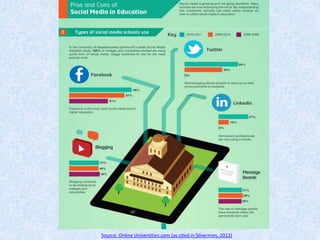
Source: Online Universities.com (as cited in Silverman, 2012)
Advantages of Social Media
• Heiberger and Harper (2008) demonstrate how social media can be utilized
throughout theories within student affairs, including Astin’s theory of student
involvement and Tinto’s retention models.
• 98% of students are using Facebook – quick, efficient, sustainable communication
• According to Qualman (2011) social media is utilized in the business world to
promote products cheaply and efficiently. Example: Ford gave individuals Ford
Fiestas for 6 months who promised to document their experiences using social
media. The results: over 7 million YouTube views, 750,000 views of photos on
Flickr, 11,000 “hand raisers” on Fiestamovement.com, 11,000 vehicle reservations,
and a 60% awareness rate (equal to all cars on the market for 2-3 years)
Social Media in the Classroom
Advantages
• Enhanced Communication – Students are comfortable to express themselves
• Increased Accessibility – Smartphones = Greater accessibility than blogs,
Blackboard
• Personal Learning Networks – Promotes cross institutional research
• Instant Academic Support Services – Advising, Virtual Office Hours,
• Student Collaboration – Easy access to groups, diverse populations, sustainable
and affordable
Useful Tips for Effective Teaching and Learning
100 ways Facebook is being used in the classroom in both k-12 and higher education
Libraries are also utilizing social media for citation assistance, broad casting live
events, and much more.
Effective Tips for Teaching Online
Social Media in the Co-Curricular
• Public Safety – Counseling to meet student needs and act proactively instead of
reactively, instant relay of information (Remember Virginia Tech?)
• Alumni – Connecting students and alumni will increase career opportunities,
sustainable advertising for homecoming and other alumni events
• Institutional Partnerships – Network with other institutions, find out what others
are doing in increase high impact student learning without leaving campus
• Virtual Tours – Increased opportunities for students with disabilities, increased
recruitment area
• Financial Resources – Instant counseling, inclusive and accessible location for
posting scholarships
20 Colleges and universities that are highly utilizing social media: Including the University
of Notre Dame, Harvard, Columbia, Johns Hopkins, Duke and many more.
Social Media in the Co-Curricular
• Career Development – Alumni connections, efficient resume/e-portfolio
evaluations, effective communication with potential employers,
• Student Involvement – Sustainably and efficiently advertise programs to
the student body, increased communication and connection with non-
traditional students = higher retention (Astin, 1984)
• Intercultural Awareness – Students can engage in diversity on a greater
level
• Inclusion and Equity – Engage and effectively communicate with off-
campus residents in a sustainable manner
Negatives Associated with Social Media
• Signs of other psychological disorders, including antisocial behaviors, mania and aggressive tendencies
with strong Facebook presence
• Facebook can be distracting and can negatively impact learning. Studies found that middle school, high
school and college students who checked Facebook at least once during a 15-minute study period
achieved lower grades.
• Can Encourage poor grammar and spelling
• Creating a culture in which a single mistake such as a racy picture or poorly thought-out comment can
cause irreparable harm to your reputation and can cause legal issues
• Increased risk of identity theft
• 22% of college students report cyberbullying (HealthDay, 2011)
• Allowing the spread of misinformation that may be perceived as fact, even in light of evidence to the
contrary
How MC Educates on Social Media
• Education is key – Workshops for professors, student affairs educators, and
students
• Create a webpage detailing the positives and negatives of social media usage
• Model, Model, Model – Brief videos housed on website and shown during
orientation to inform students of the implications of social media
Please view the videos below we created for student orientation:
Negative Social Media Presence
http://www.youtube.com/watch?v=toD6htxJJJU
Positive Social Media Presence
http://www.youtube.com/watch?v=dOet3Gsz7ZY
Provide Real-Life Examples
The following examples will be listed and linked on our new social media awareness webpage
Fired Over Facebook – Boston area firefighter fired over Facebook comment
Trending Now: Memes
• http://www.insidehighered.com/news/2012/0
2/16/campus-themed-internet-memes-go-
viral#.Tzz0tPN-OeN.facebook
Why Educate on Social Media?
Meet professional standards and support accreditation criteria
According to the Higher Learning Commission (2011), institutions must meet the
following criteria for accreditation:
• Core Component 5a – Serve the needs and expectations of constituents (98%
utilizing Facebook = need for social media.
• Core Component 4c – meeting the needs of a “global, diverse, and
technological society”
• Core Component 2a - “realistically prepares for a future shaped by multiple
societal and economic trends.”
Provide high impact student learning which meets the demands of
a changing global economy and culture
NASPA Standards of Professional Practice 8
“Members demonstrate and promote responsible behavior and support actions
that enhance personal growth and development of students.”
Recommended Links
Websites
http://www.studentadvisor.com/top-100-social-media-colleges - Top 100 Social Media Institutions
http://mashable.com/2012/02/03/higher-education-social-media/ - Social Media Data 2008-2011
http://www.techaddiction.ca/internet_addiction_statistics.html - Internet Facts and Figures
http://www.guardian.co.uk/technology/2010/nov/22/internet-encourages-bad-spelling-children - Grammar Concerns
http://health.usnews.com/health-news/family-health/brain-and-behavior/articles/2011/11/03/college-students-still-
vulnerable-to-bullying – Cyber Bullying
References
Boyd, D. M. & Ellison, N. B. (2007). Social network sites: Definition, history, and scholarship. Journal of Computer-
Mediated Communication, 13(1), 210-230. DOI: 10.1111/j.1083-6101.2007.00393.x
Heiberger, G., & Harper, R. (2008). Have you Facebooked Astin lately? Using technology to increase student
involvement. In Junco, R., & Timm, D. M., eds. Using emerging technologies to enhance student
engagement. New Directions for Student Services Issue #124. San Francisco, CA: Jossey-Bass, pp. 19-35.
Silverman, M. (2012). How higher education uses social media [INFOGRAPHIC]. Retrieved from:
http://mashable.com/2012/02/03/higher-education-social-media/
Qualman, E. (2011). Socialnomics: How social media transforms the way we live and do business. Hoboken, NJ: John
Wiley & Sons.

2010 case study competition

  • 1.
    Maximizing Social Media: HigherEducation Annukka Thelen Emily Delano John Gipson Ryan Bond Grand Valley State University
  • 2.
    Intended Usage This PowerPointwas created to serve as an independent resource addressing the history, advantages, and concerns of social media for student affairs educators and administrators within institutions of higher education. We strongly encourage utilizing the many links throughout the presentation to gain a deeper understanding of social media and how to incorporate best practices at your unique institution.
  • 3.
    What is SocialMedia? Boyd and Ellison (2007) define social media as “web- based services that allow individuals to (1) construct a public or semi-public profile within a bounded system, (2) articulate a list of other users with whom they share a connection, and (3) view and traverse their list of connections and those made by others within the system” (p. 211).
  • 4.
    Evolution of SocialMedia (Major Social Networking Sites) 1997 – 2000 Sixdegrees.com 2002 – present Friendster 2003 – present Linkedin 2003 – present MySpace 2005 – present YouTube 2005 – present Xanga 2006 – present Facebook (Open to everyone) 2006 – present Twitter Source: Boyd, D. M. & Ellison, N. B. (2007). Social network sites: Definition, history, and scholarship. Journal of Computer-Mediated Communication, 13(1), 210-230. DOI: 10.1111/j.1083-6101.2007.00393.x
  • 5.
    Source: Online Universities.com(as cited in Silverman, 2012)
  • 6.
    Advantages of SocialMedia • Heiberger and Harper (2008) demonstrate how social media can be utilized throughout theories within student affairs, including Astin’s theory of student involvement and Tinto’s retention models. • 98% of students are using Facebook – quick, efficient, sustainable communication • According to Qualman (2011) social media is utilized in the business world to promote products cheaply and efficiently. Example: Ford gave individuals Ford Fiestas for 6 months who promised to document their experiences using social media. The results: over 7 million YouTube views, 750,000 views of photos on Flickr, 11,000 “hand raisers” on Fiestamovement.com, 11,000 vehicle reservations, and a 60% awareness rate (equal to all cars on the market for 2-3 years)
  • 7.
    Social Media inthe Classroom Advantages • Enhanced Communication – Students are comfortable to express themselves • Increased Accessibility – Smartphones = Greater accessibility than blogs, Blackboard • Personal Learning Networks – Promotes cross institutional research • Instant Academic Support Services – Advising, Virtual Office Hours, • Student Collaboration – Easy access to groups, diverse populations, sustainable and affordable Useful Tips for Effective Teaching and Learning 100 ways Facebook is being used in the classroom in both k-12 and higher education Libraries are also utilizing social media for citation assistance, broad casting live events, and much more. Effective Tips for Teaching Online
  • 8.
    Social Media inthe Co-Curricular • Public Safety – Counseling to meet student needs and act proactively instead of reactively, instant relay of information (Remember Virginia Tech?) • Alumni – Connecting students and alumni will increase career opportunities, sustainable advertising for homecoming and other alumni events • Institutional Partnerships – Network with other institutions, find out what others are doing in increase high impact student learning without leaving campus • Virtual Tours – Increased opportunities for students with disabilities, increased recruitment area • Financial Resources – Instant counseling, inclusive and accessible location for posting scholarships 20 Colleges and universities that are highly utilizing social media: Including the University of Notre Dame, Harvard, Columbia, Johns Hopkins, Duke and many more.
  • 9.
    Social Media inthe Co-Curricular • Career Development – Alumni connections, efficient resume/e-portfolio evaluations, effective communication with potential employers, • Student Involvement – Sustainably and efficiently advertise programs to the student body, increased communication and connection with non- traditional students = higher retention (Astin, 1984) • Intercultural Awareness – Students can engage in diversity on a greater level • Inclusion and Equity – Engage and effectively communicate with off- campus residents in a sustainable manner
  • 10.
    Negatives Associated withSocial Media • Signs of other psychological disorders, including antisocial behaviors, mania and aggressive tendencies with strong Facebook presence • Facebook can be distracting and can negatively impact learning. Studies found that middle school, high school and college students who checked Facebook at least once during a 15-minute study period achieved lower grades. • Can Encourage poor grammar and spelling • Creating a culture in which a single mistake such as a racy picture or poorly thought-out comment can cause irreparable harm to your reputation and can cause legal issues • Increased risk of identity theft • 22% of college students report cyberbullying (HealthDay, 2011) • Allowing the spread of misinformation that may be perceived as fact, even in light of evidence to the contrary
  • 11.
    How MC Educateson Social Media • Education is key – Workshops for professors, student affairs educators, and students • Create a webpage detailing the positives and negatives of social media usage • Model, Model, Model – Brief videos housed on website and shown during orientation to inform students of the implications of social media Please view the videos below we created for student orientation: Negative Social Media Presence http://www.youtube.com/watch?v=toD6htxJJJU Positive Social Media Presence http://www.youtube.com/watch?v=dOet3Gsz7ZY
  • 12.
    Provide Real-Life Examples Thefollowing examples will be listed and linked on our new social media awareness webpage Fired Over Facebook – Boston area firefighter fired over Facebook comment
  • 13.
    Trending Now: Memes •http://www.insidehighered.com/news/2012/0 2/16/campus-themed-internet-memes-go- viral#.Tzz0tPN-OeN.facebook
  • 14.
    Why Educate onSocial Media? Meet professional standards and support accreditation criteria According to the Higher Learning Commission (2011), institutions must meet the following criteria for accreditation: • Core Component 5a – Serve the needs and expectations of constituents (98% utilizing Facebook = need for social media. • Core Component 4c – meeting the needs of a “global, diverse, and technological society” • Core Component 2a - “realistically prepares for a future shaped by multiple societal and economic trends.” Provide high impact student learning which meets the demands of a changing global economy and culture NASPA Standards of Professional Practice 8 “Members demonstrate and promote responsible behavior and support actions that enhance personal growth and development of students.”
  • 15.
    Recommended Links Websites http://www.studentadvisor.com/top-100-social-media-colleges -Top 100 Social Media Institutions http://mashable.com/2012/02/03/higher-education-social-media/ - Social Media Data 2008-2011 http://www.techaddiction.ca/internet_addiction_statistics.html - Internet Facts and Figures http://www.guardian.co.uk/technology/2010/nov/22/internet-encourages-bad-spelling-children - Grammar Concerns http://health.usnews.com/health-news/family-health/brain-and-behavior/articles/2011/11/03/college-students-still- vulnerable-to-bullying – Cyber Bullying
  • 16.
    References Boyd, D. M.& Ellison, N. B. (2007). Social network sites: Definition, history, and scholarship. Journal of Computer- Mediated Communication, 13(1), 210-230. DOI: 10.1111/j.1083-6101.2007.00393.x Heiberger, G., & Harper, R. (2008). Have you Facebooked Astin lately? Using technology to increase student involvement. In Junco, R., & Timm, D. M., eds. Using emerging technologies to enhance student engagement. New Directions for Student Services Issue #124. San Francisco, CA: Jossey-Bass, pp. 19-35. Silverman, M. (2012). How higher education uses social media [INFOGRAPHIC]. Retrieved from: http://mashable.com/2012/02/03/higher-education-social-media/ Qualman, E. (2011). Socialnomics: How social media transforms the way we live and do business. Hoboken, NJ: John Wiley & Sons.

Editor's Notes

  • #4 Notice how similar the logos are, coincidence?
  • #6 “Who’s using social media? Let’s focus on the 3 key websites – Facebook, Twitter, and LinkedIn – compared to traditional classroom resources – blogging, and message boards. A link is included under the picture rather than a direct citation so that users can access the full resource if desired.
  • #7 Public Safety – Instant alerts for campus, easy access to information Alumni Connections – Opportunities for networking with alumni Institutional Partnerships – Opportunity for resource sharing, networking Virtual Tours – Sustainable tours, increased access for students with disabilities, provide a wider recruitment base Career Development – resume building, networking, job postings, social media education, program advertisement Student Involvement – Housing and Student Life can advertise programs across campus, no paper advertising (sustainable), recruitment for clubs, ease of updating materials, easily evaluate the effectiveness of programs/policies through polls Financial Resources – Scholarship announcements, access to financial aid resources/representatives Intercultural Awareness – allows individuals to network with individuals from various backgrounds (Race, ethnicity, gender, age, socio-economic status, religion, sexual orientation, etc.) Enhanced Communication – paperless advertising, increased faculty/student and student/student interaction, class announcements, utilized more frequently than email Increased Accessability – smartphones, ipads, laptops, computer labs Personal Learning Networks – allows individuals to share information, easily adapted to the classroom, LINK Instant Academic Support Services – Library services, academic advising, writing center, tutoring centers, IT support (Blackboard) Student Collaboration – easily establish and connect with groups, virtual collaboration for distance learning
  • #13 The