1
Personality Type Discovery and Analysis 2
Myers-Briggs 4
The Four Temperaments 14
Introversion & Extroversion in Depth 16
Communication and Conflict Resolution 22
Body Language 24
Dealing with Conflict 32
Nonviolent Communication 36
Tips Throughout the Four Steps of NVC 46
Compassionate Communication 50
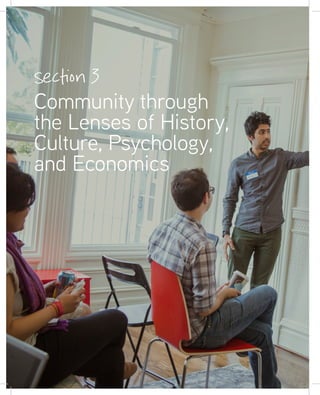
Community through the Lenses of History,
Culture, Psychology, and Economics 54
Community throughout history: Trust and Sharing 56
Community Across Cultures: Individualism vs. Collectivism 59
Community Psychology: Motivation and Value of Participation 60
Community Economics: The Tragedy of the Commons 62
Community Challenges: Game Theory 64
Vignettes of Community 66
Defining Community 68
Case studies of community living 70
Credits, References, and Resources 82
Contents
SECTION 2
SECTION 3
SECTION 4
SECTION 1
2 · Personality Type Discovery and Analysis
Personality Type
Discovery and
Analysis
3
Although personality type doesn’t define people, it can help you
understand certain fundamental lenses through which people view the
world, and help you figure out when and how someone is looking through
a different lens than you are.
You’ll better interpret why someone is behaving the way they are.
You’ll better know how to respond to them based on their unique
views and needs.
Everyone together will have a common language that can serve as
a “shortcut” to addressing an issue.
Differences between two housemates can be talked about based
on personality type differences, rather than on the personal
“me and you” level. This takes the weight off of judging or blaming
an individual, and keeps the conversation on the universal level -
much safer!
Why explore personality type?
Meyers Briggs p.5
The Four Temperaments p.14
Introversion vs. Extroversion p.16
In this section we will discuss:
4 · Personality Type Discovery and Analysis
Note: In Myers-Briggs terms, these words do not mean what they usually mean in colloquial
conversation, so make sure you pay attention to their definitions!
Information and quotes in this section derived from Do What You Are: Discover the Perfect Career for You Through the Secrets of
Personality Type by Paul D. Tieger and Barbara Barron
The Myers-Briggs Type Indicator is a personality assessment that gives
you a 4-letter acronym describing your personality, based on ways you
see the world and ways you make decisions. There are 16 personality
types in total.
Myers-Briggs
Where does the test come from? Psychoanalyst Carl Jung started a theory about personality
types that he published in his book Psychological Types in 1921. The mother-daughter duo
Katharine Briggs and Isabel Briggs Myers expanded upon his theory adding more personality
types, and created the MBTI - Myers-Briggs test instrument, a test that you can take which will
show you what your personality type is out of 16 personality types.
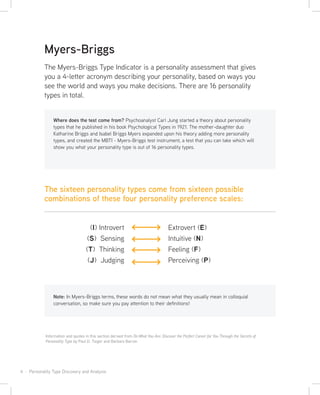
The sixteen personality types come from sixteen possible
combinations of these four personality preference scales:
(I) Introvert
(S) Sensing
(T) Thinking
(J) Judging
Extrovert (E)
Intuitive (N)
Feeling (F)
Perceiving (P)
5
Everyone can find themselves on some part of the spectrum for each of these four scales (for example,
choose “introvert” or “extrovert”), which are each referred to by their first letter (besides Intuition which is
called “N”). Once you figure out which side of the spectrum you land on for all four, the four letters you’ve
collected become the acronym for your personality type.
You’ll probably notice that for perhaps one or two of the scales, you’re unsure which side you land on. This
is normal as each scale is indeed a spectrum so we have a bit of each characteristic inside us. As a solution,
you can figure out which personality types you could potentially be (such as ENFP and INFP) and then read
about each of those and see if you feel one fits you better.
Find your type
But what if I land in the middle?
Now lets look at each scale in depth...
(and see where you think you land)
6 · Personality Type Discovery and Analysis
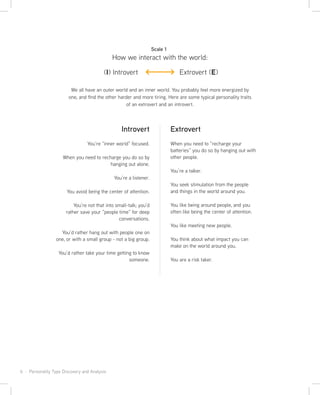
We all have an outer world and an inner world. You probably feel more energized by
one, and find the other harder and more tiring. Here are some typical personality traits
of an extrovert and an introvert.
Extrovert
When you need to “recharge your
batteries” you do so by hanging out with
other people.
You’re a talker.
You seek stimulation from the people
and things in the world around you.
You like being around people, and you
often like being the center of attention.
You like meeting new people.
You think about what impact you can
make on the world around you.
You are a risk taker.
Introvert
You’re “inner world” focused.
When you need to recharge you do so by
hanging out alone.
You’re a listener.
You avoid being the center of attention.
You’re not that into small-talk; you’d
rather save your “people time” for deep
conversations.
You’d rather hang out with people one on
one, or with a small group - not a big group.
You’d rather take your time getting to know
someone.
How we interact with the world:
Scale 1
(I) Introvert Extrovert (E)
7
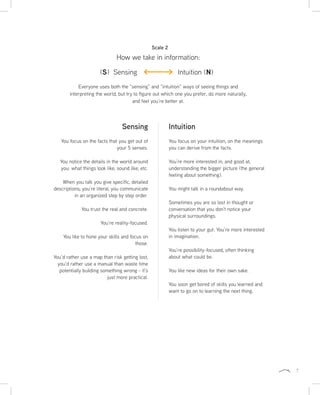
Everyone uses both the “sensing” and “intuition” ways of seeing things and
interpreting the world, but try to figure out which one you prefer, do more naturally,
and feel you’re better at.
Intuition
You focus on your intuition, on the meanings
you can derive from the facts.
You’re more interested in, and good at,
understanding the bigger picture (the general
feeling about something).
You might talk in a roundabout way.
Sometimes you are so lost in thought or
conversation that you don’t notice your
physical surroundings.
You listen to your gut. You’re more interested
in imagination.
You’re possibility-focused, often thinking
about what could be.
You like new ideas for their own sake.
You soon get bored of skills you learned and
want to go on to learning the next thing.
Sensing
You focus on the facts that you get out of
your 5 senses.
You notice the details in the world around
you: what things look like, sound like, etc.
When you talk you give specific, detailed
descriptions; you’re literal, you communicate
in an organized step by step order.
You trust the real and concrete.
You’re reality-focused.
You like to hone your skills and focus on
those.
You’d rather use a map than risk getting lost,
you’d rather use a manual than waste time
potentially building something wrong - it’s
just more practical.
How we take in information:
Scale 2
(S) Sensing Intuition (N)
8 · Personality Type Discovery and Analysis
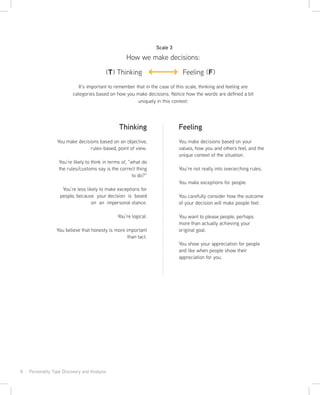
It’s important to remember that in the case of this scale, thinking and feeling are
categories based on how you make decisions. Notice how the words are defined a bit
uniquely in this context:
Feeling
You make decisions based on your
values, how you and others feel, and the
unique context of the situation.
You’re not really into overarching rules.
You make exceptions for people.
You carefully consider how the outcome
of your decision will make people feel.
You want to please people, perhaps
more than actually achieving your
original goal.
You show your appreciation for people
and like when people show their
appreciation for you.
Thinking
You make decisions based on an objective,
rules-based, point of view.
You’re likely to think in terms of, “what do
the rules/customs say is the correct thing
to do?”
You’re less likely to make exceptions for
people, because your decision is based
on an impersonal stance.
You’re logical.
You believe that honesty is more important
than tact.
How we make decisions:
Scale 3
(T) Thinking Feeling (F)
9
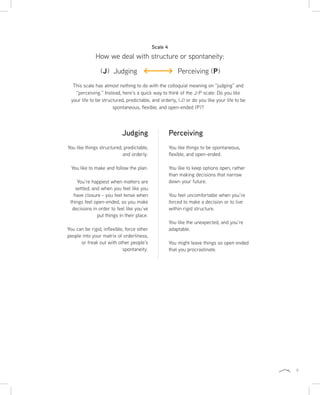
This scale has almost nothing to do with the colloquial meaning on “judging” and
“perceiving.” Instead, here’s a quick way to think of the J-P scale: Do you like
your life to be structured, predictable, and orderly, (J) or do you like your life to be
spontaneous, flexible, and open-ended (P)?
Perceiving
You like things to be spontaneous,
flexible, and open-ended.
You like to keep options open, rather
than making decisions that narrow
down your future.
You feel uncomfortable when you’re
forced to make a decision or to live
within rigid structure.
You like the unexpected, and you’re
adaptable.
You might leave things so open ended
that you procrastinate.
Judging
You like things structured, predictable,
and orderly.
You like to make and follow the plan.
You’re happiest when matters are
settled, and when you feel like you
have closure - you feel tense when
things feel open-ended, so you make
decisions in order to feel like you’ve
put things in their place.
You can be rigid, inflexible, force other
people into your matrix of orderliness,
or freak out with other people’s
spontaneity.
How we deal with structure or spontaneity:
Scale 4
(J) Judging Perceiving (P)
10 · Personality Type Discovery and Analysis
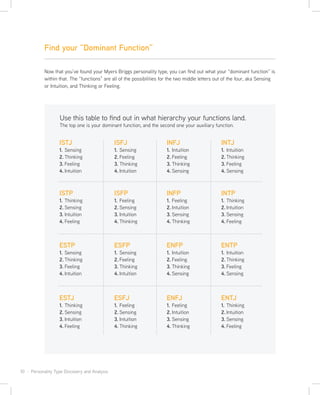
Find your “Dominant Function”
Now that you’ve found your Myers Briggs personality type, you can find out what your “dominant function” is
within that. The “functions” are all of the possibilities for the two middle letters out of the four, aka Sensing
or Intuition, and Thinking or Feeling.
Use this table to find out in what hierarchy your functions land.
The top one is your dominant function, and the second one your auxiliary function.
ISTJ
1. Sensing
2. Thinking
3. Feeling
4. Intuition
ISTP
1. Thinking
2. Sensing
3. Intuition
4. Feeling
ESTP
1. Sensing
2. Thinking
3. Feeling
4. Intuition
ESTJ
1. Thinking
2. Sensing
3. Intuition
4. Feeling
ESFJ
1. Feeling
2. Sensing
3. Intuition
4. Thinking
ENFJ
1. Feeling
2. Intuition
3. Sensing
4. Thinking
ENTJ
1. Thinking
2. Intuition
3. Sensing
4. Feeling
ESFP
1. Sensing
2. Feeling
3. Thinking
4. Intuition
ENFP
1. Intuition
2. Feeling
3. Thinking
4. Sensing
ENTP
1. Intuition
2. Thinking
3. Feeling
4. Sensing
ISFP
1. Feeling
2. Sensing
3. Intuition
4. Thinking
INFP
1. Feeling
2. Intuition
3. Sensing
4. Thinking
INTP
1. Thinking
2. Intuition
3. Sensing
4. Feeling
ISFJ
1. Sensing
2. Feeling
3. Thinking
4. Intuition
INFJ
1. Intuition
2. Feeling
3. Thinking
4. Sensing
INTJ
1. Intuition
2. Thinking
3. Feeling
4. Sensing
11
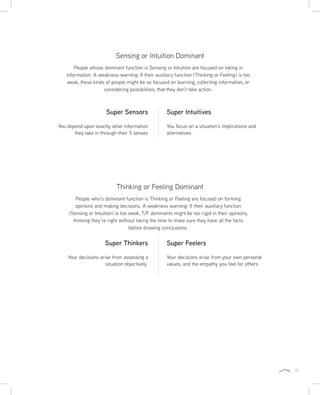
Sensing or Intuition Dominant
Thinking or Feeling Dominant
People whose dominant function is Sensing or Intuition are focused on taking in
information. A weakness warning: If their auxiliary function (Thinking or Feeling) is too
weak, these kinds of people might be so focused on learning, collecting information, or
considering possibilities, that they don’t take action.
People who’s dominant function is Thinking or Feeling are focused on forming
opinions and making decisions. A weakness warning: If their auxiliary function
(Sensing or Intuition) is too weak, T/F dominants might be too rigid in their opinions,
thinking they’re right without taking the time to make sure they have all the facts
before drawing conclusions.
Super Sensors
You depend upon exactly what information
they take in through their 5 senses
Super Thinkers
Your decisions arise from assessing a
situation objectively.
Super Intuitives
You focus on a situation’s implications and
alternatives
Super Feelers
Your decisions arise from your own personal
values, and the empathy you feel for others.
12 · Personality Type Discovery and Analysis
Check out the original texts if you’d like to further explore Myers-Briggs:
Introduction to Type: A Description of the Theory and Application of the Myers-Briggs Type
Indicator, by Isabel Briggs Myers (1987)
Manual: A Guide to the Development and Use of the Myers-Briggs Type Indicator, by Isabel
Briggs Myers and Mary McCaulley (1985)
Gifts Differing, by Isabel Briggs Myers (1980)
Additional Myers-Briggs Resources
13
14 · Personality Type Discovery and Analysis
You follow the rules, you like things structured, and you’re dependable and responsible.
Traditionalists are sensors who like facts, proof, and the tangible world, and are also judgers who
like predictability and structure. “Traditionalists value law and order, security, property, rules, and
conformity. They are driven by a strong motivation to serve society’s needs. Traditionalists respect
authority, hierarchy, and the chain of command, and generally have conservative values. They
are bound by their sense of duty and always try to do the right thing, which makes them reliable,
dependable, and above all else, responsible.”
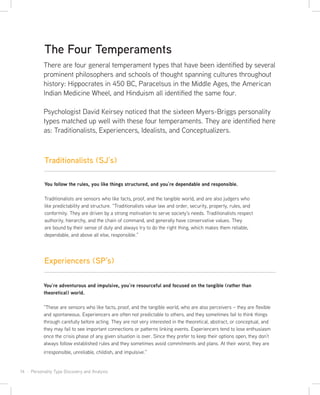
The Four Temperaments
There are four general temperament types that have been identified by several
prominent philosophers and schools of thought spanning cultures throughout
history: Hippocrates in 450 BC, Paracelsus in the Middle Ages, the American
Indian Medicine Wheel, and Hinduism all identified the same four.
Psychologist David Keirsey noticed that the sixteen Myers-Briggs personality
types matched up well with these four temperaments. They are identified here
as: Traditionalists, Experiencers, Idealists, and Conceptualizers.
Traditionalists (SJ’s)
You’re adventurous and impulsive, you’re resourceful and focused on the tangible (rather than
theoretical) world.
“These are sensors who like facts, proof, and the tangible world, who are also perceivers – they are flexible
and spontaneous. Experiencers are often not predictable to others, and they sometimes fail to think things
through carefully before acting. They are not very interested in the theoretical, abstract, or conceptual, and
they may fail to see important connections or patterns linking events. Experiencers tend to lose enthusiasm
once the crisis phase of any given situation is over. Since they prefer to keep their options open, they don’t
always follow established rules and they sometimes avoid commitments and plans. At their worst, they are
irresponsible, unreliable, childish, and impulsive.”
Experiencers (SP’s)
15
You’re focused on self-improvement and helping others, you’re a people person, you create/maintain
harmony.
These are intuitives (focused on creating meaning, finding relationships between things) and feelers (make
decisions based on personal values).
“[Idealists] enjoy using their natural ability to understand and connect with other people. They are naturally
empathetic and focus on the needs of the people involved in their work. They know how to bring out the
best in others and understand how to motivate others to do their best work. They are excellent at resolving
conflicts and at helping people work together more effectively, and have the ability help people feel good
about themselves. They are good at identifying creative solutions to problems. They communicate well. At
their best they are charismatic, receptive and accepting.”
Idealists (NF’s)
“Conceptualizers have vision and can be great innovators. They can see possibilities as well as
the big picture, and they can conceptualize and design necessary changes within an organization.
They excel at (and enjoy) strategizing, planning, and building systems to accomplish their goals.
Conceptualizers understand complex, theoretical ideas and are good at deducing principles or
trends. They enjoy being challenged, are demanding of themselves and others, and can usually
accept constructive criticism without taking it personally. At their best, they are confident, witty,
and imaginative.”
“Conceptualizers enjoy using their abilities to see possibilities and analyze them logically to solve
problems. They are interested in constantly acquiring knowledge, either for its own sake or for a
strategic purpose.”
Conceptualizers (NT’s)
You’re intuition based and search for meaning and implications of things, and you’re a logical,
impersonal decision maker.
16 · Personality Type Discovery and Analysis
“Our place on [the introversion and extroversion] continuum influences our
choice of friends and mates, how we make conversation, resolve
differences, and show love. It affects the careers we choose and whether or
not we succeed at them. It governs how likely we are to exercise, commit
adultery, function well without sleep, learn from our mistakes, place big bets
in the stock market, delay gratification, be a good leader, and ask ‘what if.’
It’s reflected in our brain pathways, neurotransmitters, and remote corners of
our nervous system.”
– Susan Cain, “Quiet”
Introversion & Extroversion in Depth
Introversion does not translate to shyness.
Introverts need less stimulation in order to feel stimulated. Stimulation is “the amount of input we have
coming in from the outside world”. Extroverts need more stimulation in order to feel the same level of
stimulated. This stimulation could be anything from meeting new people to loud music to skydiving.
We could think of an example situation in which introverts and extroverts are both in the same
medium-level stimulating experience. Introverts may experience over-arousal, while extroverts may
experience under-arousal. “Over-arousal doesn’t produce anxiety so much as the sense that you can’t
think straight - that you’ve had enough and would like to go home now. Under-arousal is something
like cabin fever. Not enough is happening: you feel itchy, restless, and sluggish, like you need to get out
of the house already.”
Our modern western culture favors extroversion as an ideal. This is a sign that we may be a little too
focused on assertive behavior and miss out on noticing those who are quieter. When many people are
together in a group having a discussion, a few non-shy extroverts will dominate, and introverts might
be overlooked. When people are trying to make a decision in a group, pay extra careful attention to
make sure you give the introverts a chance to express their opinion.
Information, quotes, and Quiz in this section derived from Quiet: The Power of Introverts in a World that Can’t Stop Talking by Susan
Cain.
What does it really mean to be introverted or extroverted?
17
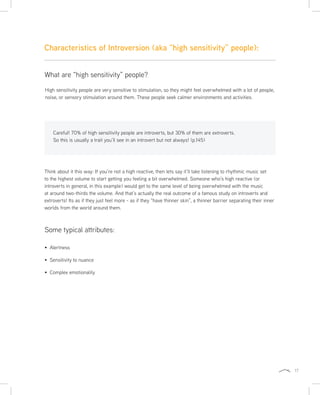
Characteristics of Introversion (aka “high sensitivity” people):
Think about it this way: If you’re not a high reactive, then lets say it’ll take listening to rhythmic music set
to the highest volume to start getting you feeling a bit overwhelmed. Someone who’s high reactive (or
introverts in general, in this example) would get to the same level of being overwhelmed with the music
at around two-thirds the volume. And that’s actually the real outcome of a famous study on introverts and
extroverts! Its as if they just feel more - as if they “have thinner skin”, a thinner barrier separating their inner
worlds from the world around them.
High sensitivity people are very sensitive to stimulation, so they might feel overwhelmed with a lot of people,
noise, or sensory stimulation around them. These people seek calmer environments and activities.
What are “high sensitivity” people?
Careful! 70% of high sensitivity people are introverts, but 30% of them are extroverts.
So this is usually a trait you’ll see in an introvert but not always! (p.145)
Some typical attributes:
Alertness
Sensitivity to nuance
Complex emotionality
18 · Personality Type Discovery and Analysis
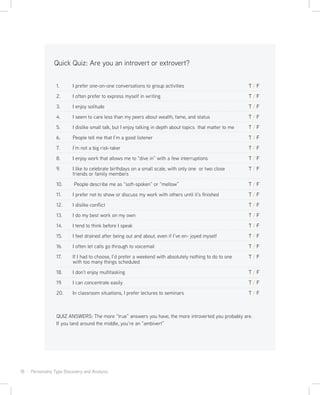
QUIZ ANSWERS: The more “true” answers you have, the more introverted you probably are.
If you land around the middle, you’re an “ambivert”
Quick Quiz: Are you an introvert or extrovert?
1. I prefer one-on-one conversations to group activities
2. I often prefer to express myself in writing
3. I enjoy solitude
4. I seem to care less than my peers about wealth, fame, and status
5. I dislike small talk, but I enjoy talking in depth about topics that matter to me
6. People tell me that I’m a good listener
7. I’m not a big risk-taker
8. I enjoy work that allows me to “dive in” with a few interruptions
9. I like to celebrate birthdays on a small scale, with only one or two close
friends or family members
10. People describe me as “soft-spoken” or “mellow”
11. I prefer not to show or discuss my work with others until it’s finished
12. I dislike conflict
13. I do my best work on my own
14. I tend to think before I speak
15. I feel drained after being out and about, even if I’ve en- joyed myself
16. I often let calls go through to voicemail
17. If I had to choose, I’d prefer a weekend with absolutely nothing to do to one
with too many things scheduled
18. I don’t enjoy multitasking
19. I can concentrate easily
20. In classroom situations, I prefer lectures to seminars
T / F
T / F
T / F
T / F
T / F
T / F
T / F
T / F
T / F
T / F
T / F
T / F
T / F
T / F
T / F
T / F
T / F
T / F
T / F
T / F
19
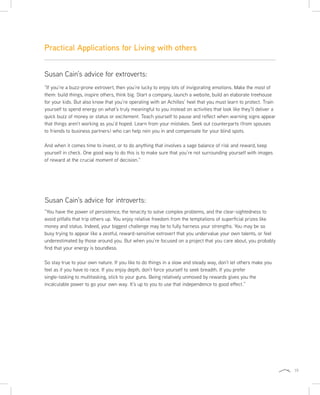
“If you’re a buzz-prone extrovert, then you’re lucky to enjoy lots of invigorating emotions. Make the most of
them: build things, inspire others, think big. Start a company, launch a website, build an elaborate treehouse
for your kids. But also know that you’re operating with an Achilles’ heel that you must learn to protect. Train
yourself to spend energy on what’s truly meaningful to you instead on activities that look like they’ll deliver a
quick buzz of money or status or excitement. Teach yourself to pause and reflect when warning signs appear
that things aren’t working as you’d hoped. Learn from your mistakes. Seek out counterparts (from spouses
to friends to business partners) who can help rein you in and compensate for your blind spots.
And when it comes time to invest, or to do anything that involves a sage balance of risk and reward, keep
yourself in check. One good way to do this is to make sure that you’re not surrounding yourself with images
of reward at the crucial moment of decision.”
“You have the power of persistence, the tenacity to solve complex problems, and the clear-sightedness to
avoid pitfalls that trip others up. You enjoy relative freedom from the temptations of superficial prizes like
money and status. Indeed, your biggest challenge may be to fully harness your strengths. You may be so
busy trying to appear like a zestful, reward-sensitive extrovert that you undervalue your own talents, or feel
underestimated by those around you. But when you’re focused on a project that you care about, you probably
find that your energy is boundless.
So stay true to your own nature. If you like to do things in a slow and steady way, don’t let others make you
feel as if you have to race. If you enjoy depth, don’t force yourself to seek breadth. If you prefer
single-tasking to multitasking, stick to your guns. Being relatively unmoved by rewards gives you the
incalculable power to go your own way. It’s up to you to use that independence to good effect.”
Practical Applications for Living with others
Susan Cain’s advice for introverts:
Susan Cain’s advice for extroverts:
20 · Personality Type Discovery and Analysis
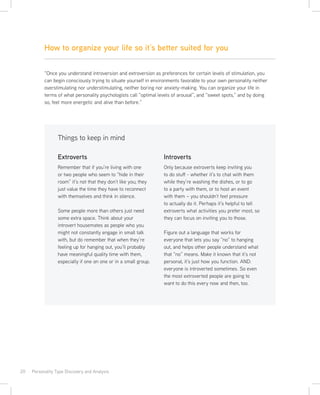
How to organize your life so it’s better suited for you
“Once you understand introversion and extroversion as preferences for certain levels of stimulation, you
can begin consciously trying to situate yourself in environments favorable to your own personality neither
overstimulating nor understimulating, neither boring nor anxiety-making. You can organize your life in
terms of what personality psychologists call “optimal levels of arousal”, and “sweet spots,” and by doing
so, feel more energetic and alive than before.”
Things to keep in mind
Remember that if you’re living with one
or two people who seem to “hide in their
room” it’s not that they don’t like you; they
just value the time they have to reconnect
with themselves and think in silence.
Some people more than others just need
some extra space. Think about your
introvert housemates as people who you
might not constantly engage in small talk
with, but do remember that when they’re
feeling up for hanging out, you’ll probably
have meaningful quality time with them,
especially if one on one or in a small group.
Extroverts Introverts
Only because extroverts keep inviting you
to do stuff - whether it’s to chat with them
while they’re washing the dishes, or to go
to a party with them, or to host an event
with them – you shouldn’t feel pressure
to actually do it. Perhaps it’s helpful to tell
extroverts what activities you prefer most, so
they can focus on inviting you to those.
Figure out a language that works for
everyone that lets you say “no” to hanging
out, and helps other people understand what
that “no” means. Make it known that it’s not
personal, it’s just how you function. AND:
everyone is introverted sometimes. So even
the most extroverted people are going to
want to do this every now and then, too.
21
The Spontaneous type:
Some personality types are flexible, spontaneous, plan everything at the last second, change their plans at
the last second, arrive late at things, or decide not to show up. These people will probably feel constrained
and pressured if they’re told they have to be somewhere no matter what, or that someone else is controlling
their time. These people will probably have trouble giving you advanced notice on activities they are going to
do (because they don’t know yet!) which you might like to join in on.
Obviously most people land somewhere in the middle of this spectrum, but using the extremes allows for a
clearer comparison. It just so happens that introverts are often the former (allows for controlled stimulation)
and extroverts the latter (more adventure).
How People Organize Their Time
The Organized type:
Some personality types are rigid about their schedules, get everywhere on time, don’t like spontaneity,
don’t like changing plans, and won’t want to randomly get up and go somewhere last minute before getting
prepared. These people do like to have their plans organized, to be able to picture what they’re going to do
throughout the day, to have fair warning if that changes, and expect other people to follow through with their
commitments.
22 · Communication and Conflict Resolution
Communication and
Conflict Resolution
23
This section is intended as a resource for more effective
communication with your housemates. You’ll learn fun tips for
the everyday, and important suggestions for when the road gets
rocky - or how to avoid even getting to that point!
Body Language p.24
Dealing with Conflict p.32
Non-Violent Communication p.36
Tips throught out the Four Steps of NVC p.46
Compassionate Communication p.50
In this section we will discuss:
24 · Communication and Conflict Resolution
You can learn a lot about what someone is “saying” when they aren’t
even using words.
Recognizing body language subtleties can also help you to become more
aware of the way you come off to others. So next time you can pay
attention to 1) the way you feel, 2) what your body is “saying”, and 3)
what you want to communicate, and ask yourself, do they match?
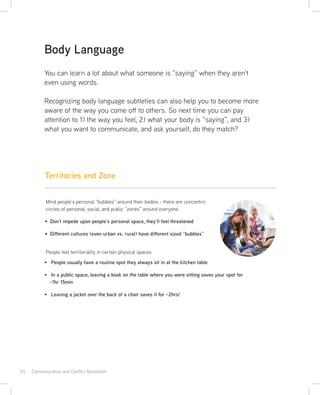
People usually have a routine spot they always sit in at the kitchen table
In a public space, leaving a book on the table where you were sitting saves your spot for
~1hr 15min
Leaving a jacket over the back of a chair saves it for ~2hrs!
Territories and Zone
Mind people’s personal “bubbles” around their bodies - there are concentric
circles of personal, social, and public “zones” around everyone
Don’t impede upon people’s personal space, they’ll feel threatened
Different cultures (even urban vs. rural) have different sized “bubbles”
People feel territoriality in certain physical spaces
Body Language
25
Palm Gestures
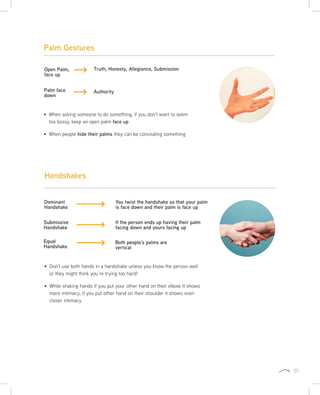
Open Palm,
face up
Palm face
down
Authority
Truth, Honesty, Allegiance, Submission
When asking someone to do something, if you don’t want to seem
too bossy, keep an open palm face up
When people hide their palms they can be concealing something
Handshakes
Dominant
Handshake
Submissive
Handshake
Equal
Handshake
You twist the handshake so that your palm
is face down and their palm is face up
If the person ends up having their palm
facing down and yours facing up
Both people’s palms are
vertical
Don’t use both hands in a handshake unless you know the person well
or they might think you’re trying too hard!
While shaking hands if you put your other hand on their elbow it shows
more intimacy; if you put other hand on their shoulder it shows even
closer intimacy
26 · Communication and Conflict Resolution
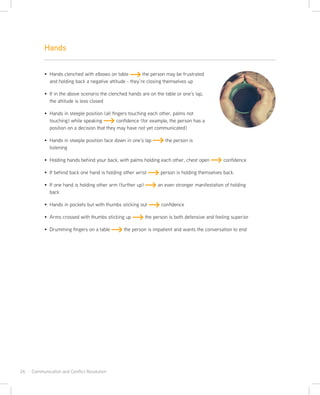
Hands clenched with elbows on table the person may be frustrated
and holding back a negative attitude - they’re closing themselves up
If in the above scenario the clenched hands are on the table or one’s lap,
the attitude is less closed
Hands in steeple position (all fingers touching each other, palms not
touching) while speaking confidence (for example, the person has a
position on a decision that they may have not yet communicated)
Hands in steeple position face down in one’s lap the person is
listening
Holding hands behind your back, with palms holding each other, chest open confidence
If behind back one hand is holding other wrist person is holding themselves back.
If one hand is holding other arm (further up) an even stronger manifestation of holding
back
Hands in pockets but with thumbs sticking out confidence
Arms crossed with thumbs sticking up the person is both defensive and feeling superior
Drumming fingers on a table the person is impatient and wants the conversation to end
Hands
27
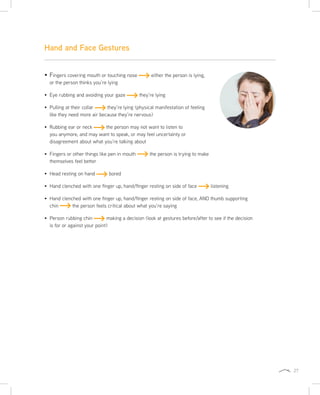
Fingers covering mouth or touching nose either the person is lying,
or the person thinks you’re lying
Eye rubbing and avoiding your gaze they’re lying
Pulling at their collar they’re lying (physical manifestation of feeling
like they need more air because they’re nervous)
Rubbing ear or neck the person may not want to listen to
you anymore, and may want to speak, or may feel uncertainty or
disagreement about what you’re talking about
Fingers or other things like pen in mouth the person is trying to make
themselves feel better
Head resting on hand bored
Hand clenched with one finger up, hand/finger resting on side of face listening
Hand clenched with one finger up, hand/finger resting on side of face, AND thumb supporting
chin the person feels critical about what you’re saying
Person rubbing chin making a decision (look at gestures before/after to see if the decision
is for or against your point)
Hand and Face Gestures
28 · Communication and Conflict Resolution
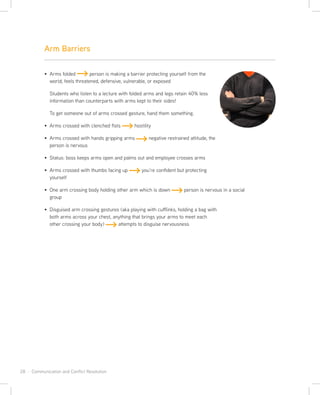
Arms folded person is making a barrier protecting yourself from the
world; feels threatened, defensive, vulnerable, or exposed
Students who listen to a lecture with folded arms and legs retain 40% less
information than counterparts with arms kept to their sides!
To get someone out of arms crossed gesture, hand them something.
Arms crossed with clenched fists hostility
Arms crossed with hands gripping arms negative restrained attitude, the
person is nervous
Status: boss keeps arms open and palms out and employee crosses arms
Arms crossed with thumbs facing up you’re confident but protecting
yourself
One arm crossing body holding other arm which is down person is nervous in a social
group
Disguised arm crossing gestures (aka playing with cufflinks, holding a bag with
both arms across your chest, anything that brings your arms to meet each
other crossing your body) attempts to disguise nervousness
Arm Barriers
29
1. Standing with arms and legs crossed Defensive position
2. Legs uncrossed, arms still crossed
3. One arm comes out of the arms crossed
4. Arm goes to hip or pocket
5. Leg points toward person you’re speaking to open and comfortable
Leg Barriers
Legs crossed:
Can be cultural
Important to assess meaning by observing this alongside correlating
gestures
Can be nervousness, reserved, defensive
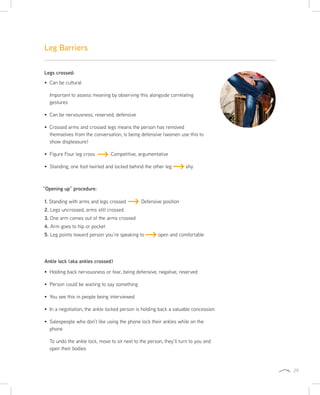
Crossed arms and crossed legs means the person has removed
themselves from the conversation, is being defensive (women use this to
show displeasure)
Figure Four leg cross Competitive, argumentative
Standing, one foot twirled and locked behind the other leg shy
“Opening up” procedure:
Holding back nervousness or fear, being defensive, negative, reserved
Person could be waiting to say something
You see this in people being interviewed
In a negotiation, the ankle locked person is holding back a valuable concession
Salespeople who don’t like using the phone lock their ankles while on the
phone
To undo the ankle lock, move to sit next to the person, they’ll turn to you and
open their bodies
Ankle lock (aka ankles crossed)
30 · Communication and Conflict Resolution
Other Common Actions
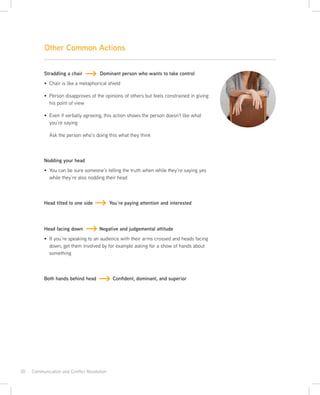
Straddling a chair Dominant person who wants to take control
Chair is like a metaphorical shield
Person disapproves of the opinions of others but feels constrained in giving
his point of view
Even if verbally agreeing, this action shows the person doesn’t like what
you’re saying
Ask the person who’s doing this what they think
Nodding your head
You can be sure someone’s telling the truth when while they’re saying yes
while they’re also nodding their head
Head tilted to one side You’re paying attention and interested
Head facing down Negative and judgemental attitude
If you’re speaking to an audience with their arms crossed and heads facing
down, get them involved by for example asking for a show of hands about
something
Both hands behind head Confident, dominant, and superior
31
32 · Communication and Conflict Resolution
How Our Histories Affect Our Present
Dealing with Conflict
It’s important to acknowledge our own strengths and weaknesses when dealing with conflict. A good
exercise to practice, either alone or with others, is taking time to think or write about your childhood
experience with conflict within your own family. Being aware of what we learned about conflict in childhood
can elucidate ways in which we see the world today.
What role do you usually hold when conflict comes up in your current relationships?
How do you react differently to people with different role types? How does your role change?
Who instigated conflict?
Who avoided it and how?
What types of power were manifested and how?
Who was the peacekeeper, and how did they do it?
What seemed like healthy conflict management and resolution?
What seemed like unhealthy conflict dynamics?
How did people express themselves or not?
What was your role?
How did you deal with conflict with different members of your family individually?
What happened when conflict occurred as a group; what roles did each person take?
Think about that role you had as a child, and see if you notice it having come up recently
with any conflicts with friends or romantic partners you can remember.
33
If you’re currently experiencing a conflict or discomfort with someone, try writing them a letter, even if you
never plan on sending it. By putting your feelings in words you’ll understand them better, be able to reflect
on what’s truly important, and potentially find ways you can reach solutions. It’ll also better prepare you for
what you would like to say in person when the time is right.
If you do choose share your written words, it’s often helpful to wait a while and take a second look with fresh
eyes before sharing. That time will give you more perspective and emotional space.
What’s the Structure Behind the Problem?
“Conflict is a call for creativity; it is something to resolve rather than
avoid…most people try to resolve conflict at the interpersonal level,
but it is more effective to address conflict at the level of structure
and process.”1
Watch out for some differences in structure or process that could be
causing conflict:
Personality differences
Differences in values
Outcomes not meeting expectations
Power unequally divided
Perceptions of a situation differing
Writing is reflecting
1
Moench, Tom Conflict and Change, Cohousing Handbook, p. 36
34 · Communication and Conflict Resolution
Yes, you have differing perspectives on what you’re arguing about. But make sure you share the same
perspectives on what is a fair way to converse, by respecting each person’s right to express their feelings,
and each person’s boundaries.
Remember that in order for the discussion to be successful, BOTH people have to “win”. If only one person
wins and the other loses, the problem that caused the argument in the first place hasn’t been resolved.
Having the last word today doesn’t ensure a peaceful day tomorrow.
If an argument starts heating up, try calling a “time out”, where the conversation freezes immediately and
each person goes to whatever location makes him or her feel calm so that they can reflect. Then they come
back to continue the conversation after they’ve had time to chill out. 1
It’s helpful to have the right space and time in which concerns or problems can be discussed. WIth hectic
schedules, sometimes a conflict will passively escalate because the people involved haven’t had time to bond
and connect. Some structured time set aside to just hang out in a safe space with no distractions, where you
can have fun and express your appreciation for each other is also a good place to then also express needs,
fears, and feedback.
If you are beginning to feel uncomfortable with someone’s behavior, stating your needs and reviewing
housemate expectations at a housemate meeting can be a great opportunity to communicate your needs to
the entire group without singling anyone out. Consistent housemate meetings allow a chance for people to
review their needs before conflicts escalate.
Make sure to express the positive as well as the negative when possible.
Hardy, Janet and Easton Dossie. The Ethical Slut , p. 140
Create the Right Space to Talk
If You’ve Got to Argue...
35
Annoyed with someone? You’re already thinking about all the negatives, so balance yourself out by
reminding yourself to think about the value this person has to you – think of the positive traits this
person has, and what you admire about them. If you feel the relationship is important to you, you’ll be
able to work through the conflict that you’re having. If one of you has given up on the relationship, see
if you can get help from a trusted friend to check in our your perspectives.
The Campus team is available to provide support as an objective mediator and facilitator.
“Keep your attention focused on the other person. Besides not getting distracted with other activities, don’t
go into your own similar experiences, how you would feel in their place, or what you think they should do.” 2
Instead, focus on understanding as best possible what the other person is trying to communicate - it’s like
trying to solve a puzzle. Ask questions, and repeat back what you heard so you can make sure you’re both
on the same page. It’ll also help them feel heard and understood.
Remind Yourself of the Good Side (Yes, There is One)
How to Listen
2
Chriss Scotthanson & Kelly Scotthanson, Cohousing Handbook , p. 32
36 · Communication and Conflict Resolution
Nonviolent Communication (NVC) is an approach to speaking and listening founded on the
principles of nonviolence, our natural state of compassion.
The primary purpose of NVC is to improve the quality of connection with yourself and with
others so that compassion becomes a part of all conversations and relationships.
NVC focuses on the reality that human beings share the same basic needs, and that
everyone’s actions are really just part of a strategy to meet those needs.
It helps us become aware of judgment, fear, obligation, duty, reward, punishment, guilt, and
shame, and to avoid using them to control situations.
NVC identifies bad habits and automatic reactions and teaches the value of conscious
responses.
NVC is honest and clear communication paired with respectful, active, and empathetic
attention to others.
Nonviolent Communication
Nonviolent Communication is a framework of peaceful communication to
resolve conflict.3
3
Thank you to Laura Taylor for her contribution to this section on Nonviolent Communication
Introduction
37
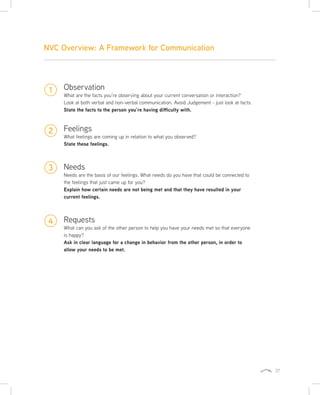
Observation
What are the facts you’re observing about your current conversation or interaction?
Look at both verbal and non-verbal communication. Avoid Judgement - just look at facts.
State the facts to the person you’re having difficulty with.
Feelings
What feelings are coming up in relation to what you observed?
State these feelings.
Needs
Needs are the basis of our feelings. What needs do you have that could be connected to
the feelings that just came up for you?
Explain how certain needs are not being met and that they have resulted in your
current feelings.
Requests
What can you ask of the other person to help you have your needs met so that everyone
is happy?
Ask in clear language for a change in behavior from the other person, in order to
allow your needs to be met.
1
2
3
4
NVC Overview: A Framework for Communication
38 · Communication and Conflict Resolution
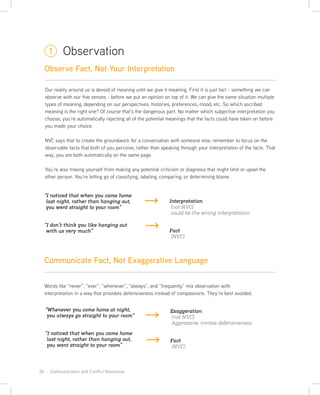
Observe Fact, Not Your Interpretation
Observation
Our reality around us is devoid of meaning until we give it meaning. First it is just fact - something we can
observe with our five senses - before we put an opinion on top of it. We can give the same situation multiple
types of meaning, depending on our perspectives, histories, preferences, mood, etc. So which ascribed
meaning is the right one? Of course that’s the dangerous part. No matter which subjective interpretation you
choose, you’re automatically rejecting all of the potential meanings that the facts could have taken on before
you made your choice.
NVC says that to create the groundwork for a conversation with someone else, remember to focus on the
observable facts that both of you perceive, rather than speaking through your interpretation of the facts. That
way, you are both automatically on the same page.
You’re also freeing yourself from making any potential criticism or diagnosis that might limit or upset the
other person. You’re letting go of classifying, labeling, comparing, or determining blame.
1
“I noticed that when you came home
last night, rather than hanging out,
you went straight to your room”
“I don’t think you like hanging out
with us very much”
Interpretation
(not NVC)
could be the wrong interpretation
Fact
(NVC)
Words like “never”, “ever”, “whenever”, “always”, and “frequently” mix observation with
interpretation in a way that provokes defensiveness instead of compassions. They’re best avoided.
Communicate Fact, Not Exaggerative Language
“Whenever you come home at night,
you always go straight to your room”
“I noticed that when you came home
last night, rather than hanging out,
you went straight to your room”
Exaggeration
(not NVC)
Aggressive, invites defensiveness
Fact
(NVC)
39
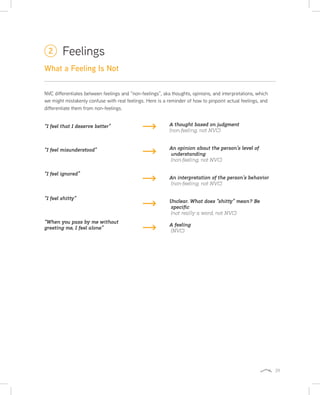
NVC differentiates between feelings and “non-feelings”, aka thoughts, opinions, and interpretations, which
we might mistakenly confuse with real feelings. Here is a reminder of how to pinpoint actual feelings, and
differentiate them from non-feelings.
What a Feeling Is Not
Feelings2
“I feel that I deserve better”
“I feel misunderstood”
“I feel ignored”
“I feel shitty”
“When you pass by me without
greeting me, I feel alone”
A thought based on judgment
(non-feeling, not NVC)
An opinion about the person’s level of
understanding
(non-feeling, not NVC)
An interpretation of the person’s behavior
(non-feeling, not NVC)
Unclear. What does “shitty” mean? Be
specific
(not really a word, not NVC)
A feeling
(NVC)
40 · Communication and Conflict Resolution
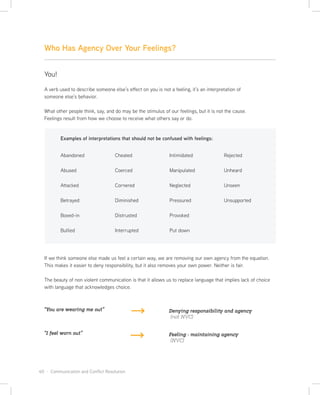
You!
A verb used to describe someone else’s effect on you is not a feeling, it’s an interpretation of
someone else’s behavior.
What other people think, say, and do may be the stimulus of our feelings, but it is not the cause.
Feelings result from how we choose to receive what others say or do.
Who Has Agency Over Your Feelings?
Abandoned
Abused
Attacked
Betrayed
Boxed-in
Bullied
Cheated
Coerced
Cornered
Diminished
Distrusted
Interrupted
Intimidated
Manipulated
Neglected
Pressured
Provoked
Put down
Rejected
Unheard
Unseen
Unsupported
Examples of interpretations that should not be confused with feelings:
If we think someone else made us feel a certain way, we are removing our own agency from the equation.
This makes it easier to deny responsibility, but it also removes your own power. Neither is fair.
The beauty of non violent communication is that it allows us to replace language that implies lack of choice
with language that acknowledges choice.
“You are wearing me out”
“I feel worn out”
Denying responsibility and agency
(not NVC)
Feeling - maintaining agency
(NVC)
41
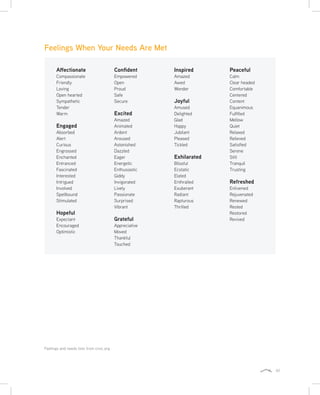
Feelings When Your Needs Are Met
Feelings and needs lists from cnvc.org
Affectionate
Compassionate
Friendly
Loving
Open hearted
Sympathetic
Tender
Warm
Engaged
Absorbed
Alert
Curious
Engrossed
Enchanted
Entranced
Fascinated
Interested
Intrigued
Involved
Spellbound
Stimulated
Hopeful
Expectant
Encouraged
Optimistic
Confident
Empowered
Open
Proud
Safe
Secure
Excited
Amazed
Animated
Ardent
Aroused
Astonished
Dazzled
Eager
Energetic
Enthusiastic
Giddy
Invigorated
Lively
Passionate
Surprised
Vibrant
Grateful
Appreciative
Moved
Thankful
Touched
Inspired
Amazed
Awed
Wonder
Joyful
Amused
Delighted
Glad
Happy
Jubilant
Pleased
Tickled
Exhilarated
Blissful
Ecstatic
Elated
Enthralled
Exuberant
Radiant
Rapturous
Thrilled
Peaceful
Calm
Clear headed
Comfortable
Centered
Content
Equanimous
Fulfilled
Mellow
Quiet
Relaxed
Relieved
Satisfied
Serene
Still
Tranquil
Trusting
Refreshed
Enlivened
Rejuvenated
Renewed
Rested
Restored
Revived
42 · Communication and Conflict Resolution
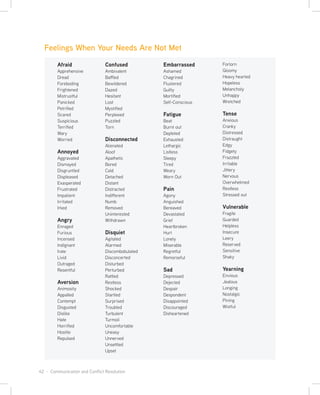
Feelings When Your Needs Are Not Met
Forlorn
Gloomy
Heavy hearted
Hopeless
Melancholy
Unhappy
Wretched
Tense
Anxious
Cranky
Distressed
Distraught
Edgy
Fidgety
Frazzled
Irritable
Jittery
Nervous
Overwhelmed
Restless
Stressed out
Vulnerable
Fragile
Guarded
Helpless
Insecure
Leery
Reserved
Sensitive
Shaky
Yearning
Envious
Jealous
Longing
Nostalgic
Pining
Wistful
Afraid
Apprehensive
Dread
Foreboding
Frightened
Mistrustful
Panicked
Petrified
Scared
Suspicious
Terrified
Wary
Worried
Annoyed
Aggravated
Dismayed
Disgruntled
Displeased
Exasperated
Frustrated
Impatient
Irritated
Irked
Angry
Enraged
Furious
Incensed
Indignant
Irate
Livid
Outraged
Resentful
Aversion
Animosity
Appalled
Contempt
Disgusted
Dislike
Hate
Horrified
Hostile
Repulsed
Confused
Ambivalent
Baffled
Bewildered
Dazed
Hesitant
Lost
Mystified
Perplexed
Puzzled
Torn
Disconnected
Alienated
Aloof
Apathetic
Bored
Cold
Detached
Distant
Distracted
Indifferent
Numb
Removed
Uninterested
Withdrawn
Disquiet
Agitated
Alarmed
Discombobulated
Disconcerted
Disturbed
Perturbed
Rattled
Restless
Shocked
Startled
Surprised
Troubled
Turbulent
Turmoil
Uncomfortable
Uneasy
Unnerved
Unsettled
Upset
Embarrassed
Ashamed
Chagrined
Flustered
Guilty
Mortified
Self-Conscious
Fatigue
Beat
Burnt out
Depleted
Exhausted
Lethargic
Listless
Sleepy
Tired
Weary
Worn Out
Pain
Agony
Anguished
Bereaved
Devastated
Grief
Heartbroken
Hurt
Lonely
Miserable
Regretful
Remorseful
Sad
Depressed
Dejected
Despair
Despondent
Disappointed
Discouraged
Disheartened
43
One way to communicate your feelings and needs together is to make the causation clear, by saying
for example: “When [X EVENT OCCURS]....I feel [FEELING]… because I [STATE NEED]....”
Finding the Needs Underneath Your Feelings
Needs3
Autonomy
Choice
Freedom
Independence
Space
Spontaneity
Meaning
Awareness
Celebration of Life
Challenge
Clarity
Competence
Consciousness
Contribution
Creativity
Discovery
Efficacy
Effectiveness
Growth
Hope
Learning
Mourning
Participation
Purpose
Self-Expression
Stimulation
To Matter
Understanding
What are you missing that you need? Below are some possibilities.
Connection
Acceptance
Affection
Appreciation
Belonging
Cooperation
Communication
Closeness
Community
Companionship
Compassion
Consideration
Consistency
Empathy
Inclusion
Intimacy
Love
Mutuality
Nurturing
Respect/Self-Respect
Safety
Security
Stability
Support
To Know and Be Known
To See and Be Seen
To Understand and
Be Understood
Trust
Warmth
Physical
Well-Being
Air
Food
Movement/
Exercise
Rest/Sleep
Sexual
Expression
Safety
Shelter
Touch
Water
Honesty
Authenticity
Integrity
Presence
Play
Joy
Humor
Peace
Beauty
Communion
Ease
Equality
Harmony
Inspiration
Order
44 · Communication and Conflict Resolution
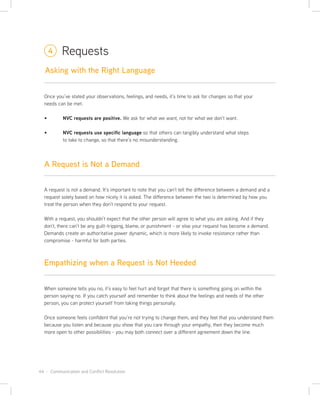
Once you’ve stated your observations, feelings, and needs, it’s time to ask for changes so that your
needs can be met.
NVC requests are positive. We ask for what we want, not for what we don’t want.
NVC requests use specific language so that others can tangibly understand what steps
to take to change, so that there’s no misunderstanding.
Asking with the Right Language
Requests4
A request is not a demand. It’s important to note that you can’t tell the difference between a demand and a
request solely based on how nicely it is asked. The difference between the two is determined by how you
treat the person when they don’t respond to your request.
With a request, you shouldn’t expect that the other person will agree to what you are asking. And if they
don’t, there can’t be any guilt-tripping, blame, or punishment - or else your request has become a demand.
Demands create an authoritative power dynamic, which is more likely to invoke resistance rather than
compromise - harmful for both parties.
A Request is Not a Demand
When someone tells you no, it’s easy to feel hurt and forget that there is something going on within the
person saying no. If you catch yourself and remember to think about the feelings and needs of the other
person, you can protect yourself from taking things personally.
Once someone feels confident that you’re not trying to change them, and they feel that you understand them
because you listen and because you show that you care through your empathy, then they become much
more open to other possibilities - you may both connect over a different agreement down the line.
Empathizing when a Request is Not Heeded
45
46 · Communication and Conflict Resolution
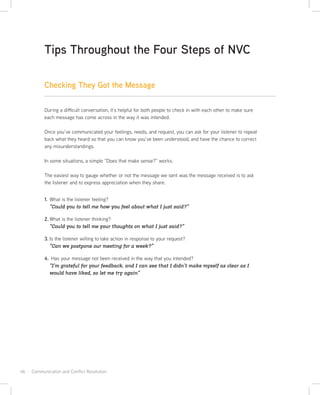
During a difficult conversation, it’s helpful for both people to check in with each other to make sure
each message has come across in the way it was intended.
Once you’ve communicated your feelings, needs, and request, you can ask for your listener to repeat
back what they heard so that you can know you’ve been understood, and have the chance to correct
any misunderstandings.
In some situations, a simple “Does that make sense?” works.
The easiest way to gauge whether or not the message we sent was the message received is to ask
the listener and to express appreciation when they share.
1. What is the listener feeling?
“Could you to tell me how you feel about what I just said?”
2. What is the listener thinking?
“Could you to tell me your thoughts on what I just said?”
3. Is the listener willing to take action in response to your request?
“Can we postpone our meeting for a week?”
4. Has your message not been received in the way that you intended?
“I’m grateful for your feedback, and I can see that I didn’t make myself as clear as I
would have liked, so let me try again”
Checking They Got the Message
Tips Throughout the Four Steps of NVC
47
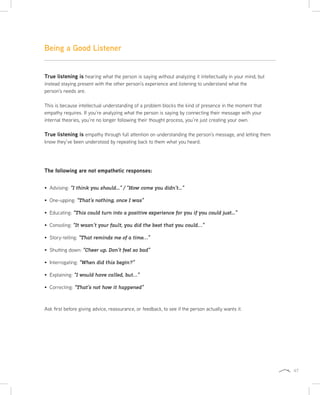
Being a Good Listener
True listening is hearing what the person is saying without analyzing it intellectually in your mind, but
instead staying present with the other person’s experience and listening to understand what the
person’s needs are.
This is because intellectual understanding of a problem blocks the kind of presence in the moment that
empathy requires. If you’re analyzing what the person is saying by connecting their message with your
internal theories, you’re no longer following their thought process, you’re just creating your own.
True listening is empathy through full attention on understanding the person’s message, and letting them
know they’ve been understood by repeating back to them what you heard.
The following are not empathetic responses:
Advising: “I think you should...” / “How come you didn’t...”
One-upping: “That’s nothing, once I was”
Educating: “This could turn into a positive experience for you if you could just...”
Consoling: “It wasn’t your fault, you did the best that you could…”
Story-telling: “That reminds me of a time…”
Shutting down: “Cheer up. Don’t feel so bad”
Interrogating: “When did this begin?”
Explaining: “I would have called, but…”
Correcting: “That’s not how it happened”
Ask first before giving advice, reassurance, or feedback, to see if the person actually wants it.
48 · Communication and Conflict Resolution
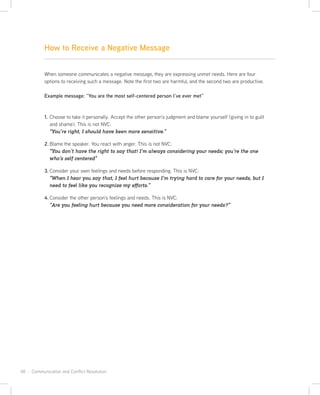
When someone communicates a negative message, they are expressing unmet needs. Here are four
options to receiving such a message. Note the first two are harmful, and the second two are productive.
Example message: “You are the most self-centered person I’ve ever met”
1. Choose to take it personally. Accept the other person’s judgment and blame yourself (giving in to guilt
and shame). This is not NVC:
“You’re right, I should have been more sensitive.”
2. Blame the speaker. You react with anger. This is not NVC:
“You don’t have the right to say that! I’m always considering your needs; you’re the one
who’s self centered”
3. Consider your own feelings and needs before responding. This is NVC:
“When I hear you say that, I feel hurt because I’m trying hard to care for your needs, but I
need to feel like you recognize my efforts.”
4. Consider the other person’s feelings and needs. This is NVC:
“Are you feeling hurt because you need more consideration for your needs?”
How to Receive a Negative Message
49
Being a nonviolent communicator does not mean that you are somehow supposed to suppress anger.
However, it does mean making a distinction between the stimulus of anger (perhaps something the person
you’re with did) and the cause (your own needs).
When you’re angry, try to remove the other person from responsibility for that anger, so that you don’t end
up blaming or punishing them for your feelings and unmet needs. Instead of finding external fault, identify
where your anger is located in your own thought process. When you find the reason why you’re angry, you
can express your anger in a proactive, clear way.
Four steps to expressing anger:
1. Stop and breathe. Refrain from blaming and punishing
2. Identify the judgmental thoughts that are making you angry
3. Connect these thoughts to core needs that are not being met
4. Finally, express anger through the lens of your feelings and needs
Feeling Angry?
Expressing Gratitude: is an opportunity to let the other person know how your life has been enriched by
their actions or words. You can share what the person did that you want to celebrate, how you feel about
what they’ve done, and how they met your needs. YAY!
Receiving Gratitude: We’ve all grown accustomed to a culture where buying, earning, and deserving are the
standard modes of interaction, so sometimes simple giving and receiving can make us uncomfortable. One
way to move beyond this discomfort is to receive appreciation with the same empathy we express when
actively listening to others. You can accept the appreciation without feelings of superiority or false humility by
being genuine in your gratefulness that you have enriched the life of another.
Feeling Grateful? Remember to Give and Receive Appreciation
50 · Communication and Conflict Resolution
The 12 Strategies:
The book “Words Can Change Your Brain” written by neuroscientists and citing
results from brain studies sets forth the 12 strategies of compassionate
communication. They seem simple, but actually following them takes a lot of
practice. Try practicing deliberately for just a half hour per day, and after a
while you’ll start catching on more and more, and things will start to happen.
Compassionate Communication
1. Relax
Before starting any conversation, relax your muscles and take 5 slow breaths by yourself, counting to 5 when
inhaling, and to 5 when exhaling. (After this, you should notice a difference in your energy level and focus.)
2. Stay Present
Focus on what is actually happening around you - what are you seeing, hearing, feeling? Notice your 5
senses.
3. Cultivate Inner Silence
Turn off that little voice in your head that keeps jabbering while the person you’re talking to is talking, and
actually pay attention to what they’re saying without worrying about what you think about it or what you
want to say next
4. Increase Positivity
Remind yourself about the qualities you most like about the person you’re with
Experiment: Observe strangers in a public place and ask yourself, “what is their partner’s favorite thing
about them?”
When having a negative reaction to something, focus on finding positive, tangible (even if small) solutions
51
5. Reflect on your Deepest Values
Meditate for a minute or two to clear your head, and then think about what word embodies the values that
most matter to you in life. Do this every day for a week, and collect a list by the end of the week that you
then cut down to the top few. Think about your value(s) deliberately every now and then (or before an
important or difficult conversation) as a way to center yourself
6. Access a Pleasant Memory
Before an encounter with another person, (or during an encounter when you need to center yourself and
calm down) get yourself into a good mood by thinking about something you really like in your head, like a
place or person you love
7. Observe Non-Verbal Cues
So much of communication is in body language, facial expression, voice pitch, and voice speed. Be aware of
what those cues communicate to you. Help others “hear” themselves through their cues. Be aware of which
cues you are sending out
8. Express Appreciation
Remember to acknowledge what others have said and what you liked about it, especially if you’re about to
critique them
When you end a conversation on a positive note, people will have a more pleasant memory of the entire
conversation. (The ending of an event colors the memory of the entire thing)
9. Speak Warmly
Purposely choose the tone of your voice. It says more than your words do
10. Speak Slowly
When you slow down, you sound nicer, more caring, more calming, and you’re able to actually choose the
words you want. It’s impossible to create aggressive conversation when you speak slowly and warmly
Experiment: Practice a conversation with someone where you both speak EXTREMELY slowly, with huge
pauses between each of your words (so much so that it’s uncomfortable and kind of boring and you get
antsy). See if you can get used to speaking like that for a while, and try speaking like that while discussing
a difficult topic - DON’T speed up.
52 · Communication and Conflict Resolution
11. Speak Briefly
People can only hold 4 points of information in their head at one time, during 30 seconds at a time. If you
speak for longer than 30 seconds, people aren’t going to be able to fully grasp what you said. Cut your
speech into much shorter sections, and let the other person talk between each of your messages
Experiment: Ask the person you’re talking to for each of you to be mindful to only speak for 30 seconds
each. It’s amazing how much deeper of an exchange you’ll have, because you’ll actually both be present
and responding to each piece of information you exchange. Let the conversation take you to the topics it
does.
12. Listen Deeply
Let go of the inner voice in your head, forget about where you want the conversation to go, forget about what
the person’s conversation topic is reminding you about in your own life. Actually try to understand everything
about what the person is saying - what do they mean by what they’re saying? Why are they saying it like
that? What information is behind it? Realize that you don’t know all the assumptions, experiences, and
nuances behind what someone is saying, and try to figure them out. Ask lots of questions. Picture the
situation visually while you’re listening to the person, so you can best accompany them and stay focused.
Decide on a set length of time you’re going to talk (for example, 20 min). Then set an alarm for every
3 minutes. Only one person is allowed to talk during each 3-minute period, and you alternate. Keep eye
contact. If you’re discussing some type of conflict or disagreement, don’t start any sentences with “You.”
Instead, focus on “I”.
“In some Native American cultures it is customary to wait several minutes after a person speaks before
responding: it is rude and disrespectful to fail to think about what the person has said, and to speak
immediately would indicate that you have simply been waiting for the speaker to be quiet so that you can
then attempt to change his or her mind.”
Try doing this: Let there be a very long pause between each time each person speaks. You’ll notice that
the speaker might continue what they were saying a bit, whereas if the other person had already begun
responding, they wouldn’t have been able to take their thought process all the way.4
Exercises
4
These exercises are courtesy of the book The Ethical Slut
53
54 · Community through the Lenses of History, Culture, Psychology, and Economics
Community through
the Lenses of History,
Culture, Psychology,
and Economics
55
In this section we will discuss:
Community Throughout History: Trust and Sharing p.56
Community Across Cultures: Individualism vs.. Collectivism p.59
Community Psychology: Motivation and Value Participation p.60
Community Economics: The Tragedy of the Commons p.62
Community Challenges: Game Theory p.64
How have the vision and values of community changed over time?
How do he concepts of individualism vs. collectivism differ across cultures?
What do psychology and behavioral economics tell us about how we treat
each other when we create together, and share space, resources, and
responsibilities?
This section provides a glimpse.
56 · Community through the Lenses of History, Culture, Psychology, and Economics
Prehistoric tribes were focused on sharing everything: food, resources, family, and risks. In the words
of Jared Diamond, “Huntergatherers practiced the most successful and longestlasting lifestyle in human
history”. Small knit groups of a few dozen people who knew each other intimately expected to give and
receive, and such sharing reinforced bonding.
In comparison, our modern day western society has grown so large that natural human tendencies no longer
have the framework that originally allowed them to successfully manifest. In modern cities, people can
remain anonymous, and responsibility and reputation can be avoided, so people end up exhibiting different
behaviors. In The Power of Scale, anthropologist John Bodley wrote: “The size of human societies and
cultures matters because larger societies will naturally have more concentrated power. Larger societies will
be less democratic than smaller societies, and they will have an unequal distribution of risks and rewards.”...
Human nature functions one way in the context of intimate, interdependent societies, but set loose in
anonymity, we become a different creature.”
“British anthropologist Robin Dunbar plotted overall group size against the neocortical development of the
brain. Using this correlation, he predicted that humans start losing track of who’s doing what to whom when
group size hits about 150 individuals. In Dunbar’s words, “The limit imposed by neocortical processing
capacity is simply on the number of individuals with whom a stable interpersonal relationship can be
maintained.” Other anthropologists had arrived at the same number by observing that when group sizes
grew much beyond that, they tend to split into two smaller groups.”
To counter those who believe humans are simply selfish, it seems that our external environment actually
influences how we act. Richard Dawkins, author of The Selfish Gene, explains that “just as egalitarianism
and resource and risksharing memes were favored in the prehistoric environment, the selfishness meme has
flourished in most of the postagricultural world. As economist John Gowdy explains, “’Rational economic
behavior’ is peculiar to market capitalism and is an embedded set of beliefs, not an objective universal law
of nature. The myth of economic man explains the organizing principle of contemporary capitalism, nothing
more or less.”
Info from this section sourced from Sex at Dawn: How We Mate, Why We Stray, and What It Means for Modern Relationships, by
Christopher Ryan and Cacilda Jetha
COMMUNITY THROUGHOUT HISTORY:
Trust and Sharing
The Good Ol’ Days
Our Current Reality
57
The sharing economy is a growing movement of peer-based organizations in which goods, services and
experiences are exchanged between real human beings who learn about each other and often meet in
person, and who become empowered together building up local and global communities around shared
interests and support, fostering co-creation, sharing, local autonomy, and even better environmental
practices. It just so happens that people also save money and time.
Ridesharing test
Bike-sharing
Co-Working
Crowdfunding
Microfinance
Peer to Peer Debt Financing
Timebanking
Co-living
Intentional Communities
Peer to Peer Accommodations
Collaborative Cooking and Meals
Community Gardening
Hackerspaces / Makerspaces
Open Source Coding
Open Source Education Platforms
Crowd Product Creation
Group Buying
Online Civic Action
Clothing Swaps
Tool Sharing Networks
Reuse and Recycle Networks
Sharing Wifi and Energy
Peer to Peer Delivery Services
Sports Groups
What sectors and activities are in the sharing economy?
Any! Here are a few examples:
The Future we’re Creating
58 · Community through the Lenses of History, Culture, Psychology, and Economics
Trust and reputation are the new currency in the sharing economy. As thought leader Rachel Botsman says
at TED, “So if someone asked you for the three words that would sum up your reputation, what would you
say? How would people describe your judgment, your knowledge, your behaviors, in different situations?
...The answer to this question will become profoundly important in an age where reputation
will be your most valuable asset.”
Sharing economy industry leaders have been studying trust and finding ways to create trust between
individual strangers to help increase interactions and transactions we can experience with each other
directly, rather than relying on intermediaries to assure safety and quality.
Botsman also elucidates how our connections online are a helpful step toward trusting strangers offline:
“Over the past 20 years, we’ve evolved from trusting people online to share information to
trusting to handing over our credit card information, and now we’re entering the third trust
wave: connecting trustworthy strangers to create all kinds of people powered marketplaces. I
actually came across this fascinating study by the Pew Center this week that revealed that an
active Facebook user is three times as likely as a noninternet user to believe that most people
are trustworthy. Virtual trust will transform the way we trust one another face to face.”
Info from Rachel Botsman’s speech, “The Currency of the New Economy is Trust”, on TED
59
COMMUNITY ACROSS CULTURES:
Individualism vs. Collectivism
It’s interesting to look at how eastern vs. western cultures value behaviors on different ends on the
individualism vs.. collectivism spectrum. For example, in the United States, the poster child country
for individualism, breaking away from the rule and being innovative, such as creating a career as an
entrepreneur, is highly valued. Moving far away from family and friends is considered normal. Young people
most often have the freedom to date and choose their spouse. Compare these norms to countries in the
“global south”, or think about how they characterize some typical “western” ideals of independence, freedom,
power, and selfactualization, and how that differs from the “eastern” ideals of tradition, respect for elders,
and group harmony.
In one example, PsychoEconomist Sheena Lyengar studies decision making based on these cultural
differences. Her results show that oftentimes the American way, where an individual makes his or her own
decisions, is more overwhelming, leading to paralysis, guilt, and other reactions based on a feeling of isolated
responsibility. In her TED talk “On the Art of Choosing” she states:
“First assumption: if a choice affects you, then you should be the one to make it....
[But] when, in contrast, two or more individuals see their choices and their outcomes as
intimately connected, then they may amplify one another’s success by turning choosing into
a collective act. To insist that they choose independently might actually compromise both
their performance and their relationships. Yet that is exactly what the American paradigm
demands. It leaves little room for interdependence or an acknowledgment of individual
fallibility. It requires that everyone treat choice as a private and selfdefining act. People that
have grown up in such a paradigm might find it motivating, but it is a mistake to assume that
everyone thrives under the pressure of choosing alone.”
60 · Community through the Lenses of History, Culture, Psychology, and Economics
COMMUNITY PSYCHOLOGY:
Motivation and Value of Participation
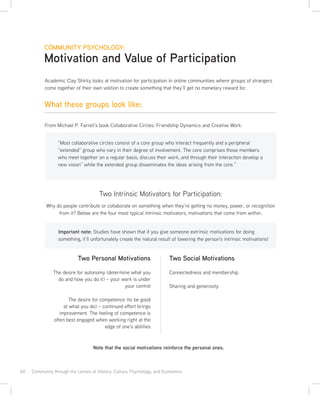
Academic Clay Shirky looks at motivation for participation in online communities where groups of strangers
come together of their own volition to create something that they’ll get no monetary reward for.
What these groups look like:
“Most collaborative circles consist of a core group who interact frequently and a peripheral
“extended” group who vary in their degree of involvement. The core comprises those members
who meet together on a regular basis, discuss their work, and through their interaction develop a
new vision” while the extended group disseminates the ideas arising from the core.”
From Michael P. Farrell’s book Collaborative Circles: Friendship Dynamics and Creative Work:
Two Intrinsic Motivators for Participation:
Why do people contribute or collaborate on something when they’re getting no money, power, or recognition
from it? Below are the four most typical intrinsic motivators, motivations that come from within.
Two Personal Motivations
The desire for autonomy (determine what you
do and how you do it) – your work is under
your control
The desire for competence (to be good
at what you do) – continued effort brings
improvement. The feeling of competence is
often best engaged when working right at the
edge of one’s abilities
Two Social Motivations
Connectedness and membership
Sharing and generosity
Important note: Studies have shown that if you give someone extrinsic motivations for doing
something, it’ll unfortunately create the natural result of lowering the person’s intrinsic motivations!
Note that the social motivations reinforce the personal ones.
61
Four Sharing Levels and their Created Value:
Personal Sharing / Personal Value
At this level, a collection of strangers
participate as individuals, and all get personal
value out of participating..
Communal Sharing / Communal Value
At this level, people form a group and collaborate,
creating value for those inside the group.
Public Sharing / Public Value
At this level, a group creates a public resource
available to anyone, even those who did not
participate in the creation of their source. The
creators desire and benefit from newcomers
experiencing and adopting their creation.
Civic Sharing / Civic Value
At this level, a group works to transform society.
This is like the public level, but specifically focused
on goals and ideals of creating a better world.
Public and civic value are the most beneficial to society, but the most difficult to create. As inventor and
entrepreneur Dean Kamen says, “In a free culture, you get what you celebrate.” Our culture celebrates
rewards personal and communal value most, monetarily.
Shirky’s proposed solution:
“If you do a web search for ‘we as a society,” you will find a litany of failed causes, because
society isn’t the kind of unit that can have conversations, come to decisions, and take
action. Civic value rarely comes from sudden social conversions; nor does it bubble up from
individual actions. It comes, instead, from the work of groups, small groups at first that
grow in size and importance, the pattern of collaborative circles, communities and practice,
and many other group patterns. If we want to create new forms of civic value, we need to
improve the ability of small groups to try radical things”
Info from Clay Shirky’s book Cognitive Surplus: Creativity and Generosity in a Connected Age
62 · Community through the Lenses of History, Culture, Psychology, and Economics
COMMUNITY ECONOMICS:
The Tragedy of the Commons
In 1833 William Forster Lloyd described a situation in which multiple sheep herders shared the same grazing
land. In this scenario, there isn’t enough grass for all sheep to graze freely, so herders should take turns
and limit their sheep’s grazing. However, what was expressed in this example and what is now used as a
metaphor, is the fact that each herder would try to coopt the system, realizing that since the rest of the group
was respecting the limits, they could take advantage and let their sheep graze more, for their own benefit.
However, since each herder thought in that same way, everyone crossed the limit, and everyone ended up
depleting the land.
We can take this example and associate it to any situation in which a group of people need to limit their use
of a resource in order for it to be maintained for all, but where oftentimes, due to each person’s desire for
individual gain, cheating leads to loss for all. This isn’t always malevolent; it happens all the time. There are
a few ways to address the tragedy of the commons with any resource. One is a top down approach where a
governing body sets limits on use. Another is privatizing the resource so that it’s no longer shared: when one
person is responsible for it, she’ll make sure to use it only to the extent possible without damaging it.
Elinor Ostrom, who won the Nobel Prize in Economic Sciences, proposed a third approach: cooperative
agreements. She developed her approach while studying various environmental systems that experience
commonpool resource problems, including forest systems, irrigation systems, and fisheries.
In her approach, the people sharing the resource set their own rules for using it. This allows those who have
the best knowledge of the resource to determine the most appropriate rules. As a result, rules imposed by
the group, rather than by outsiders or powerful insiders, are less likely to be violated and more likely to be
effective. For example, she found that with government managed farm irrigation systems, only 42% were
high performing, but with farmer managed irrigation systems, over 72% were high performing (even though
they oftentimes had worse engineering than the government ones!).
63
Because a cooperative agreement is voluntary, it must have well defined rights, and duties to respect those
rights. Ostrom identified seven types or rules necessary for an effective cooperative agreement:
Boundary Rules
Who has access to what space
Position Rules
What position each user has in the system
Choice Rules
What a user can and can’t do
Information Rules
How much information is available to users
Aggregation Rules
Who has control over the system
Scope Rules
What potential actions/outcomes can occur
Payoff Rules
Who gets benefits and costs, and how
much of each
It’s also important to note that communication is key. Not surprisingly, Ostrom found that those groups that
are lacking clear communication are more likely to overuse their resource.
From Elinor Ostrom’s Governing the Commons: The Evolution of Institutions for Collective Action (1990), and her Nobel Prize Lecture
(2009), available at: www.nobelprize.org—index.php
64 · Community through the Lenses of History, Culture, Psychology, and Economics
COMMUNITY CHALLENGES:
Game Theory
When it comes to how you behave, it really does matter whether or not you’re going to interact with
someone more than once. There are a series of studies in the field of international relations that take into
account the concept of “tit for tat”, or, in colloquial terms, “if you do this, then I’ll do that”. The idea is that if
we were never to see someone again, we could behave rather unpleasantly toward them, but since we know
we’re going to have to deal with the consequences of our actions later, we figure out how to cooperate.
One of the most famous experiments in game theory is called The Prisoner’s Dilemma, showing reciprocity
in social psychology. Here’s how it works, and what psychologists and economists found out:
“Imagine that two suspects are arrested, but the police don’t have enough evidence for a
conviction. After the prisoners are separated, each gets the same offer: If you testify against
your partner and he remains silent, you’ll go free and he’ll get the full tenyear sentence.
If he fesses up but you don’t, you’ll do the time while he walks free. If neither of you talks,
you’ll both get six months. If you both talk, you’ll both do five years. Each prisoner must
choose to snitch or remain silent. Each is told the other won’t know about his decision. How
will the prisoners respond?
In the classic form of the game, participants almost always betray one another, as each
sees the benefit of quick betrayal: talk first, and walk away free. But take the theoretical
conclusion to a prison anywhere in the world and as what happens to “rats”. Theory finally
caught up to reality when scientists decided to let players gain experience with the game
and see whether their behavior changed over time. As Robert Axelrod explains in The
Evolution of Cooperation, players soon learned that they had a better chance if they kept
quiet and assumed that their partner would do the same. If their partner talked, he acquired
a bad reputation and was punished, in a “tit-for-tat” pattern. Over time, those players with
the more altruistic approached flourished, while those who acted only in their individual
short-term interest met serious problems.
65
This section quoted from Ryan and Jetha’s Sex at Dawn
The classic interpretation of the experiment took another blow when psychologist Gregory
S. Berns and his colleagues decided to monitor female players with an MRI machine. Berns
et al. We’re expecting to find that subjects would react most strongly to being cheated when
one tried to cooperate and the other “snitched.” But that’s not what they found. “The results
really surprised us,” Berns told Natalie Angier, of The New York Timesˆ. The brain responded
most energetically to acts of cooperation. Analyzing the brain scans, Berns and his team found
that when the women cooperated, two parts of the brain, both responsive to dopamine, were
activated. “It’s reassuring,” he said. “In some ways, it says that we’re wired to cooperate with
each other”
66 · Vignettes of Community
Vignettes of Community
67
This chapter considers questions like these as we look at various
communities to learn what helps create, build, and strengthen bonds
between their members. Each of the examples below illuminates best
practices for community building and can help members of the Campus
community nurture the shared environment of their group house.
What are some different types of communities?
What techniques do different communities employ to build
strong cultures amongst their members?
What kinds of rituals develop in thriving communities?
Defining Community p.68
Case Studies of Community Living p.70
In this section we will discuss:
68 · Vignettes of Community
We spend most of our time in communities and micro-communities, some of which feel much more
communal than others. Why do we develop and belong to communities? And how do we define a
community? Further, what compels us to join, contribute to and participate in a community? Do our
interests bind us through interactions? Perhaps. But, why do we need these interactions?
In our individualist culture our communities are suffering. And I firmly believe Americans are now more
than ever depressed, stressed, under-satisfied and unfulfilled simply because our society lacks the
interconnectedness of what true community provides. Even in marriages and family units, many are
missing the boat. When husbands, wives and children run in eight different directions, how does anyone
experience sustained connection? Work obligations, the buzzing of phone, email, ballet class, soccer
practice, errands, business trips, masters programs and increased earnings have taken the back burner to
family meals, staying at home and seeing children’s first steps. In this attempt to satisfy individual hunger,
many end up confused, isolated, lonely, and baffled they are not happy at the end of the rainbow.
Enter community. Enter the reason we join anything. The crux of community is so primal that with all of
our technology and hecticness, we seem to have forgotten.
I woke up this morning realizing that communities are simply agreements formed through societal
constructs and intentional groups. Communities are all around us. A family is a community. The military
is a community. Our workplace is a community. Many of us agree to be a part our micro-communities
without questioning their purpose. Why would we belong to families, cities, churches and nations without
questioning our belonging?
I think the reason is because we need to belong. Human beings need connection. And beneath that, we
need to love and be loved. Communities provide a platform that gives us the opportunity to experience
that. And when we experience human connection, we’re compelled to contribute and participate on an
intensified level. Sometimes, we’re even compelled to change our beliefs.
There are communities with dangerous consequences, such as violent gangs, militaries, and extremists.
Why do these groups exist? What does their communion provide? I firmly believe these groups, these
communities form out of our hierarchy of needs: safety, security and the need for belonging and love. We
know that when one or both of these things are missing, there is a vulnerability for misguided leadership
and followers attempting to fill a void.
Defining Community
What is Community?
Contributor Chelsea Rustrum shares her article on the need for community:
69
We need each other for safety and beyond that we need the friendship and the association we get from
sharing an interest, cause, or set of beliefs. And isn’t that awesome? We’re not robots after all.
Online communities are built on the same premise and if you notice, some of the most successful
communities on the web spend a considerable amount of time, energy and effort on listening to the people
they serve, creating a reality that focuses on their collective needs (often at the cost of immediate profit).
I believe this new age of collaborative consumption and production will gain more and more momentum.
Underutilized space, time and resources are economically advantageous, but they also provide a segue to fill
that void of lost human connection in a powerful, positive way.
When we’re able to reach out to a stranger and help them help themselves, we both win emotionally and
economically. Our most ultimate needs becomes fulfilled. By sharing, we create new communities born out
of a new kind of shared interaction. Instead of sharing the same currency, we’re sharing physical objects
and beyond that we’re sharing ourselves.
These concepts aren’t meant to be ethereal and airy. These concepts and ideas will change the way we
do business. The internet is an equalizer. We’re at the beginning of something big, only this time instead of
technology connecting people, people will connect technology to make a better world for all of us.
Examples of a community What a Community provides
Why do communities exist?
Marriage
Family
Work/Job
Church
City
Gangs
Military
Country
Non-Profit
LGBT
Startup Team
Business
Craigslist
Couchsurfing
Belonging
Togetherness
Ownership
Commonality
Shared Experience
Purpose/Mission
Association
Security
70 · Vignettes of Community
Co-ops
Alana Glassco, Stanford alumna, writes here about her experience living at a co-op during college:
“EBF (Enchanted Broccoli Forest - so named after the famous vegetarian cookbook, even though most
people in the house are no longer vegetarian) is the co-op I lived in at Stanford for 2.5 years. It is a pretty
big co-op (53 people), so it was run by a team of 7 staff members. Each staff member had a different
responsibility (organizing the cleaning schedule, ordering bulk food, planning parties, etc), but it was also the
responsibility of the whole staff team to host regular house meetings in order to get input from everyone else
in the house, too. We didn’t use a voting method to make decisions - there were too many people, and you
could never make everyone happy - but we did make sure to listen to everyone’s opinion on any issue that
came up, and in the end the staff made the final decision.
In terms of culture and community, we definitely learned that the more social events (both small events just
for the house, and large parties for friends and friends of friends), the better! We would host a happy hour
every Wednesday night where we would get a couple of kegs and usually some sort of local live music, and
this went on for so many years that pretty much everyone in the neighborhood knew to stop by EBF on any
Wednesday night for a good time.
House meals (and cleaning up after the meals) is also a huge part of this. Eating meals together is a great
way to spend time together and get to know each other. We had a cooking crew of 6 people each weekday
who spent 3 hours making dinner, and a cleaning crew of 4 people to clean up after dinner. This way each
person had one house job a week. Each person also had one “deep clean” of the whole house per quarter.”
Case studies of community living
71
Ecovillages
“The concept of the ecovillage is based on the desire to
create ecologically and socially sustainable communities.
Cohousing is often seen as an ingredient of the ecovillage
concept because it addresses many of the social issues of
community, but the ecovillage movement conceives of a more
radical change in our relationship to the planet...Often the goal
of the ecovillage is to establish a sustainable, non- consuming
infrastructure, including agriculture, commercial activity,
and the appropriate use of power and water. Often the goal
of an ecovillage is a total and comprehensive move toward
environmentalism”1
Sahadna Forest:
An Intentional Community - Volunteer Based, Focused on Reforestation
Kate Friedman writes here about her experience living at Sahadna Forest:
“Life at Sadhana Forest is communal in all regards. Before even entering the community one is asked to
pledge three things: that you will be vegan, that you will not drink alcohol, smoke cigarettes, or do drugs, and
that you will practice gift economy by doing sevas (services) for the community. By having principles that
everyone must adhere to, the community already has definition upon entering it.
The day at Sadhana Forest is structured around the reforestation work, through a community of people
who live, work, and play together. Volunteers choose from a variety of sevas, which vary from once a week,
to every day, to multiple times per day. Some of these sevas include planting trees, cooking and cleaning
for the community, rotating solar panels, managing the tool shed, refilling wash stations, and managing
compost. Sevas require different numbers of people each day depending on the weather and how many
people are in the community. For example, more people are needed to cook, clean, and do composting when
the community is large (~100 people), and when the community is smaller (~30 people) more people are
needed and available to work in the forest. Since all sevas require more than one person at a time, it’s clear
when someone is not fulfilling their duties - generally because someone is sick or has decided to leave the
community. Rarely are there volunteers who slack off or skip a seva.
Some evenings have special community events like Open Stage in which community members can perform
anything for/with the community. Colloquially it’s called the “Un-talent Show” to encourage inclusion and
usually the entire community attends. On Friday nights there is an Eco Film Club where people from other
villages join us for an Eco Film screening and a vegan meal- all free. People can also come to the community
before the film for a tour of the community and demonstration of water techniques in the forest.”
1
Cohousing Handbook
72 · Vignettes of Community
Physical Spaces
[Freespace]:
A creative physical space without rules
Ilana Lipsett, cofounder of Freespace explains their
governance processes:
[Freespace] began as a 14,000 square foot building in
downtown San Francisco. When organizers received
the building for $1 in its first month, they then turned
it over to the community - to be defined by those who
showed up and participated. It is “a temporary space
for lasting change”. In one month, the building became an open space where anyone in San Francisco
wanting to create something new and creative in a shared space could come and paint, host events,
dance, create workshops, do yoga, make art together, garden, and anything else they want to do. People
brought resources and materials, made new friends, created groups around different projects, and
anyone interested in creating together did so. The only hard and fast rules for the space were “no money”
and “no alcohol”. [Freespace] is an example of what happens when people have freedom, space, and
permission to create whatever they want, with other people who want to create and participate, in an
enormous space with shared resources and no rules for getting messy.
“[Freespace] has been described both as a “do-ocracy” and an “ad-hocracy”, meaning that
if someone saw something that needed to be done - they did it. There was a small core team of about
10 people who felt empowered to make decisions related to event and art curation, media relations,
partnerships and external stakeholder relationships, communications, operations, etc. As the experiment
flourished, people more naturally fell into roles to which they were best suited and developed an ad
hoc system which worked so that those in the space felt empowered to make decisions and answer
urgent questions. We began by having nightly meetings to discuss what happened during the day and
what needed to be done for the next - everything from who could buy supplies and pay for utilities to
planning for upcoming events. As the core team fell into a routine we moved to weekly meetings and
opened them up to whomever wished to join. In addition to the core, there were hundreds of volunteers
who were inspired to offer up what they had - time, skills, passion, a class, a workshop, etc. The biggest
challenge was ensuring that there were enough people to staff the constantly open space (10 hours a
day, 7 days a week), and holding people accountable to commitments they’d made - whether those were
volunteer shifts, needed repairs, etc. Because everyone was a volunteer, it was a delicate dance between
appreciating what they were offering and pushing to make sure all commitments were kept so that they
didn’t fall on the shoulders of the same few.
73
HUB Impact:
A coworking space
In a co-working space, people from various backgrounds
and working on different projects and businesses share
the same office space. The result is synchronistic synergy,
new friendships, shared ideas, and networking connections.
Members find others with complementary skill sets, and have
access to experienced, informed people from similar or related
fields available to provide feedback on current projects. They
also have the chance to attend events that may not only
educate ducate but also inspire them to pursue new initiatives.
One example is HUB Impact, a co-working space for “changemakers” focused on solving social and
environmental problems. It fosters education and events, and business incubation. By providing companies
in the field with a meaningful support network of new potential partners, clients, mentors, and friends, HUB
Impact empowers individuals and companies to co-create, share resources, and create positive change
together in their city. Working there allows for an experience of inspiration, discovery, collaboration, shared
values, and belonging - and the solidification of an ecosystem where its members play active roles in each
other’s experience. These members are entrepreneurs, freelancers, corporate professionals, and others
looking for community, resources, and support for their work. The coworking space provides this space
for meaningful conversations and unlikely connections, catalyzing talent and opportunities. The end goal is
smarter, better connected, more fully equipped professionals driving more successful companies.
74 · Vignettes of Community
City Life Wellness:
A spiritual and creative community space
There used to be a beautiful space in Brooklyn, New York
called City Life Wellness. This was a space where events
were held for a more “hippie”/spiritually focused community
in New York. The events centered around dance, music,
meditation, art, and other creative and spiritual practices.
The space had a culture unto itself. Certain cultural practices
allowed for shared experiences and bonding. For example, it
was common for everyone to calmly hug when greeting and
leaving old and new friends. It was also common for everyone to introduce themselves to each other, and
initiate conversation with each other, even if they had never met before. It was understood that everyone in
the space was automatically already a friend. This allowed for a quickened amount of time between meeting
and sharing.
It was common for people to speak more slowly and more softly. There was a calming understanding of
suspended judgment, perpetuated by people allowing themselves the freedom to act, dance, speak, etc,
however they’d like, and thus allowing for others to take freedom into their own hands as well. It was a
space where creativity and openness was valued and welcomed. The culture was successfully maintained
because at each event, the majority of participants had already been there before, so newcomers quickly
observed ways in which people acted. Also, at large events there was often someone greeting people at
the door whose clothing, makeup, hair, tone of voice and word choice all already set the tone of creativity,
kindness, and calm mindfulness.
City Life Wellness is helpful in demonstrating the importance of the culture cultivated within a community.
When community members share common values and deliberately create a culture based around these
values, they can become self-reinforcing. Creating shared cultural practices or rituals can also strengthen
these values and provide commonalities around which members can bond and feel more connected to the
community.
75
Burning Man:
The power of temporary communities
Burning Man is an annual festival that takes place in Black Rock
City, Nevada. Over 65,000 people come together to create a
temporary community that, for one week, is the second largest
city in the entire state. Interactive art installations are created;
music can be heard playing throughout “the playa”; and complete
strangers meet one another, interact, and spend the week
learning from one another and sharing a common experience.
Although Burning Man is just one week a year, the relationships
that participants build with one another often last a lifetime. The culture surrounding the event is one
of complete open-mindedness, creativity, and collaboration. Every year, the event is growing. This is a
testament to the power and importance of community. It is also a reminder that strong, lasting communal
bonds can be forged quickly – so long as members of the community come together with a shared purpose
and strive to create meaningful connections.
Contributor Persepsion tells her perspective:
The Facts:
“Every August for the past twenty years, a temporary city arises in the desert of Nevada. Comprised of
over 65,000 people, it is the second largest city in the state one week out of the year. People from all
parts of the world gather in celebration of art, collaboration, and shared humanity. Large interactive art
installations, ranging as far as the stretches of the imagination can reach, litter the nearly five mile expanse
of dry, prehistoric lakebed referred to by the populace as, “the playa.” In order to take residence in this
city, you must bring everything you need to survive a week in the desert including food, water, and shelter.
Most importantly, however, you must come equipped with an open mind willing to submerse yourself in an
environment where social interactions are far from what you would encounter with any stranger you might
meet on the street where you came from.”
The Feelings:
“If you took an evening glimpse through the lens of a satellite across the expanse of deserts spreading the
Pacific Southwest; California, Nevada, Arizona...beyond the cities of lights, past the dark swatches of cactus-
dotted sand, until you glimpse the glow of firelight casting shadows below, you’ll find groups of people
gathered under the moonlight.
People come together in the desert to celebrate. With the steady beat of drums booming beneath their feet,
faces visible only by the dim glow of lighting set up around the space where a DJ stands wielding musical
harmonies and from the movement of fireballs on the ends of staves, metal fans, long chains held by dancers
moving to the rhythm, a temporary community comes together to share their human experience.
Temporary communities are created through these gatherings where individuals, often those not knowing
one another before trekking out to a secret location in the desert, can come together with a common thread
of intention: to share moments feeling connected to one another.”
76 · Vignettes of Community
Occupy Wall Street:
The Zuccotti Park experience
The Occupy Wall Street movement sparked the creation of
strong, self-sustaining communities in cities throughout the
country. Zuccotti Park in New York was home to the largest
of these communities. Through the movement, strangers
came together in the park to create a shared community.
Within Zuccotti Park, there was a designated sleeping area
where participants set up tents. There was also a shared
“closet” where people could search through boxes filled with sleeping gear and clothing, including blankets,
sweaters, and kids clothes. A community kitchen and food serving area was established, where people
would prepare food, set it out buffet style, and serve it for free.
There was also a library, carefully organized and labeled by genre, filled with all sorts of books: fiction,
politics, economics, poetry, etc. The books were all donated and free to borrow and read. Additionally, a
tech space was set up within the park – a place where people could come with laptops, generators, and
extension cords to work on media creation and dissemination. Two welcome booths – one in English, the
other in Spanish – provided pamphlets to help educate visitors about the Occupy movement and how they
could get involved.
Beyond the physical layout of the space, the participants at Zuccotti Park actually turned this community into
a thriving society in several ways. They independently printed two newspapers, one in English and one in
Spanish. There was also a t-shirt printing section, where recycled-fabric t-shirts were printed for free and
given to anyone who requested one. The silkscreen prints were designed by Occupy participants.
Throughout the day, people held discussion groups on a number of topics – things like immigrants rights,
equality in the workplace, and alternative banking structures. These discussion groups were organized
on a huge chalkboard calendar where every activity of the day was described with time and place, and all
who were interested were welcome to join. These groups actually persisted beyond the Occupy movement,
continuing to meet outside of Zuccotti Park once the physical community had been evacuated.
There were also nightly meetings, where everyone came together to report news, raise concerns, and vote
on decisions affecting the entire community. Topics to be discussed were decided beforehand, and projected
on a big screen. Anyone interested in speaking would line up and wait their turn. Because megaphones and
speakers weren’t allowed, the concept of the human microphone was born. Speakers would speak slowly,
and only say one section of each sentence at a time, breaking it up into two or three phrases. Each phrase
would then be repeated by the people closest to the speaker, and then the by people behind them, and so
on – until the people at the back of the crowd could hear. Only then would the speaker continue his or her
sentence. In this way, everyone listened actively, participating in what was being said and cooperating
with one another to ensure everyone heard the message.
77
Taken in whole, the community that emerged in Zuccotti Park during the Occupy movement was
extraordinary for its physical structure, organization, and communication methods. Because everything
was donated and free to have or use, it represents a great example of a self-sustaining, teamwork-based
community. That its members were able to essentially create their own society is a testament to the power
of community.
78 · Vignettes of Community
The Responsive Classroom Approach:
What kindergarten can teach us about
community living
Contributor Kate Friedman is an innovative kindergarten
teacher, whose experience of community building in a
classroom setting has striking parallels to a shared living
environment. In her work, Friedman emphasizes three
factors that assist in the process of community building: the
environment, the rules, and systems that “validate emotions and
personal needs.” By examining what Friedman says about each of these factors, we can gather valuable tools
for community building within shared homes.
Environment:
“With respect to environment, the layout of the space is crucial to the success of the community. Borrowing
from ideas of decentralization in business, making the environment, or space, accessible to all is key in having
students become invested in its organization and maintenance. One way to foster this is through community
meetings where environment is the topic of discussion. Key questions such as “where and when will we use
this?” help guide students to create space collectively. In a housing community, communal decisions about
how the kitchen cabinets, refrigerator, bathroom cabinets, and closets are used and organized will aid in
creating community around the environment.”
Rules:
“The rules are a crucial aspect to successful community building as well. By involving participants in rule-
making, not only are they invested in those rules, but assumptions are knocked down as everyone is starting
from the same place. In a housing community, one participant can get frustrated if another leaves dirty dishes
in the sink, however, that may be a norm for that participant. By creating, agreeing on, and posting rules
together, and having a process for evaluating them, participants are more likely to follow the rules. Additionally,
decisions are made regarding consequences to not following the rules.”
Systems:
“Community meetings are a system to bring people together, with a purpose. By validating what students
[or community house members] have to say and giving them a space to share, they are more likely to stay
invested in the community as they see how it benefits both themselves and the larger classroom community.
Rules around community meetings are necessary to ensure its maintenance as a safe space. Some of these
rules include listening respectively, not interrupting, not arguing, and in many cases having an object that gets
passed so that only the person holding the object can be the speaker.
Another way to think about systems within the community are to validate what each individual brings to the
community. In classrooms that follow the Responsive Classroom approach, there are “expert charts” that have
79
a space for every student to communicate skills or talents they are experts at. In the classroom we define
“expert” as someone who knows something so well they can teach it to others. This is extremely successful
as a tool for creating collaboration as well as a decentralized community where everyone is seen as having
valuable knowledge and not just the leader or teacher.
Systems are also powerful for validating feelings. In noisy classrooms sometimes students need a quiet
space to calm down and get ready to rejoin the activity. In some classrooms that follow the Responsive
Classroom approach, there is a designated “quiet zone”. This is equally as applicable in a shared living
environment where residents may need a chill-out zone. Rules around how late and loudly music can be
played, as well as how many house guests can be over at one time, and how common spaces are shared can
aid in further developing a sense of community.
These systems are most effective when created with the community, which then takes ownership over those
systems, and will enforce them in a reasonable way. When there is shared responsibility, members within the
community feel central to it and work, voluntarily, to keep the community running smoothly.”
80 · Vignettes of Community
Lyft:
Rituals and the sharing economy
From the moment that Lyft burst onto the scene of the
sharing economy, it positioned itself as more than just a ride
sharing service. Instead, it functions as an actual community.
The company achieved this by introducing into the ride
sharing process certain characteristics and rituals that
every member of the community shares. The moustache,
which drivers put on the front of their car, is identifiable,
memorable, and silly. There is also a specific cultural ritual
that all members share: the fist bump. This gives the feeling of a secret handshake, an informal and friendly
action shared between friends. It automatically makes riders and drivers alike feel connected with one
another, as if they actually know one another. Riders are also encouraged to sit in the front seat, allowing
everyone in the car to feel like equals. The dual rating system also keeps everyone – drivers and riders alike
– on their best behavior.
For Lyft drivers, there are additional resources that help them feel connected to a wider community. If a
driver consistently receives low ratings, they get paired up with other drivers to get some advice. There is
also a chat service for drivers that helps them easily communicate with one another and meet up during the
workday.
Lyft carefully selects their drivers, looking for people who are kind, intelligent, and resourceful. They aim
to employ people who are able to provide a happy and healthy experience for all passengers. Drivers that
created unhappy experiences for passengers are removed from the network if they receive bad ratings and
do not improve.
Key takeaways from Lyft that work for any community:
Think about the type of culture you want in the community, and choose people that
embody that culture
Teach everyone a shared language or ritual that will help people feel they belong
and identify with each other
Devise a way for people’s reputations to be transparent, as well as a way by which
people can learn from others in the community about how to create the best experience
Find ways for members to easily connect with each other and get to know each
other better on their own time
Create quick, visual ways for people to identify each other as being a part of the
community
81
Couchsurfing:
A cautionary tale
Couchsurfing was one of the first sharing economy
networks. It allows travelers to sleep on people’s couches for
free. It’s a way for locals and travelers to get to know each
other and have cross-cultural authentic experiences. When
couchsurfing began, an excited group of travelers, sharers,
and values-driven people used it, supported it, and helped
it grow through word of mouth. New people quickly learned
what it was like to have a good couchsurfing experience by
interacting with others who were already more experienced in couchsurfing interactions. Doing so, they
learned the culture and were then able to pass it on themselves. When people were “couchsurfing,” they
were not just finding a place to crash for free, they were meeting a new friend in a new city. Hosts and
travelers alike learned from one another and shared the experience.
Some people feel, however, that the network may have grown too quickly, and perhaps without a mindful,
focused way of maintaining the culture and values that made it so meaningful when it first started. As
the couchsurfing movement grew, the once cohesive culture became more fragmented. More and more,
travelers and hosts began not spending so much time with each other during travel experiences. In the past,
travelers and locals would share time together during the day, the locals showing travelers their favorite
spots or activities. Now, there are often travelers who seem to just be interested in finding a free place to
sleep, rather than having a chance to exchange experiences and grow a friendship.
What we can learn from the example of couchsurfng is that when building and growing a new community,
we must be aware that the culture we want to create can diffuse and change when bringing in more and
more members. If there are cultural practices or values that are essential to a certain community, it is
important to teach new members about these values and expectations. It may be helpful to pair up new
members of a community with older members as mentors or guides. It’s also great to have an initiation
or training period that helps introduce new members to the values, systems, rituals, and structures of the
community. In this way, the culture can be maintained even as an increasingly diverse group of people joins
the community.
82 · Credits, References, and Resources
Author
Olivia Frazão
Social entrepreneur, creative writer and artist.
I help build community and marketplaces both online and offline.
Find me on Linked-In.
Thank You for texts and authorship from the following contributors:
Laura Taylor: writer, educator, Met opera performer, dancer, singer, and travel enthusiast.
Hillary Coleman: lawyer-to-be, art aficionado, book enthusiast, and outdoor enthusiast.
Kate Friedman: teacher, education consultant, participatory art activist
Chelsea Rustrum: entrepreneur, sharing economy thought leader
Ilana Lipsett: organizer, community builder, urbanist, policy nerd
Alana Glassco: data scientist by trade, hippie at heart
Perseption: community organizer, activist
Credits, References, and Resources
83
Books About psychology:
Dialogue and the Art of Thinking Together - by William Isaacs
Words can Change Your Brain: 12 Conversation Strategies to Build Trust, Resolve
Conflict and Increase Intimacy - by Andrew Newberg, M.D., and Mark Robert Waldman
Quiet: The Power of Introverts in a World that Can’t Stop Talking - by Susan Cain
Body Language: How to Read Others’ Thoughts by Their Gestures - by Allan Pease
Do What You Are: Discover the Perfect Career for You Through the Secrets of Personality Type - by
Paul D. Tieger and Barbara Barron
The Defining Decade: Why Your Twenties Matter - and How to Make the Most of Them Now - by Meg
Jay, Ph.D
Books About relationships:
The Skilled Facilitator: Practical Wisdom For Developing Effective Groups - by Roger M. Schwarz
Sex at Dawn: How We Mate, Why We Stray, and What it Means for Modern Relationships - by
Christopher Ryan and Cacilda Jethá
The Ethical Slut: A Practical Guide to Polyamory, Open Relationships, and Other Adventures - by
Dossie Easton and Janet W. Hardy
The Cohousing Handbook: Building a Place for Community - by Chris Scotthanson and Kelly
Scotthanson
The following resources were cited, quoted, and served as inspiration for this Guide:
Books About economics / politics:
Cognitive Surplus: Creativity and Generosity in a Connected Age - by Clay Shirky
Governing the Commons: The Evolution of Institutions for Col- lective Action (1990) -
by Elinor Ostrom
84 · Credits, References, and Resources
Other books
I Love You but I Don’t Trust You: The Complete Guide to Restoring Trust in Your Relationship - by Mira
Kirsehbaum
Bowling Alone: The Collapse and Revival of American Community -by Robert Putnam
Reputation Economics - Joshua Klein
Swarmwise: The Tactical Manual to Changing the World - by Rick Falkvinge
Walk Out Walk On: A Learning Journey into Communities Daring to Live the Future
Now - by Margaret Wheatley and Debo- rah Frieze
Emotional Intelligence - by Dan Goldman
Learned Optimism: How to Change Your Mind and Your LIfe - by Martin E. Seligman
Who Am I? Personality Types for Self Discovery - by Robert Frager
Positivity: Groundbreaking Research Reveals How to Embrace the Hidden Strength of Positive
Emotions, overcome Negativity, and Thrive - by Narbara Fredrickson
Games People Play: The Psychology of Human Relationships - by Eric Berne
Flow: The Psychology of Optimal Experience - by Mihaly Csik- szentmihalyi
85
Websites
Art of Hosting - www.artofhosting.org
Enneagram personality types - www.enneagraminstitute.com
Theory of Multiple Intelligences - howardgardner.com
5 Languages of Love - www.5lovelanguages.com
The Responsive Classroom - www.responsiveclassroom.org
The Big Five (personality types) - en.wikipedia.org- Big_Five_personality_traits
Games People Play: The Psychology of Human Relationships - ebookbrowsee.net
Dragon Dreaming - dragondreaming.org
Intentional Communities - www.ic.org
Integral Theory - www.kenwilber.com
Culture Clash: Cultural Diversity in Intentional Communities - www.ic.org—culturediversity.php
Videos
Rachel Botsman’s TED talk: The Currency of the New Economy is Trust - www.ted.com
Sheena Lyengar’s TED talk: The Art of Choosing - www.ted.com
The Story of Solutions (on Youtube)
Elinor Ostrom’s Nobel Prize lecture - www.nobelprize.org
Intent Casting - by Seb Paquet (on Vimeo)
86 · Credits, References, and Resources
Communities exemplified:
[Freespace] creative open space - freespace.io
Sahadna Forest ecovillage - sadhanaforest.org
HUB Impact coworking space - www.impacthub.net
Burning Man - www.burningman.com
Stanford co-op housing - www.stanford.edu
Occupy Wall Street activist movement - occupywallst.org
City Life Wellness spiritual and creative community space
Lyft ride sharing network - www.lyft.me
Couchsurfing travel community - www.couchsurfing.org

Campus Community Guide 2

  • 1.
    1 Personality Type Discoveryand Analysis 2 Myers-Briggs 4 The Four Temperaments 14 Introversion & Extroversion in Depth 16 Communication and Conflict Resolution 22 Body Language 24 Dealing with Conflict 32 Nonviolent Communication 36 Tips Throughout the Four Steps of NVC 46 Compassionate Communication 50 Community through the Lenses of History, Culture, Psychology, and Economics 54 Community throughout history: Trust and Sharing 56 Community Across Cultures: Individualism vs. Collectivism 59 Community Psychology: Motivation and Value of Participation 60 Community Economics: The Tragedy of the Commons 62 Community Challenges: Game Theory 64 Vignettes of Community 66 Defining Community 68 Case studies of community living 70 Credits, References, and Resources 82 Contents SECTION 2 SECTION 3 SECTION 4 SECTION 1
  • 2.
    2 · PersonalityType Discovery and Analysis Personality Type Discovery and Analysis
  • 3.
    3 Although personality typedoesn’t define people, it can help you understand certain fundamental lenses through which people view the world, and help you figure out when and how someone is looking through a different lens than you are. You’ll better interpret why someone is behaving the way they are. You’ll better know how to respond to them based on their unique views and needs. Everyone together will have a common language that can serve as a “shortcut” to addressing an issue. Differences between two housemates can be talked about based on personality type differences, rather than on the personal “me and you” level. This takes the weight off of judging or blaming an individual, and keeps the conversation on the universal level - much safer! Why explore personality type? Meyers Briggs p.5 The Four Temperaments p.14 Introversion vs. Extroversion p.16 In this section we will discuss:
  • 4.
    4 · PersonalityType Discovery and Analysis Note: In Myers-Briggs terms, these words do not mean what they usually mean in colloquial conversation, so make sure you pay attention to their definitions! Information and quotes in this section derived from Do What You Are: Discover the Perfect Career for You Through the Secrets of Personality Type by Paul D. Tieger and Barbara Barron The Myers-Briggs Type Indicator is a personality assessment that gives you a 4-letter acronym describing your personality, based on ways you see the world and ways you make decisions. There are 16 personality types in total. Myers-Briggs Where does the test come from? Psychoanalyst Carl Jung started a theory about personality types that he published in his book Psychological Types in 1921. The mother-daughter duo Katharine Briggs and Isabel Briggs Myers expanded upon his theory adding more personality types, and created the MBTI - Myers-Briggs test instrument, a test that you can take which will show you what your personality type is out of 16 personality types. The sixteen personality types come from sixteen possible combinations of these four personality preference scales: (I) Introvert (S) Sensing (T) Thinking (J) Judging Extrovert (E) Intuitive (N) Feeling (F) Perceiving (P)
  • 5.
    5 Everyone can findthemselves on some part of the spectrum for each of these four scales (for example, choose “introvert” or “extrovert”), which are each referred to by their first letter (besides Intuition which is called “N”). Once you figure out which side of the spectrum you land on for all four, the four letters you’ve collected become the acronym for your personality type. You’ll probably notice that for perhaps one or two of the scales, you’re unsure which side you land on. This is normal as each scale is indeed a spectrum so we have a bit of each characteristic inside us. As a solution, you can figure out which personality types you could potentially be (such as ENFP and INFP) and then read about each of those and see if you feel one fits you better. Find your type But what if I land in the middle? Now lets look at each scale in depth... (and see where you think you land)
  • 6.
    6 · PersonalityType Discovery and Analysis We all have an outer world and an inner world. You probably feel more energized by one, and find the other harder and more tiring. Here are some typical personality traits of an extrovert and an introvert. Extrovert When you need to “recharge your batteries” you do so by hanging out with other people. You’re a talker. You seek stimulation from the people and things in the world around you. You like being around people, and you often like being the center of attention. You like meeting new people. You think about what impact you can make on the world around you. You are a risk taker. Introvert You’re “inner world” focused. When you need to recharge you do so by hanging out alone. You’re a listener. You avoid being the center of attention. You’re not that into small-talk; you’d rather save your “people time” for deep conversations. You’d rather hang out with people one on one, or with a small group - not a big group. You’d rather take your time getting to know someone. How we interact with the world: Scale 1 (I) Introvert Extrovert (E)
  • 7.
    7 Everyone uses boththe “sensing” and “intuition” ways of seeing things and interpreting the world, but try to figure out which one you prefer, do more naturally, and feel you’re better at. Intuition You focus on your intuition, on the meanings you can derive from the facts. You’re more interested in, and good at, understanding the bigger picture (the general feeling about something). You might talk in a roundabout way. Sometimes you are so lost in thought or conversation that you don’t notice your physical surroundings. You listen to your gut. You’re more interested in imagination. You’re possibility-focused, often thinking about what could be. You like new ideas for their own sake. You soon get bored of skills you learned and want to go on to learning the next thing. Sensing You focus on the facts that you get out of your 5 senses. You notice the details in the world around you: what things look like, sound like, etc. When you talk you give specific, detailed descriptions; you’re literal, you communicate in an organized step by step order. You trust the real and concrete. You’re reality-focused. You like to hone your skills and focus on those. You’d rather use a map than risk getting lost, you’d rather use a manual than waste time potentially building something wrong - it’s just more practical. How we take in information: Scale 2 (S) Sensing Intuition (N)
  • 8.
    8 · PersonalityType Discovery and Analysis It’s important to remember that in the case of this scale, thinking and feeling are categories based on how you make decisions. Notice how the words are defined a bit uniquely in this context: Feeling You make decisions based on your values, how you and others feel, and the unique context of the situation. You’re not really into overarching rules. You make exceptions for people. You carefully consider how the outcome of your decision will make people feel. You want to please people, perhaps more than actually achieving your original goal. You show your appreciation for people and like when people show their appreciation for you. Thinking You make decisions based on an objective, rules-based, point of view. You’re likely to think in terms of, “what do the rules/customs say is the correct thing to do?” You’re less likely to make exceptions for people, because your decision is based on an impersonal stance. You’re logical. You believe that honesty is more important than tact. How we make decisions: Scale 3 (T) Thinking Feeling (F)
  • 9.
    9 This scale hasalmost nothing to do with the colloquial meaning on “judging” and “perceiving.” Instead, here’s a quick way to think of the J-P scale: Do you like your life to be structured, predictable, and orderly, (J) or do you like your life to be spontaneous, flexible, and open-ended (P)? Perceiving You like things to be spontaneous, flexible, and open-ended. You like to keep options open, rather than making decisions that narrow down your future. You feel uncomfortable when you’re forced to make a decision or to live within rigid structure. You like the unexpected, and you’re adaptable. You might leave things so open ended that you procrastinate. Judging You like things structured, predictable, and orderly. You like to make and follow the plan. You’re happiest when matters are settled, and when you feel like you have closure - you feel tense when things feel open-ended, so you make decisions in order to feel like you’ve put things in their place. You can be rigid, inflexible, force other people into your matrix of orderliness, or freak out with other people’s spontaneity. How we deal with structure or spontaneity: Scale 4 (J) Judging Perceiving (P)
  • 10.
    10 · PersonalityType Discovery and Analysis Find your “Dominant Function” Now that you’ve found your Myers Briggs personality type, you can find out what your “dominant function” is within that. The “functions” are all of the possibilities for the two middle letters out of the four, aka Sensing or Intuition, and Thinking or Feeling. Use this table to find out in what hierarchy your functions land. The top one is your dominant function, and the second one your auxiliary function. ISTJ 1. Sensing 2. Thinking 3. Feeling 4. Intuition ISTP 1. Thinking 2. Sensing 3. Intuition 4. Feeling ESTP 1. Sensing 2. Thinking 3. Feeling 4. Intuition ESTJ 1. Thinking 2. Sensing 3. Intuition 4. Feeling ESFJ 1. Feeling 2. Sensing 3. Intuition 4. Thinking ENFJ 1. Feeling 2. Intuition 3. Sensing 4. Thinking ENTJ 1. Thinking 2. Intuition 3. Sensing 4. Feeling ESFP 1. Sensing 2. Feeling 3. Thinking 4. Intuition ENFP 1. Intuition 2. Feeling 3. Thinking 4. Sensing ENTP 1. Intuition 2. Thinking 3. Feeling 4. Sensing ISFP 1. Feeling 2. Sensing 3. Intuition 4. Thinking INFP 1. Feeling 2. Intuition 3. Sensing 4. Thinking INTP 1. Thinking 2. Intuition 3. Sensing 4. Feeling ISFJ 1. Sensing 2. Feeling 3. Thinking 4. Intuition INFJ 1. Intuition 2. Feeling 3. Thinking 4. Sensing INTJ 1. Intuition 2. Thinking 3. Feeling 4. Sensing
  • 11.
    11 Sensing or IntuitionDominant Thinking or Feeling Dominant People whose dominant function is Sensing or Intuition are focused on taking in information. A weakness warning: If their auxiliary function (Thinking or Feeling) is too weak, these kinds of people might be so focused on learning, collecting information, or considering possibilities, that they don’t take action. People who’s dominant function is Thinking or Feeling are focused on forming opinions and making decisions. A weakness warning: If their auxiliary function (Sensing or Intuition) is too weak, T/F dominants might be too rigid in their opinions, thinking they’re right without taking the time to make sure they have all the facts before drawing conclusions. Super Sensors You depend upon exactly what information they take in through their 5 senses Super Thinkers Your decisions arise from assessing a situation objectively. Super Intuitives You focus on a situation’s implications and alternatives Super Feelers Your decisions arise from your own personal values, and the empathy you feel for others.
  • 12.
    12 · PersonalityType Discovery and Analysis Check out the original texts if you’d like to further explore Myers-Briggs: Introduction to Type: A Description of the Theory and Application of the Myers-Briggs Type Indicator, by Isabel Briggs Myers (1987) Manual: A Guide to the Development and Use of the Myers-Briggs Type Indicator, by Isabel Briggs Myers and Mary McCaulley (1985) Gifts Differing, by Isabel Briggs Myers (1980) Additional Myers-Briggs Resources
  • 13.
  • 14.
    14 · PersonalityType Discovery and Analysis You follow the rules, you like things structured, and you’re dependable and responsible. Traditionalists are sensors who like facts, proof, and the tangible world, and are also judgers who like predictability and structure. “Traditionalists value law and order, security, property, rules, and conformity. They are driven by a strong motivation to serve society’s needs. Traditionalists respect authority, hierarchy, and the chain of command, and generally have conservative values. They are bound by their sense of duty and always try to do the right thing, which makes them reliable, dependable, and above all else, responsible.” The Four Temperaments There are four general temperament types that have been identified by several prominent philosophers and schools of thought spanning cultures throughout history: Hippocrates in 450 BC, Paracelsus in the Middle Ages, the American Indian Medicine Wheel, and Hinduism all identified the same four. Psychologist David Keirsey noticed that the sixteen Myers-Briggs personality types matched up well with these four temperaments. They are identified here as: Traditionalists, Experiencers, Idealists, and Conceptualizers. Traditionalists (SJ’s) You’re adventurous and impulsive, you’re resourceful and focused on the tangible (rather than theoretical) world. “These are sensors who like facts, proof, and the tangible world, who are also perceivers – they are flexible and spontaneous. Experiencers are often not predictable to others, and they sometimes fail to think things through carefully before acting. They are not very interested in the theoretical, abstract, or conceptual, and they may fail to see important connections or patterns linking events. Experiencers tend to lose enthusiasm once the crisis phase of any given situation is over. Since they prefer to keep their options open, they don’t always follow established rules and they sometimes avoid commitments and plans. At their worst, they are irresponsible, unreliable, childish, and impulsive.” Experiencers (SP’s)
  • 15.
    15 You’re focused onself-improvement and helping others, you’re a people person, you create/maintain harmony. These are intuitives (focused on creating meaning, finding relationships between things) and feelers (make decisions based on personal values). “[Idealists] enjoy using their natural ability to understand and connect with other people. They are naturally empathetic and focus on the needs of the people involved in their work. They know how to bring out the best in others and understand how to motivate others to do their best work. They are excellent at resolving conflicts and at helping people work together more effectively, and have the ability help people feel good about themselves. They are good at identifying creative solutions to problems. They communicate well. At their best they are charismatic, receptive and accepting.” Idealists (NF’s) “Conceptualizers have vision and can be great innovators. They can see possibilities as well as the big picture, and they can conceptualize and design necessary changes within an organization. They excel at (and enjoy) strategizing, planning, and building systems to accomplish their goals. Conceptualizers understand complex, theoretical ideas and are good at deducing principles or trends. They enjoy being challenged, are demanding of themselves and others, and can usually accept constructive criticism without taking it personally. At their best, they are confident, witty, and imaginative.” “Conceptualizers enjoy using their abilities to see possibilities and analyze them logically to solve problems. They are interested in constantly acquiring knowledge, either for its own sake or for a strategic purpose.” Conceptualizers (NT’s) You’re intuition based and search for meaning and implications of things, and you’re a logical, impersonal decision maker.
  • 16.
    16 · PersonalityType Discovery and Analysis “Our place on [the introversion and extroversion] continuum influences our choice of friends and mates, how we make conversation, resolve differences, and show love. It affects the careers we choose and whether or not we succeed at them. It governs how likely we are to exercise, commit adultery, function well without sleep, learn from our mistakes, place big bets in the stock market, delay gratification, be a good leader, and ask ‘what if.’ It’s reflected in our brain pathways, neurotransmitters, and remote corners of our nervous system.” – Susan Cain, “Quiet” Introversion & Extroversion in Depth Introversion does not translate to shyness. Introverts need less stimulation in order to feel stimulated. Stimulation is “the amount of input we have coming in from the outside world”. Extroverts need more stimulation in order to feel the same level of stimulated. This stimulation could be anything from meeting new people to loud music to skydiving. We could think of an example situation in which introverts and extroverts are both in the same medium-level stimulating experience. Introverts may experience over-arousal, while extroverts may experience under-arousal. “Over-arousal doesn’t produce anxiety so much as the sense that you can’t think straight - that you’ve had enough and would like to go home now. Under-arousal is something like cabin fever. Not enough is happening: you feel itchy, restless, and sluggish, like you need to get out of the house already.” Our modern western culture favors extroversion as an ideal. This is a sign that we may be a little too focused on assertive behavior and miss out on noticing those who are quieter. When many people are together in a group having a discussion, a few non-shy extroverts will dominate, and introverts might be overlooked. When people are trying to make a decision in a group, pay extra careful attention to make sure you give the introverts a chance to express their opinion. Information, quotes, and Quiz in this section derived from Quiet: The Power of Introverts in a World that Can’t Stop Talking by Susan Cain. What does it really mean to be introverted or extroverted?
  • 17.
    17 Characteristics of Introversion(aka “high sensitivity” people): Think about it this way: If you’re not a high reactive, then lets say it’ll take listening to rhythmic music set to the highest volume to start getting you feeling a bit overwhelmed. Someone who’s high reactive (or introverts in general, in this example) would get to the same level of being overwhelmed with the music at around two-thirds the volume. And that’s actually the real outcome of a famous study on introverts and extroverts! Its as if they just feel more - as if they “have thinner skin”, a thinner barrier separating their inner worlds from the world around them. High sensitivity people are very sensitive to stimulation, so they might feel overwhelmed with a lot of people, noise, or sensory stimulation around them. These people seek calmer environments and activities. What are “high sensitivity” people? Careful! 70% of high sensitivity people are introverts, but 30% of them are extroverts. So this is usually a trait you’ll see in an introvert but not always! (p.145) Some typical attributes: Alertness Sensitivity to nuance Complex emotionality
  • 18.
    18 · PersonalityType Discovery and Analysis QUIZ ANSWERS: The more “true” answers you have, the more introverted you probably are. If you land around the middle, you’re an “ambivert” Quick Quiz: Are you an introvert or extrovert? 1. I prefer one-on-one conversations to group activities 2. I often prefer to express myself in writing 3. I enjoy solitude 4. I seem to care less than my peers about wealth, fame, and status 5. I dislike small talk, but I enjoy talking in depth about topics that matter to me 6. People tell me that I’m a good listener 7. I’m not a big risk-taker 8. I enjoy work that allows me to “dive in” with a few interruptions 9. I like to celebrate birthdays on a small scale, with only one or two close friends or family members 10. People describe me as “soft-spoken” or “mellow” 11. I prefer not to show or discuss my work with others until it’s finished 12. I dislike conflict 13. I do my best work on my own 14. I tend to think before I speak 15. I feel drained after being out and about, even if I’ve en- joyed myself 16. I often let calls go through to voicemail 17. If I had to choose, I’d prefer a weekend with absolutely nothing to do to one with too many things scheduled 18. I don’t enjoy multitasking 19. I can concentrate easily 20. In classroom situations, I prefer lectures to seminars T / F T / F T / F T / F T / F T / F T / F T / F T / F T / F T / F T / F T / F T / F T / F T / F T / F T / F T / F T / F
  • 19.
    19 “If you’re abuzz-prone extrovert, then you’re lucky to enjoy lots of invigorating emotions. Make the most of them: build things, inspire others, think big. Start a company, launch a website, build an elaborate treehouse for your kids. But also know that you’re operating with an Achilles’ heel that you must learn to protect. Train yourself to spend energy on what’s truly meaningful to you instead on activities that look like they’ll deliver a quick buzz of money or status or excitement. Teach yourself to pause and reflect when warning signs appear that things aren’t working as you’d hoped. Learn from your mistakes. Seek out counterparts (from spouses to friends to business partners) who can help rein you in and compensate for your blind spots. And when it comes time to invest, or to do anything that involves a sage balance of risk and reward, keep yourself in check. One good way to do this is to make sure that you’re not surrounding yourself with images of reward at the crucial moment of decision.” “You have the power of persistence, the tenacity to solve complex problems, and the clear-sightedness to avoid pitfalls that trip others up. You enjoy relative freedom from the temptations of superficial prizes like money and status. Indeed, your biggest challenge may be to fully harness your strengths. You may be so busy trying to appear like a zestful, reward-sensitive extrovert that you undervalue your own talents, or feel underestimated by those around you. But when you’re focused on a project that you care about, you probably find that your energy is boundless. So stay true to your own nature. If you like to do things in a slow and steady way, don’t let others make you feel as if you have to race. If you enjoy depth, don’t force yourself to seek breadth. If you prefer single-tasking to multitasking, stick to your guns. Being relatively unmoved by rewards gives you the incalculable power to go your own way. It’s up to you to use that independence to good effect.” Practical Applications for Living with others Susan Cain’s advice for introverts: Susan Cain’s advice for extroverts:
  • 20.
    20 · PersonalityType Discovery and Analysis How to organize your life so it’s better suited for you “Once you understand introversion and extroversion as preferences for certain levels of stimulation, you can begin consciously trying to situate yourself in environments favorable to your own personality neither overstimulating nor understimulating, neither boring nor anxiety-making. You can organize your life in terms of what personality psychologists call “optimal levels of arousal”, and “sweet spots,” and by doing so, feel more energetic and alive than before.” Things to keep in mind Remember that if you’re living with one or two people who seem to “hide in their room” it’s not that they don’t like you; they just value the time they have to reconnect with themselves and think in silence. Some people more than others just need some extra space. Think about your introvert housemates as people who you might not constantly engage in small talk with, but do remember that when they’re feeling up for hanging out, you’ll probably have meaningful quality time with them, especially if one on one or in a small group. Extroverts Introverts Only because extroverts keep inviting you to do stuff - whether it’s to chat with them while they’re washing the dishes, or to go to a party with them, or to host an event with them – you shouldn’t feel pressure to actually do it. Perhaps it’s helpful to tell extroverts what activities you prefer most, so they can focus on inviting you to those. Figure out a language that works for everyone that lets you say “no” to hanging out, and helps other people understand what that “no” means. Make it known that it’s not personal, it’s just how you function. AND: everyone is introverted sometimes. So even the most extroverted people are going to want to do this every now and then, too.
  • 21.
    21 The Spontaneous type: Somepersonality types are flexible, spontaneous, plan everything at the last second, change their plans at the last second, arrive late at things, or decide not to show up. These people will probably feel constrained and pressured if they’re told they have to be somewhere no matter what, or that someone else is controlling their time. These people will probably have trouble giving you advanced notice on activities they are going to do (because they don’t know yet!) which you might like to join in on. Obviously most people land somewhere in the middle of this spectrum, but using the extremes allows for a clearer comparison. It just so happens that introverts are often the former (allows for controlled stimulation) and extroverts the latter (more adventure). How People Organize Their Time The Organized type: Some personality types are rigid about their schedules, get everywhere on time, don’t like spontaneity, don’t like changing plans, and won’t want to randomly get up and go somewhere last minute before getting prepared. These people do like to have their plans organized, to be able to picture what they’re going to do throughout the day, to have fair warning if that changes, and expect other people to follow through with their commitments.
  • 22.
    22 · Communicationand Conflict Resolution Communication and Conflict Resolution
  • 23.
    23 This section isintended as a resource for more effective communication with your housemates. You’ll learn fun tips for the everyday, and important suggestions for when the road gets rocky - or how to avoid even getting to that point! Body Language p.24 Dealing with Conflict p.32 Non-Violent Communication p.36 Tips throught out the Four Steps of NVC p.46 Compassionate Communication p.50 In this section we will discuss:
  • 24.
    24 · Communicationand Conflict Resolution You can learn a lot about what someone is “saying” when they aren’t even using words. Recognizing body language subtleties can also help you to become more aware of the way you come off to others. So next time you can pay attention to 1) the way you feel, 2) what your body is “saying”, and 3) what you want to communicate, and ask yourself, do they match? People usually have a routine spot they always sit in at the kitchen table In a public space, leaving a book on the table where you were sitting saves your spot for ~1hr 15min Leaving a jacket over the back of a chair saves it for ~2hrs! Territories and Zone Mind people’s personal “bubbles” around their bodies - there are concentric circles of personal, social, and public “zones” around everyone Don’t impede upon people’s personal space, they’ll feel threatened Different cultures (even urban vs. rural) have different sized “bubbles” People feel territoriality in certain physical spaces Body Language
  • 25.
    25 Palm Gestures Open Palm, faceup Palm face down Authority Truth, Honesty, Allegiance, Submission When asking someone to do something, if you don’t want to seem too bossy, keep an open palm face up When people hide their palms they can be concealing something Handshakes Dominant Handshake Submissive Handshake Equal Handshake You twist the handshake so that your palm is face down and their palm is face up If the person ends up having their palm facing down and yours facing up Both people’s palms are vertical Don’t use both hands in a handshake unless you know the person well or they might think you’re trying too hard! While shaking hands if you put your other hand on their elbow it shows more intimacy; if you put other hand on their shoulder it shows even closer intimacy
  • 26.
    26 · Communicationand Conflict Resolution Hands clenched with elbows on table the person may be frustrated and holding back a negative attitude - they’re closing themselves up If in the above scenario the clenched hands are on the table or one’s lap, the attitude is less closed Hands in steeple position (all fingers touching each other, palms not touching) while speaking confidence (for example, the person has a position on a decision that they may have not yet communicated) Hands in steeple position face down in one’s lap the person is listening Holding hands behind your back, with palms holding each other, chest open confidence If behind back one hand is holding other wrist person is holding themselves back. If one hand is holding other arm (further up) an even stronger manifestation of holding back Hands in pockets but with thumbs sticking out confidence Arms crossed with thumbs sticking up the person is both defensive and feeling superior Drumming fingers on a table the person is impatient and wants the conversation to end Hands
  • 27.
    27 Fingers covering mouthor touching nose either the person is lying, or the person thinks you’re lying Eye rubbing and avoiding your gaze they’re lying Pulling at their collar they’re lying (physical manifestation of feeling like they need more air because they’re nervous) Rubbing ear or neck the person may not want to listen to you anymore, and may want to speak, or may feel uncertainty or disagreement about what you’re talking about Fingers or other things like pen in mouth the person is trying to make themselves feel better Head resting on hand bored Hand clenched with one finger up, hand/finger resting on side of face listening Hand clenched with one finger up, hand/finger resting on side of face, AND thumb supporting chin the person feels critical about what you’re saying Person rubbing chin making a decision (look at gestures before/after to see if the decision is for or against your point) Hand and Face Gestures
  • 28.
    28 · Communicationand Conflict Resolution Arms folded person is making a barrier protecting yourself from the world; feels threatened, defensive, vulnerable, or exposed Students who listen to a lecture with folded arms and legs retain 40% less information than counterparts with arms kept to their sides! To get someone out of arms crossed gesture, hand them something. Arms crossed with clenched fists hostility Arms crossed with hands gripping arms negative restrained attitude, the person is nervous Status: boss keeps arms open and palms out and employee crosses arms Arms crossed with thumbs facing up you’re confident but protecting yourself One arm crossing body holding other arm which is down person is nervous in a social group Disguised arm crossing gestures (aka playing with cufflinks, holding a bag with both arms across your chest, anything that brings your arms to meet each other crossing your body) attempts to disguise nervousness Arm Barriers
  • 29.
    29 1. Standing witharms and legs crossed Defensive position 2. Legs uncrossed, arms still crossed 3. One arm comes out of the arms crossed 4. Arm goes to hip or pocket 5. Leg points toward person you’re speaking to open and comfortable Leg Barriers Legs crossed: Can be cultural Important to assess meaning by observing this alongside correlating gestures Can be nervousness, reserved, defensive Crossed arms and crossed legs means the person has removed themselves from the conversation, is being defensive (women use this to show displeasure) Figure Four leg cross Competitive, argumentative Standing, one foot twirled and locked behind the other leg shy “Opening up” procedure: Holding back nervousness or fear, being defensive, negative, reserved Person could be waiting to say something You see this in people being interviewed In a negotiation, the ankle locked person is holding back a valuable concession Salespeople who don’t like using the phone lock their ankles while on the phone To undo the ankle lock, move to sit next to the person, they’ll turn to you and open their bodies Ankle lock (aka ankles crossed)
  • 30.
    30 · Communicationand Conflict Resolution Other Common Actions Straddling a chair Dominant person who wants to take control Chair is like a metaphorical shield Person disapproves of the opinions of others but feels constrained in giving his point of view Even if verbally agreeing, this action shows the person doesn’t like what you’re saying Ask the person who’s doing this what they think Nodding your head You can be sure someone’s telling the truth when while they’re saying yes while they’re also nodding their head Head tilted to one side You’re paying attention and interested Head facing down Negative and judgemental attitude If you’re speaking to an audience with their arms crossed and heads facing down, get them involved by for example asking for a show of hands about something Both hands behind head Confident, dominant, and superior
  • 31.
  • 32.
    32 · Communicationand Conflict Resolution How Our Histories Affect Our Present Dealing with Conflict It’s important to acknowledge our own strengths and weaknesses when dealing with conflict. A good exercise to practice, either alone or with others, is taking time to think or write about your childhood experience with conflict within your own family. Being aware of what we learned about conflict in childhood can elucidate ways in which we see the world today. What role do you usually hold when conflict comes up in your current relationships? How do you react differently to people with different role types? How does your role change? Who instigated conflict? Who avoided it and how? What types of power were manifested and how? Who was the peacekeeper, and how did they do it? What seemed like healthy conflict management and resolution? What seemed like unhealthy conflict dynamics? How did people express themselves or not? What was your role? How did you deal with conflict with different members of your family individually? What happened when conflict occurred as a group; what roles did each person take? Think about that role you had as a child, and see if you notice it having come up recently with any conflicts with friends or romantic partners you can remember.
  • 33.
    33 If you’re currentlyexperiencing a conflict or discomfort with someone, try writing them a letter, even if you never plan on sending it. By putting your feelings in words you’ll understand them better, be able to reflect on what’s truly important, and potentially find ways you can reach solutions. It’ll also better prepare you for what you would like to say in person when the time is right. If you do choose share your written words, it’s often helpful to wait a while and take a second look with fresh eyes before sharing. That time will give you more perspective and emotional space. What’s the Structure Behind the Problem? “Conflict is a call for creativity; it is something to resolve rather than avoid…most people try to resolve conflict at the interpersonal level, but it is more effective to address conflict at the level of structure and process.”1 Watch out for some differences in structure or process that could be causing conflict: Personality differences Differences in values Outcomes not meeting expectations Power unequally divided Perceptions of a situation differing Writing is reflecting 1 Moench, Tom Conflict and Change, Cohousing Handbook, p. 36
  • 34.
    34 · Communicationand Conflict Resolution Yes, you have differing perspectives on what you’re arguing about. But make sure you share the same perspectives on what is a fair way to converse, by respecting each person’s right to express their feelings, and each person’s boundaries. Remember that in order for the discussion to be successful, BOTH people have to “win”. If only one person wins and the other loses, the problem that caused the argument in the first place hasn’t been resolved. Having the last word today doesn’t ensure a peaceful day tomorrow. If an argument starts heating up, try calling a “time out”, where the conversation freezes immediately and each person goes to whatever location makes him or her feel calm so that they can reflect. Then they come back to continue the conversation after they’ve had time to chill out. 1 It’s helpful to have the right space and time in which concerns or problems can be discussed. WIth hectic schedules, sometimes a conflict will passively escalate because the people involved haven’t had time to bond and connect. Some structured time set aside to just hang out in a safe space with no distractions, where you can have fun and express your appreciation for each other is also a good place to then also express needs, fears, and feedback. If you are beginning to feel uncomfortable with someone’s behavior, stating your needs and reviewing housemate expectations at a housemate meeting can be a great opportunity to communicate your needs to the entire group without singling anyone out. Consistent housemate meetings allow a chance for people to review their needs before conflicts escalate. Make sure to express the positive as well as the negative when possible. Hardy, Janet and Easton Dossie. The Ethical Slut , p. 140 Create the Right Space to Talk If You’ve Got to Argue...
  • 35.
    35 Annoyed with someone?You’re already thinking about all the negatives, so balance yourself out by reminding yourself to think about the value this person has to you – think of the positive traits this person has, and what you admire about them. If you feel the relationship is important to you, you’ll be able to work through the conflict that you’re having. If one of you has given up on the relationship, see if you can get help from a trusted friend to check in our your perspectives. The Campus team is available to provide support as an objective mediator and facilitator. “Keep your attention focused on the other person. Besides not getting distracted with other activities, don’t go into your own similar experiences, how you would feel in their place, or what you think they should do.” 2 Instead, focus on understanding as best possible what the other person is trying to communicate - it’s like trying to solve a puzzle. Ask questions, and repeat back what you heard so you can make sure you’re both on the same page. It’ll also help them feel heard and understood. Remind Yourself of the Good Side (Yes, There is One) How to Listen 2 Chriss Scotthanson & Kelly Scotthanson, Cohousing Handbook , p. 32
  • 36.
    36 · Communicationand Conflict Resolution Nonviolent Communication (NVC) is an approach to speaking and listening founded on the principles of nonviolence, our natural state of compassion. The primary purpose of NVC is to improve the quality of connection with yourself and with others so that compassion becomes a part of all conversations and relationships. NVC focuses on the reality that human beings share the same basic needs, and that everyone’s actions are really just part of a strategy to meet those needs. It helps us become aware of judgment, fear, obligation, duty, reward, punishment, guilt, and shame, and to avoid using them to control situations. NVC identifies bad habits and automatic reactions and teaches the value of conscious responses. NVC is honest and clear communication paired with respectful, active, and empathetic attention to others. Nonviolent Communication Nonviolent Communication is a framework of peaceful communication to resolve conflict.3 3 Thank you to Laura Taylor for her contribution to this section on Nonviolent Communication Introduction
  • 37.
    37 Observation What are thefacts you’re observing about your current conversation or interaction? Look at both verbal and non-verbal communication. Avoid Judgement - just look at facts. State the facts to the person you’re having difficulty with. Feelings What feelings are coming up in relation to what you observed? State these feelings. Needs Needs are the basis of our feelings. What needs do you have that could be connected to the feelings that just came up for you? Explain how certain needs are not being met and that they have resulted in your current feelings. Requests What can you ask of the other person to help you have your needs met so that everyone is happy? Ask in clear language for a change in behavior from the other person, in order to allow your needs to be met. 1 2 3 4 NVC Overview: A Framework for Communication
  • 38.
    38 · Communicationand Conflict Resolution Observe Fact, Not Your Interpretation Observation Our reality around us is devoid of meaning until we give it meaning. First it is just fact - something we can observe with our five senses - before we put an opinion on top of it. We can give the same situation multiple types of meaning, depending on our perspectives, histories, preferences, mood, etc. So which ascribed meaning is the right one? Of course that’s the dangerous part. No matter which subjective interpretation you choose, you’re automatically rejecting all of the potential meanings that the facts could have taken on before you made your choice. NVC says that to create the groundwork for a conversation with someone else, remember to focus on the observable facts that both of you perceive, rather than speaking through your interpretation of the facts. That way, you are both automatically on the same page. You’re also freeing yourself from making any potential criticism or diagnosis that might limit or upset the other person. You’re letting go of classifying, labeling, comparing, or determining blame. 1 “I noticed that when you came home last night, rather than hanging out, you went straight to your room” “I don’t think you like hanging out with us very much” Interpretation (not NVC) could be the wrong interpretation Fact (NVC) Words like “never”, “ever”, “whenever”, “always”, and “frequently” mix observation with interpretation in a way that provokes defensiveness instead of compassions. They’re best avoided. Communicate Fact, Not Exaggerative Language “Whenever you come home at night, you always go straight to your room” “I noticed that when you came home last night, rather than hanging out, you went straight to your room” Exaggeration (not NVC) Aggressive, invites defensiveness Fact (NVC)
  • 39.
    39 NVC differentiates betweenfeelings and “non-feelings”, aka thoughts, opinions, and interpretations, which we might mistakenly confuse with real feelings. Here is a reminder of how to pinpoint actual feelings, and differentiate them from non-feelings. What a Feeling Is Not Feelings2 “I feel that I deserve better” “I feel misunderstood” “I feel ignored” “I feel shitty” “When you pass by me without greeting me, I feel alone” A thought based on judgment (non-feeling, not NVC) An opinion about the person’s level of understanding (non-feeling, not NVC) An interpretation of the person’s behavior (non-feeling, not NVC) Unclear. What does “shitty” mean? Be specific (not really a word, not NVC) A feeling (NVC)
  • 40.
    40 · Communicationand Conflict Resolution You! A verb used to describe someone else’s effect on you is not a feeling, it’s an interpretation of someone else’s behavior. What other people think, say, and do may be the stimulus of our feelings, but it is not the cause. Feelings result from how we choose to receive what others say or do. Who Has Agency Over Your Feelings? Abandoned Abused Attacked Betrayed Boxed-in Bullied Cheated Coerced Cornered Diminished Distrusted Interrupted Intimidated Manipulated Neglected Pressured Provoked Put down Rejected Unheard Unseen Unsupported Examples of interpretations that should not be confused with feelings: If we think someone else made us feel a certain way, we are removing our own agency from the equation. This makes it easier to deny responsibility, but it also removes your own power. Neither is fair. The beauty of non violent communication is that it allows us to replace language that implies lack of choice with language that acknowledges choice. “You are wearing me out” “I feel worn out” Denying responsibility and agency (not NVC) Feeling - maintaining agency (NVC)
  • 41.
    41 Feelings When YourNeeds Are Met Feelings and needs lists from cnvc.org Affectionate Compassionate Friendly Loving Open hearted Sympathetic Tender Warm Engaged Absorbed Alert Curious Engrossed Enchanted Entranced Fascinated Interested Intrigued Involved Spellbound Stimulated Hopeful Expectant Encouraged Optimistic Confident Empowered Open Proud Safe Secure Excited Amazed Animated Ardent Aroused Astonished Dazzled Eager Energetic Enthusiastic Giddy Invigorated Lively Passionate Surprised Vibrant Grateful Appreciative Moved Thankful Touched Inspired Amazed Awed Wonder Joyful Amused Delighted Glad Happy Jubilant Pleased Tickled Exhilarated Blissful Ecstatic Elated Enthralled Exuberant Radiant Rapturous Thrilled Peaceful Calm Clear headed Comfortable Centered Content Equanimous Fulfilled Mellow Quiet Relaxed Relieved Satisfied Serene Still Tranquil Trusting Refreshed Enlivened Rejuvenated Renewed Rested Restored Revived
  • 42.
    42 · Communicationand Conflict Resolution Feelings When Your Needs Are Not Met Forlorn Gloomy Heavy hearted Hopeless Melancholy Unhappy Wretched Tense Anxious Cranky Distressed Distraught Edgy Fidgety Frazzled Irritable Jittery Nervous Overwhelmed Restless Stressed out Vulnerable Fragile Guarded Helpless Insecure Leery Reserved Sensitive Shaky Yearning Envious Jealous Longing Nostalgic Pining Wistful Afraid Apprehensive Dread Foreboding Frightened Mistrustful Panicked Petrified Scared Suspicious Terrified Wary Worried Annoyed Aggravated Dismayed Disgruntled Displeased Exasperated Frustrated Impatient Irritated Irked Angry Enraged Furious Incensed Indignant Irate Livid Outraged Resentful Aversion Animosity Appalled Contempt Disgusted Dislike Hate Horrified Hostile Repulsed Confused Ambivalent Baffled Bewildered Dazed Hesitant Lost Mystified Perplexed Puzzled Torn Disconnected Alienated Aloof Apathetic Bored Cold Detached Distant Distracted Indifferent Numb Removed Uninterested Withdrawn Disquiet Agitated Alarmed Discombobulated Disconcerted Disturbed Perturbed Rattled Restless Shocked Startled Surprised Troubled Turbulent Turmoil Uncomfortable Uneasy Unnerved Unsettled Upset Embarrassed Ashamed Chagrined Flustered Guilty Mortified Self-Conscious Fatigue Beat Burnt out Depleted Exhausted Lethargic Listless Sleepy Tired Weary Worn Out Pain Agony Anguished Bereaved Devastated Grief Heartbroken Hurt Lonely Miserable Regretful Remorseful Sad Depressed Dejected Despair Despondent Disappointed Discouraged Disheartened
  • 43.
    43 One way tocommunicate your feelings and needs together is to make the causation clear, by saying for example: “When [X EVENT OCCURS]....I feel [FEELING]… because I [STATE NEED]....” Finding the Needs Underneath Your Feelings Needs3 Autonomy Choice Freedom Independence Space Spontaneity Meaning Awareness Celebration of Life Challenge Clarity Competence Consciousness Contribution Creativity Discovery Efficacy Effectiveness Growth Hope Learning Mourning Participation Purpose Self-Expression Stimulation To Matter Understanding What are you missing that you need? Below are some possibilities. Connection Acceptance Affection Appreciation Belonging Cooperation Communication Closeness Community Companionship Compassion Consideration Consistency Empathy Inclusion Intimacy Love Mutuality Nurturing Respect/Self-Respect Safety Security Stability Support To Know and Be Known To See and Be Seen To Understand and Be Understood Trust Warmth Physical Well-Being Air Food Movement/ Exercise Rest/Sleep Sexual Expression Safety Shelter Touch Water Honesty Authenticity Integrity Presence Play Joy Humor Peace Beauty Communion Ease Equality Harmony Inspiration Order
  • 44.
    44 · Communicationand Conflict Resolution Once you’ve stated your observations, feelings, and needs, it’s time to ask for changes so that your needs can be met. NVC requests are positive. We ask for what we want, not for what we don’t want. NVC requests use specific language so that others can tangibly understand what steps to take to change, so that there’s no misunderstanding. Asking with the Right Language Requests4 A request is not a demand. It’s important to note that you can’t tell the difference between a demand and a request solely based on how nicely it is asked. The difference between the two is determined by how you treat the person when they don’t respond to your request. With a request, you shouldn’t expect that the other person will agree to what you are asking. And if they don’t, there can’t be any guilt-tripping, blame, or punishment - or else your request has become a demand. Demands create an authoritative power dynamic, which is more likely to invoke resistance rather than compromise - harmful for both parties. A Request is Not a Demand When someone tells you no, it’s easy to feel hurt and forget that there is something going on within the person saying no. If you catch yourself and remember to think about the feelings and needs of the other person, you can protect yourself from taking things personally. Once someone feels confident that you’re not trying to change them, and they feel that you understand them because you listen and because you show that you care through your empathy, then they become much more open to other possibilities - you may both connect over a different agreement down the line. Empathizing when a Request is Not Heeded
  • 45.
  • 46.
    46 · Communicationand Conflict Resolution During a difficult conversation, it’s helpful for both people to check in with each other to make sure each message has come across in the way it was intended. Once you’ve communicated your feelings, needs, and request, you can ask for your listener to repeat back what they heard so that you can know you’ve been understood, and have the chance to correct any misunderstandings. In some situations, a simple “Does that make sense?” works. The easiest way to gauge whether or not the message we sent was the message received is to ask the listener and to express appreciation when they share. 1. What is the listener feeling? “Could you to tell me how you feel about what I just said?” 2. What is the listener thinking? “Could you to tell me your thoughts on what I just said?” 3. Is the listener willing to take action in response to your request? “Can we postpone our meeting for a week?” 4. Has your message not been received in the way that you intended? “I’m grateful for your feedback, and I can see that I didn’t make myself as clear as I would have liked, so let me try again” Checking They Got the Message Tips Throughout the Four Steps of NVC
  • 47.
    47 Being a GoodListener True listening is hearing what the person is saying without analyzing it intellectually in your mind, but instead staying present with the other person’s experience and listening to understand what the person’s needs are. This is because intellectual understanding of a problem blocks the kind of presence in the moment that empathy requires. If you’re analyzing what the person is saying by connecting their message with your internal theories, you’re no longer following their thought process, you’re just creating your own. True listening is empathy through full attention on understanding the person’s message, and letting them know they’ve been understood by repeating back to them what you heard. The following are not empathetic responses: Advising: “I think you should...” / “How come you didn’t...” One-upping: “That’s nothing, once I was” Educating: “This could turn into a positive experience for you if you could just...” Consoling: “It wasn’t your fault, you did the best that you could…” Story-telling: “That reminds me of a time…” Shutting down: “Cheer up. Don’t feel so bad” Interrogating: “When did this begin?” Explaining: “I would have called, but…” Correcting: “That’s not how it happened” Ask first before giving advice, reassurance, or feedback, to see if the person actually wants it.
  • 48.
    48 · Communicationand Conflict Resolution When someone communicates a negative message, they are expressing unmet needs. Here are four options to receiving such a message. Note the first two are harmful, and the second two are productive. Example message: “You are the most self-centered person I’ve ever met” 1. Choose to take it personally. Accept the other person’s judgment and blame yourself (giving in to guilt and shame). This is not NVC: “You’re right, I should have been more sensitive.” 2. Blame the speaker. You react with anger. This is not NVC: “You don’t have the right to say that! I’m always considering your needs; you’re the one who’s self centered” 3. Consider your own feelings and needs before responding. This is NVC: “When I hear you say that, I feel hurt because I’m trying hard to care for your needs, but I need to feel like you recognize my efforts.” 4. Consider the other person’s feelings and needs. This is NVC: “Are you feeling hurt because you need more consideration for your needs?” How to Receive a Negative Message
  • 49.
    49 Being a nonviolentcommunicator does not mean that you are somehow supposed to suppress anger. However, it does mean making a distinction between the stimulus of anger (perhaps something the person you’re with did) and the cause (your own needs). When you’re angry, try to remove the other person from responsibility for that anger, so that you don’t end up blaming or punishing them for your feelings and unmet needs. Instead of finding external fault, identify where your anger is located in your own thought process. When you find the reason why you’re angry, you can express your anger in a proactive, clear way. Four steps to expressing anger: 1. Stop and breathe. Refrain from blaming and punishing 2. Identify the judgmental thoughts that are making you angry 3. Connect these thoughts to core needs that are not being met 4. Finally, express anger through the lens of your feelings and needs Feeling Angry? Expressing Gratitude: is an opportunity to let the other person know how your life has been enriched by their actions or words. You can share what the person did that you want to celebrate, how you feel about what they’ve done, and how they met your needs. YAY! Receiving Gratitude: We’ve all grown accustomed to a culture where buying, earning, and deserving are the standard modes of interaction, so sometimes simple giving and receiving can make us uncomfortable. One way to move beyond this discomfort is to receive appreciation with the same empathy we express when actively listening to others. You can accept the appreciation without feelings of superiority or false humility by being genuine in your gratefulness that you have enriched the life of another. Feeling Grateful? Remember to Give and Receive Appreciation
  • 50.
    50 · Communicationand Conflict Resolution The 12 Strategies: The book “Words Can Change Your Brain” written by neuroscientists and citing results from brain studies sets forth the 12 strategies of compassionate communication. They seem simple, but actually following them takes a lot of practice. Try practicing deliberately for just a half hour per day, and after a while you’ll start catching on more and more, and things will start to happen. Compassionate Communication 1. Relax Before starting any conversation, relax your muscles and take 5 slow breaths by yourself, counting to 5 when inhaling, and to 5 when exhaling. (After this, you should notice a difference in your energy level and focus.) 2. Stay Present Focus on what is actually happening around you - what are you seeing, hearing, feeling? Notice your 5 senses. 3. Cultivate Inner Silence Turn off that little voice in your head that keeps jabbering while the person you’re talking to is talking, and actually pay attention to what they’re saying without worrying about what you think about it or what you want to say next 4. Increase Positivity Remind yourself about the qualities you most like about the person you’re with Experiment: Observe strangers in a public place and ask yourself, “what is their partner’s favorite thing about them?” When having a negative reaction to something, focus on finding positive, tangible (even if small) solutions
  • 51.
    51 5. Reflect onyour Deepest Values Meditate for a minute or two to clear your head, and then think about what word embodies the values that most matter to you in life. Do this every day for a week, and collect a list by the end of the week that you then cut down to the top few. Think about your value(s) deliberately every now and then (or before an important or difficult conversation) as a way to center yourself 6. Access a Pleasant Memory Before an encounter with another person, (or during an encounter when you need to center yourself and calm down) get yourself into a good mood by thinking about something you really like in your head, like a place or person you love 7. Observe Non-Verbal Cues So much of communication is in body language, facial expression, voice pitch, and voice speed. Be aware of what those cues communicate to you. Help others “hear” themselves through their cues. Be aware of which cues you are sending out 8. Express Appreciation Remember to acknowledge what others have said and what you liked about it, especially if you’re about to critique them When you end a conversation on a positive note, people will have a more pleasant memory of the entire conversation. (The ending of an event colors the memory of the entire thing) 9. Speak Warmly Purposely choose the tone of your voice. It says more than your words do 10. Speak Slowly When you slow down, you sound nicer, more caring, more calming, and you’re able to actually choose the words you want. It’s impossible to create aggressive conversation when you speak slowly and warmly Experiment: Practice a conversation with someone where you both speak EXTREMELY slowly, with huge pauses between each of your words (so much so that it’s uncomfortable and kind of boring and you get antsy). See if you can get used to speaking like that for a while, and try speaking like that while discussing a difficult topic - DON’T speed up.
  • 52.
    52 · Communicationand Conflict Resolution 11. Speak Briefly People can only hold 4 points of information in their head at one time, during 30 seconds at a time. If you speak for longer than 30 seconds, people aren’t going to be able to fully grasp what you said. Cut your speech into much shorter sections, and let the other person talk between each of your messages Experiment: Ask the person you’re talking to for each of you to be mindful to only speak for 30 seconds each. It’s amazing how much deeper of an exchange you’ll have, because you’ll actually both be present and responding to each piece of information you exchange. Let the conversation take you to the topics it does. 12. Listen Deeply Let go of the inner voice in your head, forget about where you want the conversation to go, forget about what the person’s conversation topic is reminding you about in your own life. Actually try to understand everything about what the person is saying - what do they mean by what they’re saying? Why are they saying it like that? What information is behind it? Realize that you don’t know all the assumptions, experiences, and nuances behind what someone is saying, and try to figure them out. Ask lots of questions. Picture the situation visually while you’re listening to the person, so you can best accompany them and stay focused. Decide on a set length of time you’re going to talk (for example, 20 min). Then set an alarm for every 3 minutes. Only one person is allowed to talk during each 3-minute period, and you alternate. Keep eye contact. If you’re discussing some type of conflict or disagreement, don’t start any sentences with “You.” Instead, focus on “I”. “In some Native American cultures it is customary to wait several minutes after a person speaks before responding: it is rude and disrespectful to fail to think about what the person has said, and to speak immediately would indicate that you have simply been waiting for the speaker to be quiet so that you can then attempt to change his or her mind.” Try doing this: Let there be a very long pause between each time each person speaks. You’ll notice that the speaker might continue what they were saying a bit, whereas if the other person had already begun responding, they wouldn’t have been able to take their thought process all the way.4 Exercises 4 These exercises are courtesy of the book The Ethical Slut
  • 53.
  • 54.
    54 · Communitythrough the Lenses of History, Culture, Psychology, and Economics Community through the Lenses of History, Culture, Psychology, and Economics
  • 55.
    55 In this sectionwe will discuss: Community Throughout History: Trust and Sharing p.56 Community Across Cultures: Individualism vs.. Collectivism p.59 Community Psychology: Motivation and Value Participation p.60 Community Economics: The Tragedy of the Commons p.62 Community Challenges: Game Theory p.64 How have the vision and values of community changed over time? How do he concepts of individualism vs. collectivism differ across cultures? What do psychology and behavioral economics tell us about how we treat each other when we create together, and share space, resources, and responsibilities? This section provides a glimpse.
  • 56.
    56 · Communitythrough the Lenses of History, Culture, Psychology, and Economics Prehistoric tribes were focused on sharing everything: food, resources, family, and risks. In the words of Jared Diamond, “Huntergatherers practiced the most successful and longestlasting lifestyle in human history”. Small knit groups of a few dozen people who knew each other intimately expected to give and receive, and such sharing reinforced bonding. In comparison, our modern day western society has grown so large that natural human tendencies no longer have the framework that originally allowed them to successfully manifest. In modern cities, people can remain anonymous, and responsibility and reputation can be avoided, so people end up exhibiting different behaviors. In The Power of Scale, anthropologist John Bodley wrote: “The size of human societies and cultures matters because larger societies will naturally have more concentrated power. Larger societies will be less democratic than smaller societies, and they will have an unequal distribution of risks and rewards.”... Human nature functions one way in the context of intimate, interdependent societies, but set loose in anonymity, we become a different creature.” “British anthropologist Robin Dunbar plotted overall group size against the neocortical development of the brain. Using this correlation, he predicted that humans start losing track of who’s doing what to whom when group size hits about 150 individuals. In Dunbar’s words, “The limit imposed by neocortical processing capacity is simply on the number of individuals with whom a stable interpersonal relationship can be maintained.” Other anthropologists had arrived at the same number by observing that when group sizes grew much beyond that, they tend to split into two smaller groups.” To counter those who believe humans are simply selfish, it seems that our external environment actually influences how we act. Richard Dawkins, author of The Selfish Gene, explains that “just as egalitarianism and resource and risksharing memes were favored in the prehistoric environment, the selfishness meme has flourished in most of the postagricultural world. As economist John Gowdy explains, “’Rational economic behavior’ is peculiar to market capitalism and is an embedded set of beliefs, not an objective universal law of nature. The myth of economic man explains the organizing principle of contemporary capitalism, nothing more or less.” Info from this section sourced from Sex at Dawn: How We Mate, Why We Stray, and What It Means for Modern Relationships, by Christopher Ryan and Cacilda Jetha COMMUNITY THROUGHOUT HISTORY: Trust and Sharing The Good Ol’ Days Our Current Reality
  • 57.
    57 The sharing economyis a growing movement of peer-based organizations in which goods, services and experiences are exchanged between real human beings who learn about each other and often meet in person, and who become empowered together building up local and global communities around shared interests and support, fostering co-creation, sharing, local autonomy, and even better environmental practices. It just so happens that people also save money and time. Ridesharing test Bike-sharing Co-Working Crowdfunding Microfinance Peer to Peer Debt Financing Timebanking Co-living Intentional Communities Peer to Peer Accommodations Collaborative Cooking and Meals Community Gardening Hackerspaces / Makerspaces Open Source Coding Open Source Education Platforms Crowd Product Creation Group Buying Online Civic Action Clothing Swaps Tool Sharing Networks Reuse and Recycle Networks Sharing Wifi and Energy Peer to Peer Delivery Services Sports Groups What sectors and activities are in the sharing economy? Any! Here are a few examples: The Future we’re Creating
  • 58.
    58 · Communitythrough the Lenses of History, Culture, Psychology, and Economics Trust and reputation are the new currency in the sharing economy. As thought leader Rachel Botsman says at TED, “So if someone asked you for the three words that would sum up your reputation, what would you say? How would people describe your judgment, your knowledge, your behaviors, in different situations? ...The answer to this question will become profoundly important in an age where reputation will be your most valuable asset.” Sharing economy industry leaders have been studying trust and finding ways to create trust between individual strangers to help increase interactions and transactions we can experience with each other directly, rather than relying on intermediaries to assure safety and quality. Botsman also elucidates how our connections online are a helpful step toward trusting strangers offline: “Over the past 20 years, we’ve evolved from trusting people online to share information to trusting to handing over our credit card information, and now we’re entering the third trust wave: connecting trustworthy strangers to create all kinds of people powered marketplaces. I actually came across this fascinating study by the Pew Center this week that revealed that an active Facebook user is three times as likely as a noninternet user to believe that most people are trustworthy. Virtual trust will transform the way we trust one another face to face.” Info from Rachel Botsman’s speech, “The Currency of the New Economy is Trust”, on TED
  • 59.
    59 COMMUNITY ACROSS CULTURES: Individualismvs. Collectivism It’s interesting to look at how eastern vs. western cultures value behaviors on different ends on the individualism vs.. collectivism spectrum. For example, in the United States, the poster child country for individualism, breaking away from the rule and being innovative, such as creating a career as an entrepreneur, is highly valued. Moving far away from family and friends is considered normal. Young people most often have the freedom to date and choose their spouse. Compare these norms to countries in the “global south”, or think about how they characterize some typical “western” ideals of independence, freedom, power, and selfactualization, and how that differs from the “eastern” ideals of tradition, respect for elders, and group harmony. In one example, PsychoEconomist Sheena Lyengar studies decision making based on these cultural differences. Her results show that oftentimes the American way, where an individual makes his or her own decisions, is more overwhelming, leading to paralysis, guilt, and other reactions based on a feeling of isolated responsibility. In her TED talk “On the Art of Choosing” she states: “First assumption: if a choice affects you, then you should be the one to make it.... [But] when, in contrast, two or more individuals see their choices and their outcomes as intimately connected, then they may amplify one another’s success by turning choosing into a collective act. To insist that they choose independently might actually compromise both their performance and their relationships. Yet that is exactly what the American paradigm demands. It leaves little room for interdependence or an acknowledgment of individual fallibility. It requires that everyone treat choice as a private and selfdefining act. People that have grown up in such a paradigm might find it motivating, but it is a mistake to assume that everyone thrives under the pressure of choosing alone.”
  • 60.
    60 · Communitythrough the Lenses of History, Culture, Psychology, and Economics COMMUNITY PSYCHOLOGY: Motivation and Value of Participation Academic Clay Shirky looks at motivation for participation in online communities where groups of strangers come together of their own volition to create something that they’ll get no monetary reward for. What these groups look like: “Most collaborative circles consist of a core group who interact frequently and a peripheral “extended” group who vary in their degree of involvement. The core comprises those members who meet together on a regular basis, discuss their work, and through their interaction develop a new vision” while the extended group disseminates the ideas arising from the core.” From Michael P. Farrell’s book Collaborative Circles: Friendship Dynamics and Creative Work: Two Intrinsic Motivators for Participation: Why do people contribute or collaborate on something when they’re getting no money, power, or recognition from it? Below are the four most typical intrinsic motivators, motivations that come from within. Two Personal Motivations The desire for autonomy (determine what you do and how you do it) – your work is under your control The desire for competence (to be good at what you do) – continued effort brings improvement. The feeling of competence is often best engaged when working right at the edge of one’s abilities Two Social Motivations Connectedness and membership Sharing and generosity Important note: Studies have shown that if you give someone extrinsic motivations for doing something, it’ll unfortunately create the natural result of lowering the person’s intrinsic motivations! Note that the social motivations reinforce the personal ones.
  • 61.
    61 Four Sharing Levelsand their Created Value: Personal Sharing / Personal Value At this level, a collection of strangers participate as individuals, and all get personal value out of participating.. Communal Sharing / Communal Value At this level, people form a group and collaborate, creating value for those inside the group. Public Sharing / Public Value At this level, a group creates a public resource available to anyone, even those who did not participate in the creation of their source. The creators desire and benefit from newcomers experiencing and adopting their creation. Civic Sharing / Civic Value At this level, a group works to transform society. This is like the public level, but specifically focused on goals and ideals of creating a better world. Public and civic value are the most beneficial to society, but the most difficult to create. As inventor and entrepreneur Dean Kamen says, “In a free culture, you get what you celebrate.” Our culture celebrates rewards personal and communal value most, monetarily. Shirky’s proposed solution: “If you do a web search for ‘we as a society,” you will find a litany of failed causes, because society isn’t the kind of unit that can have conversations, come to decisions, and take action. Civic value rarely comes from sudden social conversions; nor does it bubble up from individual actions. It comes, instead, from the work of groups, small groups at first that grow in size and importance, the pattern of collaborative circles, communities and practice, and many other group patterns. If we want to create new forms of civic value, we need to improve the ability of small groups to try radical things” Info from Clay Shirky’s book Cognitive Surplus: Creativity and Generosity in a Connected Age
  • 62.
    62 · Communitythrough the Lenses of History, Culture, Psychology, and Economics COMMUNITY ECONOMICS: The Tragedy of the Commons In 1833 William Forster Lloyd described a situation in which multiple sheep herders shared the same grazing land. In this scenario, there isn’t enough grass for all sheep to graze freely, so herders should take turns and limit their sheep’s grazing. However, what was expressed in this example and what is now used as a metaphor, is the fact that each herder would try to coopt the system, realizing that since the rest of the group was respecting the limits, they could take advantage and let their sheep graze more, for their own benefit. However, since each herder thought in that same way, everyone crossed the limit, and everyone ended up depleting the land. We can take this example and associate it to any situation in which a group of people need to limit their use of a resource in order for it to be maintained for all, but where oftentimes, due to each person’s desire for individual gain, cheating leads to loss for all. This isn’t always malevolent; it happens all the time. There are a few ways to address the tragedy of the commons with any resource. One is a top down approach where a governing body sets limits on use. Another is privatizing the resource so that it’s no longer shared: when one person is responsible for it, she’ll make sure to use it only to the extent possible without damaging it. Elinor Ostrom, who won the Nobel Prize in Economic Sciences, proposed a third approach: cooperative agreements. She developed her approach while studying various environmental systems that experience commonpool resource problems, including forest systems, irrigation systems, and fisheries. In her approach, the people sharing the resource set their own rules for using it. This allows those who have the best knowledge of the resource to determine the most appropriate rules. As a result, rules imposed by the group, rather than by outsiders or powerful insiders, are less likely to be violated and more likely to be effective. For example, she found that with government managed farm irrigation systems, only 42% were high performing, but with farmer managed irrigation systems, over 72% were high performing (even though they oftentimes had worse engineering than the government ones!).
  • 63.
    63 Because a cooperativeagreement is voluntary, it must have well defined rights, and duties to respect those rights. Ostrom identified seven types or rules necessary for an effective cooperative agreement: Boundary Rules Who has access to what space Position Rules What position each user has in the system Choice Rules What a user can and can’t do Information Rules How much information is available to users Aggregation Rules Who has control over the system Scope Rules What potential actions/outcomes can occur Payoff Rules Who gets benefits and costs, and how much of each It’s also important to note that communication is key. Not surprisingly, Ostrom found that those groups that are lacking clear communication are more likely to overuse their resource. From Elinor Ostrom’s Governing the Commons: The Evolution of Institutions for Collective Action (1990), and her Nobel Prize Lecture (2009), available at: www.nobelprize.org—index.php
  • 64.
    64 · Communitythrough the Lenses of History, Culture, Psychology, and Economics COMMUNITY CHALLENGES: Game Theory When it comes to how you behave, it really does matter whether or not you’re going to interact with someone more than once. There are a series of studies in the field of international relations that take into account the concept of “tit for tat”, or, in colloquial terms, “if you do this, then I’ll do that”. The idea is that if we were never to see someone again, we could behave rather unpleasantly toward them, but since we know we’re going to have to deal with the consequences of our actions later, we figure out how to cooperate. One of the most famous experiments in game theory is called The Prisoner’s Dilemma, showing reciprocity in social psychology. Here’s how it works, and what psychologists and economists found out: “Imagine that two suspects are arrested, but the police don’t have enough evidence for a conviction. After the prisoners are separated, each gets the same offer: If you testify against your partner and he remains silent, you’ll go free and he’ll get the full tenyear sentence. If he fesses up but you don’t, you’ll do the time while he walks free. If neither of you talks, you’ll both get six months. If you both talk, you’ll both do five years. Each prisoner must choose to snitch or remain silent. Each is told the other won’t know about his decision. How will the prisoners respond? In the classic form of the game, participants almost always betray one another, as each sees the benefit of quick betrayal: talk first, and walk away free. But take the theoretical conclusion to a prison anywhere in the world and as what happens to “rats”. Theory finally caught up to reality when scientists decided to let players gain experience with the game and see whether their behavior changed over time. As Robert Axelrod explains in The Evolution of Cooperation, players soon learned that they had a better chance if they kept quiet and assumed that their partner would do the same. If their partner talked, he acquired a bad reputation and was punished, in a “tit-for-tat” pattern. Over time, those players with the more altruistic approached flourished, while those who acted only in their individual short-term interest met serious problems.
  • 65.
    65 This section quotedfrom Ryan and Jetha’s Sex at Dawn The classic interpretation of the experiment took another blow when psychologist Gregory S. Berns and his colleagues decided to monitor female players with an MRI machine. Berns et al. We’re expecting to find that subjects would react most strongly to being cheated when one tried to cooperate and the other “snitched.” But that’s not what they found. “The results really surprised us,” Berns told Natalie Angier, of The New York Timesˆ. The brain responded most energetically to acts of cooperation. Analyzing the brain scans, Berns and his team found that when the women cooperated, two parts of the brain, both responsive to dopamine, were activated. “It’s reassuring,” he said. “In some ways, it says that we’re wired to cooperate with each other”
  • 66.
    66 · Vignettesof Community Vignettes of Community
  • 67.
    67 This chapter considersquestions like these as we look at various communities to learn what helps create, build, and strengthen bonds between their members. Each of the examples below illuminates best practices for community building and can help members of the Campus community nurture the shared environment of their group house. What are some different types of communities? What techniques do different communities employ to build strong cultures amongst their members? What kinds of rituals develop in thriving communities? Defining Community p.68 Case Studies of Community Living p.70 In this section we will discuss:
  • 68.
    68 · Vignettesof Community We spend most of our time in communities and micro-communities, some of which feel much more communal than others. Why do we develop and belong to communities? And how do we define a community? Further, what compels us to join, contribute to and participate in a community? Do our interests bind us through interactions? Perhaps. But, why do we need these interactions? In our individualist culture our communities are suffering. And I firmly believe Americans are now more than ever depressed, stressed, under-satisfied and unfulfilled simply because our society lacks the interconnectedness of what true community provides. Even in marriages and family units, many are missing the boat. When husbands, wives and children run in eight different directions, how does anyone experience sustained connection? Work obligations, the buzzing of phone, email, ballet class, soccer practice, errands, business trips, masters programs and increased earnings have taken the back burner to family meals, staying at home and seeing children’s first steps. In this attempt to satisfy individual hunger, many end up confused, isolated, lonely, and baffled they are not happy at the end of the rainbow. Enter community. Enter the reason we join anything. The crux of community is so primal that with all of our technology and hecticness, we seem to have forgotten. I woke up this morning realizing that communities are simply agreements formed through societal constructs and intentional groups. Communities are all around us. A family is a community. The military is a community. Our workplace is a community. Many of us agree to be a part our micro-communities without questioning their purpose. Why would we belong to families, cities, churches and nations without questioning our belonging? I think the reason is because we need to belong. Human beings need connection. And beneath that, we need to love and be loved. Communities provide a platform that gives us the opportunity to experience that. And when we experience human connection, we’re compelled to contribute and participate on an intensified level. Sometimes, we’re even compelled to change our beliefs. There are communities with dangerous consequences, such as violent gangs, militaries, and extremists. Why do these groups exist? What does their communion provide? I firmly believe these groups, these communities form out of our hierarchy of needs: safety, security and the need for belonging and love. We know that when one or both of these things are missing, there is a vulnerability for misguided leadership and followers attempting to fill a void. Defining Community What is Community? Contributor Chelsea Rustrum shares her article on the need for community:
  • 69.
    69 We need eachother for safety and beyond that we need the friendship and the association we get from sharing an interest, cause, or set of beliefs. And isn’t that awesome? We’re not robots after all. Online communities are built on the same premise and if you notice, some of the most successful communities on the web spend a considerable amount of time, energy and effort on listening to the people they serve, creating a reality that focuses on their collective needs (often at the cost of immediate profit). I believe this new age of collaborative consumption and production will gain more and more momentum. Underutilized space, time and resources are economically advantageous, but they also provide a segue to fill that void of lost human connection in a powerful, positive way. When we’re able to reach out to a stranger and help them help themselves, we both win emotionally and economically. Our most ultimate needs becomes fulfilled. By sharing, we create new communities born out of a new kind of shared interaction. Instead of sharing the same currency, we’re sharing physical objects and beyond that we’re sharing ourselves. These concepts aren’t meant to be ethereal and airy. These concepts and ideas will change the way we do business. The internet is an equalizer. We’re at the beginning of something big, only this time instead of technology connecting people, people will connect technology to make a better world for all of us. Examples of a community What a Community provides Why do communities exist? Marriage Family Work/Job Church City Gangs Military Country Non-Profit LGBT Startup Team Business Craigslist Couchsurfing Belonging Togetherness Ownership Commonality Shared Experience Purpose/Mission Association Security
  • 70.
    70 · Vignettesof Community Co-ops Alana Glassco, Stanford alumna, writes here about her experience living at a co-op during college: “EBF (Enchanted Broccoli Forest - so named after the famous vegetarian cookbook, even though most people in the house are no longer vegetarian) is the co-op I lived in at Stanford for 2.5 years. It is a pretty big co-op (53 people), so it was run by a team of 7 staff members. Each staff member had a different responsibility (organizing the cleaning schedule, ordering bulk food, planning parties, etc), but it was also the responsibility of the whole staff team to host regular house meetings in order to get input from everyone else in the house, too. We didn’t use a voting method to make decisions - there were too many people, and you could never make everyone happy - but we did make sure to listen to everyone’s opinion on any issue that came up, and in the end the staff made the final decision. In terms of culture and community, we definitely learned that the more social events (both small events just for the house, and large parties for friends and friends of friends), the better! We would host a happy hour every Wednesday night where we would get a couple of kegs and usually some sort of local live music, and this went on for so many years that pretty much everyone in the neighborhood knew to stop by EBF on any Wednesday night for a good time. House meals (and cleaning up after the meals) is also a huge part of this. Eating meals together is a great way to spend time together and get to know each other. We had a cooking crew of 6 people each weekday who spent 3 hours making dinner, and a cleaning crew of 4 people to clean up after dinner. This way each person had one house job a week. Each person also had one “deep clean” of the whole house per quarter.” Case studies of community living
  • 71.
    71 Ecovillages “The concept ofthe ecovillage is based on the desire to create ecologically and socially sustainable communities. Cohousing is often seen as an ingredient of the ecovillage concept because it addresses many of the social issues of community, but the ecovillage movement conceives of a more radical change in our relationship to the planet...Often the goal of the ecovillage is to establish a sustainable, non- consuming infrastructure, including agriculture, commercial activity, and the appropriate use of power and water. Often the goal of an ecovillage is a total and comprehensive move toward environmentalism”1 Sahadna Forest: An Intentional Community - Volunteer Based, Focused on Reforestation Kate Friedman writes here about her experience living at Sahadna Forest: “Life at Sadhana Forest is communal in all regards. Before even entering the community one is asked to pledge three things: that you will be vegan, that you will not drink alcohol, smoke cigarettes, or do drugs, and that you will practice gift economy by doing sevas (services) for the community. By having principles that everyone must adhere to, the community already has definition upon entering it. The day at Sadhana Forest is structured around the reforestation work, through a community of people who live, work, and play together. Volunteers choose from a variety of sevas, which vary from once a week, to every day, to multiple times per day. Some of these sevas include planting trees, cooking and cleaning for the community, rotating solar panels, managing the tool shed, refilling wash stations, and managing compost. Sevas require different numbers of people each day depending on the weather and how many people are in the community. For example, more people are needed to cook, clean, and do composting when the community is large (~100 people), and when the community is smaller (~30 people) more people are needed and available to work in the forest. Since all sevas require more than one person at a time, it’s clear when someone is not fulfilling their duties - generally because someone is sick or has decided to leave the community. Rarely are there volunteers who slack off or skip a seva. Some evenings have special community events like Open Stage in which community members can perform anything for/with the community. Colloquially it’s called the “Un-talent Show” to encourage inclusion and usually the entire community attends. On Friday nights there is an Eco Film Club where people from other villages join us for an Eco Film screening and a vegan meal- all free. People can also come to the community before the film for a tour of the community and demonstration of water techniques in the forest.” 1 Cohousing Handbook
  • 72.
    72 · Vignettesof Community Physical Spaces [Freespace]: A creative physical space without rules Ilana Lipsett, cofounder of Freespace explains their governance processes: [Freespace] began as a 14,000 square foot building in downtown San Francisco. When organizers received the building for $1 in its first month, they then turned it over to the community - to be defined by those who showed up and participated. It is “a temporary space for lasting change”. In one month, the building became an open space where anyone in San Francisco wanting to create something new and creative in a shared space could come and paint, host events, dance, create workshops, do yoga, make art together, garden, and anything else they want to do. People brought resources and materials, made new friends, created groups around different projects, and anyone interested in creating together did so. The only hard and fast rules for the space were “no money” and “no alcohol”. [Freespace] is an example of what happens when people have freedom, space, and permission to create whatever they want, with other people who want to create and participate, in an enormous space with shared resources and no rules for getting messy. “[Freespace] has been described both as a “do-ocracy” and an “ad-hocracy”, meaning that if someone saw something that needed to be done - they did it. There was a small core team of about 10 people who felt empowered to make decisions related to event and art curation, media relations, partnerships and external stakeholder relationships, communications, operations, etc. As the experiment flourished, people more naturally fell into roles to which they were best suited and developed an ad hoc system which worked so that those in the space felt empowered to make decisions and answer urgent questions. We began by having nightly meetings to discuss what happened during the day and what needed to be done for the next - everything from who could buy supplies and pay for utilities to planning for upcoming events. As the core team fell into a routine we moved to weekly meetings and opened them up to whomever wished to join. In addition to the core, there were hundreds of volunteers who were inspired to offer up what they had - time, skills, passion, a class, a workshop, etc. The biggest challenge was ensuring that there were enough people to staff the constantly open space (10 hours a day, 7 days a week), and holding people accountable to commitments they’d made - whether those were volunteer shifts, needed repairs, etc. Because everyone was a volunteer, it was a delicate dance between appreciating what they were offering and pushing to make sure all commitments were kept so that they didn’t fall on the shoulders of the same few.
  • 73.
    73 HUB Impact: A coworkingspace In a co-working space, people from various backgrounds and working on different projects and businesses share the same office space. The result is synchronistic synergy, new friendships, shared ideas, and networking connections. Members find others with complementary skill sets, and have access to experienced, informed people from similar or related fields available to provide feedback on current projects. They also have the chance to attend events that may not only educate ducate but also inspire them to pursue new initiatives. One example is HUB Impact, a co-working space for “changemakers” focused on solving social and environmental problems. It fosters education and events, and business incubation. By providing companies in the field with a meaningful support network of new potential partners, clients, mentors, and friends, HUB Impact empowers individuals and companies to co-create, share resources, and create positive change together in their city. Working there allows for an experience of inspiration, discovery, collaboration, shared values, and belonging - and the solidification of an ecosystem where its members play active roles in each other’s experience. These members are entrepreneurs, freelancers, corporate professionals, and others looking for community, resources, and support for their work. The coworking space provides this space for meaningful conversations and unlikely connections, catalyzing talent and opportunities. The end goal is smarter, better connected, more fully equipped professionals driving more successful companies.
  • 74.
    74 · Vignettesof Community City Life Wellness: A spiritual and creative community space There used to be a beautiful space in Brooklyn, New York called City Life Wellness. This was a space where events were held for a more “hippie”/spiritually focused community in New York. The events centered around dance, music, meditation, art, and other creative and spiritual practices. The space had a culture unto itself. Certain cultural practices allowed for shared experiences and bonding. For example, it was common for everyone to calmly hug when greeting and leaving old and new friends. It was also common for everyone to introduce themselves to each other, and initiate conversation with each other, even if they had never met before. It was understood that everyone in the space was automatically already a friend. This allowed for a quickened amount of time between meeting and sharing. It was common for people to speak more slowly and more softly. There was a calming understanding of suspended judgment, perpetuated by people allowing themselves the freedom to act, dance, speak, etc, however they’d like, and thus allowing for others to take freedom into their own hands as well. It was a space where creativity and openness was valued and welcomed. The culture was successfully maintained because at each event, the majority of participants had already been there before, so newcomers quickly observed ways in which people acted. Also, at large events there was often someone greeting people at the door whose clothing, makeup, hair, tone of voice and word choice all already set the tone of creativity, kindness, and calm mindfulness. City Life Wellness is helpful in demonstrating the importance of the culture cultivated within a community. When community members share common values and deliberately create a culture based around these values, they can become self-reinforcing. Creating shared cultural practices or rituals can also strengthen these values and provide commonalities around which members can bond and feel more connected to the community.
  • 75.
    75 Burning Man: The powerof temporary communities Burning Man is an annual festival that takes place in Black Rock City, Nevada. Over 65,000 people come together to create a temporary community that, for one week, is the second largest city in the entire state. Interactive art installations are created; music can be heard playing throughout “the playa”; and complete strangers meet one another, interact, and spend the week learning from one another and sharing a common experience. Although Burning Man is just one week a year, the relationships that participants build with one another often last a lifetime. The culture surrounding the event is one of complete open-mindedness, creativity, and collaboration. Every year, the event is growing. This is a testament to the power and importance of community. It is also a reminder that strong, lasting communal bonds can be forged quickly – so long as members of the community come together with a shared purpose and strive to create meaningful connections. Contributor Persepsion tells her perspective: The Facts: “Every August for the past twenty years, a temporary city arises in the desert of Nevada. Comprised of over 65,000 people, it is the second largest city in the state one week out of the year. People from all parts of the world gather in celebration of art, collaboration, and shared humanity. Large interactive art installations, ranging as far as the stretches of the imagination can reach, litter the nearly five mile expanse of dry, prehistoric lakebed referred to by the populace as, “the playa.” In order to take residence in this city, you must bring everything you need to survive a week in the desert including food, water, and shelter. Most importantly, however, you must come equipped with an open mind willing to submerse yourself in an environment where social interactions are far from what you would encounter with any stranger you might meet on the street where you came from.” The Feelings: “If you took an evening glimpse through the lens of a satellite across the expanse of deserts spreading the Pacific Southwest; California, Nevada, Arizona...beyond the cities of lights, past the dark swatches of cactus- dotted sand, until you glimpse the glow of firelight casting shadows below, you’ll find groups of people gathered under the moonlight. People come together in the desert to celebrate. With the steady beat of drums booming beneath their feet, faces visible only by the dim glow of lighting set up around the space where a DJ stands wielding musical harmonies and from the movement of fireballs on the ends of staves, metal fans, long chains held by dancers moving to the rhythm, a temporary community comes together to share their human experience. Temporary communities are created through these gatherings where individuals, often those not knowing one another before trekking out to a secret location in the desert, can come together with a common thread of intention: to share moments feeling connected to one another.”
  • 76.
    76 · Vignettesof Community Occupy Wall Street: The Zuccotti Park experience The Occupy Wall Street movement sparked the creation of strong, self-sustaining communities in cities throughout the country. Zuccotti Park in New York was home to the largest of these communities. Through the movement, strangers came together in the park to create a shared community. Within Zuccotti Park, there was a designated sleeping area where participants set up tents. There was also a shared “closet” where people could search through boxes filled with sleeping gear and clothing, including blankets, sweaters, and kids clothes. A community kitchen and food serving area was established, where people would prepare food, set it out buffet style, and serve it for free. There was also a library, carefully organized and labeled by genre, filled with all sorts of books: fiction, politics, economics, poetry, etc. The books were all donated and free to borrow and read. Additionally, a tech space was set up within the park – a place where people could come with laptops, generators, and extension cords to work on media creation and dissemination. Two welcome booths – one in English, the other in Spanish – provided pamphlets to help educate visitors about the Occupy movement and how they could get involved. Beyond the physical layout of the space, the participants at Zuccotti Park actually turned this community into a thriving society in several ways. They independently printed two newspapers, one in English and one in Spanish. There was also a t-shirt printing section, where recycled-fabric t-shirts were printed for free and given to anyone who requested one. The silkscreen prints were designed by Occupy participants. Throughout the day, people held discussion groups on a number of topics – things like immigrants rights, equality in the workplace, and alternative banking structures. These discussion groups were organized on a huge chalkboard calendar where every activity of the day was described with time and place, and all who were interested were welcome to join. These groups actually persisted beyond the Occupy movement, continuing to meet outside of Zuccotti Park once the physical community had been evacuated. There were also nightly meetings, where everyone came together to report news, raise concerns, and vote on decisions affecting the entire community. Topics to be discussed were decided beforehand, and projected on a big screen. Anyone interested in speaking would line up and wait their turn. Because megaphones and speakers weren’t allowed, the concept of the human microphone was born. Speakers would speak slowly, and only say one section of each sentence at a time, breaking it up into two or three phrases. Each phrase would then be repeated by the people closest to the speaker, and then the by people behind them, and so on – until the people at the back of the crowd could hear. Only then would the speaker continue his or her sentence. In this way, everyone listened actively, participating in what was being said and cooperating with one another to ensure everyone heard the message.
  • 77.
    77 Taken in whole,the community that emerged in Zuccotti Park during the Occupy movement was extraordinary for its physical structure, organization, and communication methods. Because everything was donated and free to have or use, it represents a great example of a self-sustaining, teamwork-based community. That its members were able to essentially create their own society is a testament to the power of community.
  • 78.
    78 · Vignettesof Community The Responsive Classroom Approach: What kindergarten can teach us about community living Contributor Kate Friedman is an innovative kindergarten teacher, whose experience of community building in a classroom setting has striking parallels to a shared living environment. In her work, Friedman emphasizes three factors that assist in the process of community building: the environment, the rules, and systems that “validate emotions and personal needs.” By examining what Friedman says about each of these factors, we can gather valuable tools for community building within shared homes. Environment: “With respect to environment, the layout of the space is crucial to the success of the community. Borrowing from ideas of decentralization in business, making the environment, or space, accessible to all is key in having students become invested in its organization and maintenance. One way to foster this is through community meetings where environment is the topic of discussion. Key questions such as “where and when will we use this?” help guide students to create space collectively. In a housing community, communal decisions about how the kitchen cabinets, refrigerator, bathroom cabinets, and closets are used and organized will aid in creating community around the environment.” Rules: “The rules are a crucial aspect to successful community building as well. By involving participants in rule- making, not only are they invested in those rules, but assumptions are knocked down as everyone is starting from the same place. In a housing community, one participant can get frustrated if another leaves dirty dishes in the sink, however, that may be a norm for that participant. By creating, agreeing on, and posting rules together, and having a process for evaluating them, participants are more likely to follow the rules. Additionally, decisions are made regarding consequences to not following the rules.” Systems: “Community meetings are a system to bring people together, with a purpose. By validating what students [or community house members] have to say and giving them a space to share, they are more likely to stay invested in the community as they see how it benefits both themselves and the larger classroom community. Rules around community meetings are necessary to ensure its maintenance as a safe space. Some of these rules include listening respectively, not interrupting, not arguing, and in many cases having an object that gets passed so that only the person holding the object can be the speaker. Another way to think about systems within the community are to validate what each individual brings to the community. In classrooms that follow the Responsive Classroom approach, there are “expert charts” that have
  • 79.
    79 a space forevery student to communicate skills or talents they are experts at. In the classroom we define “expert” as someone who knows something so well they can teach it to others. This is extremely successful as a tool for creating collaboration as well as a decentralized community where everyone is seen as having valuable knowledge and not just the leader or teacher. Systems are also powerful for validating feelings. In noisy classrooms sometimes students need a quiet space to calm down and get ready to rejoin the activity. In some classrooms that follow the Responsive Classroom approach, there is a designated “quiet zone”. This is equally as applicable in a shared living environment where residents may need a chill-out zone. Rules around how late and loudly music can be played, as well as how many house guests can be over at one time, and how common spaces are shared can aid in further developing a sense of community. These systems are most effective when created with the community, which then takes ownership over those systems, and will enforce them in a reasonable way. When there is shared responsibility, members within the community feel central to it and work, voluntarily, to keep the community running smoothly.”
  • 80.
    80 · Vignettesof Community Lyft: Rituals and the sharing economy From the moment that Lyft burst onto the scene of the sharing economy, it positioned itself as more than just a ride sharing service. Instead, it functions as an actual community. The company achieved this by introducing into the ride sharing process certain characteristics and rituals that every member of the community shares. The moustache, which drivers put on the front of their car, is identifiable, memorable, and silly. There is also a specific cultural ritual that all members share: the fist bump. This gives the feeling of a secret handshake, an informal and friendly action shared between friends. It automatically makes riders and drivers alike feel connected with one another, as if they actually know one another. Riders are also encouraged to sit in the front seat, allowing everyone in the car to feel like equals. The dual rating system also keeps everyone – drivers and riders alike – on their best behavior. For Lyft drivers, there are additional resources that help them feel connected to a wider community. If a driver consistently receives low ratings, they get paired up with other drivers to get some advice. There is also a chat service for drivers that helps them easily communicate with one another and meet up during the workday. Lyft carefully selects their drivers, looking for people who are kind, intelligent, and resourceful. They aim to employ people who are able to provide a happy and healthy experience for all passengers. Drivers that created unhappy experiences for passengers are removed from the network if they receive bad ratings and do not improve. Key takeaways from Lyft that work for any community: Think about the type of culture you want in the community, and choose people that embody that culture Teach everyone a shared language or ritual that will help people feel they belong and identify with each other Devise a way for people’s reputations to be transparent, as well as a way by which people can learn from others in the community about how to create the best experience Find ways for members to easily connect with each other and get to know each other better on their own time Create quick, visual ways for people to identify each other as being a part of the community
  • 81.
    81 Couchsurfing: A cautionary tale Couchsurfingwas one of the first sharing economy networks. It allows travelers to sleep on people’s couches for free. It’s a way for locals and travelers to get to know each other and have cross-cultural authentic experiences. When couchsurfing began, an excited group of travelers, sharers, and values-driven people used it, supported it, and helped it grow through word of mouth. New people quickly learned what it was like to have a good couchsurfing experience by interacting with others who were already more experienced in couchsurfing interactions. Doing so, they learned the culture and were then able to pass it on themselves. When people were “couchsurfing,” they were not just finding a place to crash for free, they were meeting a new friend in a new city. Hosts and travelers alike learned from one another and shared the experience. Some people feel, however, that the network may have grown too quickly, and perhaps without a mindful, focused way of maintaining the culture and values that made it so meaningful when it first started. As the couchsurfing movement grew, the once cohesive culture became more fragmented. More and more, travelers and hosts began not spending so much time with each other during travel experiences. In the past, travelers and locals would share time together during the day, the locals showing travelers their favorite spots or activities. Now, there are often travelers who seem to just be interested in finding a free place to sleep, rather than having a chance to exchange experiences and grow a friendship. What we can learn from the example of couchsurfng is that when building and growing a new community, we must be aware that the culture we want to create can diffuse and change when bringing in more and more members. If there are cultural practices or values that are essential to a certain community, it is important to teach new members about these values and expectations. It may be helpful to pair up new members of a community with older members as mentors or guides. It’s also great to have an initiation or training period that helps introduce new members to the values, systems, rituals, and structures of the community. In this way, the culture can be maintained even as an increasingly diverse group of people joins the community.
  • 82.
    82 · Credits,References, and Resources Author Olivia Frazão Social entrepreneur, creative writer and artist. I help build community and marketplaces both online and offline. Find me on Linked-In. Thank You for texts and authorship from the following contributors: Laura Taylor: writer, educator, Met opera performer, dancer, singer, and travel enthusiast. Hillary Coleman: lawyer-to-be, art aficionado, book enthusiast, and outdoor enthusiast. Kate Friedman: teacher, education consultant, participatory art activist Chelsea Rustrum: entrepreneur, sharing economy thought leader Ilana Lipsett: organizer, community builder, urbanist, policy nerd Alana Glassco: data scientist by trade, hippie at heart Perseption: community organizer, activist Credits, References, and Resources
  • 83.
    83 Books About psychology: Dialogueand the Art of Thinking Together - by William Isaacs Words can Change Your Brain: 12 Conversation Strategies to Build Trust, Resolve Conflict and Increase Intimacy - by Andrew Newberg, M.D., and Mark Robert Waldman Quiet: The Power of Introverts in a World that Can’t Stop Talking - by Susan Cain Body Language: How to Read Others’ Thoughts by Their Gestures - by Allan Pease Do What You Are: Discover the Perfect Career for You Through the Secrets of Personality Type - by Paul D. Tieger and Barbara Barron The Defining Decade: Why Your Twenties Matter - and How to Make the Most of Them Now - by Meg Jay, Ph.D Books About relationships: The Skilled Facilitator: Practical Wisdom For Developing Effective Groups - by Roger M. Schwarz Sex at Dawn: How We Mate, Why We Stray, and What it Means for Modern Relationships - by Christopher Ryan and Cacilda Jethá The Ethical Slut: A Practical Guide to Polyamory, Open Relationships, and Other Adventures - by Dossie Easton and Janet W. Hardy The Cohousing Handbook: Building a Place for Community - by Chris Scotthanson and Kelly Scotthanson The following resources were cited, quoted, and served as inspiration for this Guide: Books About economics / politics: Cognitive Surplus: Creativity and Generosity in a Connected Age - by Clay Shirky Governing the Commons: The Evolution of Institutions for Col- lective Action (1990) - by Elinor Ostrom
  • 84.
    84 · Credits,References, and Resources Other books I Love You but I Don’t Trust You: The Complete Guide to Restoring Trust in Your Relationship - by Mira Kirsehbaum Bowling Alone: The Collapse and Revival of American Community -by Robert Putnam Reputation Economics - Joshua Klein Swarmwise: The Tactical Manual to Changing the World - by Rick Falkvinge Walk Out Walk On: A Learning Journey into Communities Daring to Live the Future Now - by Margaret Wheatley and Debo- rah Frieze Emotional Intelligence - by Dan Goldman Learned Optimism: How to Change Your Mind and Your LIfe - by Martin E. Seligman Who Am I? Personality Types for Self Discovery - by Robert Frager Positivity: Groundbreaking Research Reveals How to Embrace the Hidden Strength of Positive Emotions, overcome Negativity, and Thrive - by Narbara Fredrickson Games People Play: The Psychology of Human Relationships - by Eric Berne Flow: The Psychology of Optimal Experience - by Mihaly Csik- szentmihalyi
  • 85.
    85 Websites Art of Hosting- www.artofhosting.org Enneagram personality types - www.enneagraminstitute.com Theory of Multiple Intelligences - howardgardner.com 5 Languages of Love - www.5lovelanguages.com The Responsive Classroom - www.responsiveclassroom.org The Big Five (personality types) - en.wikipedia.org- Big_Five_personality_traits Games People Play: The Psychology of Human Relationships - ebookbrowsee.net Dragon Dreaming - dragondreaming.org Intentional Communities - www.ic.org Integral Theory - www.kenwilber.com Culture Clash: Cultural Diversity in Intentional Communities - www.ic.org—culturediversity.php Videos Rachel Botsman’s TED talk: The Currency of the New Economy is Trust - www.ted.com Sheena Lyengar’s TED talk: The Art of Choosing - www.ted.com The Story of Solutions (on Youtube) Elinor Ostrom’s Nobel Prize lecture - www.nobelprize.org Intent Casting - by Seb Paquet (on Vimeo)
  • 86.
    86 · Credits,References, and Resources Communities exemplified: [Freespace] creative open space - freespace.io Sahadna Forest ecovillage - sadhanaforest.org HUB Impact coworking space - www.impacthub.net Burning Man - www.burningman.com Stanford co-op housing - www.stanford.edu Occupy Wall Street activist movement - occupywallst.org City Life Wellness spiritual and creative community space Lyft ride sharing network - www.lyft.me Couchsurfing travel community - www.couchsurfing.org