Boom San Agustin's document focuses on utilizing the Myers-Briggs Type Indicator (MBTI) to effectively profile clients and enhance sales techniques. It elaborates on different personality types and their cognitive functions, offering insights on how to interact with diverse clients based on their preferences for energy, information processing, decision-making, and lifestyle organization. Additionally, the document emphasizes the importance of asking effective open-ended and closed-ended questions to better understand clients' needs and motivations.
Extroverts
Act first, thenreflect while
working on it
Communicate to get a
reaction
Feel a decline in energy when
they are inactive or deep in
thought and reflection
Are recharged when
interacting with others
20.
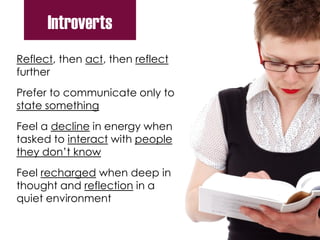
Reflect, then act,then reflect
further
Prefer to communicate only to
state something
Feel a decline in energy when
tasked to interact with people
they don’t know
Feel recharged when deep in
thought and reflection in a
quiet environment
Introverts
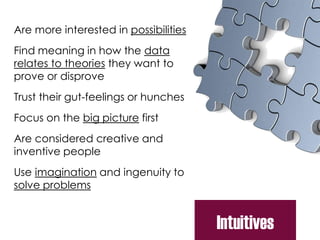
Are more interestedin possibilities
Find meaning in how the data
relates to theories they want to
prove or disprove
Trust their gut-feelings or hunches
Focus on the big picture first
Are considered creative and
inventive people
Use imagination and ingenuity to
solve problems
Intuitives
24.
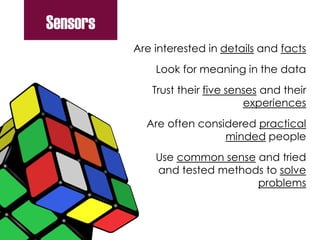
Are interested indetails and facts
Look for meaning in the data
Trust their five senses and their
experiences
Are often considered practical
minded people
Use common sense and tried
and tested methods to solve
problems
Sensors
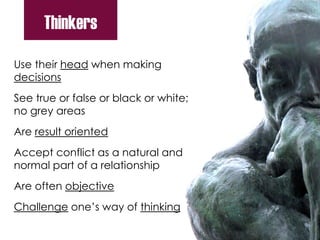
Use their headwhen making
decisions
See true or false or black or white;
no grey areas
Are result oriented
Accept conflict as a natural and
normal part of a relationship
Are often objective
Challenge one’s way of thinking
Thinkers
28.
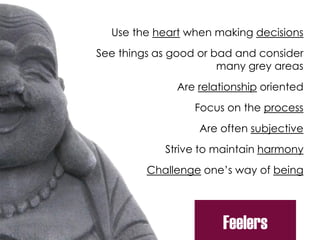
Use the heartwhen making decisions
See things as good or bad and consider
many grey areas
Are relationship oriented
Focus on the process
Are often subjective
Strive to maintain harmony
Challenge one’s way of being
Feelers
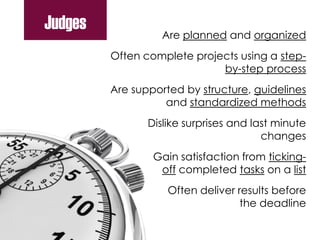
Are planned andorganized
Often complete projects using a step-
by-step process
Are supported by structure, guidelines
and standardized methods
Dislike surprises and last minute
changes
Gain satisfaction from ticking-
off completed tasks on a list
Often deliver results before
the deadline
Judges
32.
Are flexible andspontaneous
Enjoy freedom and variety
Resist structure, rules and plans
Can adapt to changes almost
immediately
May also use lists; but, will
probably add to, continually alter
or lose the list altogether
Often work on projects at the very
last minute
Perceivers
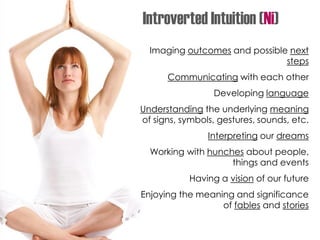
Imaging outcomes andpossible next
steps
Communicating with each other
Developing language
Understanding the underlying meaning
of signs, symbols, gestures, sounds, etc.
Interpreting our dreams
Working with hunches about people,
things and events
Having a vision of our future
Enjoying the meaning and significance
of fables and stories
Introverted Intuition (Ni)
36.
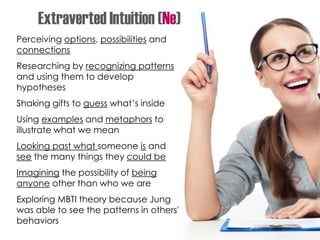
Perceiving options, possibilitiesand
connections
Researching by recognizing patterns
and using them to develop
hypotheses
Shaking gifts to guess what’s inside
Using examples and metaphors to
illustrate what we mean
Looking past what someone is and
see the many things they could be
Imagining the possibility of being
anyone other than who we are
Exploring MBTI theory because Jung
was able to see the patterns in others'
behaviors
Extraverted Intuition (Ne)
37.
How can youtell if a person is an
introverted or extraverted intuitive
38.
What questions canyou ask to determine
introverted or extraverted intuition
39.
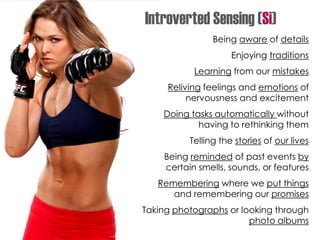
Being aware ofdetails
Enjoying traditions
Learning from our mistakes
Reliving feelings and emotions of
nervousness and excitement
Doing tasks automatically without
having to rethinking them
Telling the stories of our lives
Being reminded of past events by
certain smells, sounds, or features
Remembering where we put things
and remembering our promises
Taking photographs or looking through
photo albums
Introverted Sensing (Si)
40.
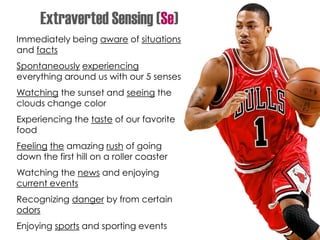
Immediately being awareof situations
and facts
Spontaneously experiencing
everything around us with our 5 senses
Watching the sunset and seeing the
clouds change color
Experiencing the taste of our favorite
food
Feeling the amazing rush of going
down the first hill on a roller coaster
Watching the news and enjoying
current events
Recognizing danger by from certain
odors
Enjoying sports and sporting events
Extraverted Sensing (Se)
41.
How can youtell if a person is an
introverted or extraverted sensor
42.
What questions canyou ask to determine
introverted or extraverted sensing
43.
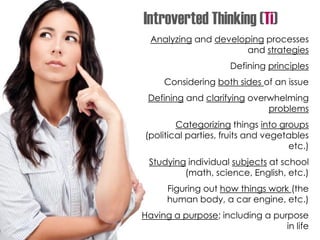
Analyzing and developingprocesses
and strategies
Defining principles
Considering both sides of an issue
Defining and clarifying overwhelming
problems
Categorizing things into groups
(political parties, fruits and vegetables
etc.)
Studying individual subjects at school
(math, science, English, etc.)
Figuring out how things work (the
human body, a car engine, etc.)
Having a purpose; including a purpose
in life
Introverted Thinking (Ti)
44.
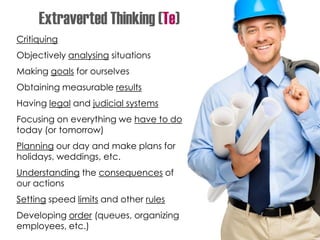
Critiquing
Objectively analysing situations
Makinggoals for ourselves
Obtaining measurable results
Having legal and judicial systems
Focusing on everything we have to do
today (or tomorrow)
Planning our day and make plans for
holidays, weddings, etc.
Understanding the consequences of
our actions
Setting speed limits and other rules
Developing order (queues, organizing
employees, etc.)
Extraverted Thinking (Te)
45.
How can youtell if a person is an
introverted or extraverted thinker
46.
What questions canyou ask to determine
introverted or extraverted thinking
47.
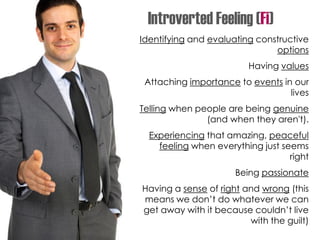
Identifying and evaluatingconstructive
options
Having values
Attaching importance to events in our
lives
Telling when people are being genuine
(and when they aren't).
Experiencing that amazing, peaceful
feeling when everything just seems
right
Being passionate
Having a sense of right and wrong (this
means we don’t do whatever we can
get away with it because couldn’t live
with the guilt)
Introverted Feeling (Fi)
48.
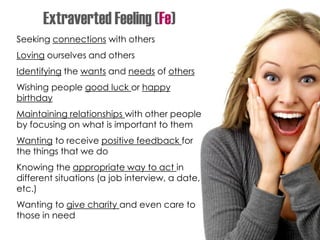
Seeking connections withothers
Loving ourselves and others
Identifying the wants and needs of others
Wishing people good luck or happy
birthday
Maintaining relationships with other people
by focusing on what is important to them
Wanting to receive positive feedback for
the things that we do
Knowing the appropriate way to act in
different situations (a job interview, a date,
etc.)
Wanting to give charity and even care to
those in need
Extraverted Feeling (Fe)
49.
How can youtell if a person is an
introverted or extraverted feeler
50.
What questions canyou ask to determine
introverted or extraverted feeling
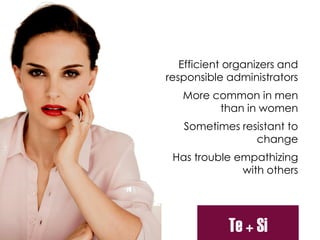
Efficient organizers and
responsibleadministrators
More common in men
than in women
Sometimes resistant to

change
Has trouble empathizing
with others
Te + Si
88.
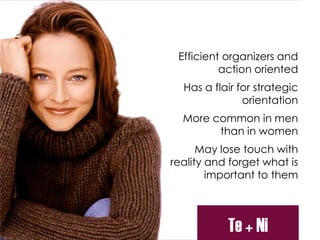
Efficient organizers and
actionoriented
Has a flair for strategic
orientation
More common in men
than in women
May lose touch with
reality and forget what is
important to them
Te + Ni
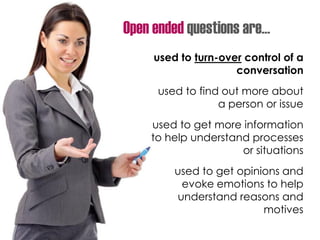
used to turn-overcontrol of a
conversation
used to find out more about
a person or issue
used to get more information
to help understand processes
or situations
used to get opinions and
evoke emotions to help
understand reasons and
motives
Open ended questions are…
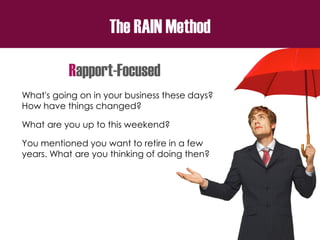
The RAIN Method
Rapport-Focused
What'sgoing on in your business these days?
How have things changed?
What are you up to this weekend?
You mentioned you want to retire in a few
years. What are you thinking of doing then?
102.
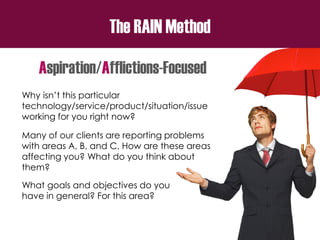
The RAIN Method
Aspiration/Afflictions-Focused
Whyisn’t this particular
technology/service/product/situation/issue
working for you right now?
Many of our clients are reporting problems
with areas A, B, and C. How are these areas
affecting you? What do you think about
them?
What goals and objectives do you
have in general? For this area?
103.
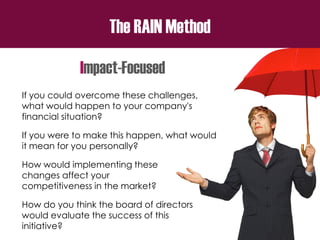
The RAIN Method
Impact-Focused
Ifyou could overcome these challenges,
what would happen to your company's
financial situation?
If you were to make this happen, what would
it mean for you personally?
How would implementing these
changes affect your
competitiveness in the market?
How do you think the board of directors
would evaluate the success of this
initiative?
104.
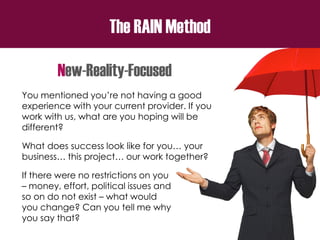
The RAIN Method
New-Reality-Focused
Youmentioned you’re not having a good
experience with your current provider. If you
work with us, what are you hoping will be
different?
What does success look like for you… your
business… this project… our work together?
If there were no restrictions on you
– money, effort, political issues and
so on do not exist – what would
you change? Can you tell me why
you say that?
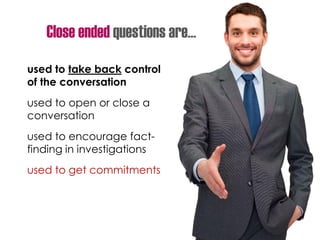
used to takeback control
of the conversation
used to open or close a
conversation
used to encourage fact-
finding in investigations
used to get commitments
Close ended questions are…